
Call Us
+86 136 6007 9809
Call Us
+86 136 6007 9809

Aug. 15, 2026
Precision Insert Nut Solutions for High-Performance Plastic Components
Modern product design increasingly combines plastic housings and structural components with reliable metal threads. This approach reduces weight, simplifies assembly,
and provides greater design flexibility while maintaining a durable threaded connection.
However, directly tapping threads into plastic can create problems such as thread stripping, low torque resistance, inconsistent assembly performance, and premature failure after repeated fastening and removal.
Insert nuts and threaded inserts for plastic provide an engineered solution by integrating a durable metal thread into a plastic component.
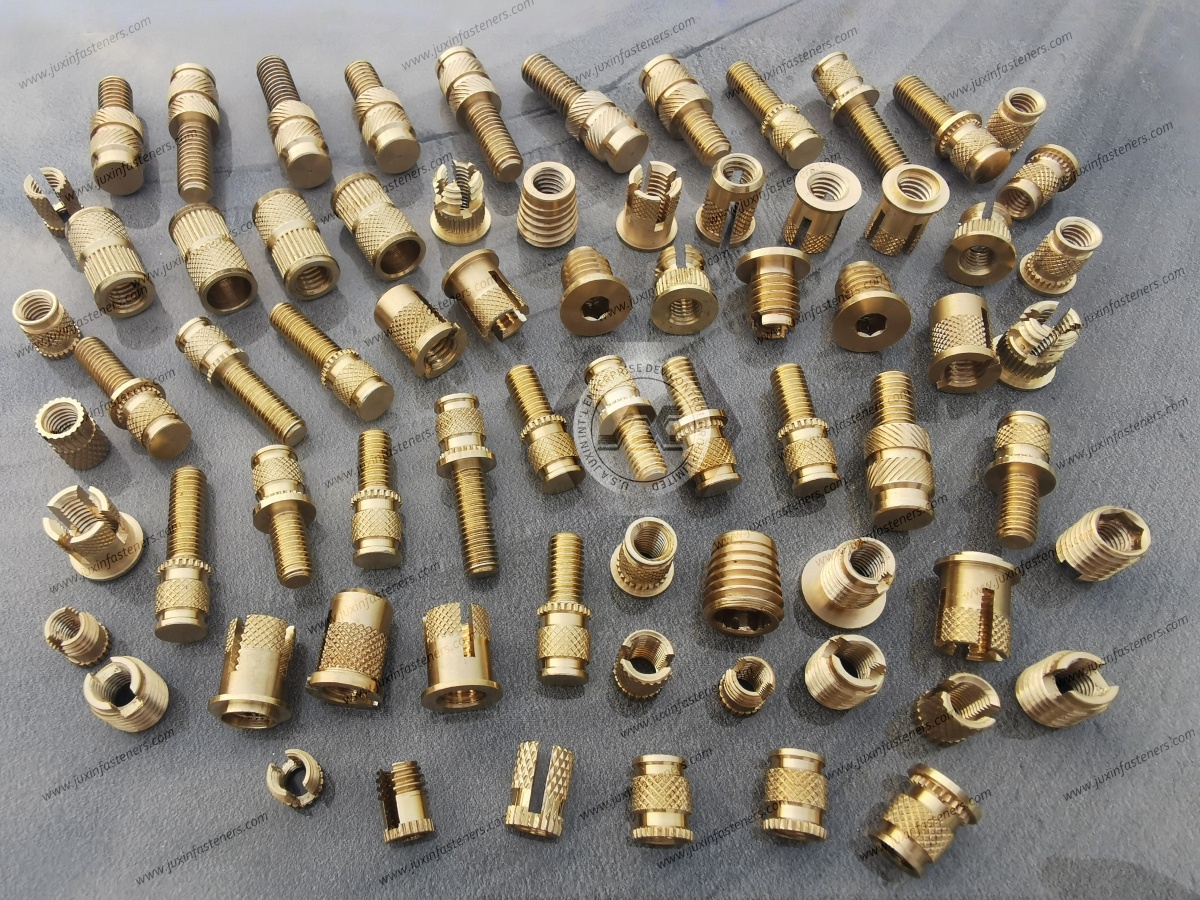
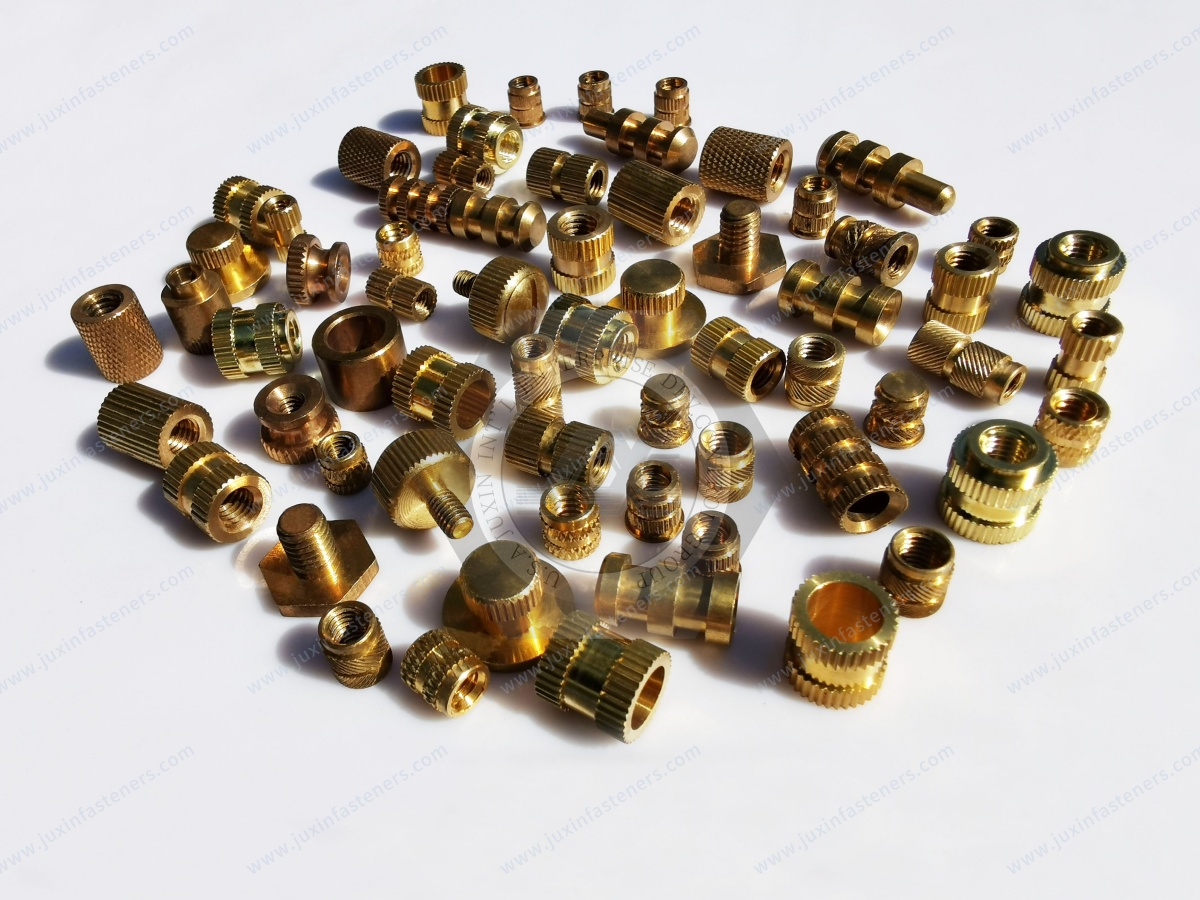
JUXIN FASTENERS supplies insert nuts, brass threaded inserts, heat-set inserts, press-fit inserts, injection molding inserts, and customized threaded inserts for demanding
applications across automotive, consumer electronics, medical devices, home appliances, industrial automation, and other engineered plastic products.
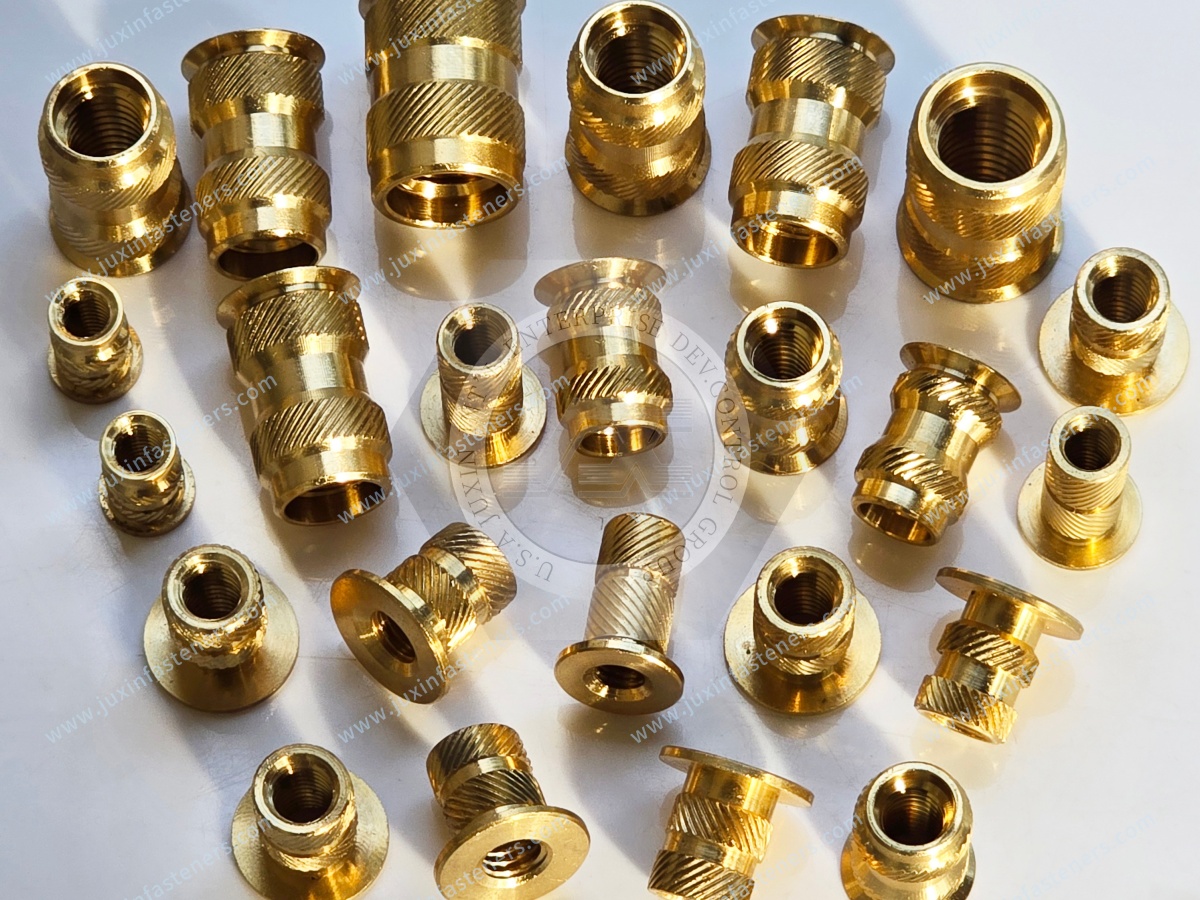
Why Use Insert Nuts Instead of Directly Tapping Plastic?
Directly molded or tapped plastic threads can be suitable for some low-load applications. However, repeated assembly and disassembly can gradually damage plastic threads.
This becomes particularly important for products that require:
Repeated maintenance
Frequent assembly and disassembly
Higher tightening torque
Higher pull-out resistance
Better thread durability
Consistent assembly performance
Automated production
A metal threaded insert for plastic creates a more durable internal thread while allowing the main component to remain lightweight and predominantly plastic.
Key Benefits of Insert Nuts
Higher thread strength than direct plastic tapping
Improved resistance to thread stripping
Better torque resistance
Suitable for repeated assembly and disassembly
Supports lightweight plastic housing designs
Compatible with multiple installation processes
Suitable for automated assembly
Available in brass, stainless steel, aluminum, and other materials
Can be customized for application-specific requirements
1. Automotive Insert Nut Solutions
Automotive components increasingly use engineered plastics to reduce weight and simplify vehicle design.
Automotive insert nuts are used in applications where plastic components require reliable metal threads.
Potential applications include:
Automotive interior components
Instrument panels
Sensor housings
Electronic control units
Trim components
Door components
Battery-related plastic housings
Electrical connectors
Lightweight structural components
Automotive environments can expose fastening components to vibration, temperature cycling, moisture, automotive fluids, and repeated mechanical loading.
For this reason, automotive threaded inserts for plastic require appropriate pull-out strength, torque resistance, dimensional consistency, and corrosion performance.
Insert Nuts for Automotive Interior Components
Interior components often need to be lightweight while supporting screws, brackets, clips, or electronic modules.
A brass insert nut can provide a durable metal thread inside a plastic component without requiring a fully metallic housing.
This can help manufacturers reduce component weight while maintaining reliable assembly performance.
Insert Nuts for EV and Battery Applications
Electric vehicles have accelerated the use of lightweight plastic housings and electrical components.
Applications may include:
Battery system housings
Sensor housings
Electrical modules
Charging components
Thermal management components
Electronic control systems
Depending on the application, engineers may need to evaluate temperature resistance, vibration performance, torque requirements, pull-out strength, material compatibility, and corrosion resistance.
For automotive programs requiring formal quality documentation, supplier quality systems and traceability should also be aligned with the customer's requirements.
2. Consumer Electronics and 3C Insert Nut Solutions
Consumer electronics require extremely small fastening components while maintaining reliable assembly performance.
Products such as:
Smartphones
Tablets
Wearable devices
Routers
Smart devices
Electronic controllers
Portable equipment
Consumer electronic housings
often use thin plastic walls where conventional threaded connections are difficult to implement.
Miniature insert nuts and precision threaded inserts provide an effective solution for creating durable threads in compact plastic components.
Miniature Threaded Inserts for Thin-Wall Plastic Parts
Electronics manufacturers increasingly require smaller components and thinner housings.
In some applications, plastic wall thickness can be below 1 mm, creating significant design challenges.
Insert selection may therefore involve:
Small outside diameters
Short insert lengths
Fine threads
Controlled knurl geometry
Accurate installation tolerances
Crack-resistant designs
Consistent insertion force
Depending on the application, miniature insert sizes can extend into very small metric thread sizes.
The exact insert geometry should be matched to the plastic material, wall thickness, hole design, installation method, and required pull-out performance.
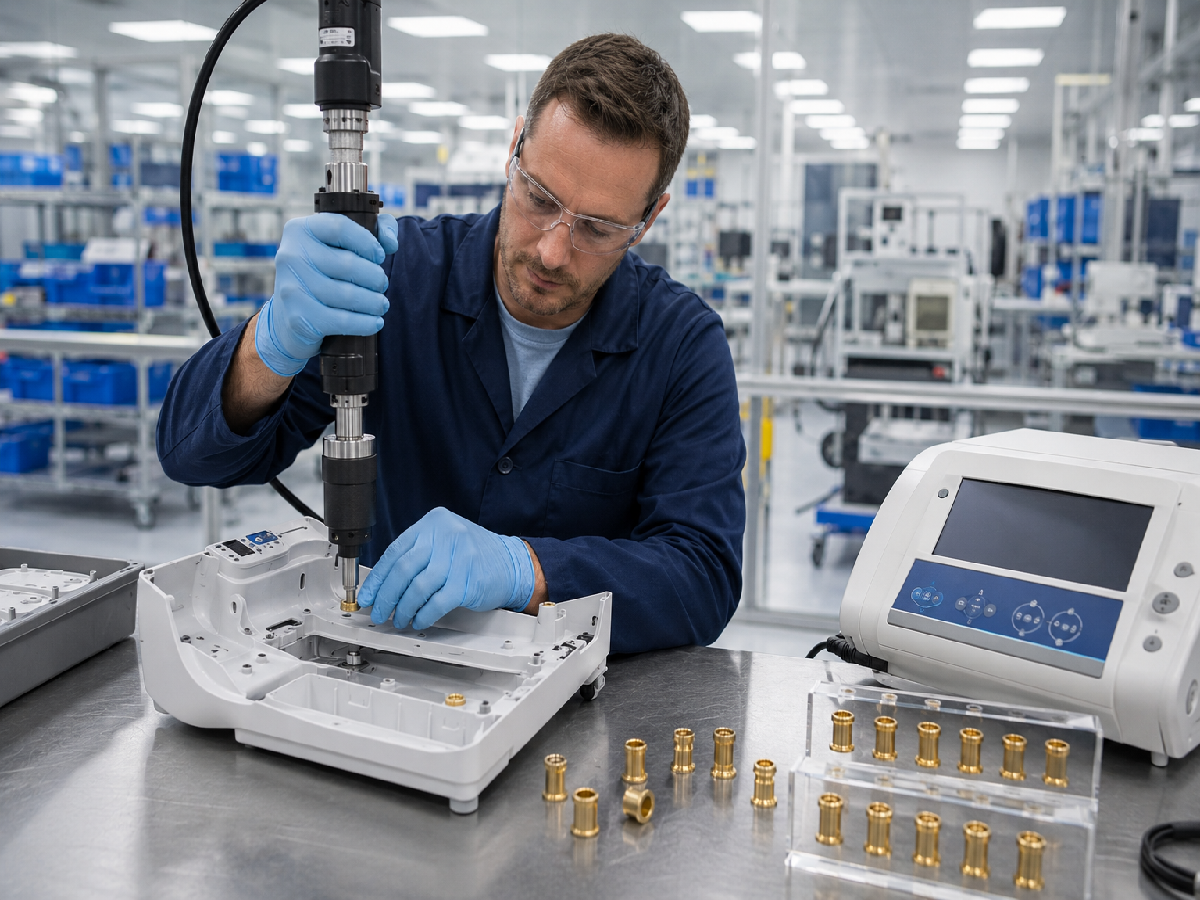
Insert Nuts for Automated Electronics Assembly
High-volume electronics production often relies on automated assembly equipment.
Insert nuts may be installed through:
Automated press fitting
Heat staking
Ultrasonic insertion
In-mold installation
Specialized insertion equipment
For high-speed production, dimensional consistency becomes particularly important.
An insert that varies significantly in outside diameter, knurl geometry, or insertion force can create production problems such as:
Incomplete insertion
Plastic cracking
Component deformation
Loose inserts
Assembly downtime
For this reason, precision manufacturing and process control are critical for electronics applications.
3. Medical Device Threaded Insert Solutions
Medical equipment requires fastening components with strict requirements for cleanliness, dimensional consistency, reliability, and material selection.
Potential applications include:
Patient monitoring equipment
Diagnostic equipment
Medical device housings
Laboratory equipment
Portable medical instruments
Surgical equipment housings
Medical electronics
Medical device threaded inserts can provide durable metal threads inside engineered plastic housings.
Clean and Precise Insert Nut Manufacturing
Medical applications may require careful control of:
Burrs
Surface contamination
Metal particles
Dimensional tolerances
Thread accuracy
Material composition
Surface finish
A burr-free and properly controlled insert can help reduce the risk of loose particles entering sensitive equipment during assembly or service.
Material selection should also follow the customer's application, regulatory, and material requirements.
Where lead-free materials are required, suitable copper alloys or other compliant materials can be specified according to the application.
Insert Nuts for Repeated Medical Equipment Assembly
Medical devices can require maintenance, calibration, replacement, or repeated disassembly.
A direct plastic thread may deteriorate after repeated assembly cycles.
A metal threaded insert provides a more durable thread interface, helping support:
Repeated screw installation
Consistent torque
Thread durability
Maintenance access
Longer component service life
For applications involving sterilization or elevated temperatures, the insert material and plastic substrate must be evaluated together.
4. Home Appliance and Smart Home Insert Nuts
Home appliances combine high-volume manufacturing with strong cost and quality requirements.
Potential applications include:
Air conditioners
Refrigerators
Washing machines
Robot vacuum cleaners
Kitchen appliances
Smart home devices
Control panels
Plastic equipment housings
Consumer electrical products
Insert nuts for plastic housings allow manufacturers to integrate durable metal threads without converting the entire component into metal.
High-Volume Insert Nut Manufacturing for Appliances
Home appliance production often involves millions of components and highly automated assembly processes.
Therefore, insert nuts must provide:
Consistent dimensions
Stable insertion force
Reliable retention
Repeatable torque performance
High production efficiency
Competitive total cost
Stable supply
For mass production, manufacturing process selection becomes particularly important.
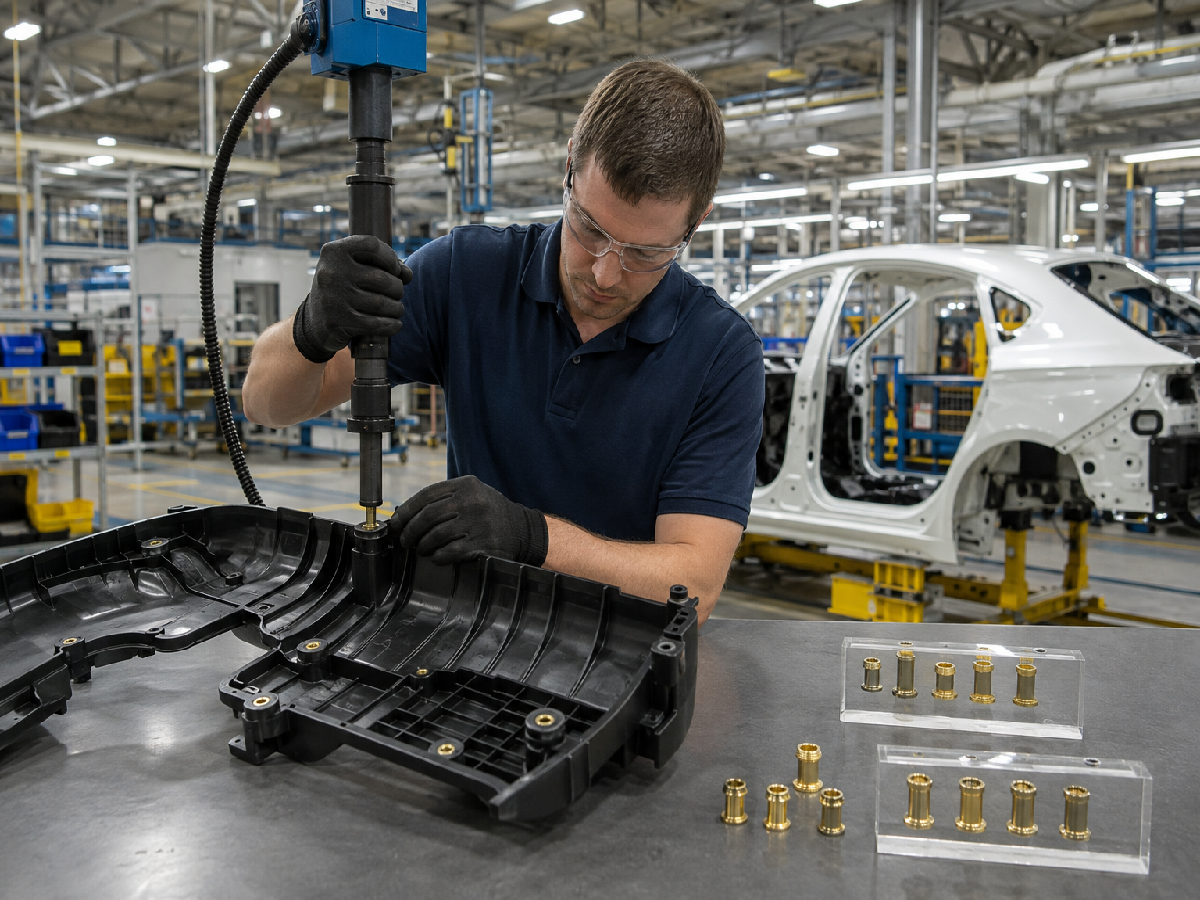
Heat-Set Inserts for Plastic Components
Heat-set inserts are widely used with thermoplastics.
During installation, controlled heat softens the surrounding plastic, allowing the insert to embed into the component.
After cooling, the plastic solidifies around the insert and creates mechanical retention.
Heat-set installation can provide:
Reliable thread formation
Good retention
Efficient automated installation
Suitable performance for many thermoplastic materials
Press-Fit Insert Nuts
Press-fit inserts can be installed mechanically without heating the plastic.
They may be suitable for applications where:
The plastic is compatible with mechanical insertion
Post-molding installation is preferred
Production speed is important
Heating is undesirable
Component geometry allows press insertion
The insert knurl and interference fit must be correctly matched to the plastic material and hole dimensions.
5. Industrial Automation and Communication Equipment
Industrial automation equipment operates in environments where vibration, temperature changes, moisture, and chemical exposure can affect fastening performance.
Potential applications include:
PLC housings
Industrial switches
Control cabinets
Automation controllers
Sensor housings
Industrial communication equipment
Machine-control systems
Electrical enclosures
Industrial threaded inserts provide durable internal threads for equipment housings and plastic structural components.
Corrosion-Resistant Insert Nuts for Industrial Applications
Industrial equipment may operate in environments where standard brass or carbon-steel components are not sufficient.
Depending on the application, engineers may consider:
Brass inserts
Stainless steel inserts
Aluminum inserts
Nickel-plated inserts
Other application-specific finishes
Nickel plating, for example, can provide additional surface protection and may improve corrosion resistance for selected industrial environments.
Material and surface treatment should always be selected according to the actual operating conditions.
Insert Nuts for PLC and Industrial Control Housings
PLC systems, industrial switches, control modules, and communication equipment often use plastic housings to reduce weight and simplify manufacturing.
However, these housings still need reliable threaded mounting points for:
Circuit boards
Covers
Brackets
Cable management components
Internal modules
External mounting components
Insert nuts provide a durable metal thread while allowing manufacturers to maintain a lightweight plastic housing.
Insert Nut Manufacturing Processes
Different applications require different installation and manufacturing methods.
In-Mold Injection Molding
The insert is positioned in the mold before plastic injection.
The plastic flows around the insert and mechanically locks it into the component.
Advantages
High production efficiency
Excellent integration with molded components
Suitable for high-volume manufacturing
Reduced secondary operations
This process is particularly attractive for high-volume automotive, electronics, and appliance components.
Heat Staking / Heat-Set Installation
The insert is installed after the plastic component has been molded.
Controlled heat softens the surrounding thermoplastic, allowing the insert to penetrate the component.
Advantages
Suitable for post-mold installation
Good retention
Compatible with automated production
Flexible for different component designs
Ultrasonic Installation
Ultrasonic energy can be used to generate localized heat and embed the insert into compatible thermoplastic materials.
This method can provide:
Fast cycle times
Accurate installation
Automated processing
Reduced overall thermal exposure
The process must be optimized for the insert geometry and plastic material.
Cold Press-Fit Installation
Press-fit installation uses mechanical force rather than heat.
It may be suitable for selected thermoplastics and thermoset materials.
The hole diameter, insert outside diameter, knurl profile, material hardness, and insertion force must be matched to achieve reliable retention.
Insert Nut Knurling and Anti-Rotation Designs
The external geometry of an insert directly affects its performance in plastic.
Common designs include:
Straight knurl
Diagonal knurl
Double diagonal knurl
Anti-rotation grooves
Specialized locking profiles
Knurl geometry helps transfer torque from the screw through the insert into the surrounding plastic.
The correct profile depends on:
Plastic material
Wall thickness
Hole diameter
Installation process
Required torque
Pull-out load
Component geometry
Insert Nut Materials
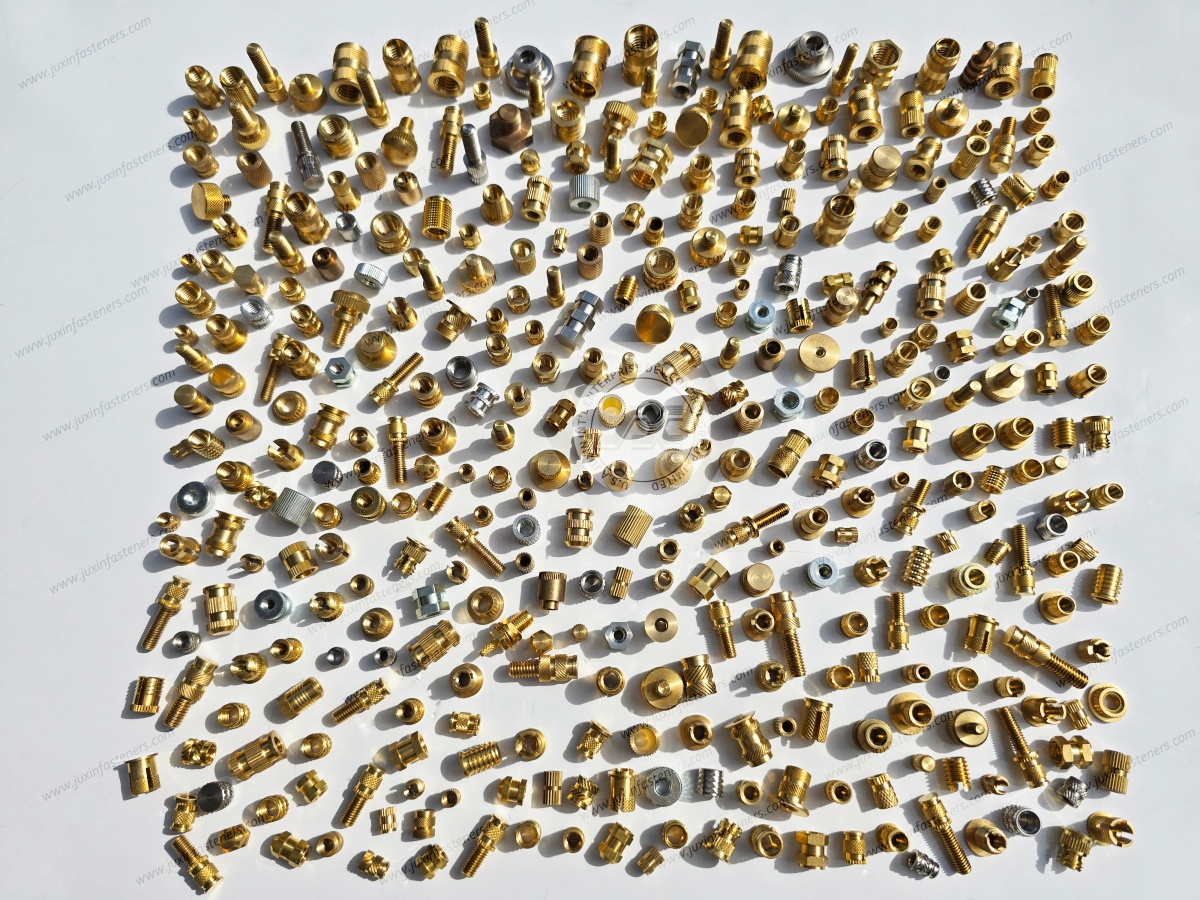
Material selection should be based on application requirements.
Brass Insert Nuts
Brass is widely used because it provides:
Good machinability
Reliable thread performance
Good corrosion resistance
Suitable electrical conductivity
Compatibility with many plastic applications
Stainless Steel Inserts
Stainless steel may be selected where higher corrosion resistance or mechanical performance is required.
Aluminum Inserts
Aluminum can be considered where lightweight construction is particularly important.
The appropriate material should be determined according to the application's mechanical, environmental, electrical, and regulatory requirements.
Engineering Selection of Threaded Inserts
A professional insert selection process should consider more than thread size.
Engineers should evaluate:
Plastic Material
ABS, PC, PA, POM, glass-filled plastics, and other engineering polymers behave differently during insertion.
Wall Thickness
Thin-wall applications require careful control of insert geometry and installation force.
Thread Size
Metric and inch thread options should be selected according to the mating fastener and assembly design.
Installation Method
Choose between:
In-mold installation
Heat setting
Ultrasonic insertion
Press fitting
Pull-Out Resistance
The insert must remain securely embedded under the expected axial load.
Torque Resistance
The insert must resist rotation when the screw is tightened or removed.
Environmental Exposure
Temperature, humidity, chemicals, vibration, and corrosion must be considered.
Dimensional Tolerance
High-precision applications may require tightly controlled outside diameter, thread dimensions, and knurl geometry.
Insert Nuts for Lightweight Product Design
One of the major advantages of threaded inserts is their ability to combine lightweight plastic construction with durable metal threads.
Instead of manufacturing an entire component from metal, engineers can use a plastic body with strategically positioned metal inserts.
This approach can help:
Reduce component weight
Reduce material consumption
Simplify product architecture
Eliminate some welding operations
Reduce riveting requirements
Improve assembly efficiency
Support automated manufacturing
This makes threaded inserts particularly valuable in automotive, electronics, appliances, medical equipment, and industrial automation.
Insert Nut Solutions for Procurement Teams
When sourcing insert nuts, procurement teams should define the complete technical specification.
Important requirements include:
Insert type
Thread size
Insert length
Outside diameter
Material
Knurl profile
Surface treatment
Tolerance
Installation method
Pull-out requirements
Torque requirements
Packaging
Quality documentation
For high-volume applications, supplier capability and process consistency are equally important.
A low unit price does not necessarily represent the lowest total cost if inconsistent insertion force, dimensional variation, or poor retention creates production problems.
Customized Insert Nut Solutions
Different industries require different insert geometries.
JUXIN FASTENERS can support application-specific requirements involving:
Custom dimensions
Metric threads
Inch threads
Brass
Stainless steel
Aluminum
Special knurl patterns
Anti-rotation designs
Nickel plating
Tight dimensional tolerances
Custom packaging
OEM requirements
For new projects, providing the plastic material, component drawing, hole dimensions, thread specification, installation process, and expected loading conditions helps engineers select the appropriate insert design.
Why Choose JUXIN FASTENERS?
JUXIN FASTENERS provides threaded insert and industrial fastening solutions for plastic components and engineered assemblies.
Our product range includes:
Brass insert nuts
Threaded inserts for plastic
Heat-set inserts
Press-fit inserts
Injection molding inserts
Knurled inserts
Self-clinching fasteners
Rivet nuts
Welding nuts
Bolts
Nuts
Washers
Customized fasteners
Our solutions are suitable for a wide range of industries, including:
Automotive
Interior components, sensor housings, electronic modules, and EV-related plastic components.
Consumer Electronics
Compact housings, routers, wearable devices, electronic products, and thin-wall plastic components.
Medical Devices
Medical equipment housings, monitoring equipment, diagnostic equipment, and precision plastic components.
Home Appliances
Air conditioners, refrigerators, robot vacuum cleaners, kitchen equipment, and smart home products.
Industrial Automation
PLC housings, industrial switches, sensors, control systems, and automation equipment.
Frequently Asked Questions About Insert Nuts
What is an insert nut?
An insert nut is a metal threaded component installed into plastic or another substrate to create a durable internal thread for screw assembly.
Why use threaded inserts instead of tapping plastic?
Threaded inserts provide a metal thread that can offer better resistance to stripping, improved torque performance, and greater durability during repeated assembly and disassembly.
What are brass insert nuts used for?
Brass insert nuts are widely used in plastic housings and components because brass provides good machinability, thread durability, corrosion resistance, and electrical conductivity.
What are heat-set inserts?
Heat-set inserts are threaded inserts installed into thermoplastic components using controlled heat. The softened plastic flows around the insert and forms mechanical retention after cooling.
What is the difference between heat-set and press-fit inserts?
Heat-set inserts use heat to embed the insert into compatible thermoplastics, while press-fit inserts rely primarily on mechanical interference and external geometry to retain the insert.
Can insert nuts be used in automotive applications?
Yes. Automotive insert nuts can be used in plastic interior components, sensor housings, electronic modules, battery-related components, and other engineered plastic assemblies where durable threaded connections are required.
Can insert nuts be used in thin plastic walls?
Yes, specialized miniature and thin-wall threaded inserts can be designed for compact plastic components. The insert geometry must be matched carefully to wall thickness, plastic material, hole size, and required retention.
What materials are available for threaded inserts?
Common materials include brass, stainless steel, and aluminum. Surface treatments such as nickel plating may also be specified for selected applications.
Industrial Insert Nut Solutions for Engineers and Procurement Teams
As manufacturers continue to adopt lightweight plastics, automated assembly, and modular product architectures, threaded inserts for plastic have become an important fastening technology.
From automotive components and consumer electronics to medical devices, home appliances, PLC housings, and industrial automation equipment, the correct insert can provide a reliable metal thread without sacrificing the advantages of plastic construction.
JUXIN FASTENERS supports engineers, OEMs, manufacturers, distributors, and procurement teams with insert nut and threaded insert solutions designed around application requirements.
For technical inquiries, drawings, samples, specifications, or OEM requirements:
Email: info@juxinfasteners.com
Website: www.juxinfasteners.com
JUXIN FASTENERS — Precision Threaded Insert Solutions for Plastic Components and Industrial Applications.
 MORE NEWS
Aug. 16, 2026
Aug. 16, 2026
Aug. 16, 2026
Contact Us
Tel.:
+86 020 8621 0320
+86 020 3121 6067
E-mail:
Technical Support:
Navigation
SEND INQUIREY