
Call Us
+86 136 6007 9809
Call Us
+86 136 6007 9809

Aug. 12, 2026
Material Selection and Structural Integrity Guide for Industrial Shafts: Engineering Solutions for High-Performance Power Transmission
In mechanical power transmission, industrial shafts are the backbone of rotating machinery. Selecting the right shaft material and specifying the correct heat treatment is not just a matter of textbook formulas—it is a critical decision that dictates equipment lifespan, operational safety, and overall manufacturing cost-efficiency.
For procurement managers and mechanical design engineers alike, optimizing this balance is key to preventing catastrophic field failures. This comprehensive guide outlines the strategic logic for material selection, critical stress-concentration risks, and application-specific solutions for industrial shafts.
1. The Core Logic of Shaft Material Selection
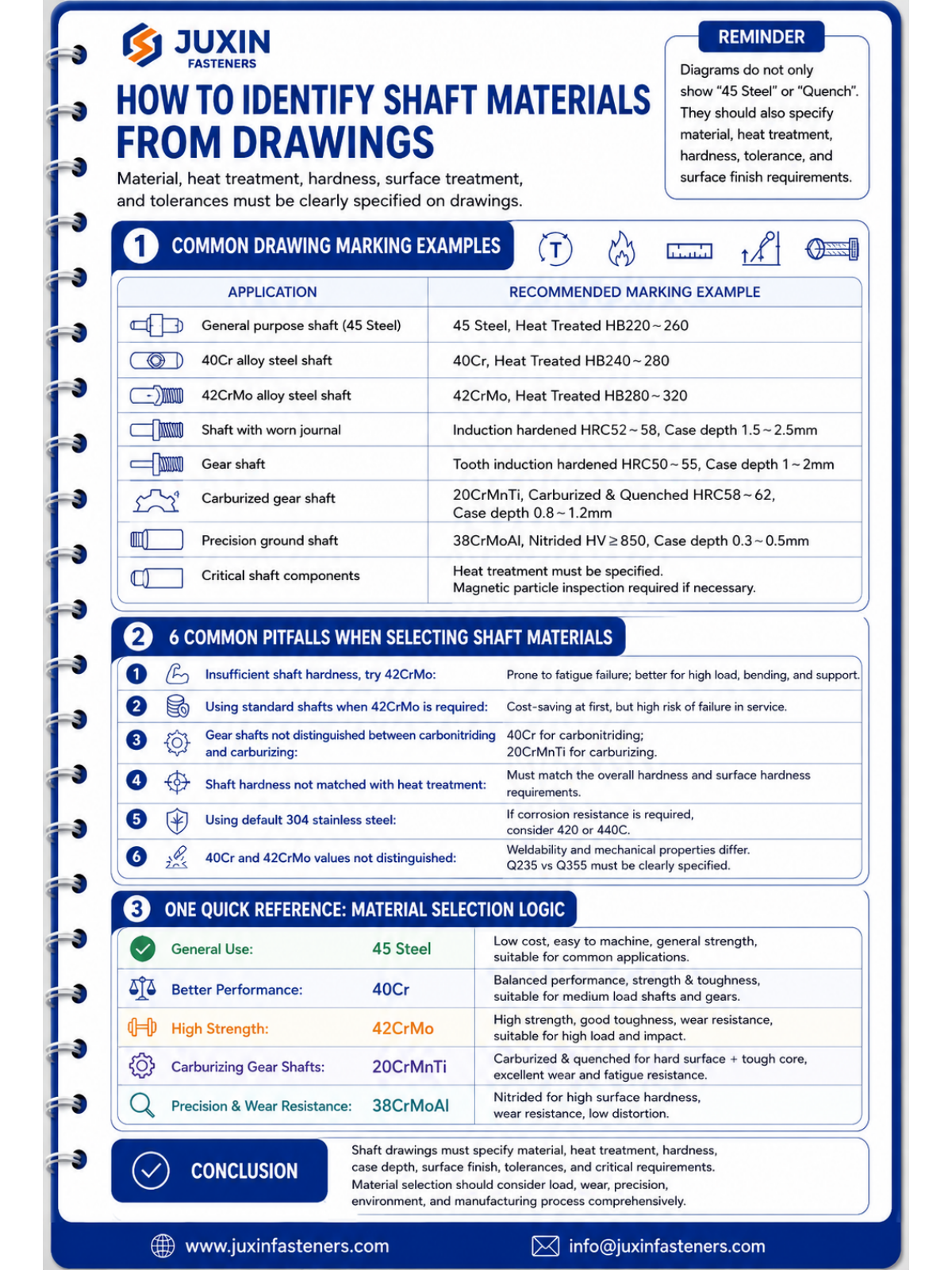
When engineering industrial shafts, material selection generally follows a tiered approach based on load, torque, fatigue resistance, and environmental conditions. A quick, field-proven rule of thumb for engineering teams is:
Standard Applications: Grade 1045 Carbon Steel (45#)
Enhanced Stability & Uniformity: Grade 5140 Alloy Steel (40Cr)
Heavy-Duty & High-Strength: Grade 4140 Chromoly Steel (42CrMo)
Integral Gear Shafts: Grade 5120/8620 Case-Hardening Steel (20CrMnTi)
Precision & High Wear Resistance: Grade 41AlCrMo7 Nitriding Steel (38CrMoAl)
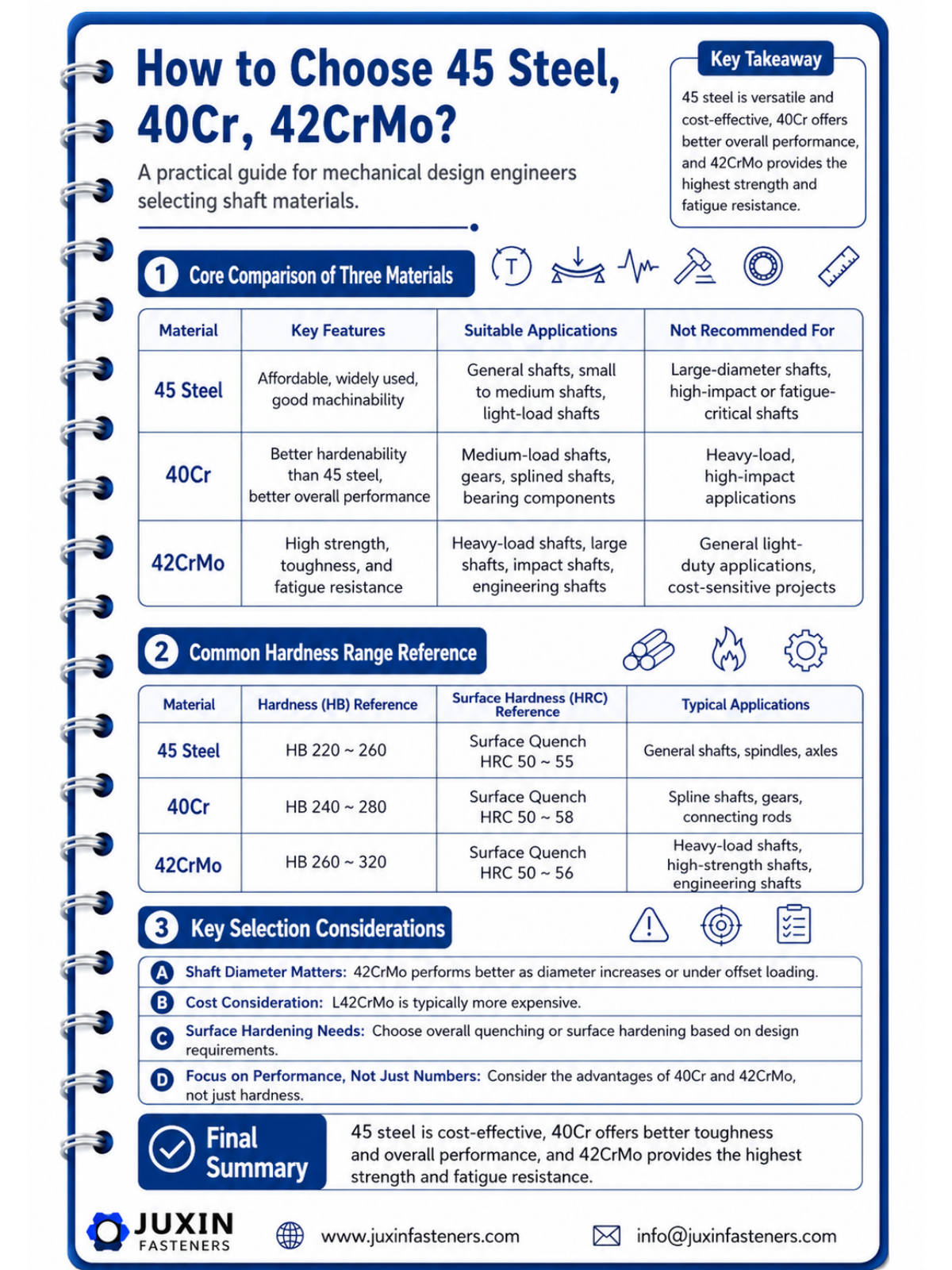
2. Deep Dive: Comparing 1045 (45#), 5140 (40Cr), and 4140 (42CrMo)
These three grades represent the vast majority of medium-carbon and alloy steels used in custom shaft manufacturing. Understanding their distinct boundaries ensures you do not over-engineer or under-specify.
International Grade | Common Equivalent | Core Strengthening Mechanism | Primary Application Threshold |
AISI 1045 / DIN C45 | 45# | Quenched & Tempered (Q&T) / Induction Hardened | General drive shafts, low-to-medium torque, cost-sensitive projects. |
AISI 5140 / DIN 41Cr4 | 40Cr | Chromium Alloyed + Q&T | High hardenability requirements, medium loads, enhanced core toughness. |
AISI 4140 / DIN 42CrMo4 | 42CrMo | Cr-Mo Alloyed + Premium Q&T | Heavy-duty power transmission, high fatigue limits, impact resistance. |
AISI 1045 Carbon Steel Shafts
Ideal for general-purpose transmission shafts where extreme stresses are absent. It delivers cost-effective, dependable performance when properly normalized or quenched and tempered.
AISI 5140 Alloy Steel Shafts
The addition of chromium drastically improves hardenability compared to 1045. When cross-sections are large, 5140 ensures uniform mechanical properties from the surface to the core, minimizing internal residual stresses.
AISI 4140 Chromoly Steel Shafts
Engineered for high-torque, heavy-duty machinery. Chromium and molybdenum combinations provide superior fatigue strength, exceptional fracture toughness, and excellent resistance to impact loads under harsh operational conditions.
3. Application-Specific Material Solutions
Different shaft geometries and functional configurations demand specialized metallurgical properties. Below is the technical breakdown by component type:
Standard Transmission Shafts
Primary Materials: AISI 1045 / AISI 5140
Solution: For light-to-medium industrial gearboxes and conveyors. 1045 provides optimal machinability and sufficient structural yield strength.
Heavy-Duty & Impact-Loaded Shafts
Primary Material: AISI 4140
Solution: For mining equipment, wind energy components, and heavy industrial drives. High fatigue limits prevent failure under alternating torsion cycles.
Integral Gear Shafts & Spline Shafts
Primary Material: 20CrMnTi / AISI 5120 / AISI 8620
Solution: Gear teeth require high surface hardness () to combat pitting and wear, while the shaft core must remain tough to absorb shock loads. Carburizing and quenching provide the ideal hard case and ductile core.
Precision Lead Screws & High-Wear Shafts
Primary Material: AISI 41AlCrMo7 (38CrMoAl)
Solution: Linear motion shafts and precision ball screws require minimal thermal distortion. Nitriding creates an ultra-hard, corrosion-resistant surface layer without the dimensional deformation caused by oil quenching.
4. Avoiding Failure: Mitigating Stress Concentration
Engineering Fact: The majority of industrial shaft failures in the field are not caused by insufficient tensile strength of the material, but by poor geometric design and acute stress concentrations.
Rotating shafts are highly susceptible to fatigue failure. Fatigue cracks almost always initiate at geometric transitions. When designing and detailing shaft drawings, special attention must be paid to:
Shaft Shoulders: Sharp transitions create massive stress multipliers. Always maximize the fillet radius () at points of diameter change.
Keyways & Splines: Sharp internal corners in keyway slots act as stress risers. Use sled-runner or rounded-end keyways where possible.
Undercuts & Snap Ring Grooves: Relief grooves for grinding or retaining rings significantly reduce the effective cross-sectional area and invite fatigue cracks.
5. B2B Blueprint: How to Specify Shaft Technical Requirements on Blueprints
To ensure seamless global sourcing and precision manufacturing, engineering drawings must never simply list a material grade like "45 Steel Shaft" or a vague process like "Hardening". Complete technical callouts protect your supply chain from geometric and metallurgical deviations.
A professional, compliant shaft drawing specification must clearly delineate Material Grade, Heat Treatment Process, Target Hardness, Effective Case Depth, and the Specific Processing Zone.
Case Study Specification Layouts:
Example 1: High-Strength Drive Shaft
Material: AISI 4140 (DIN 42CrMo4)
Heat Treatment: Quenched & Tempered (Q&T) to core; functional journals Induction Hardened.
Hardness Profile: Core: ; Induction Zone: .
Effective Case Depth: on specified journals.
Location: Induction harden zone designated per drawing sheet section A-A.
Example 2: Heavy-Duty Spline Gear Shaft
Material: 20CrMnTi (Alloy Case-Hardening Steel)
Heat Treatment: Carburized, Quenched, and Low-Temperature Tempered.
Hardness Profile: Surface: ; Core: .
Effective Case Depth: on spline and gear teeth profiles.
Looking for Custom Industrial Shaft Manufacturing Solutions?
At JUXIN FASTENERS, we specialize in precision machining, custom forging, and advanced heat treatment for high-performance industrial shafts, custom fasteners, and heavy-duty power transmission components. Whether you require standard AISI 1045 transmission shafts, high-fatigue AISI 4140 solutions, or precise case-hardened spline shafts, our engineering team ensures strict adherence to your rigorous technical specifications.
[Contact Our Engineering Team Today] for a comprehensive technical review, material validation, or an RFQ on your upcoming project.
 MORE NEWS
Sep. 27, 2026
Sep. 27, 2026
Sep. 27, 2026
Contact Us
Tel.:
+86 020 8621 0320
+86 020 3121 6067
E-mail:
Technical Support:
Navigation
SEND INQUIREY