
Call Us
+86 136 6007 9809
Call Us
+86 136 6007 9809

Aug. 12, 2026
Shaft Material Selection Guide: How to Choose the Right Material for Precision Shaft Components
The Complete Engineering Guide for OEM Shaft Manufacturing, Heat Treatment & Material Selection
In mechanical power transmission systems, shaft components are among the most critical load-bearing parts. Whether used in industrial machinery, automotive assemblies, agricultural equipment, automation systems, construction machinery, robotics, pumps, gearboxes, or precision equipment, shaft performance depends largely on selecting the correct material and heat treatment.
Many engineers focus only on material strength. However, in real engineering applications, material selection, heat treatment, structural design, and stress concentration work together to determine shaft reliability.
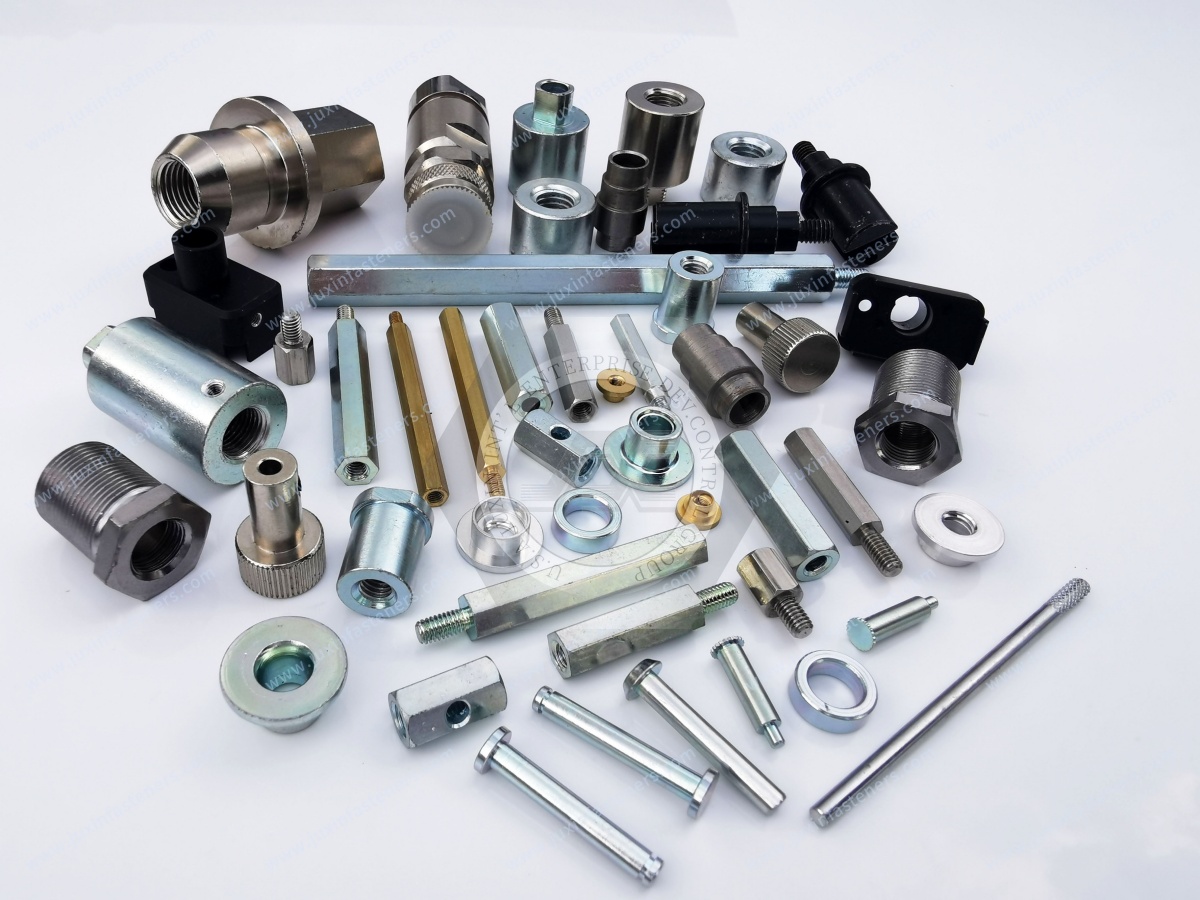
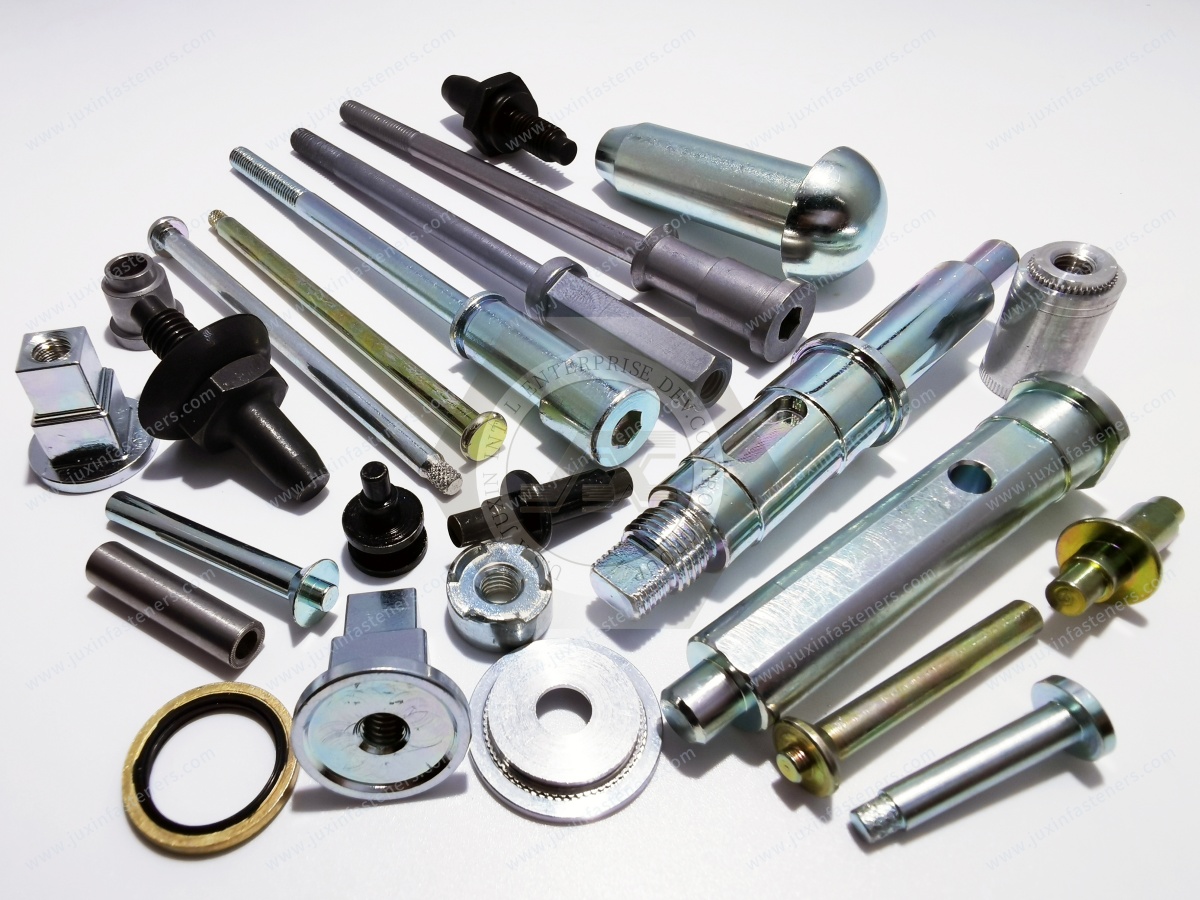
At JUXIN FASTENERS, we manufacture custom precision-machined shafts, stepped shafts, spline shafts, threaded shafts, gear shafts, drive shafts, transmission shafts, precision CNC shaft components, and OEM mechanical parts according to customer drawings and international standards.
This guide explains how professional engineers select shaft materials in modern mechanical design.
Why Shaft Material Selection Matters
A shaft continuously experiences:
Torsional loads
Bending loads
Cyclic fatigue
Shock loading
Wear
Surface friction
Corrosion (depending on environment)
Choosing the wrong material may result in:
Premature shaft failure
Fat treatment cracking
Excessive wear
Fatigue fracture
Plastic deformation
Reduced bearing life
Unexpected machine downtime
The goal is not to select the strongest material, but the most suitable material for the operating conditions.
Shaft Material Selection Logic
Professional engineers typically follow this decision sequence:
Step 1 — Determine Working Load
Ask:
Light duty?
Medium duty?
Heavy duty?
High impact?
Fatigue loading?
The required strength determines the material grade.
Step 2 — Determine Wear Requirements
Questions include:
Bearing journals?
Sliding contact?
Gear engagement?
Spline transmission?
Higher wear resistance often requires surface hardening.
Step 3 — Determine Precision Requirements
Examples:
Ball screw shafts
Servo shafts
Guide shafts
Precision positioning shafts
These applications demand excellent dimensional stability after heat treatment.
Step 4 — Select Appropriate Heat Treatment
Heat treatment is often more important than the material itself.
Common processes include:
Quenching & Tempering (Q&T)
Induction Hardening
Carburizing
Nitriding
Stress Relieving
Common Shaft Materials and Typical Applications
45 Steel (AISI 1045)
Best For: General-purpose transmission shafts
45 Steel remains one of the most widely used shaft materials because it offers an excellent balance between cost and mechanical performance.
Typical applications include:
Drive shafts
Pump shafts
Motor shafts
Conveyor shafts
General machinery
Advantages:
Economical
Easy machining
Good toughness
Stable mechanical properties
Suitable for most standard industrial equipment.
40Cr Alloy Steel
Best For: Medium-load precision shafts
40Cr offers higher hardenability and more uniform mechanical properties than 45 Steel.
Common applications:
Transmission shafts
Spline shafts
Servo shafts
Machine tool shafts
Industrial gearbox shafts
Advantages:
Higher strength
Better fatigue resistance
Improved toughness
Excellent heat treatment response
For many OEM applications, 40Cr represents the ideal balance between cost and performance.
42CrMo Alloy Steel
Best For: Heavy-duty, high-strength shafts
When high torque and impact loads are involved, engineers often select 42CrMo.
Typical applications:
Excavator shafts
Construction equipment
Mining machinery
Heavy-duty transmission shafts
Wind power equipment
Hydraulic machinery
Advantages:
Outstanding strength
Excellent fatigue resistance
High toughness
Superior impact resistance
Ideal for demanding industrial environments.
20CrMnTi Alloy Steel
Best For: Gear shafts
20CrMnTi is commonly carburized to achieve:
Extremely hard wear-resistant surfaces
Tough ductile core
Long service life
Applications include:
Gear shafts
Automotive transmission shafts
Differential shafts
High-speed gearbox components
38CrMoAl Alloy Steel
Best For: Precision wear-resistant shafts
This material is frequently nitrided to obtain:
Excellent wear resistance
High surface hardness
Minimal distortion
Outstanding dimensional stability
Applications:
Ball screw shafts
Precision lead screws
CNC machinery
High-precision automation equipment
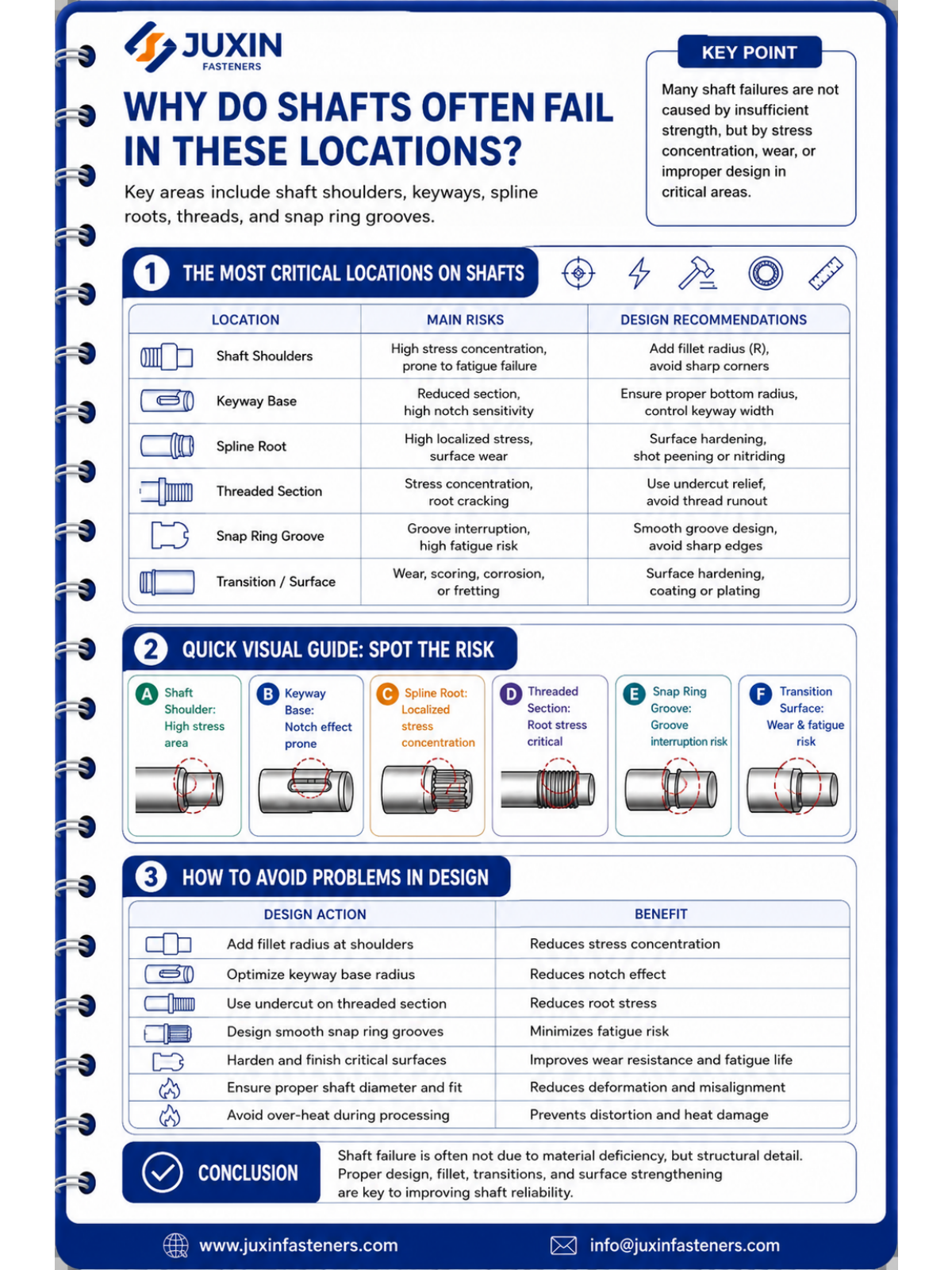
Why Do Shafts Usually Break in Specific Locations?
Many engineers assume shaft failures are caused by insufficient material strength.
In reality, stress concentration is responsible for many failures.
Critical locations include:
Shaft shoulders
Keyways
Spline roots
Relief grooves
Retaining ring grooves
Thread run-outs
Diameter transitions
These geometric features create localized stress that accelerates fatigue crack initiation.
A well-designed shaft minimizes abrupt section changes by incorporating proper fillet radii, smooth transitions, and optimized groove geometry.
In many cases, improving structural design yields greater reliability than simply selecting a stronger material.
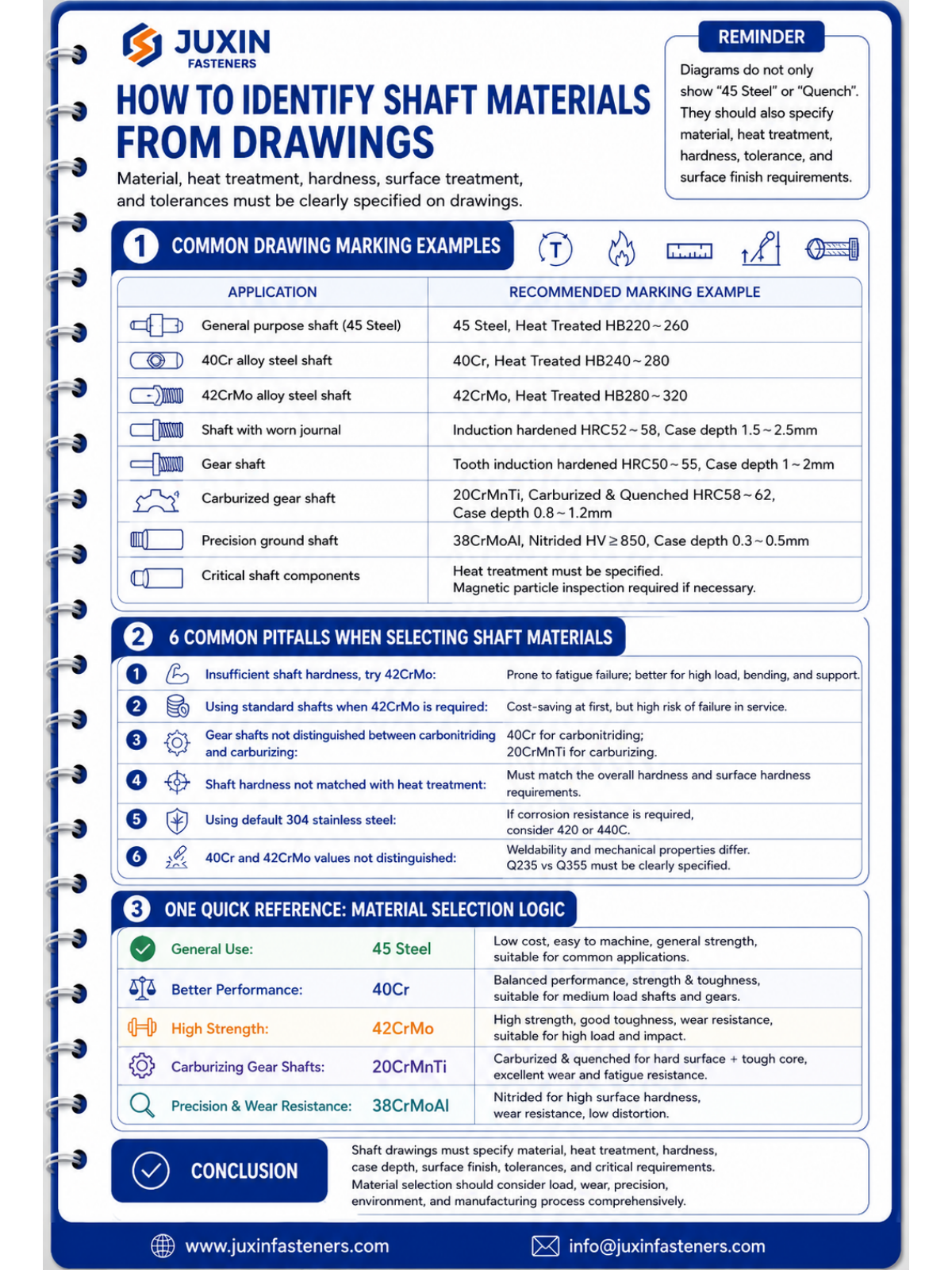
Shaft Drawings Should Specify More Than Just the Material
Many engineering drawings simply state:
"45 Steel"
"Quenched"
"Hardened"
This information is incomplete.
Professional manufacturing drawings should specify:
Material grade
Heat treatment method
Hardness range (HRC/HB)
Effective hardened layer depth
Heat-treated areas
Surface finish requirements
Dimensional tolerances
Geometric tolerances
Complete specifications ensure consistent manufacturing quality and reduce communication errors between design, machining, and inspection teams.
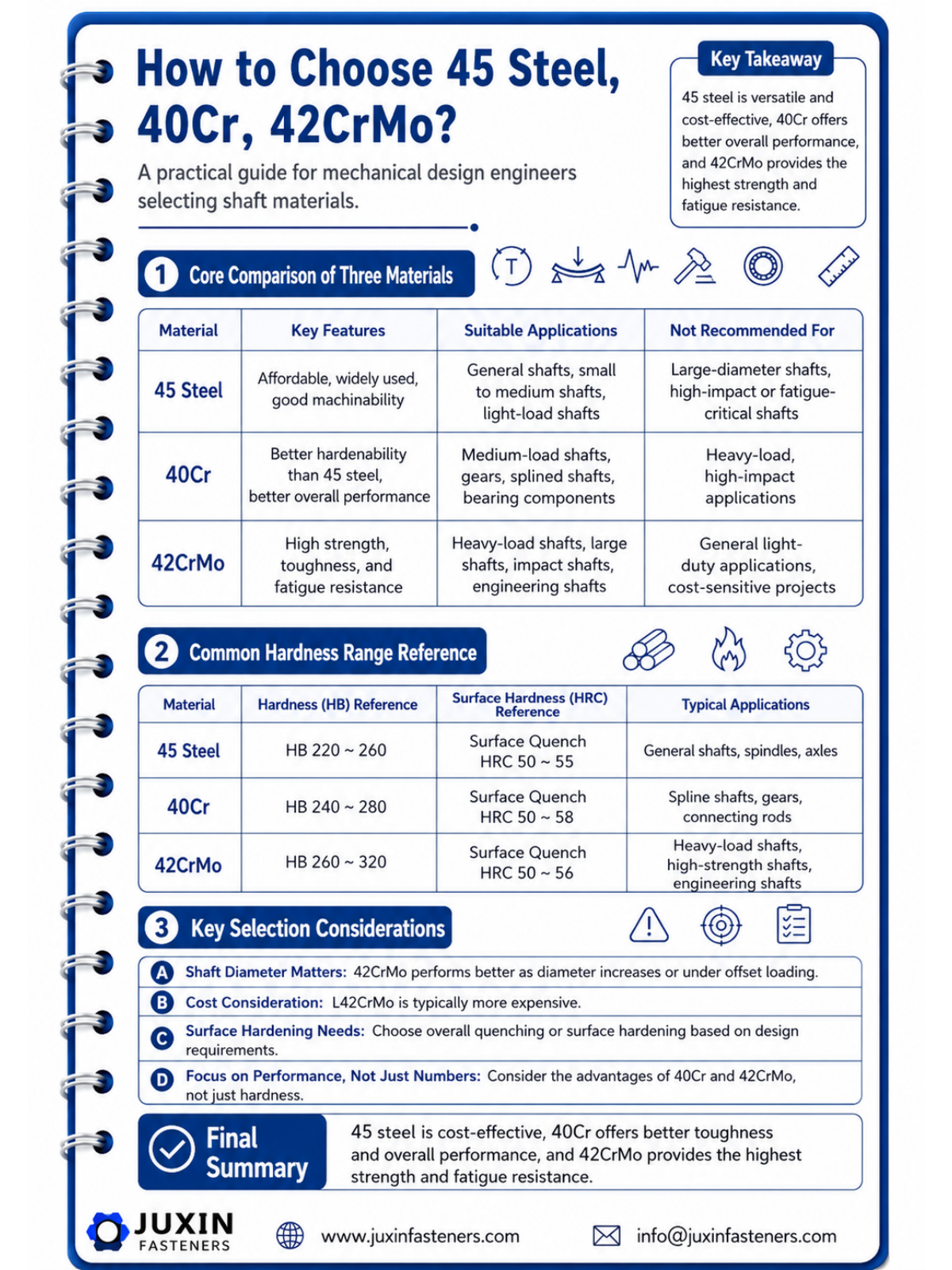
Choosing Between 45 Steel, 40Cr and 42CrMo
Material | Recommended Applications | Main Advantages |
45 Steel | General transmission shafts | Cost-effective, easy machining, suitable for standard industrial use |
40Cr | Medium-duty shafts | Better strength, toughness and fatigue resistance |
42CrMo | Heavy-duty shafts | High strength, high torque capacity, superior fatigue performance |
As a general guideline:
45 Steel → Standard industrial applications.
40Cr → Better overall mechanical performance with improved durability.
42CrMo → Heavy-load, high-impact, and high-fatigue operating conditions.
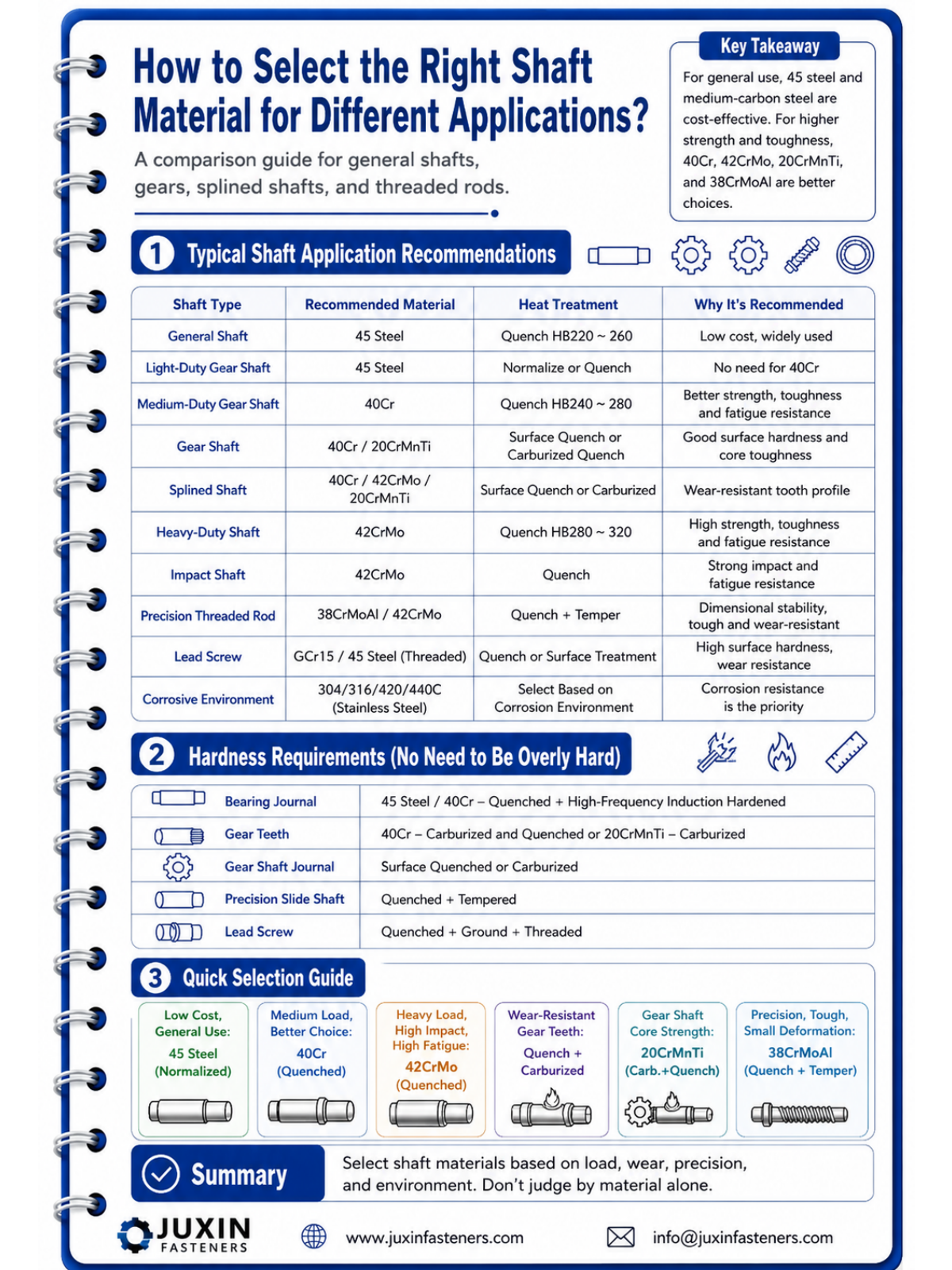
Material Recommendations for Different Shaft Types
Different shaft designs require different engineering priorities.
Shaft Type | Recommended Material |
Standard Transmission Shaft | 45 Steel |
Medium-Duty Shaft | 40Cr |
Heavy-Duty Drive Shaft | 42CrMo |
Gear Shaft | 40Cr / 20CrMnTi |
Spline Shaft | 40Cr / 42CrMo |
Precision Lead Screw | 38CrMoAl |
Ball Screw Shaft | 38CrMoAl |
High-Speed Shaft | 40Cr |
Heavy Shock Shaft | 42CrMo |
OEM Precision Shaft Manufacturing Services
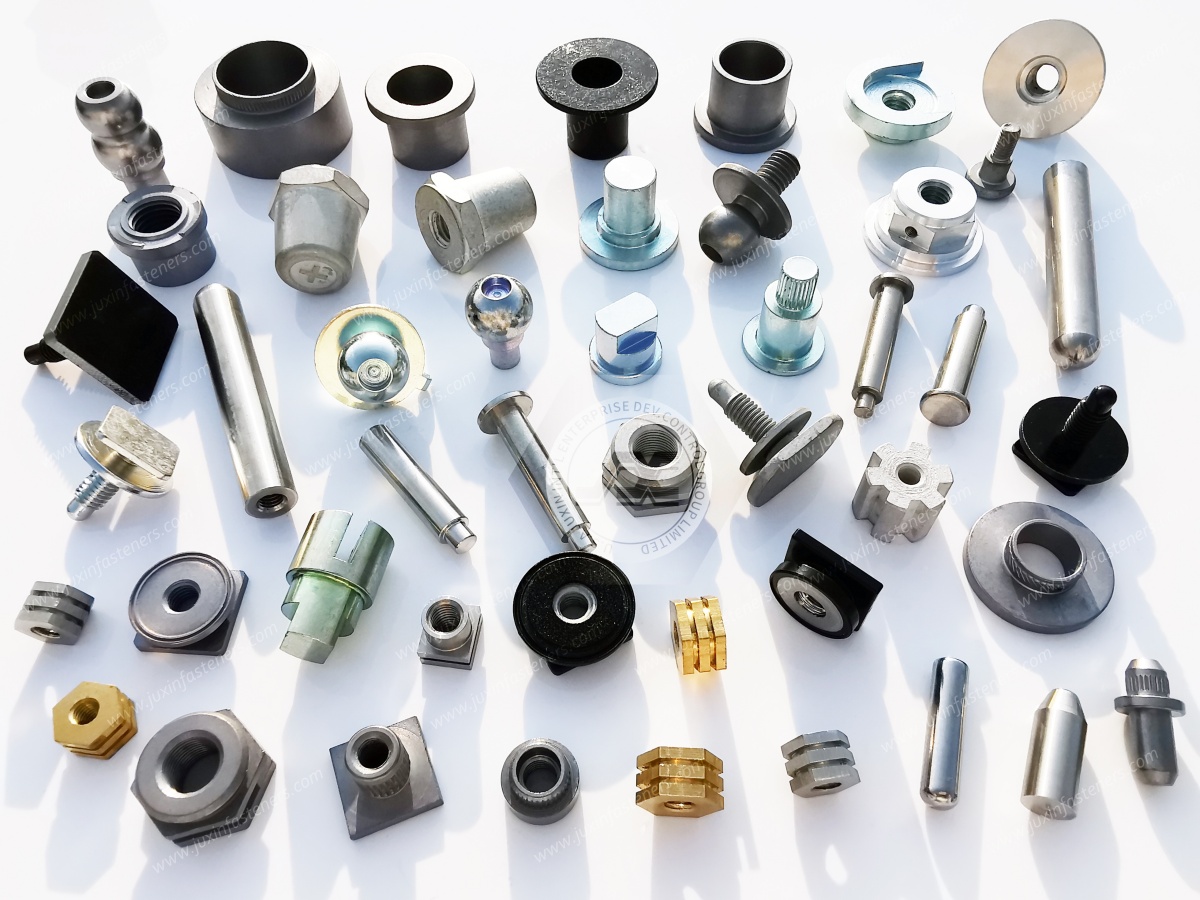
JUXIN FASTENERS supplies custom CNC machined shaft components for global OEM manufacturers.
Our manufacturing capabilities include:
Precision CNC Turning
CNC Milling
Multi-axis Machining
Precision Grinding
Thread Rolling
Gear Hobbing
Spline Machining
Induction Hardening
Carburizing
Nitriding
Quenching & Tempering
Precision Inspection
We manufacture:
Precision Shafts
Stepped Shafts
Threaded Shafts
Gear Shafts
Drive Shafts
Transmission Shafts
Spline Shafts
Worm Shafts
Motor Shafts
Pump Shafts
Custom CNC Shaft Parts
OEM Machined Components
Materials include:
Carbon Steel
Alloy Steel
Stainless Steel
Aluminum
Brass
Titanium
Engineering Plastics
All products are manufactured according to customer drawings, samples, or OEM specifications.
Conclusion
Selecting the correct shaft material is far more than choosing the highest-strength steel. Successful shaft design requires balancing load capacity, fatigue resistance, wear performance, heat treatment, manufacturability, dimensional stability, and overall cost.
Whether the application calls for the economy of 45 Steel, the balanced performance of 40Cr, the heavy-duty strength of 42CrMo, the carburized durability of 20CrMnTi, or the precision wear resistance of 38CrMoAl, the right combination of material, heat treatment, and structural design is essential for long-term reliability.
At JUXIN FASTENERS, we provide custom precision machined shafts, CNC shaft components, transmission shafts, spline shafts, gear shafts, OEM mechanical parts, and complete machining solutions tailored to the requirements of global industrial, automotive, automation, agricultural, and heavy equipment manufacturers.
 MORE NEWS
Sep. 27, 2026
Sep. 27, 2026
Sep. 27, 2026
Contact Us
Tel.:
+86 020 8621 0320
+86 020 3121 6067
E-mail:
Technical Support:
Navigation
SEND INQUIREY