Call Us
+86 136 6007 9809
Call Us
+86 136 6007 9809

Nov. 19, 2026
Precision Stainless Steel Screws and Custom Fasteners for Medical Equipment Manufacturing
Medical equipment manufacturing—encompassing clinical diagnostic analyzers, automated laboratory instruments, patient monitoring systems, mobile medical carts, and imaging equipment housings—imposes stringent mechanical, hygienic, and serviceability demands on structural and enclosure hardware. Unlike general industrial machinery, clinical equipment undergoes daily chemical wipe-downs, operates inside space-constrained tabletop or cart footprints, and requires strong controls to reduce loose-hardware risks or premature cosmetic corrosion during routine servicing.
Note on Application Scope: This engineering guide addresses external medical equipment enclosures, diagnostic chassis, laboratory instrumentation, imaging housings, and mobile medical carts. It does not cover implantable devices, surgical tools, or regulated sterile patient-contact components, and Juxin Fasteners does not claim medical-device certification unless specifically verified for an individual project. As an industrial fastener manufacturer, Juxin Fasteners supplies precision stainless steel screws for diagnostic equipment OEMs—alongside miniature CNC fasteners, captive panel screws, and threaded inserts—manufactured to customer 2D/3D drawings for industrial batch production.
Core Fastening Requirements in Diagnostic and Laboratory Equipment
Mechanical design engineers and purchasing teams in medical equipment manufacturing balance four overlapping reliability priorities:
Repeated Disinfectant Exposure and Corrosion Resistance
Hospital and clinical laboratory protocols require frequent surface disinfection using isopropyl alcohol (IPA), diluted sodium hypochlorite (bleach), accelerated hydrogen peroxide, phenolic cleaners, and quaternary ammonium compounds. Low-grade plated steel fasteners quickly corrode, blister, or flake under these chemicals—compromising both enclosure appearance and equipment hygiene.
Reducing Loose-Fastener Risks During Maintenance
Calibration panels, reagent access doors, optical sensor covers, and power-module shields are opened repeatedly by field service engineers. A loose M2 or M3 screw falling into a centrifuge chamber, optical bench, or high-voltage analyzer board can cause catastrophic instrument downtime.
Compact Packaging and Tight Concentricity
Benchtop diagnostic analyzers and portable patient monitors pack optics, fluidics, and PCBs into tight internal envelopes. Standard commercial screw heads frequently interfere with adjacent moving stages or sleek molded bezels, driving demand for ultra-low-profile screws for laboratory instruments and custom miniature stepped fasteners.
Non-Magnetic and Low-Permeability Environments
Imaging equipment housings—particularly enclosures and support hardware operating near Magnetic Resonance Imaging (MRI) suites—require fasteners that avoid ferromagnetic attraction and minimize magnetic field distortion.
Material Selection and Disinfectant Compatibility Matrix
Choosing the right fastener material for a medical equipment enclosure depends on chemical exposure, mechanical clamping load, magnetic constraints, and mating housing material.
| Fastener Material | Corrosion & Disinfectant Resistance | Magnetic Behavior | Galling / Wear Consideration | Typical Medical Equipment Use |
|---|---|---|---|---|
| 304 Stainless Steel (A2 designation depends on product standard) | Good against IPA and mild cleaners; vulnerable to pitting under strong chloride bleach | Annealed: essentially non-magnetic; cold working introduces slight magnetism | High galling risk against stainless threads if driven dry at high speed | Dry internal chassis frames, light-duty cart brackets, non-bleach zones |
| 316 / 316L Stainless Steel (A4 designation depends on product standard) | Superior resistance to chloride bleach, saline spills, and aggressive lab disinfectants | Lower magnetic permeability than 304; 316L may offer low magnetic permeability in some conditions, but finished-part permeability must be tested | High galling risk in fine miniature threads; requires torque/lube control | External analyzer covers, fluidic trays, lab washdown panels, medical carts |
| Brass (C36000 / CuZn39Pb3 or Lead-Free Grades) | Moderate; avoid prolonged exposure to ammonia-based cleaners | Non-magnetic | Very low galling risk; excellent machinability for knurled inserts | Brass inserts pressed or heat-set into plastic housings for patient monitors |
| Engineered Polymers (PA66, POM, PEEK — Project Evaluated) | Polymer-specific: check environmental stress cracking (ESC) against IPA/bleach | Typically non-ferromagnetic and electrically insulating; assess fillers and application-specific properties | Zero metallic galling; lower shear strength and creep limits under load | Non-magnetic MRI-adjacent covers, electrical isolation spacers, low-load panels |
Surface Finish and Resistance to Cleaning Agents
Evaluating the resistance of stainless steel fasteners to cleaning agents requires looking beyond alloy composition to surface condition. During cold forming or CNC machining, microscopic free iron particles from tooling can transfer onto stainless steel surfaces, causing localized rust staining after bleach wipe-downs. Specifying passivated 316L stainless steel fasteners for laboratory equipment—where an acid passivation treatment removes free surface iron and promotes a uniform chromium-oxide passive film—substantially enhances surface corrosion resistance. In addition, smooth head contours (such as button-head or low-profile hexalobular/Torx drives without deep debris traps) make exterior wipe-downs faster and more effective.
Miniature CNC Fasteners, Captive Screws, and Ultra-Low Profile Hardware
Diagnostic instruments and imaging enclosures rely heavily on specialized small-format hardware that goes beyond standard commercial fasteners.
Miniature CNC-Machined 316L Fasteners and Small-Diameter Custom Screws
For compact optical mounts, fluidic manifolds, and sensor brackets, engineers routinely specify miniature CNC-machined 316L stainless steel fasteners and custom M1.6, M2, or M2.5 screws. At diameters below M3, thread pitch accuracy, head-to-shank concentricity, and clean burr-free drive recesses become critical. Even minor burrs in an M1.6 socket recess prevent driver engagement, leading to cam-out and stripped heads on the assembly line. Ultra-low-profile screws for laboratory instruments reduce vertical stack height where sliding trays or protective covers pass within millimeters of a structural fastener head.
Captive Panel Screws for Medical Device Enclosures
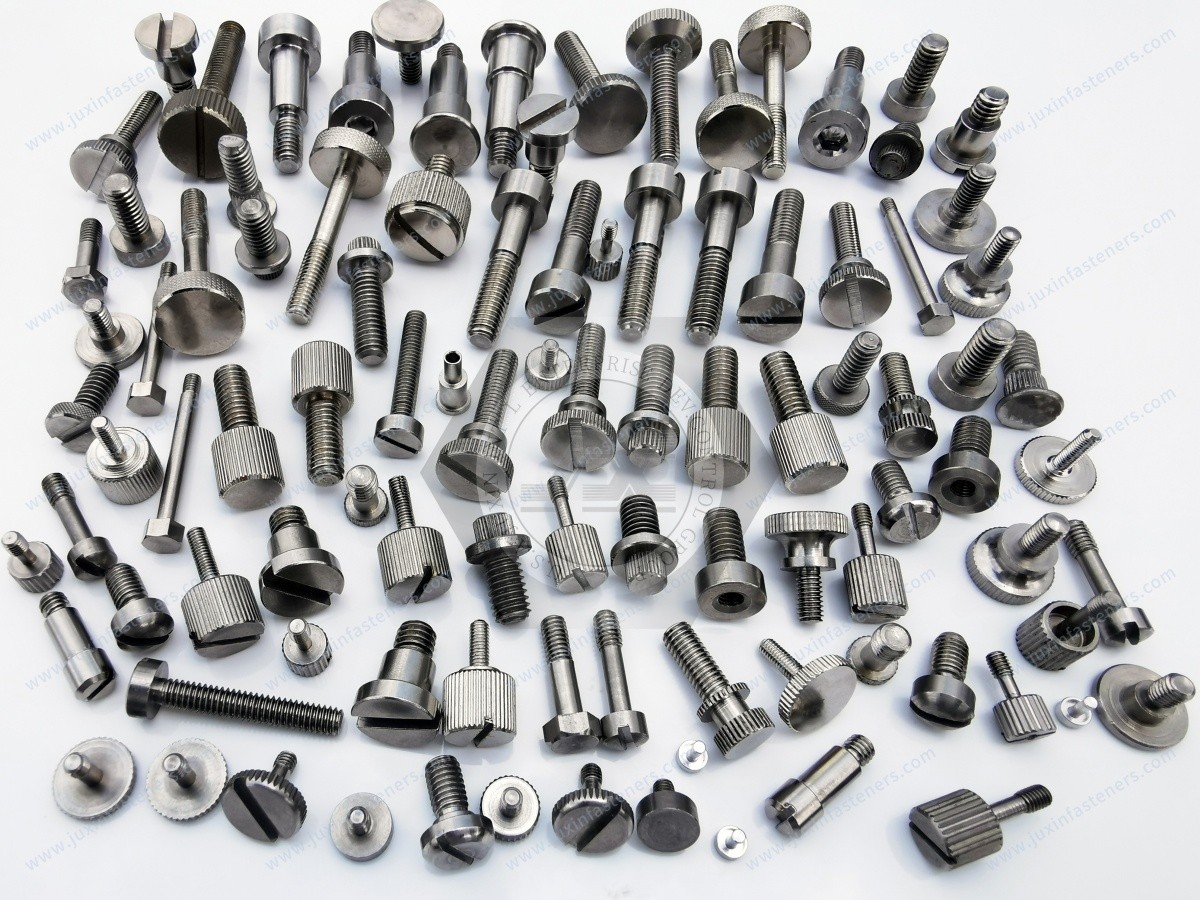
Specifying captive panel screws for medical device enclosures helps mitigate loose-hardware risks across external service doors and internal diagnostic sub-modules. Captive designs—utilizing reduced-diameter retaining shanks, press-in ferrules, spring-loaded knobs, or flare-in sleeves—help retain the screw in the removable panel during servicing. For enclosures requiring frequent hand access without tools, custom knurled stainless steel thumb screws with captive shanks allow rapid servicing while maintaining a clean, corrosion-resistant finish.
Preventing Galling in Miniature Stainless Screws
Thread galling (cold welding) occurs when frictional heat and contact pressure tear away the protective chromium-oxide film on mating stainless steel threads, locking the screw permanently into the tapped hole. On small-diameter M2 to M4 stainless fasteners, galling often snaps the screw head off entirely during installation or service removal. Preventing galling in miniature stainless screws requires disciplined engineering controls:
Reduce automated screwdriver RPM during installation to limit frictional heat buildup.
Avoid pairing identical soft 304-on-304 threads where possible; mate stainless screws into brass threaded inserts, aluminum-bronze, or appropriately treated stainless nuts.
Where chemical compatibility and cleanliness allow, evaluate OEM-approved dry-film lubricants or controlled anti-galling surface coatings during prototype testing.
Polymer Housings, Medical Carts, and MRI-Adjacent Enclosures
Modern medical devices blend injection-molded polymer housings (ABS, PC/ABS, glass-filled nylon) with rigid sheet-metal frames.
Threaded Inserts for Medical Plastic Housings
Cutting threads directly into molded medical enclosures yields weak, single-use joints that strip easily during field maintenance. Specifying threaded inserts for medical plastic housings—such as brass inserts for patient monitor housings or 316 stainless steel knurled inserts—creates durable, reusable metal threads inside polymer bosses. Heat-set and ultrasonic installation melt the surrounding thermoplastic cleanly into opposed knurl bands and undercuts, delivering balanced pull-out and rotational torque-out resistance without inducing the radial hoop stress that causes press-fit inserts to crack polycarbonate housings over time.
Stainless Steel Sheet-Metal Fasteners for Medical Carts
Mobile diagnostic carts, anesthesia workstations, and infusion-pump stands experience constant rolling vibration, hospital elevator thresholds, and daily sanitizer wipe-downs. Stainless steel sheet-metal fasteners for medical carts—including stainless steel blind rivet nuts, self-clinching nuts and studs, and flanged button-head screws—provide strong, flush-mounted joints across thin tubular frames and stainless/powder-coated sheet metal shelves without creating sharp internal protrusions that could snag cables or hoses.
Non-Magnetic Fasteners for MRI Equipment Housings
Near high-field MRI magnets, ferromagnetic carbon steel fasteners present severe projectile and image-artifact hazards. Cold-worked austenitic stainless steel can exhibit increased magnetic response due to strain-induced martensite formation. When engineers specify non-magnetic fasteners for MRI equipment housings, material selection must be evaluated carefully—often favoring annealed 316L stainless steel (verified for low magnetic permeability per OEM requirements), brass, titanium, or non-metallic engineering polymers depending on structural load and proximity to the magnetic field.
Manufacturing Route Selection: Cold Heading vs. CNC Machining
Medical equipment programs typically run in lower-to-medium annual volumes compared to automotive platforms, yet demand tight dimensional consistency and high aesthetic cleanliness. Juxin Fasteners evaluates each customer drawing to match the fastener to the optimal manufacturing route:
CNC Machining: Frequently the preferred route for miniature M1.6–M3 precision screws, custom stepped captive screws, knurled thumb screws, brass threaded inserts, and tight-tolerance sensor shafts where tooling investment for cold heading is not justified by batch volume or where geometric complexity requires multi-axis turning.
Cold Heading and Cold Forming: Cost-effective for medium-to-high annual batch volumes of standard-profile stainless machine screws, flange screws, and rivet-nut blanks used across medical carts and high-volume diagnostic platforms.
Multi-Process Combination: For mid-to-high volume custom captive screws or flanged shafts, cold forming the primary blank followed by CNC secondary turning of captive grooves, undercuts, or tight-tolerance shanks can significantly reduce per-piece manufacturing cost while preserving precision.
Quality Verification, Traceability, and OEM Procurement Requirements
Medical equipment procurement managers and quality engineers prioritize documentation, consistency, and clean packaging alongside dimensional precision.
Lot Traceability Requirements for Medical Equipment OEMs
When a medical equipment program requires fastener lot traceability, procurement teams should define the documentation in the RFQ—such as raw material heat-lot traceability, chemical/mechanical mill certificates (e.g., EN 10204 3.1 style material test reports where applicable and confirmed per order), dimensional inspection reports, and First Article Inspection (FAI) packages. Because certification and cleanroom-grade washing requirements vary significantly across diagnostic OEMs, every traceability, cleaning, and packaging specification must be reviewed and confirmed on a project-by-project basis prior to order acceptance.
OEM Design and RFQ Checklist
To receive an accurate engineering feasibility review and batch quotation from Juxin Fasteners, send your technical documentation to info@juxinfasteners.com with:
Complete 2D drawings (PDF) noting critical-to-quality (CTQ) tolerances, thread standards, surface roughness, and 3D CAD models (STEP/IGES)
Exact material specification (e.g., 304, 316, 316L, brass grade, or polymer) and any non-magnetic permeability requirements
Surface finish requirements (e.g., passivation, burr-free cosmetic edges, anti-galling treatment)
Expected disinfectant/cleaning agents and service removal frequency
Documentation, lot traceability, packaging, sample quantity, and Estimated Annual Usage (EAU)
Contact Us
Tel.:
+86 020 8621 0320
+86 020 3121 6067
E-mail:
Technical Support:
Navigation
SEND INQUIREY