Call Us
+86 136 6007 9809
Call Us
+86 136 6007 9809

Nov. 19, 2026
Custom Fasteners for Network Equipment Chassis and Telecommunications Cabinets
Modern telecommunications infrastructure spans climate-controlled central offices, hyperscale network distribution rooms, roadside fiber-optic cabinets, and pole-mounted 5G outdoor enclosures. Across all of these environments, mechanical engineers face a shared structural constraint: cabinet frames, equipment rails, and sub-chassis panels are fabricated from thin sheet metal—commonly cold-rolled steel (SPCC), electro-galvanized steel (SECC), aluminum alloys, or stainless steel in thicknesses ranging from 1.0 mm to 2.5 mm. Direct tapping into sheet metal this thin rarely delivers enough engaged threads to withstand repeated equipment swaps, shipping shock, or wind-induced vibration.
As an industrial fastener manufacturer, Juxin Fasteners provides custom fasteners for network equipment chassis and telecommunications cabinets through drawing-based OEM/ODM production. By combining cold heading, cold forming, CNC machining, and product-specific secondary operations according to part geometry and batch volume, we support global telecom OEMs, Tier-1 cabinet fabricators, and sheet-metal contractors transitioning from prototype designs to industrial batch production.
Core Fastening Challenges in Telecommunications & Network Enclosures
Selecting fastening hardware for network cabinets is not a simple catalog lookup. Poor fastener selection causes measurable field failures, slow assembly throughput, and costly rail replacements during maintenance cycles.
Thin-Sheet Load Transfer and Thread Stripping
Standard 19-inch EIA-310 / IEC 60297 equipment racks carry heavy switches, optical line terminals, power shelves, and battery trays on vertical mounting rails. When rails are tapped directly—such as traditional two-post telecom frames using 12-24 telecom rack screws—a single cross-threaded screw can permanently ruin an entire vertical rail section, forcing costly field re-tapping or cabinet replacement.
Restricted Access and Blind-Side Assembly
High-density fiber-optic patch panels and compact 5G radio enclosures leave minimal tool clearance behind mounting flanges. Assembly technicians often cannot reach the back of a panel to hold a standard hex nut, making blind-side or pre-installed permanent sheet-metal hardware essential for production-line efficiency.
Repeated Servicing and Loose Hardware Risks
Network cards, fan trays, air filters, and outdoor door covers must be removed and reinstalled repeatedly over a 10- to 20-year service life. Loose screws dropped inside live telecom equipment create immediate short-circuit hazards, airflow obstructions, and maintenance delays.
Outdoor Weathering, Coastal Corrosion, and Thermal Cycling
Outdoor 5G small-cell enclosures and roadside fiber distribution hubs experience rain, condensation, road salt, UV radiation, and wide diurnal temperature swings. Standard zinc-plated carbon steel hardware can experience red rust, seized threads, and galvanic corrosion when mated directly to aluminum enclosures.
Cage Nuts vs. Self-Clinching Nuts vs. Closed-End Blind Rivet Nuts
One of the most consequential engineering decisions in network cabinet design is choosing how to generate strong, durable threads in thin rails and chassis walls. When evaluating cage nuts, self-clinching nuts, and blind rivet nuts for telecom racks, engineers must weigh serviceability, sheet hardness, coating sequence, and assembly ergonomics.
| Engineering Criterion | Cage Nuts (M6 / 10-32) | Self-Clinching Nuts & Studs | Closed-End Blind Rivet Nuts |
|---|---|---|---|
| Primary Telecom Application | 19-inch square-hole server & network rack rails | Internal chassis brackets, fiber-optic sub-panels, power shelves | Outdoor 5G cabinets, sealed doors, tubular frames with blind-side access |
| Installation Access Required | Front or rear snap-in to 9.5 mm (0.375") square hole | Access to both sides for parallel-action press installation | One-sided (blind-side) installation via manual or pneumatic pull tool |
| Sheet Hardness Sensitivity | Independent of rail hardness (spring steel cage clips onto hole) | Critical: fastener must be significantly harder than host sheet metal | Depends on fastener design, sheet strength, grip range, hole geometry and setting force |
| Thread Replacement if Damaged | High: a damaged nut can be removed and replaced | Low: permanently swaged into sheet metal; removal risks panel damage | Moderate: requires drilling out and reinstalling a replacement insert |
| Alignment Tolerance (Float) | Built-in radial float accommodates chassis mounting tolerances | Fixed zero-float position; requires tight CNC punch accuracy | Fixed zero-float position; hole tolerance governs concentricity |
| Ingress / Weather Sealing | Open hole; not suited for NEMA/IP sealed exterior walls | Flush/low-profile, but requires sealing validation for IP-rated walls | Closed-end barrel closes one potential ingress path; head-to-sheet interface still needs sealing validation |
| Powder-Coat Sequence | Often installed after coating; check coating thickness, hole edges and electrical contact requirements | Installed before coating (requires thread masking) or into pre-plated sheet | Can be installed after powder coating; hole-edge coating damage and sealing must be validated |
Rack Mounting Hardware: M6, 10-32, and 12-24 Standards
Global network equipment OEMs frequently ship the same rack platform to North America, Europe, and Asia-Pacific, creating dual metric and unified thread requirements.
Choosing Between M6 and 10-32 Cage Nuts
Modern four-post network and data-center racks predominantly standardize on square mounting holes that accept either M6 (metric, dominant in Europe, Asia, and global hyperscale deployments) or 10-32 (UNF fine thread, widely specified across North American enterprise and carrier facilities) cage nuts. The spring-steel cage retains a square floating nut inside the cutout, compensating for minor tolerances in switch mounting ears and isolating rail damage to a disposable, low-cost nut.
Preventing Cross-Threading in Server Rack Rails
Cross-threading is a recurring field-service risk in network rack deployment. Technicians frequently mix M6 and 12-24 or 10-32 screws visually, or drive standard flat-tipped screws at slight angles under tight cable congestion. Engineers mitigate this risk by specifying rack screws with a dog-point or pilot-point lead-in tip that aligns the screw axis before thread engagement begins, paired with a captive nylon or plastic washer under the head to prevent marring painted rack rails and equipment ears.
Self-Clinching Fasteners and Captive Panel Screws for Chassis Fabrication
Inside the cabinet—where equipment shelves, optical splice trays, fan modules, and front bezels mount to thin sheet-metal sub-assemblies—permanent press-in and retained fasteners provide superior rigidity and clean internal geometry.
Self-Clinching Nuts and Studs for Fiber Optic Enclosures
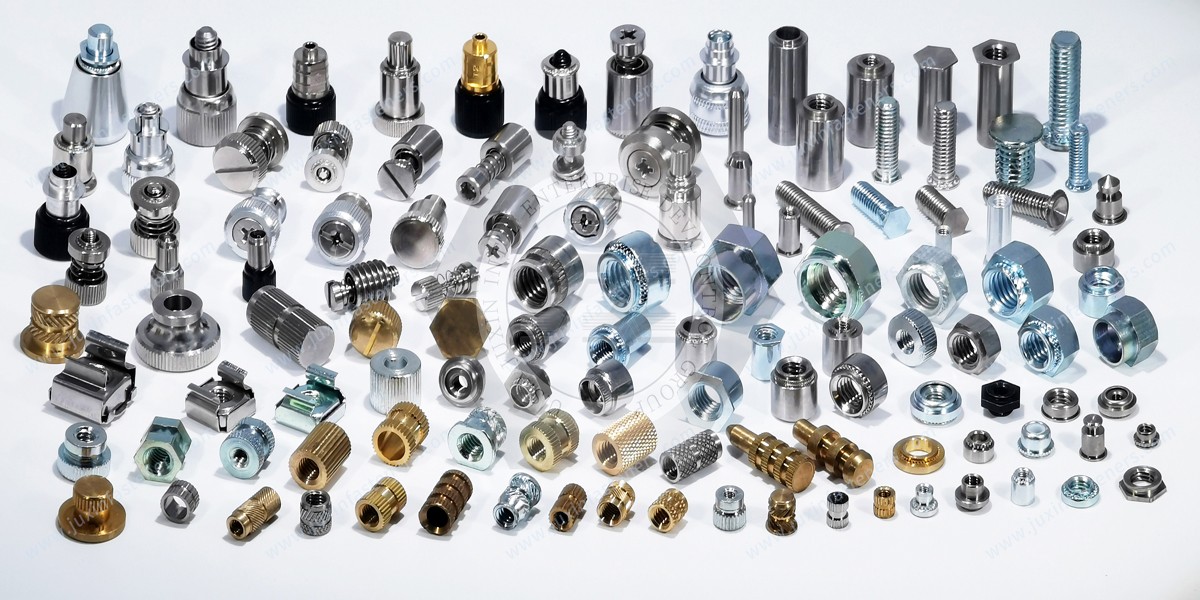
For OEM thin-sheet fastening programs, Juxin Fasteners evaluates sheet thickness, minimum edge distance, and material hardness during drawing review. When pressed into a properly sized punched hole using parallel squeezing force, the serrated clinching ring displaces host sheet metal into an annular undercut, locking the fastener against both push-out and rotational torque-out. Self-clinching studs for fiber optic enclosures create clean, flush exterior surfaces on thin aluminum or SECC sub-panels, allowing installers to hang heavy optical modules onto projecting studs before tightening nuts—greatly simplifying one-person installation.
Critical Hardness Rule for Self-Clinching Hardware
Self-clinching fails when the host sheet metal is too hard to cold-flow into the fastener's undercut. Standard carbon steel self-clinching nuts perform reliably in cold-rolled steel and aluminum, whereas clinching into 300-series stainless steel sheets requires specialized precipitation-hardened or work-hardened stainless fasteners specifically rated for stainless-into-stainless clinching. If an enclosure uses hard stainless panels or has already been powder-coated, blind rivet nuts or weld studs are typically more reliable alternatives.
Captive Panel Screws for Network Cabinets
A manufacturer of self-clinching panel fasteners can help telecom OEMs integrate captive panel screws into removable faceplates, power supply bezels, and maintenance covers. Available in spring-loaded, flare-in, press-in, and floating designs, these screws are designed to stay attached to the removable panel even when fully disengaged from the chassis thread. Knurled or combination-drive heads (such as Phillips/slotted or Torx/knurled) allow technicians to start fasteners by hand and finalize torque with controlled drivers, helping reduce the risk of dropped-screw failures inside energized switching gear.
Outdoor 5G Enclosures: Corrosion Control, Sealing, and Grounding
Outdoor base stations, pole-mounted 5G radios, and curbside broadband cabinets operate in far harsher environments than indoor server rooms.
316 Stainless Steel Outdoor Telecom Enclosure Fasteners
In coastal regions, industrial zones, or areas using winter de-icing salts, standard 304 (A2) stainless steel can develop localized chloride pitting and tea-staining. Specifying 316 stainless steel fasteners for outdoor telecom enclosures (ISO 3506 grade A4, containing molybdenum) significantly improves resistance to chloride-induced pitting and crevice corrosion on external hinges, pole-mount brackets, cable glands, and door latches.
Closed-End Rivet Nuts for Outdoor 5G Cabinets
Where exterior accessories, sunshields, or mounting brackets attach to sealed outdoor housings, open-end threaded inserts allow moisture, condensation, and dust to travel straight through the thread bore into sensitive electronics. Closed-end rivet nuts for outdoor 5G cabinets feature a sealed bottom barrel that blocks ingress paths through the fastener body. When paired with an under-head elastomer O-ring or sealing washer and a hexagonal or knurled body to resist spin-out, closed-end rivet nuts maintain enclosure sealing integrity—though final IP or NEMA ingress ratings must always be verified by the OEM on the complete assembled enclosure.
Grounding Lug Hardware for Telecom Enclosures
Lightning protection and electromagnetic compatibility (EMC) require low-impedance protective earthing between cabinet doors, chassis rails, and copper ground bars. Engineers must distinguish mechanical panel fastening from electrical bonding. Grounding lug hardware for telecom enclosures—typically stainless steel or copper-alloy studs, nuts, and star/serrated contact washers—must penetrate non-conductive paint or anodizing layers to achieve reliable electrical continuity. Nonmetallic fasteners or standard nylon cable mounts for network racks serve strictly for mechanical wire routing and dielectric spacing, never as primary electrical grounding paths.
Manufacturing Process Selection for Telecom OEM Programs
Telecom cabinet hardware spans high-volume standard items and specialized custom-engineered fasteners. Juxin Fasteners evaluates each customer drawing to match geometry, tolerance, and Estimated Annual Usage (EAU) to the most economical manufacturing route:
Cold Heading and Cold Forming: Ideal for high-volume batch production of rack mounting screws, flange screws, cage-nut mating bolts, and standard self-clinching or rivet-nut blanks, delivering high material utilization and uninterrupted grain flow.
CNC Machining: Well-suited for custom captive panel screw retainers, non-standard standoffs, stepped shoulder spacers, low-to-medium volume chassis pins, and precision secondary features such as under-head cross-holes, fine knurling, or tight concentricity grooves.
Multi-Process Integration: Many custom telecom fasteners—such as specialized captive screws or stepped self-clinching studs—can be evaluated for cold forming of the primary blank combined with CNC secondary machining, balancing tooling amortization against unit cost at OEM production scale.
Surface Finishing and Secondary Operations: Depending on drawing specifications, parts may incorporate zinc plating, black oxide/zinc finishes for low-glare cabinet aesthetics, stainless steel passivation, or pre-applied thread-locking patches (evaluated per project requirements).
Quality Verification and OEM Design Checklist
Before releasing telecom cabinet fastener drawings for batch production, engineering and production teams should verify the following items:
Sheet Material and Hardness Verification: Confirm exact host sheet alloy, temper, thickness tolerance, and whether fasteners are installed before or after powder coating or plating.
Thread Compatibility Across Regions: Verify whether the cabinet program specifies Metric (M5/M6) or Unified (10-32/12-24) hardware to reduce assembly-line mix-ups.
Anti-Galling on Stainless Hardware: For stainless hardware on outdoor 5G enclosures, control installation speed, inspect thread quality, and confirm material suitability for the joint and its coastal exposure. Validate any lubricant or anti-galling coating with the OEM on representative assemblies.
Push-Out, Torque-Out, and Cycle Validation: Validate actual installation push-out and torque-out performance on representative coated sheet-metal coupons prior to finalizing tooling and batch release.
Dimensional First Article Inspection (FAI): Verify critical head heights, shank lengths, pilot-point geometries, thread gauges (GO/NO-GO), and spring-cage retention dimensions against the 2D drawing.
Request an OEM Drawing Review and Quotation
Juxin Fasteners is an industrial fastener manufacturer supporting global telecommunications, network rack, and enclosure OEMs with standard and made-to-drawing fastening solutions for industrial batch production. To initiate an engineering feasibility review and competitive quotation, send your technical package to info@juxinfasteners.com including:
2D engineering drawings (PDF) with critical tolerances and 3D CAD models (STEP/IGES)
Required fastener material grade, thread standard (Metric or UNC/UNF), and surface finish
Host sheet metal alloy, thickness range, hardness, and coating sequence
Environmental exposure conditions (indoor rack vs. coastal/outdoor 5G enclosure)
Initial sample quantity, batch order size, and Estimated Annual Usage (EAU)
Contact Us
Tel.:
+86 020 8621 0320
+86 020 3121 6067
E-mail:
Technical Support:
Navigation
SEND INQUIREY