
Call Us
+86 136 6007 9809
Call Us
+86 136 6007 9809

Aug. 11, 2026
RoHS Zinc Plating vs Hexavalent Chromate
Why Surface Appearance Changes in Modern Fastener Coatings
In global fastener procurement, one of the most common technical misunderstandings comes from comparing modern RoHS-compliant zinc coatings with traditional hexavalent chromate finishes.
At Juxin Fasteners, we frequently help OEM customers resolve appearance-related disputes arising from this transition.
This article explains the engineering reason behind color differences and how to properly evaluate coated fasteners.
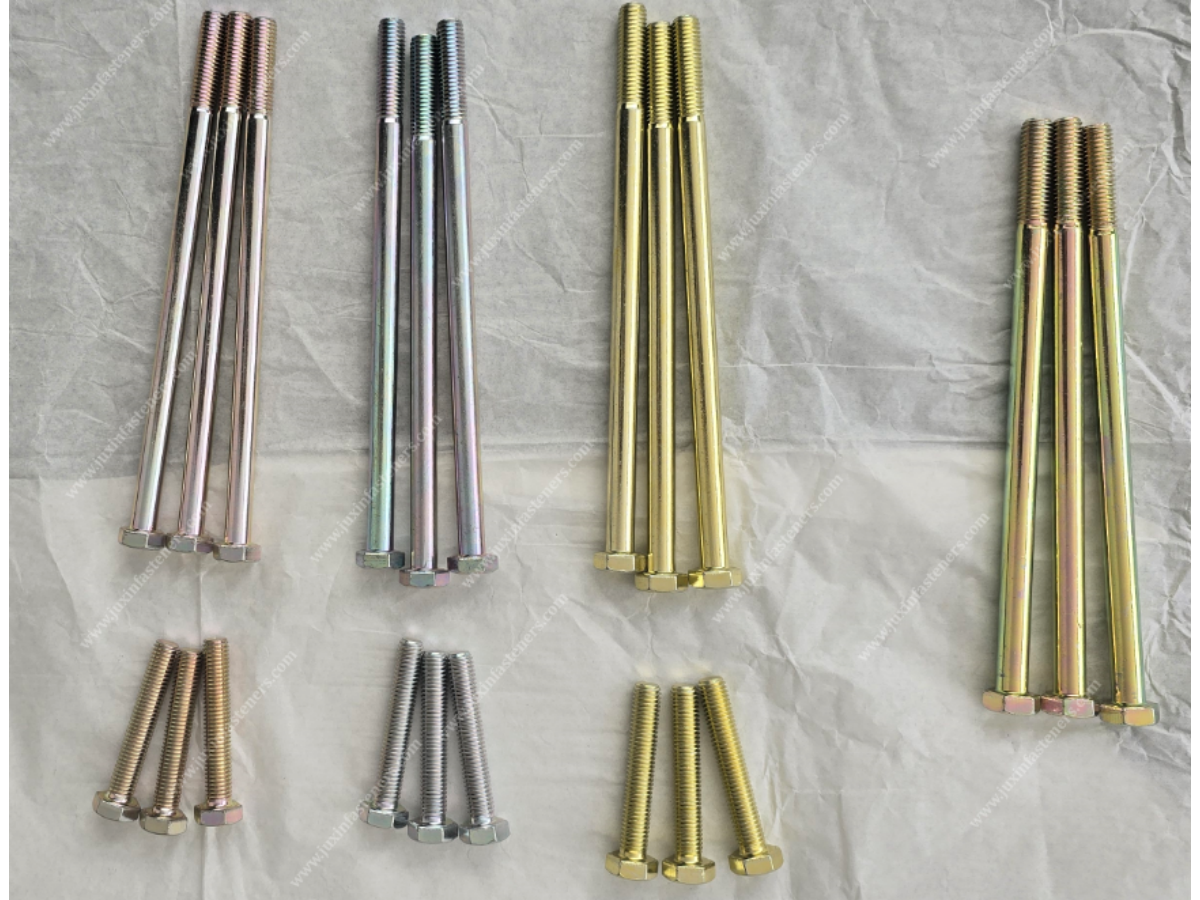
1. Why RoHS Changed Zinc Plating Technology
The introduction of RoHS (Restriction of Hazardous Substances) and REACH regulations significantly changed surface treatment chemistry in fastener manufacturing.
The key change is:
Replacement of hexavalent chromium (Cr6+) with trivalent chromium (Cr3+) systems
This change was made for:
Environmental safety
Worker health protection
Regulatory compliance in EU / US markets
Long-term sustainability in manufacturing
However, this chemical transition also directly affected surface appearance.
2. Hexavalent vs Trivalent Chromate – Visual Difference
Hexavalent Chromate (Legacy System)
Typical appearance:
Bright yellow
Strong rainbow / iridescent effect
High color saturation
Visually “gold-like” finish
Characteristics:
Widely used in older industrial fasteners
Strong visual consistency in legacy systems
Now restricted or banned in most markets
Trivalent Chromate (Modern RoHS System)
Typical appearance:
Light yellow / pale yellow
Blue tint / silver-blue
Softer and less saturated appearance
Characteristics:
RoHS & REACH compliant
Widely used in automotive & electronics
More environmentally stable
Slight batch-to-batch variation is normal
3. Key Engineering Insight
The same zinc plating specification does NOT guarantee the same visual appearance when switching from hexavalent to trivalent systems.
This is one of the most important misunderstandings in global fastener sourcing.
The reason is simple:
Different chemical reaction mechanisms
Different film structure formation
Different light reflection behavior
Even if coating thickness and corrosion performance are similar, appearance will still differ.
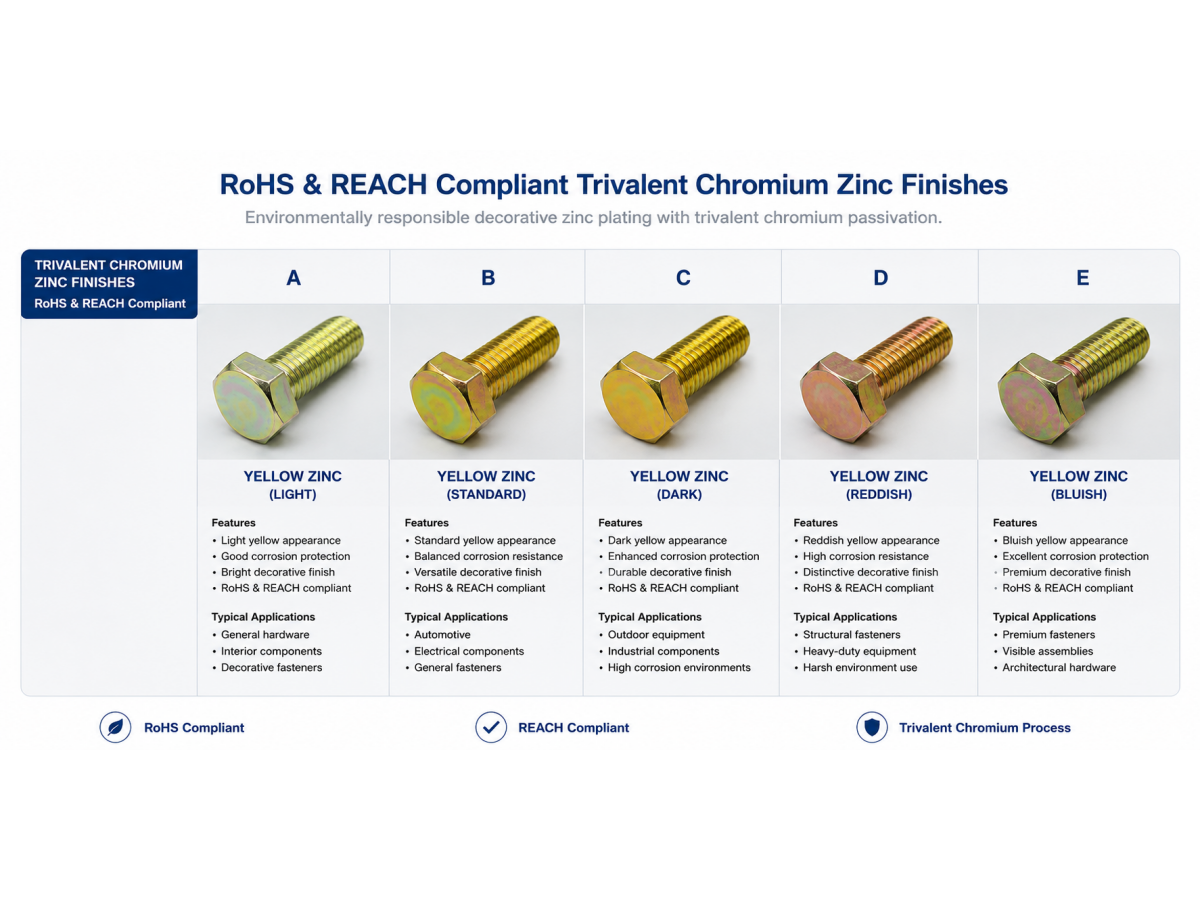
4. Why RoHS-Compliant Zinc Plating Looks Different
The appearance difference is not a quality issue.
It is caused by:
Chromate chemistry change (Cr6 → Cr3)
Lower color pigmentation intensity
Different surface oxide layer structure
More stable but less visually aggressive coating film
As a result:
✔ Colors are lighter
✔ Yellow is less intense
✔ Blue tones are more visible
✔ Iridescence is reduced
5. Common Misunderstanding in Procurement
Many buyers compare:
Old hexavalent samples
vs
New RoHS-compliant production parts
and assume:
❌ “Color is wrong”
❌ “Quality is inconsistent”
❌ “Supplier mismatch”
However, in engineering reality:
These are two different chemical systems, not two different quality levels.
6. Engineering Acceptance Standard (Critical Section)
Unless otherwise specified, acceptance of zinc-plated fasteners should be based on:
✔ Coating thickness (micron level control)
✔ Salt spray corrosion resistance
✔ Mechanical performance requirements
✔ RoHS / REACH compliance
NOT:
❌ Visual color matching
❌ Brightness level comparison
❌ Supplier-to-supplier appearance consistency
7. Industry Application Impact
This issue is especially important in:
Automotive fasteners
Electric vehicle systems (EV platforms)
Electrical enclosures
Industrial machinery assemblies
Export OEM components
At Juxin Fasteners, we help engineering teams ensure:
Correct specification interpretation
Stable coating performance
Regulatory compliance alignment
Cross-supplier consistency validation
8. Why This Matters for OEM Projects
Misunderstanding RoHS surface changes can lead to:
Unnecessary supplier disputes
Delayed approvals
Incorrect rejection of compliant parts
Engineering documentation confusion
Understanding the chemistry difference helps prevent:
Costly miscommunication in global sourcing projects
9. Practical Engineering Recommendation
If your project involves zinc-plated fasteners, we recommend:
✔ Define performance first (corrosion/torque / durability)
✔ Define compliance requirements (RoHS / REACH)
✔ Approve visual samples separately if appearance is critical
✔ Avoid using old hexavalent parts as visual reference for RoHS production
10. Conclusion
RoHS compliance is not only a regulatory upgrade — it is a fundamental change in surface chemistry.
Therefore, visual appearance differences between legacy and modern zinc plating systems are expected and technically unavoidable.
Engineering evaluation should always prioritize performance over appearance.
Contact Engineering Support
For technical support on zinc plating, zinc nickel coatings, or OEM fastener surface specifications:
Juxin Fasteners
Email: info@juxinfasteners.com
 MORE NEWS
Sep. 27, 2026
Sep. 27, 2026
Sep. 27, 2026
Contact Us
Tel.:
+86 020 8621 0320
+86 020 3121 6067
E-mail:
Technical Support:
Navigation
SEND INQUIREY