
Call Us
+86 136 6007 9809
Call Us
+86 136 6007 9809

Aug. 29, 2026
A fastener may weigh only a few grams.
But the material, coating system and manufacturing process behind that small component can influence product reliability, corrosion protection, assembly performance, regulatory requirements and the environmental expectations of an entire supply chain.
At JUXIN FASTENERS, this is why we take fastener surface treatment seriously.
For zinc-plated screws, nuts, bolts, studs and other industrial fasteners requiring colored conversion coatings, we focus on trivalent chromium zinc plating and environmentally responsible surface-treatment processes for applicable OEM and industrial applications.
We do not select a plating system simply because it produces an attractive color or a low purchase price.
The surface treatment becomes part of our customer's product.
That product may eventually be used in an automotive factory, EV battery system, electrical enclosure, telecommunications cabinet, HVAC system, industrial machine, rail transit application, solar installation or other demanding industrial equipment.
For procurement managers, supply-chain teams and design engineers, the coating specification therefore deserves the same attention as material grade, thread configuration and mechanical requirements.
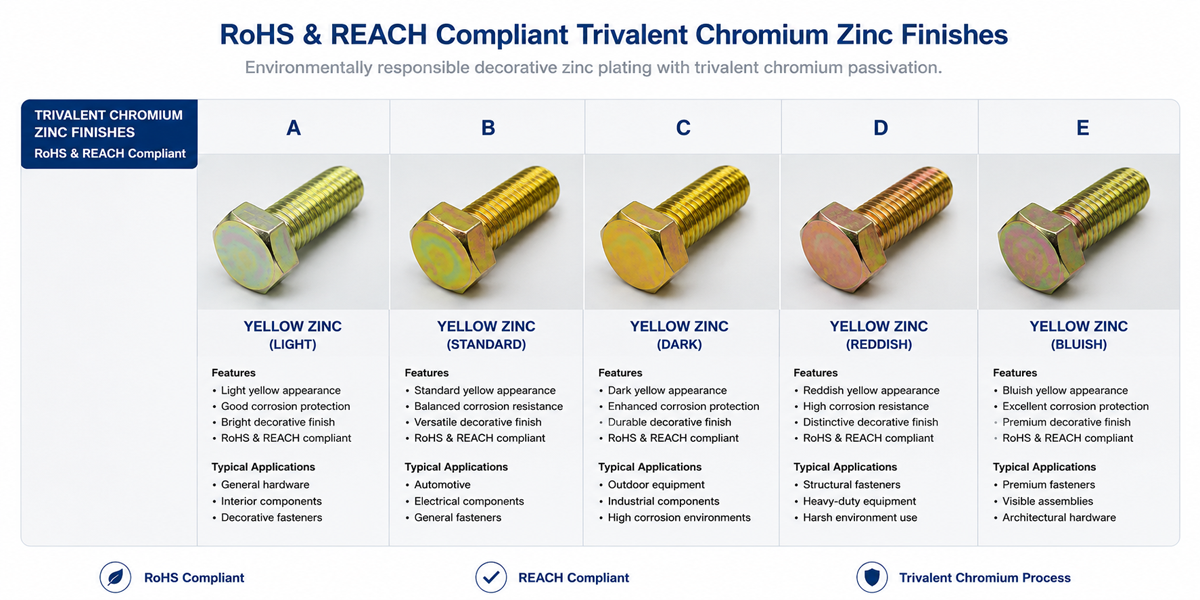
Zinc plating is widely used on carbon steel fasteners because zinc provides sacrificial corrosion protection to the underlying steel.
A conversion coating or passivation layer can be applied after zinc plating to improve corrosion performance and provide specific functional and visual characteristics.
For industrial fasteners, the chemistry used in this conversion stage is not simply a cosmetic decision.
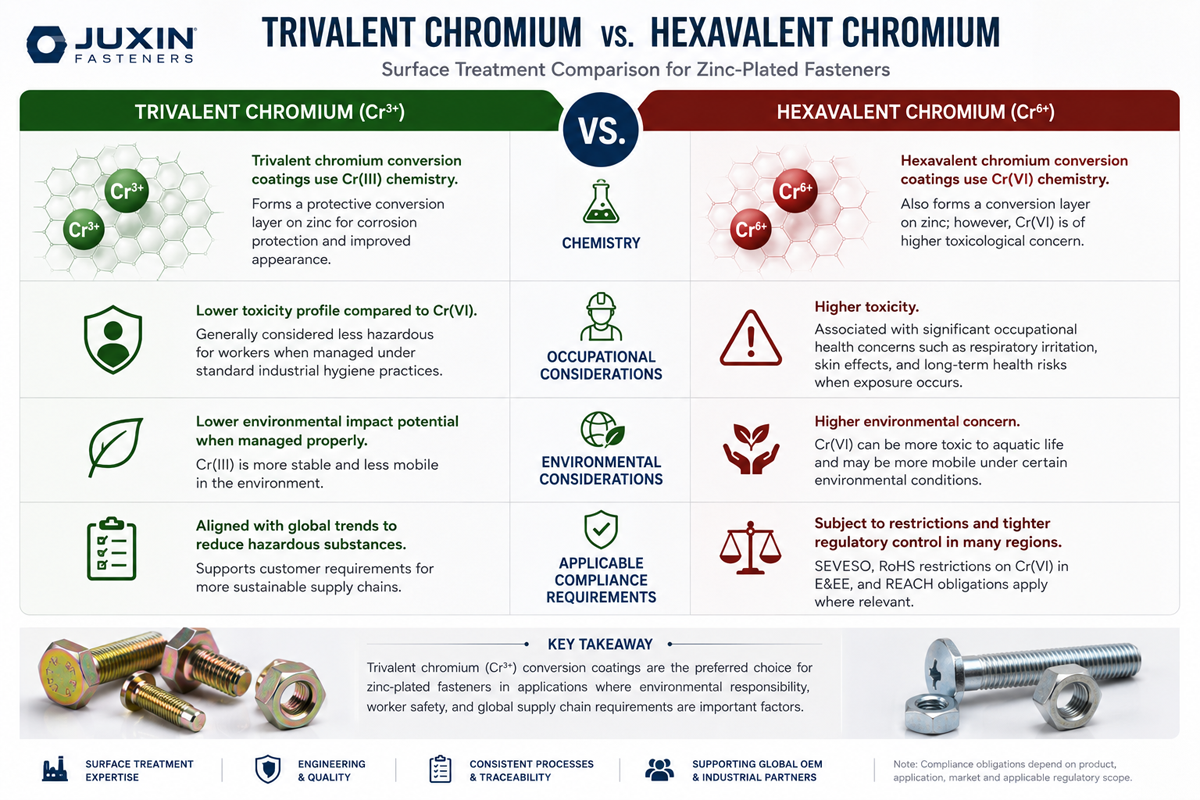
One important distinction is between trivalent chromium, Cr(III), and hexavalent chromium, Cr(VI).
Hexavalent chromium is associated with significant occupational health hazards and is subject to regulatory controls in many applications and markets.
For applicable electrical and electronic equipment, the EU RoHS framework restricts certain hazardous substances, including hexavalent chromium compounds.
REACH also establishes obligations and restrictions concerning substances and their use within the European supply chain.
As a result, international OEM buyers increasingly need to understand not only the base material of a fastener, but also the surface-treatment chemistry and applicable compliance requirements.
For procurement and engineering teams, surface treatment should therefore be treated as part of material and compliance engineering, rather than simply a finishing operation.
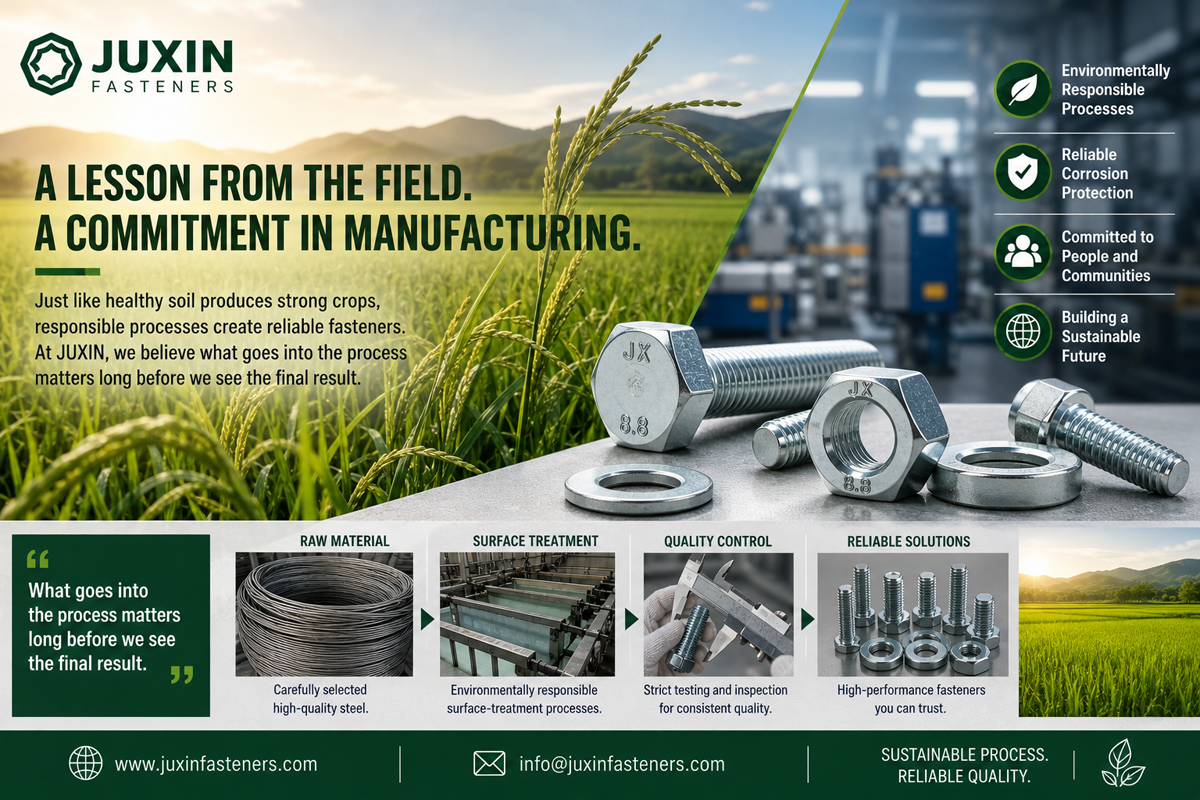
The terminology can be confusing when purchasing zinc-plated fasteners.
Traditional zinc-plated fasteners have historically been available with different chromate conversion systems, including systems based on hexavalent chromium.
Modern surface-treatment technologies can use trivalent chromium conversion chemistry instead.
The distinction matters because the two chromium oxidation states have substantially different regulatory and occupational-health profiles.
However, buyers should avoid treating the word "trivalent" as a substitute for a complete compliance specification.
A proper fastener specification should identify:
Base material
Zinc coating system
Conversion coating or passivation
Coating thickness
Corrosion-performance requirement
Mechanical grade
Thread requirements
Applicable regulatory requirements
Customer-specific restricted-substance requirements
Required documentation
This provides a much more reliable procurement specification than simply stating "environmentally friendly zinc plating."
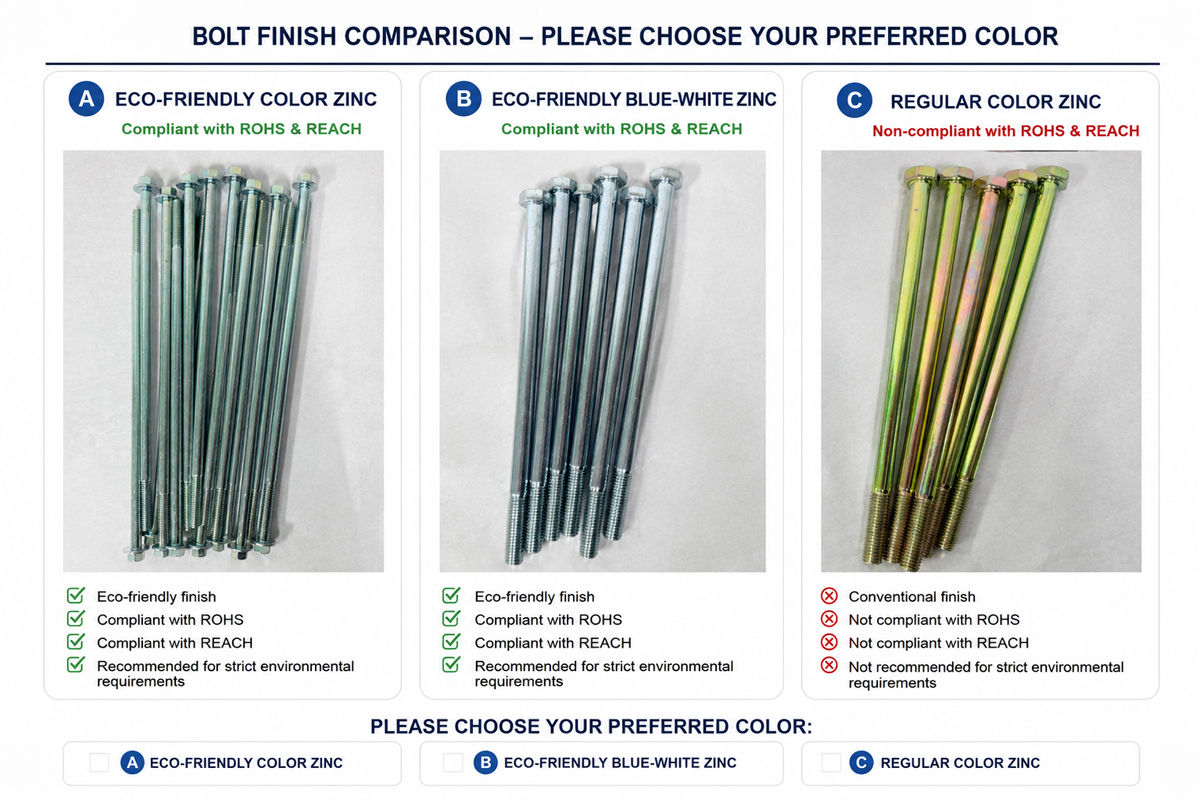
Our approach is straightforward:
The surface-treatment system should match the technical requirements, regulatory scope and application requirements of the finished product.
For customers requiring zinc-plated fasteners with trivalent chromium conversion systems, JUXIN can supply:
Trivalent chromium zinc plated screws
Trivalent zinc plated nuts
Zinc plated bolts
Zinc plated studs
Zinc plated washers
Custom zinc plated industrial fasteners
OEM fasteners with specified surface-treatment requirements
Fasteners manufactured to customer drawings
RoHS- and REACH-oriented fastener solutions
The exact coating system, substrate, corrosion requirement and compliance documentation should always be confirmed according to the customer's application and applicable regulatory scope.
This is especially important for global OEM programs where one fastener may become part of a product sold across multiple markets.
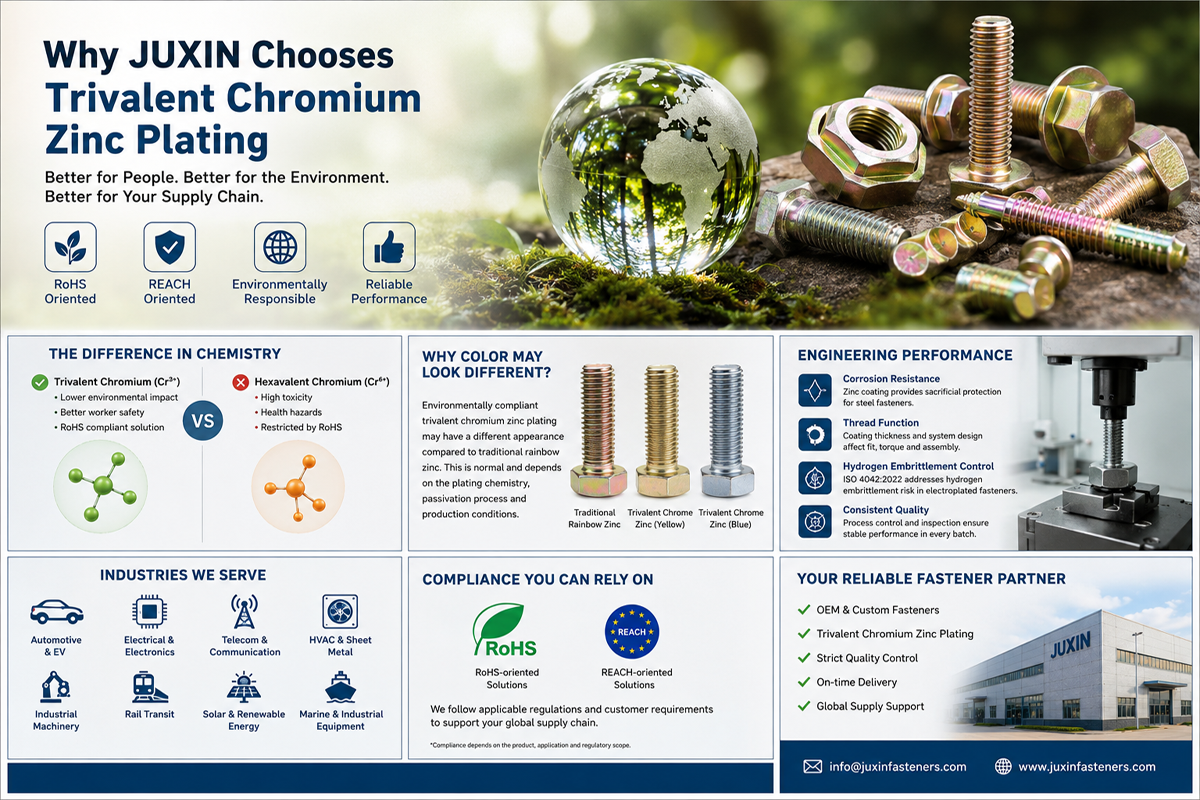
One question frequently arises when customers compare zinc-plated fasteners from different suppliers:
Why does the color look different?
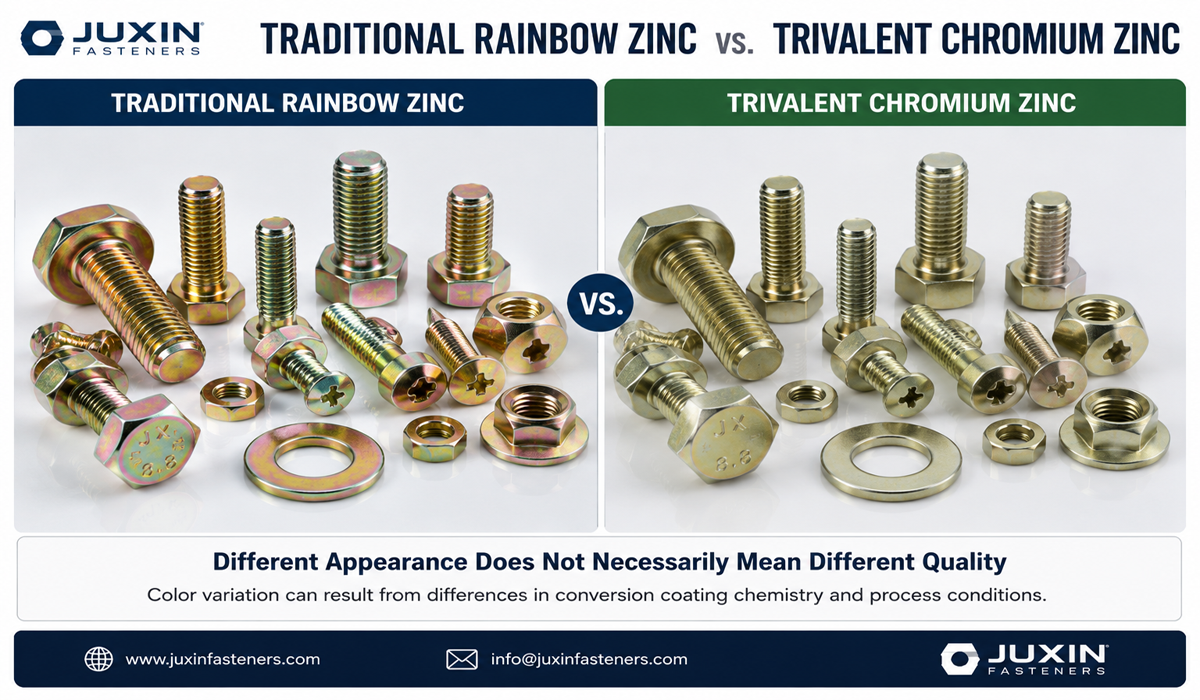
A customer may be familiar with traditional yellow zinc, rainbow zinc or other colorful chromate appearances and then compare them with a modern trivalent chromium zinc-plated fastener.
The appearance may not be identical.
That does not automatically indicate a quality problem.
The final appearance of a zinc-plated fastener can be affected by:
Zinc plating chemistry
Conversion coating chemistry
Passivation process
Process parameters
Coating thickness
Sealing system
Substrate condition
Production conditions
In other words:
A change in surface-treatment chemistry can change the visual appearance of the finished fastener.
This is why procurement teams and design engineers should define both functional coating requirements and acceptable appearance requirements during the specification stage.
If corrosion protection, regulatory requirements and appearance are all important, these requirements should be evaluated together.
At JUXIN, we believe technical differences should be explained clearly rather than promising a traditional appearance that may not correspond to the required surface-treatment system.
Choosing a zinc-plated fastener is not simply a question of whether the product is "green."
The coating system can influence several aspects of fastener performance.
Zinc coatings provide sacrificial protection to steel fasteners.
The appropriate zinc coating and conversion system should be selected according to the intended environment, exposure conditions and required corrosion performance.
For demanding environments, engineers should consider whether a conventional zinc plating system is sufficient or whether another coating or material should be evaluated.
Coating thickness can influence thread dimensions and the interaction between mating components.
This can affect:
Thread fit
Installation torque
Friction
Clamping force
Automated assembly
Repeated installation
This is particularly relevant for high-volume OEM production and automated fastening systems.
Electroplating can introduce hydrogen into susceptible high-strength steel fasteners.
For applicable high-strength fasteners, appropriate process controls and post-plating treatments should therefore be considered.
Fastener specifications should identify the mechanical grade and applicable requirements so that the plating process can be evaluated accordingly.
For products entering regulated markets, the complete material and surface-treatment system should be evaluated against applicable requirements such as:
EU RoHS
EU REACH
Customer restricted-substance lists
Industry-specific requirements
Destination-market regulations
The appropriate compliance documentation should be established as part of the procurement process.
Colored zinc finishes can be specified when appearance matters.
However, acceptable color variation should be established with an understanding that different conversion-coating technologies can produce different visual results.
For OEM production, a retained sample, approved reference sample or agreed appearance specification can help reduce unnecessary color disputes between suppliers and customers.
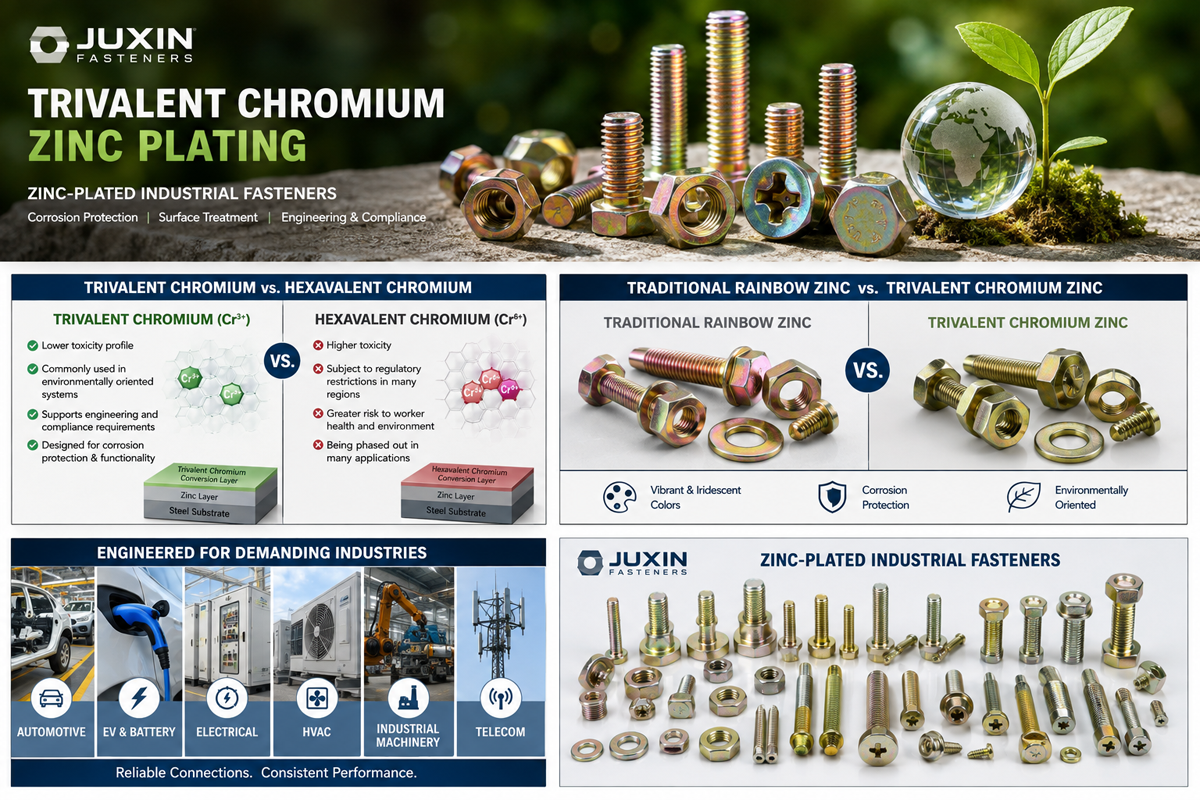
JUXIN supplies zinc-plated and custom industrial fasteners for OEM applications where corrosion protection, dimensional consistency, surface treatment and material requirements need to be controlled.
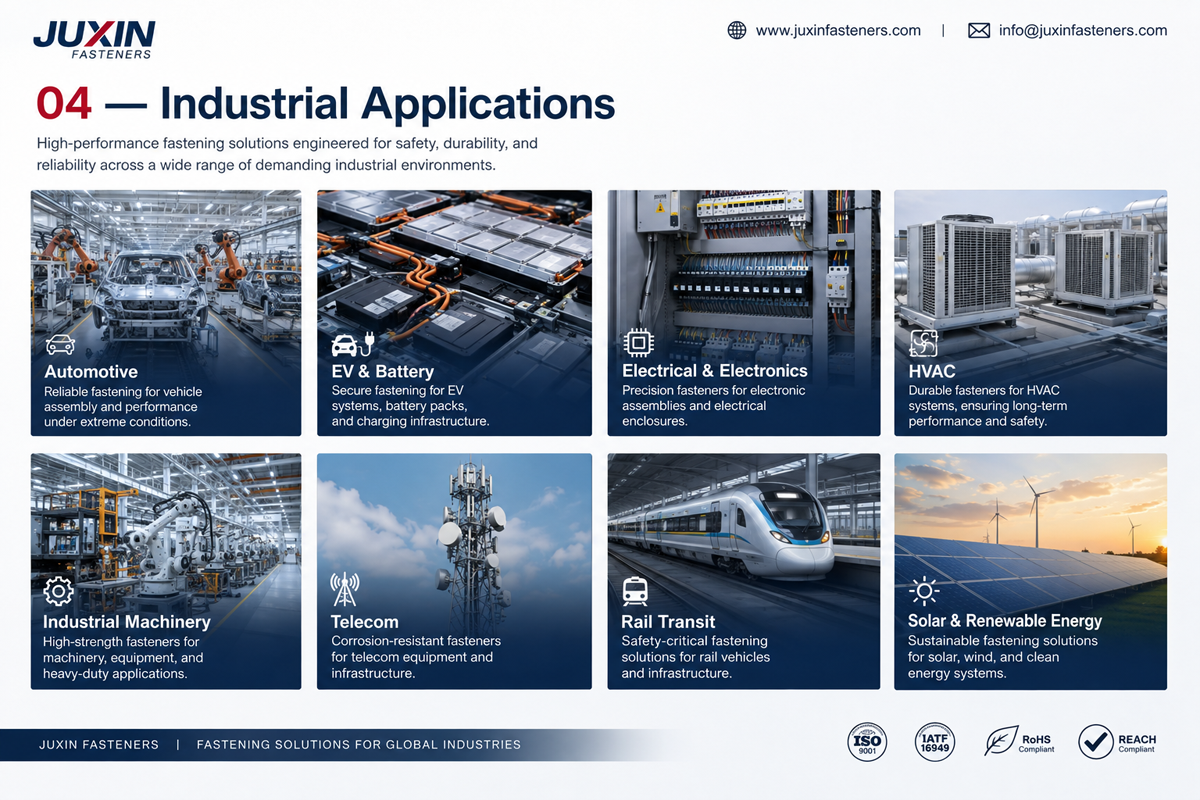
Zinc-plated screws, nuts and bolts can be used in selected vehicle structures, brackets, electrical assemblies, battery-related components and supporting systems.
Fastener selection should be based on the actual environment and engineering specification.
Industrial fasteners are used in electrical enclosures, control cabinets, equipment housings and sheet-metal assemblies.
Where products enter regulated markets, the fastener material and coating system may form part of the customer's restricted-substance and compliance requirements.
Zinc-plated fasteners can be used in telecom cabinets, communication equipment, equipment frames and sheet-metal assemblies.
The appropriate coating system should be selected according to the installation environment and expected service conditions.
Fasteners are widely used in HVAC equipment, ductwork, equipment housings, brackets and fabricated sheet-metal structures.
Procurement teams may require a combination of corrosion protection, economical production and consistent assembly performance.
OEM screws, nuts, bolts, studs and custom fasteners support machinery, automation equipment and mechanical assemblies.
For repeated production, stable specifications and consistent surface treatment are important for supplier qualification and production control.
Fasteners may be used in equipment housings, brackets, structural assemblies and supporting systems.
Rail applications can involve specific engineering and environmental requirements, so coating selection should be based on the actual application specification.
Fasteners are used throughout equipment structures, electrical assemblies and supporting components.
Environmental exposure should be evaluated before selecting the appropriate fastener material and coating system.
Zinc-plated fasteners can be suitable for selected industrial environments, but more aggressive or continuously exposed environments may require alternative materials or coating systems.
The correct solution depends on the actual corrosion conditions rather than the product category alone.
For procurement managers and supply-chain teams, the lowest unit price does not necessarily represent the lowest total procurement cost.
An incorrect coating specification can result in:
Additional supplier qualification
Compliance documentation problems
Appearance disputes
Assembly issues
Corrosion-performance concerns
Production delays
Requalification costs
Supplier replacement later in the project
For this reason, JUXIN encourages customers to establish the complete fastener specification before production.
A practical specification sequence is:
Material → Standard → Dimensions → Thread → Strength Grade → Surface Treatment → Coating Requirement → Corrosion Requirement → Compliance → Inspection → Packaging
This approach is particularly useful for OEM and long-term supply programs where the same fastener specification must remain stable across repeated production batches.
Not every industrial application can use standard catalog hardware.
OEM customers may require:
Non-standard dimensions
Special thread configurations
Customized head designs
Specific plating requirements
Special corrosion-performance requirements
Drawing-controlled dimensions
Customer-approved samples
Custom packaging
Batch traceability
Inspection requirements
JUXIN supports custom zinc plated fastener manufacturing based on customer drawings, specifications and application requirements.
Our product range includes:
Screws
Bolts
Nuts
Studs
Washers
Rivet nuts
Weld fasteners
Self-clinching fasteners
Threaded inserts
CNC machined components
Custom industrial fastening components
This allows procurement teams to source both standard and customized fastening components through one industrial supply partner.
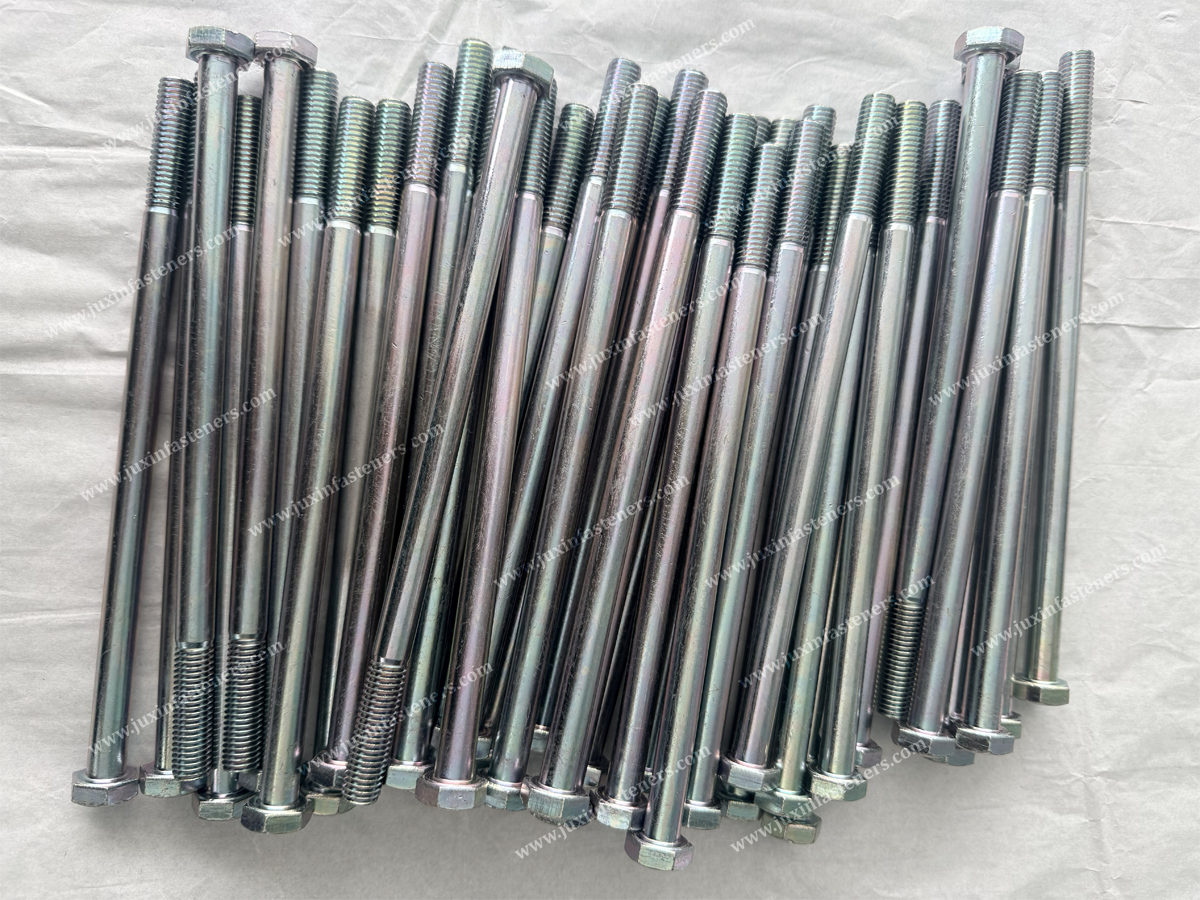
A fastener is a small component.
But its specification can connect multiple parts of the supply chain:
Steel → Fastener Manufacturing → Surface Treatment → Inspection → Packaging → OEM Assembly → Finished Product
Each stage can affect the final component.
This is why surface treatment should be considered at the beginning of product development rather than after the fastener has already been selected.
For design engineers, this means considering coating requirements alongside material, strength and dimensional requirements.
For procurement managers, it means defining the coating system and compliance documentation before supplier qualification.
For supply-chain managers, it means establishing a stable specification that can be maintained across production batches and future sourcing cycles.
We do not believe that responsible manufacturing should be reduced to a marketing label.
For applicable zinc-plated fastener programs, our focus is on appropriate trivalent chromium conversion systems, controlled manufacturing processes and customer-specific compliance requirements.
The objective is to develop a fastening solution that addresses the complete application:
Performance + Corrosion Protection + Surface Treatment + Compliance + Manufacturing Consistency
Because "environmentally responsible" should not simply be a statement printed on a product page.
It should be considered when the fastener is specified, manufactured, inspected and supplied.
A fastener may be small.
The manufacturing decisions behind it are not.
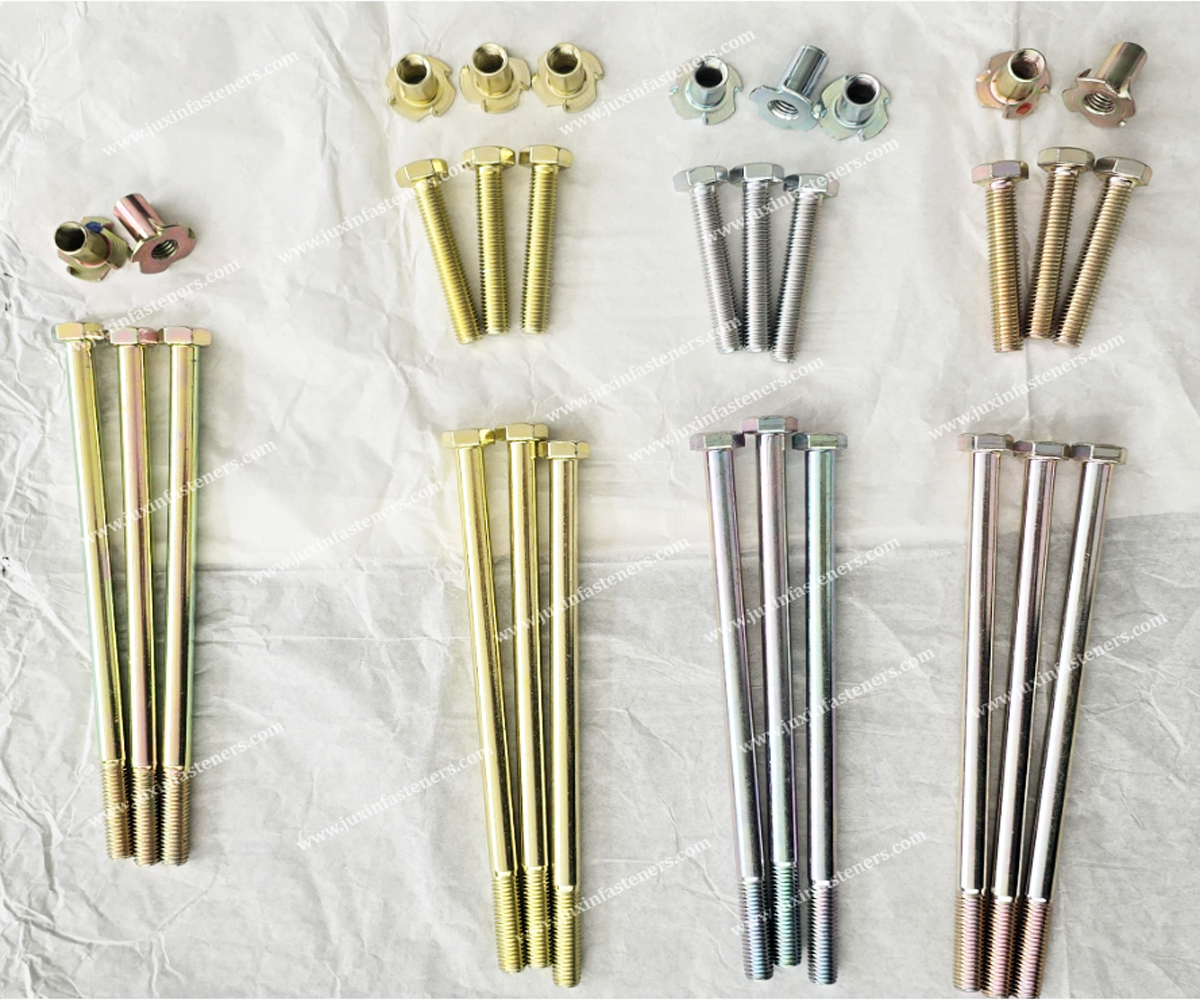
JUXIN FASTENERS supports OEM manufacturers, procurement managers, sourcing teams, supply-chain managers, structural engineers and design engineers with industrial fastening solutions for international markets.
Our capabilities include:
Zinc plated screws
Trivalent chromium zinc plated fasteners
Zinc plated nuts
Zinc plated bolts
Zinc plated studs
Stainless steel fasteners
Rivet nuts
Weld fasteners
Self-clinching fasteners
Threaded inserts
CNC machined components
Custom OEM fasteners
If you are developing or sourcing trivalent chromium zinc plated fasteners, send us your drawings, specifications or current fastener samples.
We can review:
Fastener standard
Material and strength grade
Dimensions
Thread specification
Zinc coating requirement
Conversion coating requirement
Corrosion-resistance requirement
RoHS / REACH requirements
Inspection requirements
Annual or project quantity
Packaging requirements
Contact JUXIN FASTENERS
Email: info@juxinfasteners.com
Website: www.juxinfasteners.com
WhatsApp: +86 13660079809
JUXIN FASTENERS — Industrial Fastening Solutions for OEM and Global Supply Chains.
Regulatory requirements vary according to product type, application, market and customer requirements. RoHS and REACH applicability and compliance should be confirmed against the actual material, coating system, product configuration and relevant regulatory scope.
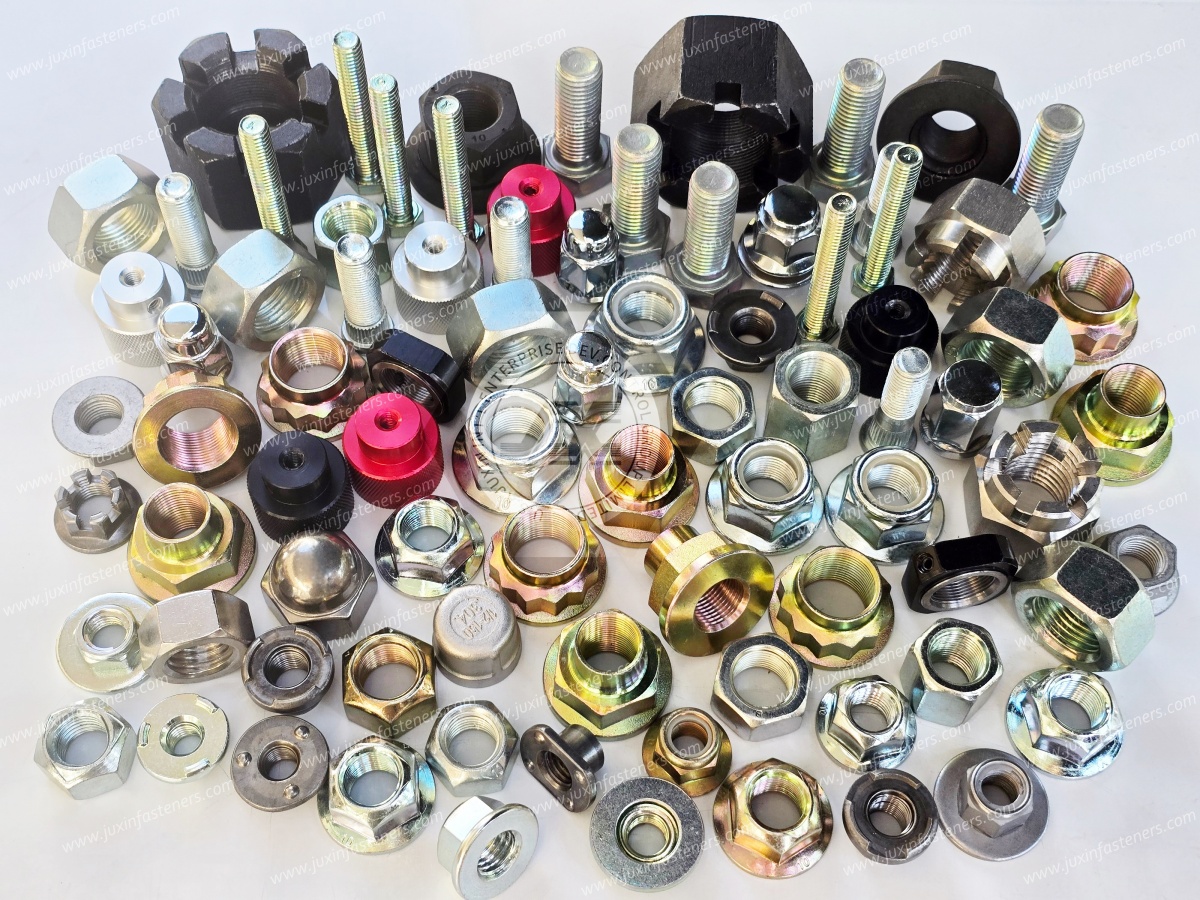
 MORE NEWS
Sep. 25, 2026
Sep. 25, 2026
Sep. 25, 2026
Contact Us
Tel.:
+86 020 8621 0320
+86 020 3121 6067
E-mail:
Technical Support:
Navigation
SEND INQUIREY