
Call Us
+86 136 6007 9809
Call Us
+86 136 6007 9809

Aug. 11, 2026
Zinc Nickel vs Zinc Plating
Key Differences in Corrosion Resistance, Appearance, and OEM Applications
In modern OEM manufacturing, especially in the automotive and electric vehicle industries,
the choice between zinc plating and zinc-nickel coating has become a critical engineering decision.
At Juxin Fasteners, we regularly support global engineering teams in selecting the correct
surface treatment based on performance requirements rather than visual appearance.
This article explains the key differences between these two widely used coating systems.
1. Overview: Two Different Engineering Systems
Although both coatings are based on zinc, they are fundamentally different in structure and performance.
Zinc Plating (Electro Zinc)
Pure zinc coating applied by an electrochemical process
Cost-effective general protection system
Widely used in standard industrial fasteners
Zinc Nickel Coating (Zn-Ni Alloy)
Alloy coating typically containing 12–15% nickel
Advanced corrosion protection system
Designed for high-performance and automotive applications
2. Corrosion Resistance Performance
This is the most important engineering difference.
Zinc Plating
Typical salt spray performance: 48–120 hours
Basic corrosion protection
Suitable for indoor or mild environments
Zinc Nickel Coating
Typical salt spray performance: 720–1000+ hours
High resistance to chloride and harsh environments
Designed for long-term durability
Zinc nickel coatings provide 5–10 times higher corrosion resistance compared to standard zinc plating.
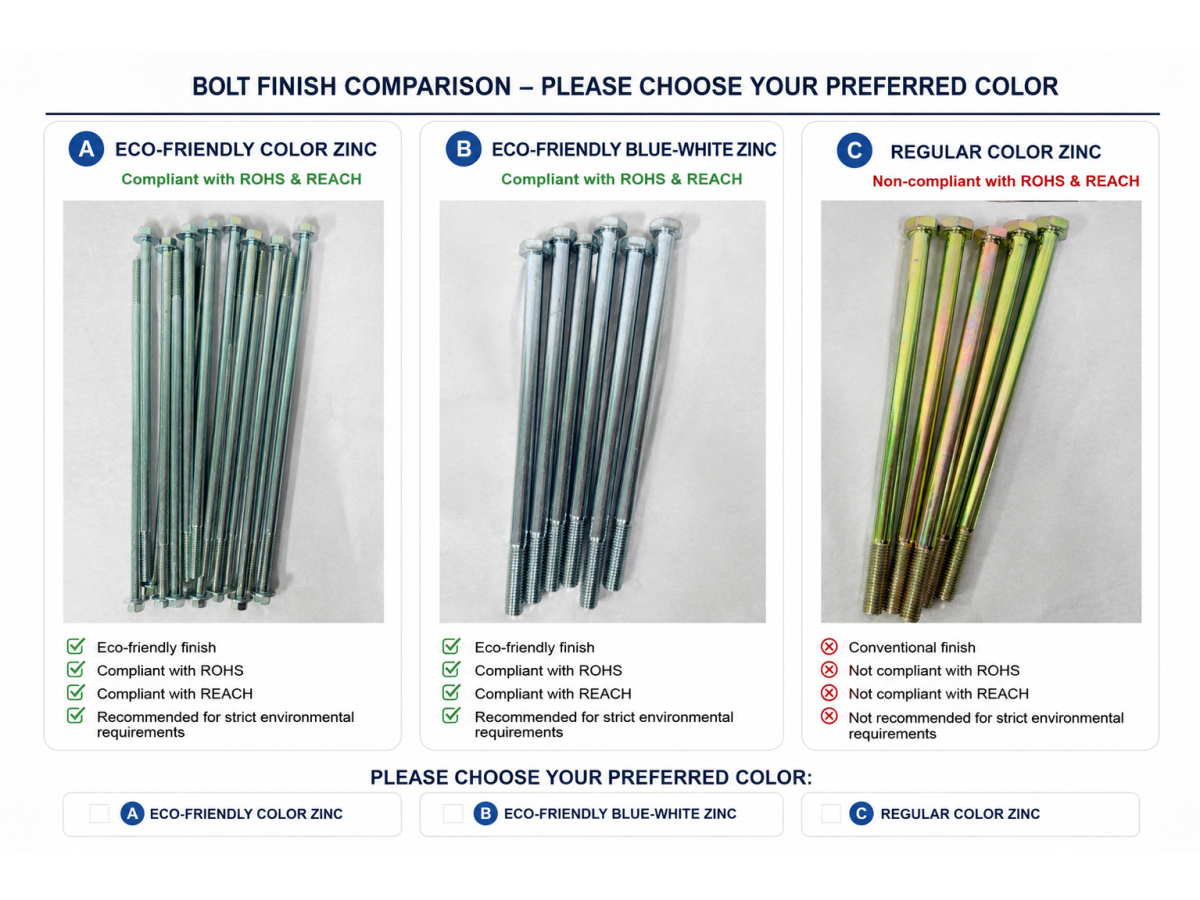
3. Appearance Differences (Engineering Reference Only)
Zinc Plating Appearance
Silver
Light blue
Yellow (with chromate conversion)
Black finishes available
Appearance varies significantly depending on passivation system.
Zinc Nickel Appearance
Silver gray
Blue-gray tone
Matte metallic finish
Key characteristic:
More uniform and stable appearance across batches compared to zinc plating.
However:
Appearance should never be used as a performance indicator.
4. Why Zinc Nickel Performs Better
The improved performance comes from:
Nickel alloy incorporation (12–15%)
Denser crystal structure
Reduced porosity
Stronger barrier protection
Better resistance to white rust and red rust
These structural advantages make zinc nickel ideal for harsh environments.
5. Application Differences in OEM Industries
Zinc Plating Applications
General industrial fasteners
Indoor equipment
Low-cost assemblies
Electrical enclosures (non-critical zones)
Zinc Nickel Applications
Automotive powertrain systems
EV battery systems
Chassis components
Brake systems
High-vibration assemblies
Export-grade corrosion-critical fasteners
At Juxin Fasteners, zinc nickel coatings are widely used in:
New energy vehicle systems
Automotive OEM fastening solutions
High-end industrial equipment
6. Engineering Misconception: “Looks the Same = Same Quality”
One common misunderstanding is:
❌ If zinc nickel and zinc plating look similar, they must perform similarly
This is incorrect.
Surface appearance does NOT reflect corrosion performance.
Two coatings may look similar under certain lighting conditions but perform completely differently in real environments.
7. Cost vs Performance Consideration
Zinc Plating
Lower cost
Standard protection
Mass production suitable
Zinc Nickel
Higher cost
Advanced corrosion resistance
Long-life engineering applications
The selection should always be based on:
✔ Service environment
✔ Required corrosion life
✔ OEM specifications
✔ Regulatory requirements
NOT price alone.
8. Engineering Selection Recommendation
For OEM fastener design, we recommend:
Use Zinc Plating When:
Indoor environment
Low corrosion risk
Cost-sensitive applications
Use Zinc Nickel When:
Outdoor or humid environments
Automotive / EV systems
High corrosion resistance required
Long service life expectation
9. Critical Engineering Statement
Zinc nickel coating is NOT an aesthetic upgrade of zinc plating.
It is a completely different corrosion protection system.
10. Integration with Modern OEM Requirements
With increasing global requirements for:
RoHS compliance
REACH compliance
EV platform durability standards
Lightweight design optimization
Zinc nickel has become a preferred solution in modern engineering systems.
At Juxin Fasteners, we support:
Zinc plated fasteners
Zinc nickel coated fasteners
Custom CNC machining parts
Non-standard OEM fastening systems
11. Conclusion
Zinc plating and zinc nickel coatings serve different engineering purposes.
The correct selection should always be based on performance requirements, not appearance or cost alone.
Understanding this difference helps OEM engineers:
✔ Improve product reliability
✔ Reduce corrosion failure risk
✔ Avoid unnecessary supplier disputes
✔ Optimize lifecycle cost
Contact Engineering Support
For technical consultation on zinc plating, zinc nickel coating, or OEM fastener solutions:
Juxin Fasteners
Email: info@juxinfasteners.com

 MORE NEWS
Sep. 27, 2026
Sep. 27, 2026
Sep. 27, 2026
Contact Us
Tel.:
+86 020 8621 0320
+86 020 3121 6067
E-mail:
Technical Support:
Navigation
SEND INQUIREY