
Call Us
+86 136 6007 9809
Call Us
+86 136 6007 9809

Aug. 11, 2026
A purchasing team receives two batches of zinc-plated fasteners.
Both are nominally the same part. Both are made from the specified steel. Both were ordered with a zinc electroplated finish.
Yet one batch looks bright silver-blue, while another appears slightly gray. Under different lighting, one may even show a faint iridescent tone.
Does the color difference mean that one batch has inferior plating?
Not necessarily.
The appearance of zinc-plated fasteners is influenced by more than the zinc deposit itself. The zinc layer, conversion coating or passivation system,
optional sealer or topcoat, substrate condition, coating thickness, plating process and viewing conditions can all influence the final appearance.
For engineers, procurement managers and supplier quality teams, the more useful question is not simply:
“Are these two batches exactly the same color?”
It is:
“Do these fasteners meet the specified coating system, thickness, corrosion-performance, functional and appearance requirements?”
That distinction can prevent unnecessary rejection of acceptable production—and, equally importantly,
prevent a visually attractive coating from being accepted without verifying its actual engineering requirements.
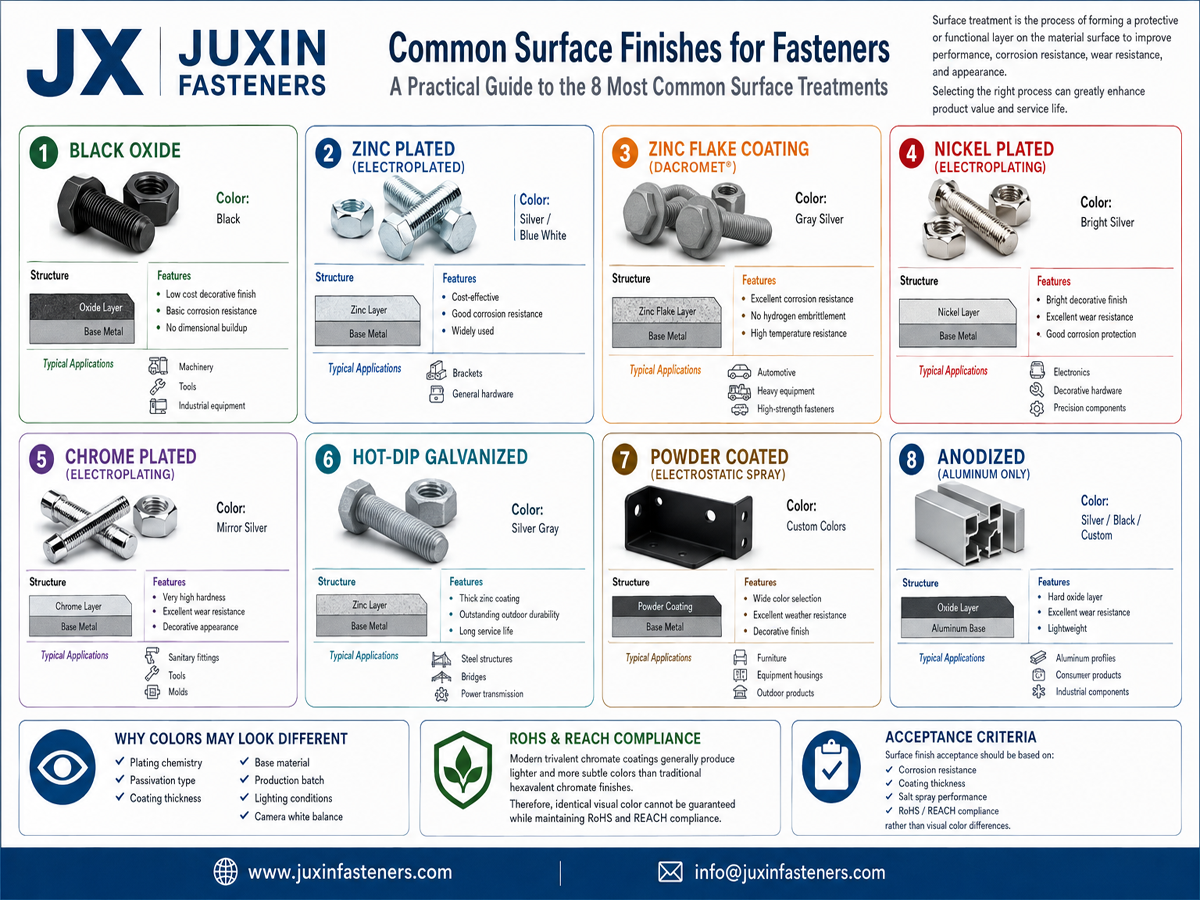
Zinc-plated fasteners can vary in appearance because the final visible surface is affected by several interacting variables, including:
zinc electroplating process
zinc coating thickness
conversion coating or passivation chemistry
sealer or topcoat
base-metal surface condition
heat treatment and manufacturing history
plating-bath condition
process time and temperature
drying and handling
part geometry
lighting and viewing conditions
Therefore, color alone should not be used as a substitute for coating specification or performance verification.
If cosmetic consistency is important, appearance requirements should be defined separately and agreed before production.
A common sourcing mistake is to specify only:
Zinc plated
That description may be insufficient for an OEM drawing or purchase specification.
The finished surface of an electroplated fastener can involve several layers or process stages:
Steel substrate → zinc deposit → conversion coating/passivation → optional sealer or topcoat
Each stage can influence the final result.
This explains why two fasteners that are both casually described as “zinc plated” may not look identical—and may not necessarily have identical corrosion performance either.
For industrial sourcing, engineers should define the required coating system and performance, rather than relying on appearance terminology alone.
One of the largest influences on appearance is the conversion coating applied after zinc electroplating.
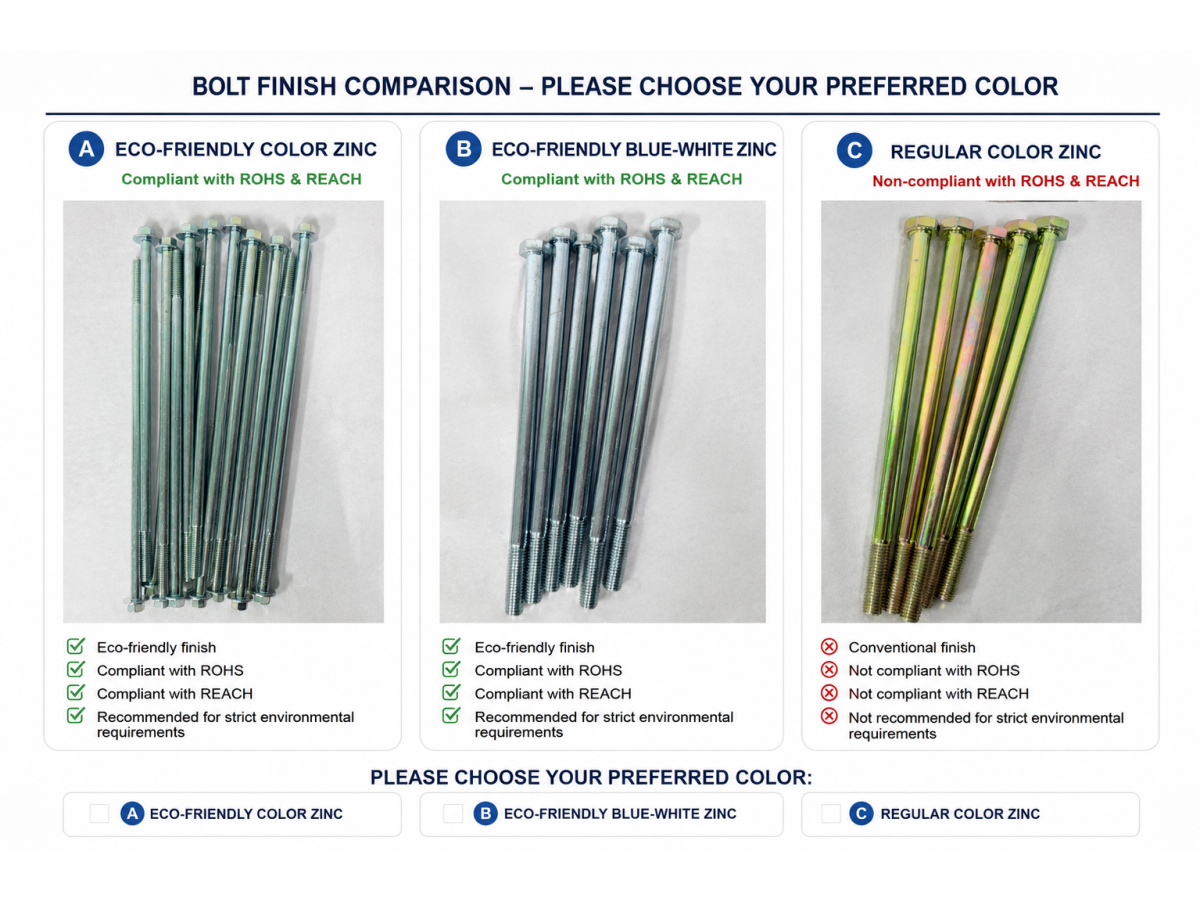
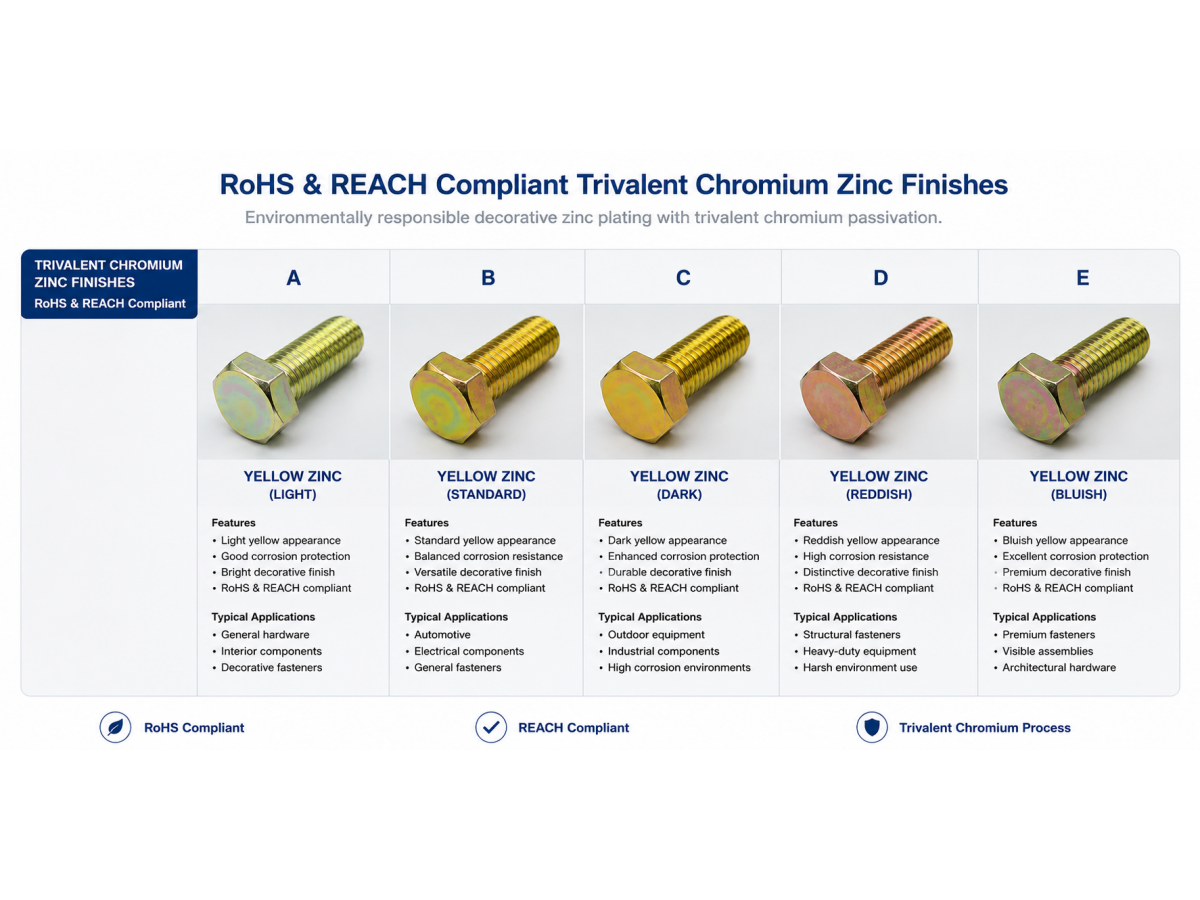
Modern zinc-plating systems can use different passivation chemistries and formulations. Depending on the specified system and process, the finished fastener may appear:
clear or silver
silver-blue
slightly gray
yellow or iridescent
black
Even within a nominal color family, exact visual appearance can vary.
This is especially important when sourcing from multiple approved suppliers.
Two suppliers may both provide technically acceptable zinc coating systems, yet their parts may not be visually identical unless the finish and appearance requirements have been tightly defined.
Do not specify a finish solely by an informal color description such as “blue zinc” if coating performance matters.
Define the applicable coating specification, coating system, required thickness or service condition,
passivation or conversion coating where applicable, and any required sealer or topcoat.
The thickness of an electroplated zinc deposit can influence the visual character of the surface.
However, appearance should not be used to estimate coating thickness.
A brighter-looking fastener is not automatically more heavily plated, and a slightly darker or grayer part is not automatically under-plated.
Coating thickness should be verified using an appropriate measurement method and acceptance requirement.
For procurement and quality teams, this creates an important distinction:
Visual inspection answers an appearance question.
Thickness measurement answers a coating-thickness question.
The two should not be confused.
Electroplating does not completely erase the condition of the underlying component.
The final appearance can be influenced by:
steel composition
surface roughness
cold forming
machining
stamping
thread rolling
heat treatment
scale removal
cleaning
pickling
polishing or other pretreatment
For example, a cold-formed fastener and a machined component may not exhibit exactly the same visual texture after plating even when a similar coating system is applied.
This becomes particularly relevant for custom fasteners and mixed manufacturing processes,
where an assembly may contain stamped, machined, cold-formed or heat-treated components.
Fasteners are geometrically complex compared with flat test panels.
A screw, nut, rivet nut, threaded insert or custom formed component may contain:
external threads
internal threads
recesses
under-head areas
blind features
deep corners
knurls
flanges
stamped features
These geometries affect current distribution, solution drainage and the way the surface is visually observed.
As a result, a threaded fastener should not be evaluated as though it were a perfectly flat decorative panel.
This is particularly important when cosmetic requirements are being applied to complex custom fasteners.
Electroplating is a controlled industrial process, but it involves chemical and electrochemical variables.
Appearance can be influenced by changes in:
bath condition
chemical concentration
pH
temperature
current density
immersion time
passivation condition
rinsing
drying
sealer application
rack or barrel processing
part loading
A controlled process should maintain the specified functional requirements, but this does not necessarily mean every production lot will have a perfectly identical visual tone.
For this reason, an OEM that requires tight cosmetic consistency should define that requirement explicitly rather than assuming it is inherent in the words “zinc plated.”
Another frequently overlooked variable is the use of a sealer or topcoat after passivation.
Depending on the coating system, an additional layer may be used to modify characteristics such as:
corrosion performance
friction behavior
appearance
handling characteristics
This matters particularly for threaded fasteners.
A coating system is not only about corrosion.
Changes to the finished surface can also affect the coefficient of friction and therefore the relationship between installation torque and clamp load.
For engineered bolted joints, changing the plating or topcoat without considering friction behavior can be more significant than a small difference in color.
Two fasteners can look almost identical but have different friction characteristics.
Conversely, two fasteners can look slightly different while still meeting the same specified functional coating requirements.
That is why engineering acceptance should be based on the drawing and agreed coating specification—not visual similarity alone.
No—not by itself.
Color difference is evidence of a visual difference. It does not, on its own, prove whether the coating is acceptable or unacceptable.
The correct evaluation depends on the requirements specified for the part.
| Requirement | What It Tells the Buyer |
|---|---|
| Coating specification | Defines the required finishing system |
| Coating thickness | Confirms required zinc deposit thickness where specified |
| Conversion coating/passivation | Defines the post-plating treatment |
| Sealer/topcoat | May affect corrosion, appearance and friction |
| Corrosion requirement | Defines required corrosion-performance verification |
| Thread functionality | Confirms coating has not compromised assembly |
| Friction requirement | Important for torque-controlled bolted joints |
| Appearance requirement | Controls cosmetic expectations where necessary |
| Restricted-substance requirement | Addresses applicable material/substance restrictions |
The key sourcing principle is:
Appearance and functional coating performance should be treated as separate acceptance characteristics unless the specification explicitly connects them.
Yes.
A visually attractive surface does not automatically prove that the coating meets:
specified thickness
corrosion requirements
thread-fit requirements
friction requirements
adhesion requirements where applicable
restricted-substance requirements
This is why photographs alone are insufficient for approving a technical plating deviation.
The reverse is also true: a minor shade difference does not automatically prove that the coating is defective.
For globally sourced fasteners, coating requirements should be based on the applicable international or customer specification.
ISO 4042 addresses electroplated coating systems for fasteners and is an important reference for specifying electroplated finishes on threaded fasteners.
ASTM F1941/F1941M is commonly used for electrodeposited coatings on mechanical fasteners in North American supply chains.
The correct specification depends on the customer's drawing, fastener type, application and supply-chain requirements.
A drawing should not simply replace one coating designation with another standard without checking technical equivalence.
Color variation may attract immediate attention because it is visible.
A much more important issue for certain high-strength steel fasteners is invisible:
hydrogen embrittlement risk.
Cleaning, pickling and electroplating processes can introduce hydrogen into susceptible high-strength steel components.
Depending on material strength, manufacturing route and applicable specification, appropriate process controls and post-plating treatment may therefore be required.
This creates an important supplier-development lesson:
Do not spend all of the inspection effort debating a small shade difference while overlooking material strength and plating-process risks that can affect actual joint reliability.
When high-strength fasteners are involved, the plating specification should be reviewed together with:
material
hardness or strength level
manufacturing process
applicable coating specification
hydrogen-embrittlement control requirements
application criticality
One of the most common procurement misconceptions is:
“This batch looks darker, so perhaps its corrosion resistance is worse.”
That conclusion cannot be made from color alone.
Corrosion performance depends on the complete coating system and the specified test conditions.
Likewise, salt-spray test results should not be converted casually into a guaranteed number of years of outdoor service.
Accelerated corrosion testing is useful for comparing and qualifying coating systems under defined conditions, but actual service life also depends on:
humidity
chloride exposure
temperature
wet/dry cycles
pollutants
assembly geometry
scratches and installation damage
contact with other materials
maintenance
real operating environment
For outdoor, coastal or marine equipment, material and coating selection therefore requires more than choosing the zinc finish that “looks best.”
Appearance should be controlled when it matters to the finished product.
Examples can include:
exposed consumer-facing assemblies
visible automotive components
architectural hardware
equipment control panels
branded industrial products
components mounted side-by-side
assemblies where multiple suppliers' parts remain visible
In these situations, the buyer and supplier should agree on the cosmetic requirement before mass production.
Useful controls can include:
approved master samples
boundary samples
defined viewing distance
defined lighting conditions
acceptable color variation
designated cosmetic surfaces
agreed defect criteria
lot-to-lot expectations
A photograph sent by email can help communicate a concern, but it should not replace a properly defined cosmetic acceptance standard.
For hidden or primarily functional fasteners, exact shade matching may provide little engineering value.
Examples may include:
internal machinery fasteners
fasteners hidden inside cabinets
structural joints
internal mounting hardware
non-visible automotive assemblies
industrial equipment
internal electrical equipment
In these applications, engineering teams may place greater emphasis on:
dimensional conformity
material
mechanical properties
coating thickness
corrosion performance
thread fit
installation performance
friction requirements
traceability requirements
This does not mean appearance can never matter. It means the acceptance criteria should reflect the actual function of the part.
When a new production lot appears different from a previous lot, avoid immediately accepting or rejecting it based only on photographs.
Check:
drawing revision
coating designation
required standard
thickness requirement
passivation or conversion coating
sealer or topcoat
appearance requirement
corrosion requirement
Ask whether anything changed in:
plating supplier
coating chemistry
passivation
sealer
process route
substrate
heat treatment
Where required, review:
coating thickness
corrosion-test documentation
thread functionality
friction requirement
dimensional conformity
material documentation
applicable restricted-substance documentation
If cosmetic consistency is specified, compare the production lot against the agreed master or boundary sample under controlled conditions.
If the coating system itself changed—not merely its visual shade—the change may require technical review before acceptance.
This is particularly important when corrosion performance, friction or high-strength fastener processing could be affected.
Before releasing an RFQ or production drawing, consider whether the specification clearly answers the following questions:
What electroplated coating system is required?
Which international or customer coating specification applies?
What coating thickness or service condition is required?
Which conversion coating or passivation is required?
Is a sealer or topcoat required?
Is a corrosion-performance requirement specified?
Does the joint require controlled friction?
Is the fastener high-strength steel requiring hydrogen-embrittlement consideration?
Are there restricted-substance requirements?
Is cosmetic appearance functionally important?
If appearance matters, is there an approved reference sample?
Are critical surfaces or threads identified?
Answering these questions before sourcing is far more effective than resolving plating disputes after production.
For custom or production fasteners, procurement teams should ideally provide:
part number
2D drawing
3D model where relevant
fastener standard or custom geometry
material and strength class
required coating specification
coating thickness or service condition
passivation or conversion coating requirement
sealer or topcoat requirement
corrosion requirement
appearance requirement
friction requirement where applicable
annual demand
order quantity
inspection requirements
packaging requirements
If the current drawing simply states “zinc plated”, it may be worth reviewing whether the finish specification is sufficiently detailed for multi-supplier production.
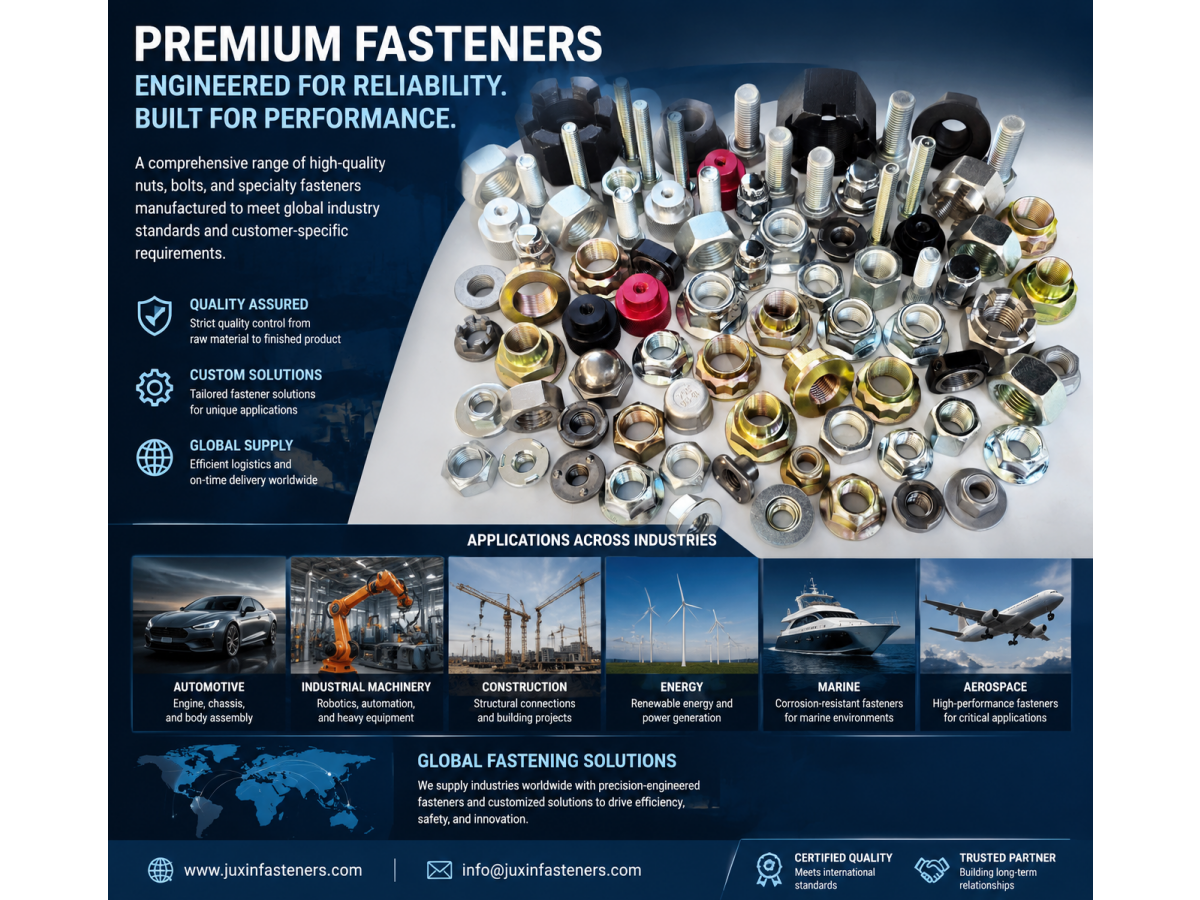
JUXIN FASTENERS supplies standard and custom fastening components for industrial OEM applications, including:
zinc-plated screws
zinc-plated bolts
zinc-plated nuts
prevailing-torque and lock nuts
weld nuts
weld studs
rivet nuts
threaded inserts
blind rivets
stamped fastening components
cold-formed special fasteners
custom fasteners manufactured to customer drawings
Surface-finishing requirements can be evaluated together with the component material, geometry, thread, assembly function and end-use environment.
For applications where zinc electroplating is not the appropriate solution,
material or finish alternatives should be evaluated based on the actual corrosion environment and engineering requirements rather than appearance alone.
For engineers and sourcing teams evaluating fastening systems, this topic can connect with relevant JUXIN FASTENERS technical pages covering:
corrosion-resistant fasteners for outdoor applications
304 vs 316 stainless steel fasteners
fastener surface finishes and corrosion protection
prevailing-torque and lock nuts
custom fasteners for OEM applications
rivet nuts and blind fastening solutions
outdoor and harsh-environment fastening systems
Internal links should be added only when the corresponding relevant page exists on the website.
Differences in the zinc coating system, conversion coating or passivation, process conditions, substrate and viewing conditions can produce silver,
blue-silver, gray or other visual variations. Exact appearance should not be used by itself to determine coating quality.
Not necessarily. Visual shade is not a reliable method for determining coating thickness.
Thickness should be measured using an appropriate inspection method.
Yes. Different approved coating processes can produce visual differences.
If identical appearance is required across suppliers, the cosmetic requirement should be defined and controlled.
Not necessarily. Functional coating requirements and exact cosmetic appearance are different characteristics.
If tight visual consistency is required, it should be specified separately.
It depends on the coating system, required service environment and expected corrosion performance.
Normal atmospheric exposure, industrial environments, high humidity and coastal or marine conditions can present very different corrosion demands.
Severe chloride exposure may justify evaluating another coating system or a more corrosion-resistant fastener material.
Selection should therefore be based on actual exposure conditions rather than the generic description “outdoor use.”
Photographs can help identify visible differences, but technical acceptance should be based on the agreed drawing,
coating specification and measurable requirements.
Lighting, camera settings, white balance and display calibration can significantly change perceived color.
Send the drawing, material or strength class, dimensions, thread requirements, coating specification, corrosion requirement,
appearance requirement, annual volume and any inspection or packaging requirements.
A difference in zinc-plating color is not automatically evidence of poor fastener quality.
The visible appearance of an electroplated fastener is influenced by the zinc deposit, conversion coating, optional sealer or topcoat,
substrate condition, geometry, process conditions and viewing environment.
For engineering and OEM procurement, the correct approach is to separate cosmetic appearance from measurable functional requirements.
When appearance matters, define and control it.
When corrosion performance matters, specify and verify it.
When joint performance matters, consider the complete interaction between fastener material, coating,
friction, thread function, installation and service environment.
That is a much stronger basis for supplier qualification than judging zinc-plated fasteners by color alone.
For custom zinc-plated fasteners, special surface finishes, drawing-based components or OEM fastening projects, send JUXIN FASTENERS:
your 2D drawing or 3D model
material or strength class
thread specification
required coating system
corrosion requirement
application environment
estimated order quantity and annual demand
inspection requirements
Our team can review the fastening and surface-finishing requirements before quotation.
JUXIN FASTENERS
Website: www.juxinfasteners.com
Email: info@juxinfasteners.com
Contact Us
Tel.:
+86 020 8621 0320
+86 020 3121 6067
E-mail:
Technical Support:
Navigation
SEND INQUIREY



