Call Us
+86 136 6007 9809
Call Us
+86 136 6007 9809

Telecommunications equipment combines mechanical, electrical, RF and environmental requirements within relatively compact assemblies.
Base stations, antenna systems, remote radio units (RRUs), outdoor enclosures, communication cabinets and electronic modules may be exposed to sunlight,
humidity, temperature cycling, wind-induced vibration and, depending on their location, salt-laden or industrial atmospheres.
Product Specification
Telecommunications equipment combines mechanical, electrical, RF and environmental requirements within relatively compact assemblies.
Base stations, antenna systems, remote radio units (RRUs), outdoor enclosures, communication cabinets and electronic modules may be exposed to sunlight, humidity,
temperature cycling, wind-induced vibration and, depending on their location, salt-laden or industrial atmospheres.
Fastener selection can therefore affect more than mechanical assembly.
In RF-sensitive locations, engineers may need to consider whether a fastening component introduces an unwanted conductive interface or interacts with the electromagnetic environment.
In outdoor installations, the fastener material may also need to be evaluated for UV exposure, moisture, temperature cycling, corrosion at mating interfaces and long-term dimensional stability.
This is where plastic hardware can become part of the engineering solution.
Depending on the assembly, the product family may include plastic screws, nylon screws, plastic machine screws, nylon machine screws, plastic bolts, nylon bolts,
plastic nuts, nylon hex nuts, plastic flat washers, nylon insulating washers, shoulder washers, cup washers, insulating cup washers,
plastic spacers, nylon spacers, industrial plastic spacers, PCB spacers, threaded standoffs, male-to-female standoffs, female-to-female standoffs,
threaded inserts and custom polymer fastening components.
For outdoor and RF-sensitive applications, engineers may evaluate polymer families such as PA6, PA66, POM/Acetal, PVDF or PEEK depending on the actual environment and mechanical requirements.
JUXIN FASTENERS provides industrial fastening and custom component solutions for OEM applications.
The appropriate material, geometry, thread configuration, environmental requirements and application-specific performance criteria should be established during engineering review rather than assumed from the word “plastic.”
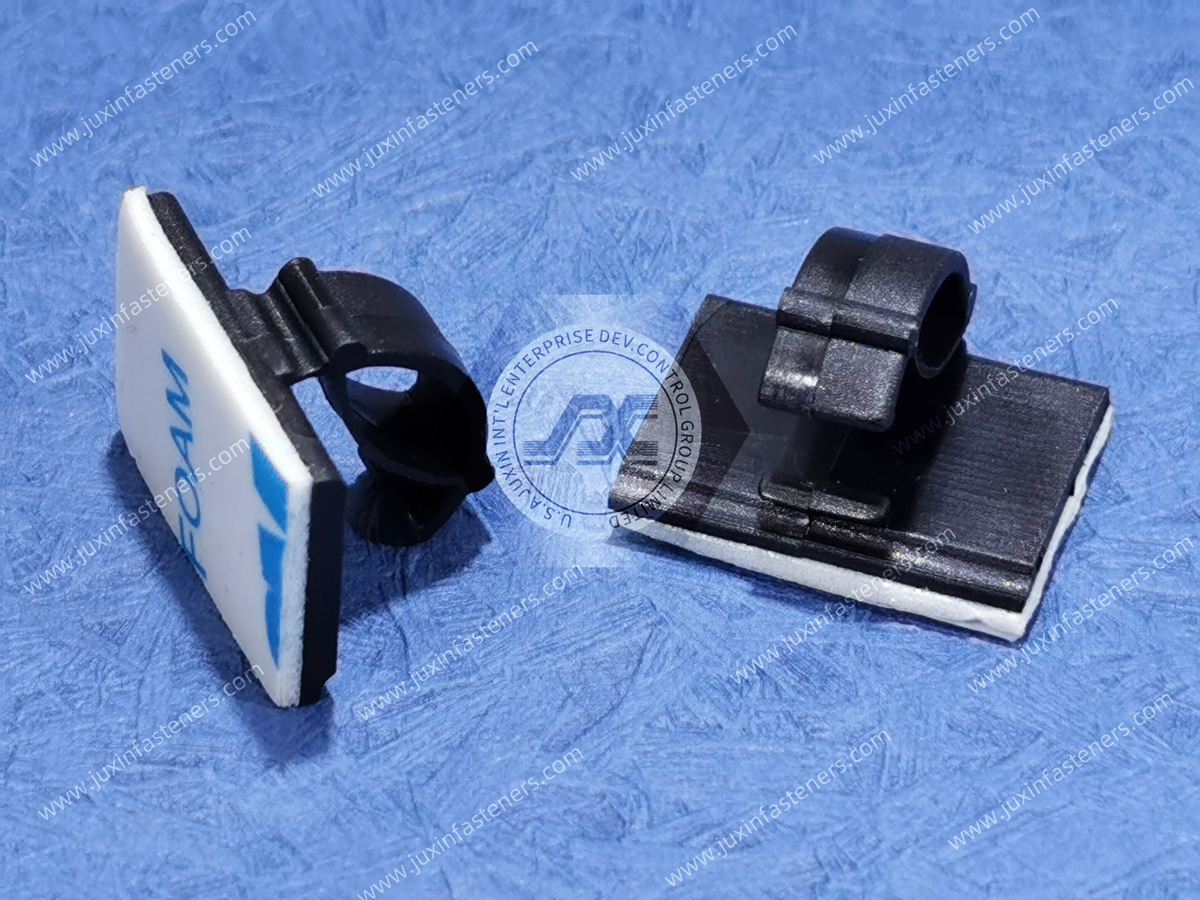
Telecommunications and antenna equipment designers may consider plastic hardware when the assembly requires one or more of the following:
A non-conductive fastening interface
Reduced metallic content in an RF-sensitive location
Electrical isolation between components
Lower-density fastening hardware
Separation between conductive components
Resistance to selected outdoor environmental conditions
Compatibility with polymer housings or composite structures
Controlled spacing around PCBs, cables, sensors or electronic modules
Reduced risk of direct metal-to-metal contact at selected interfaces
However, plastic hardware should not automatically be described as RF-transparent, PIM-free, UV-proof or weatherproof.
RF performance is determined by the complete system. Fastener location, material, geometry, quantity, frequency range,
nearby antenna elements and enclosure construction can all affect the engineering result.
Likewise, outdoor durability depends on the selected polymer, formulation, exposure conditions, installation environment and joint design.
The practical engineering question is therefore:
Does the selected plastic hardware provide the required mechanical, electrical, RF-interface and environmental characteristics at its actual location within the telecommunications assembly?

Antenna assemblies and RF equipment can contain areas where conductive components need to be carefully controlled.
Metallic fasteners located close to antenna elements may become part of the electromagnetic environment. In some designs, engineers may therefore evaluate non-conductive polymer hardware.
Potential considerations include:
Fastener position relative to antenna elements
Operating frequency
Fastener geometry
Material dielectric characteristics
Quantity and spacing of fasteners
Nearby conductive structures
Surface condition
Mechanical movement
Overall antenna and enclosure design
A polymer fastener may reduce the amount of exposed metal at a selected location, but it does not automatically guarantee RF transparency or eliminate electromagnetic interaction.
For RF-critical assemblies, the fastening component should be evaluated as part of the antenna or RF system.
Passive intermodulation (PIM) is a system-level concern in many RF assemblies.
Fastener selection can be relevant when mechanical interfaces contain:
Dissimilar metals
Loose or unstable conductive contacts
Contaminated surfaces
Damaged conductive interfaces
Components located near RF current paths
A plastic fastener may be useful where a non-conductive interface is desirable, but it should not be marketed as an automatic solution to PIM.
The engineering decision should consider the actual RF architecture and the location of the fastener.
Outdoor telecommunications infrastructure can experience prolonged solar radiation and changing environmental conditions.
For outdoor plastic hardware, engineers may need to evaluate:
UV exposure
Temperature cycling
Humidity
Rain and condensation
Freeze-thaw exposure where applicable
Mechanical loading
Material embrittlement
Color and surface changes
Long-term dimensional stability
A black plastic component is not automatically UV stabilized.
If UV resistance is important, the required resin grade or formulation should be specified and verified.
Polyamide materials such as nylon can absorb moisture.
This can influence dimensional characteristics and mechanical behavior.
For outdoor telecommunications assemblies, engineers should consider whether moisture exposure could affect:
Thread fit
Hole dimensions
Clamping behavior
Component dimensions
Long-term mechanical performance
Assembly tolerances
This is particularly relevant when specifying nylon screws, nylon nuts, nylon spacers and PCB standoffs in precision outdoor equipment.
Antenna and base-station structures may experience dynamic loading caused by wind and equipment vibration.
Plastic hardware should therefore be evaluated for:
Joint loading
Thread engagement
Fastener geometry
Stress relaxation
Creep
Mating component stiffness
Installation method
Vibration environment
Where long-term retention is critical, engineers may evaluate the complete fastening architecture rather than relying on a plastic fastener alone.
Telecommunications OEMs often need multiple component types rather than a single fastener.
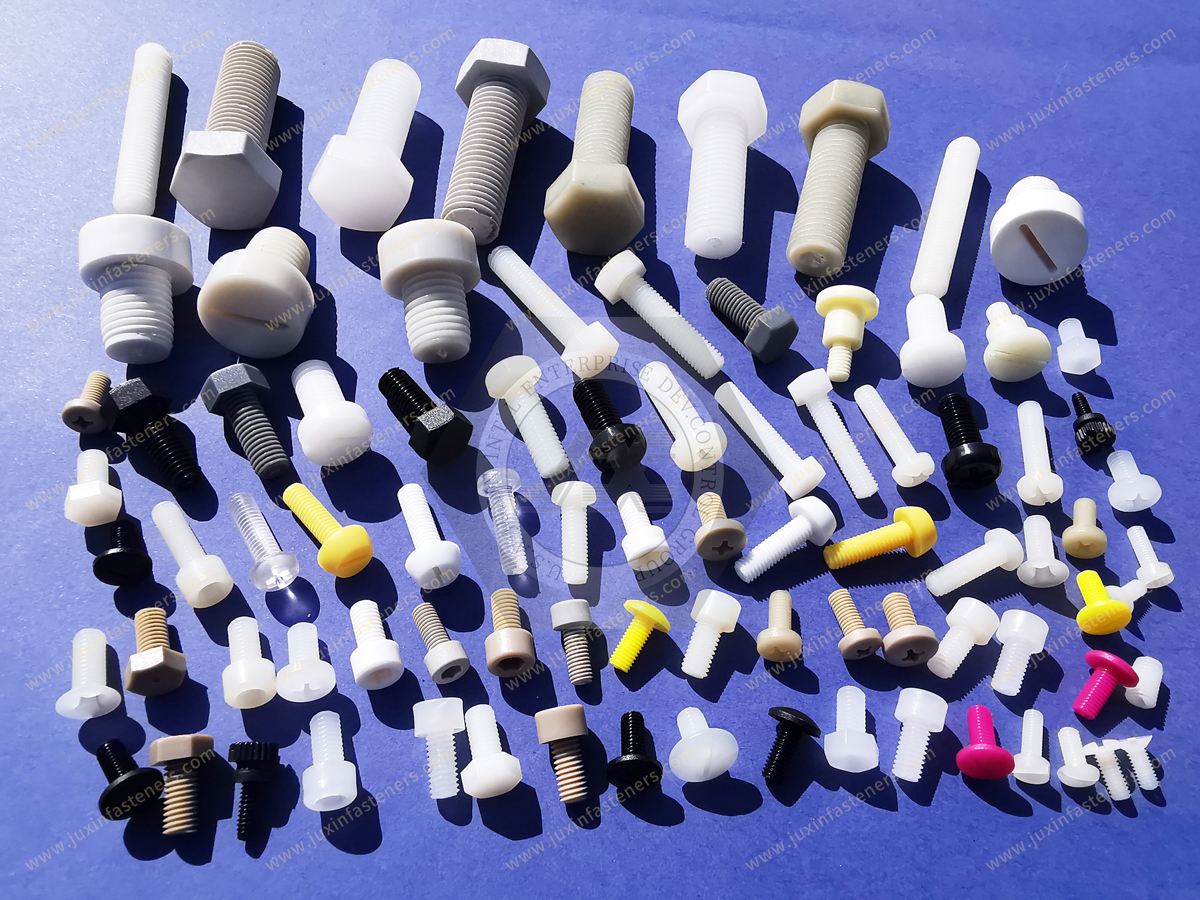
Plastic screws, nylon screws, plastic machine screws and nylon machine screws may be considered for enclosure covers, electrical assemblies,
brackets, internal electronic structures and selected RF-sensitive locations.
Potential benefits may include:
Electrical non-conductivity
Low density
Reduced exposed metal
Compatibility with polymer or composite structures
Corrosion resistance at the polymer component itself
The actual material and thread configuration should be selected according to the application.
Plastic bolts and nylon bolts may be used where larger fastening interfaces or longer threaded engagement are required.
Engineers should evaluate:
Joint load
Thread engagement
Clamp requirements
Temperature
Moisture
Creep and stress relaxation
Mating nut
Washer configuration
Installation method
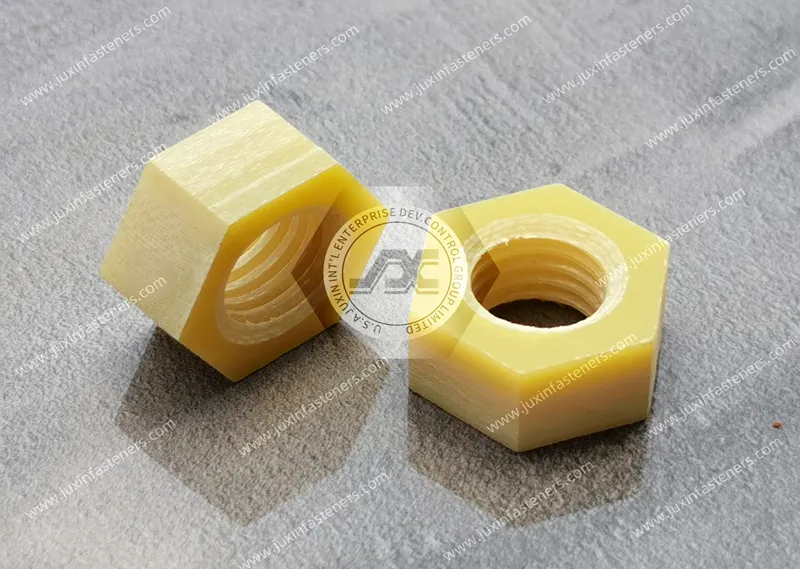
Plastic nuts, nylon nuts, plastic hex nuts and nylon hex nuts can provide non-conductive mating hardware for selected assemblies.
They may be paired with:
Plastic screws
Nylon screws
Plastic bolts
Nylon bolts
Selected metallic fasteners
For outdoor equipment, moisture exposure and dimensional changes should be considered when selecting polyamide components.
Plastic flat washers, nylon insulating washers, shoulder washers, cup washers and insulating cup washers can be used for:
Load distribution
Electrical separation
Surface protection
Controlled spacing
Separation between fastener and enclosure surfaces
The correct washer type depends on the interface geometry.
A shoulder washer, for example, can provide both radial and axial separation, while a flat washer primarily distributes load over a surface.
Telecommunications equipment contains extensive electronic assemblies.
Plastic spacers, nylon spacers, PCB spacers, threaded standoffs, male-to-female standoffs and female-to-female standoffs may be used for:
PCB mounting
Electronic module spacing
Sensor mounting
Cable routing
Control boards
Radio electronics
Enclosure subassemblies
These components can also help establish repeatable mechanical spacing between electronic and structural elements.
Plastic housings may require stronger or more durable internal threads, particularly where repeated assembly is expected.
Depending on the housing material and manufacturing method, engineers may evaluate:
Heat-set inserts
Heat-set brass inserts
Ultrasonic inserts
Molded-in inserts
Expansion inserts
Brass thread inserts
The appropriate insert should be evaluated together with the plastic housing, boss geometry, installation method and required assembly cycle.
Telecommunications equipment frequently contains application-specific interfaces.
A custom polymer component may be appropriate when a standard screw, washer, spacer or standoff does not meet the required:
Geometry
Mounting position
Electrical separation
Clearance
Thread configuration
Material
Packaging
Assembly requirement
This is where a drawing-based OEM sourcing process becomes more useful than selecting a generic catalog item.
Material selection should start with the actual environment rather than with a preferred polymer.
| Polymer Family | Potential Characteristics | Possible Telecom Applications | Key Engineering Considerations |
|---|---|---|---|
| PA6 / Nylon | Good general engineering characteristics and electrical non-conductivity; moisture absorption is relevant | Internal electronic assemblies, spacers, standoffs and selected enclosure hardware | Moisture, dimensional stability, temperature and chemical exposure |
| PA66 / Nylon | Useful mechanical and thermal characteristics for many industrial assemblies | Base-station hardware, electronic mounting and enclosure components | Moisture absorption, UV formulation, creep, temperature and joint loading |
| POM / Acetal | Rigidity, low friction and useful dimensional stability | Mechanical guides, latches, positioning components and internal mechanisms | Chemical exposure, wear, temperature and load |
| PVDF | Strong chemical and environmental resistance characteristics | Specialized outdoor or chemically exposed components | Specific environment, mechanical loading, temperature and material grade |
| PEEK | High-performance engineering polymer with strong mechanical and thermal characteristics | Specialized high-temperature or demanding electronic/mechanical assemblies | Grade, cost, machining, temperature, chemical exposure and mechanical requirements |
This table is a material-selection starting point, not a qualification statement.
The same polymer may perform differently depending on its grade, formulation, geometry, processing method and application environment.
For outdoor applications, engineers may consider a UV-stabilized nylon formulation where the component is exposed to prolonged sunlight.
Potential applications include:
Outdoor base-station enclosures
Antenna support components
Cable-routing hardware
Equipment brackets
Outdoor electronic housings
Selected radome-related fastening interfaces
However, “black nylon” and “UV-stabilized nylon” should not be treated as the same specification.
If UV durability is important, the RFQ should identify the required environmental exposure and material specification.
POM/Acetal can be considered when dimensional stability, rigidity and low friction are important.
Potential applications include:
Internal equipment mechanisms
Sliding components
Cable-routing mechanisms
Mechanical guides
Latches
Precision positioning components
However, POM should not automatically be selected for direct exposure to every outdoor chemical or UV environment.
The actual exposure and operating temperature should be evaluated.
PVDF and PEEK are more specialized engineering polymers.
PVDF may be considered when chemical and environmental resistance is a major design requirement.
PEEK may be considered when the application requires a combination of mechanical performance, thermal capability and dimensional stability that exceeds the intended range of general-purpose nylon or POM.
Neither should be selected simply because it is a “higher-performance” material.
A higher-cost material only creates value when its characteristics address an actual engineering requirement.
For antenna and RF equipment, the following questions are more useful than simply asking whether a fastener is “RF transparent”:
Where is the fastener located relative to the antenna element?
What frequency range is involved?
Is the fastener located in an RF current path?
Is electrical conductivity required or undesirable?
Could the fastener geometry influence the local electromagnetic field?
Is PIM performance part of the equipment specification?
Are there conductive interfaces near the fastener?
Does the fastening component move or loosen under vibration?
Does the material change with temperature or moisture?
Does the completed assembly require RF validation?
This approach creates a much more meaningful engineering specification.
Plastic hardware can be considered in several base-station assemblies.
Potential products include:
Plastic machine screws
Nylon bolts
Plastic nuts
Nylon washers
Shoulder washers
Plastic spacers
The engineering focus may include weather exposure, electrical isolation, enclosure material and joint loading.
RRU assemblies may contain:
PCB assemblies
Electronic modules
Cable-management structures
Internal brackets
Spacers
Standoffs
Insulating components
PCB spacers, threaded standoffs, male-to-female standoffs and female-to-female standoffs can provide controlled spacing between boards and surrounding structures.
For RF-sensitive structures, polymer fastening components may be considered where reduced metallic content is desirable.
The exact suitability depends on:
Fastener location
Material
Geometry
Antenna architecture
Environmental exposure
Mechanical loading
RF validation requirements
Plastic hardware should therefore be evaluated as part of the complete antenna assembly.
Telecommunications infrastructure requires extensive routing of coaxial, fiber-optic and power cables.
Plastic hardware can be integrated with:
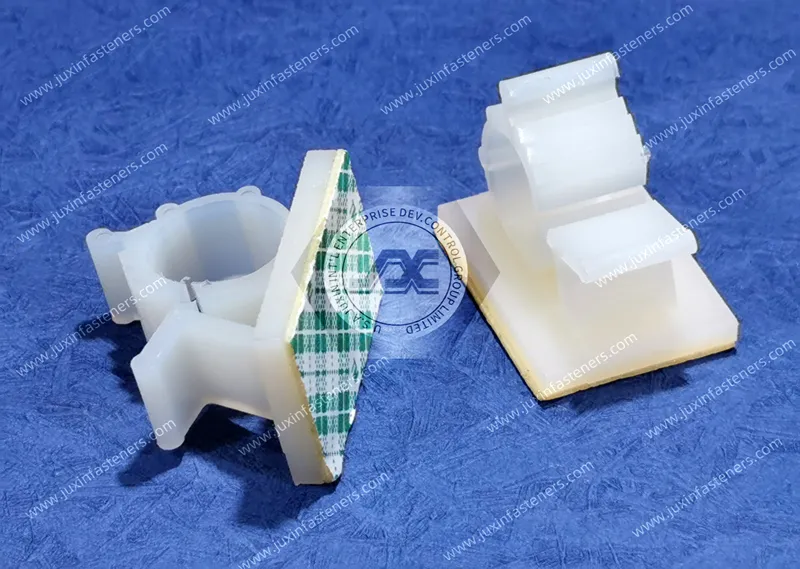
Cable clamps
Cable-routing brackets
Spacers
Insulating washers
Plastic screws and nuts
The objective is not simply to use plastic everywhere, but to place the appropriate component where it provides a useful mechanical or electrical interface.

The same Plastic Hardware product architecture can support other industries with similar electrical, environmental or lightweighting requirements.
Applications may include:
Battery electronics
Control modules
Sensor assemblies
Thermal-management brackets
Electrical enclosures
Cable-routing systems
Relevant components can include:
Plastic screws
Nylon nuts
Insulating washers
Shoulder washers
Spacers
PCB standoffs
These components may be used where electrical separation or non-conductive interfaces are required.
Plastic hardware can be considered for:
Equipment enclosures
Electronic assemblies
Chemical-handling support structures
PCB mounting
Controlled-environment mechanisms
Non-metallic fastening components may be considered for:
Electronic instruments
Sensor assemblies
Equipment housings
Laboratory equipment
Selected non-magnetic interfaces
Material and cleaning compatibility must be evaluated according to the actual application.
One useful way to improve the initial component selection is to divide the application into four independent questions.
| Engineering Question | Primary Concern | Product Families to Evaluate |
|---|---|---|
| Is the fastener close to an RF-sensitive region? | Conductivity, geometry and RF interaction | Plastic screws, nylon screws, plastic nuts, insulating washers |
| Is the fastener outdoors? | UV, moisture, temperature and weathering | UV-specified nylon, POM, PVDF or other application-appropriate polymers |
| Is the component supporting electronics? | Spacing, insulation and assembly access | PCB spacers, threaded standoffs, shoulder washers |
| Is repeated assembly required? | Thread durability and joint retention | Plastic hardware with threaded inserts or other reinforced interfaces |
This creates a better decision path than selecting a polymer based only on its general material description.
For example:
Outdoor + RF-sensitive + moderate mechanical load
may lead to an evaluation of a weather-appropriate non-conductive fastening configuration.
Whereas:
Indoor + PCB mounting + controlled environment
may make nylon spacers or threaded standoffs a more straightforward starting point.
And:
Repeated assembly + plastic housing
may lead engineers to evaluate threaded inserts for plastic rather than relying solely on a molded polymer thread.
Plastic hardware should not automatically replace metallic hardware in every telecommunications assembly.
A different solution may be more appropriate where the joint requires:
High mechanical preload
High structural loading
High-temperature performance beyond the selected polymer's capability
High wear resistance
Extremely tight dimensional stability under changing conditions
A defined conductive grounding or bonding path
High resistance to thread deformation
Repeated high-load assembly
Specific qualification or validation requirements
In these cases, engineers may need to evaluate a different polymer, a reinforced fastening architecture, a metallic fastener, or a hybrid assembly.
A good RFQ allows engineering and procurement teams to move from a generic “plastic fastener” request to a technically reviewable component.
Specify whether the requirement is for:
Plastic screws
Nylon screws
Plastic machine screws
Nylon machine screws
Plastic bolts
Nylon bolts
Plastic nuts
Nylon hex nuts
Plastic flat washers
Nylon insulating washers
Shoulder washers
Cup washers
Insulating cup washers
Plastic spacers
Nylon spacers
PCB spacers
Threaded standoffs
Male-to-female standoffs
Female-to-female standoffs
Threaded inserts
Custom polymer fastening components
Also identify the equipment subsystem, such as:
Base station enclosure
RRU
Antenna housing
Radome-related assembly
PCB assembly
Cable-management structure
Outdoor electronics module
Provide:
2D technical drawing
3D CAD file where available
Thread specification
Critical dimensions
Tolerances
Head geometry
Washer requirements
Mating component information
Assembly orientation
Metric threads may reference applicable ISO/DIN requirements, while inch-based designs may use ASME/ANSI Unified Thread conventions where appropriate.
Specify:
Polymer family
Resin grade where required
Filled or unfilled formulation
Color
UV requirements
Environmental exposure
Electrical requirements
Mechanical requirements
Avoid vague requirements such as “strong plastic” or “weatherproof plastic” when a controlled engineering specification is available.
For RF-sensitive applications, provide:
Operating frequency
Fastener location
Distance from RF elements where relevant
PIM requirements if applicable
RF performance criteria
Electrical conductivity requirements
Relevant assembly-level validation requirements
This gives the supplier a meaningful basis for component evaluation.
Identify:
UV exposure
Temperature range
Humidity
Salt-laden atmosphere
Rain or condensation
Chemical exposure
Vibration
Expected installation environment
Specific environmental requirements are much more useful than simply stating “outdoor use.”
Procurement teams should provide:
Prototype quantity
Annual demand
Forecast
Production batch requirements
Delivery schedule
Packaging
Labeling
Inspection requirements
Lot traceability requirements
Multi-SKU BOM
A telecommunications OEM may use dozens of plastic fastening components across one equipment platform.
A typical BOM may contain:
Plastic machine screws
Nylon machine screws
Plastic bolts
Nylon bolts
Plastic nuts
Nylon hex nuts
Nylon washers
Plastic flat washers
Shoulder washers
Insulating cup washers
Plastic spacers
Nylon spacers
PCB spacers
Threaded standoffs
Male-to-female standoffs
Female-to-female standoffs
Threaded inserts
Custom polymer components
Submitting the complete BOM can allow procurement and engineering teams to evaluate the components as a coordinated sourcing program.
This may help identify:
Common materials
Common thread sizes
Standard versus custom components
Potential component standardization
Packaging requirements
Inspection requirements
Prototype and production quantities
For supply chain managers, this approach can be more useful than evaluating every low-value plastic component as a separate sourcing project.
For OEM telecommunications programs, supplier qualification should consider more than unit price.
The supplier should be able to review:
Technical drawings
CAD data
Thread specifications
Material requirements
Tolerances
Assembly interfaces
Application conditions
Procurement teams should clarify:
Material identification
Resin grade
Material documentation
Lot control
Special formulation requirements
The quality process should define:
Dimensional inspection
Thread inspection
Visual inspection
Surface requirements
Batch control
Nonconformance handling
Telecommunications equipment programs often involve multiple related plastic hardware SKUs.
A coordinated supplier relationship can cover:
Screws
Bolts
Nuts
Washers
Spacers
Standoffs
Inserts
Custom polymer components
This can reduce unnecessary supplier fragmentation while keeping technical specifications under control.
Before releasing telecom plastic hardware to production, engineers should verify:
Correct polymer family
Correct resin grade where specified
UV requirements
Moisture sensitivity
Temperature exposure
Mechanical loading
Creep and stress relaxation
Thread engagement
Installation method
Washer configuration
RF location where relevant
Electrical requirements
Dimensional tolerances
Surface condition
Packaging
Inspection criteria
Traceability requirements
For RF-sensitive applications, component verification should be connected to the complete equipment or antenna design rather than performed in isolation.
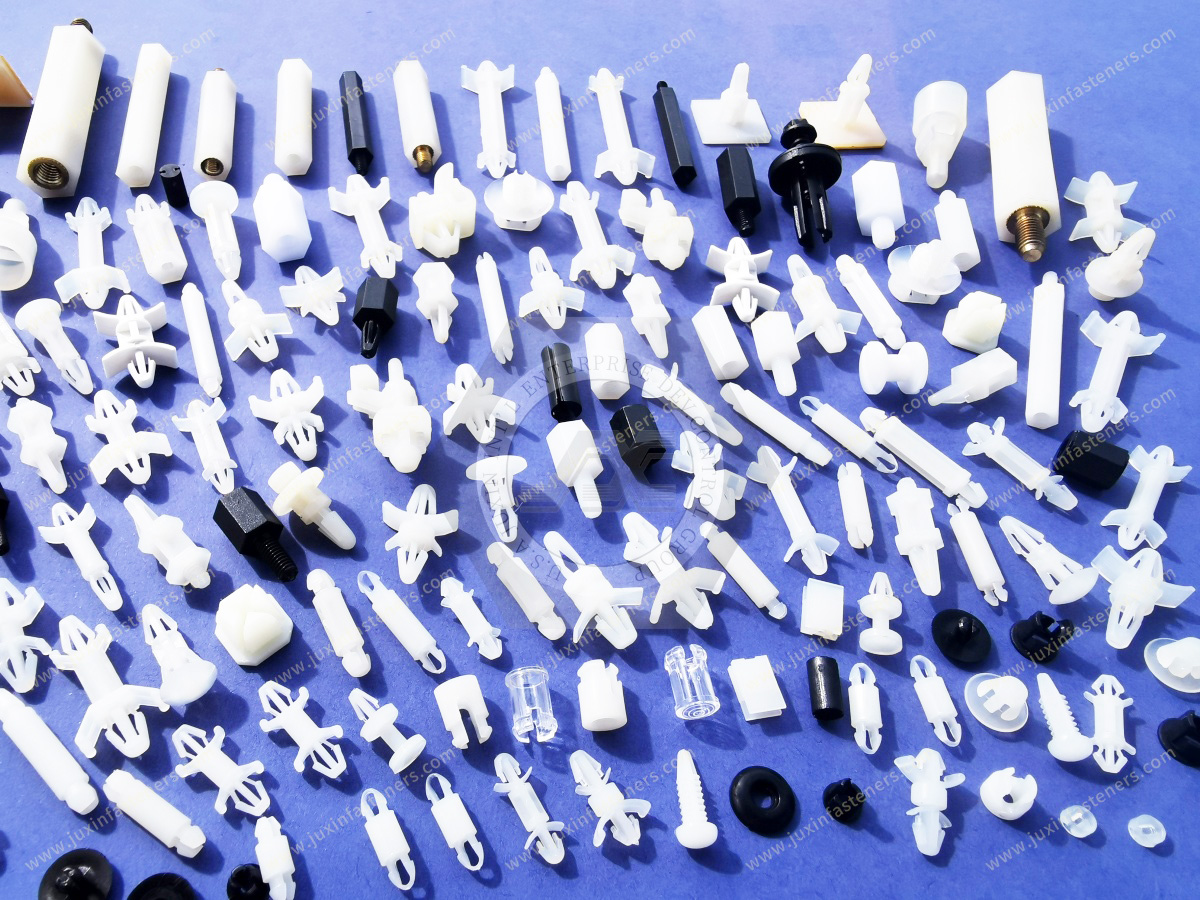
Plastic hardware may be selected for electrical non-conductivity, reduced metallic content, lower density, controlled spacing, corrosion resistance of the polymer itself, or compatibility with polymer and composite structures.
The actual benefit depends on where and how the component is used.
Many polymers are electrically non-conductive and may have useful dielectric characteristics, but “RF transparent” is not a universal property of every plastic fastener.
Fastener material, geometry, location, frequency and the surrounding RF structure all matter.
No fastener material should be described as automatically eliminating PIM.
PIM is a system-level RF issue involving materials, mechanical interfaces, surface conditions, contact forces and RF architecture. Plastic hardware may be useful in selected locations where a non-conductive interface is desirable.
Nylon fasteners can be suitable for selected outdoor applications when the polymer grade, UV exposure, moisture, temperature and mechanical requirements are compatible.
For prolonged outdoor exposure, the specific UV and environmental requirements should be identified.
No. Color alone does not establish UV stabilization.
If long-term outdoor exposure is important, the required UV-stabilized material specification should be identified and verified.
PVDF may be considered where specific chemical or environmental resistance is important. The actual application conditions and mechanical requirements should determine whether PVDF is appropriate.
Yes, plastic hardware may be used in selected antenna and enclosure assemblies.
For RF-sensitive locations, engineers should evaluate fastener material, geometry, location and complete system performance rather than assuming every plastic fastener is automatically RF neutral.
Yes. PCB spacers, nylon spacers, threaded standoffs, male-to-female standoffs and female-to-female standoffs are commonly relevant to electronic mounting architectures.
The required board spacing, thread configuration, insulation requirements and assembly method should be specified.
Yes. A complete BOM can be submitted for technical review so that screws, bolts, nuts, washers, spacers, standoffs, inserts and custom polymer components can be evaluated as a coordinated sourcing program.
Telecommunications fastening is not simply a choice between metal and plastic.
The engineering decision depends on the relationship between RF environment, mechanical loading, electrical requirements, UV exposure, moisture, temperature, material compatibility, component geometry and the complete equipment architecture.
JUXIN FASTENERS provides industrial fastening and custom component solutions for OEM applications, including plastic and nylon screws, bolts, nuts, washers, spacers, standoffs,
threaded inserts and custom polymer fastening components.
For telecommunications equipment, antenna systems, base stations, remote radio units, electronic enclosures and outdoor communication infrastructure, engineering and procurement teams can provide:
2D technical drawings
3D CAD files
Polymer requirements
Thread specifications
RF application information
UV and outdoor exposure requirements
Temperature and humidity conditions
Mechanical loading requirements
Packaging requirements
Inspection requirements
Multi-SKU BOMs
Prototype and annual volume requirements
Send your technical requirements to info@juxinfasteners.com for engineering review and OEM sourcing discussion.
A complete technical specification allows the appropriate Plastic Hardware product, material and configuration to be evaluated against the actual telecommunications application.
Product Packaging
Packaging Standard
At Juxin Fasteners, we apply standardized export packaging to ensure product protection, traceability, and compliance with international logistics requirements.
1. Standard Export Packaging
Unless otherwise specified, all products will be packed according to our factory standard export packaging, which includes:
Moisture-resistant inner protection
Poly bag or small box packing as required
Reinforced export cartons
Clear labeling with part number, specification, batch number, and quantity
Palletizing for sea or air shipment when necessary
Our standard packaging is designed to ensure safe transportation, efficient warehousing, and long-distance international shipping.
2. Customized Packaging Options
We also provide customized packaging solutions according to customer requirements, including but not limited to:
Private labeling
Customized barcodes
Specific carton dimensions
Retail packaging
Special pallet configuration
Customer-specific marking and identification
So that you know, customized packaging may involve additional costs and extended lead time depending on the complexity of the requirements.
3. Compliance & Quality Assurance
All packaging processes are controlled under our ISO 9001 quality management system to ensure consistency, traceability, and product integrity throughout the supply chain.
Product Pictures
Hot Products
Contact Us
Tel.:
+86 020 8621 0320
+86 020 3121 6067
E-mail:
Technical Support:
Navigation
SEND INQUIREY