
Call Us
+86 136 6007 9809
Call Us
+86 136 6007 9809

Oct. 19, 2023
ASME B18.21.1 external tooth lock washers are toothed washers used beneath compatible screw heads, bolt heads,
or nuts where the joint design benefits from localized tooth engagement with the adjacent bearing surfaces.
Unlike a plain washer, an external tooth lock washer has teeth around its outside diameter.
As the fastener is tightened, these teeth can engage the contacting surfaces and create resistance to relative rotation.
The actual behavior of the joint depends on the washer geometry, material, hardness, mating surfaces, coatings, installation conditions, and applied preload.
For engineers and sourcing teams, selecting an external tooth lock washer therefore involves more than matching a washer to a nominal fastener size.
The complete joint—including the mating material, surface finish, required electrical contact, corrosion environment, service loading, and assembly method—should be considered.
JUXIN FASTENERS supplies standard and custom washers and fastening components for industrial OEM applications and supports drawing-based, specification-based, and sample-based sourcing requirements.
ASME B18.21.1 covers helical spring-lock, tooth-lock, and plain washers in inch-series dimensions.
Within the tooth-lock washer category, the standard includes dimensional requirements for several configurations, including external tooth-lock washers.
An external tooth lock washer has multiple teeth projecting around its outer circumference.
When compressed beneath a compatible fastener bearing surface, the teeth are intended to engage the contacting surfaces.
This geometry distinguishes it from:
plain washers, which primarily provide a bearing surface or distribute load;
internal tooth lock washers, whose teeth are located around the inside diameter;
internal/external tooth lock washers, which incorporate both tooth locations;
countersunk external tooth lock washers, which are designed around compatible countersunk fastener geometry;
helical spring-lock washers, which use a fundamentally different geometry and operating principle.
These products should not automatically be treated as interchangeable simply because they are all commonly described as "lock washers."
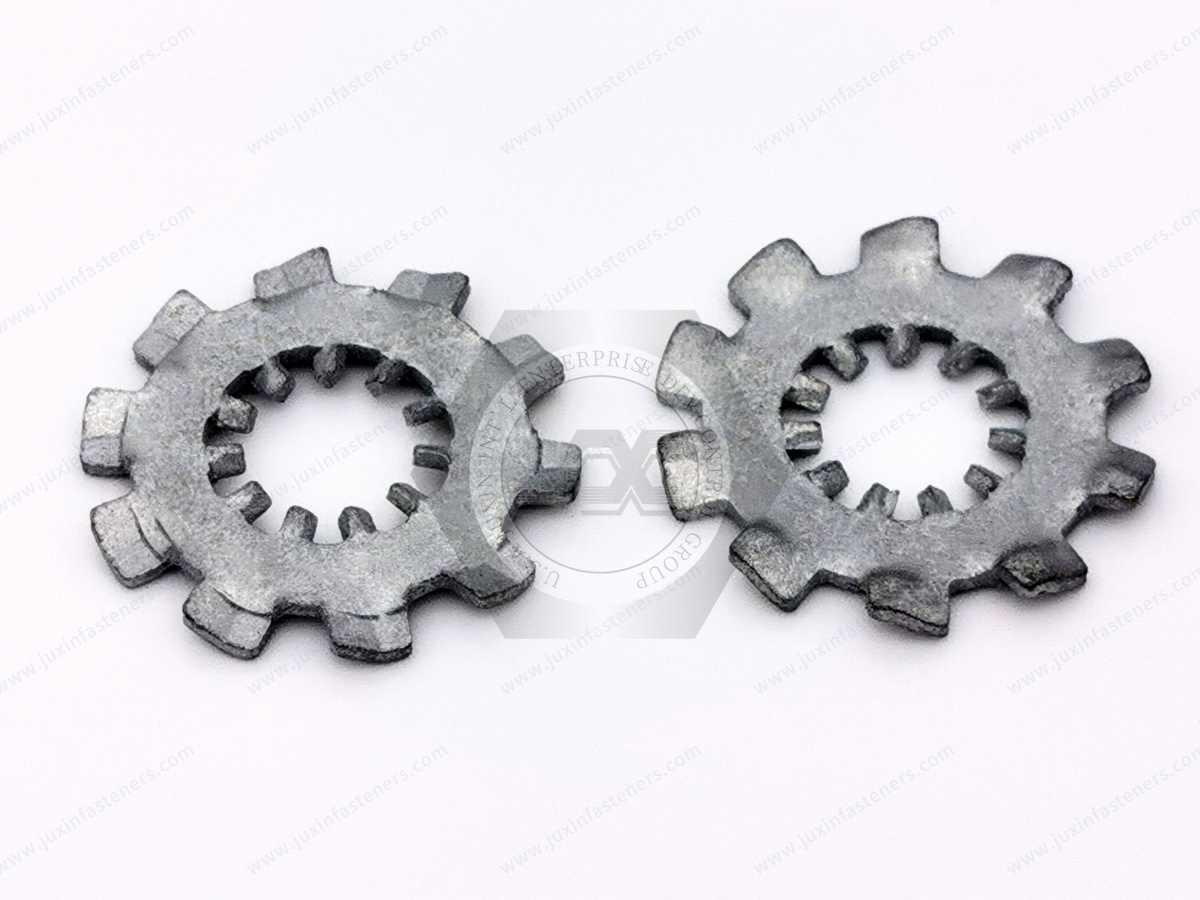
One important sourcing distinction is frequently missed in online product descriptions: ASME B18.21.1 is an inch-series washer standard.
For tooth-lock washers, the standard covers designated inch fastener sizes rather than metric M-series sizes.
Therefore, a washer described as "ASME B18.21.1 M6" or "ASME B18.21.1 M10" should not automatically be assumed to be a standard ASME B18.21.1 product.
If a project requires a metric external tooth washer, the required dimensions should instead be verified against the applicable metric specification, customer drawing, or approved product specification.
This distinction is particularly important for international OEM sourcing because visually similar inch and metric tooth washers can have different inside diameters,
outside diameters, tooth geometry, thickness, and fit.
The functional feature of an external tooth washer is the series of formed teeth around its outside diameter.
During tightening, the washer is compressed between the rotating fastener component and the mating surface. Depending on the material and surface condition, the teeth can locally engage those surfaces.
This engagement can increase resistance to relative rotation at the washer interfaces.
However, an external tooth washer should not be described as automatically increasing bolt preload or clamp load.
Clamp load is primarily generated by tightening the threaded fastener and is influenced by tightening method, friction, fastener geometry, materials, coatings, and joint conditions.
The washer is therefore one element of the joint design—not a substitute for proper preload control.
No.
The term "lock" in the name of a tooth lock washer should not be interpreted as a guarantee that a threaded joint will remain permanently locked.
Whether a bolted joint resists loosening depends on the entire fastening system, including:
fastener preload;
joint stiffness;
transverse movement;
vibration amplitude;
impact loading;
mating materials;
bearing surface condition;
coatings and lubrication;
thermal cycling;
washer geometry;
installation process.
For assemblies exposed to significant vibration, cyclic transverse movement, safety-critical loading, or severe service conditions,
engineers should validate the complete joint and determine whether another locking strategy is required.
Possible alternatives depend on the application and may include prevailing-torque nuts, serrated flange fasteners, wedge-locking systems,
thread-locking compounds, mechanical locking features, or application-specific fastener designs.
The correct solution should be selected for the actual joint rather than assuming that every product containing the word "lock" provides the same level or mechanism of loosening resistance.
External and internal tooth washers operate on a similar general principle but place their teeth in different locations.
| Feature | External Tooth Washer | Internal Tooth Washer |
|---|---|---|
| Tooth location | Outside diameter | Inside diameter |
| Engagement area | Farther from washer center | Closer to fastener shank |
| Space requirement | Requires sufficient surrounding clearance | More compact outside profile |
| Visual identification | Teeth clearly extend outward | Teeth point inward |
| Selection factor | Available bearing area and surrounding clearance | Head geometry and limited outside clearance |
External teeth act at a larger radius from the fastener axis, which can be useful where the available bearing surface accommodates the larger toothed outside diameter.
Internal tooth washers may be preferable where external clearance is restricted or where the fastener head geometry better accommodates inward-facing teeth.
The selection should be based on actual fastener geometry and joint configuration rather than treating one design as universally superior.
ASME B18.21.1 also recognizes tooth-lock washer configurations beyond standard external and internal tooth designs.
These washers incorporate teeth around both the inner and outer regions of the washer.
They should not be confused with a standard external tooth washer. The geometry creates different contact conditions and requires appropriate bearing-surface dimensions.
Countersunk tooth-lock washers are designed for use with compatible countersunk fastener geometries.
A standard flat external tooth washer should not simply be substituted beneath a countersunk head without evaluating seating geometry and the intended bearing interface.
This distinction matters because the washer must work with—not interfere with—the geometry of the fastener head and joint.
Material selection affects tooth formation, elasticity, surface engagement, corrosion behavior, and compatibility with the rest of the assembly.
Common sourcing categories may include carbon or spring steels and corrosion-resistant stainless steels, depending on the applicable specification and product design.
Steel tooth washers can be suitable for many general industrial assemblies and can be combined with an appropriate protective finish where corrosion protection is required.
The exact material and processing condition should be defined according to the applicable specification, drawing, and required washer performance.
Stainless steel external tooth washers may be selected where corrosion resistance or material compatibility is important.
For OEM sourcing, the exact stainless material should be specified rather than relying only on a generic description such as "stainless steel."
Material choice should consider:
service environment;
mating fastener material;
mating component material;
galvanic compatibility;
required corrosion resistance;
mechanical behavior;
surface condition;
customer specifications.
A stainless washer is not automatically the correct choice for every corrosive environment, particularly when dissimilar metals are present.
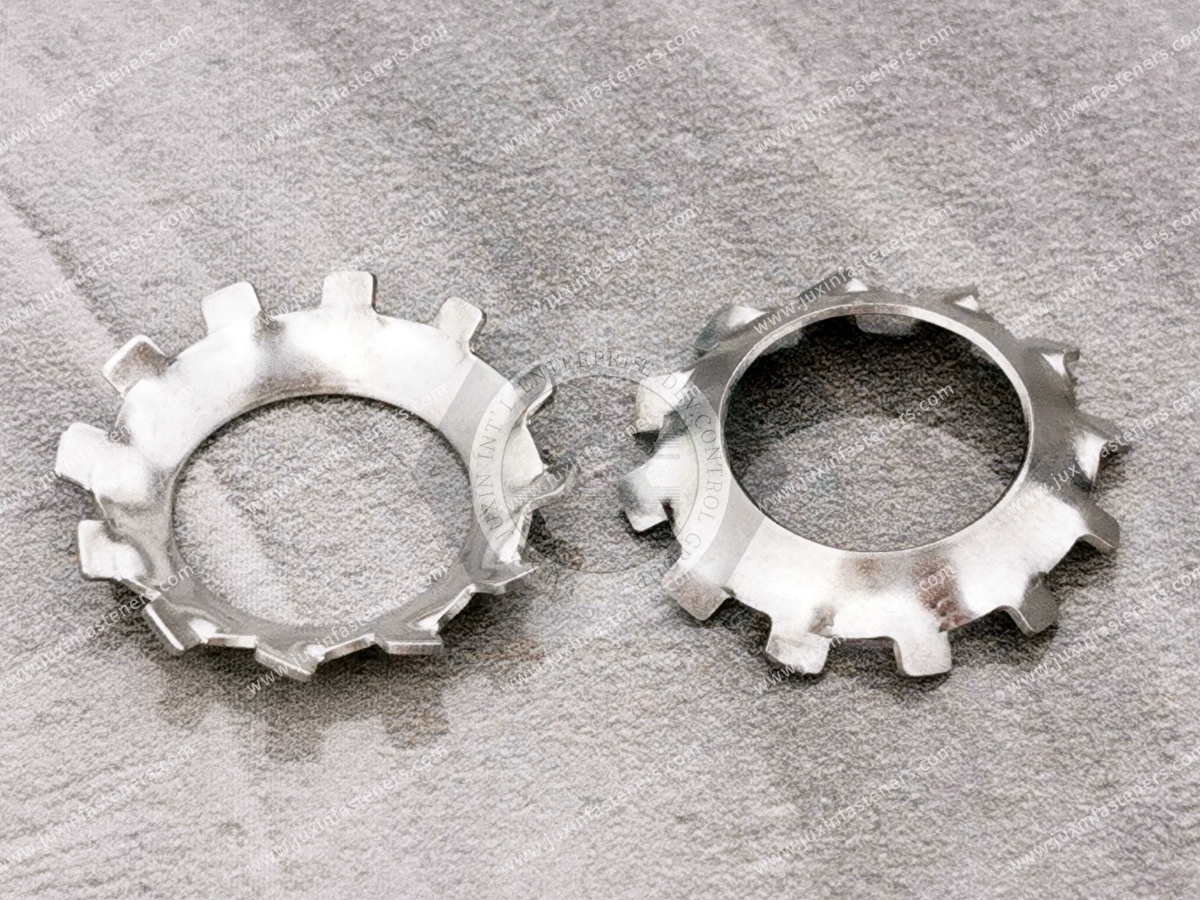
External tooth lock washers may be supplied with different finishes depending on material, application, corrosion requirements, appearance, and customer specifications.
Potential finish categories can include:
zinc-based coatings;
phosphate-based finishes;
nickel-based finishes;
mechanically applied coatings;
zinc-flake coating systems;
passivated stainless surfaces where applicable;
customer-specified coating systems.
The coating should not be selected independently from the washer's functional geometry.
Because the teeth are intended to contact or penetrate the mating surface to some degree, coating thickness, hardness, friction, and surface condition can influence assembly behavior.
For OEM projects, coating selection should therefore consider both corrosion protection and joint function.
One of the most important engineering considerations with tooth washers is the condition of the surfaces they contact.
The same washer can behave differently against:
bare steel;
plated steel;
stainless steel;
aluminum;
painted surfaces;
powder-coated surfaces;
anodized surfaces;
soft conductive coatings;
hardened bearing surfaces.
A tooth washer that engages readily with one surface may behave differently against a harder or thicker coating.
This is especially important when a design requires both mechanical retention and preservation of a decorative or corrosion-protective surface.
Designers should consider whether tooth penetration into the mating surface is acceptable.
The teeth may locally disturb paint, powder coating, plating, or another surface layer during tightening.
That may be useful in some applications but undesirable in others.
Potential consequences include:
localized coating damage;
exposure of base metal;
changes in corrosion behavior;
cosmetic marking;
variation in electrical contact;
changes in friction conditions.
For corrosion-sensitive assemblies, the washer should therefore be evaluated as part of the complete coating system rather than simply added after the surface finish has already been specified.
Toothed washers are sometimes used in electrical assemblies because tooth engagement may help establish metal-to-metal contact through certain surface films or coatings.
However, an external tooth washer alone should not be assumed to create a compliant grounding or bonding connection.
Electrical performance depends on factors such as:
mating materials;
coating type and thickness;
contact pressure;
washer geometry;
assembly torque;
environmental exposure;
corrosion;
required electrical resistance;
applicable equipment or safety requirements.
For electrical equipment, control cabinets, power distribution assemblies, and electronic enclosures,
the grounding or bonding requirement should be defined separately from the mechanical fastening requirement.
Where electrical continuity is critical, the completed connection should be validated according to the applicable product and system requirements.
External tooth washers can be considered when:
a compact mechanical locking feature is desired;
the fastener has sufficient bearing area for the washer;
the surrounding geometry provides clearance for external teeth;
localized tooth engagement with the mating surface is acceptable;
the selected surface materials allow the intended interaction;
the joint does not rely on the washer as its only unvalidated protection against severe vibration loosening.
They are commonly considered for general industrial fastening, electrical equipment, enclosures, machinery, appliances,
HVAC equipment, control systems, and other OEM assemblies where their geometry is compatible with the joint.
An external tooth lock washer may not be the preferred solution when:
damage to the mating surface is unacceptable;
the joint experiences severe transverse vibration or cyclic slip;
a controlled high-preload structural joint is required;
the bearing surface is too small or geometrically incompatible;
the surrounding space cannot accommodate external teeth;
electrical continuity must meet a defined resistance requirement without application testing;
the assembly requires repeated disassembly and reassembly;
the joint has safety-critical locking requirements that require a validated locking system.
In these situations, the complete fastening strategy should be reviewed rather than simply changing washer style.
Tooth lock washers can experience permanent deformation or changes at the tooth contact points during installation.
After removal, the original tooth geometry and surface engagement condition may no longer be identical to those of an unused washer.
For this reason, reuse should not be assumed without considering the product specification, application requirements, and actual condition of the washer.
For controlled OEM assembly, replacement with a new washer may provide more predictable assembly conditions when the design or quality plan requires it.
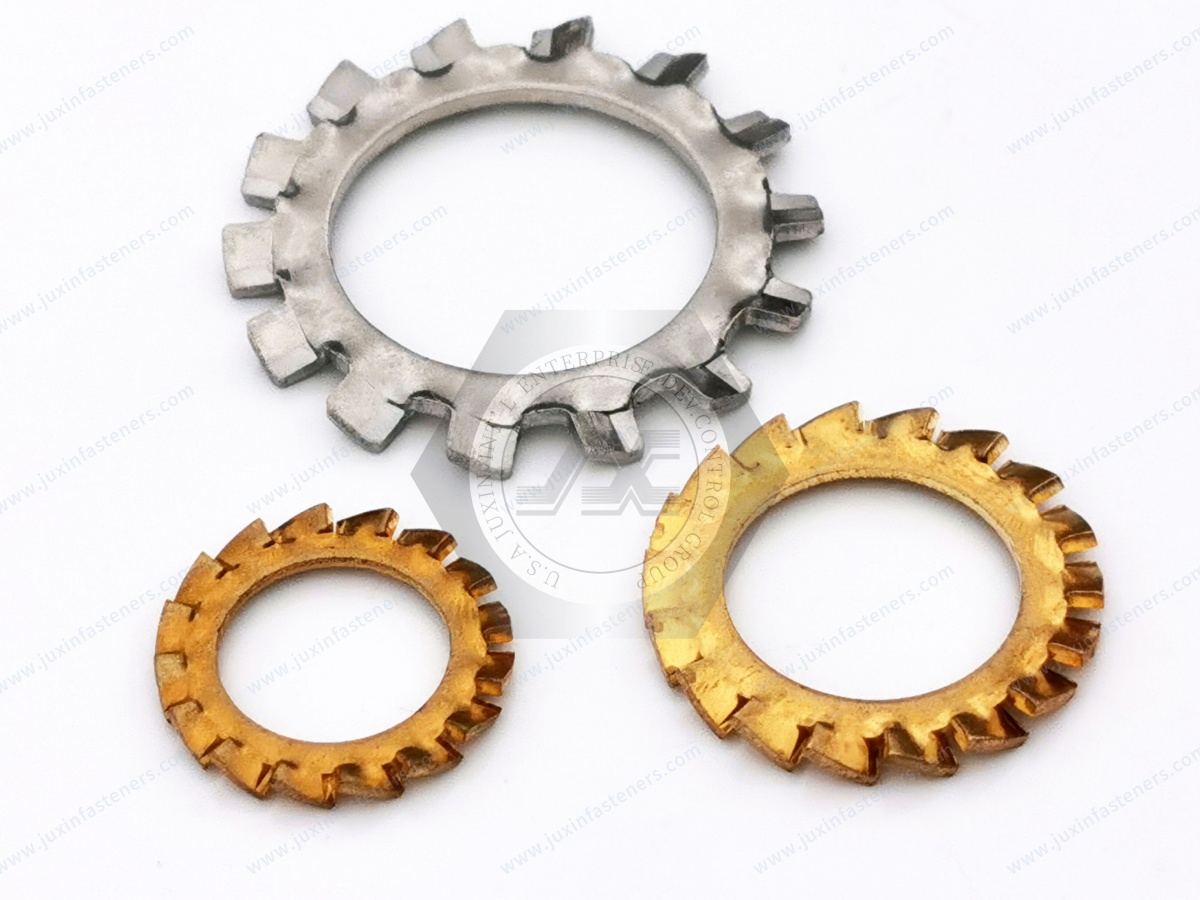
External tooth washers can be found in electrical enclosures, control equipment, mounting hardware, terminal-related assemblies, and other mechanically fastened components.
Where electrical bonding is part of the design, electrical performance must be evaluated separately from mechanical retention.
Control assemblies, equipment housings, brackets, guards, sensors, actuators, and other industrial components may use external tooth washers where their geometry and surface interaction suit the joint.
Fans, housings, control assemblies, brackets, and equipment panels can include threaded joints where tooth washers are considered as part of the fastening system.
Washers may be used in motors, panels, brackets, housings, and general mechanical assemblies, subject to material, corrosion, hygiene, and equipment-specific requirements.
External tooth washers may be used in suitable non-critical mechanical, electrical, bracket, enclosure, or accessory assemblies.
They should not automatically be specified for safety-critical automotive joints merely because vibration is present. Automotive fastening decisions should follow the applicable joint requirements, customer specifications, and validation process.
Equipment cabinets, chassis, brackets, racks, and electronic enclosures may use tooth washers where compact fastening and controlled surface engagement are useful.
Rather than selecting an external tooth washer only by nominal screw size, engineers can evaluate the joint through a short decision path.
Determine whether the assembly uses inch or metric threads and whether ASME B18.21.1 is actually the applicable washer specification.
Confirm that the fastener head or nut provides suitable contact with the washer and that the external teeth have adequate surrounding clearance.
Consider material hardness, plating, paint, powder coating, anodizing, and other surface treatments.
Determine whether the washer is intended primarily for rotational resistance, surface engagement, electrical contact, assembly retention, or another defined function.
Consider corrosion exposure, temperature cycling, vibration, impact, maintenance, and disassembly requirements.
Choose the washer material and coating based on both environmental requirements and compatibility with the complete fastened assembly.
If loosening resistance, electrical continuity, corrosion behavior, or another performance characteristic is critical, validation should be performed on the actual assembly or a representative joint.
For procurement and supplier-development teams, the washer description alone may not contain enough information to establish an accurate quotation.
Useful sourcing information can include:
applicable standard or customer drawing;
nominal fastener size;
washer type: external, internal, internal/external, or countersunk;
material requirement;
finish or coating;
corrosion requirement where applicable;
dimensional tolerances outside the standard;
application or mating material;
inspection requirements;
packaging requirements;
estimated annual usage or order quantity.
These factors can affect manufacturing method, tooling, secondary processing, inspection, packaging, MOQ, lead time, and unit cost.
For custom or non-standard tooth washers, a drawing is particularly useful because apparently small changes in tooth geometry, thickness,
inside diameter, outside diameter, or material can change the manufacturing approach.
Not every OEM application fits a catalog washer.
A custom external tooth washer may be considered when the application requires:
a non-standard inside diameter;
modified outside diameter;
special tooth geometry;
different washer thickness;
application-specific material;
special surface treatment;
mating geometry unique to the assembly;
drawing-controlled dimensions;
integration into an OEM-specific fastening system.
JUXIN FASTENERS supports both standard fastener sourcing and custom fastener development based on available technical information.
You do not need to have every specification finalized before contacting us.
Have a drawing? Send the drawing.
Have a 3D CAD model? Send the available CAD data.
Have an existing physical sample? We can start by reviewing the sample.
Only have photos and key dimensions? Those can still provide a useful starting point.
Still defining the washer specification? Tell us the application, fastener size, mating material, and current requirements.
JUXIN FASTENERS can review the available information and identify which additional details may be useful for quotation, manufacturing feasibility review, or custom development.
It is an inch-series tooth-lock washer with teeth around the outside diameter. ASME B18.21.1 defines dimensional and other applicable requirements for tooth-lock washers covered by the standard.
ASME B18.21.1 is an inch-series standard. A metric external tooth washer should therefore be specified according to the applicable metric standard, customer drawing,
or approved product specification rather than automatically being identified as an ASME B18.21.1 washer.
They should not be described as automatically increasing clamp load. Bolt preload is generated through tightening and depends on the complete fastener and joint system.
The teeth primarily interact with the contacting surfaces and can provide resistance to relative rotation.
Not necessarily. Its effectiveness depends on the joint design, preload, vibration, transverse movement, materials, surface conditions, and installation.
Applications with demanding vibration or safety requirements should use a locking strategy validated for the actual joint.
External tooth washers have teeth around the outside diameter, while internal tooth washers have teeth around the inside diameter.
The appropriate design depends on available bearing area, clearance, fastener geometry, and the intended surface interaction.
The teeth can locally disturb coatings as they engage the mating surface. Whether this is acceptable depends on the coating system, corrosion requirements, cosmetic requirements, and intended function of the joint.
They can be used in some electrically conductive assemblies, but the washer alone does not guarantee a compliant grounding or bonding connection.
Electrical performance should be validated against the actual materials, coatings, assembly conditions, and applicable requirements.
Reuse should not automatically be assumed. Installation can alter the tooth geometry and contact surfaces. The decision should follow the applicable product specification and assembly requirements.
Yes. JUXIN FASTENERS supports drawing-based and sample-based development of custom fastening components.
The available drawing, CAD data, sample, photographs, dimensions, material requirements, or application information can be used as the starting point for technical review.
The right external tooth lock washer is defined by more than its nominal fastener size.
Standard, geometry, material, coating, mating surface, assembly conditions, and service environment all influence whether the washer is appropriate for the joint.
JUXIN FASTENERS supports global OEM, ODM, Tier 1, Tier 2, industrial equipment, engineering, procurement,
and supplier-development teams with standard and custom washers, screws, bolts, nuts, and application-specific fastening components.
For an existing ASME B18.21.1 external tooth lock washer, a custom washer drawing, or an application that still needs specification review, send us the information you currently have.
Our team can review the available requirements and support quotation, manufacturing feasibility, sample development, and production sourcing.
Email: info@juxinfasteners.com
Website: www.juxinfasteners.com
 MORE NEWS
Sep. 27, 2026
Sep. 27, 2026
Sep. 27, 2026
Contact Us
Tel.:
+86 020 8621 0320
+86 020 3121 6067
E-mail:
Technical Support:
Navigation
SEND INQUIREY