
Call Us
+86 136 6007 9809
Call Us
+86 136 6007 9809

Oct. 20, 2023
Serrated conical lock washers are formed washers that combine a conical profile with serrated contact features. In metric fastening systems,
DIN 6798 V is commonly referenced for the Form V serrated lock washer designed around countersunk fastener geometry.
Also described in the market as conical serrated lock washers, countersunk serrated lock washers, serrated countersunk washers,
or Form V serrated washers, these components should not be confused with ordinary flat external-tooth washers or plain conical spring washers.
Their geometry matters.
The conical form is intended to work with a compatible countersunk fastener interface, while the serrated surfaces create localized engagement between contacting components.
Whether that engagement provides the required resistance to relative rotation depends on the complete joint—including fastener geometry,
preload, mating material, surface hardness, coating, installation conditions, and service loading.
JUXIN FASTENERS supplies standard and custom washers and fastening components for industrial OEM applications, with support for specification-based, drawing-based, and sample-based sourcing.
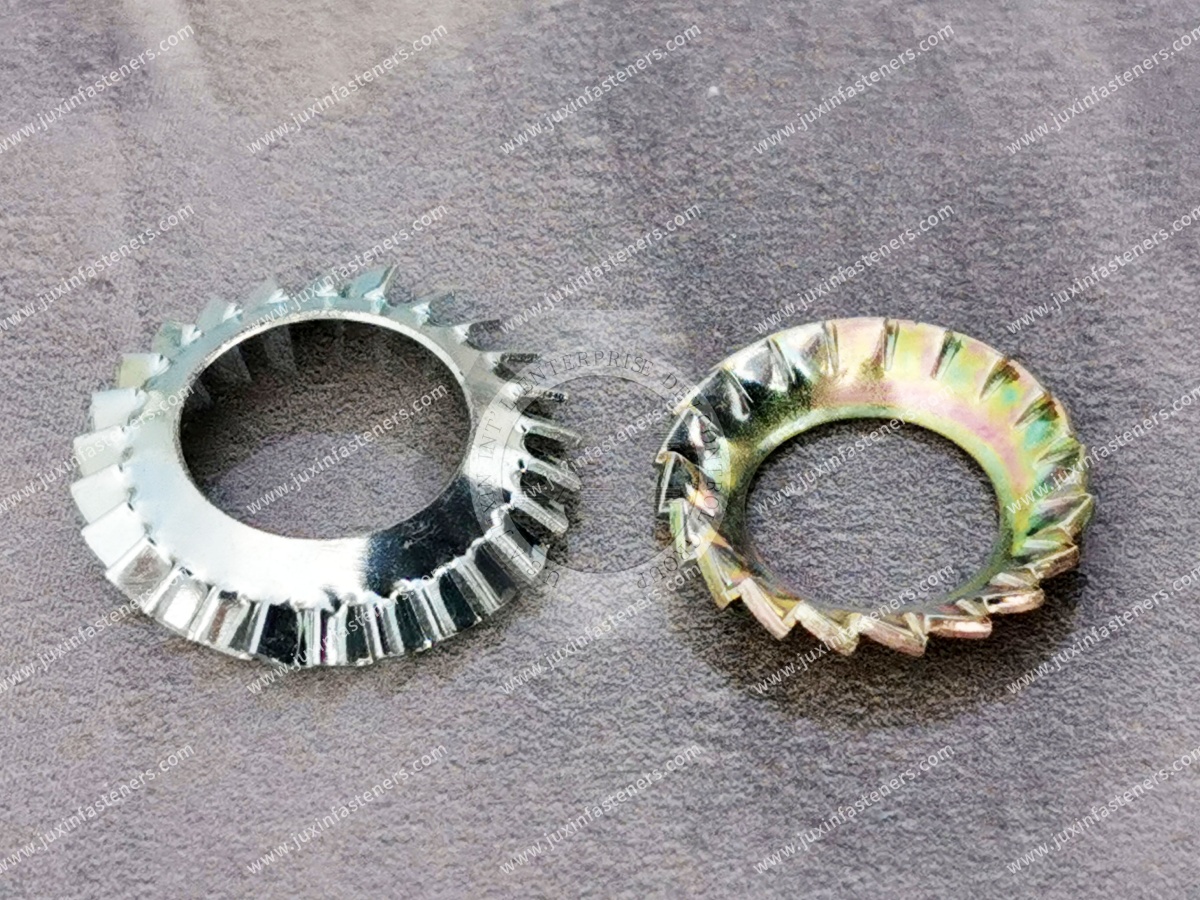
A serrated conical lock washer is a washer formed into a shallow conical profile and incorporating serrations that interact with adjacent contact surfaces when the fastener is tightened.
DIN 6798 identifies several serrated washer forms. Form V refers to the conical or countersunk configuration and is commonly associated with countersunk-head fastening applications.
This makes DIN 6798 V fundamentally different in geometry from a flat external serrated washer.
The washer should therefore be selected according to the fastener head and bearing interface—not simply according to nominal thread size.
One of the most common sourcing problems is treating every DIN 6798 serrated washer as the same component.
They are not.
| Washer Form | General Geometry | Typical Selection Consideration |
|---|---|---|
| DIN 6798 A | External serrations, generally flat form | Conventional bearing surfaces with suitable outside clearance |
| DIN 6798 J | Internal serrations | Applications where inward serration geometry better matches the bearing interface |
| DIN 6798 V | Conical / countersunk serrated form | Compatible countersunk fastener geometry |
The difference is important because changing from Form A to Form V changes the washer-to-fastener contact geometry.
A purchasing description that says only "DIN 6798 washer" may therefore be insufficient for an accurate quotation.
For OEM sourcing, the required form should be identified whenever possible.
Another useful distinction is between DIN 6798 V serrated lock washers and DIN 6796 conical spring washers.
Both can appear conical when viewed from the side, but they represent different washer categories.
DIN 6798 V is associated with a serrated Form V geometry, whereas DIN 6796 covers conical spring washers for bolted connections.
A conical profile alone is therefore not enough to identify a washer.
When replacing an existing component or sourcing from a photograph, engineers and buyers should also examine:
whether serrations are present;
where the serrations are located;
inside diameter;
outside diameter;
washer thickness;
cone geometry;
mating screw-head geometry;
material;
surface finish.
This prevents a visually similar but functionally different washer from being quoted as a substitute.
The washer operates through the interaction of several geometric features rather than through a single "locking" mechanism.
The washer is formed rather than completely flat. During assembly, the conical geometry interacts with the fastener and bearing interface as tightening progresses.
The serrations create multiple localized contact points.
Depending on the materials, hardness, coatings, and applied preload, these serrations can engage the adjacent surfaces and increase resistance to relative rotation.
For Form V applications, compatibility with the countersunk fastener geometry is particularly important.
The washer should seat in a way that supports the intended interface rather than creating unintended edge contact, interference, or uneven seating.
This is why washer selection should begin with the joint geometry—not with the assumption that any serrated washer can be installed beneath any screw head.
It can contribute to rotational resistance, but "lock washer" should not be interpreted as a guarantee against loosening.
Threaded-joint behavior depends on factors including:
fastener preload;
tightening method;
joint stiffness;
transverse movement;
vibration;
impact;
thermal cycling;
fastener material;
mating material;
washer material;
surface hardness;
coatings;
lubrication;
geometry.
If the application is exposed to severe vibration, cyclic transverse movement, or safety-critical loading, the complete joint should be validated.
A serrated conical washer is one fastening element. It should not be treated as a universal substitute for a validated locking system.
Countersunk screws create a different bearing interface from conventional hex-head, socket-head, or pan-head fasteners.
With a conventional flat washer, the contact geometry may not correspond to the angled underside of a countersunk head.
A Form V serrated washer addresses a different geometric requirement by providing a conical interface intended for compatible countersunk fastening arrangements.
For engineers, this means the relevant question is not simply:
"Which lock washer fits an M6 screw?"
A more useful question is:
"Which washer geometry is compatible with this M6 fastener head and the joint's bearing surface?"
That distinction can prevent poor seating and incorrect washer substitution.
Serrated washers depend on contact with adjacent surfaces. The behavior of the same washer can therefore change significantly depending on what it contacts.
Relevant surface conditions include:
bare carbon steel;
zinc-plated steel;
stainless steel;
aluminum;
painted steel;
powder-coated surfaces;
anodized aluminum;
hardened surfaces;
decorative coatings.
Serrations that engage readily with one material or coating may behave differently against another.
The washer should therefore be evaluated as part of the complete surface system.
They can locally mark or disturb a coating where the serrations contact the surface.
Depending on the assembly, this may be acceptable, intentional, or undesirable.
Potential considerations include:
localized coating penetration;
cosmetic marking;
exposure of base material;
corrosion behavior;
changes in friction;
changes in electrical contact;
coating debris after assembly.
For painted, powder-coated, plated, or anodized assemblies, engineers should determine whether serration engagement is compatible with the required surface protection and appearance.
This becomes especially important in outdoor equipment, electrical enclosures, transportation components, and other assemblies exposed to corrosive environments.
Material should be selected according to both mechanical requirements and environmental conditions.
Common commercial categories can include spring steels and stainless steels, depending on the applicable specification, product configuration, and customer requirement.
Spring-steel washer designs can provide the formed mechanical characteristics required by many serrated washer applications.
The actual material grade, processing condition, and hardness should follow the applicable specification or approved drawing rather than being assumed from the product name.
Stainless steel may be selected where corrosion resistance is important.
The exact stainless grade should be specified when material performance matters. A generic "stainless steel" description may not provide enough information for an OEM-controlled component.
Selection should consider:
operating environment;
mating materials;
corrosion exposure;
galvanic compatibility;
surface condition;
required mechanical behavior;
customer material specifications.
Steel serrated conical washers can be supplied with different surface treatments depending on project requirements.
Potential categories include:
zinc-based coatings;
phosphate-based finishes;
zinc-flake coating systems;
nickel-based finishes;
other customer-specified coatings.
Stainless versions may use material-appropriate surface finishing or passivation requirements where specified.
However, coating selection is not purely a corrosion decision.
Because the serrations form part of the functional contact interface, coating thickness, hardness, friction, and surface behavior can influence how the washer seats and engages.
For drawing-controlled OEM components, washer material and coating should therefore be reviewed together.
Reuse should not automatically be assumed.
This corrects a common oversimplification in product descriptions.
During tightening, the washer can experience deformation and its serrations can alter the mating surfaces or themselves be affected by contact.
After disassembly, the washer and contact interface may therefore no longer be in the same condition as before the first installation.
Whether reuse is acceptable depends on:
the applicable specification;
washer condition;
serration condition;
permanent deformation;
mating-surface condition;
assembly requirements;
quality-control requirements.
For controlled OEM production or performance-critical joints, a new washer can provide more predictable assembly conditions where the specification or quality plan requires replacement.
This washer type may be appropriate when:
the fastener geometry is compatible with a conical or countersunk washer interface;
localized serration engagement is acceptable;
the surrounding geometry accommodates the washer;
the selected materials provide suitable contact behavior;
the surface coating can tolerate the intended interaction;
the joint design benefits from increased resistance to relative rotation at the washer interface.
It can be considered in suitable mechanical and industrial assemblies rather than being limited to one industry.
A serrated conical washer may not be appropriate when:
the fastener head geometry is incompatible;
the mating surface must remain unmarred;
coating penetration is unacceptable;
the joint requires controlled structural preload without serrated surface interaction;
severe transverse vibration requires another validated locking strategy;
repeated disassembly is a major design requirement;
safety-critical retention depends on a defined locking system;
electrical contact must meet a specified resistance without application validation.
Alternative fastening strategies depend on the application and can include other serrated washer forms, conical spring washers, prevailing-torque nuts, serrated flange fasteners, wedge-locking systems, thread-locking compounds, or application-specific mechanical locking features.
The alternatives should not be considered automatically interchangeable.
Serrated conical washers can be used in compatible machine housings, brackets, guards, adjustment mechanisms, and equipment assemblies where countersunk fasteners and serrated contact are appropriate.
Automation equipment frequently combines compact mechanical assemblies, sensors, brackets, actuators, housings, and control components.
Where countersunk screws are used to maintain a flush or low-profile assembly, Form V washer geometry may be relevant if the joint design also calls for serrated surface engagement.
Electrical cabinets, control equipment, mounting systems, and electronic enclosures can include countersunk fastening points.
Material compatibility, coatings, corrosion requirements, and any electrical bonding requirements should be evaluated separately.
Panels, housings, fans, brackets, control assemblies, and related equipment can contain countersunk fasteners where conical serrated washer geometry may be suitable.
Suitable brackets, housings, interior systems, electrical assemblies, accessories,
and other non-critical fastening locations may use serrated conical washers where approved by the relevant design requirements.
The washer should not automatically be specified for safety-critical automotive joints solely because the assembly experiences vibration.
DIN 6798 V and drawing-controlled serrated conical washers can also appear in equipment where compact countersunk fastening and controlled surface engagement are required.
For engineers evaluating a serrated conical lock washer, the following decision path can help define the requirement.
Determine nominal size, head style, thread system, and underside geometry.
If the fastener uses countersunk geometry, evaluate whether Form V corresponds to the intended bearing arrangement.
Do not specify only "DIN 6798."
Confirm whether the application requires Form A, J, V, or another washer design.
Check substrate material, hardness, plating, paint, powder coating, anodizing, and other finishes.
Determine whether the washer is being selected for rotational resistance, countersunk seating, surface engagement, assembly retention, or another design objective.
Consider vibration, thermal cycling, corrosion exposure, maintenance, disassembly, and other operating conditions.
Where loosening resistance or another functional characteristic is critical, testing should represent the actual fastener, washer, mating surfaces, coatings, tightening process, and service conditions.
For sourcing teams, "serrated conical washer" may not provide enough information for accurate supplier comparison.
Useful quotation information can include:
DIN 6798 V or other applicable specification;
nominal fastener size;
washer form;
material;
surface finish;
dimensional requirements;
mating fastener geometry;
corrosion requirements where applicable;
drawing or existing sample;
inspection requirements;
packaging requirements;
order quantity or estimated annual demand.
These factors can influence material sourcing, tooling, forming operations, heat treatment where applicable, coating, inspection, MOQ, lead time, packaging, and unit cost.
A standard DIN 6798 V washer may satisfy many applications, but OEM projects sometimes require drawing-controlled variants.
Custom development may be appropriate when the project requires:
non-standard inside diameter;
modified outside diameter;
different cone geometry;
modified serration geometry;
application-specific thickness;
special material;
special coating;
non-standard fastener-head interface;
drawing-controlled tolerances;
replacement of an existing proprietary washer.
JUXIN FASTENERS supports standard and custom washer sourcing based on customer drawings, specifications, samples, and available application information.
Legacy equipment frequently creates a different sourcing problem: the buyer has a washer but does not know its standard.
That does not need to stop the RFQ.
A physical sample can be particularly useful for identifying:
inside diameter;
outside diameter;
thickness;
cone angle or formed profile;
serration location;
approximate tooth geometry;
material;
coating;
mating fastener geometry.
Photographs with basic dimensions can also provide a useful starting point.
JUXIN FASTENERS can review the available information and determine which additional dimensions or specifications may be needed before quotation or sample development.
Have a drawing? Send the drawing.
Have a 3D CAD model? Send the available CAD data.
Have an existing washer? A physical sample can be used as a starting point.
Only have photographs and key dimensions? Send what is currently available.
Know the DIN designation but not every material or coating detail? Tell us the standard, size, application, and current requirement.
Still defining the component? Describe the mating screw, assembly, material, environment, and expected function.
JUXIN FASTENERS can review the available information and identify the additional details needed for quotation, manufacturing feasibility, sample development, or production sourcing.
A serrated conical lock washer combines a formed conical profile with serrated contact features.
The geometry allows it to work with compatible fastener and bearing interfaces while the serrations create localized surface engagement.
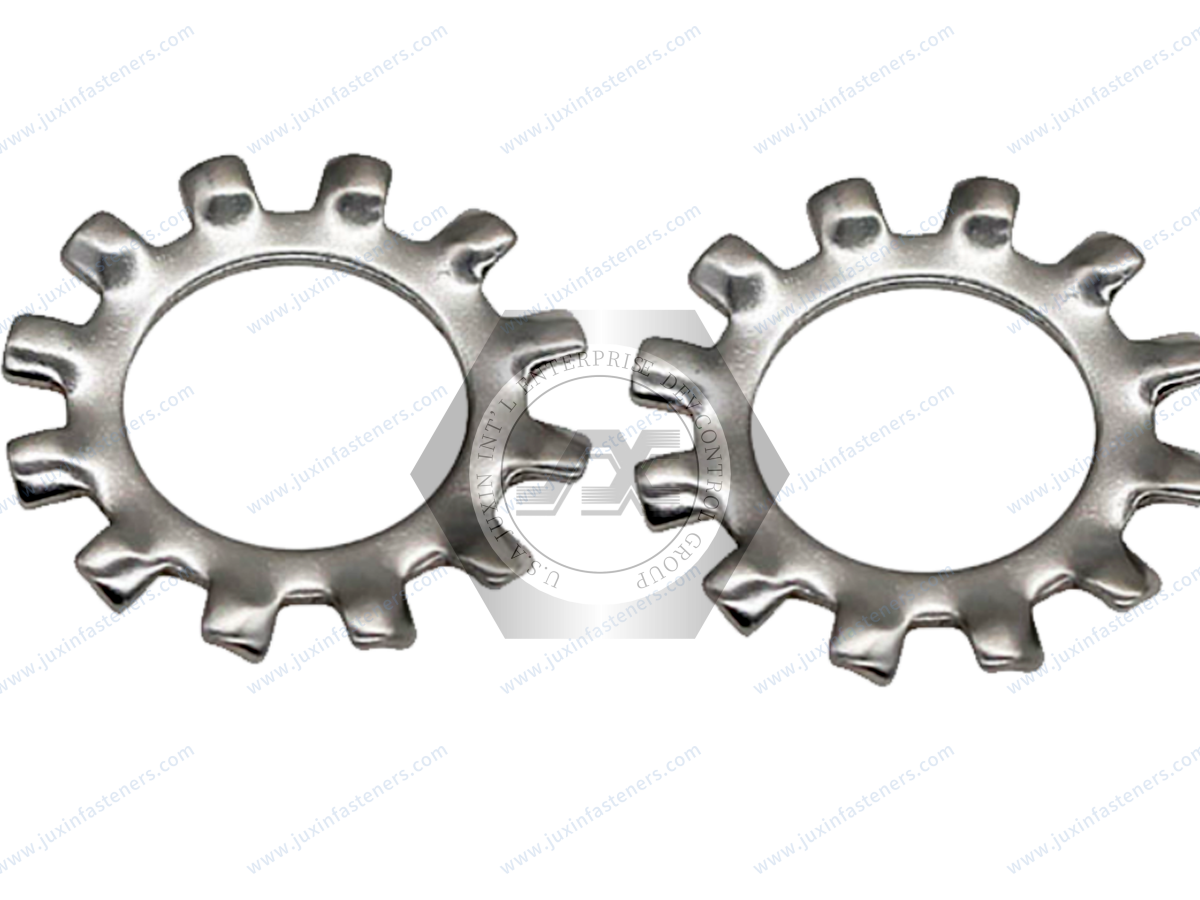
DIN 6798 V identifies the Form V serrated lock washer, a conical or countersunk configuration associated with compatible countersunk fastening applications.
DIN 6798 A is an external-serrated washer form, while DIN 6798 V uses a conical or countersunk geometry. They should not be treated as interchangeable because their fastener-head and bearing interfaces differ.
No. DIN 6798 V refers to a serrated Form V washer, while DIN 6796 covers conical spring washers for bolted connections. Similar-looking conical profiles do not make the products equivalent.
DIN 6798 V geometry is associated with countersunk fastening arrangements. Actual compatibility should still be verified against the screw head, washer dimensions, and joint design.
They can contribute to resistance against relative rotation, but they do not guarantee that a threaded joint cannot loosen. Joint preload, transverse movement, vibration, mating surfaces, coatings, and installation conditions all affect performance.
The serrations can locally disturb coatings where they contact the mating surface. Engineers should evaluate whether this is acceptable for the corrosion, appearance, and functional requirements of the assembly.
Reuse should not be assumed. The washer and its serrations may be altered during installation, and the mating surface may also change.
Reuse should follow the applicable specification and assembly requirements.
Yes. JUXIN FASTENERS supports drawing-based and sample-based development of custom fastening components.
Drawings, CAD data, samples, photographs, dimensions, or available application information can provide the starting point for review.
Yes. Send the physical sample, photographs, available dimensions, mating fastener information, or other technical data you have.
JUXIN FASTENERS can review the information and identify what else may be required for evaluation.
A serrated conical lock washer should be selected as part of the complete fastened joint—not simply by matching a thread size.
The washer form, countersunk fastener geometry, mating material, surface coating, corrosion environment, assembly process, and service conditions all influence the final selection.
JUXIN FASTENERS supports global OEM, ODM, Tier 1, Tier 2, engineering, procurement, sourcing, and supplier-development teams with standard and custom washers and application-specific fastening components.
Whether your requirement is a DIN 6798 V serrated conical lock washer, a drawing-controlled special washer,
or a legacy component that needs to be developed from an existing sample, send us the technical information currently available.
We can support specification review, drawing review, manufacturing feasibility evaluation, sample development, quotation, and production sourcing.
Email: info@juxinfasteners.com
Website: www.juxinfasteners.com
 MORE NEWS
Sep. 27, 2026
Sep. 27, 2026
Sep. 27, 2026
Contact Us
Tel.:
+86 020 8621 0320
+86 020 3121 6067
E-mail:
Technical Support:
Navigation
SEND INQUIREY