
Call Us
+86 136 6007 9809
Call Us
+86 136 6007 9809

Sep. 12, 2026
Automotive interior development brings together many different engineering requirements, including component fit, assembly efficiency, appearance, serviceability, material compatibility,
and control of unwanted panel movement or noise. Within modern vehicle interiors, assemblies such as door cards, instrument panels, center consoles, garnish panels,
access covers, and overhead modules rely on a range of specialized fastening components.
Sourcing these components requires more than matching a generic product name or catalog image. The appropriate fastener depends on the mating components,
mounting interface, panel thickness, retention mechanism, material behavior, installation method, serviceability, and production requirements.
JUXIN FASTENERS is an OEM-oriented supplier of customer-specific, non-standard, and application-specific automotive fastening components.
The company supplies both polymer and metal fastening components according to customer drawings, specifications, material requirements, mating interfaces, application conditions, and production requirements.
For automotive interior trim, the key principle is straightforward:
The fastener should be selected as part of the joint, not as an isolated product.
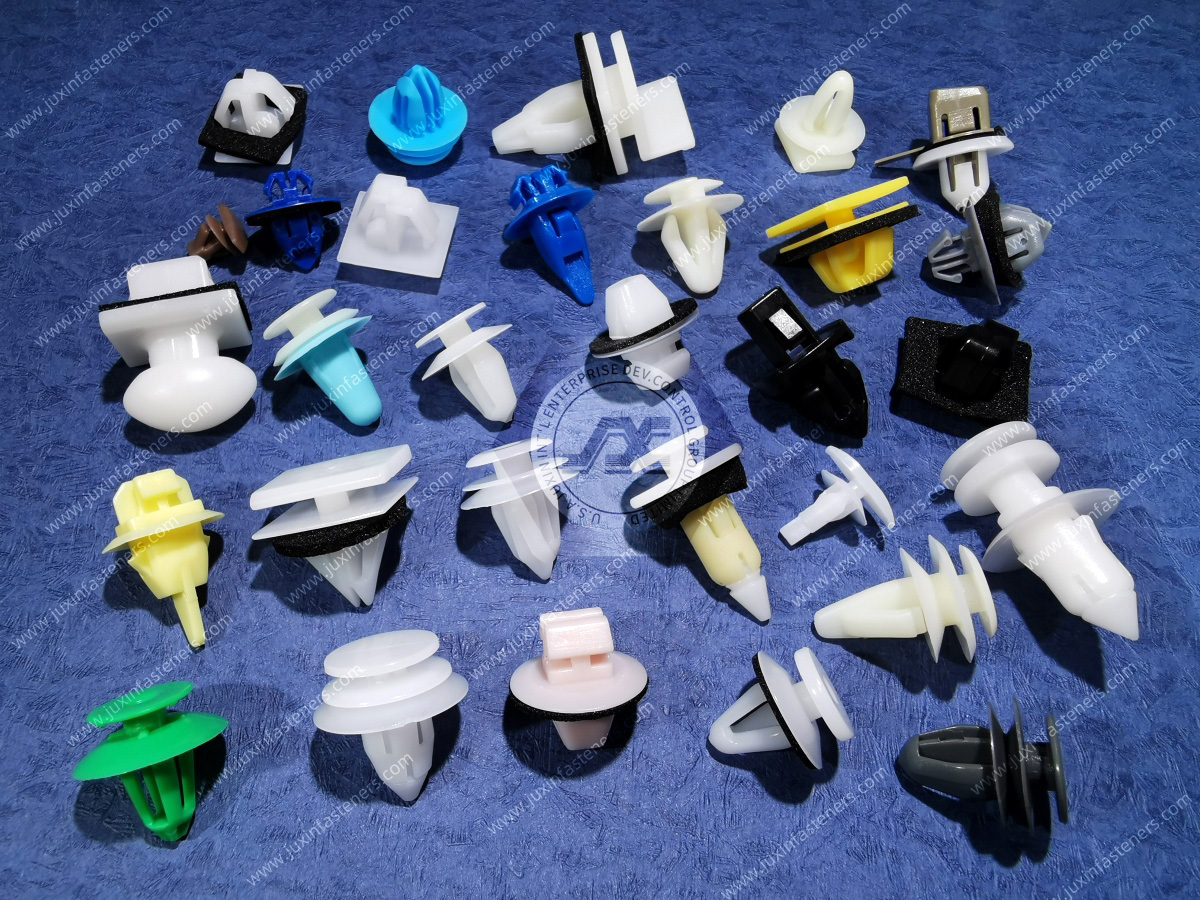
Automotive interior trim fasteners are mechanical fastening components used to attach interior panels, decorative trim, functional covers,
housings, and related components to vehicle structures or carrier components.
They can include:
Push-type retainers
Plastic trim clips
Snap-fit retainers
Screw-type retainers
Plastic push rivets
Plastic screws
Plastic nuts
Washers
Spacers
Customer-specific metal screws
Other application-specific fastening components
The correct fastener architecture depends on how the interior component must be positioned, retained, installed, removed, and integrated with its mating structure.
For example, a door card may use multiple plastic retainers around its perimeter while using screw-type fastening at selected mounting points.
A dashboard access panel may require a serviceable screw-retainer interface, while a decorative garnish may use a snap-fit or push-type retaining mechanism.
The engineering requirement is therefore not simply:
“Which trim clip do we need?”
It is:
“What fastening interface is required for this specific interior assembly?”
A vehicle interior contains many different panel constructions, mounting interfaces, and assembly requirements.
A universal “trim clip” approach may therefore be unsuitable when the application changes.
Interior components can include rigid molded panels, flexible trim surfaces, composite structures, carrier panels, decorative components, and other material constructions.
The fastener must interact appropriately with the specific panel and supporting structure.
Interior attachment points may use:
Circular holes
Slots
Formed openings
Structural ribs
Brackets
Captive mounting features
Other customer-specific interfaces
The mounting interface can determine the required fastener geometry.
Some interior components may primarily be installed during vehicle assembly, while others may require later access for inspection, maintenance, wiring, electronics, or service.
A serviceable panel may therefore require a different fastening architecture from a component intended for limited removal.
Depending on the assembly design, a component may require:
Direct push-in installation
Snap-fit engagement
Sliding engagement
Screw installation
A combination of locating and fastening operations
Installation direction and operator accessibility can affect fastener selection.
Interior joints may connect:
Plastic to metal
Plastic to plastic
Composite to metal
Polymer components to other carrier structures
Material pairing can influence dimensional behavior, retention, friction, and assembly characteristics.
For a broader overview of automotive polymer fastening components, see Automotive Plastic Fasteners: Types, Applications & OEM Sourcing Guide.
Different interior applications use different fastening architectures.
Push-type retainers are commonly used for panel and trim attachment where a push-in retention mechanism is appropriate.
Depending on the design, a push retainer may incorporate:
A head or flange
An expandable or flexible shank
Retention ribs
Barbs or other engagement features
A central pin or related locking feature
During installation, the component is inserted into the mounting interface and the retention mechanism engages the mating panel or structure.
Engineers should evaluate mounting-hole dimensions, panel thickness, grip range, retention geometry, installation direction, insertion requirements, and serviceability.
For a more detailed discussion, see Push-Type Retainers for Automotive Applications: Engineering & Sourcing Guide.
Automotive plastic trim clips cover a broad range of polymer fastening designs used to locate and retain interior panels and trim components.
Depending on the design, they may use:
Flexible retention fingers
Barbed or ribbed features
Snap-fit elements
Flange or head retention
Locating features
Application-specific engagement geometry
They can be used in door trim, garnish panels, instrument-panel trim, console components, and other interior applications.
Their suitability depends on the actual mating interface rather than appearance alone.
See Automotive Trim & Moulding Clips: Engineering, Retention & OEM Sourcing Guide for additional information about clip geometry and retention.
Screw-type retainers combine a retaining component with a screw interface.
Depending on the design, the retainer may incorporate:
A pre-formed internal thread
A thread-forming interface
A screw-receiving sleeve
A flange
A snap-in feature
An expandable feature
An anti-rotation feature
The actual architecture depends on the application.
Screw-type retainers can be considered where a serviceable threaded fastening interface is required for an interior panel or component.
Further engineering information is available in Automotive Screw-Type Retainers: Engineering, Thread Integration & OEM Sourcing Guide.
Plastic push rivets can be used where a push-in retention mechanism is appropriate for trim panels, covers, ducts, and other lightweight interior components.
Depending on the design, a push rivet may use a center pin, expandable body, or other retention mechanism.
The mounting hole, panel thickness, retention geometry, installation method, and service requirements should be evaluated before selecting the component.
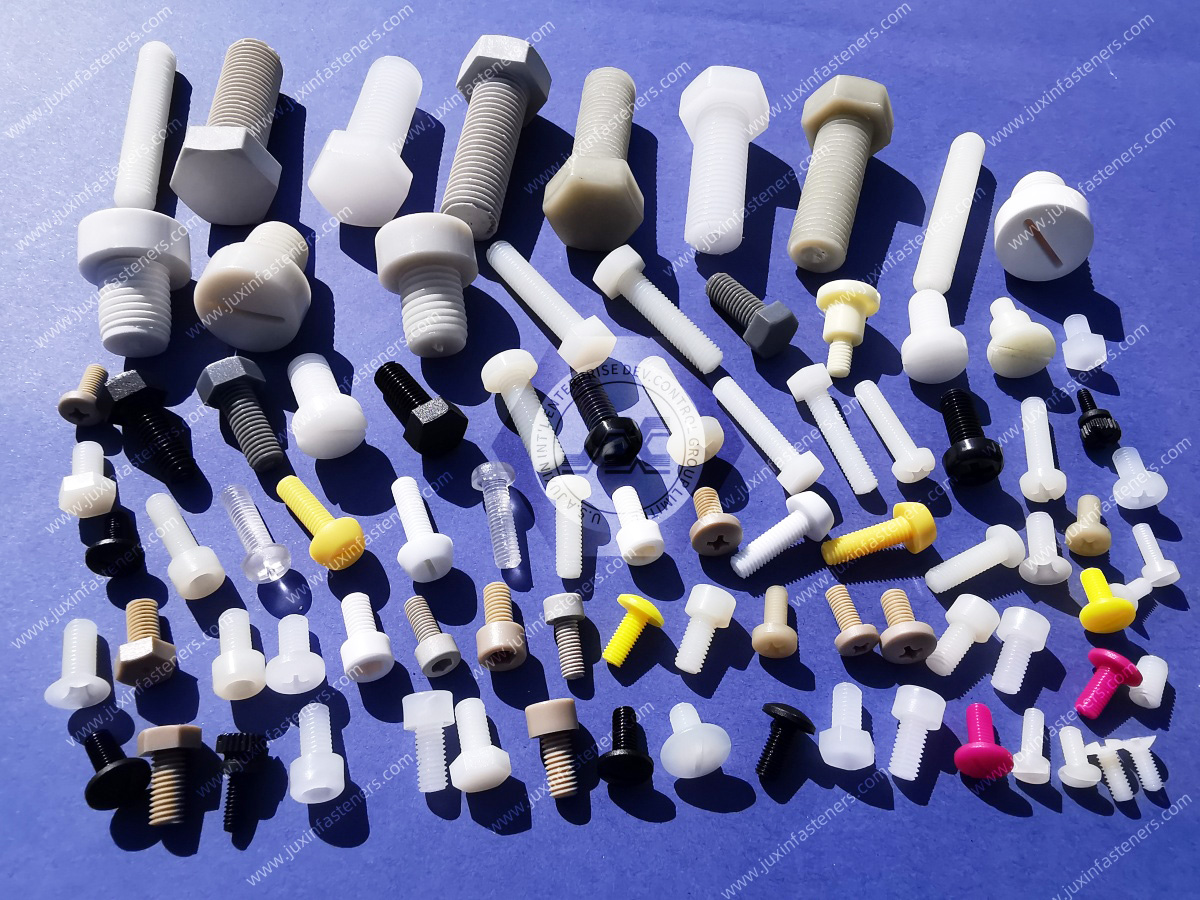
Polymer components can also include:
Plastic screws
Plastic bolts
Plastic nuts
Plastic washers
Plastic spacers
Application-specific polymer components
These may be considered where polymer material characteristics are compatible with the joint and application requirements.
Material selection should be based on the actual application rather than an assumption that polymer components are automatically interchangeable with metal fasteners.
Door trim assemblies, often referred to as door cards, combine decorative surfaces with functional components such as armrests, storage areas, speaker grilles, switches, handles, and electronic interfaces.
Fastening requirements can therefore vary within the same door assembly.
A door card may use multiple trim retainers for distributed panel attachment while selected locations may use screw-type retainers or customer-specific metal screws.
Important engineering considerations can include:
Mounting-hole geometry
Panel thickness
Grip range
Retention mechanism
Installation direction
Material pairing
Serviceability
Assembly accessibility
Environmental exposure within the door system
Door assemblies can also involve plastic-to-metal joints where a polymer retainer interacts with a metal carrier panel.
The fastener should be evaluated together with the mating components and the intended assembly process.
For a broader application discussion, see Automotive Door Systems: Fastening Engineering, Retainers & OEM Sourcing Guide.
Instrument panels contain a combination of trim components, carrier structures, electronics, ducts, brackets, displays, and other functional elements.
Different parts of the dashboard can therefore require different fastening architectures.
Potential components include:
Plastic retainers
Trim clips
Screw-type retainers
Customer-specific screws
Nuts
Washers
Spacers
Other application-specific fastening components
Engineers should consider mounting geometry, panel construction, material pairing, installation direction, serviceability, and thermal exposure.
Interior components can experience temperature variation during vehicle operation and storage. Polymer material selection should therefore consider temperature-dependent behavior, dimensional changes, creep, stress relaxation, and the geometry of the retaining feature.
Where electronics or service-access components are involved, the fastening design may also need to accommodate assembly access and future removal.
The exact requirement should be established from the customer's application and engineering specification.
Center consoles, pillar garnishes, headliner trim, overhead modules, floor-tunnel trim, and other interior components can have different installation constraints.
These applications may combine visible decorative surfaces with concealed mounting interfaces.
Depending on the design, fastening may involve:
Snap-fit clips
Push retainers
Screw-type retainers
Plastic screws
Customer-specific metal screws
Locating features
Spacers
Other application-specific components
A console side panel, for example, may first require locating features to establish position and then use clips or screws to complete retention.
This illustrates an important engineering principle:
Locating and fastening are not necessarily the same function.
A component may use one feature to position the trim and another to provide retention.
When sourcing such components, engineers should provide the supplier with the relevant mating geometry rather than relying only on the generic component name.
A major engineering consideration in interior trim is the relationship between the fastener and the materials being joined.
A polymer retainer may engage a steel or aluminum panel.
Because polymers and metals can respond differently to temperature changes and mechanical loading, the joint should be evaluated for:
Differential dimensional change
Retention geometry
Mounting-hole condition
Panel thickness
Material stiffness
Fastener flexibility
Installation requirements
Serviceability
The fastener geometry and polymer grade can influence how the component behaves within the joint.
Plastic-to-plastic assemblies can involve different polymer families, different stiffness levels, and different molded geometries.
Important considerations may include:
Mating geometry
Draft and assembly direction
Retention feature geometry
Material compatibility
Deflection
Insertion force
Extraction requirements
Dimensional stability
The same fastener should not automatically be assumed suitable for both plastic-to-metal and plastic-to-plastic applications.
For additional selection guidance, see How to Select Automotive Plastic Fasteners for Body, Trim and Interior Applications.
Mounting-hole geometry is one of the most important factors in automotive interior fastener selection.
A component may have the correct overall appearance but still be unsuitable if the mounting interface differs.
Mounting interfaces may be circular, square, rectangular, slotted, molded, stamped, or otherwise application-specific.
The fastener's retention features must correspond to the actual opening.
The combined thickness of the mating components affects the required functional length and grip range.
For example, a clip intended for a thin trim panel may not be suitable when an additional carrier or reinforcement layer changes the total stack-up.
Grip range describes the usable thickness range that a retaining component can accommodate.
The required grip range should be established from the actual assembly stack-up rather than estimated from the product category.
The area surrounding the mounting hole can also influence fastener selection.
Nearby ribs, edges, brackets, wiring, reinforcement features, and other components may affect installation access and fastener geometry.
For a deeper engineering discussion, see Automotive Plastic Fastener Design: Hole Size, Retention & Mating Geometry.
Material selection should be based on both the fastening function and the application environment.
Nylon / PA6 / PA66 may be considered for automotive retainers, clips, and other polymer fastening components where its combination of mechanical behavior, flexibility, and application compatibility is appropriate.
However, Nylon is moisture-sensitive, and its dimensional and mechanical behavior can change with environmental conditioning.
The specific polymer grade, component geometry, wall thickness, retention deflection, and application conditions all matter.
POM / Acetal may be considered where the application requires characteristics such as dimensional stability, stiffness, or favorable friction behavior.
Its suitability depends on the actual component design and mating interface.
PP may be considered for applications where its material characteristics, flexibility, chemical compatibility, and dimensional behavior are appropriate.
Again, the exact polymer grade and fastener geometry should be evaluated together.
Metal components may be appropriate where the joint requires a threaded interface, specific mechanical properties, or an application-specific geometry that is better suited to metal.
Potential materials can include carbon steel, stainless steel, or aluminum alloys depending on the component and customer requirements.
For a more detailed material comparison, see Nylon vs Other Plastics for Automotive Retainers: Engineering Performance Guide.
Interior trim is assembled during vehicle production, but some components may also require later access.
Serviceability should therefore be considered during the initial fastening design.
Engineers may need to establish an acceptable balance between installation effort and retention requirements.
Insertion and extraction behavior depends on the fastener geometry, mating interface, material, hole condition, and installation method.
Universal force values should not be assumed.
Where a panel is intended to be removed and reinstalled, the retention mechanism and mating interface should be evaluated for the expected service conditions.
A fastening system designed primarily for initial assembly may not be appropriate for repeated service.
Fasteners located in restricted spaces may require specific installation directions or tools.
The assembly process should therefore be considered together with the fastener.
This can be particularly important for instrument panels, door modules, electronic access panels, and console assemblies.
Standard catalog fasteners can be appropriate when the application matches an established configuration.
However, customer-specific components may be considered when the application involves requirements such as:
Unusual mounting-hole geometry
Special panel thickness
Specific grip range
Unique retention geometry
Restricted installation direction
Special head geometry
Customer-defined material
Customer-defined color
Specific screw interface
Application-specific dimensional requirements
Customer-specific packaging or identification
A standard product should not be rejected simply because it is standard.
The correct engineering question is whether the standard configuration satisfies the customer's actual interface and functional requirements.
If it does not, a customer-specific component may be the more appropriate sourcing route.
Customer-specific automotive fasteners are defined by the application rather than by a generic product name.
The technical definition may include:
2D engineering drawing
3D CAD model
Mating component
Mounting hole or slot
Panel thickness
Grip range
Material
Color
Geometry
Tolerance
Installation method
Service requirements
Environmental conditions
Production quantity
This information allows the supplier to evaluate the component as part of the customer's actual assembly.
For JUXIN FASTENERS, the customer-specific sourcing process is based on the supplied drawing, specifications, material requirements, application conditions, and production requirements.
The component geometry and material should be established according to the customer's specific assembly requirements.
A structured selection process helps engineers and procurement teams avoid sourcing a fastener before the joint has been adequately defined.
Identify whether the component is used in:
Door trim
Door card
Dashboard
Instrument panel
Center console
Garnish panel
Access panel
Electronic module
Headliner
Other interior assembly
Identify what the fastener is connecting.
For example:
Plastic-to-metal
Plastic-to-plastic
Composite-to-metal
Polymer component to carrier structure
Establish:
Hole
Slot
Bracket
Rib
Stud
Other mounting feature
Determine whether the application requires:
Push retention
Snap-fit retention
Clip retention
Screw fastening
Locating
Spacing
A combination of functions
Confirm the actual mounting interface and relevant dimensional requirements.
Determine the actual material stack-up and required grip range.
Specify:
Head
Shank
Retention features
Thread
Flange
Locating features
Other application-specific geometry
Evaluate the appropriate polymer or metal based on the application.
Determine whether the component will be installed manually, with tooling, or through another defined assembly process.
Establish whether the component is intended for one-time assembly, limited removal, or repeated service.
Review relevant:
Temperature
Humidity
Moisture
Chemical exposure
Material compatibility
Other application-specific environmental conditions
Consider:
Prototype quantity
Trial quantity
Production volume
Delivery schedule
Packaging
Labeling
Documentation
This sequence helps connect engineering selection with procurement execution.
Engineering and procurement teams often evaluate the same component from different perspectives.
Engineers may focus on:
Geometry
Material
Dimensional tolerances
Mating interface
Retention mechanism
Installation
Environmental conditions
Serviceability
Functional validation
Procurement and supply chain teams may focus on:
Drawing revision
Supplier manufacturing route
MOQ
Annual volume
Lead time
Packaging
Labeling
Documentation
Material traceability
Quality requirements
Supply continuity
Commercial terms
A successful sourcing project requires these two sets of requirements to be aligned.
For example, an engineer may specify a particular grip range while procurement needs to ensure that the supplier quotes the same configuration, quantity, packaging, and quality requirements.
A customer-specific interior trim fastener project can generally follow a structured sourcing path.
The customer provides the latest available engineering drawing and, where applicable, 3D CAD data.
The supplier reviews the available information, including the mating interface, material, geometry, and application requirements.
The appropriate production route depends on:
Component geometry
Material
Tolerance
Production quantity
Tooling requirements
Secondary operations
Customer specifications
The exact manufacturing process should be established according to the component rather than assumed from its product name.
Where required, initial samples can be produced for customer evaluation.
Depending on the customer's requirements, evaluation may consider:
Critical dimensions
Thread
Mounting interface
Retention
Material
Assembly fit
Surface finish
Other customer-defined requirements
The approved drawing, sample, and quality requirements establish the production basis.
Production is then arranged according to the agreed specification and production requirements.
Finished components are inspected according to the applicable requirements and packaged according to the agreed supply specification.
This workflow connects the engineering drawing with the eventual production component without assuming that every automotive fastener follows exactly the same manufacturing route.
Automotive interior trim is one part of a broader fastening ecosystem.
JUXIN FASTENERS works with customer-specific and application-specific fastening requirements across multiple automotive systems.
Representative application areas include:
Customer-specific stainless steel solid rivets, shoulder rivets, step rivets, and other linkage fastening components may be used depending on the mechanism.
Applications may include rivet nuts, customer-specific aluminum alloy fasteners, and other application-specific metal fastening components.
Engineering considerations can include corrosion exposure, mating materials, thread requirements, surface treatment, assembly torque, and environmental conditions.
Potential customer-specific components include:
Shift shafts
Shift pins
Rolling shafts
Fixed pivot shafts
Swing or pivot shafts
Shift sliding columns
Rocker pivot shafts
Ball pins
Applications may include customer-specific shafts, pins, pivot components, guide-related components, and mechanical fastening components depending on the roof mechanism.
Potential fastening components include:
Weld nuts
Flange weld nuts
Rivet nuts
Metal self-locking nuts
Other customer-specific structural fastening components
The exact component and engineering requirements depend on the structural design and customer validation requirements.
Potential components include:
Seat mounting hardware
Pins
Retainers
Structural fastening components
Other application-specific hardware
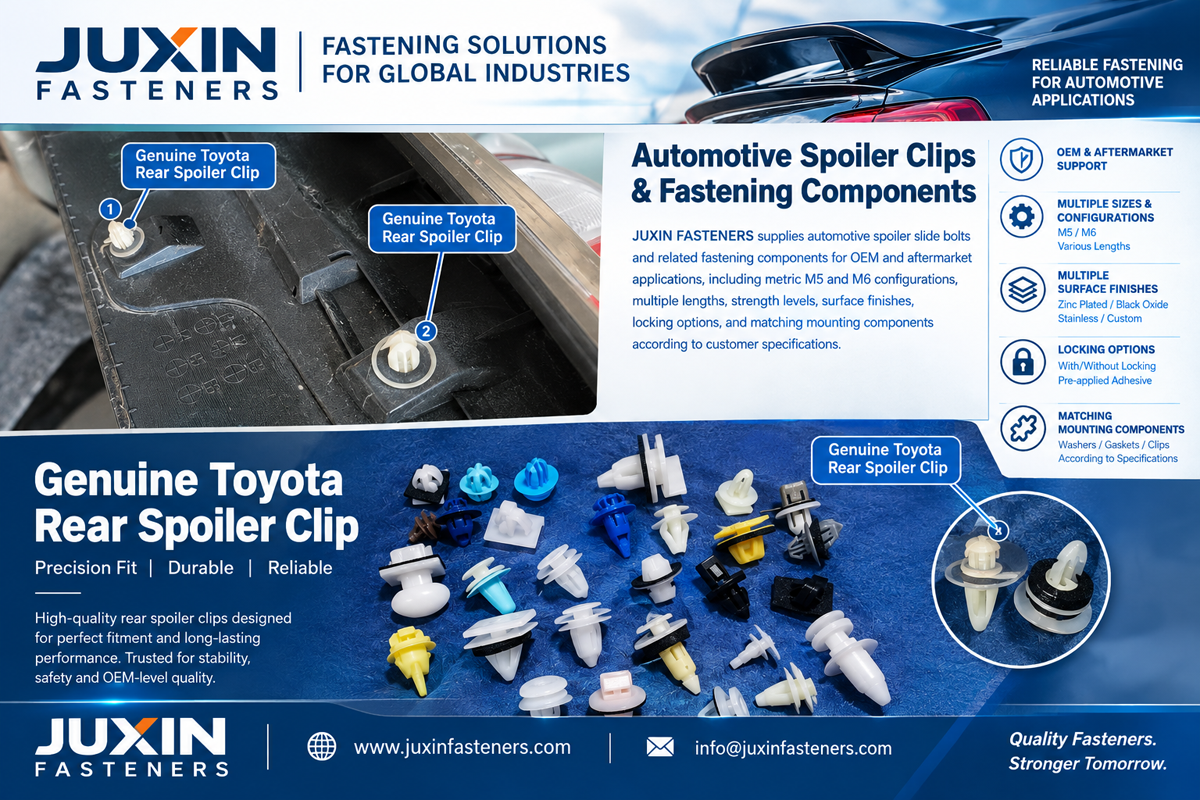
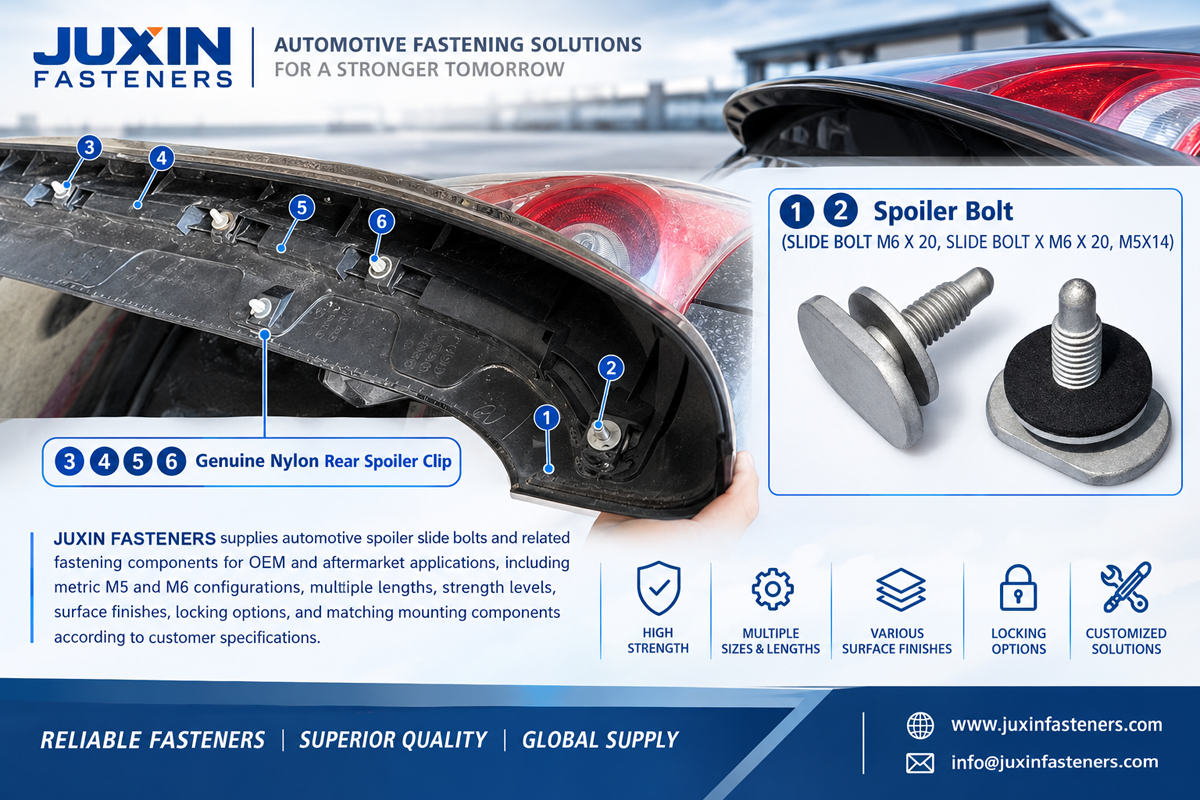
Rear spoiler applications can combine polymer and metal fastening components, including Nylon Rear Spoiler Clips and Automotive Spoiler Slide Bolts.
These examples demonstrate that JUXIN FASTENERS' automotive scope is not limited to a single clip category.
The common sourcing principle remains:
Application → Interface → Function → Geometry → Material → Assembly → Production Requirement
A rear spoiler provides a useful example of how different fastening components can work within one automotive application.
A customer-specific rear spoiler assembly may combine:
Nylon Rear Spoiler Clip
Automotive Spoiler Slide Bolt
Mounting bracket
Spoiler structure
Mounting slot, track, or channel
The Nylon Rear Spoiler Clip may provide locating, retaining, positioning, spacing, or fastening-interface functions depending on its design.
The Automotive Spoiler Slide Bolt is a metal component with special head geometry intended to engage the mating mounting interface.
Confirmed JUXIN FASTENERS configurations include:
M5 and M6
Representative M6 × 14
Representative M6 × 20
Applicable property classes 8.8 and 10.9
Color Zinc
Zinc-Nickel Alloy
Black Zinc
Certain configurations may include a pre-applied thread-locking patch
The assembly concept can be described as:
Slide → Position → Engage → Tighten
The special head geometry may engage a mounting slot, track, or channel. Any anti-rotation effect depends on the actual mating geometry.
This example demonstrates why automotive fastening should be considered as a complete system rather than as isolated product categories.
Searching only for “trim clip” may produce many visually similar products with different mounting interfaces.
A small difference in the mounting interface can affect compatibility.
The fastener must accommodate the actual material stack-up and required grip range.
For polymer components, material behavior is part of the engineering definition and should be considered before finalizing the component.
Appearance does not establish functional compatibility.
A clip may be geometrically suitable but difficult to install if its engagement path does not match the assembly process.
A component that is acceptable for initial assembly may not be appropriate for repeated removal and installation.
The supplier should manufacture against a clearly identified customer drawing revision.
Procurement teams should confirm that suppliers are quoting equivalent specifications before comparing prices.
A useful automotive interior trim fastener RFQ should include, where applicable:
2D engineering drawing
3D CAD
Drawing revision
Material specification
Polymer grade or metal specification
Color
Mounting-hole dimensions
Mounting-slot dimensions
Panel thickness
Grip range
Critical dimensions
Retention requirements
Installation method
Serviceability requirements
Surface treatment where applicable
Environmental requirements
Prototype quantity
Estimated annual volume
Packaging requirements
Labeling requirements
Quality documentation
Traceability requirements
Where a specific performance requirement is important, it should be clearly defined in the engineering or purchasing specification rather than left to supplier interpretation.
JUXIN FASTENERS is an OEM-oriented supplier of customer-specific, non-standard, and application-specific automotive fastening components.
The scope can include:
Automotive plastic retainers
Push-type retainers
Automotive trim clips
Plastic push rivets
Screw-type retainers
Plastic screws
Plastic nuts
Plastic washers
Plastic spacers
Customer-specific metal screws
Nuts and washers
Rivet nuts
Weld nuts
Stainless steel rivets
Shoulder and step rivets
Precision pins and shafts
Other application-specific automotive fastening components
The appropriate component depends on the customer's actual application and specification.
For an interior trim project, the sourcing basis can be established from:
Customer Drawing → Mating Interface → Material → Geometry → Application → Assembly → Production Requirements
JUXIN FASTENERS manufactures customer-specific components according to customer drawings, specifications, material requirements, application conditions, and production requirements.
This approach allows procurement and engineering teams to evaluate the component based on its actual application rather than relying only on a generic catalog description.
Automotive interior trim fasteners are mechanical components used to attach interior panels, trim, covers, garnish components, and related assemblies to their mating structures.
They can include plastic clips, push-type retainers, screw-type retainers, plastic push rivets, screws, nuts, washers, spacers, and other customer-specific components.
Common categories include push-type retainers, snap-fit trim clips, screw-type retainers, plastic push rivets, and other application-specific retaining components.
The appropriate type depends on the mounting interface, panel thickness, retention requirement, installation method, and serviceability.
Start with the joint rather than the product name.
Define:
Mating Components → Mounting Interface → Hole / Slot Geometry → Panel Thickness → Grip Range → Retention Function → Material → Installation Method → Serviceability
Then select the appropriate fastener architecture.
The most useful information normally includes the latest 2D drawing, 3D CAD where available, drawing revision, material, mounting-hole geometry, panel thickness,
grip range, retention requirements, installation method, environmental conditions, expected quantity, quality requirements, and packaging requirements.
Not necessarily.
Two clips can look similar while having different hole requirements, grip ranges, retention geometry, materials, installation directions, or other functional characteristics.
Interchangeability should therefore be confirmed from the actual engineering interface and requirements.
Panel thickness affects the required grip range and the relationship between the retaining features and the mating panel.
If the total material stack-up changes, the original clip may no longer provide the intended interface.
A customer-specific component may be considered when the application requires a geometry, material, grip range, mounting interface, installation method,
color, or other requirement that is not adequately addressed by an available standard configuration.
A push retainer generally relies on a push-in retention mechanism, while a screw-type retainer incorporates a screw interface.
The appropriate architecture depends on the joint function, installation method, serviceability, mating components, and customer requirements.
Nylon / PA, POM / Acetal, and PP are among the polymer families that may be considered for automotive fastening components.
The appropriate material depends on the component geometry, retention mechanism, environmental conditions, dimensional requirements, and application.
JUXIN FASTENERS manufactures customer-specific automotive fastening components according to customer drawings, specifications, material requirements, application conditions, and production requirements.
The appropriate component and production route depend on the specific project.
For OEM buyers, procurement managers, supplier-development teams, supply chain managers, and automotive engineers, the most effective starting point is a complete definition of the fastening interface.
A practical RFQ package can include:
Application + Drawing + CAD + Mating Interface + Material + Geometry + Panel Thickness + Grip Range + Assembly Method + Quantity + Quality Requirements + Packaging
JUXIN FASTENERS can evaluate customer-specific automotive interior fastening requirements based on the available engineering and purchasing information.
For an OEM or automotive component sourcing project:
Email: info@juxinfasteners.com
Website: www.juxinfasteners.com
JUXIN FASTENERS — Customer-Specific Automotive Fastening Components for OEM Applications
 MORE NEWS
Sep. 22, 2026
Sep. 22, 2026
Sep. 22, 2026
Contact Us
Tel.:
+86 020 8621 0320
+86 020 3121 6067
E-mail:
Technical Support:
Navigation
SEND INQUIREY