
Call Us
+86 136 6007 9809
Call Us
+86 136 6007 9809

Sep. 13, 2023
Bearing lock washers are specialized mechanical locking components used with bearing lock nuts to secure bearings and other components on threaded shafts.
They are fundamentally different from conventional split spring washers.
A typical bearing locking arrangement uses:
Threaded Shaft + Shaft Groove + Bearing Lock Washer + Slotted Lock Nut
In commonly used metric bearing systems, engineers and maintenance teams may encounter combinations such as:
KM Lock Nut + MB Lock Washer
The lock washer contains an inner tab that engages a groove in the shaft and multiple outer tabs that can engage a slot in the lock nut.
Once correctly installed, the system creates a positive mechanical anti-rotation feature rather than relying only on friction or spring force.
This distinction makes bearing lock washers important in rolling-bearing assemblies, electric motors, gearboxes, pumps, industrial machinery,
material-handling equipment and other rotating systems where a lock nut is used to locate or secure a component on a shaft.
For engineering and procurement teams, the correct selection path is:
Bearing Arrangement → Shaft Thread → Lock Nut → Compatible Lock Washer → Shaft Groove → Bearing Adjustment → Tab Engagement → Inspection → OEM / Replacement RFQ
JUXIN FASTENERS supports sourcing of bearing lock washers, tab washers, industrial washers, lock nuts and related custom fastening components for industrial equipment and engineered mechanical assemblies.
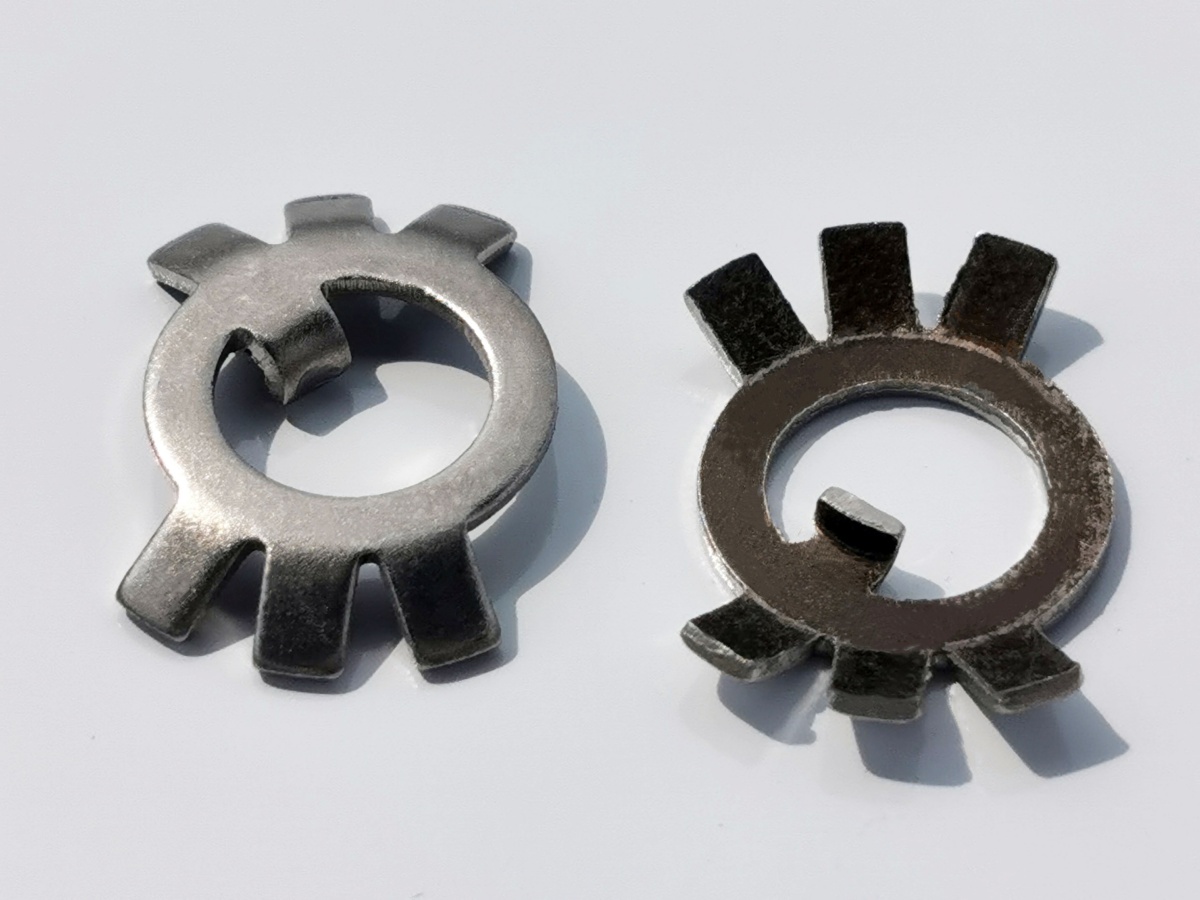
A bearing lock washer is a thin washer incorporating locking tabs designed to work with a compatible lock nut and shaft.
It is also commonly described using terms such as:
bearing lock washer;
tab lock washer;
bearing nut lock washer;
lock washer for bearing lock nut;
MB lock washer;
locking washer for KM lock nut.
Unlike a conventional split spring-lock washer, the bearing lock washer does not primarily depend on elastic spring force to resist rotation.
Instead, it uses geometric engagement.
The shaft prevents the washer from rotating.
The washer prevents the nut from rotating.
This creates a mechanical locking chain:
Shaft → Inner Tab → Lock Washer → Outer Tab → Lock Nut
These products should not be confused.
A helical split washer traditionally used beneath a bolt head or nut.
Its behavior involves elastic deformation and interaction at the bearing interface.
A multi-tab locking component used with a compatible bearing lock nut and shaft groove.
Its locking principle is mechanical engagement.
Therefore:
Bearing Lock Washer ≠ Split Spring Washer
Calling an MB-style bearing washer simply a “spring washer” can create sourcing ambiguity.
For international OEM and MRO sourcing, bearing lock washer, tab lock washer or the applicable designation is normally more precise.
Rolling bearings and other shaft-mounted components often require controlled axial positioning.
A threaded lock nut can be used to:
locate a bearing inner ring;
retain a bearing or component axially;
support bearing mounting or adjustment;
secure selected shaft-mounted components.
Once the lock nut reaches the required position, the design may need a method to prevent unintended rotation.
A compatible tab washer provides that locking function.
One of the most important distinctions between a bearing tab washer and many friction-based locking methods is the locking mechanism.
With a correctly designed system:
The washer's inner tab engages the shaft groove.
The washer therefore cannot freely rotate around the shaft.
The lock nut is positioned according to the bearing or component installation requirement.
One suitable outer washer tab is bent into a lock-nut slot.
The engaged tab mechanically restrains nut rotation relative to the washer.
The locking function is therefore based on physical engagement between components.
The inner tab is a critical feature.
It fits into a corresponding groove or keyway feature in the shaft.
Its function is to prevent the lock washer from rotating relative to the shaft.
Without correct engagement of this inner feature, the intended locking chain is incomplete.
This means procurement should not select a bearing lock washer solely by:
Outside Diameter
or:
Shaft Diameter
Compatibility with the shaft and lock nut matters.
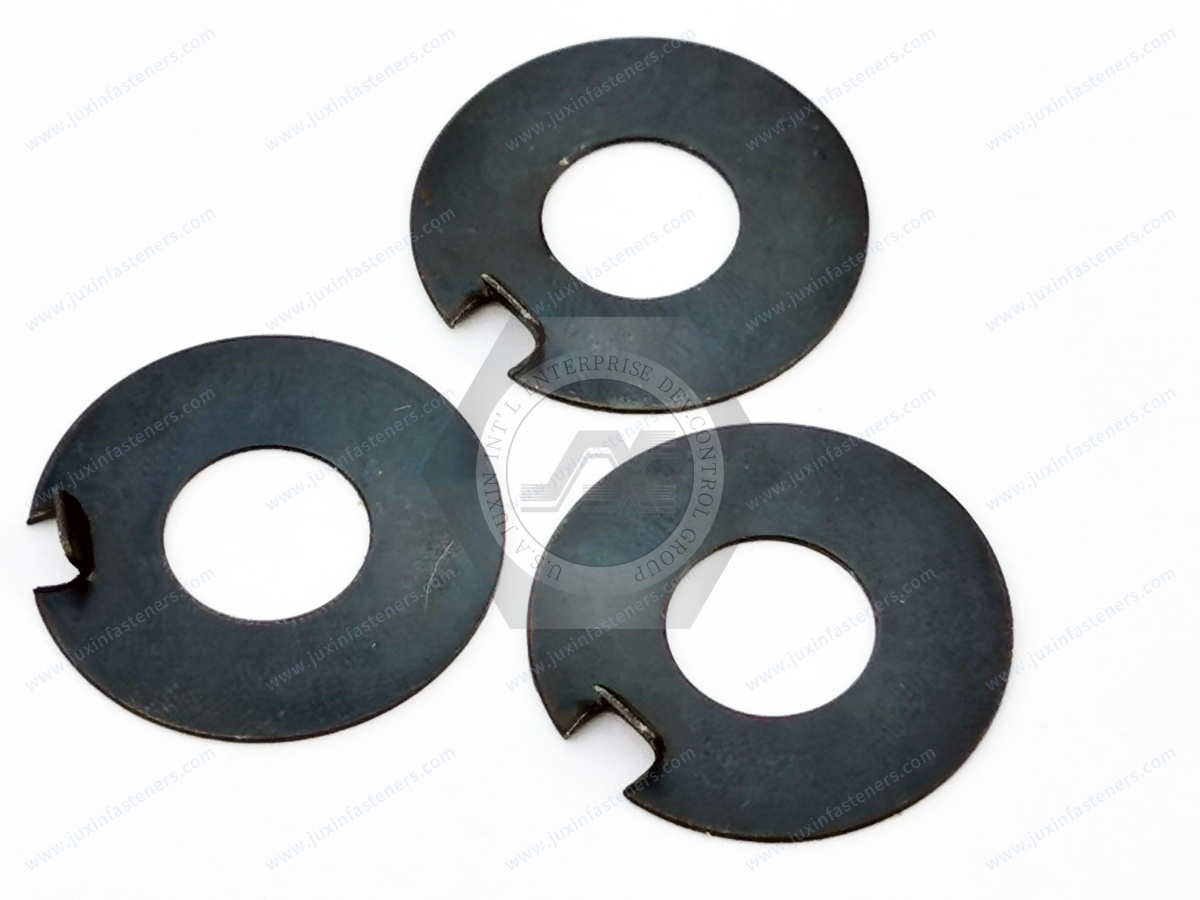
Multiple tabs are arranged around the outer circumference of a typical bearing lock washer.
After the lock nut has been positioned correctly, one suitable outer tab is bent into a corresponding slot in the lock nut.
This prevents the nut from rotating freely relative to the washer.
The system becomes:
Nut Slot → Bent Outer Tab → Washer → Inner Tab → Shaft Groove
This is why the lock nut, washer and shaft should be treated as a system.
A widely recognized metric bearing-locking arrangement uses:
KM Lock Nut + MB Lock Washer
In common bearing-industry designation systems:
KM identifies a lock nut with dimensions according to the applicable ISO-based dimensional system.
MB identifies a lock washer intended for use with a compatible KM lock nut.
This terminology is widely encountered in:
rolling-bearing catalogs;
industrial maintenance;
mechanical drawings;
replacement-part searches;
OEM procurement.
As a result, useful sourcing searches include:
MB lock washer;
MB bearing washer;
KM lock nut washer;
lock washer for KM nut;
bearing tab washer.
Not every bearing lock washer belongs to the standard KM + MB combination.
Lower-profile lock-nut systems can use:
KML Lock Nut + MBL Lock Washer
The lower sectional height can be useful where axial installation space is limited.
Therefore:
MB ≠ MBL
and:
KM ≠ KML
Procurement should identify the exact lock-nut series before ordering the washer.
DIN 5406 is an important standard reference for rolling-bearing locking devices.
It addresses dimensions and designations for locking devices used with bearing lock nuts within its scope.
These include:
lock washers;
locking clips;
related bearing-nut locking components.
For OEM sourcing, the applicable drawing, lock-nut designation and standard edition should control the requirement.
Bearing-industry lock-nut and lock-washer systems can also be associated with ISO dimensional frameworks.
In practical procurement, engineers may encounter manufacturer designations such as:
KM;
KML;
MB;
MBL;
HM;
MS.
These designations should not be treated as interchangeable.
Each belongs to a defined geometry and compatible locking arrangement.
A common purchasing mistake is:
“I need a lock washer for a 40 mm shaft.”
That may not provide enough information.
A more useful starting point is:
What lock nut is being used?
The washer must be compatible with:
lock-nut designation;
shaft thread;
shaft groove;
washer bore;
washer outside diameter;
tab geometry;
axial space.
The complete interface matters.
Two assemblies involving similar shaft diameters can use different:
thread systems;
lock nuts;
washer series;
shaft-groove geometry.
Therefore:
Same Shaft Diameter ≠ Same Bearing Lock Washer
For replacement sourcing, the existing lock-nut designation can often be more useful than a general shaft measurement.
Bearing lock nuts are installed on threaded shaft sections.
The thread requirement must be identified correctly.
Depending on the system, relevant parameters can include:
nominal thread diameter;
thread pitch;
thread form;
tolerance;
thread direction where applicable.
The washer itself does not engage the thread, but its geometry must fit the same shaft system.
The inner tab needs a compatible shaft groove.
Engineers should verify:
groove position;
groove width;
groove depth where controlled;
washer inner-tab dimensions;
shaft geometry.
A correct nut and washer combination can still fail to function as intended if the shaft groove is incorrect.
The outer circumference of a compatible lock nut includes slots or notches that provide engagement positions for the washer tab.
The washer's outer tabs provide multiple possible locking positions.
After the nut reaches its required setting, a suitable tab can be engaged with an appropriate nut slot.
The objective is to preserve the required bearing or component setting while establishing mechanical locking.
This is an important engineering distinction.
The tab washer locks the nut after the required nut position has been established.
It should not be treated as the primary method for determining:
bearing preload;
bearing internal clearance;
axial displacement;
mounting force.
Those parameters depend on the bearing arrangement and manufacturer's installation procedure.
Therefore:
Bearing Adjustment First → Locking Second
If the nut's required position does not immediately align with a convenient washer tab, do not automatically apply substantial additional tightening merely to reach the next locking position.
Changing the nut position can affect:
bearing clearance;
preload;
axial location;
bearing operating condition.
The correct action depends on the bearing manufacturer's mounting procedure and the specific locking system.
This is especially important in precision or preload-sensitive bearing arrangements.
Before installation, confirm:
shaft thread;
lock-nut designation;
washer designation;
shaft groove;
bearing arrangement;
drawing requirements.
Do not assume visually similar washers are interchangeable.
Check that the shaft groove is:
correctly located;
clean;
free from severe burrs or damage;
compatible with the washer's inner tab.
The inner tab must seat properly.
Place the washer onto the shaft so that its inner tab engages the shaft groove.
Verify that:
the washer seats correctly;
the inner tab enters the groove;
the washer is not forced into an incompatible position.
The washer should not be modified casually to compensate for an incorrect shaft groove.
Thread the compatible lock nut onto the shaft.
Use the installation method required for the bearing arrangement.
Depending on the application, this can involve:
hook spanner;
impact spanner designed for the nut;
another approved mounting tool;
controlled bearing-mounting procedure.
The objective is to position the bearing or component correctly—not merely to make a washer tab line up.
Before locking the nut, complete the required bearing mounting or adjustment procedure.
Depending on the bearing system, this may involve control of:
axial position;
internal clearance;
preload;
drive-up;
another manufacturer-defined parameter.
Follow the bearing manufacturer's procedure.
After the nut reaches the approved position, identify a suitable outer washer tab corresponding to a lock-nut slot.
Bend the selected tab into the slot using an appropriate method.
The tab should engage sufficiently to restrain the nut from unintended rotation.
Avoid uncontrolled deformation of neighboring features.
Verify that:
the washer inner tab remains correctly engaged in the shaft groove;
the washer is seated correctly;
the selected outer tab engages the nut slot;
the lock nut remains in the required position;
no installation damage compromises the locking system.
Inspection should follow the equipment or maintenance procedure.
Older instructions sometimes simply say:
“Use a screwdriver.”
That is too general for professional engineering guidance.
The installation tool should:
provide controlled tab deformation;
avoid damaging the nut;
avoid damaging the shaft;
avoid creating uncontrolled burrs;
provide sufficient access.
Use the equipment manufacturer's or maintenance procedure where one is specified.
Do not create a universal “front side/back side” rule unless it is defined by the washer design or applicable specification.
The essential functional requirements are:
correct inner-tab engagement;
correct washer seating;
correct compatibility with the lock nut;
correct outer-tab engagement.
For special washer designs, follow the manufacturer's drawing.
Some larger or different bearing lock-nut systems use a locking clip rather than a multi-tab washer.
These are different components.
A locking clip can engage:
a feature in the nut;
an appropriate shaft feature
according to the specific system.
Therefore:
Lock Washer ≠ Locking Clip
The lock-nut series determines the appropriate locking device.
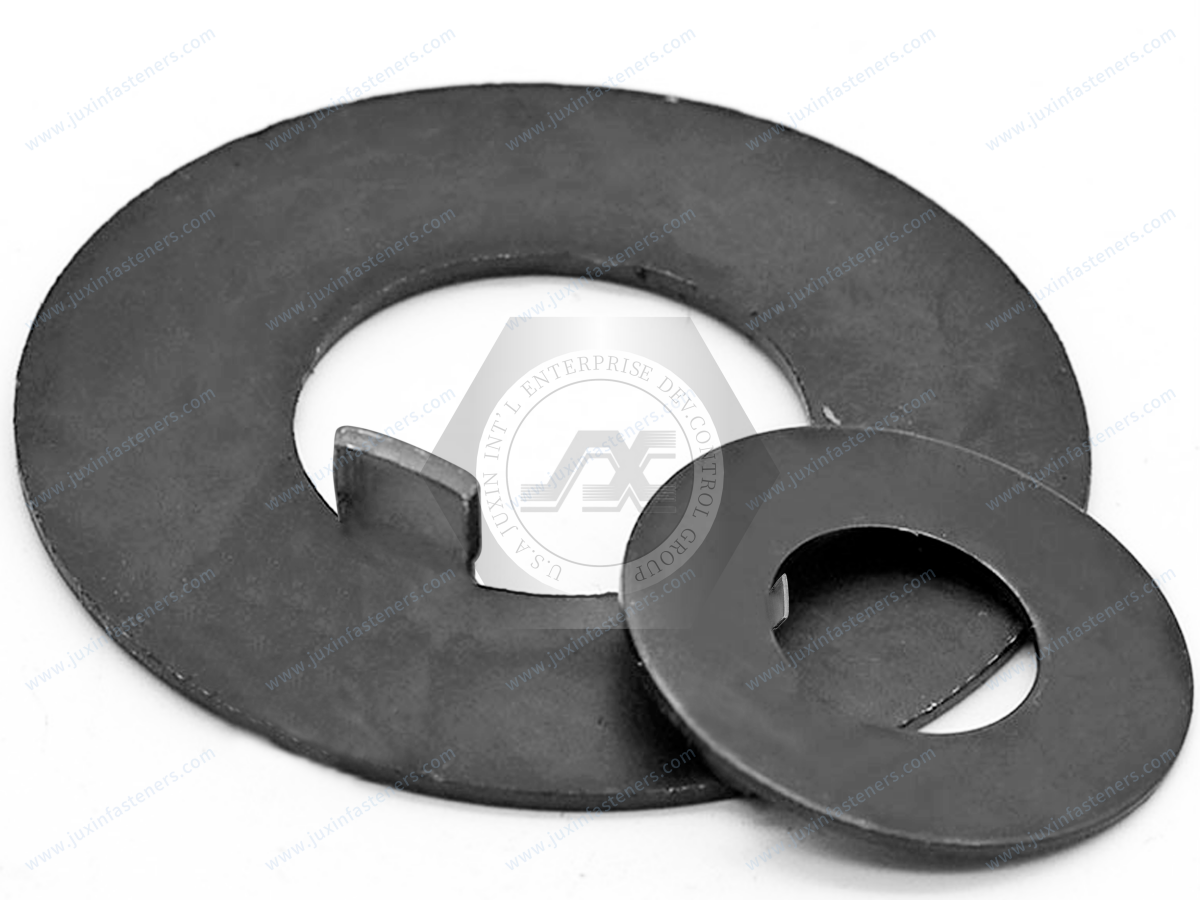
Locking plates are another mechanical locking category.
They can be used in selected shaft-nut or industrial fastener systems.
Again, the mechanism and dimensions differ from an MB-style lock washer.
Procurement should identify the exact component rather than sourcing all of them under the generic term:
Lock Washer
This distinction deserves repeating because it directly affects search and sourcing.
| Feature | Bearing Tab Lock Washer | Split Spring Washer |
|---|---|---|
| Typical Application | Bearing lock nut on shaft | General threaded fastener |
| Locking Principle | Positive tab engagement | Elastic/friction-related behavior |
| Shaft Groove | Typically required for tab system | No |
| Lock Nut Slot | Required for tab engagement | No |
| Bearing Positioning | Common application | Not primary purpose |
| Typical Search Term | MB lock washer / bearing lock washer | Spring lock washer |
The two products should not be substituted for each other.
A disc spring is an elastic conical component selected around load and deflection.
A bearing lock washer is a mechanical anti-rotation component.
Therefore:
Bearing Lock Washer ≠ Belleville Spring
Their geometry, selection criteria and engineering purpose are completely different.
A wedge-locking washer system uses paired washer geometry to resist rotational self-loosening in a bolted joint.
A bearing tab washer physically engages a shaft groove and lock-nut slot.
These are different locking mechanisms.
The term lock washer alone is therefore insufficient for technical sourcing.
The bearing tab-washer system demonstrates an important engineering principle.
Some anti-loosening systems rely largely on:
friction;
prevailing torque;
adhesive;
surface interaction.
A tab washer instead uses a positive geometric restraint.
This can be particularly valuable when the design specifically requires the nut to be mechanically prevented from rotating away from its locked position.
However, positive locking does not eliminate the need for correct initial bearing adjustment.
The washer can help retain the lock nut's rotational position.
It does not independently create or regulate bearing preload.
Bearing preload depends on the complete bearing arrangement and installation method.
Therefore:
Locking Nut Position ≠ Automatically Correct Bearing Preload
Correct adjustment must come first.
The lock washer helps secure the lock nut.
The lock nut and surrounding shaft/bearing geometry perform the actual axial location function.
The washer is one component in that retention system.
It should not be described as independently carrying every axial load in the bearing assembly.
Bearing lock washers require material properties appropriate to their forming and locking function.
The material must allow the locking tab to be formed during installation without inappropriate fracture while retaining the required geometry for the application.
Material requirements should follow:
applicable standard;
customer drawing;
approved manufacturer specification.
Do not assume every bearing lock washer must use one universal spring-steel grade.
A request such as:
“Need spring steel bearing washers.”
may not sufficiently define the product.
Procurement should identify:
washer designation;
applicable standard;
dimensions;
material requirement;
hardness where specified;
finish;
lock-nut compatibility.
Material terminology should not replace dimensional specification.
Surface treatment may be selected according to:
corrosion environment;
storage conditions;
assembly requirements;
customer specification.
Potential finishes depend on the product and material.
The coating must not interfere with:
dimensional fit;
tab engagement;
forming of the locking tab.
Where a specific coating is required, define it in the RFQ.
Bearing assemblies can operate in:
indoor machinery;
humid environments;
outdoor equipment;
contaminated industrial conditions.
Corrosion protection should be selected according to the actual service environment.
A generic plated washer should not automatically be assumed suitable for every bearing application.
A previously bent locking tab has undergone plastic deformation.
For maintenance-critical applications, do not automatically assume that a used tab washer can be repeatedly bent and reused.
Repeated bending can affect:
tab geometry;
local material condition;
engagement reliability.
Follow the equipment or bearing manufacturer's maintenance instructions.
Where reliable locking is required, replacement with the correct new washer can be the more controlled maintenance approach.
MRO teams frequently encounter old bearing lock washers without a readable part number.
A visually similar replacement is not necessarily correct.
Identify where possible:
lock-nut designation;
shaft thread;
shaft diameter;
shaft groove;
washer dimensions;
bearing arrangement.
This reduces the risk of installing a washer that fits loosely but does not lock correctly.
The primary application for MB-style tab washers is rolling-bearing locking arrangements.
Potential uses include:
locating bearing inner rings;
securing bearings on threaded shafts;
adapter-sleeve arrangements where applicable;
other manufacturer-defined bearing mounting systems.
The bearing manufacturer's mounting instructions should control installation.
Electric motors contain shaft and bearing systems where axial positioning and secure nut retention can be important.
Potential applications depend on:
motor design;
bearing arrangement;
shaft geometry.
The lock washer should be selected from the actual mechanical design rather than simply from motor power or frame size.
Gearboxes contain rotating shafts, bearings and gears requiring controlled axial positioning.
Bearing lock nuts and tab washers can be used in appropriate designs to secure shaft-mounted components.
Potential applications include:
input shafts;
output shafts;
intermediate shafts;
bearing locations.
The actual locking method depends on the gearbox design.
Industrial pumps use bearings to support rotating shafts.
Where a bearing lock nut is part of the shaft design, a compatible lock washer can provide positive mechanical locking.
Operating environment should also be considered when selecting material and surface protection.
Potential applications include:
machine tools;
production equipment;
conveyors;
material-handling systems;
rotating machinery;
drive systems.
The common requirement is not simply vibration resistance.
It is controlled retention of a lock nut in the shaft assembly.
Bearing lock washers can be used in appropriate mechanical subassemblies involving:
shafts;
bearings;
rotating components;
drive equipment.
However, generic bearing washers should not automatically be described as certified elevator safety components.
Safety-critical elevator assemblies must follow the equipment manufacturer's approved specifications.
Fans, blowers, pumps and other HVAC rotating equipment can contain bearing arrangements requiring axial retention.
Where a lock-nut-and-tab-washer system is specified, the replacement component should match the original mechanical system.
Rotating equipment used in energy systems can contain bearing-locking arrangements.
However, large or highly loaded bearing systems may use different locking devices, hydraulic nuts, locking clips or specialized bearing retention systems.
Do not assume an MB-style washer is suitable solely because the application contains a bearing.
Bearing lock washers can be relevant to:
production machinery;
electric motors;
pumps;
auxiliary rotating equipment;
manufacturing systems.
Application-specific automotive qualification should not be inferred from the generic washer design.
Modern data centers use substantial cooling and power infrastructure.
Rotating equipment can include:
pumps;
fans;
motors;
auxiliary mechanical systems.
Where those machines use threaded bearing lock nuts, compatible bearing lock washers may form part of the shaft retention system.
The application should be defined from the machine design rather than simply from the data-center industry category.
Bearing lock washers have strong MRO search intent.
Maintenance teams may search for:
replacement MB washer;
bearing lock washer size;
KM nut washer;
bearing nut tab washer;
lock washer for shaft nut;
MB washer supplier.
For MRO sourcing, the fastest identification route is often:
Existing Lock Nut Designation → Compatible Lock Washer
rather than measuring only the damaged washer.
Engineers may search:
bearing lock washer;
how does bearing lock washer work;
MB lock washer;
KM nut lock washer;
bearing tab washer installation;
bearing lock washer direction;
how to lock bearing nut;
bearing lock washer shaft groove;
MB vs MBL washer;
lock washer for bearing nut.
These are highly specific technical searches.
They are much closer to component selection than a generic search for “washers.”
Purchasing and supplier-development teams may search:
MB lock washer manufacturer;
bearing lock washer supplier;
tab lock washer manufacturer;
KM lock nut washer supplier;
DIN 5406 lock washer supplier;
bearing nut lock washer manufacturer;
custom tab washer manufacturer.
The purchasing requirement should identify the actual locking system.
The phrase:
“Bearing washer”
is ambiguous.
It can potentially refer to very different components.
A better RFQ is:
MB-Type Bearing Lock Washer for KM Lock Nut
or the exact applicable designation/drawing.
This substantially reduces sourcing errors.
| Requirement | Selection Direction |
|---|---|
| Standard KM lock nut | Check compatible MB lock washer |
| Low-profile KML lock nut | Check compatible MBL lock washer |
| Shaft lacks required groove | Do not assume MB tab washer is suitable |
| Larger lock-nut system | Check applicable locking clip/system |
| Need positive mechanical nut restraint | Evaluate compatible tab-locking system |
| Need elastic preload compensation | Evaluate disc spring system instead |
| General bolt anti-loosening | Evaluate appropriate threaded-fastener locking system |
| Replacement/MRO | Identify existing lock nut first |
| Limited axial space | Evaluate compatible low-profile system |
| Corrosive environment | Specify material/finish based on service conditions |
This can lead to the wrong product family.
Use bearing lock washer, tab lock washer or the applicable designation.
Lock-nut series and shaft geometry also matter.
The inner tab requires the correct mating feature.
This breaks the intended mechanical locking chain.
Bearing adjustment requirements should control nut position.
The washer locks the position; it does not determine the correct bearing setting.
They belong to different compatible lock-nut configurations.
Repeated plastic bending can damage the locking feature.
The locking principles are completely different.
A visually similar washer can still have incompatible dimensions.
For technical and commercial evaluation by JUXIN FASTENERS, provide where applicable:
2D drawing;
physical sample;
existing washer designation;
existing lock-nut designation;
MB designation where applicable;
MBL designation where applicable;
applicable DIN, ISO or customer specification;
shaft diameter;
shaft thread;
thread pitch;
shaft-groove dimensions;
washer inside diameter;
washer outside diameter;
washer thickness;
inner-tab dimensions;
outer-tab geometry;
number of outer tabs where specified;
material;
hardness where specified;
surface treatment;
coating requirement;
corrosion requirement;
bearing designation where useful;
application;
operating environment;
sample quantity;
production quantity;
annual demand;
replacement/MRO quantity;
inspection requirement;
packaging requirement;
labeling requirement;
customer-specific requirements.
A bearing lock washer is a tabbed mechanical locking component used with a compatible bearing lock nut and shaft groove to restrain unintended nut rotation.
No.
A bearing tab washer uses positive mechanical engagement.
A conventional split spring washer uses a different geometry and locking principle.
MB is a widely used bearing-industry designation for a metric lock washer compatible with appropriate KM lock nuts.
KM identifies a widely used metric bearing lock-nut series with dimensions based on the applicable ISO dimensional system.
MBL identifies a lock-washer series associated with compatible lower-profile KML lock nuts.
Its inner tab engages a shaft groove, preventing washer rotation. After the lock nut reaches the required position, one outer tab is bent into a nut slot to restrain the nut from rotating.
The conventional MB-style tab-locking principle requires the corresponding shaft feature for the inner tab.
Check the actual lock-nut and washer system.
Do not assume compatibility.
The washer should be matched to the applicable lock-nut series and shaft geometry.
Do not automatically assume reuse is acceptable.
The locking tab is plastically bent during installation. Follow the equipment or bearing manufacturer's maintenance requirements.
No.
The bearing should first be mounted or adjusted according to its specified procedure. The washer then helps lock the nut in the established position.
Do not arbitrarily change a preload- or clearance-sensitive bearing setting simply to obtain tab alignment.
Follow the bearing manufacturer's installation procedure.
No.
It requires a compatible shaft, lock nut, groove and locking architecture.
An MRO buyer may begin with:
“Need bearing lock washer.”
A better sourcing process asks:
What Lock Nut Is Installed?
Then:
What Is the Shaft Thread?
Is There a Compatible Shaft Groove?
Is It KM + MB, KML + MBL or Another System?
What Standard or Drawing Controls the Dimensions?
What Material and Finish Are Required?
The complete sourcing path becomes:
Bearing Arrangement → Shaft Geometry → Lock Nut → Compatible Lock Washer → Bearing Setting → Tab Locking → Inspection → Approved Part → RFQ
This prevents the common mistake of treating every tabbed circular washer as interchangeable.
JUXIN FASTENERS supports OEM and MRO sourcing of bearing lock washers, tab lock washers, industrial washers,
lock nuts and related fastening components for rotating equipment, industrial machinery, electric motors, pumps, gearboxes, HVAC equipment, material-handling systems and other engineered mechanical assemblies.
For broader washer selection, see Industrial Washers: Types, Functions & Selection Guide.
For general washer-and-bolt engineering, see Washers and Bolts: Fastening Systems Selection Guide.
For high-strength threaded fastening systems, see High-Strength Bolts & Nuts: Engineering Selection Guide.
For bearing lock washer RFQs, send your existing lock-nut designation, washer designation, drawing or sample, shaft thread,
shaft-groove dimensions, washer dimensions, material, finish, application and estimated annual demand to:
The correct bearing lock washer is not simply a washer that fits over the shaft.
It is one component of a matched mechanical locking system between the shaft, washer and bearing lock nut.
 MORE NEWS
Sep. 25, 2026
Sep. 25, 2026
Sep. 25, 2026
Contact Us
Tel.:
+86 020 8621 0320
+86 020 3121 6067
E-mail:
Technical Support:
Navigation
SEND INQUIREY