
Call Us
+86 136 6007 9809
Call Us
+86 136 6007 9809

Jul. 27, 2022
When a component requires a reliable threaded connection but the rear side of the workpiece is inaccessible, blind rivet nuts and blind rivet studs provide an efficient fastening solution.
Also known as rivnuts, threaded rivet nuts, blind threaded inserts, and blind rivet fasteners, these components create a mechanical fastening point in thin sheet metal, tubes, hollow sections, plastic components, and composite structures.
Juxin Fasteners manufactures OEM blind rivet nuts and studs for industrial applications where engineers and procurement teams require consistent installation, reliable thread performance, and efficient production.
Unlike conventional nuts that require access to both sides of the workpiece, blind rivet nuts and studs can be installed from one accessible side.
This makes them particularly useful for enclosed housings, thin-wall structures, formed sheet metal components, and assemblies where welding or rear-side access is not practical.
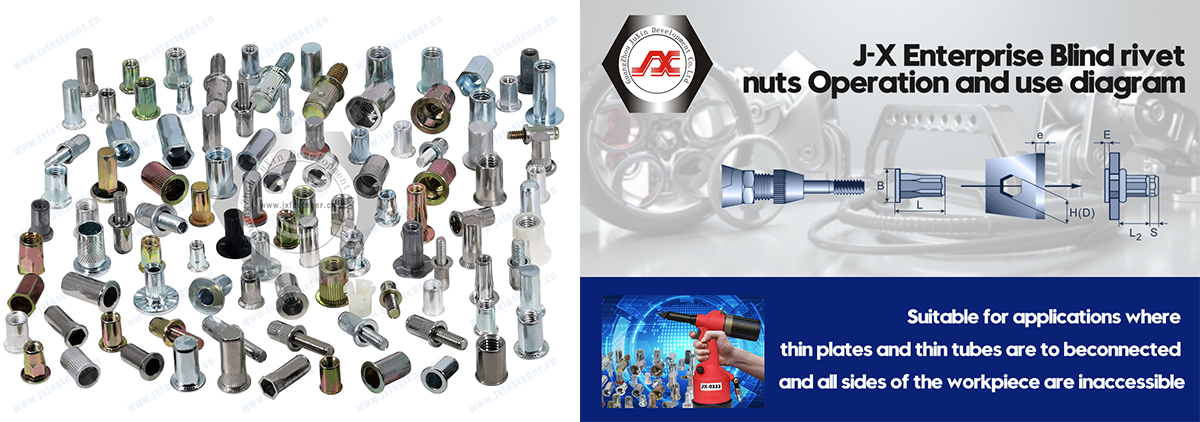
A blind rivet nut is a threaded tubular insert that is installed into a prepared hole. During installation, the body deforms on the blind side of the material, clamping the insert securely into the workpiece.
The resulting internal thread provides a fastening point for a screw or bolt.
A blind rivet stud uses the same basic installation principle but provides an external threaded stud rather than an internal thread.
Provides an internal thread for applications where a screw or bolt must be installed into a thin material.
Provides a permanently installed external thread for applications where a component, bracket, panel, or nut needs to be mounted over the stud.
Both configurations are suitable for applications requiring single-sided installation.
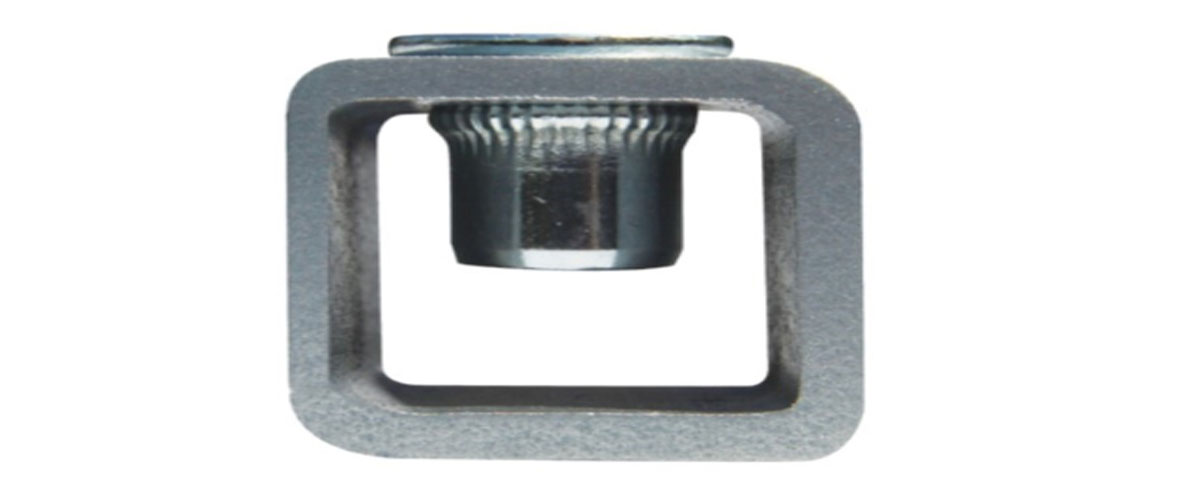
For thin materials, directly tapping threads into the parent material may not provide sufficient thread engagement.
Welding a nut can provide a threaded connection, but it may introduce:
Heat distortion
Weld spatter
Surface damage
Additional finishing
Higher processing requirements
Blind rivet nuts provide an alternative mechanical fastening method without introducing welding heat.
Single-sided installation
Threaded fastening in thin materials
No welding heat
Suitable for enclosed structures
Fast installation
Serviceable threaded connections
Suitable for automated assembly
Available in multiple materials and configurations
For OEM manufacturers, this can simplify assembly and reduce the number of manufacturing operations required to create threaded fastening points.
Sheet metal fastening is one of the most common applications for blind rivet nuts.
They can be installed in:
Aluminum sheet
Mild steel sheet
Stainless steel sheet
Galvanized sheet
Painted panels
Powder-coated components
Formed sheet metal
Enclosed profiles
Typical applications include:
Electrical cabinets
HVAC housings
Machine enclosures
Automotive components
Equipment panels
Control boxes
Battery enclosures
Industrial machinery
Because the rivet nut is installed after the sheet metal component has been formed, it can also provide greater flexibility in production planning.
Blind rivet nuts can also be used in selected plastic, composite, and lightweight material applications.
Engineering plastics and composite panels may not provide sufficient material thickness for directly tapped threads. A properly selected rivet nut can provide a more defined threaded fastening point.
Applications may include:
Plastic housings
Electrical enclosures
Automotive interior components
Composite panels
Equipment covers
Consumer and industrial equipment
For soft or brittle materials, the rivet nut geometry is particularly important.
Depending on the application, engineers may consider:
Knurled bodies
Larger blind-side deformation
Slotted designs
Larger bearing areas
Suitable grip ranges
The final configuration should be validated according to the parent material and required joint performance.
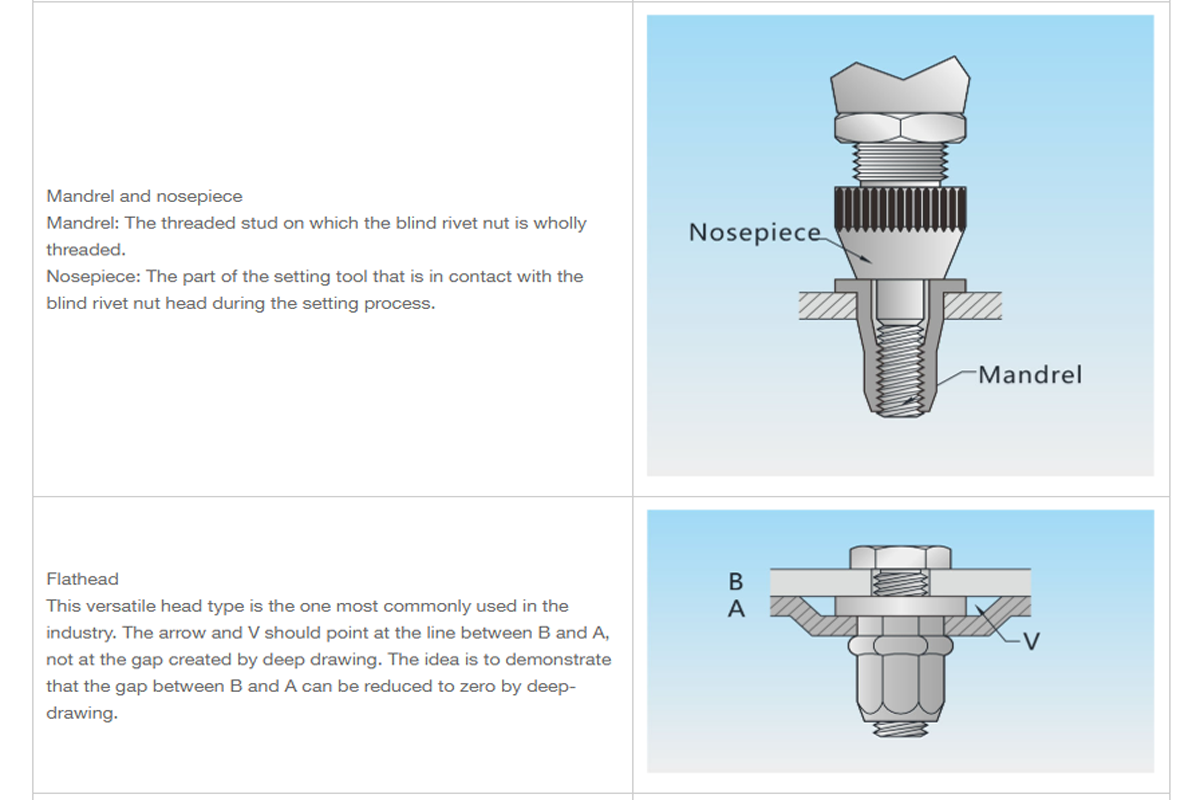
The body geometry influences rotation resistance, pull-out performance, installation requirements, and compatibility with the parent material.
Round-body blind rivet nuts are widely used for general-purpose applications where a standard round hole is preferred.
They provide a straightforward solution for many sheet metal assemblies.
Hexagonal blind rivet nuts provide enhanced resistance to rotation when installed into a corresponding hexagonal hole.
They are particularly suitable where the joint may experience higher tightening torque.
Typical applications include:
Automotive components
Electrical cabinets
Industrial machinery
Sheet metal equipment
Battery housings
Square-body configurations can provide additional mechanical engagement with the workpiece and may be considered for applications requiring enhanced anti-rotation performance.
Knurled rivet nuts provide additional mechanical engagement between the external body and the parent material.
They can be useful for:
Aluminum
Plastic
Composite materials
Soft sheet metal
Lightweight structures
The appropriate geometry should be selected according to the material and required joint performance.
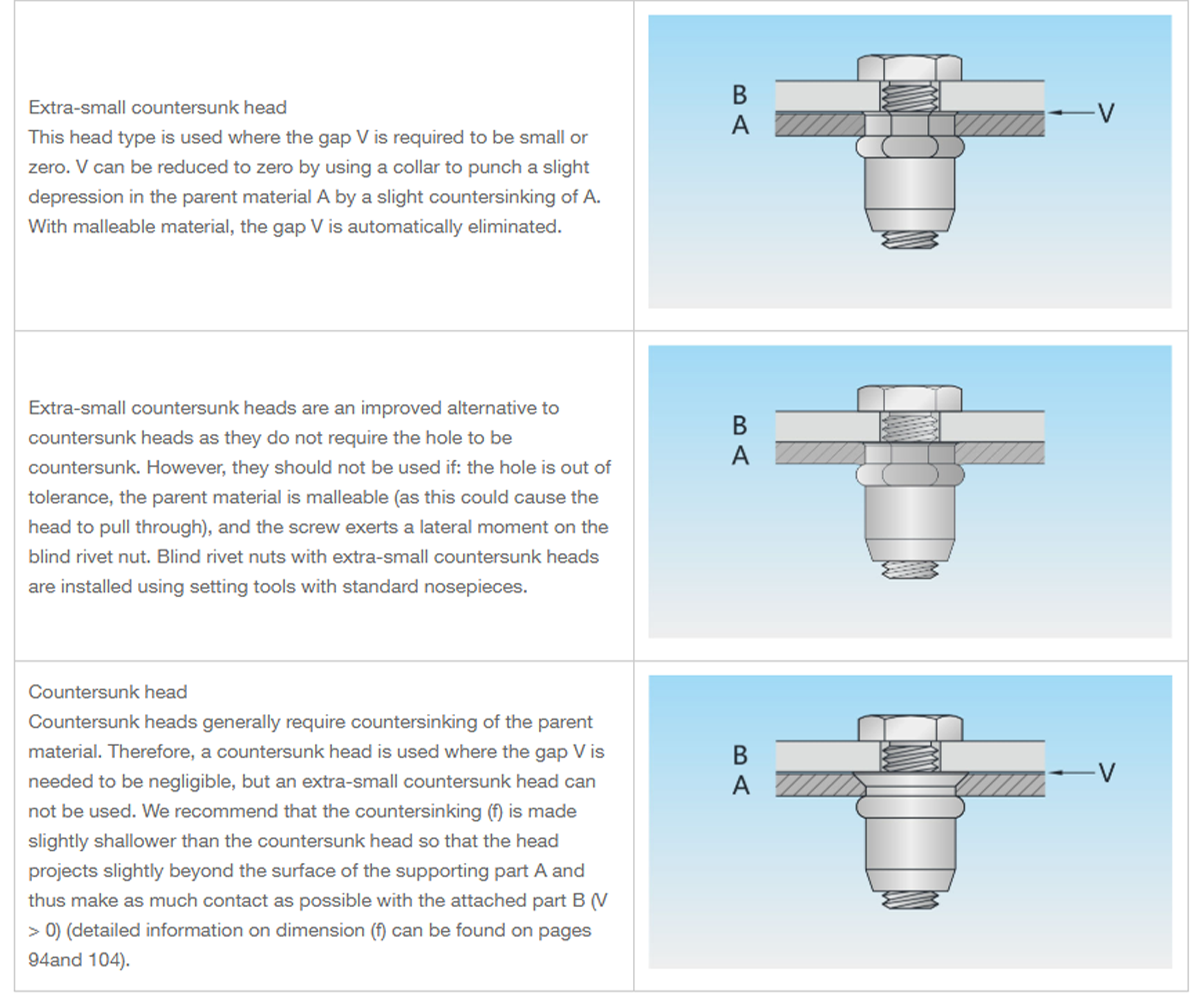
The head configuration determines how the fastener interfaces with the workpiece surface.
The flathead rivet nut is one of the most widely used configurations.
It provides a broad bearing surface against the panel and is suitable for general industrial applications.
An extra-small countersunk head can minimize the amount of fastener protrusion above the workpiece.
This can be useful where limited clearance is available.
Countersunk rivet nuts can be used where a more flush installation is required.
The parent material generally requires suitable countersinking to accommodate the head.
Engineers should select the head style based on:
Available clearance
Panel thickness
Surface requirements
Required bearing area
Assembly design
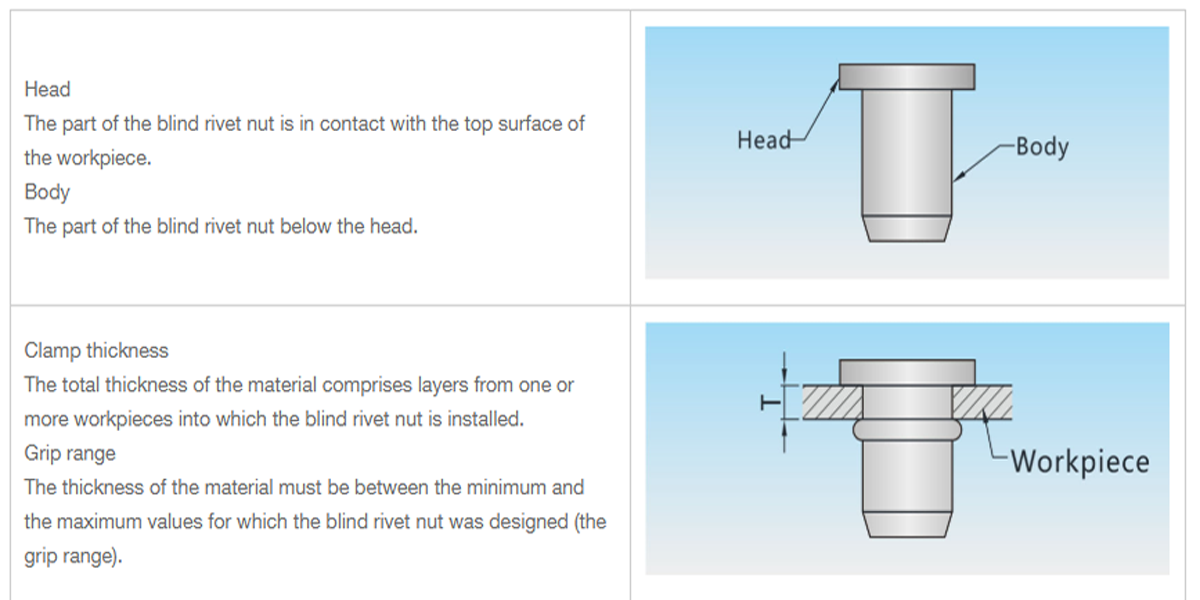
When selecting a blind rivet nut, grip range is one of the most important specifications.
Grip range defines the material thickness that the specific rivet nut can properly accommodate.
Before selecting a rivet nut, confirm:
Actual material thickness
Number of material layers
Hole diameter
Rivet nut grip range
Available installation space
Using a rivet nut outside its recommended grip range can result in inconsistent deformation and reduced joint performance.
For multi-layer assemblies, the total clamped material thickness should be considered.
A blind rivet nut is normally installed using a dedicated rivet nut installation tool.
A typical spin-pull-spin process includes four stages:
The rivet nut is threaded onto the installation mandrel.
The rivet nut is inserted into the prepared hole in the workpiece.
The tool pulls the mandrel to deform the rivet nut body on the blind side of the material.
The mandrel is rotated out of the installed rivet nut.
The exact installation procedure depends on the fastener design and installation tool.
For production applications, using the correct setting tool and installation parameters is essential for consistent results.
The installation tool should be matched to the rivet nut design, thread size, material, grip range, and production volume.
Common options include:
Manual rivet nut tools
Pneumatic rivet nut tools
Hydraulic installation systems
Battery-powered tools
Automated installation equipment
For high-volume OEM production, controlled installation equipment can improve:
Installation consistency
Production speed
Operator ergonomics
Process repeatability
Quality control
Mechanical screwdrivers or general-purpose spanners should not be substituted for the correct setting equipment when they can interfere with the intended installation process.
For automated production lines, the rivet nut should also be evaluated for feeding, orientation, mandrel compatibility, and automated installation requirements.
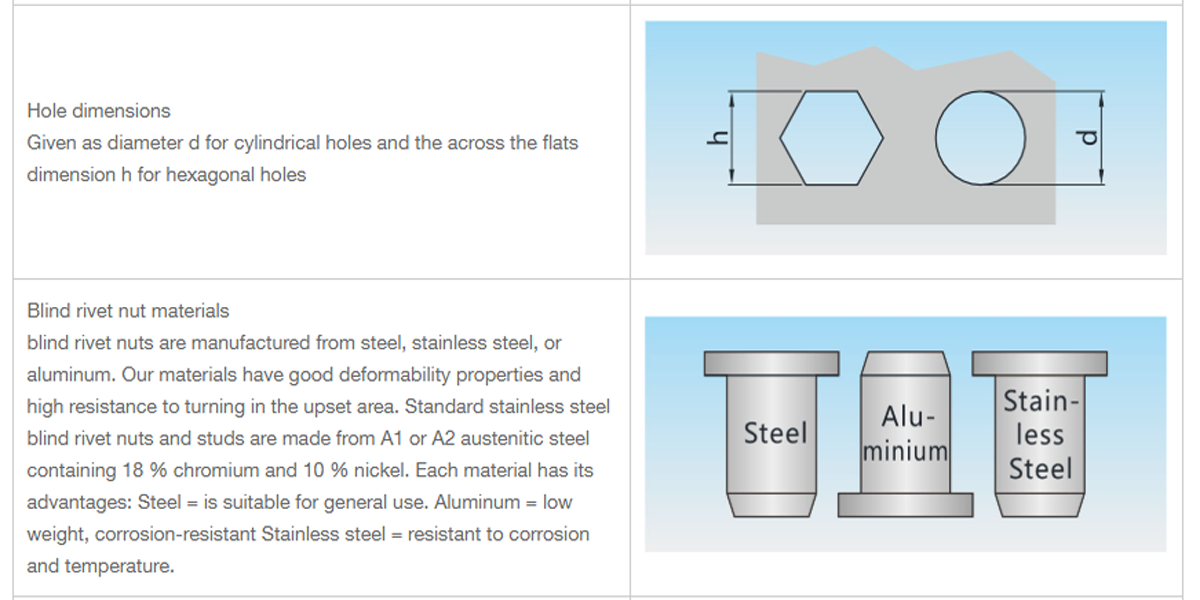
Juxin Fasteners supplies blind rivet nuts in different materials according to application requirements.
Steel rivet nuts provide a strong and cost-effective fastening solution for general industrial applications.
They are commonly used in:
Machinery
Automotive components
Sheet metal equipment
Electrical enclosures
Industrial cabinets
Surface treatment can be selected according to the required corrosion resistance.
Aluminum rivet nuts are suitable where low weight and corrosion resistance are important.
They are particularly relevant to:
Lightweight automotive components
EV applications
Aluminum sheet metal
Electronics
Equipment housings
Rail vehicle components
Stainless steel rivet nuts provide enhanced corrosion resistance and are suitable for demanding environments.
Typical applications include:
Food processing equipment
Catering equipment
Marine environments
Outdoor equipment
High-humidity applications
Corrosive industrial environments
For stainless steel installation, appropriate tooling and lubrication practices should be considered to reduce installation friction and support consistent production.
Surface treatment should be selected according to the application environment and corrosion requirements.
Available options may include:
Zinc plating
Passivation
RoHS-compliant surface treatments
Customized corrosion-resistant coatings
For applications exposed to:
Humidity
Salt spray
Chemicals
Outdoor environments
Automotive fluids
the required corrosion resistance should be defined before production.
Juxin Fasteners can evaluate suitable material and surface treatment combinations according to the customer's application requirements.
The automotive industry uses blind rivet nuts for a wide range of thin sheet metal and lightweight components.
Typical applications include:
Body components
Interior panels
Brackets
Electrical components
HVAC assemblies
Battery-related components
Cable management
Equipment mounting
Automotive Fastening Solution:
Blind rivet nuts provide single-sided threaded fastening for components where rear-side access is restricted or welding is undesirable.
Electric vehicles increasingly use lightweight aluminum housings and enclosed electrical assemblies.
Blind rivet nuts can provide threaded mounting points for:
Battery covers
Battery enclosure components
Wiring brackets
Electrical equipment
Sensors
Control modules
Protective panels
Where an installed fastening point is located within an environmental sealing boundary, sealed blind rivet nuts can be considered.
The required enclosure protection level should always be validated at the complete assembly level.
EV Battery Solution:
Juxin Fasteners supports blind rivet nut and sealed fastening solutions for lightweight EV battery and electrical assemblies.
Blind Rivet Nuts for Electrical Enclosures
Electrical cabinets and equipment housings frequently use thin sheet metal that requires multiple threaded mounting points.
Blind rivet nuts can be installed after forming, painting, or coating where the production process allows it.
Applications include:
Switch cabinets
Control panels
Power distribution enclosures
Electronics housings
Communication equipment
Instrumentation
They provide a practical alternative to welding nuts onto the enclosure.
Electrical Enclosure Solution:
Create reliable threaded mounting points without requiring access to the rear side of the cabinet panel.
HVAC and refrigeration equipment often uses thin-gauge sheet metal housings and panels.
Blind rivet nuts can be used for:
Equipment covers
Access panels
Mounting brackets
Fan assemblies
Control systems
Electrical components
Sheet metal housings
Single-sided installation is particularly useful in enclosed equipment where rear access is restricted.
HVAC & Sheet Metal Solution:
Juxin blind rivet nuts provide efficient threaded fastening for thin-gauge equipment housings.
Industrial machinery manufacturers use blind rivet nuts for modular equipment construction and serviceable panels.
Applications include:
Machine guards
Protective covers
Control cabinets
Access doors
Automation equipment
Mounting brackets
Machine enclosures
A removable screw connection allows panels and covers to be removed during maintenance without replacing the threaded fastening point.
Industrial Machinery Solution:
Blind rivet nuts support efficient assembly and maintenance of sheet metal machine components.
Rail vehicles use aluminum and steel panels extensively in interior and equipment assemblies.
Blind rivet nuts can be considered for:
Interior panels
Equipment housings
Electrical cabinets
Cable management
HVAC components
Mounting brackets
For rail applications, engineers should specify the required material, corrosion protection, vibration resistance, and joint performance according to the project requirements.
Rail Transit Solution:
Single-sided fastening simplifies installation in enclosed rail vehicle structures.
Blind rivet nuts can also provide efficient threaded connections in:
Metal furniture
Display equipment
Commercial cabinets
Storage systems
Office equipment
Lightweight frames
They can reduce the need for welding operations and provide serviceable threaded connections for modular products.
Furniture & Commercial Equipment Solution:
Fast, repeatable threaded fastening for thin metal structures and modular assemblies.
| Fastening Method | Rear Access | Thin Sheet | Welding Heat | Serviceable Thread |
|---|---|---|---|---|
| Blind Rivet Nut | Not required | Excellent | No | Yes |
| Welded Nut | Required during welding process | Good | Yes | Yes |
| Tapped Hole | Not required | Limited by material thickness | No | Yes |
| Conventional Nut & Bolt | Required | Depends on design | No | Yes |
| Self-Clinching Nut | Usually required during installation | Excellent | No | Yes |
The best solution depends on the parent material, thickness, installation access, production process, load requirements, and total cost of assembly.
Before ordering an OEM blind rivet nut, engineering and purchasing teams should confirm:
Thread size
Thread standard
Body shape
Head style
Overall length
Grip range
Material
Surface treatment
Parent material
Material thickness
Hole diameter
Hole shape
Single or multiple layers
Access restrictions
Pull-out resistance
Torque resistance
Vibration requirements
Corrosion resistance
Temperature exposure
Sealing requirements
Installation tool
Installation method
Annual quantity
Automation requirements
Packaging
Inspection requirements
Providing these specifications allows a fastening supplier to recommend a more suitable blind rivet nut or blind rivet stud rather than selecting a product solely by thread size.
Juxin Fasteners supplies OEM blind rivet nuts, blind rivet studs, threaded inserts, and customized fastening solutions for international industrial customers.
Our engineering team can work from customer drawings, samples, specifications, or application requirements.
Available solutions can include:
Round-body rivet nuts
Hexagonal rivet nuts
Square-body rivet nuts
Knurled rivet nuts
Slotted rivet nuts
Open-end rivet nuts
Closed-end rivet nuts
Sealed rivet nuts
Blind rivet studs
Aluminum rivet nuts
Steel rivet nuts
Stainless steel rivet nuts
Custom OEM configurations
We support applications across automotive, EV, rail transit, electrical, electronics, HVAC, machinery, furniture, industrial equipment, and sheet metal manufacturing.
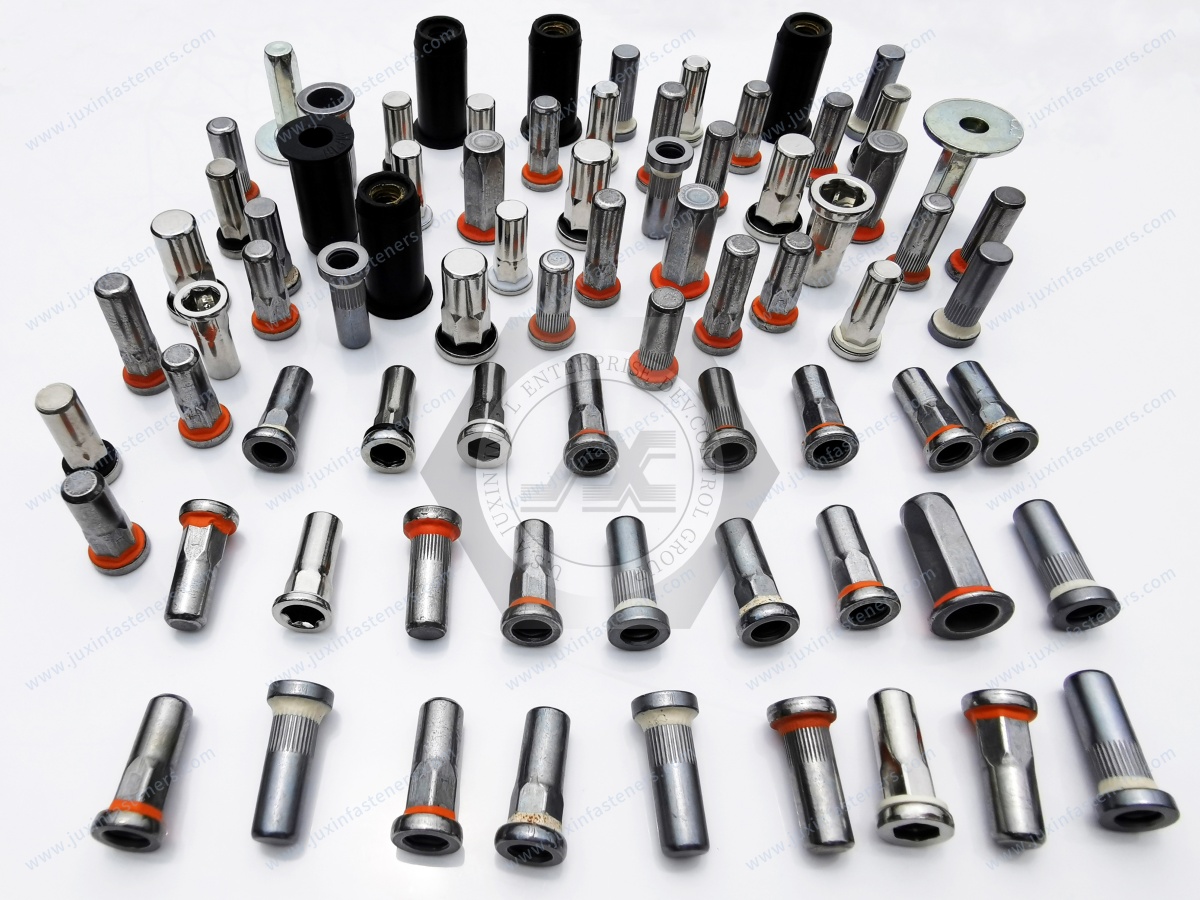
For industrial OEM applications, consistent dimensions and reliable installation performance are essential.
Juxin Fasteners can support inspection requirements including:
Dimensional inspection
Thread inspection
Grip range verification
Visual inspection
Material verification
Surface treatment inspection
Installation testing
Pull-out testing
Torque testing
Application-specific validation
Quality requirements can be aligned with customer drawings, specifications, inspection plans, and production requirements.
If your application requires a reliable threaded connection in thin sheet metal, plastic, composite material, or an enclosed structure, blind rivet nuts and studs can provide an efficient single-sided fastening solution.
Send Juxin Fasteners your:
Drawing or sample
Thread specification
Parent material
Material thickness
Hole diameter
Required grip range
Load requirements
Corrosion environment
Installation method
Annual quantity
Our engineering team can recommend a suitable blind rivet nut, blind rivet stud, sealed rivet nut, aluminum rivet nut, stainless steel rivet nut, or customized OEM fastening solution.
Juxin Fasteners
OEM Industrial Fastening Solutions
Email: info@juxinfasteners.com
 MORE NEWS
Sep. 25, 2026

Sep. 25, 2026
Sep. 25, 2026
Contact Us
Tel.:
+86 020 8621 0320
+86 020 3121 6067
E-mail:
Technical Support:
Navigation
SEND INQUIREY