
Call Us
+86 136 6007 9809
Call Us
+86 136 6007 9809

Jan. 15, 2024
Blind Rivet Nuts for EV Battery Enclosures: Sealing, Corrosion and OEM Assembly Engineering
Electric vehicle battery enclosures present fastening challenges that differ from those of ordinary sheet-metal housings.
A battery enclosure may combine aluminum sheet, extrusions, formed metal components, protective coatings, sealing interfaces, electrical insulation systems and tightly controlled assembly processes.
Threaded attachment points must be selected with consideration for mechanical loads, environmental exposure, installation access and the enclosure's safety requirements.
Blind rivet nuts for EV battery housings can provide one-sided threaded mounting points in suitable panels and enclosed structures where conventional rear-side nut installation is impractical.
However, a rivet nut that performs adequately in a general-purpose steel cabinet is not automatically suitable for a battery enclosure.
Battery-specific engineering concerns include:
Aluminum panel deformation
Grip-range compatibility
Installation-hole accuracy
Torque-out and pull-out resistance
Blind-side clearance
Galvanic corrosion
Sealing integrity
Coating damage
Conductive particles and installation debris
Electrical isolation
Thermal cycling
Vibration
Production-line repeatability
Service and maintenance requirements
JUXIN FASTENERS supplies industrial blind rivet nuts and related OEM threaded fastening components for automotive, electrical and industrial applications.
This guide focuses on selecting and specifying blind rivet nuts for suitable EV battery enclosure and battery-related equipment applications.
Why EV Battery Enclosures Need Application-Specific Fastening Selection
Battery enclosures may contain thin aluminum panels, formed steel parts, hollow profiles and locally reinforced mounting areas.
These materials do not all behave the same way during rivet nut installation.
A blind rivet nut creates retention by deforming part of its body behind the workpiece.
The installation process therefore applies local forces to the parent material.
In a relatively thin or soft aluminum panel, the wrong fastener geometry or setting process may cause deformation around the mounting hole.
In an enclosed battery structure, the blind-side deformation zone may also interfere with internal components.
If the fastener passes through an environmental sealing boundary, the installation hole can create a potential leakage path.
For these reasons, rivet nut selection should begin with the actual joint design rather than the nominal thread size.
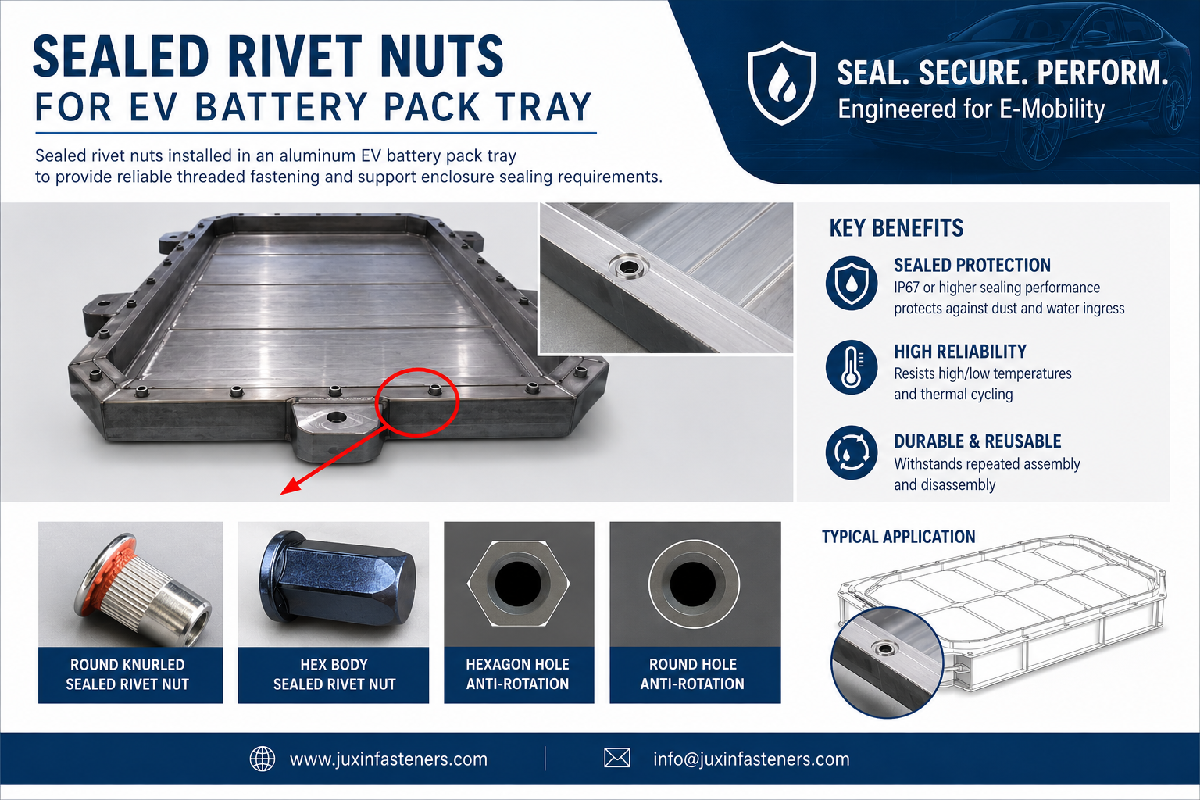
Where Blind Rivet Nuts May Be Used in EV Battery Assemblies
Potential applications include selected:
Battery enclosure accessory brackets
Cable-management supports
Electrical component mounting points
Serviceable equipment covers
External mounting accessories
Protective panels
Battery-related control equipment
Auxiliary support structures
The suitability of a rivet nut depends on the specific component and its safety classification.
A general-purpose blind rivet nut should not automatically be used for primary battery pack retention, crash-load paths, high-voltage safety-critical joints or pressure-containing connections.
Such applications require OEM-defined engineering validation and approval.
How Blind Rivet Nuts Work
A blind rivet nut is inserted into a prepared hole and mechanically set from one accessible side.
During installation, the deformable section of the fastener body forms a retaining feature behind the parent material.
The installed component provides an internal thread for a mating screw or bolt.
A common installation method is spin-pull-spin.
Spin On
The rivet nut engages the installation mandrel.
Insert
The fastener is positioned in the prepared hole.
Set
The installation tool applies the required action to deform the body behind the panel.
Spin Off
The mandrel disengages from the installed rivet nut.
Different fastener and tool designs may use different setting methods.
The installation procedure must be matched to the actual product.
Start With the Battery Enclosure Joint Design
Before selecting a blind rivet nut, define the intended function of the threaded connection.
Important questions include:
Is the fastener used for a removable cover or a permanent bracket?
Does it pass through the enclosure's sealing boundary?
Is the parent material aluminum, steel or another substrate?
Is the installation hole located near an edge or formed feature?
Is there sufficient space behind the panel for deformation?
Will the mating screw be repeatedly removed?
What tightening torque is required?
What mechanical loads act on the joint?
Are electrical isolation or bonding requirements involved?
Can the installation process be controlled and inspected?
These questions help determine whether a blind rivet nut is appropriate and which configuration should be evaluated.
Grip Range and Aluminum Panel Thickness
Grip range is one of the most important specifications for a blind rivet nut.
It defines the workpiece thickness range for which the specific fastener is designed.
For EV battery enclosure applications, parent materials may include:
Aluminum sheet
Aluminum extrusions
Formed steel sheet
Coated metal panels
Selected reinforced or composite components
The actual installation thickness must be compared with the specified grip range.
Why Incorrect Grip Range Causes Problems
If the material is thinner than the intended grip range, the fastener may not develop the correct retaining geometry.
If the material is too thick, the deformation zone may not form properly.
Potential results include:
Insufficient retention
Poor head seating
Panel deformation
Rotation during tightening
Inconsistent installation
Reduced pull-out performance
For a multilayer structure, the effective grip thickness must reflect the actual material captured during setting.
Coatings, gaps and compressible layers may affect the installation condition.
Engineering Recommendation
Specify the actual panel thickness and tolerance on the assembly drawing.
Confirm the selected fastener's grip range using the supplier's product specification.
Validate installation in representative production material.
Blind-Side Clearance: An Often Overlooked Battery Housing Constraint
A blind rivet nut requires space behind the panel for its body to deform.
In battery enclosure designs, internal space may be occupied by:
Battery modules
Cooling components
Insulation structures
Electrical connections
Sensors
Structural reinforcement
Cable-management systems
The installed deformation zone must not interfere with these components.
Engineers should evaluate:
Unset body length
Installed blind-side envelope
Mating screw protrusion
Minimum component clearance
Assembly tolerances
Potential contact during vibration or thermal expansion
For closed-end rivet nuts, the available internal thread depth also limits mating screw length.
A screw that bottoms against the closed end may prevent the intended joint preload from developing.
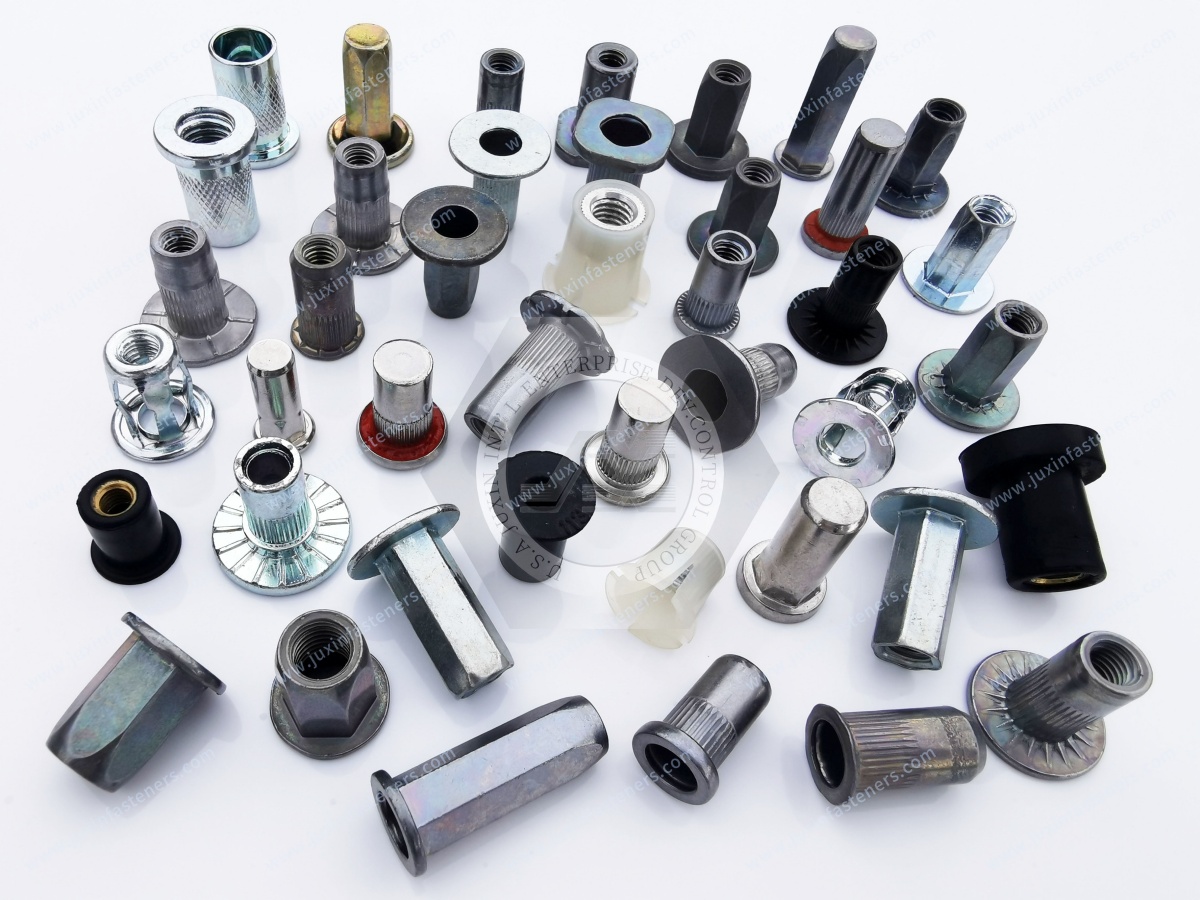
Round, Hexagonal and Knurled Rivet Nut Bodies
Body geometry influences resistance to rotation and installation-hole requirements.
Hexagonal Body Rivet Nuts
A hexagonal body engages a corresponding hexagonal hole.
This provides geometric resistance to rotation and may be useful when relatively high tightening torque is required.
However, the actual torque-out performance depends on:
Hexagonal hole dimensions
Parent material strength
Panel thickness
Fastener geometry
Installation quality
A hexagonal body is not automatically the strongest option for every substrate.
Its performance must be validated in the intended assembly.
Round-Body Rivet Nuts
Round-body rivet nuts are suitable for compatible round installation holes.
They may simplify hole preparation where a hexagonal hole is not available.
Smooth and knurled round-body configurations should be evaluated separately.
Knurled Rivet Nuts
Knurled features can provide additional engagement with compatible substrates.
For aluminum panels, the effectiveness depends on hole fit, material properties and setting deformation.
Aggressive knurling may also damage relatively soft material.
The correct geometry should balance retention and substrate integrity.
Full-Hex, Half-Hex and Special Body Configurations
Full-hex and half-hex rivet nuts are distinct designs.
Their hole requirements, deformation behavior and installed performance may differ.
For OEM procurement, the drawing should identify the required body configuration rather than using the general term "hex rivet nut" alone.
A full-hex product should not be substituted for a half-hex design without engineering review.
Open-End vs. Closed-End Rivet Nuts in Battery Enclosures
The rear-end configuration affects thread access, screw length and potential contaminant pathways.
Open-End Rivet Nuts
Open-end rivet nuts provide an open threaded passage.
They may be appropriate for brackets and other applications where the rear cavity does not create a sealing or clearance problem.
However, mating screw length must be controlled to prevent interference with internal components.
Closed-End Rivet Nuts
Closed-end rivet nuts have a closed rear body.
They may be considered where a threaded passage through the fastener is undesirable.
However, the closed end does not automatically seal the interface between the rivet nut head and the enclosure wall.
The thread depth and mating screw length must also be checked.
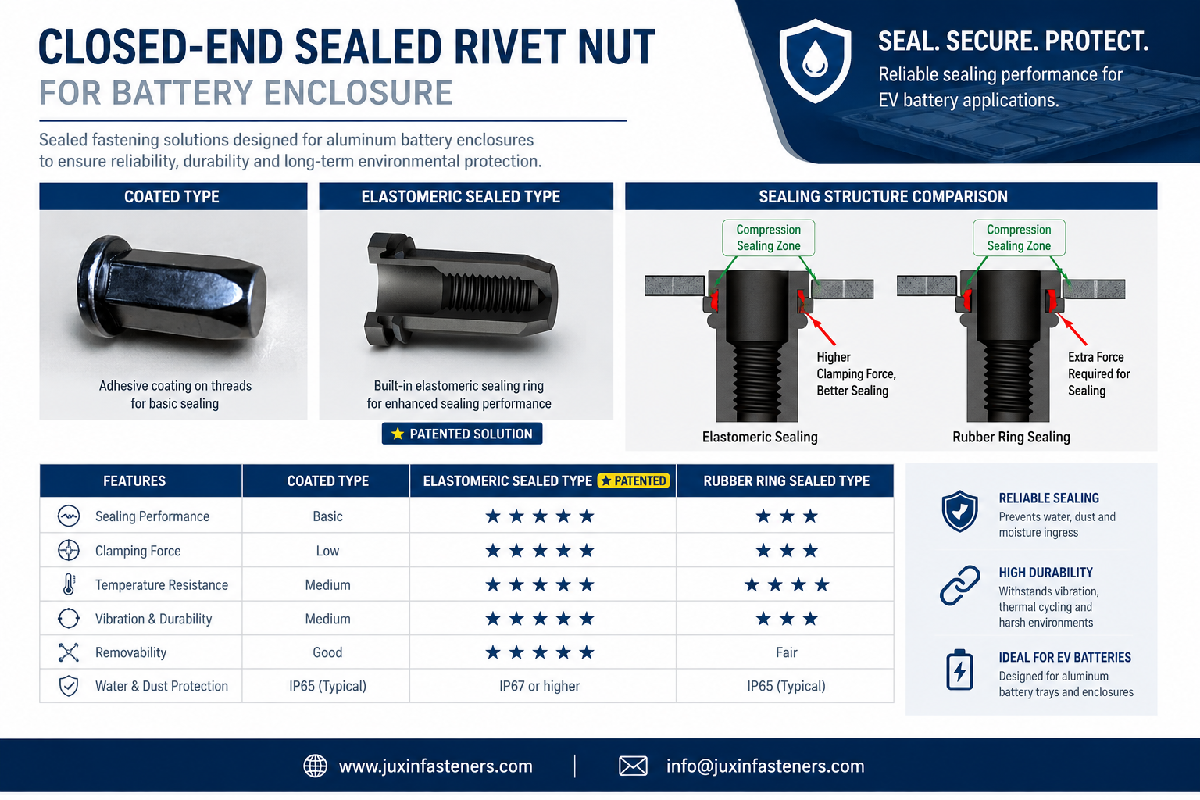
Sealed Blind Rivet Nuts and Battery Enclosure Ingress Protection
Battery enclosures may be exposed to water, road spray, dust, humidity and temperature cycling.
Where a fastening hole crosses the environmental sealing boundary, the joint may require a sealing solution.
A sealed blind rivet nut may incorporate a sealing element beneath the head or at another designed interface.
Sealing Design Considerations
The complete interface should be evaluated for:
Seal material
Compression
Panel surface finish
Hole geometry
Fastener head seating
Installation deformation
Temperature exposure
Chemical compatibility
Vibration
Aging
Closed-End Does Not Mean Waterproof
A closed-end body can block the threaded cavity at the rear of the fastener.
It does not necessarily prevent leakage around the outer body or beneath the head.
IP Ratings Apply to Tested Assemblies
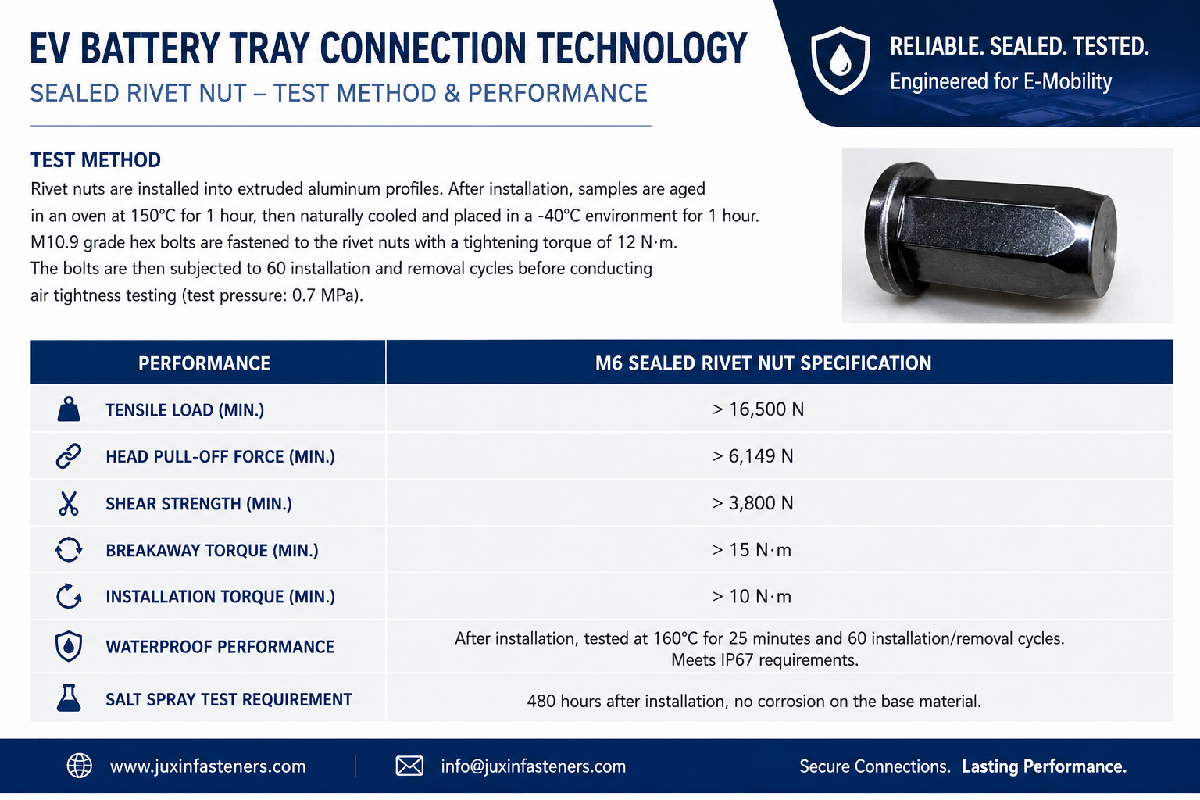
Where an EV enclosure requires a defined ingress-protection classification, the complete enclosure must be validated under the applicable test requirements.
ISO 20653 may be relevant to road-vehicle electrical equipment enclosure protection.
IEC 60529 may also be relevant to specified enclosure IP classifications.
An individual rivet nut should not be advertised as providing an enclosure-level IP rating without an appropriate tested configuration.
Pressure and Coolant Sealing
A sealed rivet nut intended to limit environmental ingress should not automatically be used as a pressure-containing coolant fitting.
Coolant circuits require separate pressure, leakage, temperature and chemical-compatibility evaluation.
Material Selection for Aluminum Battery Housings
Material selection must balance mechanical performance, installation characteristics and corrosion compatibility.
Carbon Steel Blind Rivet Nuts
Steel rivet nuts may provide suitable mechanical performance for selected battery-related assemblies.
The required steel grade and surface treatment should be defined according to the application.
Potential concerns include corrosion protection and compatibility with aluminum parent material.
Aluminum Blind Rivet Nuts
Aluminum rivet nuts may be considered for lightweight assemblies and compatible aluminum structures.
However, aluminum fasteners do not automatically provide the same thread strength or installed retention as steel alternatives.
The selected alloy and product geometry must meet the actual joint requirements.
Stainless Steel Blind Rivet Nuts
Stainless steel may be appropriate where corrosion resistance is important.
However, stainless steel and aluminum can form a galvanic couple in the presence of an electrolyte.
Installation tooling must also be compatible with the selected fastener material.
Material Selection Is a Joint-Level Decision
The parent material, fastener, coating, mating screw and operating environment must be considered together.
Choosing the same metal family as the enclosure is not sufficient by itself to establish suitability.
Galvanic Corrosion in Aluminum Battery Enclosures
Galvanic corrosion can occur when dissimilar conductive materials are electrically connected in the presence of an electrolyte.
For battery enclosures, moisture, road contaminants and damaged coatings may influence corrosion risk.
Potential mitigation approaches include:
Appropriate material selection
Compatible protective coatings
Electrical isolation where permitted
Sealing
Drainage and moisture management
Avoidance of unnecessary coating damage
The selected approach must also respect the enclosure's electrical and mechanical design.
Important Electrical Consideration
Electrical isolation and protective bonding are different requirements.
An insulating barrier may reduce galvanic interaction but may also interrupt an intended electrical bonding path.
The OEM must define whether the fastening location requires electrical continuity, isolation or neither.
A blind rivet nut should not automatically be considered a validated grounding or bonding component.
Coatings and Surface Treatments
For suitable steel rivet nuts, zinc-based or zinc-nickel surface treatments may be considered according to the customer's corrosion specification.
For applicable electroplated threaded fasteners, ISO 4042 may be relevant.
The coating specification should consider:
Base material
Coating thickness
Thread fit
Installation deformation
Corrosion exposure
Mating materials
Customer test requirements
Corrosion resistance should be evaluated for the installed joint rather than assumed from the coating name alone.
Slotted Blind Rivet Nuts for Selected Thin or Soft Materials
Some slotted rivet nut designs form multiple retaining sections behind the workpiece.
This can increase the blind-side bearing area in suitable applications.
Potential uses include selected:
Thin aluminum panels
Lightweight structures
Compatible polymer components
Composite panels
Hollow sections
However, slotted designs are not universally superior.
Their installation behavior and retention depend on the substrate and geometry.
For plastic or composite components, dedicated threaded inserts or other fastening methods may be more appropriate.
Pull-Out Resistance, Torque-Out Resistance and Joint Reliability
Two important installed-performance characteristics are pull-out resistance and torque-out resistance.
Pull-Out Resistance
Pull-out resistance describes the installed fastener's ability to resist axial removal under defined test conditions.
It depends on the fastener and the parent material.
Torque-Out Resistance
Torque-out resistance describes resistance to rotation within the installation hole.
This is particularly relevant during mating screw tightening and removal.
Thread Stripping
Thread stripping is a separate failure mode.
The rivet nut may remain securely installed while the internal thread fails.
Parent Material Failure
The surrounding aluminum panel may deform or tear before the fastener itself fails.
Vibration and Fatigue
The installed rivet nut's retention does not automatically guarantee that the complete screw joint will resist vibration loosening or fatigue.
The mating screw, preload, joint stiffness and service loads must also be considered.
Engineering Information Gain: Compare the Failure Modes
| Failure Mode | Possible Cause | Engineering Review |
|---|---|---|
| Rivet Nut Rotation | Inadequate anti-rotation engagement | Body geometry, hole dimensions, setting |
| Pull-Out | Insufficient installed retention | Grip range, substrate, deformation |
| Thread Stripping | Excessive thread load | Thread engagement, screw and insert strength |
| Panel Cracking | Local installation stress | Material, edge distance, setting process |
| Leakage | Incomplete sealing interface | Seal design and assembly validation |
| Galvanic Corrosion | Dissimilar metals and electrolyte | Materials, coatings, isolation |
| Screw Bottoming | Incorrect screw length | Closed-end thread depth and clearance |
| Installation Damage | Incorrect tooling or parameters | Tool compatibility and process control |
This failure-mode approach is more useful than selecting a fastener solely from a nominal thread-size table.
Battery-Specific Risk: Conductive Debris and Cleanliness
Battery enclosure manufacturing may involve strict contamination-control requirements.
Installation processes can generate or dislodge particles through:
Hole preparation
Burr removal
Coating damage
Tool wear
Incorrect setting
Rework or fastener removal
Metallic debris may be especially undesirable near sensitive electrical components.
Engineers and production teams should evaluate whether installation is performed before or after sensitive components are introduced into the enclosure.
Where required, the production process should include suitable cleanliness controls and inspection.
The exact acceptance criteria must follow the OEM's specification.
Battery-Specific Risk: Thermal Cycling and Differential Expansion
Battery enclosures can experience temperature changes during operation and environmental exposure.
Aluminum panels, steel fasteners, polymer seals and mating components may expand at different rates.
These differences can affect:
Contact pressure
Sealing compression
Joint preload
Local stresses
Long-term retention
Thermal cycling should therefore be considered when the fastening point is exposed to significant temperature variation.
A static room-temperature pull-out test alone may not represent all service conditions.
Installation Engineering for High-Volume EV Production
A fastener suitable for prototype assembly must also be compatible with the intended production process.
Potential installation equipment includes:
Manual tools
Pneumatic systems
Hydraulic systems
Battery-powered tools
Automated setting equipment
For production applications, important variables include:
Mandrel engagement
Setting stroke
Setting force
Tool alignment
Hole tolerance
Fastener orientation
Feeding compatibility
Blind-side clearance
Inspection requirements
Production-Line Repeatability
A stable process should consistently produce the intended installed geometry.
Potential production concerns include:
Incorrect part feeding
Mixed fastener variants
Tool wear
Incomplete setting
Thread damage
Panel deformation
Seal displacement
Incorrect fastener orientation
For automated lines, the fastener should be evaluated for feeding and orientation as well as mechanical performance.
Traceability and Inspection
The required level of traceability depends on the OEM program.
Potential inspection characteristics include:
Thread dimensions
Body and head dimensions
Material
Coating
Grip range
Installation condition
Visual defects
Torque-out performance
Pull-out performance
Sealing performance where specified
Inspection and validation requirements should be agreed before production.
EV Battery Cover and Service-Panel Fastening
Serviceable covers may require repeated removal and installation of mating screws.
This introduces requirements beyond initial fastener retention.
Engineers should consider:
Expected service cycles
Tightening torque
Thread wear
Anti-rotation performance
Access for maintenance
Seal replacement or reuse
Screw length
Repair procedures
A removable screw connection is only beneficial if the installed threaded mounting point remains suitable throughout the intended service life.
Battery Module Brackets and Auxiliary Supports
Blind rivet nuts may be considered for selected brackets and auxiliary mounting structures.
However, the required joint performance depends on the actual loading conditions.
Potential considerations include:
Static loading
Dynamic loading
Vibration
Fatigue
Local panel stiffness
Joint preload
Assembly tolerance
Safety-critical or high-load applications require the OEM's specific engineering approval.
Cooling-Related Equipment Mounting
Blind rivet nuts may provide mechanical mounting points for selected cooling-related brackets, covers or accessory components.
This does not mean that the fastener is automatically suitable for sealing a coolant circuit.
Mechanical attachment and pressure-containing fluid sealing must be evaluated separately.
OEM Procurement and Supplier Development
For OEM procurement teams, a battery enclosure fastener must satisfy both engineering and commercial requirements.
A complete sourcing review should consider:
Product geometry
Material specification
Coating requirements
Installation compatibility
Inspection scope
Sample requirements
Tooling requirements
MOQ
Production volume
Packaging
Delivery schedule
Drawing revision control
Standard vs. Custom Rivet Nuts
A standard rivet nut may be suitable when its dimensions, grip range and installed performance match the application.
A custom configuration may be considered when the assembly requires:
Special body length
Unusual grip range
Modified head geometry
Specific anti-rotation features
Sealing elements
Customer-defined material
Special coating
Production-line compatibility features
Customization should be justified by functional or manufacturing requirements.
Engineering and Procurement Selection Table
| Requirement | Selection Consideration |
|---|---|
| Thin Aluminum Panel | Grip range, deformation, bearing area |
| High Tightening Torque | Anti-rotation geometry and torque-out validation |
| Environmental Sealing | Sealed design and complete-joint testing |
| Closed Enclosure | Blind-side clearance and screw protrusion |
| Dissimilar Metals | Galvanic corrosion control |
| Repeated Maintenance | Thread durability and anti-rotation |
| Automated Assembly | Feeding, tooling and process repeatability |
| Sensitive Electrical Area | Cleanliness and electrical requirements |
| Custom OEM Program | Drawing, qualification, MOQ and tooling |
Preparing an EV Battery Enclosure Rivet Nut RFQ
To support technical review and quotation, provide:
Product Information
Thread size and pitch
Body geometry
Head configuration
Open-end or closed-end design
Material
Surface treatment
Required dimensions
Engineering drawing
Workpiece Information
Parent material
Panel thickness and tolerance
Installation hole
Available blind-side clearance
Coating or surface condition
Performance Information
Required tightening torque
Torque-out requirement
Pull-out requirement
Vibration or fatigue requirements
Corrosion exposure
Temperature range
Sealing requirements
Electrical isolation or bonding requirements
Production Information
Installation method
Setting equipment
Estimated annual volume
Order quantity
Packaging requirements
Inspection requirements
Required delivery schedule
Where requirements are not yet defined, identify them for engineering clarification rather than assuming values.
Frequently Asked Questions
Can blind rivet nuts be used in aluminum EV battery enclosures?
Yes, in suitable applications where the fastener geometry, grip range, material and installed performance are compatible with the aluminum component.
Are hexagonal rivet nuts better for battery housings?
Hexagonal bodies can provide geometric anti-rotation engagement in compatible holes, but the best design depends on the actual substrate and joint requirements.
Do closed-end rivet nuts make a battery enclosure waterproof?
No. The complete sealing interface and enclosure must be evaluated and tested.
Can a rivet nut affect battery enclosure electrical safety?
Yes. Material contact, conductive debris, electrical bonding and isolation requirements may be relevant depending on the installation location.
Should steel or aluminum rivet nuts be used in aluminum housings?
The choice depends on mechanical requirements, corrosion compatibility, installation conditions and the overall joint design.
Can blind rivet nuts be installed automatically?
Many configurations can be evaluated for automated installation, but feeding, orientation, tooling and process compatibility must be confirmed.
Are slotted rivet nuts suitable for plastic battery components?
Some specialized designs may be suitable for compatible substrates, but installation and retention require validation. Dedicated plastic threaded inserts may be preferable in other cases.
Can rivet nuts be used for battery cooling systems?
They may be suitable for selected mechanical mounting functions. They should not automatically be used as pressure-containing coolant fittings.
What testing is required for an EV battery enclosure rivet nut?
Testing depends on the application and OEM requirements. Potential evaluations include dimensional, installation, torque-out, pull-out, corrosion, vibration and sealing performance.
Can JUXIN FASTENERS review custom battery enclosure fastener drawings?
JUXIN FASTENERS welcomes drawing-based inquiries for standard and customized blind rivet nuts and related fastening components, subject to technical and commercial review.
JUXIN FASTENERS: Blind Rivet Nuts for EV Battery and Electrical Equipment
JUXIN FASTENERS supplies industrial blind rivet nuts and related threaded fastening products for international OEM and industrial purchasing requirements.
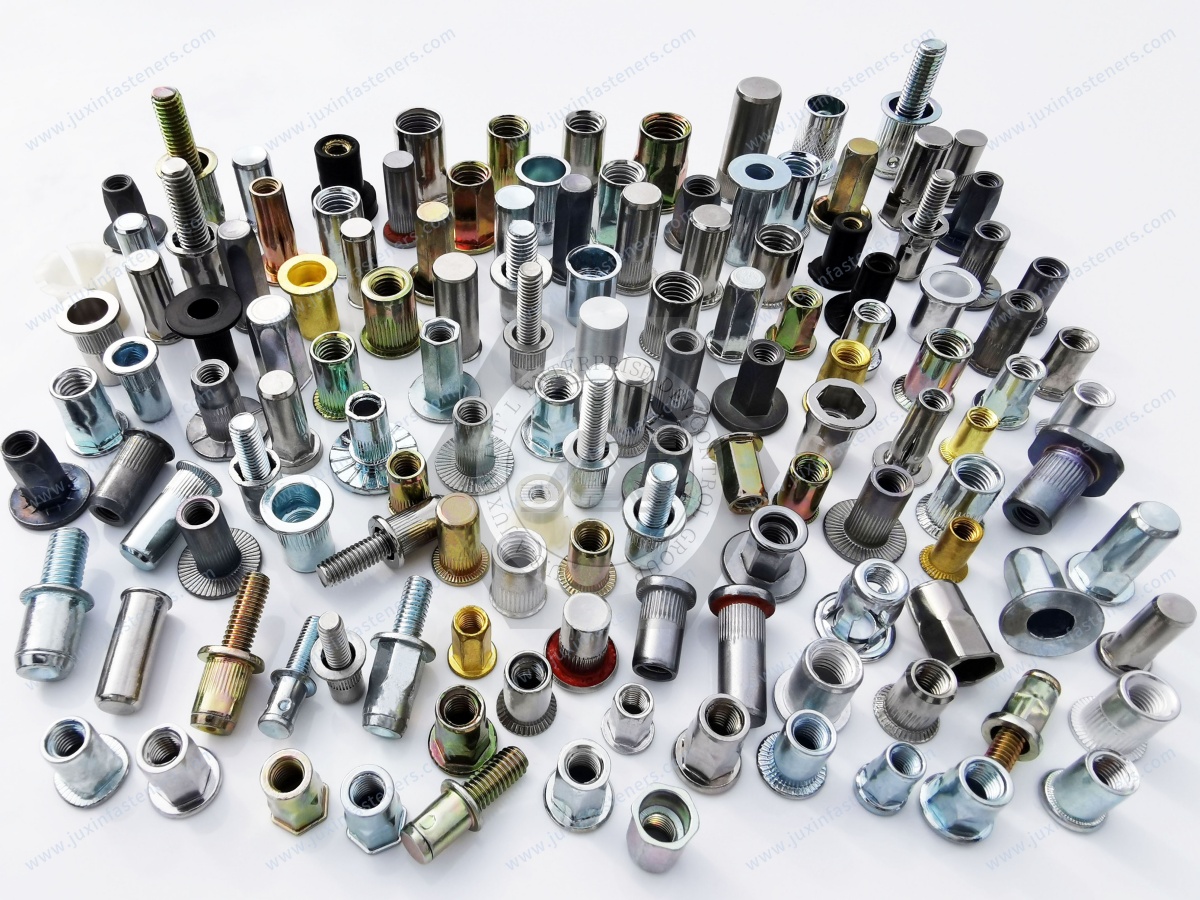
Relevant product families include:
Steel Blind Rivet Nuts
Stainless Steel Blind Rivet Nuts
Aluminum Blind Rivet Nuts
Round-Body Blind Rivet Nuts
Hexagonal-Body Blind Rivet Nuts
Knurled Blind Rivet Nuts
Slotted Blind Rivet Nuts
Open-End Blind Rivet Nuts
Closed-End Blind Rivet Nuts
Selected Sealed Configurations
Custom OEM Threaded Fasteners
The appropriate product configuration should be confirmed according to the customer's drawing, parent material, installation process and functional requirements.
Request an OEM EV Battery Enclosure Fastener Quotation
Are you developing an EV battery enclosure, aluminum housing, electrical equipment assembly or battery-related mounting structure?
JUXIN FASTENERS welcomes inquiries from automotive OEMs, Tier-1/Tier-2 suppliers, engineering teams, production managers, procurement specialists and supplier-development professionals.
Send your drawings and application requirements for review.
For faster evaluation, include:
Engineering drawing
Thread specification
Parent material and thickness
Installation hole
Grip range
Material and coating
Sealing requirements
Mechanical performance requirements
Installation method
Estimated order quantity and annual demand
Inspection and packaging requirements
We can review suitable standard or custom blind rivet nut configurations and discuss quotation arrangements.
Company: JUXIN FASTENERS
Website: www.juxinfasteners.com
Email: info@juxinfasteners.com
Send your OEM drawings, samples or RFQ to JUXIN FASTENERS for EV battery enclosure blind rivet nuts and industrial threaded fastening solutions.
 MORE NEWS

Oct. 13, 2026
Contact Us
Tel.:
+86 020 8621 0320
+86 020 3121 6067
E-mail:
Technical Support:
Navigation
SEND INQUIREY