
Call Us
+86 136 6007 9809
Call Us
+86 136 6007 9809

Apr. 18, 2026
Automation-Ready Fasteners: Quality Control, Bulk Supply and OEM Sourcing
In high-volume manufacturing, industrial fasteners must satisfy more than dimensional and material specifications.
Their geometry, surface condition, packaging and consistency must also be compatible with the equipment and processes used to install them.
This distinction is particularly important for automatic feeding systems, robotic welding cells, automated screwdriving equipment,
press-installation systems and other repetitive assembly operations.
A fastener that performs satisfactorily during manual installation may behave differently when it must pass through an orientation track, escapement, delivery mechanism or automated installation tool.
For automotive OEMs, sheet metal fabricators, electrical equipment manufacturers and industrial automation companies,
reliable fastening requires coordination between product design, supplier quality, equipment compatibility and production planning.
Bulk supply itself is not a quality defect. Properly controlled bulk production can support high-volume manufacturing efficiently.
The relevant risks arise when critical dimensions, component identification, handling conditions or functional requirements are not adequately defined and controlled.
Juxin Fasteners supplies industrial fastening components, including weld studs, weld nuts, self-clinching fasteners,
blind rivet nuts and drawing-based OEM fasteners, for applicable manufacturing and sourcing requirements.
What Makes a Fastener Suitable for Automated Production?
An automation-ready fastener is a component whose defined characteristics are compatible with the intended automated handling and installation process.
These characteristics may include:
Dimensional conformity
Consistent external geometry
Material and surface condition
Orientation characteristics
Feeder and tooling compatibility
Installation performance
Packaging and part identification
Lot consistency
The relevant characteristics depend on the product and manufacturing equipment.
A weld stud transferred pneumatically into a welding head has different requirements from a self-clinching nut installed by a press or a rivet nut installed by a setting tool.
There is no universal fastener geometry or inspection level that guarantees compatibility with every automated production system.
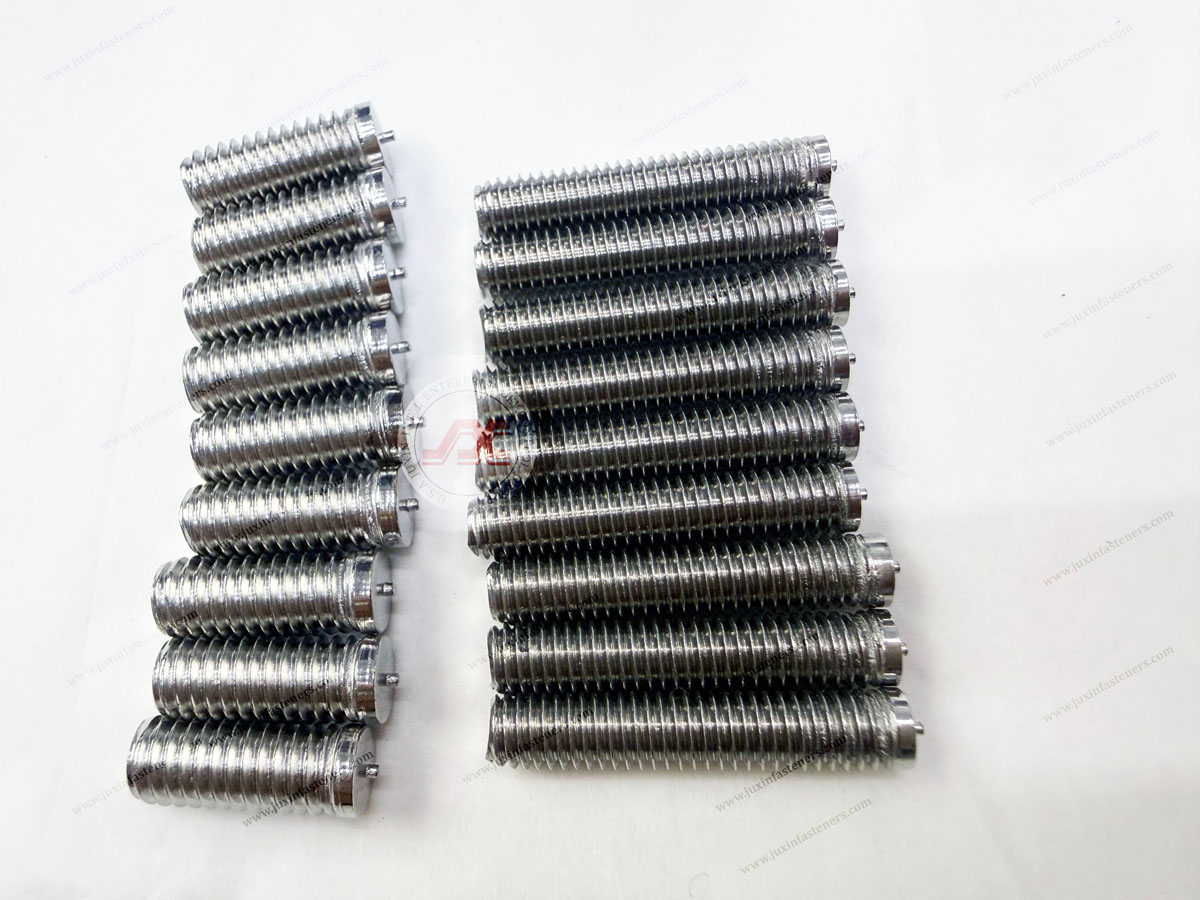
Why Bulk-Supplied Fasteners Sometimes Create Production Problems
Bulk fasteners may be manufactured, inspected and packaged in large quantities.
This supply model is common throughout industrial manufacturing and can be appropriate for automated production.
However, some component characteristics become particularly important when parts are handled repeatedly by mechanical equipment.
Mixed Components
Different thread sizes, lengths or head configurations may look similar.
If different specifications become mixed, some components may fail to pass through the feeder or may be installed incorrectly.
Dimensional Variation
A fastener can approach a drawing tolerance limit and still be conforming.
However, the available clearance within an automated feeding system may be more restrictive than the general product tolerance.
Handling Damage
Bulk transport and mechanical handling may introduce bent components, burrs, damaged threads or surface deterioration.
The risk depends on fastener geometry, material and handling conditions.
Contamination
Oil, particles or other contaminants may affect mechanical feeding, welding or subsequent assembly.
Inconsistent Packaging or Identification
Poor identification or separation of similar components may increase the risk of incorrect material being introduced into production.
These issues are not inherent to bulk supply. They are supply and process risks that can be addressed through appropriate specifications and controls.
General Industrial Fasteners vs. Automation-Specific Requirements
A standard industrial fastener and an automation-ready fastener may share the same nominal product designation.
The difference may lie in additional functional or supply requirements.
| Characteristic | General industrial specification | Additional automation consideration |
|---|---|---|
| Nominal dimensions | Applicable drawing or product standard | Compatibility with feeder clearances |
| Head or flange geometry | Dimensional conformity | Orientation and tool engagement |
| Thread condition | Thread fit and conformity | Feeding clearance and automated assembly |
| Straightness | Applicable dimensional requirement | Transfer through guides or tubes |
| Surface finish | Corrosion and product specification | Friction, handling and process compatibility |
| Inspection | Agreed acceptance plan | Additional critical-characteristic checks |
| Packaging | Shipping protection | Part separation and automated handling |
| Identification | Product and lot identification | Prevention of incorrect part loading |
| Functional testing | Product-specific requirements | Application-specific feeding or installation trials |
A supplier should not assume that compliance with a standard drawing automatically establishes performance in an automated feeding system.
Critical-to-Function Characteristics: Connecting Product Drawings to Manufacturing
One of the most useful ways to define automation-related quality requirements is to identify characteristics that directly influence the manufacturing process.
These are often described as critical-to-function characteristics.
The exact terminology and classification depend on the customer's quality system.
For automatic feeding, a critical characteristic may be related to the part's external envelope, orientation or ability to pass through a guide.
For automated installation, it may relate to thread geometry, insertion force or the interface with the installation tool.
Example: Weld Studs
Potential critical characteristics include:
Stud length
Shank diameter
Straightness
Flange geometry
Weld-end condition
Thread integrity
Example: Projection Weld Nuts
Potential critical characteristics include:
External geometry
Nut orientation features
Projection configuration
Thread condition
Electrode interface
Example: Self-Clinching Fasteners
Potential critical characteristics include:
Clinching feature geometry
Pilot or shank dimensions
Thread condition
Fastener material and hardness
Compatibility with the specified sheet material and thickness
Example: Blind Rivet Nuts
Potential critical characteristics include:
Body diameter
Head geometry
Grip range
Internal thread
Installation-tool compatibility
Deformation behavior during setting
The required characteristics must be established for the actual component and installation method.
Why Not Every Dimension Requires the Same Inspection Strategy
A component drawing may contain numerous dimensions.
Not every dimension has the same influence on feeding or installation.
Some characteristics are essential to the finished joint.
Others may be particularly important to the automated equipment.
The appropriate quality plan should reflect these different functions rather than applying an identical inspection approach to every characteristic.
Inspection and Sorting for High-Volume Fastener Supply
Inspection can involve dimensional measurement, visual examination, thread gauging, optical sorting, material verification or functional testing.
Each method evaluates particular characteristics.
Dimensional Inspection
Dimensional inspection establishes whether measured characteristics conform to specified limits.
The method depends on the feature, tolerance and measurement requirements.
Optical Sorting
Optical sorting may be used to identify specified visible geometric defects or dimensional variations.
Its effectiveness depends on equipment capability, part presentation, measurement configuration and defect type.
Optical sorting does not automatically verify material properties or mechanical performance.
Thread Inspection
Thread gauges and other suitable measurement methods can evaluate specified thread characteristics.
A visually acceptable thread is not necessarily dimensionally conforming.
Material Verification
Material verification may require appropriate documentation or testing depending on the material specification and customer requirements.
Functional Testing
Some characteristics require functional assessment rather than dimensional inspection alone.
Examples may include prevailing torque, clinching performance, rivet nut installation behavior or welding performance.
These tests are specific to the fastening technology.
100% Inspection vs. Sampling Inspection
A 100% inspection process examines every item for the characteristics covered by that process.
Sampling inspection evaluates selected items according to a defined plan.
Neither approach should be described as universally superior.
Limitations of 100% Inspection
Full inspection can be useful for certain high-risk or efficiently measurable characteristics.
However, its effectiveness depends on:
Measurement capability
Detection limits
Equipment setup
Part presentation
Acceptance criteria
Operator or automated-system performance
A component can pass a 100% visual or dimensional check and still have an undetected defect outside the scope of that inspection.
Sampling Inspection
Sampling inspection can provide a structured method for lot acceptance.
ISO 2859-1:2026 specifies acceptance sampling schemes indexed by acceptance quality limit (AQL) for inspection by attributes.
The selected sampling plan establishes a statistical acceptance approach rather than a guarantee that every accepted item is conforming.
Selecting an Inspection Strategy
The appropriate strategy depends on the consequence of failure, manufacturing process capability, characteristic being inspected and customer specification.
For example, an OEM program may specify additional sorting for a feeding-critical external dimension while using a different verification method for material properties.
The inspection plan should identify the actual requirements rather than rely on the phrase 100% quality control.
Process Control vs. Final Sorting
Final inspection can detect specified nonconforming components before shipment.
However, sorting alone does not establish that the manufacturing process is stable.
Process control addresses the conditions under which components are produced.
These may include tooling condition, equipment setup, material inputs, dimensional monitoring and corrective action.
Why the Distinction Matters
If a manufacturing process produces a recurring geometric defect, final sorting may remove detected defective components.
But without correcting the underlying cause, the defect may continue to occur.
An effective quality approach may therefore combine:
Defined product specifications
Manufacturing process controls
Appropriate inspection
Nonconforming-part management
Lot identification
Corrective action
The combination depends on the product and customer requirements.
Nonconforming Parts and Mixed-Lot Prevention
A nonconforming component is one that fails to meet a specified requirement.
Its disposition should be managed according to the applicable quality arrangement.
Possible dispositions may include segregation, rework where permitted, rejection or other customer-authorized action.
Physical Separation
Separation helps prevent nonconforming or unidentified components from being mixed with accepted material.
Part Identification
Clear identification reduces the risk of introducing an incorrect thread size, length or product configuration into production.
Drawing Revision Control
Changes in component geometry or surface treatment may influence automated handling even when the nominal part name remains unchanged.
For established OEM programs, the current drawing revision should be clearly identified.
Lot Traceability
Lot identification supports investigation when manufacturing or assembly problems are discovered.
The required traceability level depends on the product and customer specification.
Packaging as Part of the Automation Supply Specification
Packaging is often treated primarily as a logistics requirement.
For automated fasteners, it can also influence the condition and identity of components entering production.
Bulk Cartons
Bulk cartons may be suitable for robust fasteners when the packaging provides adequate protection and identification.
Smaller Separated Packs
Smaller packs may be relevant for preventing part mixing, limiting handling damage or supporting production material control.
Protective Packaging
Certain geometries or finishes may require additional protection.
Automated Presentation Packaging
Some production systems use trays, reels, oriented packs or other presentation formats.
These options depend on the fastener and installation equipment.
There Is No Universal Best Packaging Method
Packaging should be selected according to product geometry, damage risk, production handling and commercial requirements.
Special packaging may affect unit cost, shipping efficiency and lead time.
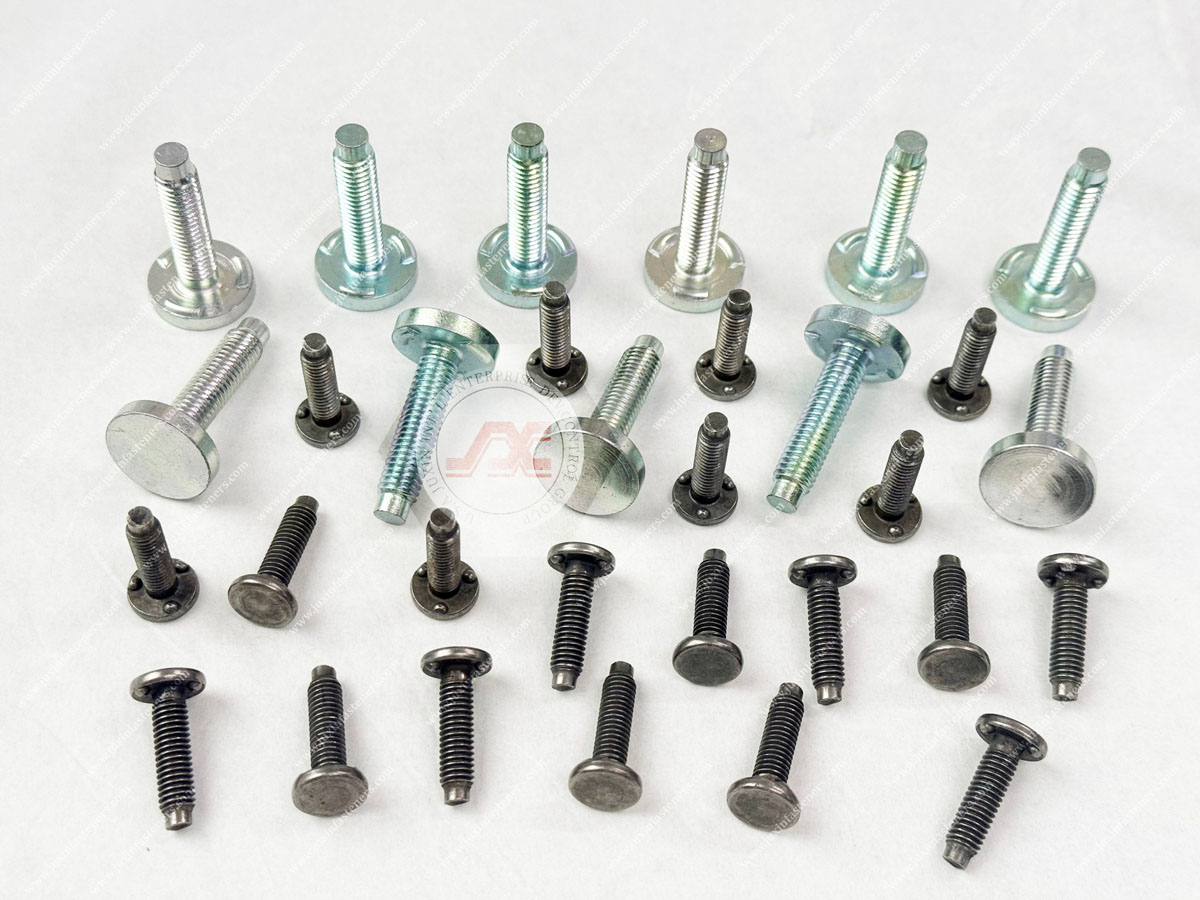
Weld Studs for Automatic Feeding and Robotic Welding
Weld studs are used to create threaded attachment points through an appropriate welding process.
Automatic feeding may involve vibratory orientation, pneumatic transfer and loading into a welding head.
Potential quality characteristics include:
Stud geometry
Flange dimensions
Straightness
Weld-end condition
Thread quality
Material and surface condition
Feeding Performance and Welding Performance
A weld stud that feeds correctly may still produce an unacceptable weld if the material, substrate or welding parameters are unsuitable.
Likewise, a weldable stud may not be compatible with a particular feeder.
These functions require separate consideration.
CD Weld Studs and Projection Weld Studs
Capacitor discharge stud welding and resistance projection welding use different process principles.
Their fastener designs and equipment interfaces should not be treated as interchangeable.
Weld Nuts for Automated Sheet Metal Production
Weld nuts provide internally threaded attachment points in fabricated metal components.
Common configurations include square, hexagonal and other projection-welded designs.
Automatic handling requirements may involve:
Orientation
External geometry
Projection configuration
Electrode engagement
Thread protection
Projection geometry affects the welding process, while the external shape may affect feeding and positioning.
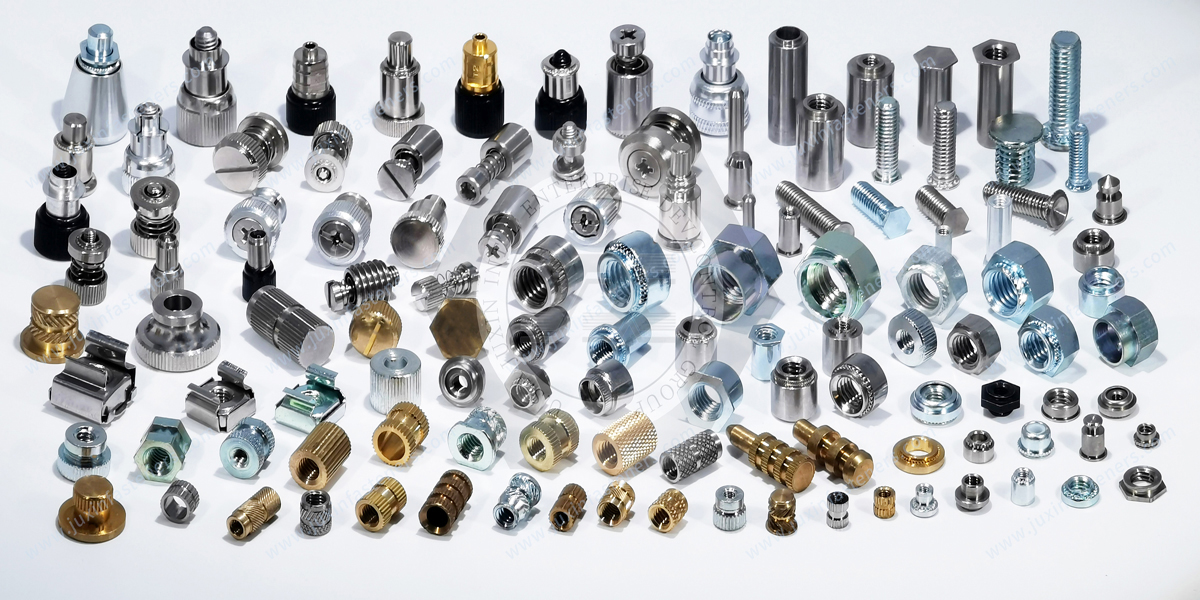
Self-Clinching Fasteners for Automated Press Installation
Self-clinching nuts, studs and standoffs provide threaded attachment points in suitable sheet metal.
They are installed through mechanical deformation rather than welding.
Relevant requirements include:
Hole dimensions
Sheet thickness
Sheet hardness
Fastener geometry
Installation force
Tooling alignment
Required push-out or torque-out performance
Automation Consideration
A self-clinching fastener may be dimensionally conforming but unsuitable for a particular sheet material or installation setup.
The installation process and finished joint performance must be considered alongside component quality.
Blind Rivet Nuts for Automated Installation
Blind rivet nuts create threaded attachment points in suitable thin-wall structures.
They can be installed from one side of the workpiece.
For automated installation, relevant characteristics may include:
Body geometry
Head dimensions
Grip range
Thread conformity
Installation-tool interface
Setting behavior
A rivet nut must deform appropriately during installation to establish the intended mechanical retention.
Its suitability depends on the component, workpiece and setting process.
Automation-Ready Does Not Mean the Same Thing for Every Fastener
A weld stud must be compatible with its welding process.
A self-clinching nut must be compatible with the sheet and press-installation conditions.
A blind rivet nut must be compatible with the workpiece grip range and setting equipment.
A screw intended for automatic driving must be compatible with the feeding and driving tools.
These requirements cannot be replaced by a single generic claim of precision manufacturing.
Automotive and Tier-1 Manufacturing
Automotive manufacturing uses welded and mechanically installed fasteners in suitable body structures, brackets, electrical assemblies and fabricated components.
Relevant fastener categories include:
Weld studs
Weld nuts
Self-clinching fasteners
Rivet nuts
Custom screws and bolts
The applicable product depends on the vehicle assembly, manufacturing process and approved engineering specification.
For production programs involving repeated automated operations, component consistency,
identification and change control can be commercially important.
Electrical Enclosures and Power Distribution Equipment
Electrical cabinets, power distribution equipment and industrial control enclosures use fabricated sheet metal structures with numerous mechanical attachment points.
Suitable fasteners may include weld studs, weld nuts, self-clinching nuts, standoffs and rivet nuts.
The choice depends on:
Sheet material and thickness
Access to the installation location
Required thread size
Assembly sequence
Mechanical loading
Service requirements
Production method
Where electrical bonding or grounding is required, electrical performance must be specified separately.
AI Data Center and Electronic Equipment Manufacturing
Server chassis, rack systems, power supply enclosures and electronic equipment structures may incorporate automated sheet metal fastening operations.
Relevant components include:
Self-clinching nuts
Self-clinching standoffs
Self-clinching studs
Weld studs
Weld nuts
Blind rivet nuts
Custom mounting hardware
Manufacturing requirements may include consistent positioning, controlled installation, compact geometry and efficient subsequent assembly.
Industrial Machinery and Robotics
Industrial machinery and robotic equipment manufacturers may use a combination of automated and manual fastening processes.
Applications can include:
Equipment housings
Sensor brackets
Control panels
Motor mounting structures
Fabricated mechanical supports
Serviceable access panels
The economic justification for automated installation depends on production volume, component complexity and equipment requirements.
HVAC and Commercial Equipment
HVAC equipment and commercial machinery often use repeated sheet metal components and mechanical mounting points.
Weld fasteners, self-clinching components and rivet nuts may be relevant to suitable assemblies.
For high-volume production, the selected fastener should fit both the equipment design and the manufacturing sequence.
Total Installed Cost: Why Unit Price Alone Is Incomplete
The purchase price of a fastener is only one element of the manufacturing cost.
A broader comparison may consider:
| Cost factor | Commercial relevance |
|---|---|
| Fastener purchase price | Direct material cost |
| Inspection and sorting | Verification and quality-control expense |
| Packaging | Protection, handling and identification |
| Feeder interruptions | Equipment availability |
| Installation cycle | Production capacity |
| Rework and scrap | Quality-related manufacturing cost |
| Tooling changes | Production engineering cost |
| Inventory and delivery | Supply-chain operating cost |
Illustrative Cost Model
A simplified way to compare supply options is:
Total relevant cost = Fastener purchase cost + Inspection and sorting cost + Packaging and handling cost + Recorded interruption cost + Rework and scrap cost.
This is an evaluation framework, not a claim that one supplier or inspection method will always be more economical.
A Higher-Priced Fastener Is Not Automatically Better
A premium component may provide value if it satisfies a verified production requirement that a lower-priced alternative does not.
However, the benefit should be evaluated against actual manufacturing performance, not assumed from marketing descriptions.
OEM Supplier Qualification and Long-Term Supply
For recurring OEM production, supplier evaluation may involve more than the initial sample.
Relevant considerations include:
Drawing and material conformity
Manufacturing feasibility
Inspection requirements
Process consistency
Lot identification
Packaging
Engineering change control
Production capacity relevant to the project
Delivery planning
Commercial terms
First Article and Production Approval
A customer may require initial samples, first-article inspection or production approval activities.
The scope depends on the industry, customer program and applicable specification.
Ongoing Production
After approval, continued supply may require consistency with the agreed drawing, material and quality requirements.
Engineering Changes
Changes to dimensions, material, finish or manufacturing process may affect feeder compatibility or installation behavior.
The customer's change-notification and approval requirements should be defined where applicable.
International Standards and Quality Planning
ISO 2859-1:2026
ISO 2859-1 defines acceptance sampling schemes indexed by AQL for inspection by attributes.
It provides a framework for specified sampling inspection and lot-acceptance decisions.
It does not certify a supplier or guarantee zero defects.
ISO 9001:2026
ISO 9001 establishes requirements for quality management systems.
Its principles are relevant to process management, documented requirements, performance evaluation and improvement.
Compliance or certification must be established independently and should not be inferred from general statements about inspection or sorting.
Product-Specific Standards
Applicable DIN, ISO, ASME, ASTM or other product standards depend on the fastener category, material and application.
A product standard may define dimensions, threads or mechanical properties.
It does not necessarily define compatibility with a particular automatic feeder or installation machine.
Metric and Inch Thread Compatibility
Metric threads and Unified UNC/UNF threads are distinct systems.
British BSW/BSF threads are also separate.
Different thread systems cannot be treated as directly interchangeable based on nominal diameter.
The actual thread specification must be included in the product drawing and purchase requirements.
Custom Fasteners and Automation-Specific OEM Requirements
Standard catalog components are suitable for many industrial applications.
However, specialized automation equipment may require customer-defined features or additional acceptance criteria.
Possible project requirements include:
Custom geometry
Special flange or head dimensions
Defined straightness
Specific thread tolerances
Surface treatment
Feeding-critical dimensions
Inspection characteristics
Part identification
Packaging configuration
Production volume and delivery requirements
The feasibility of these requirements depends on the product design, manufacturing process and quantity.
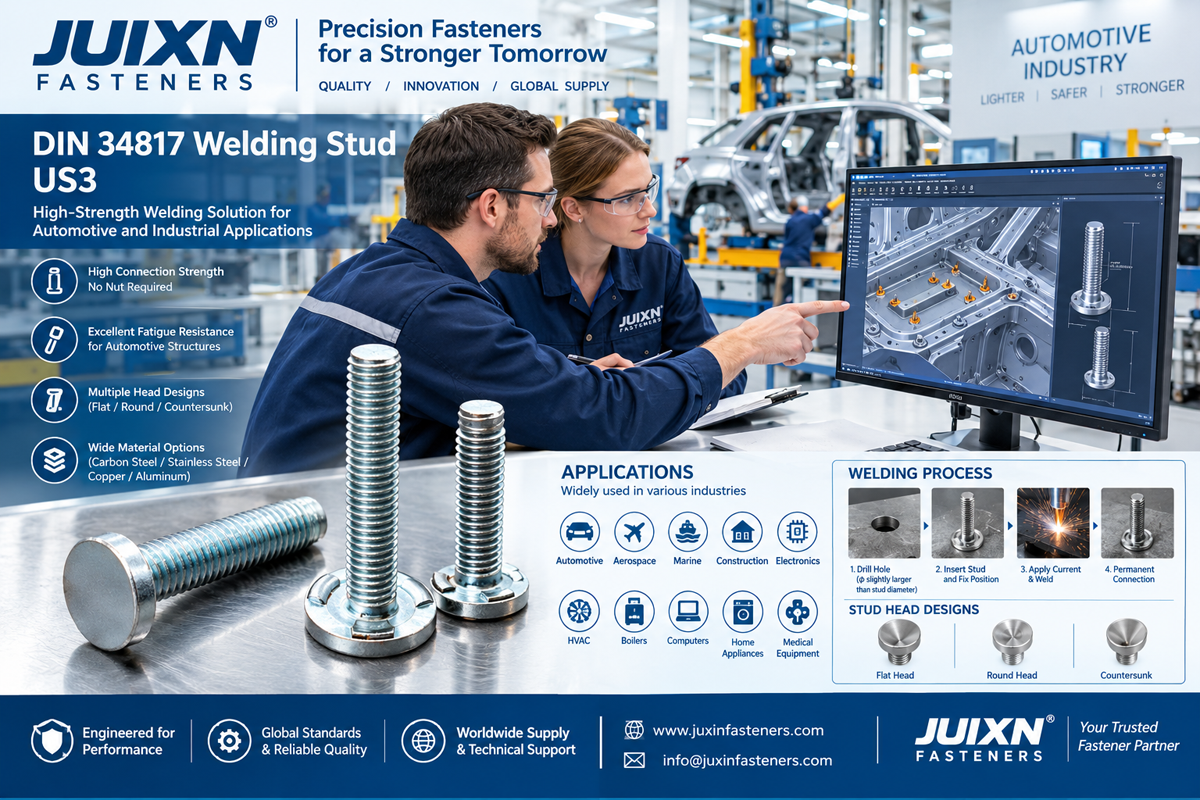
Juxin Fasteners: Industrial Fasteners for OEM Manufacturing
Juxin Fasteners supplies standard and drawing-based fastening components for international industrial manufacturing.
Relevant product families include:
Weld studs
DIN 34817 weld studs
Capacitor discharge weld studs
Projection weld studs
DIN 928 square weld nuts
Other weld nuts
Self-clinching nuts
Self-clinching studs
Self-clinching standoffs
Blind rivet nuts
Industrial screws and bolts
Custom machined fastening components
For automated manufacturing applications, component specifications can be reviewed together with the relevant material, installation process, equipment interface and purchasing requirements.
Inspection scope, additional sorting, packaging, MOQ, production arrangements and lead time are confirmed according to the individual project.
Related Engineering Resources
For more information about fastener design and automation integration, explore these Juxin Fasteners resources:
Fastener Automated Feeding and Robotics: OEM Automation Integration Guide
Fasteners for AI Data Center Electrical Cabinets and Enclosures
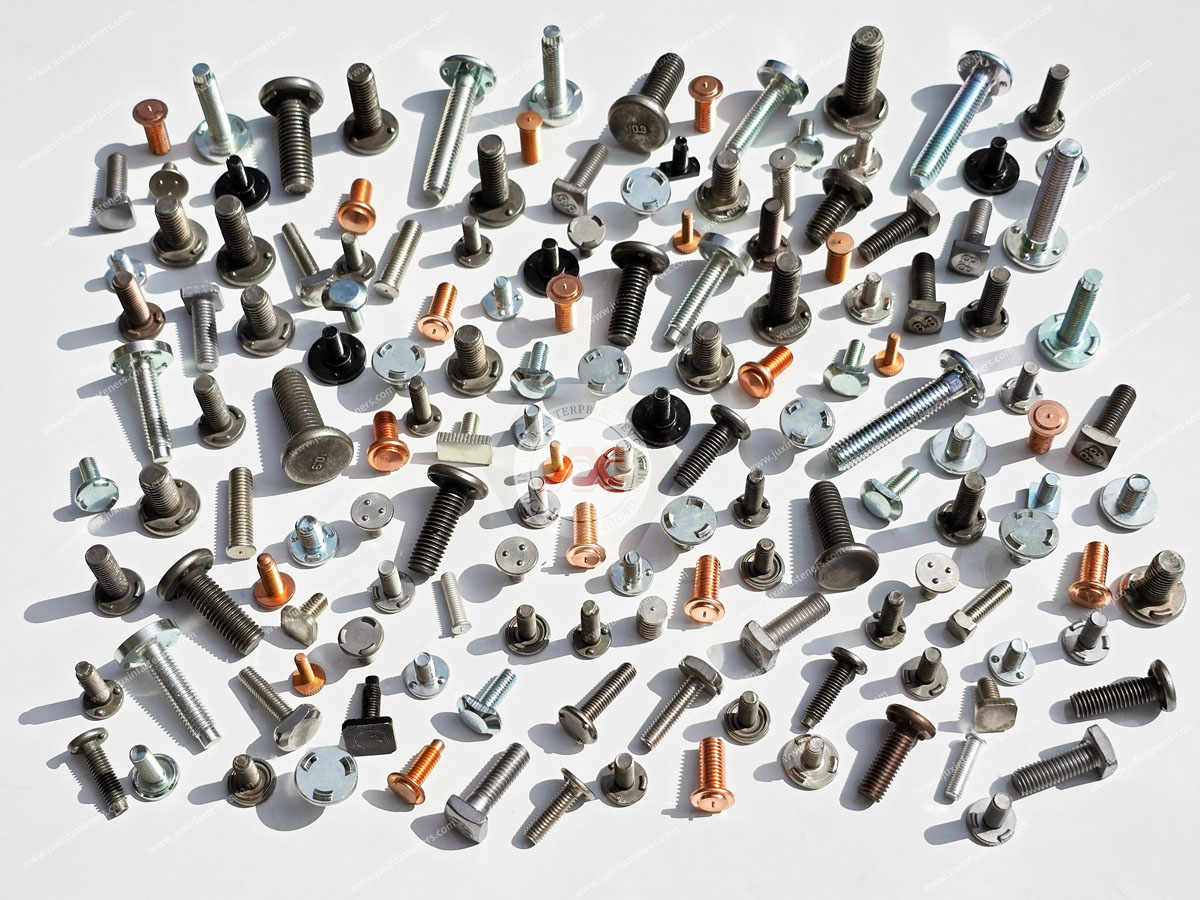
OEM RFQ — Automation-Ready Fasteners and Controlled Bulk Supply
Juxin Fasteners welcomes inquiries for industrial fasteners used in automated assembly, robotic welding,
sheet metal manufacturing and high-volume OEM production.
To evaluate an automation-specific fastening requirement, relevant information includes:
2D engineering drawing and revision
3D CAD model where applicable
Fastener type and product standard
Material grade and surface treatment
Metric or inch thread specification
Dimensional tolerances
Critical-to-function characteristics
Mating component material and thickness
Automatic feeder or installation equipment details
Installation method and functional requirements
Required inspection or sorting characteristics
Acceptance criteria and documentation
Part identification and traceability requirements
Packaging specifications
Prototype or sample quantity
Estimated annual purchasing volume
Required delivery schedule
Company: Juxin Fasteners
Website: https://www.juxinfasteners.com/
Email: info@juxinfasteners.com
For weld studs, weld nuts, self-clinching fasteners, rivet nuts and custom OEM fastening components intended for automated production,
contact Juxin Fasteners with your drawings and manufacturing requirements for technical and commercial review.
Contact Us
Tel.:
+86 020 8621 0320
+86 020 3121 6067
E-mail:
Technical Support:
Navigation
SEND INQUIREY



