
Call Us
+86 136 6007 9809
Call Us
+86 136 6007 9809

Oct. 20, 2023
Copper washers are used in industrial assemblies for several different purposes, including sealing, electrical contact,
thermal transfer, spacing, bearing, and application-specific fastening interfaces.
However, "copper washer" describes the material and basic component form—not one universal function.
A flat copper washer used beneath a fastener, a copper sealing washer used in a fluid connection, a deformable copper crush washer,
and a copper washer used as part of an electrical connection may look similar, but their engineering requirements can be significantly different.
Geometry, copper grade, material condition or temper, thickness, surface condition, mating surfaces, installation load, and operating environment all influence performance.
For engineers and procurement teams, the first sourcing question should therefore not simply be "What size copper washer do we need?"
A better starting point is:
What function must the copper washer perform in the actual assembly?
JUXIN FASTENERS supplies standard and custom washers and fastening components for industrial OEM applications and supports specification-based, drawing-based, and sample-based sourcing.
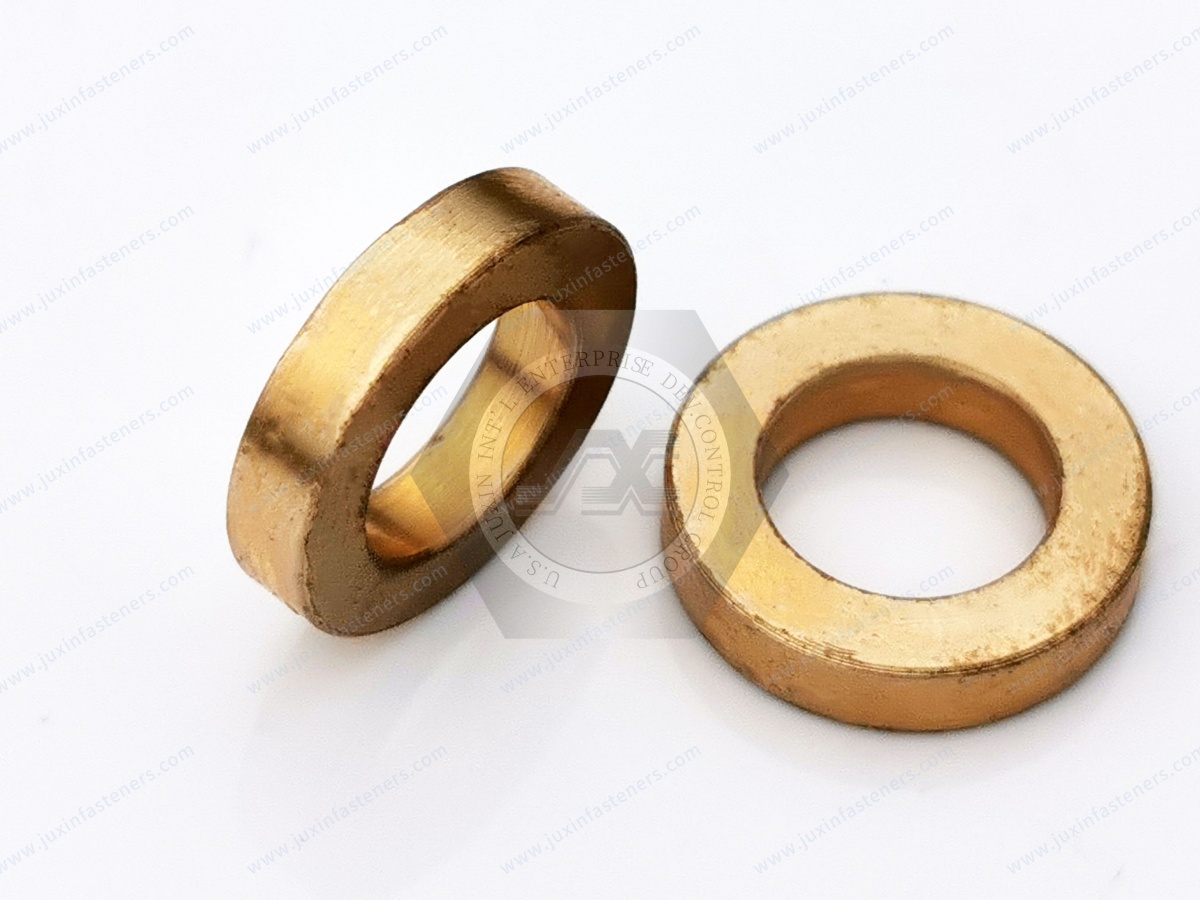
A copper washer is a washer or washer-shaped component manufactured from a specified copper material.
Depending on its design, it can be used as:
a flat bearing washer;
a sealing washer;
a crush washer;
a sealing ring;
an electrical contact washer;
a thermally conductive interface component;
a spacer or shim-like component;
a custom drawing-controlled stamped component.
Copper is selected because its combination of formability, electrical conductivity, thermal conductivity, and corrosion behavior can be useful in specific assemblies.
These properties do not mean every copper washer performs every function.
A washer designed for electrical contact, for example, should not automatically be assumed to provide a pressure seal.
This distinction is fundamental for engineering and sourcing.
| Copper Washer Type | Primary Design Intent | Important Selection Factors |
|---|---|---|
| Copper flat washer | Bearing, spacing or application-specific contact | ID, OD, thickness, material, surface condition |
| Copper sealing washer | Create a sealing interface in a designed joint | Material condition, geometry, surface finish, mating surfaces, installation load |
| Copper crush washer | Controlled deformation during assembly | Copper condition, thickness, geometry, mating surfaces, compression |
| Copper electrical washer | Conductive contact or electrical interface | Conductivity, contact surfaces, plating/coatings, contact pressure, corrosion |
| Custom copper washer | Drawing-defined function | Complete drawing, material specification, tolerances and application requirements |
The names are sometimes used loosely in purchasing, so a drawing or existing sample can be particularly useful when the function is critical.
Copper can be useful in sealing interfaces because suitable copper materials can deform under assembly load.
In a correctly designed joint, this deformation can help the washer conform to small surface irregularities between mating components.
This is different from saying that the washer simply "fills a gap."
A sealing joint depends on controlled contact between:
the washer;
the fastener or fitting;
the mating component;
the sealing surfaces.
The installation load must create the intended contact condition without producing an unacceptable failure mode.
For this reason, sealing performance depends on the complete joint rather than on copper alone.
Two copper washers with identical outside dimensions are not necessarily functionally identical.
The material condition or temper can affect how readily the washer deforms under installation load.
For sealing applications, this can influence:
conformity to mating surfaces;
contact pressure distribution;
permanent deformation;
installation behavior;
potential reuse;
consistency between assemblies.
Where a drawing specifies a particular copper grade, material condition, hardness range, or processing requirement, these should be treated as functional requirements rather than optional purchasing details.
Substituting a different copper condition solely because the dimensions match can change assembly behavior.
"Sealing washer" and "crush washer" are sometimes used interchangeably in the market, but the terms should be interpreted according to the actual component and joint.
A crush washer is generally intended to undergo controlled permanent deformation during installation.
A sealing washer may use deformation to create the sealing interface, but the exact geometry and sealing principle depend on the application.
For supplier qualification or replacement sourcing, engineers and buyers should therefore verify:
washer geometry;
inside diameter;
outside diameter;
thickness;
material specification;
material condition;
surface finish;
mating component geometry;
installation requirement.
The application should define the washer—not the informal product name alone.
Copper sealing washers can be used in suitable fluid and mechanical connections where the joint is designed around a metallic sealing interface.
Potential applications include:
threaded fluid fittings;
hydraulic connections;
lubrication-system connections;
automotive fluid-system components;
industrial equipment;
compressors and pumps;
thermal equipment;
application-specific pipe or tube fittings.
A familiar example is a copper sealing washer used with certain banjo-bolt or fluid-fitting arrangements.
However, suitability should always be verified for the actual pressure, fluid, temperature, surface finish, mating materials, fastener geometry, and installation conditions.
A generic copper washer should never be assumed to provide a validated pressure seal simply because it is made from copper.
Automotive applications are an important commercial search area for copper sealing washers and crush washers.
Depending on the vehicle system and approved design, copper washers may be encountered in certain:
brake-related hydraulic fittings;
lubrication connections;
fuel-system connections;
cooling-system interfaces;
sensor or plug sealing interfaces;
banjo-bolt assemblies;
other drawing-controlled fluid connections.
The exact washer should follow the applicable vehicle, component, or customer specification.
For automotive supplier development, dimensional similarity alone is not enough to establish interchangeability. Material, temper, thickness, sealing surfaces, and assembly requirements can all affect the joint.
Reuse should not automatically be assumed.
A copper crush or sealing washer may undergo permanent deformation during its initial installation. That deformation is often part of how the sealing interface is created.
After disassembly:
the washer thickness may have changed;
the contact surfaces may be imprinted;
the material may have work-hardened locally;
the mating-surface relationship may no longer reproduce the original condition.
Whether reuse is acceptable depends on the component specification, joint design, washer condition, and maintenance procedure.
Where the washer is intended as a deformable sealing element, replacing it during service can provide a more predictable sealing interface when required by the applicable maintenance or assembly specification.
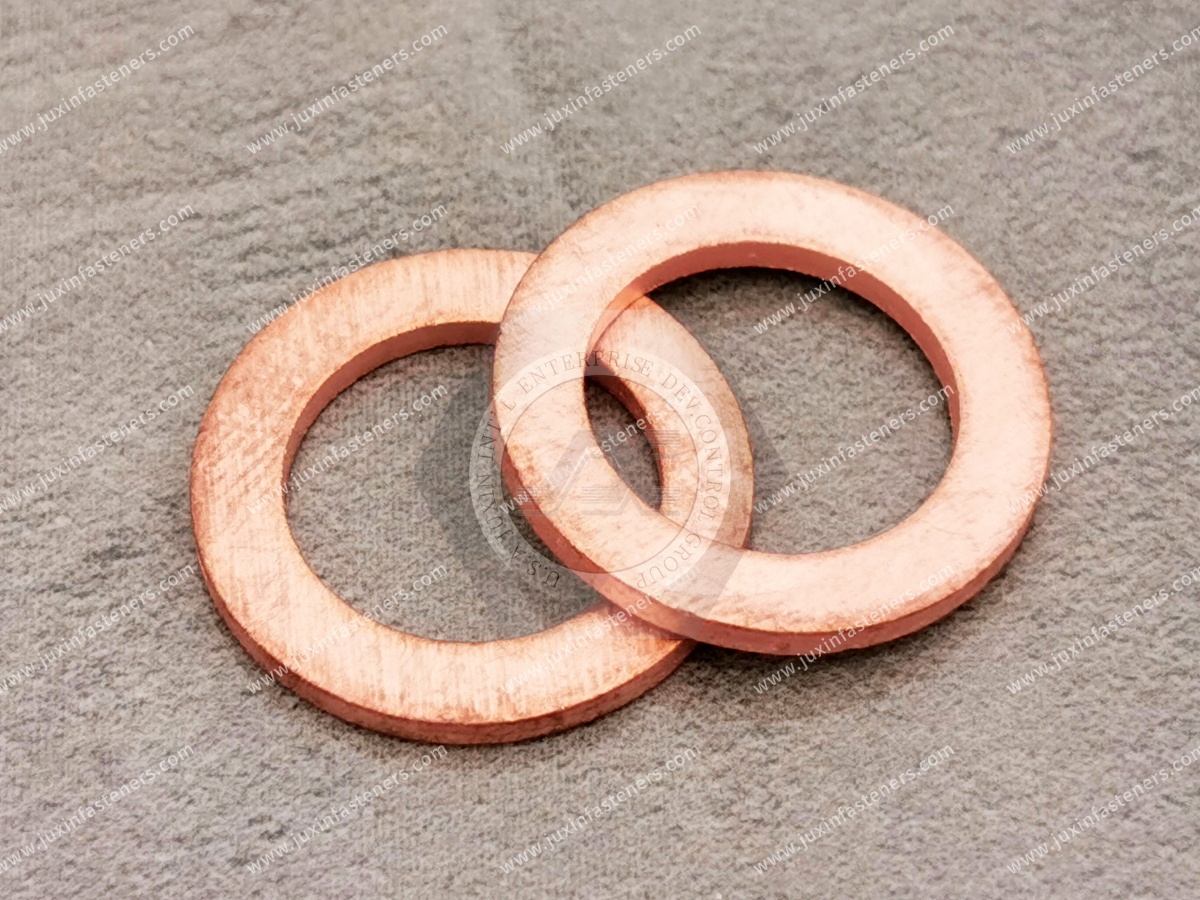
Copper alone does not create a reliable seal.
The mating surfaces matter.
Important variables can include:
surface flatness;
surface roughness;
scratches or damage;
contamination;
corrosion;
washer surface condition;
component alignment;
contact width;
installation load.
A soft washer cannot compensate for every machining defect or damaged sealing face.
If a joint repeatedly leaks even after replacing the washer, the problem may involve the mating surfaces, geometry, installation method, or another part of the joint rather than the washer itself.
This is an important consideration when troubleshooting legacy equipment.
Copper's high electrical conductivity makes it useful in certain electrical and power applications.
Depending on the design, copper washers can form part of:
busbar connections;
electrical terminals;
grounding or bonding assemblies;
power distribution equipment;
battery-related electrical connections;
power electronics assemblies;
electrical cabinets;
conductive mounting interfaces.
In these applications, the washer's function may be very different from that of a sealing washer.
Electrical performance can depend on:
copper grade;
surface cleanliness;
contact pressure;
contact area;
oxidation;
plating;
mating conductor material;
joint preload;
thermal cycling;
environmental exposure.
A copper washer alone does not guarantee a low-resistance electrical connection. The complete electrical joint must be designed appropriately.
As power density increases in electrical equipment, small conductive components can influence assembly reliability.
Copper washers may be considered in suitable connections involving:
power distribution hardware;
busbar systems;
battery systems;
energy storage equipment;
charging equipment;
industrial power electronics;
electrical switchgear;
high-current equipment.
Where the washer forms part of a current-carrying interface, engineers should distinguish mechanical dimensions from electrical requirements.
The RFQ may therefore need to define not only ID, OD, and thickness, but also copper material, surface condition, plating where applicable, and assembly function.
Copper also has high thermal conductivity, but this property should not be overinterpreted.
A copper washer can participate in heat transfer when it forms part of a suitable thermal path, but thermal performance depends on:
actual contact area;
interface pressure;
surface condition;
washer thickness;
surrounding materials;
interface resistance;
geometry;
heat-flow path.
For thermal-management applications, selecting copper based only on bulk thermal conductivity can overlook the contact interfaces that often dominate actual assembly performance.
Copper washers should not generally be described as vibration-isolation or cushioning devices simply because copper is softer than some mating materials.
If an application requires:
vibration isolation;
spring action;
preload compensation;
shock absorption;
controlled elasticity;
a washer designed specifically for that function may be more appropriate.
Copper material selection should be based on the actual function of the joint.
Copper has useful corrosion behavior in many environments, but it is not universally corrosion-proof.
The complete assembly should be considered.
When copper contacts a dissimilar metal in the presence of an electrolyte, galvanic interactions may become relevant.
Potential mating materials can include:
carbon steel;
stainless steel;
aluminum;
brass;
other copper alloys;
plated components.
The actual corrosion risk depends on material combination, environment, exposed surface areas, coatings, moisture, salts, and service conditions.
This is particularly important in outdoor equipment, transportation systems, marine-adjacent environments, HVAC systems, battery systems, and electrical installations.
Copper and brass washers should not be treated as the same product.
Copper and brass differ in:
chemical composition;
mechanical behavior;
electrical conductivity;
thermal conductivity;
hardness;
formability;
corrosion behavior;
appearance.
A brass washer should therefore not automatically be substituted for a copper washer simply because the dimensions are identical.
For electrical, sealing, or drawing-controlled applications, the specified material should be verified before substitution.
Copper washers can be produced from different copper materials depending on the application and customer specification.
Material requirements may be defined through applicable ASTM, EN, DIN, ISO, or customer-specific material specifications where relevant.
The correct standard depends on the actual copper product form, composition, manufacturing route, and application.
For this reason, a material standard should not be added to a drawing merely because it contains the word "copper."
For OEM sourcing, the most useful information is the material designation actually required by the approved drawing or application specification.
Nominal thread or bolt size alone does not fully define a copper washer.
Important dimensions can include:
The ID determines clearance around the bolt, fitting, tube, or threaded component.
The OD influences bearing area, sealing width, electrical contact area, and available installation space.
Thickness can significantly affect deformation behavior, spacing, contact geometry, and sealing performance.
For certain sealing or electrical applications, these can be functional characteristics.
Burrs, edge condition, and manufacturing direction can matter in drawing-controlled components.
For custom copper washers, these details should be evaluated against the intended assembly.
Many applications can use standard washer dimensions, while others require a drawing-controlled copper component.
Custom copper washers may be appropriate when the project requires:
non-standard ID or OD;
special thickness;
tight dimensional tolerances;
specific copper material;
defined material condition;
custom sealing geometry;
unusual shape;
electrical contact requirements;
application-specific surface finish;
drawing-controlled inspection requirements.
JUXIN FASTENERS supports standard and custom copper washer sourcing based on specifications, drawings, CAD data, samples, and available application information.
Geometry and production quantity can influence the manufacturing approach.
Simple washer geometries may be suitable for stamping or related production processes.
More complex copper components, unusual profiles, low-volume prototypes, or features that cannot be produced efficiently through conventional washer forming may require a different manufacturing process.
For custom projects, manufacturing feasibility should therefore be reviewed from the drawing rather than assuming every copper washer-shaped component should be produced in the same way.
This can affect:
tooling;
MOQ;
prototype approach;
dimensional capability;
edge condition;
lead time;
unit cost.
A practical copper washer selection process starts by defining the required function.
Is the component required for:
sealing;
controlled crushing;
bearing;
spacing;
electrical contact;
thermal transfer;
or another drawing-defined function?
Identify the mating components, fastener or fitting, sealing surfaces, available space, and contact geometry.
Specify the copper grade and material condition where they affect performance.
Consider:
fluid exposure;
pressure;
temperature;
corrosion;
moisture;
electrical current;
thermal cycling;
vibration;
maintenance requirements.
For sealing or electrical applications, mating-surface condition can be as important as washer dimensions.
Where performance depends on deformation or contact pressure, the assembly method should be considered.
Pressure sealing, electrical resistance, thermal performance, or other critical functions should be validated in the actual or representative assembly.
For purchasing teams, "copper washer M10" may not provide enough information for an accurate technical quotation.
Useful RFQ information can include:
drawing or applicable specification;
inside diameter;
outside diameter;
thickness;
copper grade;
material condition or temper;
surface requirement;
application;
mating components;
sealing requirement where applicable;
electrical requirement where applicable;
inspection requirements;
packaging requirements;
order quantity;
estimated annual demand.
These factors can influence raw material selection, manufacturing method, tooling, secondary operations, inspection, MOQ, lead time, and unit cost.
Legacy equipment often creates a practical sourcing problem: the buyer has an existing copper washer but no drawing.
That does not prevent an initial review.
A physical sample can help identify:
ID;
OD;
thickness;
material type;
surface condition;
deformation pattern;
sealing marks;
manufacturing features;
mating-component relationship.
Photographs with dimensions can also provide a useful starting point.
However, a used sealing washer may already be permanently deformed. Dimensions measured from a used sample may therefore not represent the original new-part dimensions.
This is important when reverse-engineering crush washers and other deformable sealing components.
Have a drawing? Send the drawing.
Have a 3D CAD model? Send the available CAD data.
Have a physical sample? We can start from the sample.
Only have photographs and key dimensions? Those can still be useful.
Replacing a used copper sealing washer with no original drawing? Send the washer together with information about the mating fitting or assembly if available.
Still defining the specification? Tell us whether the washer is intended for sealing, electrical contact, bearing, thermal transfer, or another function.
JUXIN FASTENERS can review the available information and identify which additional details may be needed for quotation, manufacturing feasibility review, sample development, or production sourcing.
Copper washers can be used for sealing, bearing, spacing, electrical contact, thermal transfer, and other application-specific functions.
The correct use depends on washer geometry, copper material, material condition, and joint design.
No. A copper flat washer, electrical washer, sealing washer, and crush washer can have different design requirements even when they look similar.
A copper crush washer is designed to undergo controlled permanent deformation during assembly so that it can conform to the mating sealing surfaces.
Its suitability depends on material condition, geometry, installation, and joint design.
A softer material condition can allow the copper to deform more readily under assembly load and conform to mating surfaces.
The required material condition should follow the application specification rather than being assumed for every copper washer.
Reuse should not automatically be assumed. A sealing or crush washer may be permanently deformed during its first installation.
Replacement requirements should follow the applicable component or maintenance specification.
Copper has high electrical conductivity, making copper washers useful in some electrical connections.
However, actual connection resistance also depends on surface condition, contact pressure, oxidation, plating, mating materials, and joint design.
Suitability cannot be determined from copper material alone.
Temperature and pressure capability depend on the copper grade and condition, washer geometry, mating surfaces, fluid, installation load, and complete joint design.
Copper can participate in galvanic corrosion when electrically connected to certain dissimilar metals in the presence of an electrolyte.
The risk depends on the material combination and actual service environment.
Copper and brass have different compositions and different mechanical, electrical, thermal, and corrosion characteristics.
They should not automatically be substituted for one another based only on dimensions.
Yes. JUXIN FASTENERS supports drawing-based and sample-based development of custom fastening components.
Drawings, CAD data, physical samples, photographs, dimensions, material requirements, or application information can provide the starting point for review.
A used sample can provide useful information, but deformable sealing washers may have changed dimensions during installation.
Where possible, mating-component information, photographs, assembly dimensions, or an unused sample can help improve the technical evaluation.
Copper washers can perform very different functions depending on how they are designed and installed.
A copper flat washer, sealing washer, crush washer, conductive washer, and drawing-controlled custom copper component should therefore not be treated as interchangeable products.
For engineers, the important questions are the required function, joint geometry, material condition, mating surfaces, environment, and installation method.
For procurement and supplier-development teams, defining these requirements helps suppliers evaluate the correct material and manufacturing route rather than quoting only from nominal washer size.
JUXIN FASTENERS supports global OEM, ODM, Tier 1, Tier 2, engineering, procurement, sourcing, and supplier-development teams with standard and custom washers and application-specific fastening components.
Whether your requirement is a standard copper washer, copper sealing washer, copper crush washer, conductive copper washer,
or a custom component made from a drawing or sample, send us the technical information currently available.
We can support drawing review, application review, manufacturing feasibility evaluation, sample development, quotation, and production sourcing.
Email: info@juxinfasteners.com
Website: www.juxinfasteners.com
 MORE NEWS
Sep. 27, 2026
Sep. 27, 2026
Sep. 27, 2026
Contact Us
Tel.:
+86 020 8621 0320
+86 020 3121 6067
E-mail:
Technical Support:
Navigation
SEND INQUIREY