
Call Us
+86 136 6007 9809
Call Us
+86 136 6007 9809

Oct. 20, 2023
Copper flat washers are used in mechanical and electrical assemblies where the properties of copper provide a functional advantage over a conventional steel, stainless steel, or other washer material.
Their potential benefits include high electrical conductivity, high thermal conductivity, useful formability, and compatibility with certain electrical, mechanical, and industrial applications.
However, copper is not automatically the right washer material for every joint.
Its lower mechanical strength compared with many steels, potential permanent deformation, material cost, surface oxidation, and compatibility with dissimilar metals can all affect the decision.
For engineers and procurement teams, the useful question is therefore not simply:
"Is copper a good washer material?"
The better question is:
"Does a copper flat washer provide a useful material property for this specific joint?"
JUXIN FASTENERS supplies standard and custom washers and fastening components for industrial OEM applications and supports drawing-based, specification-based, and sample-based sourcing.
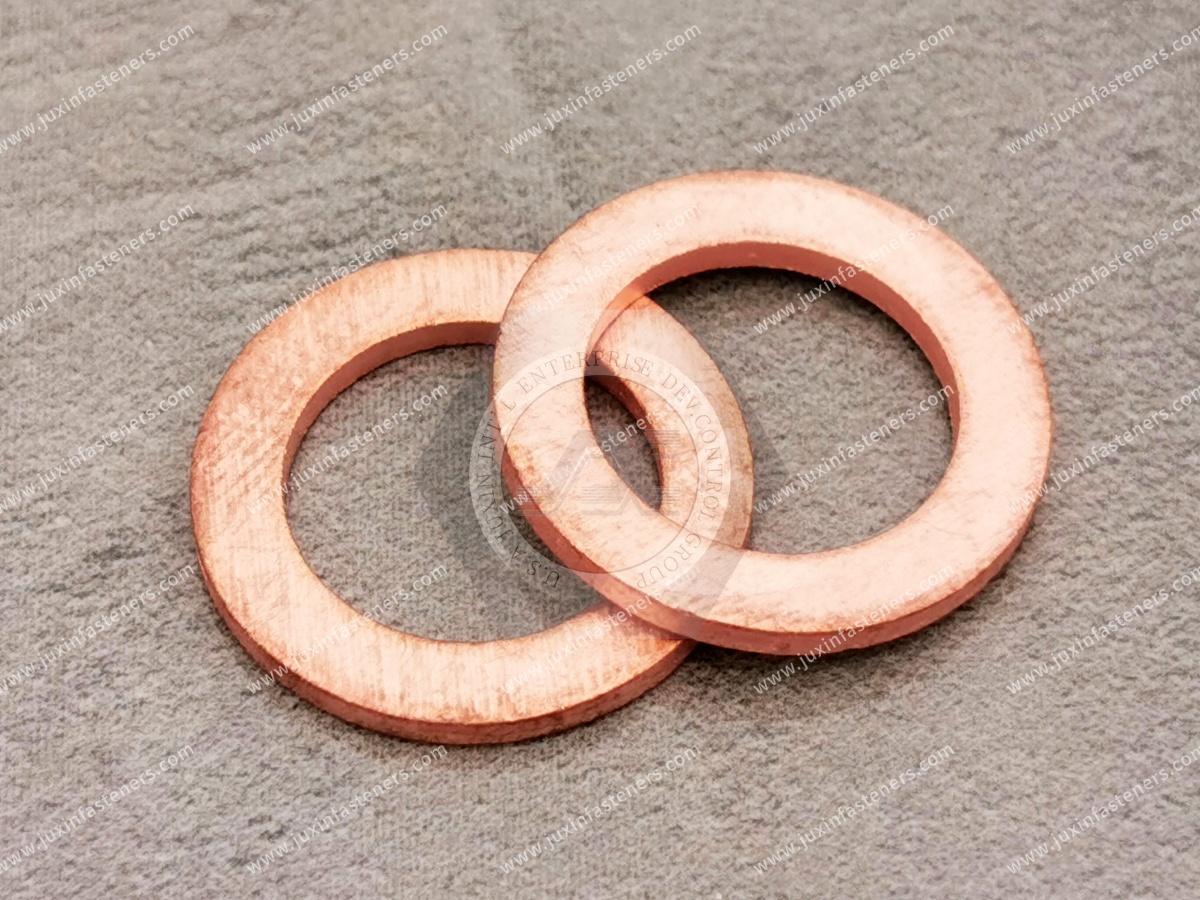
A copper flat washer is a flat washer manufactured from a specified copper material.
Its basic geometry normally includes:
an inside diameter;
an outside diameter;
a defined thickness;
flat bearing surfaces.
Depending on the application, a copper flat washer may be used for:
bearing or load distribution;
spacing;
electrical contact;
conductive interfaces;
thermal contact;
material compatibility;
application-specific mechanical interfaces.
The actual function depends on the complete assembly.
A copper flat washer should not automatically be treated as a copper sealing washer or copper crush washer simply because all three components may have a similar ring-shaped appearance.
This is one of the most important distinctions when specifying copper washers.
A copper flat washer is primarily defined by its flat washer geometry and application-specific bearing, spacing, electrical, or contact function.
A copper sealing washer is selected as part of a sealing interface.
A copper crush washer is generally intended to undergo controlled permanent deformation during installation to help create a sealing interface.
The categories can overlap in particular engineered designs, but they should not automatically be treated as interchangeable.
| Component | Typical Primary Function | Important Design Factors |
|---|---|---|
| Copper flat washer | Bearing, spacing, electrical or thermal contact | ID, OD, thickness, material, contact surfaces |
| Copper sealing washer | Metallic sealing interface | Material condition, geometry, surface finish, installation |
| Copper crush washer | Controlled deformation for sealing | Temper, thickness, geometry, compression, mating surfaces |
For sourcing, the intended function should be identified whenever possible.
Copper has several material properties that can make it useful for specialized washer applications.
Electrical conductivity is one of copper's most important advantages.
Where the washer forms part of an electrical contact path, copper can be considered for applications such as:
busbar connections;
power distribution equipment;
battery systems;
electrical terminals;
grounding or bonding assemblies;
power electronics;
switchgear;
high-current equipment.
However, electrical conductivity of the bulk material is only one part of connection performance.
Actual electrical resistance also depends on surface condition, oxidation, plating, contact area, contact pressure, joint preload, mating materials, and environmental exposure.
Copper can transfer heat efficiently compared with many conventional fastener materials.
This can be useful where a washer forms part of an intentional thermal path.
Potential applications can include:
power electronics;
electrical equipment;
thermal-management assemblies;
heat-generating equipment;
industrial electronics;
application-specific conductive interfaces.
But high bulk thermal conductivity does not automatically guarantee a low-resistance thermal joint.
Interface contact remains important.
Copper can deform more readily than many harder washer materials.
Depending on the grade and material condition, this property can be useful where controlled conformity or forming is required.
It can also be a disadvantage where the joint requires high bearing strength or dimensional stability under significant compressive loading.
Copper provides useful corrosion resistance in many environments.
However, it should not be described as universally corrosion-proof.
Material compatibility and service environment still need to be evaluated.
Flat copper washer geometries can be suitable for efficient production methods such as stamping where geometry, tolerance, material thickness, and production quantity support that process.
This makes custom copper flat washers practical for many OEM applications.
Understanding the limitations is just as important as understanding the advantages.
Copper is generally softer than many carbon-steel, alloy-steel, and hardened washer materials.
This can affect:
bearing behavior;
permanent deformation;
embedment;
dimensional stability;
load distribution;
reuse.
For highly loaded bolted joints, a copper washer should not be selected simply because copper offers corrosion resistance or conductivity.
The mechanical interface must also be suitable.
Depending on material condition and assembly load, copper can deform beneath a fastener.
This can be useful in a deliberately designed sealing interface but undesirable in a conventional structural or high-preload joint.
Material condition therefore matters.
Copper may be assembled against:
carbon steel;
stainless steel;
aluminum;
brass;
plated steel;
other conductive metals.
When dissimilar metals are electrically connected in the presence of an electrolyte, galvanic corrosion can become relevant.
The actual risk depends on the material combination, environment, relative exposed areas, coatings, moisture, and other system conditions.
Copper naturally develops surface oxides.
For many mechanical applications this may not be significant,
but electrical contact applications may require greater attention to surface condition, plating, cleaning, and environmental exposure.
Copper can be more expensive than conventional carbon-steel washer materials.
For high-volume OEM projects, the material should therefore provide a genuine functional benefit rather than being selected only because it appears more corrosion resistant or visually distinctive.
Electrical equipment is one of the most technically relevant application areas for copper flat washers.
Potential applications include:
power distribution assemblies;
busbar systems;
electrical terminals;
energy storage systems;
battery electrical connections;
power conversion equipment;
switchgear;
industrial control equipment;
power electronics.
In these assemblies, engineers should evaluate the washer as part of the complete conductive joint.
Important factors include:
washer material;
mating conductor material;
contact area;
surface finish;
plating;
oxidation;
preload;
temperature rise;
thermal cycling;
vibration;
environmental exposure.
A copper washer cannot compensate for an improperly designed electrical connection.
Busbar assemblies provide a good example of why material selection and joint design must be considered together.
A copper washer may appear compatible with a copper busbar because the materials are similar, but electrical connection performance still depends on the entire contact system.
Engineers may need to consider:
conductor material;
plated versus bare surfaces;
fastener material;
washer function;
contact pressure;
joint relaxation;
thermal cycling;
oxidation;
corrosion;
assembly process.
The washer should therefore be specified according to the electrical and mechanical requirements of the connection rather than selected only because it is copper.
Battery packs and energy storage systems contain both mechanical and electrical connections.
Copper washers may be considered in suitable conductive interfaces, terminal assemblies, power distribution hardware, and other drawing-controlled components.
However, EV and energy-storage assemblies introduce additional considerations such as:
dissimilar-metal interfaces;
thermal cycling;
vibration;
electrical resistance;
corrosion;
current-carrying requirements;
packaging constraints;
assembly traceability.
For OEM projects, the washer should follow the approved electrical and mechanical design requirements.
Copper's high thermal conductivity can be useful where a flat washer forms part of a thermal path.
But actual heat transfer through an assembly depends on more than washer material.
The thermal path includes:
contact surfaces;
interface pressure;
surface roughness;
washer thickness;
mating materials;
contact area;
surrounding geometry.
If poor contact exists at either side of the washer, interface resistance can limit heat transfer even though copper itself is highly conductive.
This is why thermal conductivity data alone should not determine washer selection.
Copper flat washers can also be used for application-specific mechanical purposes.
Depending on the design, they may provide:
spacing;
controlled separation;
bearing contact;
material compatibility;
surface protection;
custom dimensional adjustment.
However, copper's relative softness must be considered.
For high bearing loads, structural joints, or assemblies requiring long-term dimensional stability under high preload, another washer material may be more appropriate.
Copper and stainless steel solve different engineering problems.
| Selection Factor | Copper Washer | Stainless Steel Washer |
|---|---|---|
| Electrical conductivity | High | Significantly lower than copper |
| Thermal conductivity | High | Lower than copper |
| Mechanical strength | Depends on copper grade/condition; generally softer | Often higher depending on grade and condition |
| Formability | Generally good | Depends on stainless grade and condition |
| Corrosion behavior | Good in many environments but system-dependent | Good in many environments but grade-dependent |
| Galvanic considerations | Important with dissimilar metals | Also important with dissimilar metals |
| Typical reason for selection | Conductivity, thermal transfer, deformability, special interface | Mechanical performance, corrosion resistance, general fastening |
Neither material is universally better.
The correct material depends on what the joint needs to accomplish.
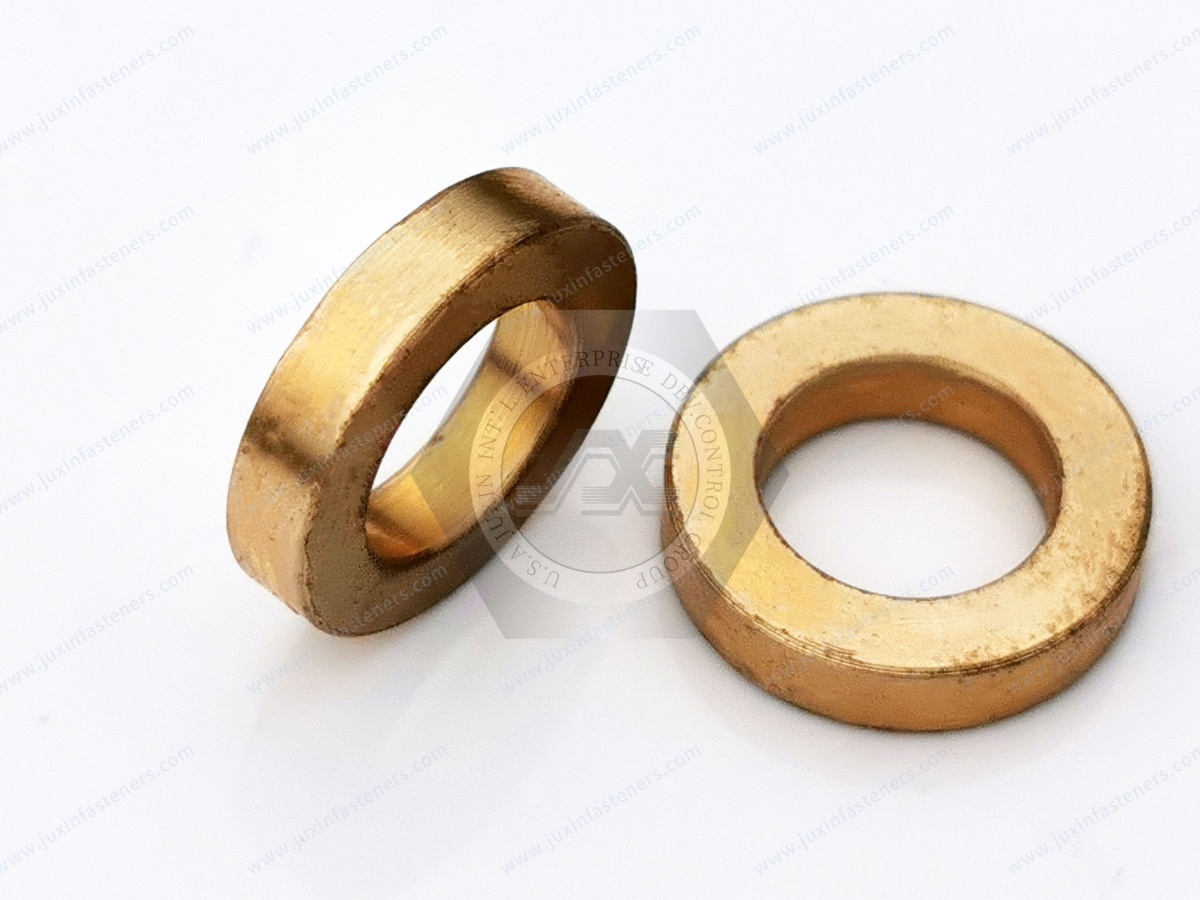
Copper and brass are also frequently confused in online catalogs and image descriptions.
Brass is a copper alloy, but it should not be treated as pure copper.
Copper and brass differ in:
composition;
electrical conductivity;
thermal conductivity;
hardness;
mechanical behavior;
formability;
corrosion characteristics;
appearance.
For electrical or drawing-controlled components, substituting brass for copper based only on washer dimensions can change functional performance.
The material designation should therefore be verified.
Not automatically.
This is an important distinction.
A flat copper washer can form part of a sealing joint if its geometry, material condition, mating surfaces, and installation process were designed for that purpose.
But simply placing an ordinary copper flat washer beneath a fastener does not create a validated liquid-tight or gas-tight seal.
If the requirement is specifically for fluid sealing, the engineer should evaluate whether the component is actually:
a copper sealing washer;
a copper crush washer;
a bonded sealing washer;
a gasket;
or another sealing component.
The sealing function should be specified explicitly.
Copper flat washers should not be selected as vibration-locking devices solely because copper is relatively soft.
A conventional copper flat washer does not provide the same locking mechanism as:
serrated lock washers;
prevailing-torque nuts;
wedge-locking systems;
thread-locking compounds;
other engineered anti-loosening systems.
If vibration loosening is the design concern, the locking strategy should be evaluated separately.
This also prevents confusion between copper flat washers and the serrated lock washer families used elsewhere in fastening systems.
"Copper" alone may not completely define an OEM component.
Different copper materials and material conditions can have different:
mechanical properties;
electrical conductivity;
formability;
hardness;
deformation behavior.
For an ordinary spacer or bearing washer, some of these differences may be less critical.
For electrical, thermal, sealing, or tightly controlled OEM applications, they may become functional requirements.
Where a customer drawing specifies a copper grade, material standard, temper, hardness, or conductivity requirement, the supplier should manufacture and inspect against that requirement.
Three dimensions often define the basic washer geometry.
The inside diameter determines clearance around the screw, bolt, stud, terminal, or other assembly feature.
The outside diameter influences:
bearing area;
electrical contact area;
available installation space;
load distribution.
Thickness can affect:
spacing;
stiffness;
deformation;
electrical path length;
thermal path;
manufacturing method.
For custom washers, tolerances on these dimensions should be based on actual assembly needs rather than made unnecessarily tight.
Over-specifying tolerances can increase manufacturing cost without improving functional performance.
Surface condition can be especially important for electrical copper washers.
Depending on the application, requirements may address:
bare copper;
surface cleaning;
oxidation control;
plating;
contact finish;
cosmetic finish.
A coating or plating can change electrical contact behavior as well as corrosion performance.
For this reason, finish requirements should be selected according to the actual assembly rather than added as a generic corrosion treatment.
Simple copper flat washers are often suitable for stamping when production volume, geometry, material thickness, and tolerances support the process.
For OEM sourcing, stamping considerations can include:
material thickness;
ID and OD relationship;
dimensional tolerance;
burr direction;
edge condition;
flatness;
tooling;
production volume.
Burr orientation can matter when one washer face contacts a sensitive electrical, sealing, or cosmetic surface.
If orientation is functionally important, it should be defined on the drawing or sourcing specification.
Standard dimensions do not cover every OEM assembly.
Custom copper flat washers may be developed for:
non-standard inside diameters;
non-standard outside diameters;
special thicknesses;
rectangular or non-circular profiles;
slots or tabs;
electrical contact features;
unusual mounting geometry;
controlled material condition;
customer-specific tolerances;
special surface requirements.
JUXIN FASTENERS supports drawing-based and sample-based development of custom copper washers and other application-specific fastening components.
A useful decision process is to start with the required function rather than the material name.
Is the requirement driven by:
electrical conductivity;
thermal conductivity;
deformability;
corrosion behavior;
material compatibility;
spacing;
bearing;
or another drawing-defined requirement?
If copper provides no functional advantage, another washer material may be more economical or mechanically suitable.
Evaluate whether the copper washer can maintain the required geometry and bearing interface under the actual assembly load.
If conductivity is important, evaluate the complete interface rather than the washer material alone.
Review dissimilar metals and environmental exposure for potential galvanic effects.
Where functional performance depends on copper grade, temper, hardness, or conductivity, specify them appropriately.
Specify only the dimensional controls needed for assembly and function.
Electrical resistance, thermal performance, sealing behavior, or other critical characteristics should be evaluated in the actual or representative assembly.
For procurement and supplier-development teams, a complete RFQ does not need to be complicated.
Useful information can include:
drawing or existing specification;
inside diameter;
outside diameter;
thickness;
copper material requirement;
material condition or temper where applicable;
surface or plating requirement;
application;
mating materials;
electrical requirements where applicable;
inspection requirements;
packaging requirements;
quantity;
estimated annual usage.
These factors can affect raw material selection, tooling, stamping process, secondary operations, inspection, MOQ, lead time, and unit cost.
For custom copper flat washers, price is not determined by washer diameter alone.
Important cost drivers can include:
copper material grade;
material thickness;
washer size;
material utilization;
tooling;
production quantity;
dimensional tolerance;
flatness requirement;
burr or edge requirements;
plating or secondary processing;
inspection;
packaging.
For high-volume production, material utilization can become particularly important because copper itself may represent a significant portion of component cost.
Design and sourcing teams can therefore benefit from reviewing both component function and manufacturing feasibility before freezing unnecessary dimensional requirements.
If an existing component has no available drawing, sourcing can start from:
a physical sample;
photographs;
basic dimensions;
mating fastener information;
assembly photographs;
material information if known.
A sample can help establish geometry and manufacturing features.
However, if the washer has been heavily compressed, worn, corroded, or previously used as a sealing component, its measured dimensions may differ from the original part.
That condition should be considered during reverse engineering.
Have a drawing? Send the drawing.
Have a CAD model? Send the available CAD data.
Have a physical sample? We can start from the sample.
Only have photographs and ID, OD, and thickness? That can still be enough for an initial review.
Know that the washer is part of an electrical connection but have not finalized the copper grade? Tell us the application and mating materials.
Need to replace an existing copper component but do not know the standard? Send the information currently available.
JUXIN FASTENERS can review the available data and identify which additional details may be useful for quotation, manufacturing feasibility, sample development, or production sourcing.
A copper flat washer is a flat washer manufactured from copper and used for bearing, spacing, electrical contact, thermal transfer, or another application-specific function.
The main material advantages include high electrical conductivity, high thermal conductivity, useful formability, and corrosion behavior suitable for many environments.
The relevance of each advantage depends on the application.
Potential limitations include lower mechanical strength than many steel washer materials, permanent deformation under load, oxidation, galvanic compatibility concerns, and higher raw-material cost.
Yes, copper is highly conductive. However, the electrical resistance of an assembled joint also depends on contact pressure, surface condition, oxidation, plating, contact area, and mating materials.
They can be used in suitable busbar and electrical connection designs, but the washer should be evaluated as part of the complete electrical and mechanical joint.
Not automatically. A copper flat washer can be part of an engineered sealing interface, but a sealing or crush washer should be specified when controlled sealing performance is required.
A conventional copper flat washer should not be treated as a dedicated anti-loosening device. If vibration loosening is a concern, an appropriate locking strategy should be selected for the actual joint.
Copper generally offers much higher electrical and thermal conductivity and greater deformability, while stainless steel often provides higher mechanical strength and different corrosion characteristics.
Selection depends on the required function.
Copper and aluminum can create galvanic-corrosion concerns under certain environmental conditions.
Material compatibility, surface treatment, moisture exposure, contact design, and the complete assembly should be evaluated.
Material condition can affect hardness, formability, deformation behavior, and other functional properties.
It can be particularly important in electrical, sealing, and drawing-controlled applications.
Yes. JUXIN FASTENERS supports drawing-based and sample-based development of custom fastening components.
Drawings, CAD data, samples, photographs, dimensions, material requirements, and application information can provide the starting point for technical review.
Copper flat washers are most valuable when the material solves a specific engineering requirement.
Electrical conductivity, thermal conductivity, deformability, corrosion behavior, and manufacturing flexibility can make copper an effective washer material—but those same characteristics do not make it suitable for every joint.
Engineers should evaluate the mechanical load, mating materials, contact surfaces, environment, and required electrical or thermal performance.
Procurement and supplier-development teams should distinguish ordinary copper flat washers from sealing washers, crush washers, and other application-specific copper components before comparing quotations.
JUXIN FASTENERS supports global OEM, ODM, Tier 1, Tier 2, engineering, procurement, sourcing, and supplier-development teams with standard and custom washers and application-specific fastening components.
Whether your requirement is a standard copper flat washer, an electrical copper washer, a drawing-controlled conductive component, or a custom washer developed from an existing sample, send us the technical information currently available.
We can support drawing review, application review, manufacturing feasibility evaluation, sample development, quotation, and production sourcing.
Email: info@juxinfasteners.com
Website: www.juxinfasteners.com
 MORE NEWS
Sep. 27, 2026
Sep. 27, 2026
Sep. 27, 2026
Contact Us
Tel.:
+86 020 8621 0320
+86 020 3121 6067
E-mail:
Technical Support:
Navigation
SEND INQUIREY