
Call Us
+86 136 6007 9809
Call Us
+86 136 6007 9809

Mar. 29, 2026
Corrosion-Resistant Weld Studs for Industrial Machinery: Materials, Welding and OEM Selection
Industrial machinery manufacturers require fastening systems that remain reliable under mechanical loading, vibration, temperature variation and environmental exposure.
Equipment used in manufacturing plants, conveyor systems, industrial automation, food processing, energy infrastructure and outdoor installations may experience:
Moisture and humidity
Condensation
Chemical exposure
Cleaning agents
Salt contamination
Temperature cycling
Mechanical vibration
Repeated maintenance
In these conditions, corrosion can affect both the mechanical integrity of a fastening point and the serviceability of the attached component.
Corrosion-resistant weld studs provide externally threaded attachment points on compatible metal structures through a qualified welding process.
Depending on the equipment design, they may be used for mounting covers, guards, cable brackets, equipment panels and selected structural or auxiliary components.
However, a corrosion-resistant stud must be evaluated as part of the complete welded and threaded assembly.
Important factors include:
Stud material
Parent metal
Welding compatibility
Surface condition
Corrosion environment
Weld geometry
Coating sequence
Joint loading
Mating nut material
Inspection requirements
Maintenance access
Production volume
For mechanical and structural engineers, the objective is to select a stud and joint configuration that meets the defined loading and environmental requirements.
For manufacturing engineers and production managers, the objective is to establish a repeatable welding process with acceptable cycle time, inspection and rework rates.
For procurement and supplier development teams, the objective is to obtain drawing-conforming fasteners with suitable materials,
dimensional consistency, documentation and supply conditions.
Juxin Fasteners welcomes drawing-based inquiries for stainless steel,
carbon steel and custom industrial threaded weld studs, subject to specification and manufacturing feasibility confirmation.
What Are Corrosion-Resistant Weld Studs?
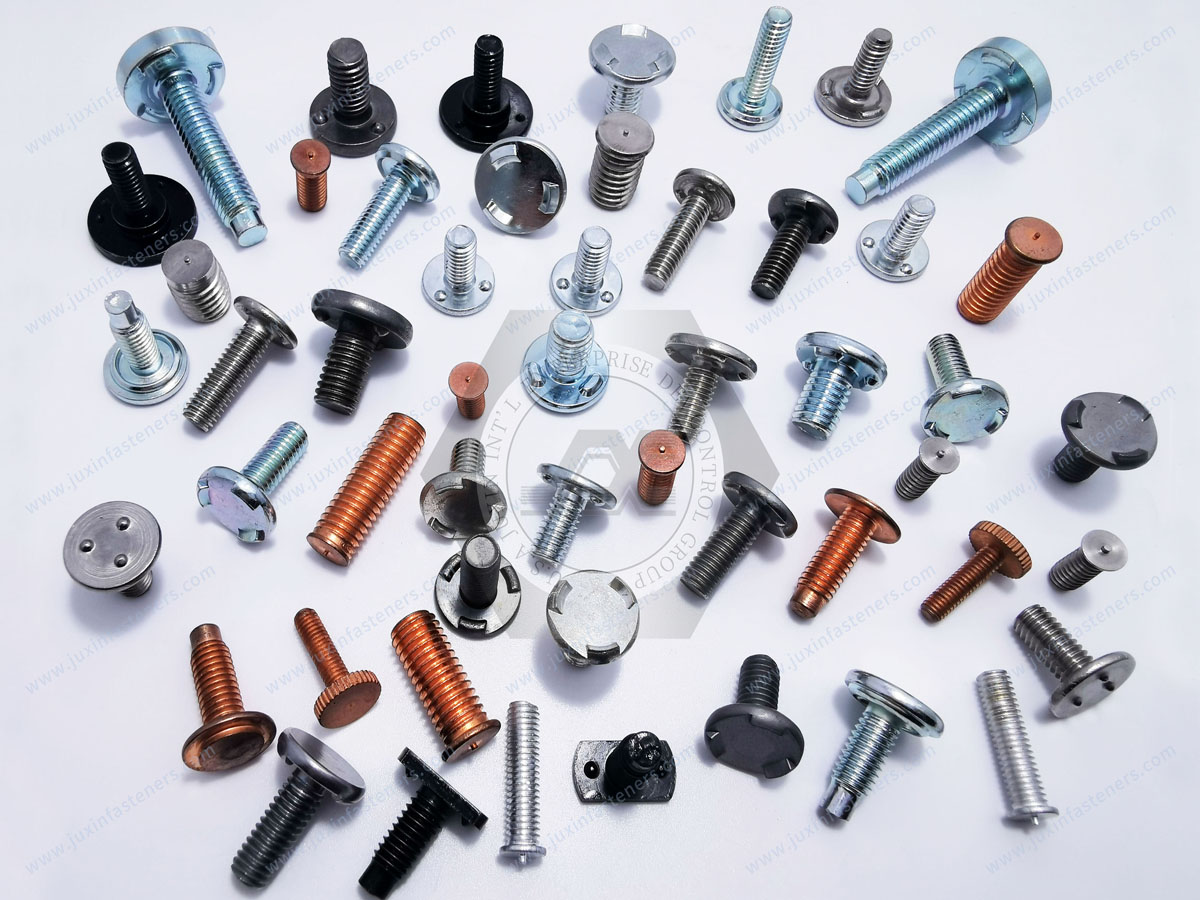
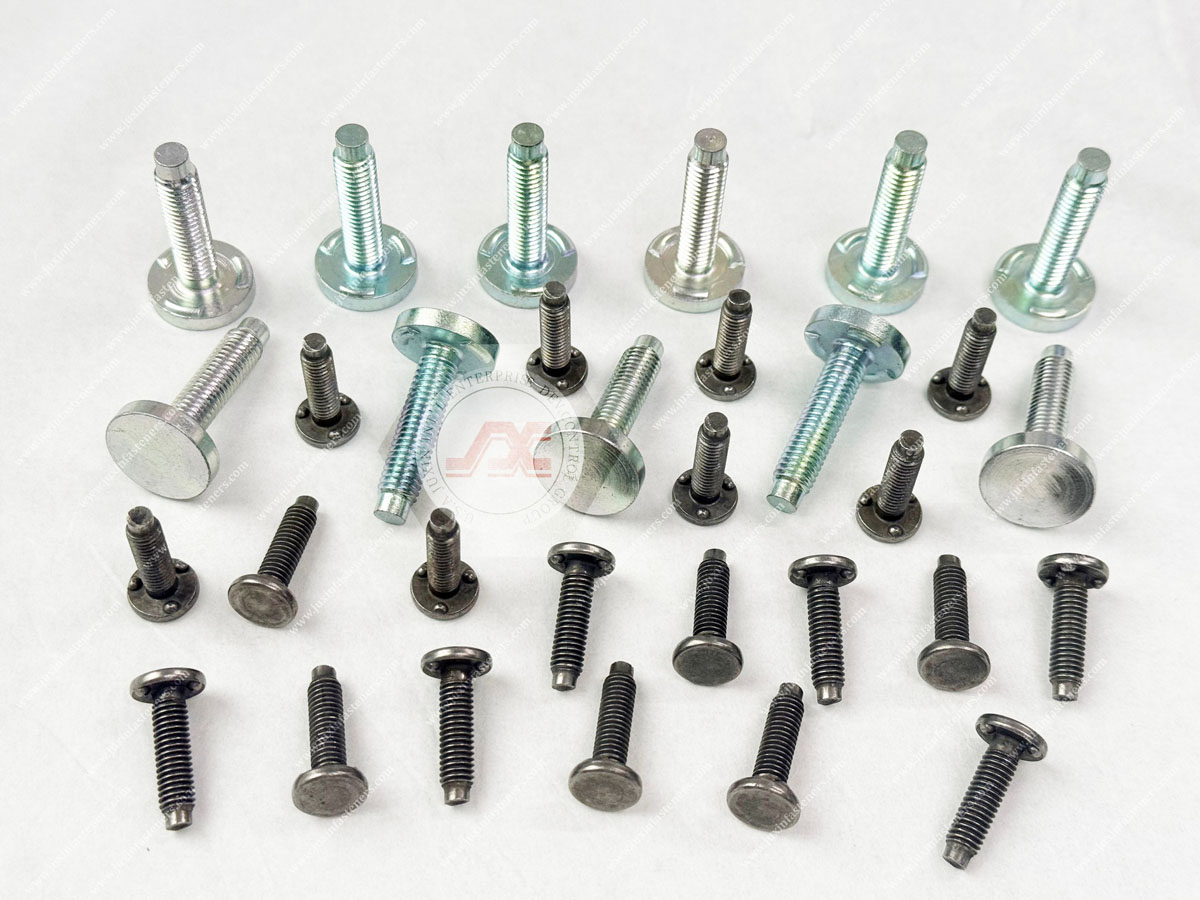
A weld stud is a fastener designed to be attached to a compatible metal component by welding.
A threaded weld stud provides an external thread for a mating nut or other specified attachment component.
Corrosion resistance may be achieved through:
Suitable base material selection
Appropriate surface protection
Controlled welding procedures
Post-weld corrosion protection
Compatible mating hardware
Environmental design measures
Important Engineering Principle
Corrosion resistance is not determined by the stud material alone.
The weld interface, heat-affected area, parent metal, coatings and mating components can all influence service life.
Typical Load Path
Mating nut → Stud thread → Stud body → Weld interface → Parent metal → Machine structure
Failure can occur at any part of this load path.
Why Weld Studs Are Used in Industrial Machinery
Potential advantages include:
Permanent attachment of the stud to a compatible metal component
Threaded mounting points without conventional through-bolting at selected locations
Reduced need for backside access
Potential reduction in separate captive hardware
Compatibility with suitable automated welding processes
Repeatable attachment-point positioning
Serviceable mating components
These advantages depend on the equipment design and welding process.
Important Limitation
A welded stud does not automatically eliminate mating nuts, prevent vibration loosening or guarantee a higher load capacity than a properly designed bolted connection.
Industrial Machinery Applications
Industrial Motor Enclosures
Motor assemblies may require mounting points for:
Protective covers
Cable brackets
Auxiliary electrical components
Equipment shields
Suitable support brackets
Engineering Considerations
Motor vibration
Thermal exposure
Corrosion
Maintenance access
Weld location
Mating nut retention
Important Limitation
A welded stud does not independently prevent the mating nut from loosening under motor vibration.
Conveyor Systems
Conveyor equipment may use weld studs for selected:
Protective guards
Cable supports
Equipment covers
Guide-related auxiliary brackets
Sensor mounting components
Engineering Considerations
Repeated vibration
Mechanical impact
Cleaning conditions
Production downtime
Maintenance frequency
Production Equipment and Machine Frames
Potential applications include:
Equipment covers
Internal mounting brackets
Machine guards
Cable routing
Auxiliary fixtures
Engineering Considerations
Load direction
Parent material thickness
Welding access
Dimensional accuracy
Service requirements
Important Limitation
Safety-critical machine structures require specific load analysis, welding qualification and customer approval.
Industrial Control Panel Assemblies
Potential applications include:
Control cabinet mounting points
Cable management brackets
Protective panels
Auxiliary electrical component supports
Engineering Considerations
Corrosion
Electrical bonding
Coating
Maintenance
Threaded joint reliability
Important Electrical Limitation
A mechanical weld stud should not automatically be treated as a qualified protective-earth or electrical bonding connection.
Electrical continuity and bonding requirements must be evaluated separately.
Stainless Steel Weld Studs for Corrosive Environments
Stainless steel is frequently considered where environmental corrosion resistance is important.
Potential applications include:
Food processing equipment
Washdown machinery
Outdoor industrial installations
Chemical processing equipment
Marine-related machinery
Corrosion-sensitive automation systems
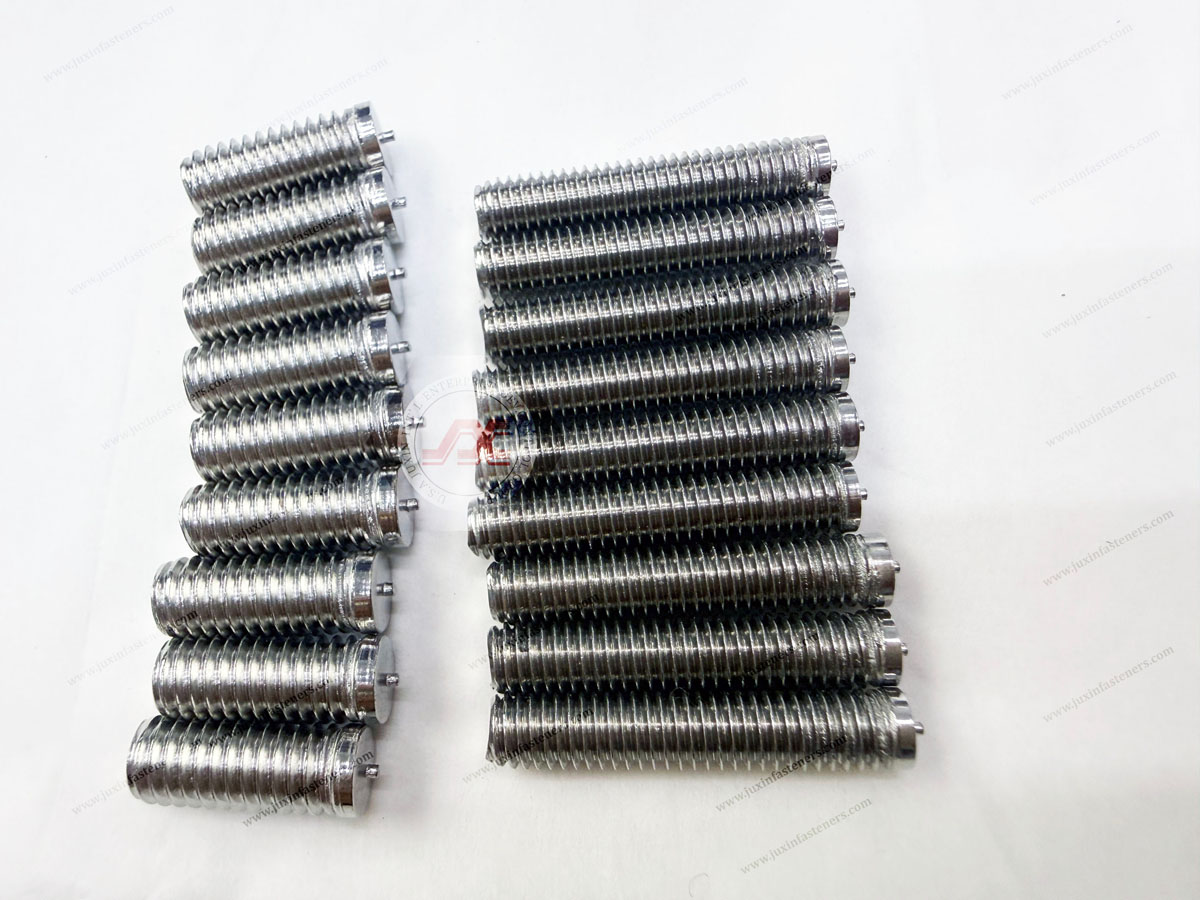
304 Stainless Steel
304-type stainless steel may be suitable for selected general industrial environments.
Its suitability depends on:
Chloride exposure
Cleaning chemicals
Temperature
Surface condition
Welding process
316 Stainless Steel
316-type stainless steel may provide improved resistance to certain chloride-containing environments compared with 304-type stainless steel.
However, it is not universally resistant to all chemicals or marine conditions.
Important Engineering Limitation
Stainless steel grade selection must consider the actual exposure.
A generic description such as “corrosion-proof stainless steel” is not technically appropriate.
Welding Considerations for Stainless Steel
Relevant factors include:
Stainless steel grade
Parent material
Welding procedure
Heat input
Surface condition
Weld contamination
Post-weld cleaning
Corrosion performance
Important Limitation
Stainless steel weld studs are not automatically compatible with carbon steel or other dissimilar parent materials.
A suitable welding procedure and corrosion assessment are required.
Information Gain: The Welded Area May Be More Vulnerable Than the Stud Body
A stainless steel stud can retain an acceptable appearance while the weld region experiences localized corrosion.
Potential causes include:
Welding heat effects
Surface contamination
Improper cleaning
Incompatible parent material
Galvanic interaction
Engineering Recommendation
Evaluate corrosion resistance at the complete welded interface, not only on the exposed stud surface.
Carbon Steel Weld Studs with Corrosion Protection
Carbon steel weld studs may be appropriate for machinery applications where the mechanical requirements, welding process and protective coating system are compatible.
Potential Advantages
Commercial practicality
Suitable mechanical properties when specified
Compatibility with selected steel welding processes
Flexibility in corrosion-protection systems
Potential Applications
Indoor manufacturing equipment
Industrial automation machinery
Conveyor structures
Factory equipment
Selected outdoor structures with qualified protection
Surface Protection Options
Depending on the process and specification, protection may involve:
Zinc-based coatings
Paint systems
Other qualified protective finishes
Post-weld surface treatment
Important Correction: Galvanized Weld Studs Are Not Automatically Weld-Ready
Zinc coatings can affect welding behavior.
Potential concerns include:
Welding fumes
Coating contamination
Weld formation
Local coating damage
Corrosion protection after welding
Engineering Recommendation
Confirm whether the specified coating is compatible with the intended welding process.
Do not assume that a conventional galvanized fastener can be welded without additional process evaluation.
Coating Before Welding vs Coating After Welding
This decision can influence both welding quality and corrosion protection.
Coating Before Welding
Potential concerns:
Electrical contact
Weld formation
Coating decomposition
Local damage
Process emissions
Coating After Welding
Potential considerations:
Surface preparation
Coverage around the stud
Thread protection
Coating thickness
Mating nut fit
Repair accessibility
Information Gain: Coating Sequence Is Part of the Fastener Specification
Two visually similar weld studs may perform differently if one is welded before coating and the other is welded through a pre-existing finish.
Engineering Recommendation
Specify the complete manufacturing and coating sequence during design and supplier qualification.
Stainless Steel vs Protected Carbon Steel Weld Studs
| Selection factor | Stainless steel | Protected carbon steel |
|---|---|---|
| Corrosion resistance | Depends on grade and exposure | Depends on coating and exposure |
| Material cost | Often higher | Often lower |
| Weldability | Grade and process dependent | Steel grade and process dependent |
| Coating requirement | Application dependent | Often required for corrosive exposure |
| Weld-area corrosion | Requires evaluation | Requires evaluation |
| Dissimilar-metal risk | Requires evaluation | Requires evaluation |
| Typical selection driver | Corrosion environment | Cost and qualified coating system |
Engineering Recommendation
Choose the material based on environmental exposure, welding compatibility, mechanical requirements and lifecycle cost.
Galvanic Corrosion and Dissimilar-Metal Assemblies
Industrial equipment may combine:
Stainless steel studs
Carbon steel panels
Aluminum components
Coated steel structures
Different mating nut materials
When dissimilar metals are electrically connected in the presence of an electrolyte, galvanic corrosion may occur.
Factors Influencing Risk
Material combination
Exposed surface area
Moisture
Salt contamination
Coating condition
Electrical continuity
Engineering Recommendation
Evaluate the complete metal combination and environment.
Where necessary, use suitable material selection, coatings, isolation or other qualified corrosion-control measures.
Important Limitation
Electrical isolation measures must not be introduced where they conflict with required electrical bonding or grounding functions.
Mechanical Property Classes and Weldability
Industrial threaded fasteners may be specified with property classes such as 8.8 or 10.9.
However, these designations should not automatically be assigned to every weld stud.
Property Class 8.8
May be relevant to certain specified steel threaded fasteners.
Property Class 10.9
May be relevant to higher-strength threaded fastener requirements.
Important Engineering Limitation
Higher mechanical strength does not automatically provide better weldability, fatigue resistance or corrosion performance.
Material chemistry, heat treatment and welding behavior must be considered.
Engineering Recommendation
Confirm the applicable product specification, mechanical requirements and welding procedure before selecting a higher-strength weld stud.
Industrial Weld Stud Installation Methods
Different stud welding methods may be used depending on the stud and parent material.
Potential processes include:
Capacitor discharge stud welding
Drawn arc stud welding
Short-cycle stud welding
Other qualified welding methods
Important Limitation
These processes are not universally interchangeable.
The stud geometry and welding method must be compatible.
Relevant Welding Standards
ISO 14555
Arc stud welding of metallic materials, where applicable.
ISO 13918
Studs and ceramic ferrules for arc stud welding, where applicable.
These standards should be applied only where their scope matches the actual process and product.
Welding Process Control
Potential process variables include:
Welding current
Welding time
Stud lift or movement
Contact pressure
Parent material thickness
Surface condition
Stud alignment
Equipment condition
Engineering Recommendation
Establish welding parameters using the actual stud, parent material and production equipment.
Important Limitation
There is no universal welding setting that guarantees acceptable performance for every stud and material combination.
Automated Stud Welding in Industrial Production
High-volume industrial equipment manufacturing may use automated stud welding systems.
Potential production features include:
Automated stud feeding
Robotic positioning
Controlled welding cycles
Process monitoring
In-line inspection
Production traceability
Production Manager's Evaluation
Cycle time
Feeding reliability
Equipment uptime
Positioning consistency
Weld acceptance rate
Rework
Scrap
Inspection requirements
Maintenance
Packaging compatibility
Information Gain: The Fastener Must Be Compatible with the Production System
A weld stud may satisfy dimensional requirements but still cause production interruptions if its geometry or packaging is incompatible with automated feeding equipment.
Engineering Recommendation
Include feeding-system compatibility in the supplier qualification process.
Weld Stud Quality Inspection and Testing
Inspection requirements should be defined according to the application, welding process and customer specification.
Dimensional Inspection
May include:
Thread dimensions
Stud length
Stud angle
Welding-end geometry
Installed height
Stud position
Visual Inspection
May identify visible abnormalities such as:
Misalignment
Surface damage
Abnormal weld appearance
Corrosion
Thread damage
Important Limitation
Visual inspection alone cannot establish complete weld integrity.
Non-Destructive Testing
Some non-destructive evaluation methods may be suitable for specific weld configurations.
However, no single method detects every possible defect in every stud weld.
Engineering Recommendation
Select inspection methods according to the relevant defect types, geometry and qualified acceptance criteria.
Mechanical Testing
Depending on the application:
Pull-off testing
Bend testing
Torque testing
Other specified mechanical tests
Important Distinction
Pull-off testing evaluates axial attachment behavior under the defined test conditions.
Torque testing may evaluate different characteristics depending on the test method.
Neither test automatically proves that the mating nut will remain secure under vibration.
Corrosion Testing
Where required, corrosion evaluation may include:
Salt spray testing
Cyclic corrosion testing
Humidity exposure
Application-specific environmental testing
ISO 9227
ISO 9227 describes salt spray test methods.
Important Limitation
Salt spray hours should not be directly converted into real-world service life without a validated correlation.
Weld Stud Failure Modes in Industrial Machinery
| Failure mode | Possible cause | Recommended action |
|---|---|---|
| Weld separation | Inadequate weld or excessive loading | Review welding process and load path |
| Parent metal tearing | Thin or weak base material | Review local structural design |
| Stud misalignment | Tooling or fixture variation | Improve positioning control |
| Thread damage | Handling, spatter or excessive torque | Review thread protection and assembly |
| Mating nut loosening | Inadequate preload or joint design | Review tightening and locking method |
| Corrosion at weld | Coating damage or material incompatibility | Review post-weld protection |
| Galvanic corrosion | Dissimilar metals and electrolyte | Review material combination |
| Fatigue cracking | Cyclic stress or local concentration | Evaluate load path and fatigue |
| Coating failure | Incorrect preparation or process | Review coating specification |
| Production interruptions | Feeding or equipment issues | Review automation compatibility |
Vibration and Fatigue Resistance
Industrial machinery may experience repeated dynamic loading.
The welded attachment and the mating threaded joint must be evaluated separately.
Weld Attachment
Relevant factors include:
Weld geometry
Parent material
Load direction
Cyclic stress
Local stiffness
Mating Threaded Joint
Relevant factors include:
Nut type
Tightening torque
Clamp load
Joint stiffness
Thread engagement
Locking method
Important Limitation
A permanently welded stud does not create a permanently locked mating nut.
Engineering Recommendation
Validate the complete assembly under the expected operating loads.
Lifecycle Cost and Maintenance Planning
Corrosion-resistant weld studs may affect equipment maintenance requirements.
However, longer service life and lower cost must be demonstrated for the specific application.
Potential Lifecycle Cost Elements
Fastener purchase price
Welding installation
Surface protection
Inspection
Assembly labor
Maintenance
Corrosion-related replacement
Downtime
Rework
Total Lifecycle Cost Framework
Lifecycle Cost = Initial Fastener Cost + Installation Cost + Corrosion Protection Cost + Inspection Cost + Maintenance Cost + Repair and Replacement Cost + Downtime Cost
This framework helps procurement and production teams compare alternatives using representative cost data.
Information Gain: A More Expensive Stud May Reduce Cost, but Not Always
Stainless steel may reduce coating requirements in some environments.
However, it may also introduce higher material costs or welding compatibility challenges.
Protected carbon steel may be commercially attractive where the coating system is effective and compatible with the manufacturing process.
Engineering Recommendation
Compare total installed and lifecycle cost rather than material price alone.
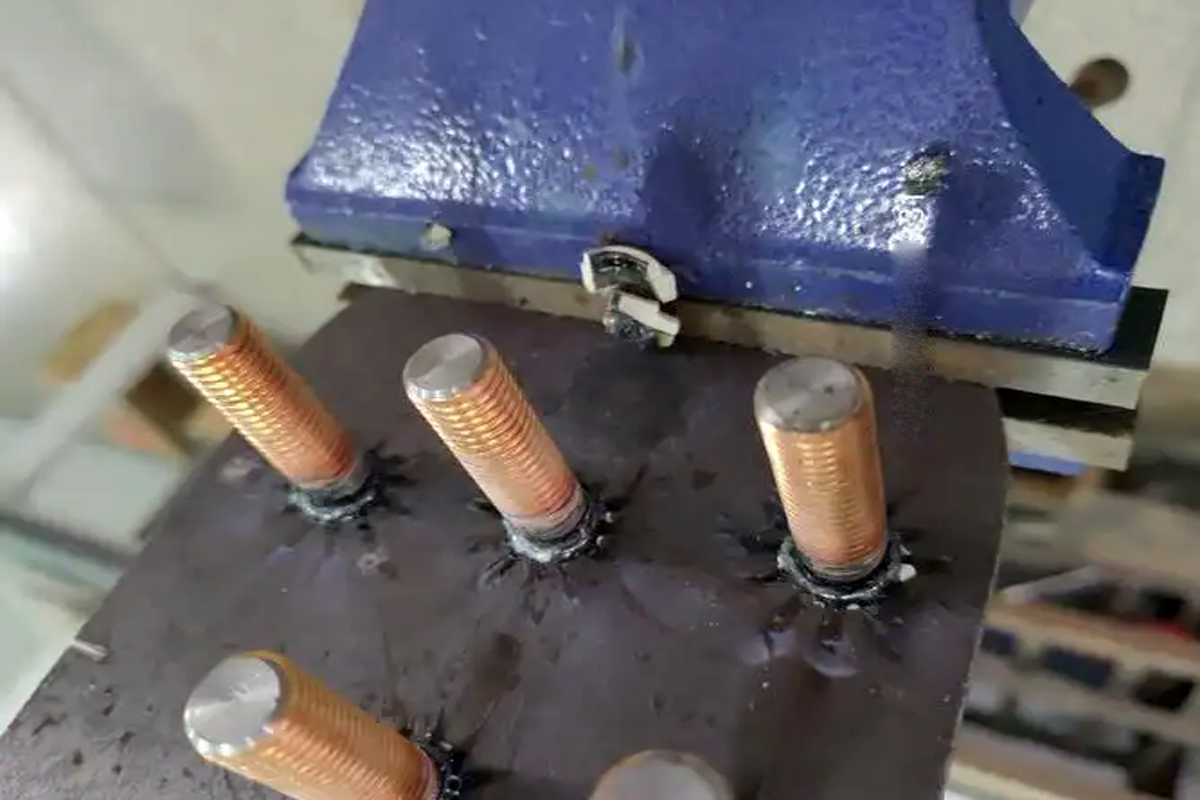
Industrial Application Selection Guide
| Application | Main engineering concern | Selection focus |
|---|---|---|
| Industrial motor enclosure | Vibration and temperature | Weld integrity and nut retention |
| Conveyor equipment | Repetitive loading | Fatigue and maintenance |
| Food processing machinery | Washdown and cleaning chemicals | Stainless grade and corrosion |
| Outdoor machinery | Moisture and weather | Material and coating |
| Chemical processing equipment | Chemical exposure | Environmental compatibility |
| Industrial control cabinets | Corrosion and electrical functions | Weld quality and bonding design |
| Automation equipment | Production repeatability | Dimensions and installation process |
| Heavy machinery | High loads and fatigue | Structural qualification |
| Energy infrastructure | Long service life | Corrosion and maintenance |
Relevant International Standards
Depending on the product and process:
ISO 261: General-purpose metric screw thread plan
ISO 965 series: Metric screw thread tolerances
ASME B1.1: Unified inch screw threads
ISO 14555: Arc stud welding of metallic materials, where applicable
ISO 13918: Studs and ceramic ferrules for arc stud welding, where applicable
ISO 9227: Salt spray testing where specified
These standards serve different purposes.
They do not independently certify a weld stud for a particular machinery application.
Metric and Inch Thread Selection
Industrial weld studs may be specified with metric or unified inch threads.
For nominal diameter reference only:
M5 ≈ 0.197 inch
M6 ≈ 0.236 inch
M8 ≈ 0.315 inch
M10 ≈ 0.394 inch
These are dimensional references only.
Metric, UNC, UNF, BSW and BSF threads are not directly interchangeable.
OEM Supplier Qualification for Industrial Weld Studs
Industrial machinery OEMs may require:
Approved drawings
Material specifications
Dimensional inspection
Welding compatibility
Corrosion requirements
Surface treatment specifications
Mechanical testing
Traceability
Change control
Customer-specific documentation
Important Procurement Principle
A weld stud supplier's product qualification does not automatically qualify the welding process at the customer's factory.
The fastener and welding procedure must be evaluated together.
OEM RFQ Checklist for Corrosion-Resistant Weld Studs
| RFQ item | Information to provide |
|---|---|
| Stud drawing | Part number and revision |
| Thread | Metric or unified inch |
| Stud dimensions | Diameter, length and welding-end geometry |
| Material | Carbon steel or specified stainless grade |
| Mechanical properties | Drawing-defined requirements |
| Parent material | Steel grade or other specified alloy |
| Parent thickness | Nominal and tolerance |
| Welding method | Specified process |
| Surface condition | Bare or specified finish |
| Corrosion environment | Humidity, chemicals, salt or outdoor |
| Coating sequence | Before or after welding |
| Mating hardware | Nut, washer and tightening conditions |
| Load requirements | Static, dynamic and fatigue |
| Inspection | Customer-defined acceptance criteria |
| Quality documentation | Customer-specific requirements |
| Prototype quantity | Sample demand |
| Annual volume | Forecast quantity |
| MOQ | Commercial confirmation |
| Lead time | Required delivery schedule |
| Packaging | Bulk or automation-compatible packaging |
Frequently Asked Questions
What are corrosion-resistant weld studs?
They are threaded welding fasteners selected with materials and corrosion-protection systems appropriate for the intended environment.
Are stainless steel weld studs better than galvanized carbon steel weld studs?
Not universally. The choice depends on corrosion exposure, weldability, cost and the complete assembly design.
Can galvanized weld studs be welded directly?
Only when the coating and welding process are specifically compatible and qualified.
Are 316 stainless steel weld studs suitable for marine environments?
They may be suitable for certain environments, but corrosion performance depends on the actual exposure and welding conditions.
Do weld studs prevent vibration loosening?
No. The mating nut joint must be evaluated separately.
Can weld studs be used on thin sheet metal?
Potentially, but parent material thickness and strength must be validated.
Are property class 10.9 weld studs always stronger in welded assemblies?
A higher nominal material strength does not guarantee a stronger welded joint or better fatigue performance.
Does non-destructive inspection detect every welding defect?
No. Inspection capability depends on the method, weld geometry and defect type.
Can stainless steel weld studs be welded to carbon steel structures?
Some combinations may be feasible with qualified procedures, but weldability and galvanic corrosion must be assessed.
What information is needed for an OEM weld stud quotation?
Provide the drawing, material, parent metal, welding method, corrosion environment, mechanical requirements, coating, inspection and forecast volume.
Juxin Fasteners: Industrial Weld Studs and Custom OEM Fastening Solutions
Juxin Fasteners welcomes inquiries for standard and drawing-specific industrial threaded weld studs.
Relevant product categories include:
Stainless steel threaded weld studs
Carbon steel threaded weld studs
Corrosion-protected weld stud designs
Industrial machinery weld studs
Custom OEM threaded welding fasteners
Related industrial fastening components
Specific material grades, dimensions, coatings, mechanical properties, manufacturing feasibility, inspection documentation,
MOQ and delivery schedules require confirmation against customer drawings.
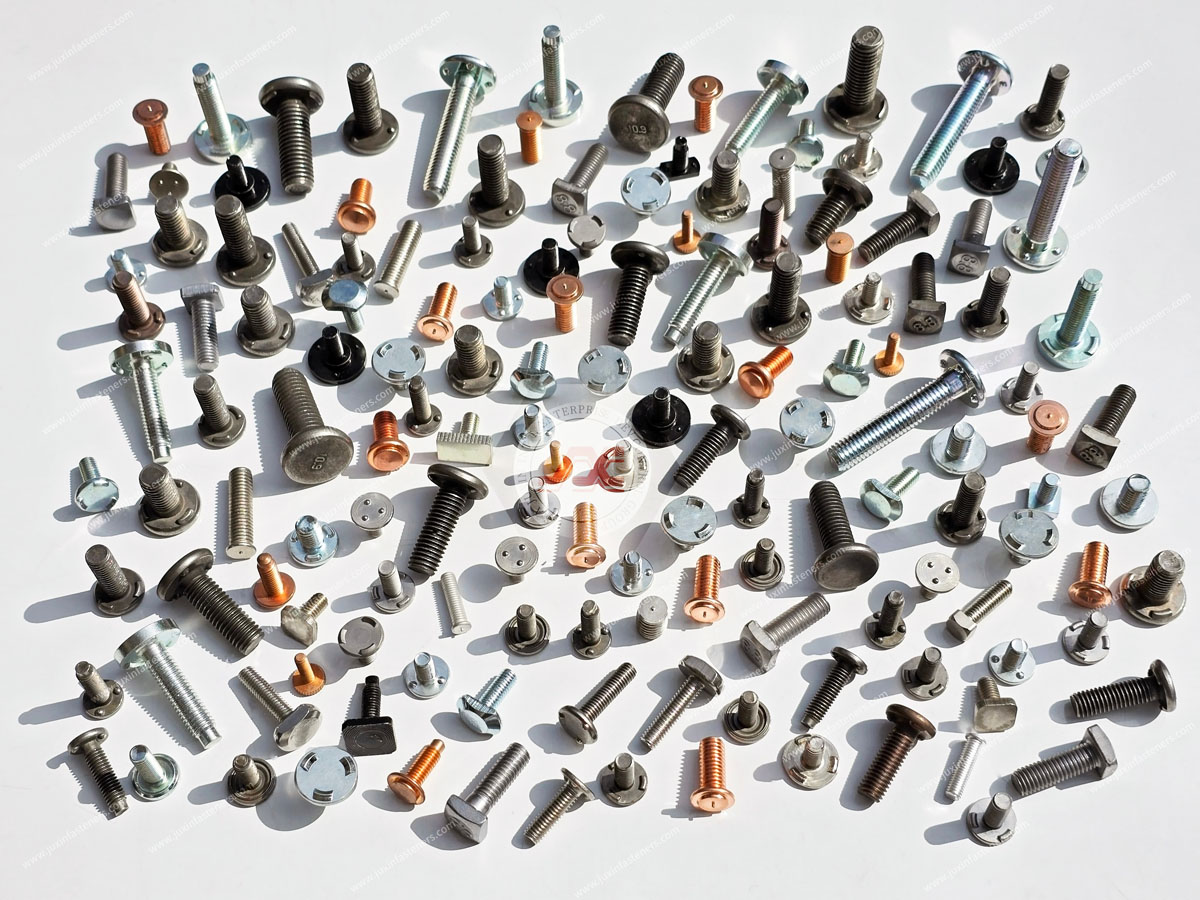
Request an OEM Corrosion-Resistant Weld Stud Quotation
Are you developing industrial machinery, sourcing stainless steel weld studs, evaluating corrosion-resistant fastening alternatives or qualifying a new weld stud supplier for production?
Juxin Fasteners welcomes drawing-based inquiries from machinery design engineers, structural engineers, manufacturing engineers,
production managers, purchasing specialists, procurement managers, supplier development teams and supply chain managers.
Please provide:
Stud drawing + thread designation + material + parent metal and thickness + welding method + corrosion environment + coating requirements
+ load conditions + mating hardware + inspection requirements + quality documentation + prototype quantity + annual volume + packaging + delivery schedule.
Our team can review the supplied information and confirm available product options, technical feasibility and quotation conditions.
Company: Juxin Fasteners
Website: https://www.juxinfasteners.com/
Email: info@juxinfasteners.com
Send your industrial weld stud drawings and OEM RFQ to Juxin Fasteners for technical confirmation and quotation.
Contact Us
Tel.:
+86 020 8621 0320
+86 020 3121 6067
E-mail:
Technical Support:
Navigation
SEND INQUIREY



