
Call Us
+86 136 6007 9809
Call Us
+86 136 6007 9809

Oct. 17, 2023
Curved spring lock washers, often called curved spring washers or saddle spring washers,
are elastic washer components used in bolted assemblies where additional joint elasticity is required within a compact installation space.
Their curved geometry allows the washer to deflect as the fastener is tightened.
This elastic deformation can help maintain contact within the assembly and compensate for limited dimensional changes, settlement, or loss of clamping force under appropriate operating conditions.
DIN 128A is commonly associated with curved spring washers used in industrial fastening applications.
However, a curved spring washer should not automatically be treated as a universal solution for vibration-induced bolt loosening.
For engineers and procurement teams, the more useful questions are:
What mechanical function is required from the washer?
Is additional elasticity needed in the joint?
What type of vibration or dynamic loading exists?
What material and corrosion environment must be considered?
Is a curved spring washer appropriate, or is another locking or preload-control solution required?
Understanding these questions is more important than simply selecting a washer by bolt diameter.
A curved spring washer is formed with a curved or saddle-shaped profile rather than a completely flat geometry.
When the bolt or nut is tightened, the washer is compressed toward a flatter condition.
This deformation stores elastic energy.
The washer therefore acts as a compact spring element within the bolted assembly.
Its function can include:
Adding elasticity to the joint
Maintaining contact between assembled components
Compensating for limited settlement
Accommodating small dimensional changes
Supporting preload retention under suitable conditions
The exact performance depends on the washer geometry, material, hardness, installation condition, fastener system, and applied load.
The basic operating sequence is:
Unloaded Curved Washer → Fastener Tightening → Elastic Deflection → Spring Reaction → Joint Operation
As the bolt or nut is tightened, the curved washer deforms.
The resulting spring reaction acts within the bolted assembly.
This additional elasticity can be useful when the joint experiences small changes caused by factors such as:
Surface settlement
Gasket compression
Thermal movement
Component tolerance
Minor dimensional variation
The washer does not create bolt preload independently.
Bolt preload is primarily generated by tightening the fastener.
The washer modifies the elastic behavior of the assembled joint.
That distinction is important for engineering design.
A flat washer and a curved spring washer perform different functions.
A flat washer is primarily used to:
Distribute bearing pressure
Protect the mating surface
Provide a suitable bearing interface
Support the bolt head or nut
A conventional flat washer is not intended to provide meaningful spring deflection.
A curved spring washer provides elastic deformation.
Its role may include:
Increasing joint elasticity
Compensating for limited settlement
Maintaining contact under changing conditions
Providing a compact spring element beneath a bolt head or nut
The correct product depends on the mechanical requirement of the joint.
These components are sometimes grouped together as "spring washers," but their geometries and operating behavior differ.
A split lock washer has a helical split-ring configuration.
A curved spring washer uses a continuous curved profile.
If an existing engineering drawing specifies one type, it should not be replaced with another simply because both products are described as spring washers.
Any substitution should consider:
Washer dimensions
Deflection behavior
Available installation space
Bolt preload
Bearing surface
Dynamic loading
Customer specification
DIN 6796 conical spring washers are designed for high-loaded bolted connections and use a conical geometry.
A DIN 128A curved spring washer uses a different geometry and should not be assumed to provide equivalent load-deflection behavior.
A useful distinction is:
Curved Spring Washer → Compact Elastic Washer for Appropriate General Fastening Applications
DIN 6796 Conical Spring Washer → Conical Washer Designed for High-Loaded Bolted Connections
The applicable standard, fastener strength, load requirement, and joint design should determine selection.
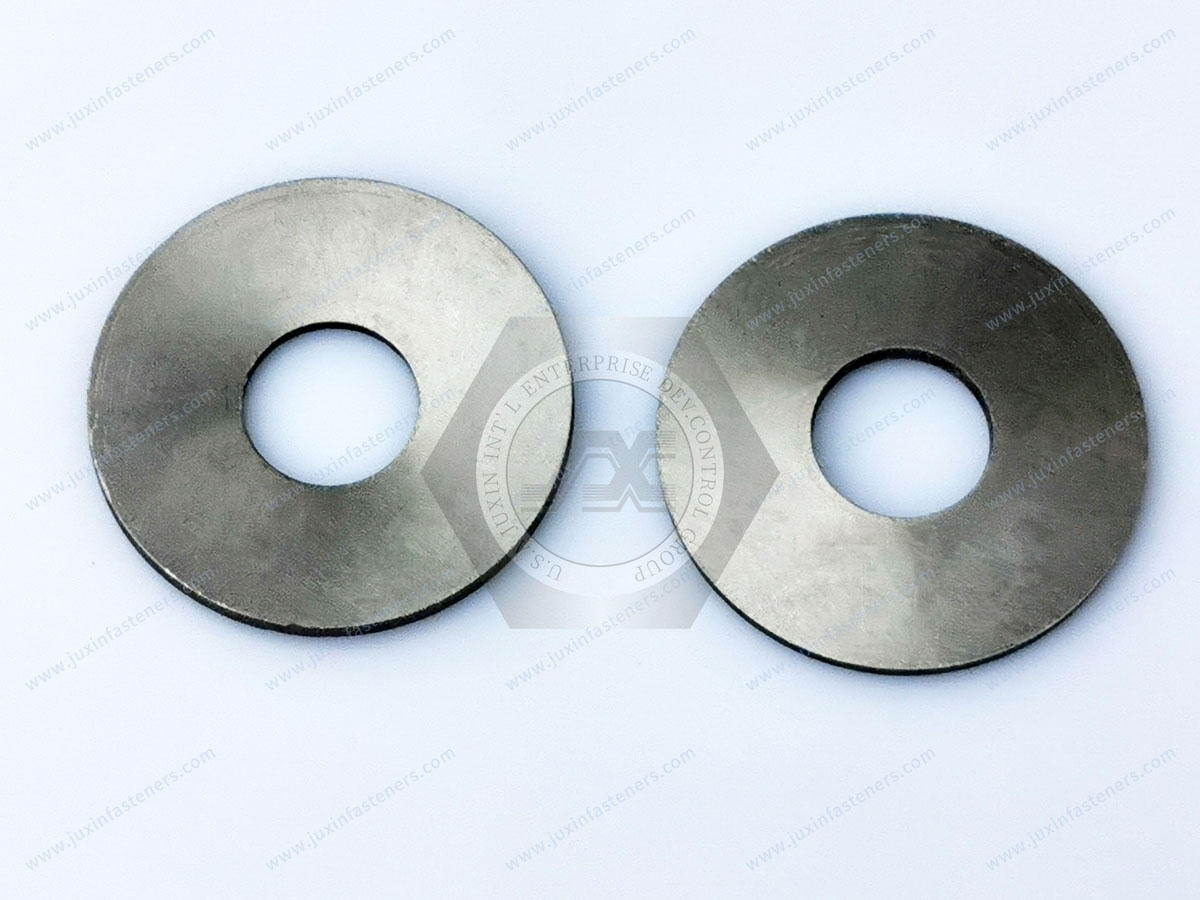
Belleville washers or disc springs are engineered spring components capable of providing controlled force-deflection characteristics.
They can also be arranged in series, parallel, or combination stacks.
Curved spring washers are generally much simpler fastening components.
For engineers:
Need Controlled High Spring Force or Designed Load-Deflection Behavior → Evaluate Disc Springs
Need Limited Elastic Compensation in a Conventional Fastened Assembly → A Curved Spring Washer May Be Appropriate
The two product families should not be treated as interchangeable.
This question requires careful engineering interpretation.
A curved spring washer can add elasticity to a bolted joint and may help maintain contact or compensate for limited preload loss.
However, no curved spring washer should automatically be described as preventing all vibration-induced loosening.
Bolted-joint behavior depends on many factors, including:
Initial preload
Bolt stiffness
Joint stiffness
Transverse movement
Vibration amplitude
Surface condition
Friction
Temperature
External loading
Joint geometry
Where severe transverse vibration, cyclic loading, or safety-critical loosening risk exists, engineers should evaluate the complete joint and determine whether a dedicated locking strategy is required.
Potential alternatives may include:
Prevailing-torque lock nuts
All-metal lock nuts
Nylon-insert lock nuts where suitable
Wedge-locking systems
Thread-locking compounds
Mechanical locking devices
Application-specific locking fasteners
A spring washer should not be used as a substitute for engineering evaluation of the joint.
One of the most useful ways to understand a curved spring washer is to think about joint elasticity rather than simply "locking."
A bolted joint behaves as an elastic system.
During operation, changes can occur because of:
Surface embedding
Paint compression
Gasket relaxation
Polymer creep
Thermal expansion
Differential thermal movement
Component settlement
If these changes reduce the effective clamping force, the joint may become less stable.
Adding an elastic washer can increase available deflection within the fastening system.
This can help the joint tolerate limited dimensional changes while maintaining contact.
Whether this produces a meaningful benefit depends on the actual washer and joint design.
Curved spring washers may be considered when:
Installation space is limited
Additional elastic deflection is desirable
The joint may experience limited settlement
Components experience thermal dimensional change
A compact spring element is required
The engineering drawing specifies DIN 128A or an equivalent curved washer
Existing equipment uses a curved spring washer that must be replaced or second-sourced
They are particularly practical when the design already incorporates this washer type and the sourcing requirement is to maintain the intended assembly geometry.
A curved spring washer should not be selected simply because:
The equipment vibrates
The bolt is important
The assembly is automotive
The assembly is aerospace
The fastener is high strength
A conventional washer previously loosened
Those conditions do not automatically establish that a curved washer is the correct solution.
For example, a joint exposed to severe transverse vibration may require a fundamentally different locking strategy.
A high-load structural joint may require a washer defined by another applicable standard.
A sealing joint may require a gasket or sealing washer.
An electrically conductive joint may have bonding requirements that a generic spring washer does not address.
The engineering problem should determine the washer.
Correct installation is essential for predictable performance.
The washer should be selected according to the applicable standard or engineering drawing rather than simply choosing a washer that physically fits over the bolt.
Important dimensional factors include:
Inside diameter
Outside diameter
Material thickness
Free height
Curvature
Bearing area
Before assembly, verify that the washer seats correctly against the intended surfaces.
Check for:
Burrs
Excessive surface damage
Contamination
Unexpected interference
Incorrect washer geometry
The washer does not determine the correct tightening torque by itself.
Installation torque depends on the complete fastener system, including:
Bolt size
Bolt material and property class
Nut
Coating
Lubrication
Friction
Joint material
Required preload
For OEM assemblies, the controlled tightening specification should come from the engineering drawing, assembly specification, or validated installation process.
A curved spring washer operates through elastic deformation.
If the washer is loaded outside its intended working condition, its spring behavior may no longer provide the expected result.
The required installed condition should therefore be evaluated according to the product specification and joint design.
Material choice affects spring performance, fatigue behavior, corrosion resistance, temperature capability, and manufacturing consistency.
Spring steel is commonly used where elastic performance and mechanical strength are required.
Potential applications include:
Industrial machinery
Motors
Pumps
Gearboxes
Production equipment
General mechanical assemblies
Heat treatment and hardness should be controlled according to the applicable product specification.
Stainless steel can be considered where corrosion resistance is important.
Potential applications include:
Food-service equipment
HVAC equipment
Medical equipment
Laboratory instruments
Outdoor equipment
Electrical equipment
Processing machinery
The required stainless steel grade should be selected according to the operating environment.
A2 and A4 stainless steels, for example, offer different corrosion characteristics and should not be treated as universally interchangeable.
Depending on the specification and operating environment, steel curved spring washers may use finishes such as:
Blackened and oiled finish
Phosphate-based coatings
Zinc-based coatings
Zinc-nickel coatings
Zinc-flake systems
Customer-specified coatings
Coating selection should consider more than corrosion resistance.
It can also affect:
Dimensions
Surface friction
Installation behavior
Appearance
Electrical conductivity
Contact surfaces
For hardened spring components, coating-process compatibility and hydrogen-embrittlement risk should also be considered where applicable.
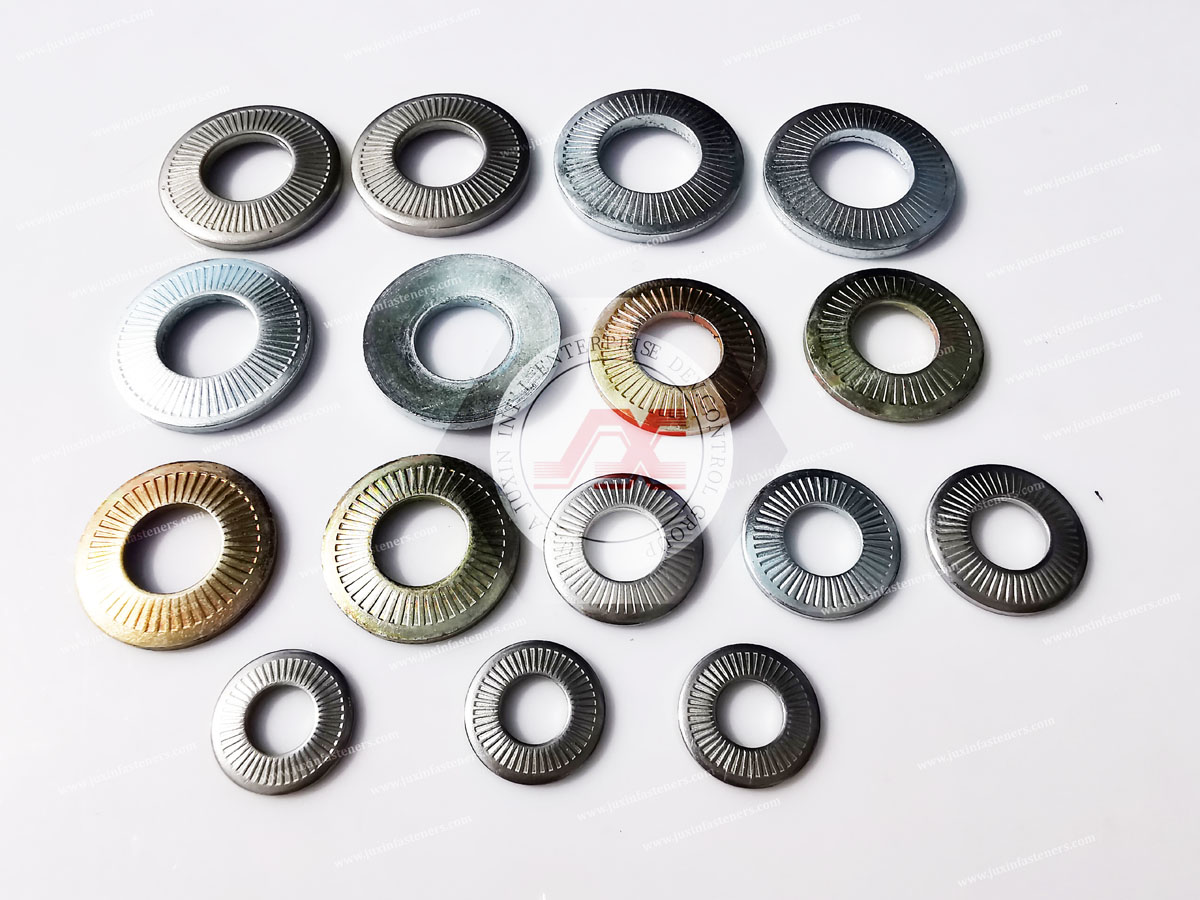
Automotive and electric-vehicle manufacturing includes thousands of bolted connections, but this does not mean curved spring washers are appropriate for every joint.
Potential applications may exist in:
Auxiliary equipment
Brackets
Mechanical subassemblies
Production equipment
Battery manufacturing equipment
Fixtures
Service equipment
For vehicle-level assemblies, washer selection should follow the controlled drawing and validated joint design.
Factors such as vibration, fatigue, corrosion, temperature, coating compatibility, and automated assembly may need evaluation.
Battery manufacturing and energy-storage systems involve mechanical frames, enclosures, cooling equipment, electrical cabinets, and production machinery.
Potential washer applications can occur in:
Equipment frames
Battery production machinery
Mechanical brackets
Cooling-system equipment
Auxiliary assemblies
Serviceable equipment
For electrical connections, engineers must separately evaluate electrical resistance, conductivity, galvanic compatibility, and grounding requirements.
A mechanical spring washer should not automatically be assumed to satisfy an electrical connection requirement.
Rail equipment can experience vibration, repeated loading, outdoor exposure, and long service intervals.
Potential applications include:
Auxiliary machinery
Electrical cabinets
HVAC equipment
Workshop equipment
Mechanical assemblies
Maintenance systems
For rail projects, customer drawings and project-specific technical requirements should control the final product selection.
Traceability, corrosion protection, material documentation, or inspection requirements may also apply.
Aerospace applications involve tightly controlled engineering specifications and qualification requirements.
Curved spring washers should only be supplied for an aerospace assembly when the applicable drawing, standard, material requirement, and approval process specifically permit the component.
Potential non-flight or equipment applications can include:
Manufacturing fixtures
Ground-support equipment
Testing systems
Production machinery
Maintenance equipment
JUXIN FASTENERS does not treat the generic term "aerospace application" as sufficient technical approval for a fastener.
Curved spring washers may be used in suitable mechanical fastening locations in:
Electrical cabinets
Switchgear
Control panels
Power-conversion equipment
Industrial enclosures
Mechanical equipment frames
Where the fastener is part of an electrical bonding or grounding path, electrical performance requirements must be evaluated separately.
AI data centers require substantial power, cooling, networking, and mechanical infrastructure.
Potential mechanical fastening applications include:
Cooling equipment
Liquid-cooling systems
Pump assemblies
Chillers
Power equipment
UPS equipment
Electrical cabinets
Mechanical frames
Support structures
Curved spring washers may be relevant where the equipment design requires additional joint elasticity, but selection should follow the actual mechanical design rather than the industry label.
Telecommunications infrastructure contains mechanical and electrical assemblies exposed to vibration, outdoor conditions, and repeated thermal cycles.
Potential applications include:
Communication equipment
Base station antennas
Outdoor cabinets
Equipment frames
Mechanical mounting systems
Power modules
Material and coating selection should reflect the environmental exposure and customer specification.
Semiconductor manufacturing equipment often requires precise mechanical assemblies and carefully controlled materials.
Potential applications can include:
Equipment frames
Auxiliary machinery
Handling equipment
Pumps
Electrical enclosures
Serviceable mechanical assemblies
Where cleanroom, vacuum, particle-control, or outgassing requirements apply, the washer material and surface treatment must be reviewed against the equipment specification.
HVAC and thermal-management systems include:
Compressors
Pumps
Fans
Chillers
Heat exchangers
Air-handling equipment
Liquid-cooling equipment
Equipment frames
These systems can experience vibration and temperature changes.
A curved spring washer may be considered where additional elastic compensation is required, but the complete joint should be evaluated.
Medical and laboratory equipment can require compact fastening systems with controlled material and cleanliness requirements.
Potential applications include:
Diagnostic equipment
Laboratory instruments
Equipment frames
Mechanical adjustment systems
Auxiliary machinery
For regulated medical-device applications, the applicable drawing, material specification, documentation, and qualification requirements take precedence over generic product recommendations.
Commercial food-service machinery often combines stainless steel structures, motors, pumps, heating systems, and removable mechanical assemblies.
Potential applications include:
Commercial ovens
Food-processing equipment
Refrigeration equipment
Beverage equipment
Kitchen machinery
Stainless steel equipment frames
Material selection should consider corrosion, cleaning chemicals, temperature, and any applicable hygiene requirements.
A stainless steel washer does not by itself establish suitability for food-contact use.
Industrial robots and automated production systems contain large numbers of mechanical connections.
Potential applications include:
Robot fixtures
Conveyor systems
Packaging machinery
Assembly equipment
Material-handling systems
Mechanical actuators
Production-line equipment
For high-dynamic joints, engineers should evaluate whether the curved washer provides sufficient joint performance or whether another locking technology is required.
General machinery and fabricated equipment remain important applications for curved spring washers.
Potential uses include:
Machine frames
Sheet metal cabinets
Covers
Brackets
Pumps
Motors
Gearboxes
Industrial instruments
Serviceable assemblies
These applications often benefit from standardized components that can be sourced consistently across multiple production locations.
Construction machinery and industrial equipment operate under demanding environmental and mechanical conditions.
Potential applications include:
Equipment enclosures
Auxiliary machinery
Control systems
Pumps
Hydraulic equipment
Mechanical brackets
For primary structural connections, engineers should follow the applicable structural bolting specification rather than automatically substituting a general curved spring washer.
A useful selection process is:
Step 1: Define the Mechanical Problem
Is the requirement:
Elastic compensation?
Surface protection?
Vibration resistance?
Preload retention?
Dedicated locking?
Sealing?
Electrical bonding?
Do not combine these into one vague requirement.
Step 2: Identify the Applicable Standard or Drawing
Determine whether the application specifies:
DIN 128A
Another international standard
OEM drawing
Legacy part
Custom geometry
Step 3: Review the Joint
Evaluate:
Bolt diameter
Bolt property class
Nut
Joint material
Bearing surface
Required preload
Available installation space
Step 4: Evaluate Operating Conditions
Consider:
Static load
Dynamic load
Vibration
Shock
Temperature
Corrosion
Maintenance interval
Step 5: Select Material and Finish
Choose the material and surface treatment based on the actual operating environment.
Step 6: Validate the Assembly
For demanding OEM applications, sample testing in the actual assembly is preferable to relying solely on catalog dimensions.
Two joints using the same bolt diameter can have completely different mechanical requirements.
Curved washers, split washers, wave washers, conical washers, and disc springs have different geometries and functions.
Additional elasticity does not automatically prevent rotational loosening.
Surface treatment can influence both corrosion performance and assembly behavior.
Material choice depends on strength, elasticity, corrosion exposure, temperature, cost, and the complete joint design.
A washer that has experienced permanent deformation, corrosion, wear, or damage should not automatically be reused.
Engineers often search for:
What is a curved spring washer?
How does a curved spring washer work?
DIN 128A washer function
Curved washer vs spring washer
Curved washer vs Belleville washer
Spring washer for preload
Washer for joint settlement
Curved spring washer installation
Their goal is to determine whether the component is technically appropriate.
Procurement teams may search for:
Curved spring washer manufacturer
DIN 128A washer supplier
Saddle spring washer supplier
Stainless steel curved spring washer
Spring steel curved washer
Custom spring washer manufacturer
OEM washer supplier
Their concerns include:
Standard compliance
Dimensions
Material
Heat treatment
Surface finish
Production consistency
Documentation
Samples
MOQ
Lead time
Cost
A successful sourcing process should connect the engineering requirement with the commercial specification.
Where possible, procurement should first determine whether a standard component satisfies the application.
A practical sourcing path is:
Standard DIN Component → Material / Finish Variant → Modified Standard Washer → Fully Custom Drawing-Based Washer
Custom manufacturing may be appropriate when the project requires:
Non-standard inside diameter
Special outside diameter
Special thickness
Modified curvature
Special material
Customer-specific hardness
Special coating
Legacy replacement component
Restricted installation envelope
For non-standard components, a controlled drawing is strongly recommended.
When qualifying a second supplier, procurement teams should not compare only nominal dimensions.
Important characteristics may include:
Material
Hardness
Heat treatment
Free height
Thickness
Curvature
Inside diameter
Outside diameter
Surface treatment
Coating thickness
Spring behavior
Visual condition
A practical second-source process is:
Existing Drawing / Sample → Specification Review → Dimensional Review → Material & Hardness → Surface Finish → Sample → Assembly Evaluation → Pilot Lot → Production
This reduces the risk of approving a washer that looks correct but behaves differently in the actual joint.
For faster technical evaluation, procurement teams should provide:
Product Information
DIN 128A or applicable standard
Customer part number
Drawing if available
Dimensions
Bolt size
Inside diameter
Outside diameter
Thickness
Free height where specified
Material
Spring steel
Stainless steel
Other specified material
Surface Treatment
Required finish
Corrosion requirement
Customer coating specification
Application
Equipment type
Static or dynamic joint
Vibration condition
Operating temperature
Environmental exposure
Commercial Information
Sample quantity
Production quantity
Estimated annual demand
Packaging requirements
Required documentation
Delivery schedule
Providing this information significantly reduces unnecessary quotation cycles.
For standardized product information, review our DIN 128A Curved Spring Washer Solutions.
For high-loaded bolted joints requiring conical washer behavior, review our DIN 6796 Conical Spring Washer Solutions.
For controlled spring-force and load-deflection requirements, review our Disc Spring / Belleville Washer Solutions.
For conventional bearing-surface load distribution, review our Flat Washer Solutions.
For angular misalignment between bearing surfaces, review our Spherical Washer Solutions.
For drawing-based parts, review our Custom Washer & Precision Metal Component Solutions.
These products should not be treated as interchangeable. Each solves a different mechanical fastening problem.
JUXIN FASTENERS supports OEM and industrial sourcing requirements for:
Curved spring washers
Saddle spring washers
DIN 128A washers
Spring steel washers
Stainless steel spring washers
Surface-treated curved washers
Custom spring washers
Drawing-based washer components
Projects can be evaluated from:
International standards
Customer drawings
Existing samples
Material specifications
Surface-treatment requirements
Application information
For new sourcing programs or second-source development, providing the original engineering specification is the most effective starting point.
The most reliable sourcing process begins with the joint requirement:
Application → Joint Function → Applicable Standard → Dimensions → Material → Finish → Sample → Assembly Validation → Production
This prevents the common mistake of selecting a washer simply because its nominal diameter matches the bolt.
For standard DIN 128A curved spring washers, stainless steel curved washers, custom spring washers, OEM programs, replacement parts,
or second-source projects, send your drawing, specification, material, finish, quantity, and application information to:
JUXIN FASTENERS can review the available technical information and evaluate an appropriate standard, modified-standard, or drawing-based washer solution for your project.
Previous: Single-Coil Washers
 MORE NEWS
Sep. 27, 2026
Sep. 27, 2026
Sep. 27, 2026
Contact Us
Tel.:
+86 020 8621 0320
+86 020 3121 6067
E-mail:
Technical Support:
Navigation
SEND INQUIREY