Call Us
+86 136 6007 9809
Call Us
+86 136 6007 9809

Nov. 13, 2023
When engineers specify a blind rivet nut for thin sheet metal, tubing or an enclosed structure, one important design decision is often overlooked:
Should the threaded insert have an open end or a closed end?
Both open-end rivet nuts and closed-end rivet nuts can create reusable internal threads from one accessible side of the workpiece.
The key difference is what happens at the blind end of the insert.
An open-end rivet nut leaves the threaded body open.
A closed-end rivet nut terminates the body with a closed bottom.
That seemingly simple difference can affect:
bolt-length tolerance;
blind-side clearance;
contamination pathways;
moisture management;
enclosure design;
inspection;
overall component length;
application cost.
JUXIN FASTENERS supplies open-end blind rivet nuts, closed-end rivet nuts, hex rivet nuts, countersunk rivet nuts, flat head rivet nuts, steel rivet nuts,
stainless steel rivet nuts, aluminum rivet nuts and custom threaded inserts for OEM industrial assemblies.
Applications include automotive and EV systems, rail transportation, industrial machinery, electrical enclosures,
telecommunications, data center equipment, HVAC systems and fabricated sheet-metal structures.
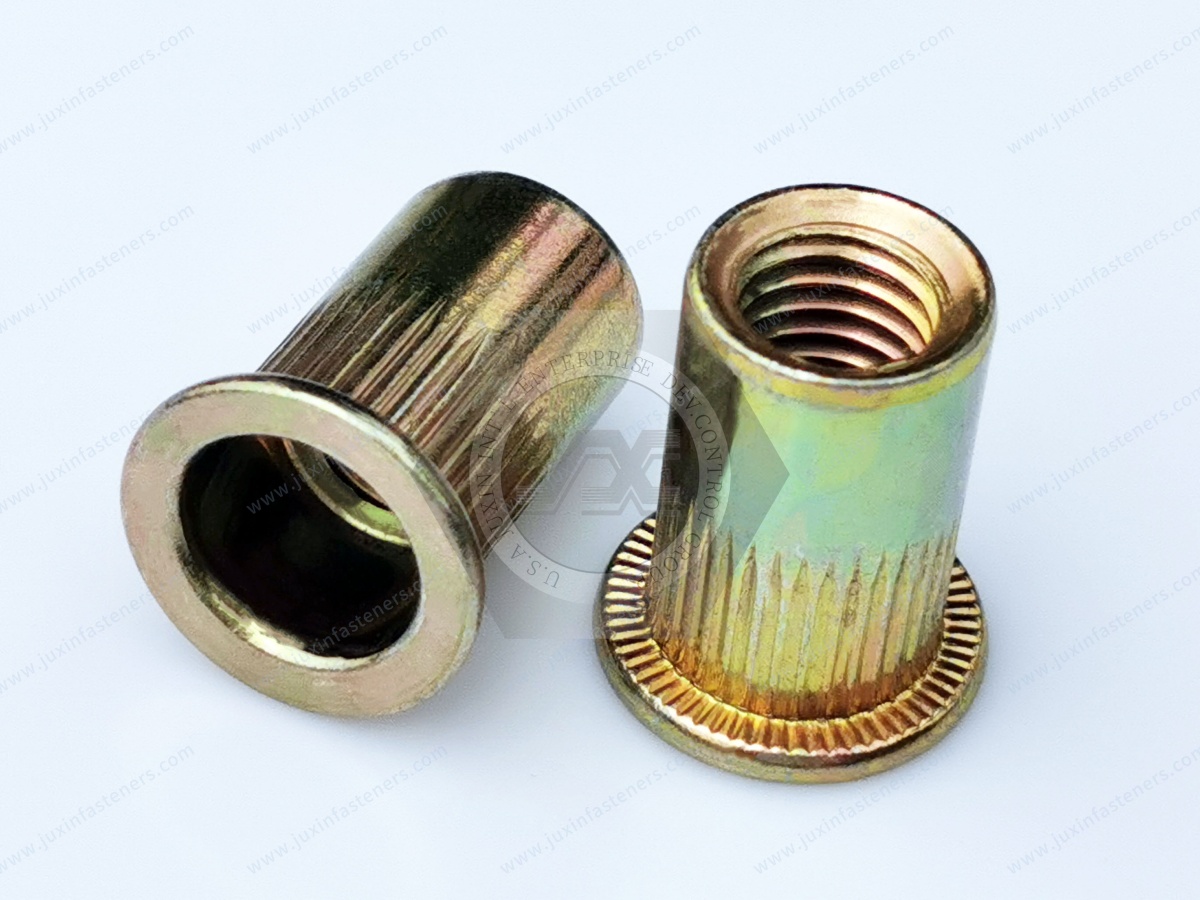
An open-end rivet nut, sometimes described as a through-hole rivet nut, open rivnut or open blind threaded insert, has an internal threaded passage that remains open at the blind end.
Like other blind rivet nuts, it is installed from one accessible side.
During installation:
the rivet nut is inserted into the prepared hole;
the installation-tool mandrel engages the internal thread;
controlled force or stroke deforms the designated body section behind the panel;
the insert becomes mechanically retained in the workpiece;
the tool is removed and the internal thread becomes available for assembly.
The term open-end refers to the fastener body—not to the accessibility required for installation.
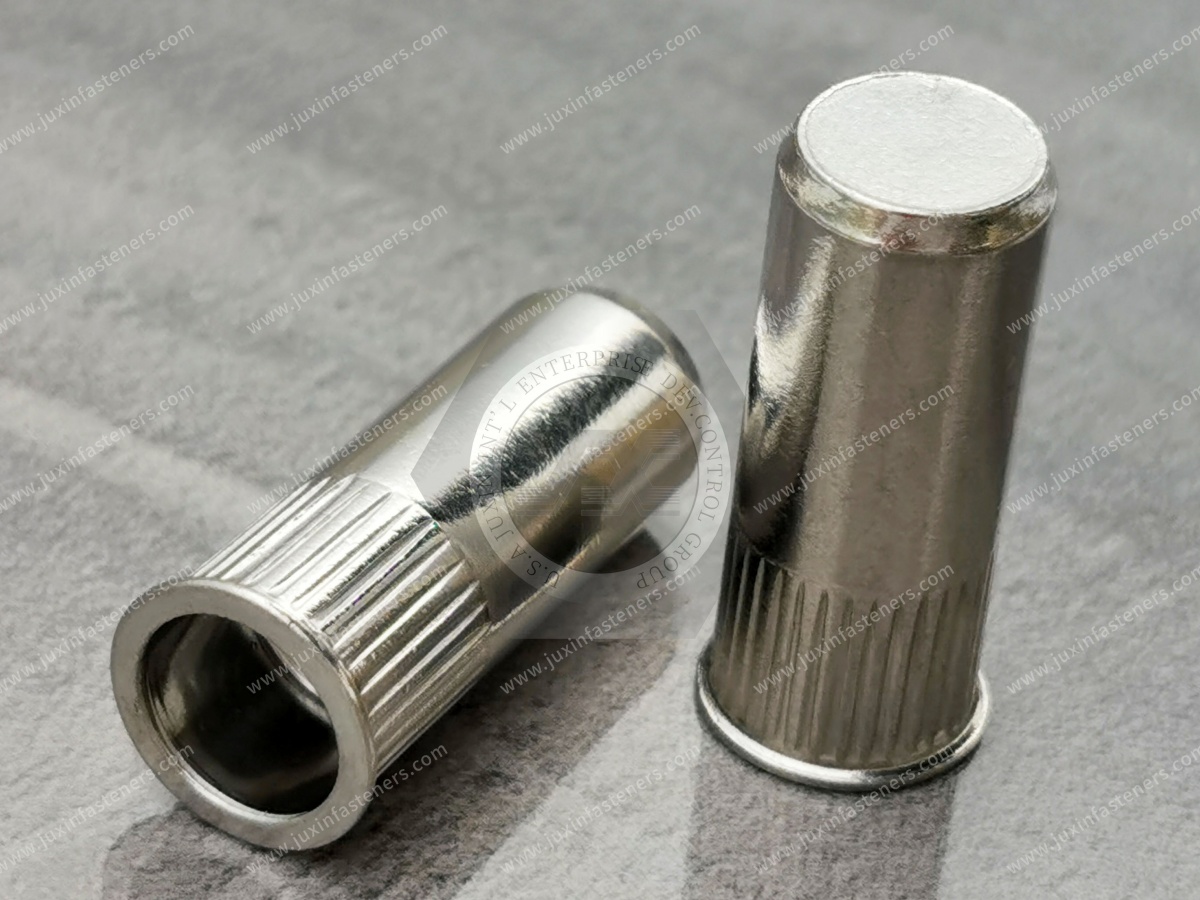
A closed-end rivet nut, also called a closed-end blind rivet nut or sealed-end rivnut, uses a body with a closed bottom behind the internal threaded section.
It is still installed from one side in the same general blind-fastening concept.
The closed end can help prevent a direct passage through the center of the installed threaded insert.
This makes it useful when the designer wants additional control over:
moisture pathways;
dirt;
dust;
process contamination;
blind-side exposure;
screw protrusion into an enclosed space.
However, the closed bottom should not automatically be interpreted as a complete environmental seal.
| Engineering Factor | Open-End Rivet Nut | Closed-End Rivet Nut |
|---|---|---|
| Blind installation | Yes | Yes |
| Internal body | Open | Closed at blind end |
| Reusable internal thread | Yes | Yes |
| Screw depth flexibility | Generally greater | Limited by internal depth |
| Screw protrusion beyond insert | Possible depending on assembly | Restricted by closed bottom |
| Direct pathway through thread center | Remains open | Closed at insert end |
| Environmental protection potential | Standard | Better candidate |
| Complete liquid sealing | Not inherent | Not inherent without validated sealing system |
| Body length | Often more compact for comparable design | May require additional closed-end length |
| Blind-side clearance | Product-specific | Requires attention to closed body length |
| Typical priority | General blind threading | Environmental isolation / controlled screw depth |
The correct selection depends on the complete assembly rather than the name of the fastener.
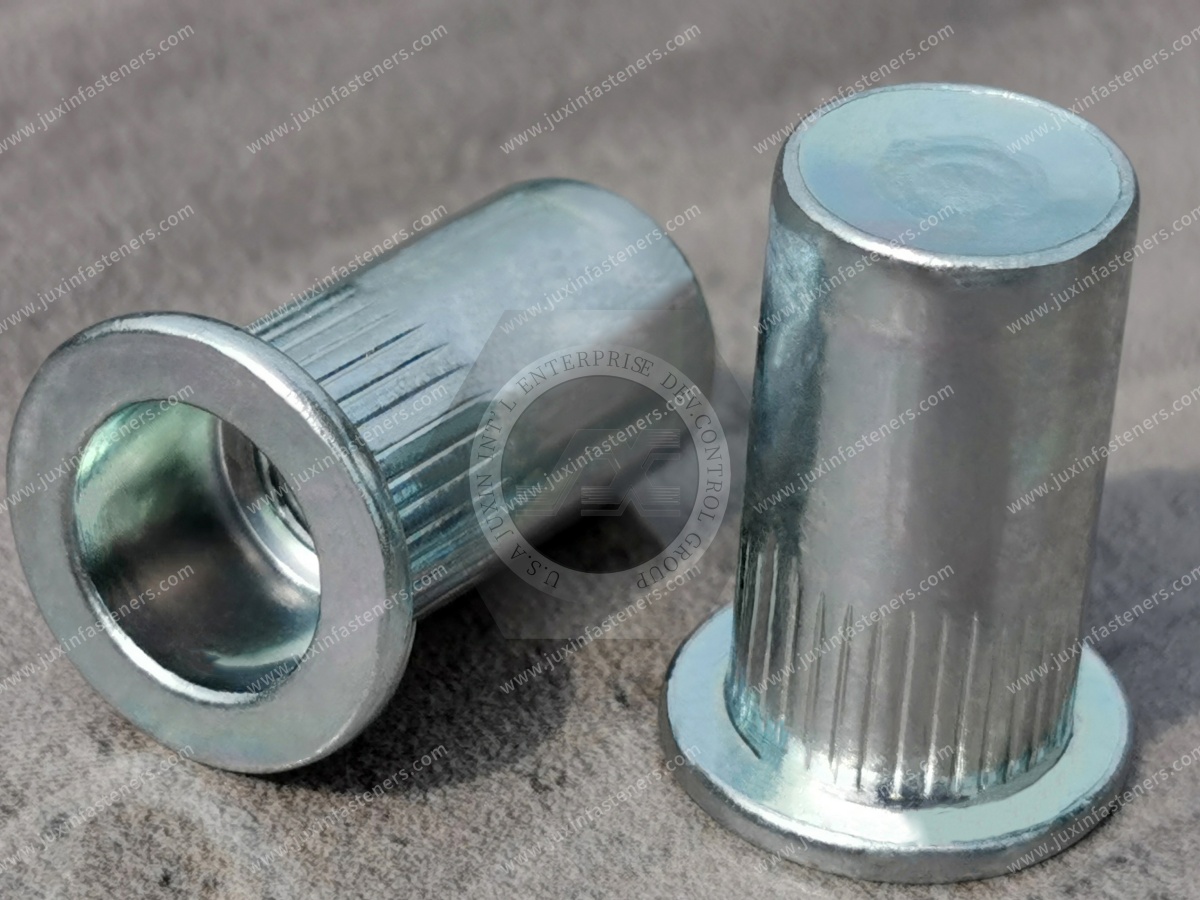
Consider an open-end rivet nut installed in an enclosure wall.
The threaded bore can create a potential pathway from the accessible side toward the blind side.
A closed-end rivet nut eliminates that direct path through the end of the insert.
This can be useful in equipment exposed to:
water splash;
condensation;
dust;
dirt;
oils;
process debris;
outdoor contamination.
But another potential path remains:
Rivet Nut Flange → Panel Interface
Therefore:
Closed Threaded End ≠ Fully Sealed Joint
Not automatically.
This is one of the most important distinctions for engineers and procurement teams.
A closed-end rivet nut blocks the direct passage through the threaded body's blind end, but water can potentially migrate around the installed fastener if the flange-to-panel interface is not adequately sealed.
A sealing system may therefore require additional features such as:
sealing washer;
bonded sealing element;
gasket;
sealant;
under-head sealing feature;
controlled panel surface;
validated installation parameters.
If the application specifies:
IP rating;
leak rate;
water ingress requirement;
pressure differential;
fluid containment;
the complete installed assembly should be tested against that requirement.
Do not approve a component simply because the catalogue description says “closed end.”
One practical advantage of an open-end design is greater flexibility in mating-screw engagement.
Depending on the surrounding assembly, a screw may extend beyond the threaded portion of the rivet nut.
This can provide greater tolerance when:
several component thicknesses are used;
different screw lengths share one attachment point;
the exact screw projection is not restricted;
blind-side clearance is available.
However, the engineer still needs to check what exists behind the insert.
An excessively long screw can interfere with:
wiring;
electronics;
moving mechanisms;
insulation;
fluid lines;
adjacent components.
The closed bottom creates a physical limit to screw penetration.
This can be useful when a designer does not want the mating screw extending into the blind-side environment.
Examples include:
electrical enclosures;
battery-system compartments;
compact electronic housings;
control cabinets;
machinery containing moving components;
assemblies with cables behind the panel.
But this creates another design requirement:
The Screw Must Not Bottom Out Before the Joint Is Properly Clamped
If the screw is too long, it may contact the closed end before sufficient clamp load is generated.
This can create misleading torque readings or damage the assembly.
For a closed-end rivet nut, engineers should verify:
Available Internal Thread Depth
against:
Screw Engagement + Attached Component Thickness + Washer Stack + Required Clearance
The design should provide sufficient thread engagement without allowing the screw to bottom out.
Therefore, a closed-end rivet nut should not be substituted directly for an open-end version without checking the mating screw.
A common misunderstanding is that open-end rivet nuts are used when both sides of the component are accessible while closed-end versions are used when only one side is accessible.
That is incorrect.
Both are blind rivet nuts.
Both are valuable precisely because installation can be completed from the accessible side of the workpiece.
The open-versus-closed decision concerns the insert body and blind-side environment—not the basic accessibility requirement.
Another common misconception is that open-end rivet nuts are inherently intended for repeated maintenance while closed-end rivet nuts are not.
Both designs can provide reusable internal threads.
Repeated service performance depends on:
thread condition;
rivet nut material;
mating screw;
assembly torque;
torque-out resistance;
installation quality;
service cycles.
If repeated maintenance is expected, these variables should be evaluated regardless of whether the body is open or closed.
Open-end versus closed-end selection does not replace normal rivet nut engineering.
The fastener still needs the correct grip range for the workpiece thickness.
If the selected rivet nut is outside its intended grip range, potential problems include:
incomplete backside deformation;
excessive deformation;
poor clamping;
panel distortion;
inconsistent seating;
reduced torque resistance;
reduced axial retention.
Therefore:
Open/Closed End + Thread Size Is Not a Complete Specification
The end configuration describes what happens at the blind end.
The head configuration describes the accessible-side interface.
A closed-end rivet nut can therefore potentially be combined with different head geometries depending on the product design.
Examples include:
Flat Head + Closed End
for general front-side support plus a closed blind end.
Countersunk / Reduced Head + Closed End
for lower front projection plus a closed blind end.
Likewise, open-end rivet nuts can use multiple head configurations.
This is why engineering drawings should define each design characteristic separately.
Body geometry influences anti-rotation and installation-hole design.
Potential configurations include:
round body;
knurled body;
half hex body;
full hex body.
For example:
Closed End + Hex Body
can combine a closed blind end with strong geometric anti-rotation.
Open End + Round Body
can provide general blind threading with simpler round-hole production.
The correct architecture depends on the application.
Open-end rivet nuts are suitable for a broad range of general blind-threading applications.
Typical examples include:
machine covers;
equipment frames;
access panels;
electrical cabinets;
automotive brackets;
interior vehicle components;
HVAC equipment;
fabricated sheet-metal structures;
automation equipment;
furniture frames.
They are particularly practical where environmental isolation through the threaded insert is not a primary design requirement.
Closed-end designs become more attractive when the blind-side environment matters.
Potential applications include:
outdoor electrical enclosures;
vehicle body assemblies;
selected EV battery components;
telecommunications cabinets;
industrial control equipment;
outdoor machinery;
rail equipment;
marine-related equipment;
equipment exposed to dirt or process contamination.
The closed bottom can also be useful where the designer wants to restrict screw penetration into the enclosed space.
Automotive fastening systems must deal with:
vibration;
corrosion;
water exposure;
road contamination;
limited access;
lightweight sheet structures;
service requirements.
Open-end rivet nuts can be suitable for many:
interior brackets;
equipment mounts;
trim structures;
body components;
serviceable assemblies.
Closed-end rivet nuts can be evaluated where additional blind-side isolation is desirable.
Potential applications include selected:
body structures;
electrical enclosures;
exterior equipment mounts;
battery-system brackets;
enclosure attachment points.
For EV battery applications, the complete fastening interface may also need to address:
sealing;
electrical isolation;
corrosion;
thermal cycling;
vibration;
service access;
OEM-specific validation.
A closed-end rivet nut alone should not be presented as an EV battery enclosure sealing system.
Closed-end rivet nuts can be valuable in enclosure walls because the closed bottom removes the direct passage through the threaded insert.
Possible applications include:
electrical cabinets;
outdoor control boxes;
switchgear;
power equipment;
instrumentation housings;
communication enclosures.
If the enclosure requires a defined ingress-protection level, however, the entire installed interface must be evaluated.
The correct engineering question is not:
“Is the rivet nut waterproof?”
It is:
“Does the complete installed fastening interface satisfy the enclosure requirement?”
Open-end rivet nuts can provide reusable threads for:
server equipment;
racks;
equipment trays;
network cabinets;
communication housings.
Closed-end designs may be considered for equipment where contamination pathways or controlled screw penetration are important.
For highly serviceable rack systems, engineers should also compare rivet nuts with cage nuts and self-clinching hardware.
Potential rivet nut applications include:
passenger interior panels;
lighting equipment;
electrical cabinets;
toilet-module assemblies;
equipment enclosures;
access covers;
partition systems.
Open-end designs may be sufficient for general interior attachment.
Closed-end designs may be evaluated where contamination, moisture or blind-side isolation becomes relevant.
Rail applications should also be reviewed against project-specific requirements for:
vibration;
corrosion;
fire/material compliance;
traceability;
inspection;
maintenance.
Open-end rivet nuts are widely applicable to:
machine guards;
covers;
equipment frames;
access panels;
automation housings.
Closed-end designs may be preferred where the blind side contains:
lubricants;
contamination-sensitive components;
electrical systems;
moving mechanisms.
Screw-length control is especially important where machinery components operate close to the blind side of the fastener.
HVAC, refrigeration and outdoor equipment can expose fasteners to:
condensation;
water;
dirt;
temperature cycling;
cleaning processes.
A closed-end rivet nut can reduce one possible contamination pathway, while additional sealing at the head-to-panel interface may still be required.
Both open-end and closed-end rivet nuts can be produced in different materials depending on the product design and application.
Steel provides a practical combination of mechanical performance and production economics.
Possible finishes include:
zinc plating;
zinc-nickel plating;
zinc-flake coating systems;
customer-specified finishes.
The finish should be selected according to the required corrosion environment.
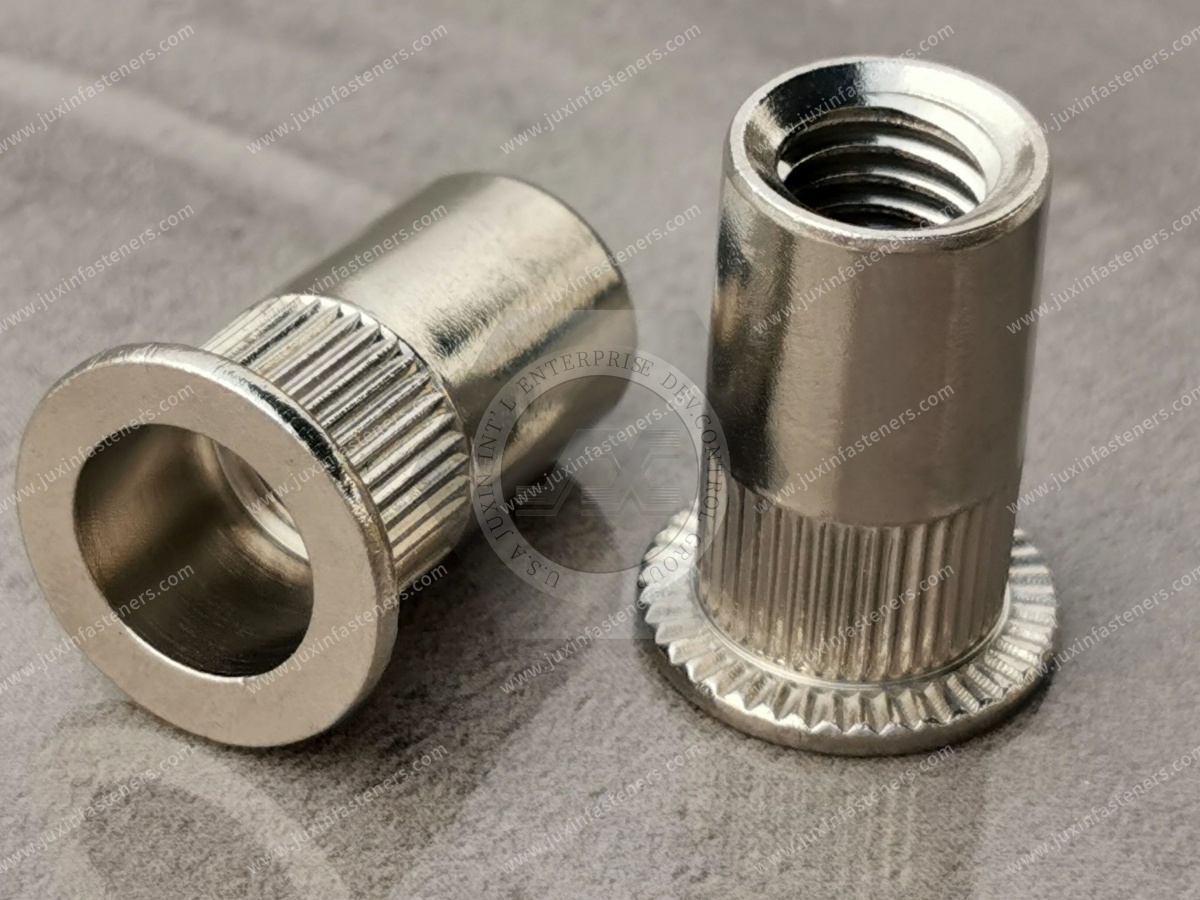
304-type and 316-type stainless steels can be considered for applications requiring greater corrosion resistance.
Potential applications include:
outdoor equipment;
food-processing machinery;
chemical equipment;
transportation;
marine-related systems;
medical and laboratory equipment.
Tool capacity should be verified because stainless rivet nuts may require greater setting loads.
Aluminum provides a lightweight option for suitable assemblies.
Applications can include:
transportation;
electronics;
aluminum structures;
lightweight industrial equipment.
Dissimilar-metal combinations should be reviewed for galvanic compatibility.
| Application Requirement | Open End | Closed End |
|---|---|---|
| General blind threading | Strong candidate | Possible |
| Lowest unnecessary design complexity | Strong candidate | Evaluate need |
| Variable screw projection | Strong candidate | Limited |
| Restricted screw penetration | Requires screw-length control | Strong candidate |
| Direct thread-path isolation | No | Strong candidate |
| Moisture-sensitive enclosure | Requires separate sealing strategy | Better candidate with validated sealing |
| Dust/process contamination | Standard | Better candidate |
| Maximum internal depth flexibility | Better | More restricted |
| Tight blind-side packaging | Check screw projection | Check body length |
| Defined leak/IP requirement | Validate complete joint | Validate complete joint |
Closed-end rivet nuts are frequently discussed only as “waterproof rivet nuts.”
That misses an important engineering use case.
A closed-end insert can also act as a controlled boundary for screw penetration.
Consider an enclosure with electronics located immediately behind the mounting panel.
An open-end insert may allow an incorrectly selected long screw to protrude into the protected volume.
A closed-end design physically limits that penetration.
Therefore closed-end selection can address two independent engineering problems:
Environmental Path Control
and
Mechanical Screw-Protrusion Control
These requirements should be evaluated separately.
The closed bottom itself occupies space.
This means the designer should verify:
overall rivet nut body length;
blind-side clearance;
nearby components;
wiring;
insulation;
moving parts.
In a tightly packaged assembly, changing from open end to closed end may solve one problem while creating another.
Always review the installed envelope.
Anti-rotation depends primarily on the installed interaction between:
body geometry;
hole geometry;
grip range;
parent material;
setting.
If high anti-rotation is required, evaluate:
knurled body;
half hex body;
full hex body;
appropriate hole design.
Do not select a closed-end rivet nut merely because higher torque resistance is required.
Axial retention depends on the complete installed joint.
Important variables include:
parent material;
panel thickness;
hole size;
rivet nut geometry;
backside deformation;
head geometry;
setting condition.
Open-end and closed-end designs should therefore be compared using installed performance data where axial loads are important.
Both open-end and closed-end rivet nuts require controlled installation.
incomplete deformation;
poor clamping;
rivet nut rotation;
inconsistent seating.
panel distortion;
body damage;
thread damage;
reduced reliability.
Closed-end designs require additional attention to the correct tool mandrel and installation setup so that the closed portion is not damaged.
Use this engineering decision path:
1. Is blind installation required?
If yes, either design may be suitable.
2. Does the application require a barrier at the blind end of the internal thread?
If yes, evaluate closed end.
3. Can the mating screw safely project beyond the threaded insert?
If yes, open end provides greater screw-length flexibility.
If no, closed end may help control penetration.
4. Is a defined environmental seal required?
If yes, specify the complete sealing system and validation requirement rather than relying only on a closed end.
5. What blind-side space is available?
Check rivet nut body length and screw projection.
6. What is the finished panel thickness?
Select the correct grip range.
7. What anti-rotation performance is required?
Select the appropriate body geometry.
8. What material and corrosion resistance are required?
Select material and surface treatment.
9. What installed performance must be validated?
Define torque-out, axial retention, sealing or other project requirements.
For an open-end or closed-end rivet nut, define as applicable:
thread diameter;
pitch or TPI;
thread tolerance;
open-end or closed-end body;
head style;
flange dimensions;
body geometry;
body dimensions;
overall length;
usable internal thread depth;
grip range;
installation-hole requirement;
parent material;
finished panel thickness;
rivet nut material;
surface treatment;
dimensional tolerances;
required installed projection;
sealing requirement;
performance requirements;
inspection criteria.
Relevant ISO, DIN, EN, ASTM, SAE, BS or ASME/ANSI requirements can be referenced where appropriate to the project.
If the closed-end design is being selected because of environmental requirements, prototype testing should reproduce the real assembly.
Test:
Production Rivet Nut
Actual Panel
Production Hole
Actual Coating
Production Setting Parameters
Mating Screw
Any Washer / Seal / Gasket
Depending on the project, validation may include:
installation consistency;
thread condition;
torque-out;
axial retention;
water ingress;
leak testing;
corrosion;
vibration;
temperature cycling;
repeated assembly.
This is more meaningful than testing the loose rivet nut by itself.
Two M6 rivet nuts may differ significantly in:
open/closed body;
head geometry;
body geometry;
overall length;
internal thread depth;
grip range;
installation hole;
material;
coating;
setting requirements.
A closed-end design may also involve different manufacturing complexity from an equivalent open-end version.
Supplier comparison should therefore use:
Drawing + Application + Panel + Installation Process + Required Performance
Procurement teams should compare:
Fastener Cost
Hole Production
Installation Tooling
Installation Cycle
Additional Seal Components
Inspection
Leak Testing if Required
Rework Risk
If a closed-end design eliminates another component or simplifies contamination control, its higher unit cost may still reduce total assembly cost.
Conversely, if no closed-end function is required, additional complexity may provide little value.
For faster technical review, provide:
part drawing;
open-end or closed-end requirement;
reason for closed-end selection if applicable;
thread size;
pitch or TPI;
head style;
body style;
grip range;
parent material;
finished panel thickness;
installation-hole geometry;
rivet nut material;
surface treatment;
mating screw size and length;
blind-side clearance;
sealing requirement;
IP/leak requirement if applicable;
service environment;
required torque-out performance;
required axial retention;
installation equipment;
prototype quantity;
annual quantity;
inspection requirements;
documentation requirements;
packaging requirements.
If the end style has not yet been determined, provide the assembly drawing and explain the environmental and packaging conditions.
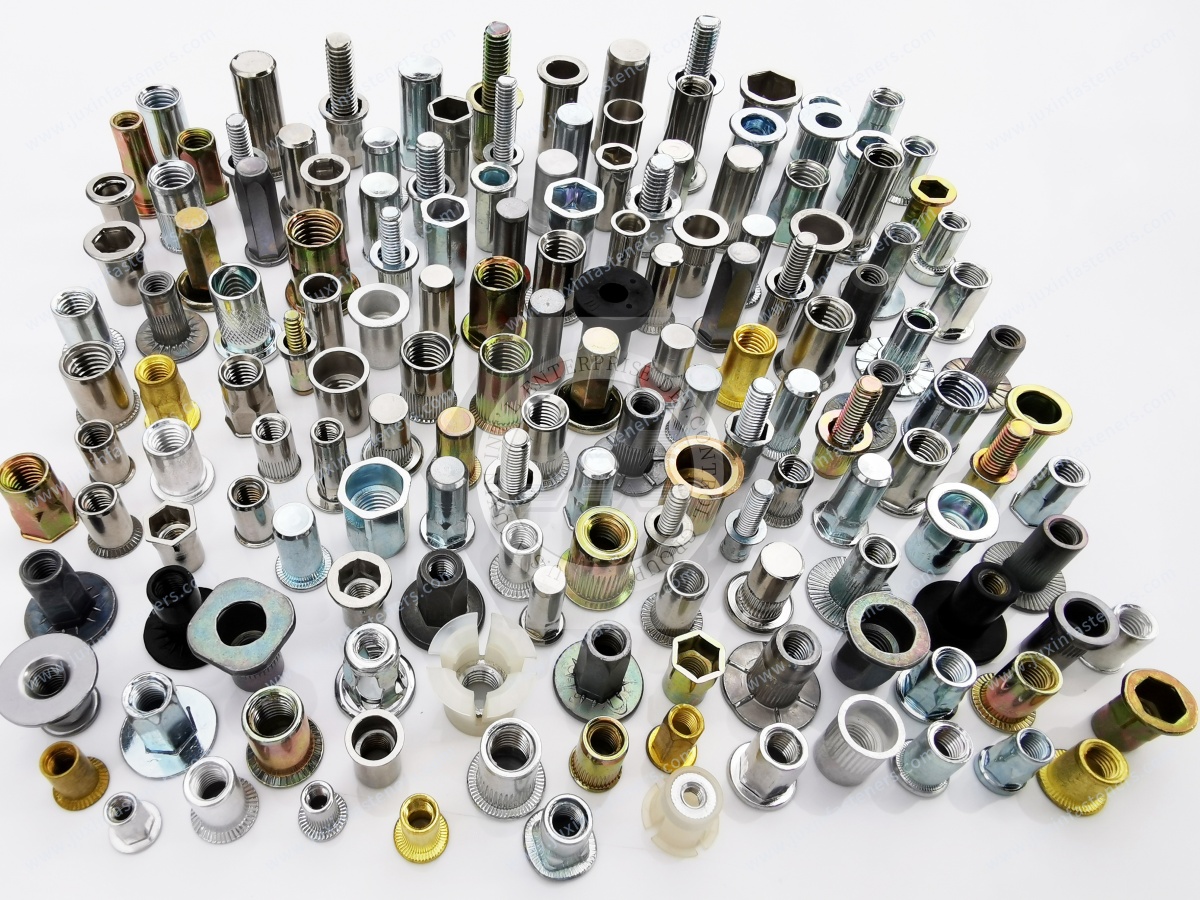
JUXIN FASTENERS supports OEM customers requiring:
open-end rivet nuts;
closed-end rivet nuts;
flat head rivet nuts;
countersunk rivet nuts;
reduced-head rivet nuts;
hex rivet nuts;
closed-end hex rivet nuts;
steel rivet nuts;
stainless steel rivet nuts;
aluminum rivet nuts;
custom blind threaded inserts.
Project support can include:
drawing review;
fastener selection;
dimensional customization;
material selection;
surface-treatment options;
prototype development;
production supply;
dimensional inspection;
customer-specific documentation;
packaging requirements.
This page should occupy the Open-End vs Closed-End Decision position inside the JUXIN FASTENERS Blind Rivet Nut Cluster.
Link internally to:
Blind Rivet Nut Hub — Article 14
for the complete rivet nut selection architecture.
Blind Rivet Nut Characteristics & Selection — Article 6
for grip range, body design and installed performance.
Hex Rivet Nuts — Article 7
when anti-rotation is the main engineering problem.
Small Countersunk Rivet Nuts — Article 8
when front-side clearance is the main problem.
Small Countersunk Hex Rivet Nuts — Article 9
for low profile plus positive geometric anti-rotation.
Closed-End Rivet Nuts — Article 10
for deeper closed-end product and application engineering.
Rivet Nut vs Self-Clinching Nut — Article 11
when the fastening technology itself has not yet been selected.
Flat Head Hex Rivet Nuts — Article 12
for larger front bearing area plus anti-rotation.
Small vs Large Countersunk Rivet Nuts — Article 13
for head geometry and installed projection selection.
The search path becomes:
Need Blind Thread
→ Open or Closed End?
→ Environmental / Screw-Protrusion Requirement
→ Head Style
→ Body Style
→ Grip Range
→ Material / Finish
→ Installed Validation
→ Product / Drawing Review
→ RFQ
If your engineering or procurement team is comparing an open-end rivet nut, closed-end rivet nut, sealed rivnut or custom blind threaded insert,
send JUXIN FASTENERS your drawing or assembly requirements.
For faster technical review, provide:
Thread + Open/Closed End + Head Style + Body Style + Grip Range + Panel Material + Finished Thickness + Hole + Screw Length
+ Blind-Side Clearance + Material + Finish + Sealing Requirement + Annual Quantity
If you need a closed-end rivet nut because of moisture, dust, contamination or enclosure requirements,
include the actual environmental requirement rather than simply specifying “waterproof.”
This allows the fastener and complete joint requirement to be evaluated correctly.
JUXIN FASTENERS
Website: www.juxinfasteners.com
Email: info@juxinfasteners.com
Contact Us
Tel.:
+86 020 8621 0320
+86 020 3121 6067
E-mail:
Technical Support:
Navigation
SEND INQUIREY