Call Us
+86 136 6007 9809
Call Us
+86 136 6007 9809

Nov. 13, 2023
Thin sheet metal creates a fundamental fastening problem: the material may not provide enough thickness for a durable tapped thread,
while the backside of the assembly may be inaccessible after forming or enclosure assembly.
A blind rivet nut, commonly called a rivet nut, rivnut, rivet insert or blind threaded insert, solves this problem by installing a reusable internal thread from one accessible side of the workpiece.
However, selecting a rivet nut involves much more than choosing an M4, M6 or M8 thread.
For an OEM assembly, the correct selection depends on:
Thread + Head Style + Body Geometry + Grip Range + Parent Material + Hole + Setting Process + Joint Load + Corrosion Environment + Service Requirements
JUXIN FASTENERS supplies blind rivet nuts, hex rivet nuts, countersunk rivet nuts, flat head rivet nuts, closed-end rivet nuts, steel rivet nuts,
stainless steel rivet nuts, aluminum rivet nuts and custom threaded inserts for industrial OEM applications.
Our fastening solutions support automotive and EV systems, rail transportation, industrial machinery, electrical equipment, telecommunications,
data center hardware, HVAC equipment, fabricated sheet-metal assemblies and other engineered products.
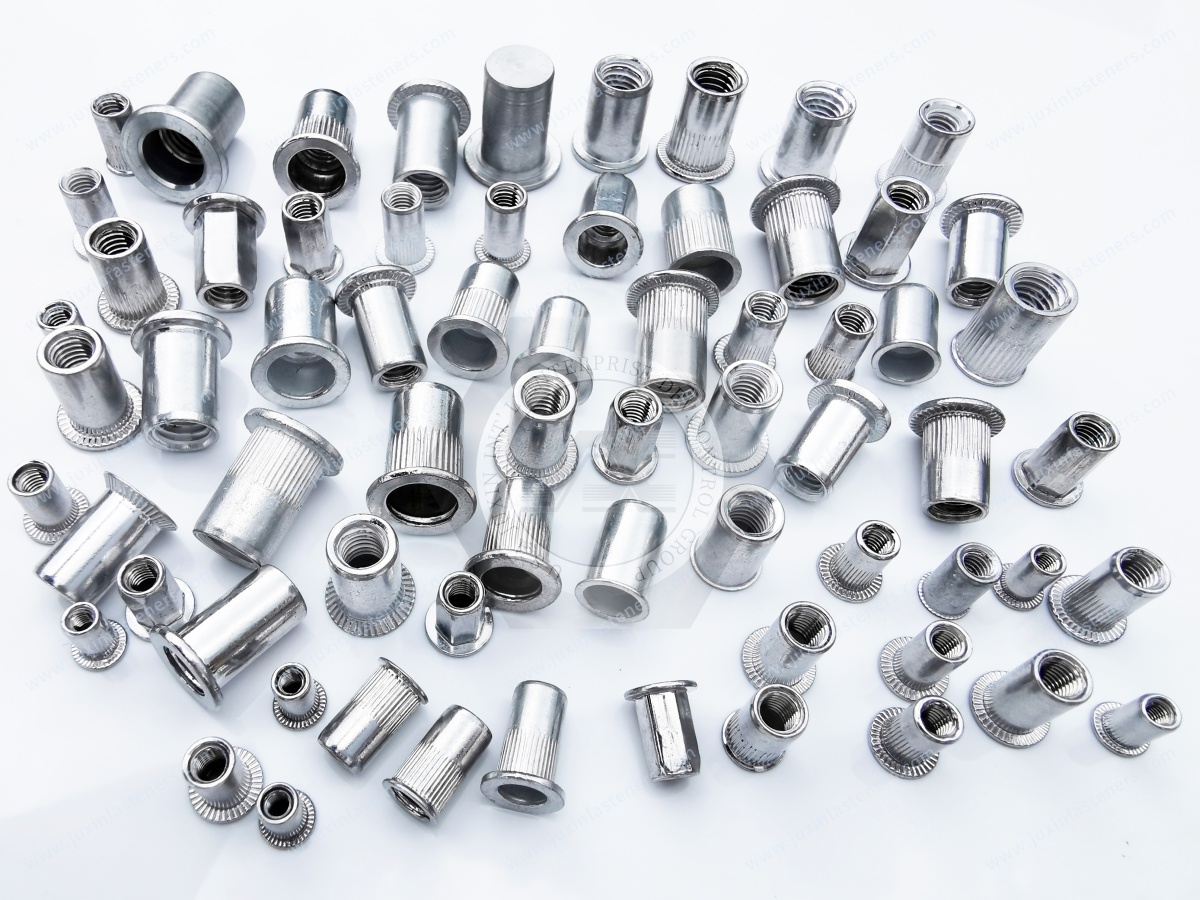
A blind rivet nut is an internally threaded mechanical insert designed to create a captive reusable thread in a workpiece.
Its defining advantage is blind-side installation.
Unlike a conventional nut that normally requires access to both sides of an assembly, a blind rivet nut can be installed when only the front side is accessible.
This makes it particularly useful for:
sheet-metal panels;
tubes;
extrusions;
closed sections;
equipment housings;
fabricated enclosures;
vehicle structures;
assemblies where backside access disappears during production.
After installation, a bolt or screw can be repeatedly assembled into the internal thread.
A typical installation sequence is:
Prepare the specified installation hole.
Insert the rivet nut from the accessible side.
Engage the installation-tool mandrel with the internal thread.
Apply the controlled setting stroke or force.
Deform the designed section of the rivet nut behind the workpiece.
Release the tool.
Install the mating screw or bolt.
The installed joint can be understood as four functional zones:
Head / Flange
Provides the front-side seating interface.
Body
Interfaces with the installation hole and contributes to rotational retention.
Deformation Zone
Forms behind the parent material during setting.
Internal Thread
Provides the reusable attachment point for the mating fastener.
This is why rivet nut performance should be evaluated as an installed fastening system, not simply as a loose metal insert.
Direct tapping requires enough material thickness to produce sufficient thread engagement.
When sheet material is too thin, direct tapping may result in:
limited thread engagement;
stripping;
poor service life;
inconsistent tightening performance.
A rivet nut adds a manufactured internal thread without requiring the sheet itself to provide the complete thread depth.
It can therefore be useful where engineers need:
Thin Material + Reusable Thread + Blind Installation
There is no single “best rivet nut.”
Different designs solve different assembly problems.
A practical selection architecture is:
Need Blind Thread
↓
Select Head Geometry
↓
Select Body Geometry
↓
Match Grip Range
↓
Select Material / Finish
↓
Validate Hole and Setting
↓
Validate Joint Performance
A flat head rivet nut has a comparatively larger front flange that provides a substantial seating surface against the parent material.
It is commonly considered where:
front-side projection is acceptable;
a larger bearing interface is desirable;
general-purpose blind threading is required.
Potential applications include:
industrial machinery;
electrical cabinets;
equipment frames;
automotive components;
fabricated sheet-metal assemblies.
The larger flange can distribute front-side contact over a broader area, but final installed performance still depends on the complete fastener, panel and setting condition.
A countersunk rivet nut or reduced-head rivet nut is selected when minimizing front-side projection is important.
Typical reasons include:
limited component clearance;
close-fitting covers;
trim assemblies;
equipment housings;
compact machinery;
aesthetic requirements.
However, “countersunk” should not automatically be interpreted as “perfectly flush.”
Installed projection depends on:
head geometry;
panel preparation;
parent material;
hole geometry;
installation condition;
dimensional tolerance.
Where surface projection is functionally critical, it should be specified dimensionally on the drawing.
A hex rivet nut uses a hexagonal body installed into a corresponding non-round hole.
Its major engineering advantage is positive geometric resistance to rotation.
This can be valuable where the assembly experiences significant torque during:
screw tightening;
screw removal;
repeated maintenance;
field servicing.
Available configurations can include:
flat head hex rivet nuts;
small countersunk hex rivet nuts;
full hex rivet nuts;
half hex rivet nuts;
closed-end hex designs.
The trade-off is that the parent component requires a suitable hexagonal or non-round installation hole.
Round-body rivet nuts can simplify hole production because they generally use round installation holes.
Depending on the design, external knurling or other body features can improve engagement with the parent material after installation.
They can be attractive where:
round holes are easier to manufacture;
production simplicity is important;
torque requirements can be achieved with the selected body and substrate.
For high rotational loads, engineers should compare installed torque-out performance rather than assuming that every knurled design is equivalent to a hex body.
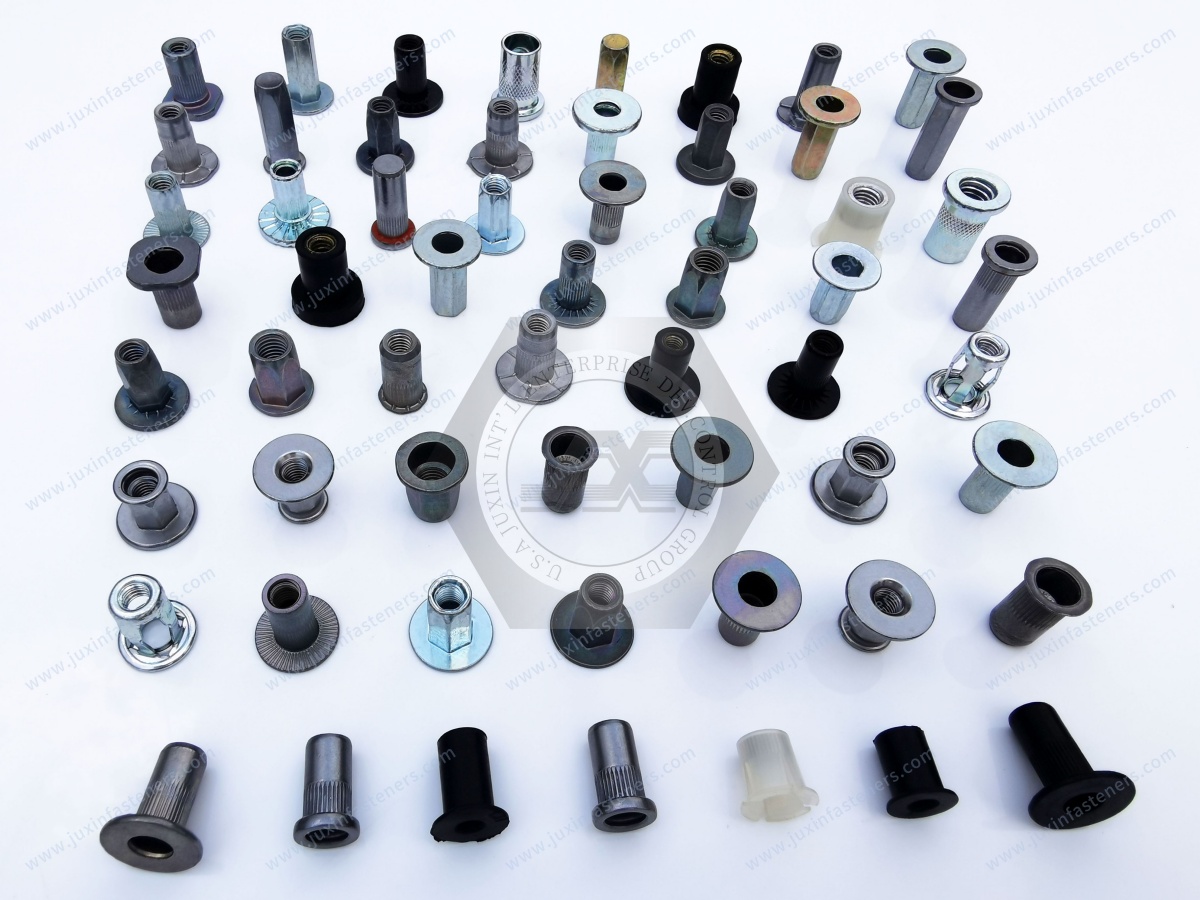
A closed-end rivet nut has a closed threaded end rather than an open body.
This can help isolate the internal thread from the blind side and may be useful where designers need additional protection against:
contamination;
dirt;
moisture pathways;
process debris;
environmental exposure.
Potential applications include:
outdoor equipment;
electrical enclosures;
automotive assemblies;
industrial machinery;
selected battery enclosures;
transportation equipment.
However:
Closed End ≠ Automatically Waterproof
Complete sealing depends on the entire interface, including:
flange;
panel surface;
installation hole;
sealing feature;
coating;
assembly geometry;
service pressure;
environmental conditions.
Where an IP or leak-performance requirement exists, the complete installed joint should be validated.
A large flange rivet nut increases the front-side bearing area.
This may be useful for:
relatively soft parent materials;
thin panels;
applications where a broader front seating surface is beneficial.
But flange diameter alone does not define pull-out performance.
Installed axial retention depends on:
Flange + Body + Deformed Bulb + Grip Range + Parent Material + Hole + Setting
Therefore, a large flange should be selected for the actual joint architecture rather than simply assumed to be “stronger.”
This distinction is frequently missed during sourcing.
The head style determines the front-side interface.
The body style affects hole engagement and rotational behavior.
This allows combinations such as:
Flat Head + Round Body
Flat Head + Hex Body
Small Countersunk Head + Round Body
Small Countersunk Head + Hex Body
Closed End + Round Body
Closed End + Hex Body
Engineers should specify both characteristics.
The grip range defines the workpiece-thickness range for which the rivet nut is designed.
This parameter directly affects how the deformation zone forms behind the panel.
A rivet nut selected outside its intended grip range can produce:
incomplete deformation;
excessive deformation;
weak clamping;
panel distortion;
poor seating;
inconsistent torque resistance;
reduced axial retention.
Therefore:
Thread Size Alone Does Not Define a Rivet Nut
Two M6 rivet nuts may have different:
body lengths;
grip ranges;
hole requirements;
flange dimensions;
setting requirements.
For production selection, consider the real stack at the installation location.
Depending on the assembly, this may include:
base sheet;
coatings;
stacked panels;
local reinforcement;
formed regions;
additional layers.
Grip-range selection should reflect the final installation condition.
The hole is not simply a clearance opening.
Its geometry influences:
insertion;
seating;
alignment;
rotational retention;
deformation behavior;
installation consistency.
An oversized hole may reduce engagement.
An undersized hole can:
prevent insertion;
damage coatings;
distort the fastener;
interfere with correct seating.
Hex rivet nuts require particular attention because the non-round hole itself is part of the anti-rotation mechanism.
Engineering and procurement teams should evaluate how the installation hole will be produced.
Possible processes include:
punching;
laser cutting;
machining;
drilling;
formed-hole operations.
A fastener with excellent installed performance may require a more expensive hole-manufacturing process.
Therefore procurement should evaluate:
Fastener Cost + Hole Preparation + Installation + Inspection + Rework
rather than comparing rivet nut unit price alone.
Material affects:
mechanical performance;
corrosion behavior;
setting force;
weight;
compatibility with the parent structure;
total cost.
Steel rivet nuts provide a practical combination of mechanical performance and cost for many industrial applications.
Possible finishes include:
zinc plating;
zinc-nickel plating;
zinc-flake coating systems;
phosphate or other customer-specified finishes.
Applications can include:
automotive assemblies;
machinery;
fabricated equipment;
electrical enclosures;
general industrial products.
Coating selection should reflect the required corrosion environment.
304-type and 316-type stainless steel rivet nuts can be considered where increased corrosion resistance is required.
Applications may include:
food-processing equipment;
outdoor equipment;
marine-related equipment;
medical and laboratory equipment;
chemical-processing machinery;
transportation equipment.
Because stainless steel can require greater installation force than some lower-strength materials, tool capability and production settings should be reviewed.
Aluminum rivet nuts provide a lightweight fastening option for suitable assemblies.
Potential applications include:
electronics;
transportation equipment;
aluminum structures;
weight-sensitive equipment.
Where aluminum rivet nuts are installed into a different metal, engineers should evaluate galvanic compatibility under the actual service environment.
Depending on the product design and customer requirement, rivet nuts can be produced with metric or inch threads.
Common metric requirements may include:
M3;
M4;
M5;
M6;
M8;
M10;
M12.
In North American OEM programs, UNC or UNF threads may also be required.
The complete specification should define:
Thread Diameter + Pitch/TPI + Thread Tolerance
rather than only the nominal diameter.
Rivet nut performance is sometimes discussed simply as “strength.”
For engineering evaluation, this should be separated into actual failure modes.
Describes resistance to rotation of the installed rivet nut in the parent material.
It is influenced by:
body geometry;
hole geometry;
parent material;
setting;
grip range.
Describes resistance to movement or failure under axial loading.
It can depend on:
head geometry;
backside deformation;
sheet material;
sheet thickness;
hole condition;
installation quality.
A rivet nut with excellent anti-rotation behavior is not automatically the best design for every axial load condition.
Rivet nut installation relies on controlled deformation.
Depending on the installation equipment, production may be controlled by:
stroke;
force;
pressure;
tool program;
combined process monitoring.
incomplete deformation;
loose installation;
poor anti-rotation;
inconsistent seating.
panel deformation;
rivet nut damage;
thread distortion;
excessive stress in the installation.
Production parameters should therefore be validated with the actual rivet nut and parent component.
Both technologies can provide captive internal threads, but they solve different manufacturing problems.
| Engineering Factor | Blind Rivet Nut | Weld Nut |
|---|---|---|
| Installation process | Mechanical deformation | Welding |
| Heat input | No welding heat | Heat introduced |
| One-side installation | Major advantage | Process dependent |
| Finished/coated panel installation | Possible depending on system | Welding can affect finish |
| Hole requirement | Yes | Product/process dependent |
| Automation | Possible | Highly automatable |
| High structural loads | Application dependent | Application dependent |
| Repair/service strategy | Depends on design | Depends on welded joint |
The decision should be based on the production architecture and required joint performance.
A self-clinching nut is pressed into suitable sheet material so the surrounding material flows into the fastener's retention features.
A blind rivet nut is set by deforming the fastener behind the parent material.
The main decision path is:
Need Blind Installation After the Structure Is Formed?
→ Rivet nut becomes a strong candidate.
Have Press Access and Suitable Sheet During Panel Production?
→ Self-clinching hardware may be worth evaluating.
Neither technology is universally superior.
Automotive assemblies increasingly combine:
thin high-strength sheet;
aluminum;
formed sections;
enclosed structures;
serviceable electrical systems;
lightweight components.
Potential rivet nut applications include:
interior panels;
brackets;
equipment mounts;
body structures;
electrical assemblies;
battery-system brackets;
selected battery-enclosure components.
For EV battery applications, the complete system may also require evaluation of:
vibration;
corrosion;
sealing;
electrical isolation;
thermal environment;
service access;
OEM-specific validation requirements.
Blind rivet nuts can be used in suitable rail-vehicle assemblies including:
interior panels;
lighting systems;
equipment cabinets;
toilet modules;
access panels;
partition assemblies;
equipment mounting.
They can be particularly useful where backside access becomes unavailable after the railcar interior is assembled.
Rail projects may impose project-specific requirements related to:
vibration;
corrosion;
fire and material compliance;
traceability;
inspection;
documentation.
Fastener selection should therefore be coordinated with the actual vehicle specification.
Rivet nuts provide reusable threads in:
electrical cabinets;
switchgear housings;
control boxes;
communication cabinets;
power equipment;
industrial electronics.
Engineering priorities can include:
low-profile heads;
repeated maintenance;
corrosion protection;
anti-rotation;
clean installation.
Sheet-metal hardware used in data centers and telecommunications systems frequently requires reusable attachment points.
Applications may include:
server chassis;
equipment racks;
network cabinets;
telecommunications enclosures;
control panels;
equipment trays.
Depending on the assembly, engineers may compare rivet nuts with:
cage nuts;
self-clinching nuts;
threaded inserts;
direct tapped features.
The correct choice depends on access, service requirements, sheet thickness and production method.
Potential applications include:
machine guards;
access covers;
equipment housings;
automation frames;
control cabinets;
fabricated machine structures.
Rivet nuts can be especially useful where panels need to be removed repeatedly for inspection or maintenance.
For repeated service cycles, torque-out resistance should be evaluated carefully.
Blind rivet nuts may be used in:
equipment housings;
ventilation systems;
access panels;
compressor enclosures;
electrical compartments;
fabricated sheet-metal structures.
They allow reusable threads without introducing welding heat into the panel.
Rivet nuts and threaded inserts can be used in aerospace-related assemblies, but aerospace applications typically require tightly controlled materials,
specifications, qualification, documentation and approved supply chains.
JUXIN FASTENERS should therefore not present a general industrial rivet nut as automatically suitable for a flight-critical aerospace application.
For aerospace-related inquiries, the required drawing, material specification, performance requirements and qualification documentation should be reviewed before supply.
Blind rivet nuts may be usable in certain plastic or composite components, but these substrates behave differently from metal sheet.
Engineers should consider:
local compression;
cracking;
creep;
temperature;
installation deformation;
cyclic loading.
For thermoplastics, alternative solutions such as:
heat-set inserts;
ultrasonic inserts;
molded-in inserts;
expansion inserts
may provide a better engineered thread depending on the application.
A practical selection sequence is:
1. Is backside access unavailable?
If yes, evaluate a blind fastening solution.
2. What reusable thread is required?
Define metric or inch thread and tolerance.
3. What is the finished material thickness?
Select the appropriate grip range.
4. What front-side profile is allowed?
Choose flat, large flange, countersunk or reduced head.
5. What anti-rotation performance is required?
Choose suitable round, knurled or hex body geometry.
6. What is the parent material?
Evaluate steel, aluminum, polymer, composite or other substrate behavior.
7. What service loads matter?
Define rotational and axial requirements separately.
8. What environment will the assembly see?
Select material and surface protection accordingly.
9. What installation equipment is available?
Confirm tool capacity and setting control.
10. What validation is required?
Define installed performance tests.
Potential causes include:
oversized hole;
unsuitable body geometry;
incorrect grip range;
insufficient setting;
soft parent material;
excessive tightening torque.
Corrective action should address the actual failure mechanism rather than simply changing fastener size.
Potential factors include:
incorrect grip range;
unsuitable panel material;
poor backside deformation;
incorrect setting;
inadequate joint design.
Installed testing should be performed where axial retention is critical.
Potential causes include:
excessive setting;
very thin substrate;
incorrect rivet nut selection;
inadequate support.
The solution may require adjustment of the fastener, setting parameters or panel design.
Potential causes include:
installation-tool misalignment;
incorrect mandrel;
over-setting;
damaged mating screw;
excessive assembly torque.
Thread condition should be included in production inspection where functionally important.
For engineering teams, one of the most useful ways to evaluate rivet nuts is to stop treating the fastener as an isolated component.
Installed performance can be represented as:
Rivet Nut
×
Parent Material
×
Hole Geometry
×
Grip Range
×
Setting Parameters
×
Mating Screw
×
Assembly Torque
×
Service Environment
A specification that controls only the rivet nut but ignores the remaining variables can still produce inconsistent assemblies.
For critical OEM applications, validate the fastener using:
Production Rivet Nut
Actual Parent Material
Production Hole
Actual Surface Finish
Production Installation Tool
Specified Mating Screw
Testing may include:
installation consistency;
dimensional inspection;
head seating;
torque-out;
axial retention;
thread condition;
panel deformation;
vibration;
corrosion;
environmental testing;
repeated assembly cycles.
Test requirements should reflect the real application rather than generic catalogue assumptions.
Depending on the application, an engineering drawing or specification should define:
thread diameter;
pitch or TPI;
thread tolerance;
head style;
flange diameter;
head height;
body geometry;
body dimensions;
overall length;
grip range;
installation-hole requirement;
parent material;
panel thickness;
fastener material;
surface treatment;
dimensional tolerances;
installed projection where critical;
performance requirements;
inspection criteria.
Applicable ISO, DIN, EN, ASTM, SAE, BS or ASME/ANSI requirements can be referenced where relevant to the project.
For procurement and supplier-development teams, comparing two rivet nut quotations by thread size and unit price is not sufficient.
Compare:
drawing conformity;
material;
head geometry;
body geometry;
grip range;
installation-hole requirement;
coating;
corrosion requirement;
dimensional capability;
installed performance;
inspection method;
lot traceability;
documentation;
packaging;
production capacity;
prototype support;
change control.
A lower-cost fastener that requires rework or creates inconsistent installation can increase total assembly cost.
For sourcing analysis, evaluate:
Fastener Cost
Hole Production
Installation Tooling
Installation Cycle
Inspection
Rework Risk
Maintenance
Lifecycle Requirements
This is particularly important when comparing rivet nuts with weld nuts, self-clinching fasteners or other threaded inserts.
For faster technical review and quotation, send JUXIN FASTENERS:
part drawing or 3D model;
application description;
thread size;
metric pitch or inch TPI;
head style;
body style;
grip range;
parent material;
finished material thickness;
hole geometry;
rivet nut material;
surface treatment;
corrosion requirement;
mating screw;
assembly torque if defined;
required torque-out performance if defined;
required axial retention if defined;
installation equipment;
prototype quantity;
annual quantity;
inspection requirements;
documentation requirements;
packaging requirements.
If the rivet nut has not yet been selected, provide the assembly drawing and application conditions instead.
JUXIN FASTENERS supports industrial OEM customers requiring:
blind rivet nuts;
flat head rivet nuts;
countersunk rivet nuts;
small countersunk rivet nuts;
large flange rivet nuts;
hex rivet nuts;
half hex rivet nuts;
full hex rivet nuts;
closed-end rivet nuts;
steel rivet nuts;
stainless steel rivet nuts;
aluminum rivet nuts;
custom threaded inserts.
Engineering and production support can include:
drawing review;
product selection;
dimensional customization;
material selection;
surface-treatment options;
prototype development;
mass production;
dimensional inspection;
customer-specific documentation;
packaging requirements.
This page should serve as the Blind Rivet Nut Pillar / Hub Page within the JUXIN FASTENERS content architecture.
From this page, link to the more specialized engineering pages:
Blind Rivet Nut Characteristics & Selection — Article 6
for deeper discussion of rivet nut operating characteristics and engineering selection.
Hex Rivet Nuts — Article 7
for high anti-rotation applications.
Small Countersunk Rivet Nuts — Article 8
for low-profile blind threaded connections.
Small Countersunk Hex Rivet Nuts — Article 9
for low profile combined with geometric anti-rotation.
Closed-End Rivet Nuts — Article 10
for applications requiring a closed threaded end and additional environmental protection.
Rivet Nut vs Self-Clinching Nut — Article 11
for captive-thread technology selection.
Flat Head Hex Rivet Nuts — Article 12
for large bearing area combined with hex-body anti-rotation.
Small vs Large Countersunk Rivet Nuts — Article 13
for head geometry, projection and bearing-area selection.
Also link to relevant product and industry pages covering:
Blind Rivet Nuts
Threaded Inserts
Self-Clinching Fasteners
Cage Nuts
Automotive Fasteners
EV Battery Fasteners
Rail Transportation Fasteners
Electrical Equipment Fasteners
Data Center Hardware
Industrial Machinery Fasteners
The search and conversion architecture becomes:
What Is a Rivet Nut?
→ Is It Suitable for My Assembly?
→ Which Head Style?
→ Which Body Style?
→ Which Grip Range?
→ Which Material / Finish?
→ Industry-Specific Requirements
→ Specialized Technical Article
→ Product / Drawing Review
→ RFQ
If your engineering or procurement team is sourcing a blind rivet nut, rivnut, threaded insert, hex rivet nut, countersunk rivet nut,
closed-end rivet nut or custom sheet-metal fastening solution, send us your drawing or assembly requirements.
For the fastest technical review, provide:
Thread + Head Style + Body Style + Grip Range + Parent Material + Finished Thickness + Hole + Material + Finish + Performance Requirement + Annual Quantity
If you have not yet selected the rivet nut type, send the assembly drawing and application conditions. Our team can review the fastening requirements and discuss suitable manufacturing options.
JUXIN FASTENERS
Website: www.juxinfasteners.com
Email: info@juxinfasteners.com
Contact Us
Tel.:
+86 020 8621 0320
+86 020 3121 6067
E-mail:
Technical Support:
Navigation
SEND INQUIREY