
Call Us
+86 136 6007 9809
Call Us
+86 136 6007 9809

Sep. 12, 2023
A familiar bolted-joint arrangement is:
Bolt + Flat Washer + Spring Washer + Nut
This combination has been used for decades in machinery, electrical equipment, industrial assemblies, maintenance work and many legacy mechanical designs.
But does every bolted joint actually need both a flat washer and a spring washer?
No.
A flat washer and a split spring washer perform different functions, and using both does not automatically create a more reliable joint.
The correct engineering decision depends on the actual problem:
Does the joint need a larger bearing area?
Does the parent material need protection from localized bearing pressure?
Is the hole oversized or slotted?
Is rotational self-loosening a concern?
Is preload loss caused by settlement or material relaxation?
Is the equipment exposed to transverse vibration?
Does the drawing or applicable standard require a specific washer?
Would another locking method be more appropriate?
For engineers and procurement teams, the better selection path is:
Joint Requirement → Bearing Interface → Preload Requirement → Loosening Mechanism → Washer Function → Locking Strategy → Material & Finish → Validation → RFQ
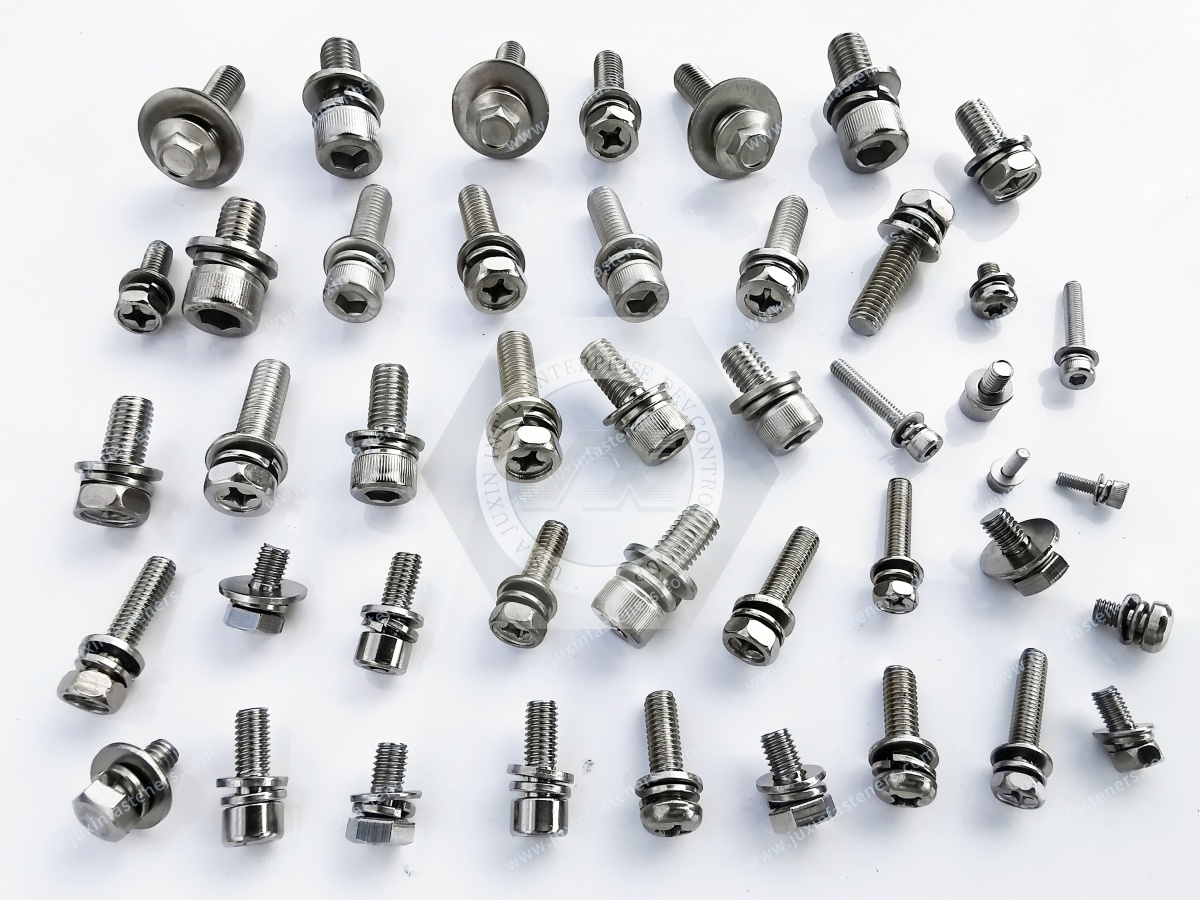
JUXIN FASTENERS supports OEM sourcing of flat washers, spring washers, disc spring washers, locking fasteners, bolts,
nuts and custom fastening components for automotive equipment, industrial machinery, electrical equipment,
AI data centers, power systems, HVAC, telecommunications, automation, heavy equipment and other engineered assemblies.
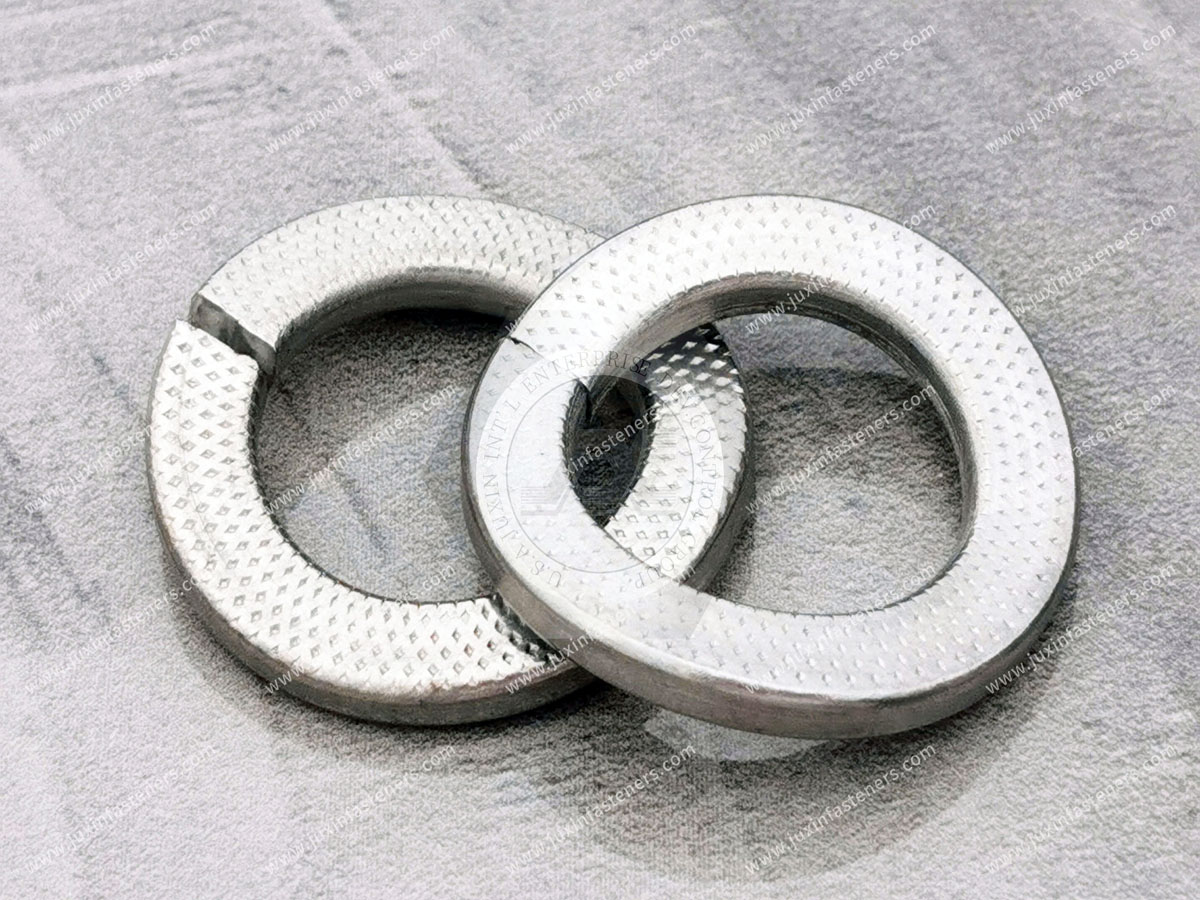
A flat washer and a split spring washer should not be treated as interchangeable components.
Their primary engineering purposes are different.
A flat washer primarily modifies the bearing interface beneath a bolt head or nut.
Depending on the joint, it can:
increase bearing area;
reduce localized indentation;
protect selected surfaces;
provide a controlled bearing interface;
support appropriate clearance holes or slots.
A conventional split spring washer, also called a helical spring-lock washer, is traditionally used as a locking element.
Its geometry creates elastic deformation during tightening and can influence friction and rotational resistance.
However, its presence does not guarantee that a bolted joint will remain locked under vibration.
This distinction is fundamental:
Flat Washer → Primarily Bearing Function
Split Spring Washer → Traditional Locking Function
Neither component should be assigned capabilities that it does not actually provide.
Sometimes.
But not automatically.
The answer depends on whether the joint has two separate engineering requirements.
For example:
Requirement 1: The parent material needs a controlled bearing surface.
A flat washer may be appropriate.
Requirement 2: The drawing or joint design specifies a split spring-lock washer.
A spring washer may also be required.
In that case, both can appear in the assembly.
But this does not mean:
Every Bolt Should Use Flat Washer + Spring Washer
That traditional combination should not be treated as a universal fastening rule.
The flat-washer-plus-spring-washer combination became common because it appears to solve two different concerns with inexpensive standard components.
The flat washer provides a broader bearing surface.
The spring washer is intended to provide a locking function.
This created a familiar assembly:
Nut → Spring Washer → Flat Washer → Joint Surface
However, modern joint engineering requires more than following a traditional hardware sequence.
The actual failure mechanism must first be understood.
Where a conventional design specifically requires both washers beneath a nut, a common arrangement is:
Nut → Spring Washer → Flat Washer → Joint Surface
The flat washer sits against the joint surface and provides the bearing interface.
The spring washer sits between the rotating nut and the flat washer.
Viewed from the opposite direction:
Joint Surface → Flat Washer → Spring Washer → Nut
This is the commonly recognized arrangement for this traditional configuration.
However:
Common Installation Order ≠ Universal Design Requirement
The engineering drawing, equipment specification or applicable standard should control the final assembly.
The flat washer is normally used where its larger bearing surface can interact directly with the clamped component.
This can help reduce localized bearing pressure beneath the fastener assembly.
The benefit can be particularly relevant when the joint surface involves:
relatively soft material;
thin material;
an appropriate oversized hole;
an appropriate slot;
a surface requiring a controlled bearing interface.
For detailed selection of ID, OD, thickness and bearing area, see the Industrial Washers: Types, Functions & Selection Guide.
In the traditional combination, the split spring washer is placed near the rotating fastener component so its geometry interacts with the adjacent surfaces as the nut is tightened.
But the fact that this arrangement is traditional does not establish that it provides sufficient anti-loosening performance for every joint.
That requires a separate vibration and locking assessment.
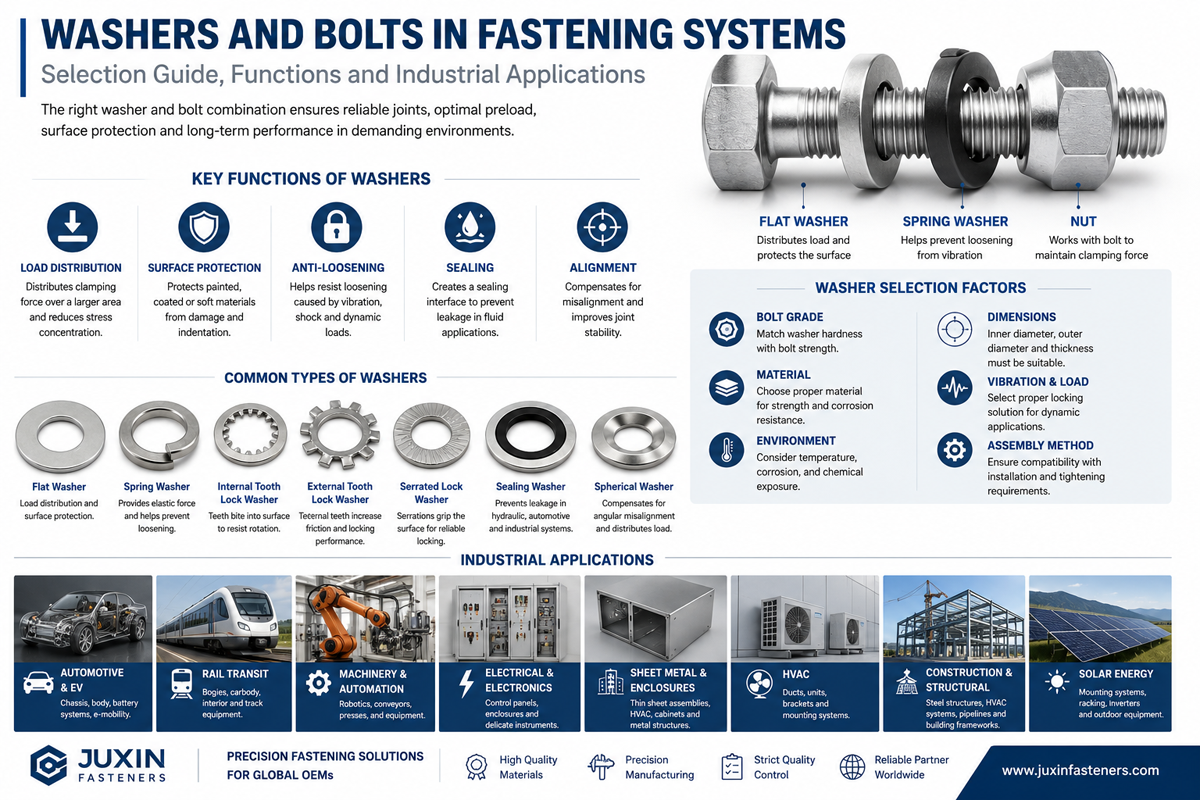
A flat washer changes how load is transferred from the bolt head or nut into the clamped material.
Potential functions include:
The washer can increase the effective bearing footprint beneath the fastener.
This can be useful where the parent material is susceptible to local deformation.
A defined washer can create a more controlled interface than an irregular or unsuitable parent surface.
Larger or specifically engineered washers may be required for selected oversized or slotted holes.
However:
Flat Washer ≠ Anti-Loosening Device
A conventional plain washer should not be selected as the primary method of preventing rotational self-loosening.
A split spring washer is a helical washer with a discontinuity in the ring.
As the fastener is tightened, the washer compresses toward a flatter condition.
Its geometry can produce elastic reaction and influence the interface beneath the rotating fastener.
Historically, this is why it has been called a:
Spring Lock Washer
or:
Helical Spring-Lock Washer
But the word lock should not be interpreted as a guarantee that the fastener cannot loosen.
This is an important distinction for engineers and purchasing teams.
Industry standards continue to use terms such as:
Helical Spring-Lock Washer
because they are established product names.
The product name itself does not establish indefinite locking performance in every bolted joint.
Therefore:
Product Name ≠ Joint Performance Guarantee
Actual performance depends on the complete connection.
This is one of the most important engineering corrections to the old way spring washers are often described.
When a bolt is properly tightened, the bolt itself develops preload.
The clamped components react to that load.
A split spring washer can also produce an elastic reaction during compression.
But:
Spring Washer Force ≠ Bolt Preload
The spring washer should not be described as the primary source of clamping force in a properly designed preloaded bolted joint.
A conventional split spring washer can become substantially compressed during tightening.
Once compressed, its remaining spring travel can be small relative to the elastic behavior of the complete bolted joint.
Therefore, it should not automatically be treated as a large preload-compensation spring.
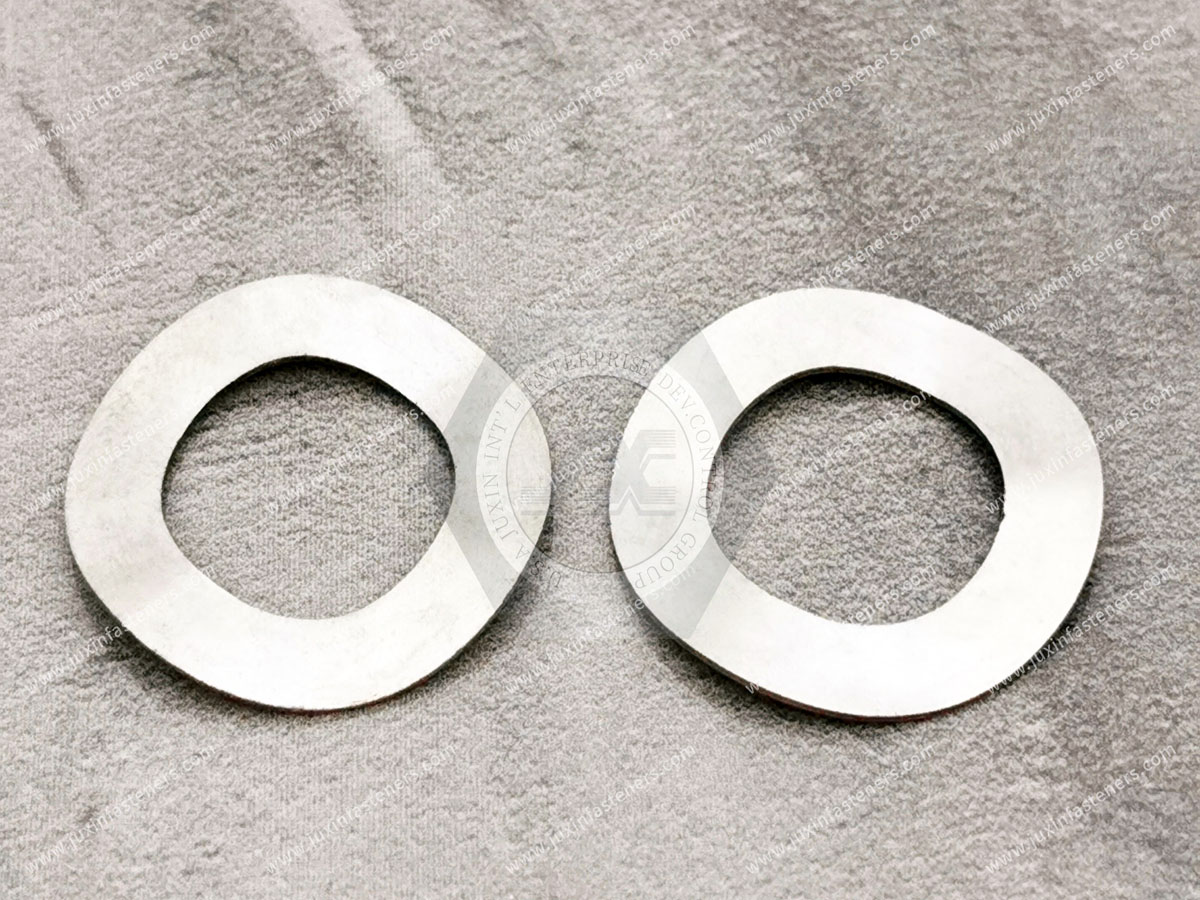
This is very different from a properly selected disc spring system designed around controlled load-deflection behavior.
These products should not be confused.
Traditionally used as a locking washer.
A conical elastic element that can be engineered around a defined load-deflection relationship.
A disc spring can also be stacked in series or parallel where the application and design require it.
Therefore:
Split Spring Washer ≠ Belleville Disc Spring
If significant elastic compensation is required, the engineer should evaluate the actual spring system rather than assuming a split lock washer provides the same function.
The original version of this article suggested that spring washers compensate for material creep.
That is too broad.
Joint relaxation can result from:
embedment;
gasket compression;
polymer creep;
coating deformation;
thermal cycling;
material relaxation.
A conventional split spring washer should not automatically be assumed to compensate sufficiently for these effects.
The required joint elasticity must be evaluated quantitatively where preload retention matters.
Temperature changes can alter preload when the fastener and clamped materials have different:
coefficients of thermal expansion;
temperatures;
stiffnesses;
dimensions.
Adding a split spring washer does not automatically solve thermal preload variation.
Thermal joint behavior must be evaluated as a system.
Another common misconception is:
Spring Washer = Vibration Absorber
That is not generally correct.
Vibration damping means dissipating mechanical energy.
Elasticity alone does not equal damping.
Therefore:
Spring Washer ≠ Vibration Damper
If the equipment requires vibration isolation or damping, that function normally belongs to another engineered component or system.
Bolted-joint loosening is more complex than simply saying:
“Vibration makes the nut turn.”
A critical mechanism in many joints is transverse movement at the interface.
If relative movement becomes sufficient to overcome frictional restraint, rotational self-loosening can develop.
Important variables include:
preload;
joint stiffness;
transverse displacement;
friction;
fastener geometry;
bearing interface;
external loading.
This is why adding a spring washer does not automatically solve every vibration problem.
A properly designed bolted joint generally relies on sufficient clamp load to keep the joint interfaces appropriately engaged.
If preload is inadequate, relative movement can become more likely.
Therefore, before selecting a locking washer, engineers should ask:
Why is the joint moving?
Possible causes include:
insufficient preload;
tightening variation;
embedment;
soft parent material;
coating relaxation;
gasket compression;
external transverse load;
thermal effects.
A locking component should not be used to hide an unresolved joint-design problem.
These two failure modes are frequently confused.
Clamp force decreases.
Possible mechanisms include:
embedment;
creep;
relaxation;
gasket compression;
thermal effects.
The screw or nut physically rotates relative to the mating thread.
These are different failure mechanisms.
A joint can lose preload without visible fastener rotation.
A locking strategy that resists rotation does not necessarily solve material relaxation.
A common assumption is:
More washers = more secure joint
Not necessarily.
Every additional interface can influence:
joint geometry;
bearing friction;
embedment;
stiffness;
stack height;
tightening behavior.
Therefore:
More Components ≠ More Reliability
Every washer should have a defined engineering purpose.
Yes.
Torque-controlled tightening depends strongly on friction.
Friction exists in:
the threads;
the bearing interface beneath the rotating fastener component.
Changing the washer configuration can change the bearing interface.
Therefore, changing from:
Nut → Joint Surface
to:
Nut → Washer → Joint Surface
or:
Nut → Spring Washer → Flat Washer → Joint Surface
can change the torque-preload relationship.
For critical joints, the tightening process should be validated with the actual hardware and surface condition.
A flat washer alone may be appropriate when the primary requirement is:
load distribution;
bearing-area increase;
surface protection;
support around an appropriate clearance hole;
compatibility with a defined fastener system.
If rotational self-loosening is not a design concern, adding a spring washer solely out of habit may not provide meaningful benefit.
Split spring washers remain widely used in:
legacy equipment;
general machinery;
electrical equipment;
customer-controlled drawings;
established assemblies.
If the existing validated design specifies one, the washer should not simply be removed without engineering approval.
This distinction matters:
Existing Controlled Design ≠ New Design Recommendation
Procurement should follow the approved drawing.
Engineering can separately evaluate whether a future design revision is appropriate.
Both may be present when:
a flat washer is needed for the bearing interface;
a spring washer is separately required by the drawing or customer specification.
The combination may also remain appropriate in validated legacy assemblies.
But the engineering logic should be:
Two Defined Functions → Two Components
not:
Two Washers → Automatically Better Joint
Some properly engineered bolted joints may require neither a conventional flat washer nor a split spring washer.
For example, the fastener system may already incorporate an appropriate:
flange;
locking feature;
bearing geometry;
prevailing-torque mechanism.
The correct hardware depends on the complete design.
A flange bolt integrates a larger bearing surface into the bolt head.
Depending on the joint design, this may reduce the need for a separate flat washer.
However, flange geometry and washer geometry are not automatically interchangeable.
Review:
bearing diameter;
parent material;
surface condition;
fastener specification;
tightening method.
A nylon-insert locknut provides prevailing torque through interaction between the nylon element and the mating thread.
This is a different locking mechanism from a split spring washer.
For joints where prevailing torque is appropriate, see Nylon Insert Locknuts for Anti-Vibration Applications.
All-metal prevailing-torque locknuts create resistance through controlled metallic thread deformation or another engineered metal locking feature.
They can be considered where:
temperature excludes polymer inserts;
the application requires an all-metal locking system;
the applicable specification permits their use.
Again:
Locknut ≠ Spring Washer
The locking mechanism is different.
Wedge-locking washer systems use a fundamentally different locking principle from conventional split spring washers.
They are engineered to resist rotational self-loosening through their specific geometry and paired washer configuration.
Where severe transverse vibration is a concern, engineers should compare actual locking mechanisms rather than treating all “lock washers” as one product category.
Thread-locking compounds act within the threaded interface.
They can provide a different approach to rotational resistance.
Selection depends on factors such as:
thread size;
material;
temperature;
service requirements;
disassembly requirements;
contamination;
production process.
No single locking method is universally appropriate.
Some applications require a positive mechanical locking feature rather than friction-dependent locking.
Examples can include appropriately engineered:
lockwire systems;
cotter pins with castellated nuts;
tab locking systems;
other application-specific retention methods.
The required solution depends on the consequence of fastener loosening.
When engineers compare locking systems, the decision should consider the mechanism.
Combines a bearing washer with a traditional split spring-lock washer.
Generates rotational resistance within the nut/thread interface.
These are fundamentally different approaches.
The selection should be based on the joint requirement, not simply component cost.
A washer arrangement acceptable in a low-risk equipment cover may not be appropriate in a critical mechanical connection.
Engineers should consider:
consequence of loosening;
vibration severity;
inspection access;
maintenance interval;
preload requirement;
environmental exposure;
safety consequences.
Higher joint criticality generally requires more deliberate locking and validation.
Traditional:
Bolt + Flat Washer + Spring Washer + Nut
should not be automatically applied to structural steel connections.
Structural bolting systems can have specific requirements governing:
bolt assemblies;
nuts;
washers;
hole types;
installation;
pretension;
inspection.
The applicable structural standard and project specification must control the joint.
Generic spring washers should not be added to a structural bolting system simply because they are perceived as extra protection.
The original article specifically referenced warehouse shelving and rack systems.
This needs more careful treatment.
Storage-rack systems are engineered structures with connection designs defined by the rack manufacturer and applicable project requirements.
Do not automatically add or remove:
flat washers;
spring washers;
locking nuts;
other fasteners
from a rack connection without following the approved system design.
The fastening arrangement should match the rack manufacturer's engineering specification.
Industrial machinery may experience:
vibration;
shock;
cyclic loading;
thermal variation.
The correct solution may involve:
flat washer;
locking fastener;
prevailing-torque nut;
thread-locking compound;
engineered locking washer;
positive mechanical locking.
The word vibration alone is not enough to select a spring washer.
Automotive systems experience vibration and cyclic loads, but different joints use very different fastening strategies.
Potential applications for conventional washers can include:
auxiliary brackets;
equipment mounts;
service assemblies;
non-safety-critical hardware.
Safety-critical automotive joints require customer-specific engineering and validation.
A generic flat-plus-spring-washer combination should not be promoted as a universal automotive anti-loosening solution.
EV systems contain:
battery-related structures;
power electronics;
thermal-management equipment;
auxiliary brackets;
service hardware.
The washer system must match the actual mechanical requirement.
A flat or spring washer does not automatically provide:
enclosure sealing;
electrical bonding;
EMI shielding;
IP protection.
These require separate engineering.
AI data centers and HPC infrastructure contain large numbers of mechanical fasteners in:
server-related equipment;
racks;
power-conversion equipment;
UPS systems;
cooling equipment;
electrical enclosures.
Flat washers can provide bearing support where required.
Where vibration or loosening is a concern, the locking strategy should be separately selected rather than automatically adding a split spring washer.
Potential applications include:
electrical cabinets;
switchgear;
control panels;
power distribution equipment;
equipment housings.
If the joint also performs an electrical bonding or grounding function, electrical contact requirements must be evaluated separately.
Flat Washer + Spring Washer ≠ Automatically Reliable Grounding Connection
Telecommunications systems use fasteners in:
cabinets;
racks;
enclosures;
equipment frames;
mounting hardware.
Washer selection can depend on:
sheet thickness;
coating;
hole geometry;
maintenance requirements;
vibration environment.
The correct washer arrangement should follow the actual assembly requirement.
HVAC equipment can contain rotating machinery and vibration sources.
Potential fastener applications include:
fan assemblies;
housings;
brackets;
service panels;
control equipment.
The presence of vibration does not automatically justify a conventional split spring washer.
The actual loosening mechanism should be identified first.
Construction, mining and agricultural machinery can experience substantial:
vibration;
impact;
cyclic loading;
contamination;
outdoor corrosion.
These environments may require more robust locking strategies than a traditional split spring washer.
Joint-specific validation becomes increasingly important as service severity increases.
Flat and spring washers can be used in appropriate non-sterile mechanical assemblies such as:
diagnostic-equipment housings;
laboratory equipment;
carts;
covers;
internal brackets.
Generic industrial washers should not automatically be represented as:
medically certified;
sterile;
biocompatible;
cleanroom-qualified.
Those requirements must be separately specified.
| Joint Requirement | Engineering Direction |
|---|---|
| Need larger bearing area | Evaluate flat washer |
| Need surface protection | Evaluate appropriate flat washer/interface |
| Soft parent material | Evaluate bearing area, OD and thickness |
| Oversized or slotted hole | Use washer geometry required by applicable design |
| Drawing specifies split spring washer | Follow controlled drawing |
| General vibration concern | Diagnose loosening mechanism first |
| Severe transverse vibration | Evaluate dedicated locking strategy |
| Material creep / relaxation | Analyze preload retention; do not rely automatically on split washer |
| Need prevailing torque | Evaluate suitable locknut or locking fastener |
| Need positive mechanical retention | Evaluate appropriate positive locking method |
| Structural bolting | Follow applicable structural system |
| Need electrical grounding | Engineer electrical interface separately |
| Need sealing | Use dedicated sealing solution |
Washer selection should follow joint requirements.
Every additional component changes the joint interface.
Their load-deflection behavior and engineering purposes are different.
Bolt preload and spring-washer reaction are not the same thing.
Elasticity does not automatically mean damping.
The name does not guarantee joint performance.
Adding or changing washers can alter the bearing interface and torque-preload relationship.
Structural connections require applicable system standards.
Existing validated drawings should not be altered casually.
First identify whether the problem is preload loss or rotational self-loosening.
Engineers may search:
do I need flat washer and spring washer;
flat washer and spring washer order;
flat washer spring washer nut order;
which washer goes first;
spring washer vs flat washer;
should I use both flat and lock washer;
does spring washer prevent loosening;
washer arrangement for bolts;
spring washer vibration effectiveness;
alternatives to spring washers.
These are decision-oriented searches.
The user is not simply asking:
“What is a washer?”
They are trying to decide how to build the joint.
Procurement and supplier-development teams may search:
flat washer supplier;
spring washer manufacturer;
flat and spring washer supplier;
industrial washer manufacturer;
ISO washer supplier;
custom washer manufacturer;
bolt nut washer supplier;
OEM fastener supplier.
For commercial sourcing, the RFQ should identify the actual engineering requirement rather than requesting a generic “washer set.”
A purchasing request may say:
M10 Bolt + Nut + Flat Washer + Spring Washer — One Set
For commodity applications that may appear sufficient.
For controlled industrial sourcing, procurement should define:
bolt standard;
bolt property class;
nut standard;
nut property class;
flat washer standard;
flat washer hardness;
spring washer type;
material;
finish;
coating;
thread;
dimensions;
application;
quantity.
This reduces substitution risk.
Potential washer materials can include:
carbon steel;
alloy steel;
stainless steel;
engineering plastics where appropriate.
Selection should consider:
mechanical loading;
hardness;
corrosion;
temperature;
mating materials;
applicable standard.
Do not specify material independently from the joint.
Washer surface treatment can affect:
corrosion behavior;
friction;
appearance;
assembly performance.
Potential finishes for applicable carbon-steel components can include:
zinc-based coatings;
trivalent chromium passivation;
black oxide where appropriate;
customer-specified coatings.
The coating should be defined by the actual environment and project requirement.
Stainless steel can provide improved corrosion resistance in appropriate environments.
However:
Stainless Steel ≠ Corrosion-Proof
Selection should consider:
chloride exposure;
chemicals;
temperature;
mating materials;
galvanic interaction.
The grade should be specified where it matters.
Depending on the product and market, applicable standards may include ISO, DIN, ASME/ANSI, EN or customer-controlled specifications.
For metric plain washers, ISO 7089 is one important reference for normal-series Product Grade A plain washers.
For inch-series helical spring-lock, tooth-lock and plain washers, ASME B18.21.1 is an important reference.
The correct standard should be specified by the drawing or purchasing requirement.
Older equipment can reference legacy DIN or other historical specifications.
Procurement should not automatically convert an existing controlled drawing to another standard based only on nominal size.
Before substitution, compare:
ID;
OD;
thickness;
hardness;
material;
mechanical requirements;
finish.
Nominally similar washers are not automatically interchangeable.
For technical and commercial evaluation by JUXIN FASTENERS, provide where applicable:
2D drawing;
physical sample;
customer part number;
application;
applicable standard;
metric or inch system;
bolt or screw size;
thread pitch or TPI;
bolt/screw standard;
bolt/screw property class or grade;
nut standard;
nut property class or grade;
flat washer requirement;
flat washer ID;
flat washer OD;
flat washer thickness;
flat washer hardness;
spring washer requirement;
spring washer type;
washer material;
stainless steel grade where applicable;
surface finish;
coating requirement;
trivalent chromium requirement where applicable;
RoHS/REACH requirement where applicable;
corrosion-test requirement;
parent material;
parent-material thickness;
hole diameter;
slot dimensions where applicable;
tightening requirement;
expected vibration environment;
operating temperature;
locking requirement;
disassembly/service requirement;
sample quantity;
production quantity;
annual demand;
inspection requirement;
packaging requirement;
labeling requirement;
customer-specific requirements.
Not necessarily.
Use each component only when it has a defined function in the joint or is required by the controlled specification.
In a traditional arrangement beneath a nut, the common sequence from the joint surface outward is:
Joint Surface → Flat Washer → Spring Washer → Nut
The approved engineering drawing or equipment specification should control the final assembly.
In the traditional flat-plus-spring-washer configuration, the spring washer is commonly positioned adjacent to the nut, with the flat washer against the joint surface.
A conventional plain washer should not be relied upon as the primary anti-loosening mechanism.
A split spring washer can influence rotational resistance, but it should not be assumed to prevent loosening reliably in every vibration environment.
A split spring washer provides elastic reaction, but its force should not be confused with bolt preload or with the load-deflection capability of a properly engineered disc spring.
They should not automatically be assumed to compensate sufficiently for thermal preload changes.
The complete joint should be analyzed.
Not automatically.
Creep and relaxation require evaluation of the complete joint and material system.
Do not add generic washers to a controlled structural bolting system unless the applicable structural specification or engineered design requires them.
Depending on the joint, alternatives can include prevailing-torque locknuts, all-metal locknuts, nylon-insert locknuts, engineered locking washer systems, thread-locking compounds or positive mechanical locking.
There is no universal replacement.
Not simply because another locking method may perform differently.
Existing validated equipment should follow its approved drawing and maintenance requirements unless engineering authorizes a design change.
A technician may begin with:
“Flat washer or spring washer first?”
An engineer should continue the question:
Why Does This Joint Need Each Washer?
Then:
What Is the Bearing Requirement?
What Is the Loosening Mechanism?
What Preload Is Required?
What Locking Strategy Is Appropriate?
What Standard Controls the Hardware?
That transforms a simple installation question into an engineering decision.
The complete path becomes:
Assembly Question → Joint Function → Failure Mechanism → Washer Requirement → Locking Strategy → Specification → Validation → Supplier RFQ
JUXIN FASTENERS supports OEM sourcing of flat washers, spring washers, disc spring washers, bolts, screws, nuts,
prevailing-torque locknuts and custom fastening components for automotive equipment, EV systems, AI data centers, power electronics,
electrical equipment, telecommunications, HVAC, industrial automation, machinery and heavy equipment.
For broader washer-family selection, see Industrial Washers: Types, Functions & Selection Guide.
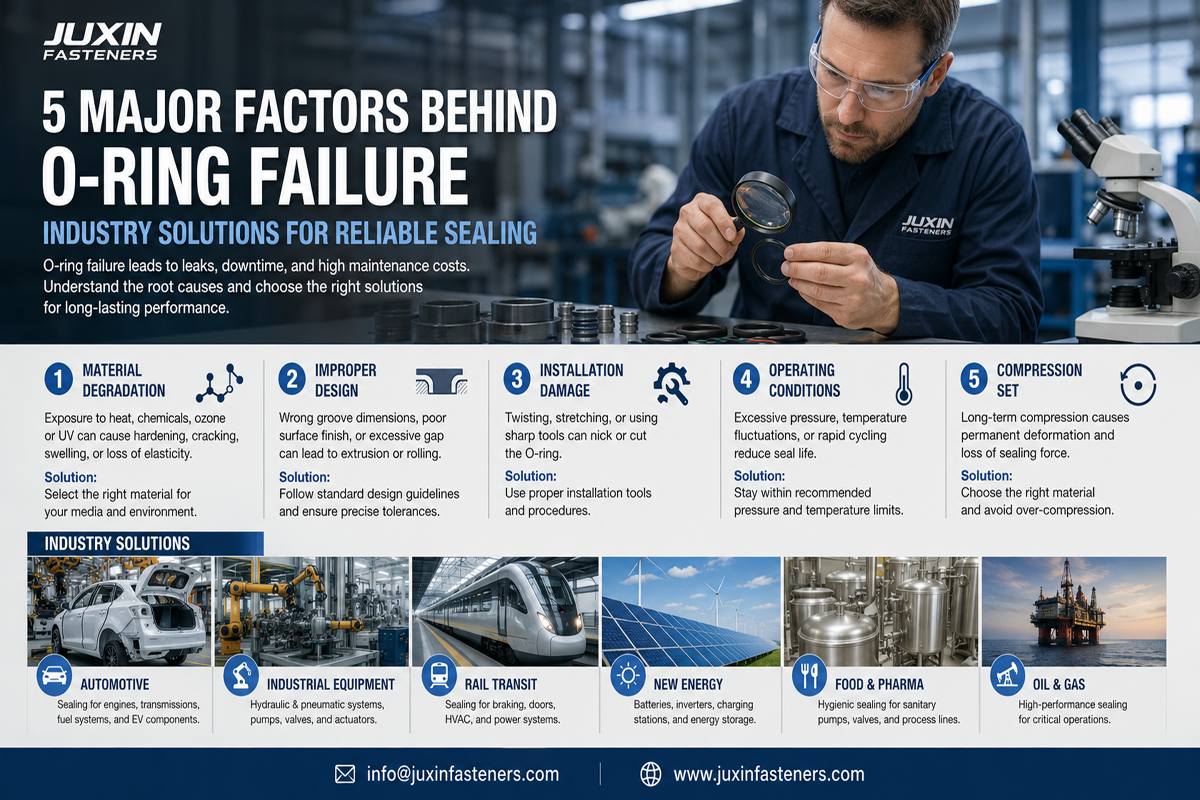
For washer-and-bolt system engineering, see Washers and Bolts: Fastening Systems Selection Guide.
For high-strength bolted joints, see High-Strength Bolts & Nuts: Engineering Selection Guide.
For prevailing-torque locking alternatives, see Nylon Insert Locknuts for Anti-Vibration Applications.
For flat washer, spring washer, bolt, nut or locking-fastener RFQs, send your drawing, applicable standard, dimensions, material, mechanical properties,
finish, joint application, locking requirement, production quantity and estimated annual demand to:
A reliable bolted joint is not created by adding washers until the assembly looks secure.
It is created by giving every component a defined engineering function.
 MORE NEWS
Sep. 25, 2026
Sep. 25, 2026
Sep. 25, 2026
Contact Us
Tel.:
+86 020 8621 0320
+86 020 3121 6067
E-mail:
Technical Support:
Navigation
SEND INQUIREY