
Call Us
+86 136 6007 9809
Call Us
+86 136 6007 9809

Sep. 11, 2023
Flat washers are among the simplest components in a bolted joint, but selecting them correctly requires more than matching a washer to the nominal diameter of a bolt.
A washer that fits over an M8, M10 or M12 bolt is not automatically the correct washer for the joint.
Engineers also need to consider:
washer inside diameter;
washer outside diameter;
washer thickness;
bearing area;
parent-material strength;
hole or slot geometry;
fastener mechanical properties;
washer material and hardness;
surface treatment;
applicable standard.
This leads to a more useful engineering question:
How much bearing area does this joint actually require?
A practical selection path is:
Bolt / Screw → Clearance Hole → Parent Material → Bearing Requirement → Washer ID → Washer OD → Thickness & Hardness → Standard → Material & Finish → Validation
JUXIN FASTENERS supports OEM sourcing of flat washers, large OD washers, hardened washers, spring washers, bolts, nuts,
screws and custom fastening components for automotive equipment, machinery, electrical equipment, power systems, HVAC, industrial automation, telecommunications, heavy equipment and other engineered assemblies.
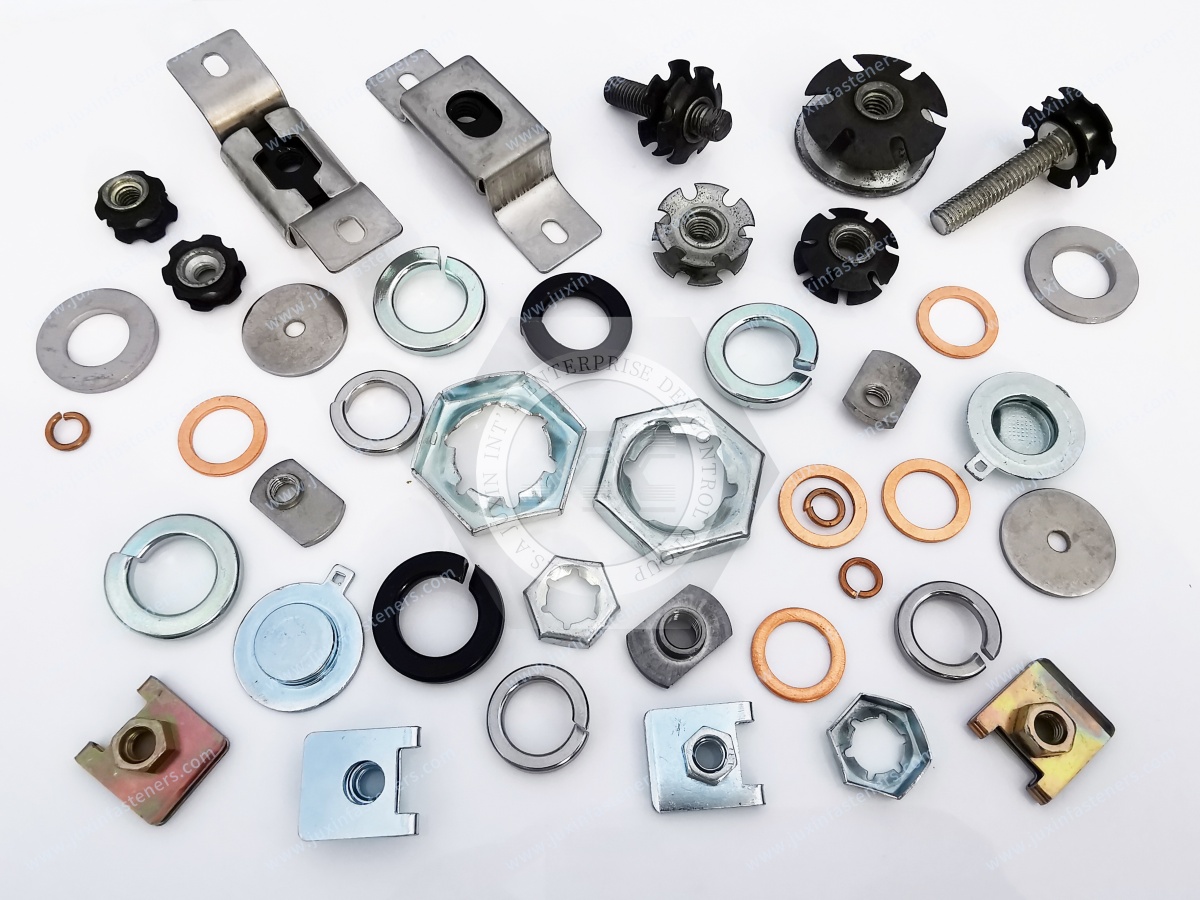
A flat washer, also called a plain washer, is generally an annular component installed beneath a bolt head, screw head or nut.
Its principal role is normally associated with the bearing interface.
Depending on the joint design, a flat washer can:
increase bearing area;
distribute clamp load over a larger surface;
reduce localized indentation;
protect selected mating surfaces;
provide a controlled bearing interface;
bridge an appropriate clearance hole or slot.
A flat washer should not automatically be considered a locking device.
The correct washer is not determined by bolt diameter alone.
For example, two joints using the same nominal bolt size may involve:
Joint A
Thick high-strength steel plate with a controlled round clearance hole.
Joint B
Thin aluminum sheet with a larger hole or slot.
Although both use the same bolt diameter, they may require different washer geometries.
Therefore:
Same Bolt Size ≠ Same Washer Requirement
When a threaded fastener is tightened, preload develops in the bolt or screw and compressive load is transferred into the clamped components.
The bolt head or nut transfers this load through a limited bearing area.
A washer changes that bearing interface.
Its effectiveness depends on the relationship between:
fastener bearing surface;
washer geometry;
washer stiffness;
parent material;
hole geometry;
applied clamp load.
This is why washer selection is a joint-design decision rather than merely a hardware-selection decision.
Flat washers are often described as distributing bolt load “evenly.”
That wording is too simplistic.
The actual contact-pressure distribution beneath a washer depends on:
washer stiffness;
washer thickness;
outside diameter;
parent-material stiffness;
fastener geometry;
joint geometry.
Increasing washer diameter can increase the potential bearing area, but the load is not necessarily distributed perfectly uniformly across the entire washer face.
Therefore:
Larger OD ≠ Perfectly Uniform Bearing Pressure
Local bearing pressure can become important when a fastener is tightened against:
thin sheet;
aluminum;
polymers;
coated materials;
other relatively compliant parent materials.
If the effective bearing area is insufficient, the joint may experience:
indentation;
local yielding;
surface damage;
embedment;
loss of clamp force.
Increasing the appropriate bearing area can help, but the washer itself must remain sufficiently stiff to transfer load effectively.
The washer inside diameter must provide appropriate clearance around the fastener.
If the ID is too small:
assembly may be difficult;
coatings can interfere;
dimensional tolerance may create fit problems.
If the ID is unnecessarily large:
effective bearing area can decrease;
support near the hole edge can change;
washer positioning can become less controlled.
Therefore:
Washer ID Should Follow the Applicable Standard or Engineered Joint Requirement
rather than being selected only because the bolt physically passes through it.
The geometry beneath the washer matters.
Engineers should identify whether the fastener passes through:
a normal clearance hole;
an enlarged hole;
an oversized hole;
a slot;
a formed sheet-metal feature;
another special opening.
The washer must provide sufficient support for the actual geometry.
A washer suitable for a normal round hole may not be suitable for a long slot or substantially oversized opening.
Outside diameter is one of the most important flat-washer selection variables.
A larger OD can increase the potential load-spreading area.
This can be useful when the parent material is:
thin;
relatively soft;
susceptible to indentation.
However:
Larger OD ≠ Automatically Better Joint
Increasing OD can also create:
packaging interference;
edge-distance problems;
reduced access;
interference with nearby features;
insufficient washer stiffness if thickness is not appropriate.
OD and thickness should be considered together.
A very large but thin washer may flex significantly under load.
That can reduce the effectiveness of the additional outside diameter.
Therefore, engineers should not evaluate washer OD independently from thickness.
Important variables include:
OD;
ID;
thickness;
material;
hardness;
clamp load;
parent-material stiffness.
This leads to another useful rule:
Large OD Without Adequate Thickness ≠ Automatically Effective Load Distribution
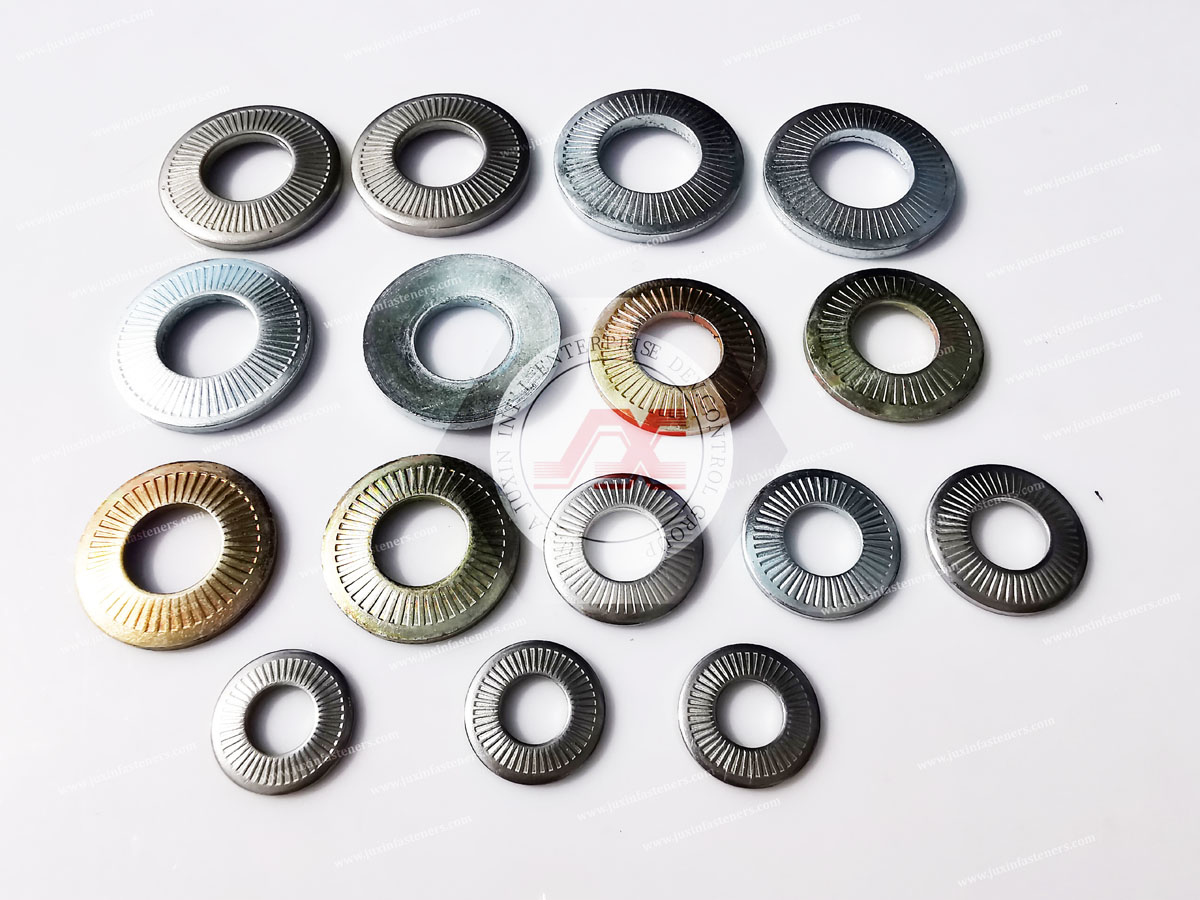
ISO 7089 specifies plain washers — normal series — product grade A within its defined scope.
It is one of the primary international references for metric plain washers.
ISO 7089 can be appropriate where the joint requires a standardized normal-series plain washer and the dimensions, material and mechanical requirements are compatible with the application.
However, specifying:
ISO 7089
does not eliminate the need to understand the joint.
The washer still has to be compatible with:
fastener;
bearing surface;
parent material;
hole geometry;
loading.
ISO 7089:2000 remains a published international standard.
ISO has also initiated development of a future revision.
For current production sourcing, the specified edition should follow the customer's drawing, purchasing specification or applicable project requirement.
A supplier should not silently change a controlled drawing from one edition to another.
ISO 7090 specifies plain washers, chamfered — normal series — product grade A within its defined scope.
Chamfered washer geometry can be relevant where the applicable fastener interface or specification requires it.
Therefore:
ISO 7089 ≠ ISO 7090
even though both are normal-series plain washer standards.
The exact standard should be taken from the engineering requirement.
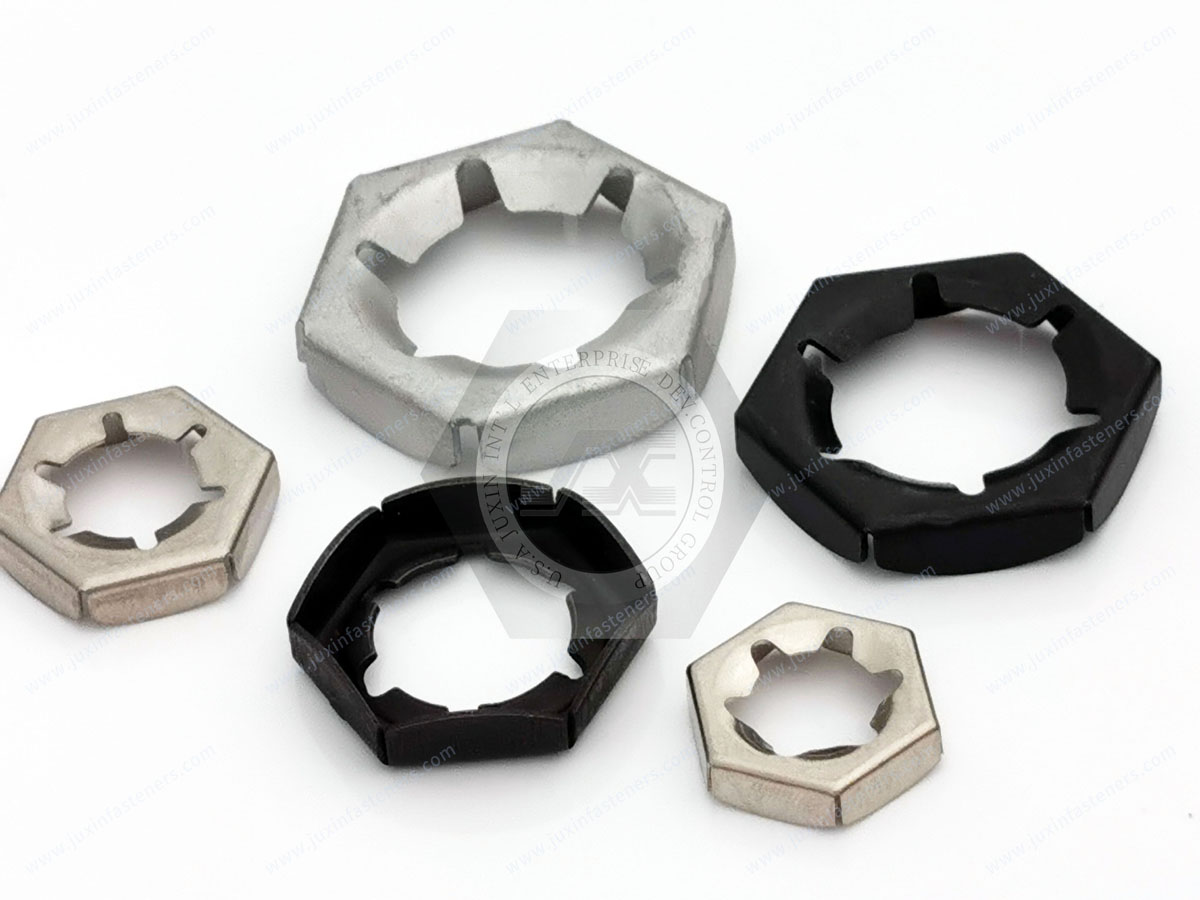
ISO 7093-1 specifies plain washers — large series — product grade A within its defined scope.
Compared with normal-series washers, large-series washers provide a different dimensional relationship and increased outside diameter for the applicable nominal size.
This can be useful where greater bearing area is required.
Potential applications can involve:
relatively soft parent materials;
thin materials;
selected sheet-metal assemblies;
applications where a larger bearing footprint is required.
However, large-series selection must still be validated against the joint.
ISO 7093-1:2000 remains published and current.
A replacement edition is under development.
This is relevant to engineering and procurement teams maintaining long-life OEM drawings.
Existing production should follow the controlled customer specification unless an approved drawing revision changes the requirement.
This is one of the most useful flat-washer comparisons.
Normal-series plain washer.
Large-series plain washer.
The engineering decision should not be:
“Which washer is stronger?”
It should be:
“What bearing footprint and interface does this joint require?”
A simplified selection concept is:
Consider where a standard bearing footprint is appropriate for the joint.
Consider where a larger bearing footprint is required and the surrounding geometry allows it.
But this is not a universal substitution rule.
The parent material, washer thickness, hardness and clamp load still matter.
In North American commercial terminology, fender washer commonly describes a flat washer with a relatively large outside diameter compared with its hole size.
Fender washers can be useful where a broad bearing footprint is required.
However:
Fender Washer Is a Commercial Product Description
while:
ISO 7093-1 Is a Defined International Standard
They should not automatically be treated as dimensionally interchangeable.
A purchasing inquiry may use terms such as:
large OD washer;
large diameter washer;
fender washer;
penny washer.
These terms can describe similar commercial intentions but may not define identical dimensions.
For OEM sourcing, provide:
ID;
OD;
thickness;
material;
finish;
drawing or standard.
This avoids ambiguity.
These are not the same engineering category.
Large OD describes geometry.
Hardened washer describes mechanical-property requirements.
A washer can potentially be:
large OD but relatively soft;
normal OD and hardened;
both large and hardened;
neither.
Therefore:
Washer Geometry ≠ Washer Hardness
This distinction is essential in high-load joints.
ASTM F436/F436M covers hardened steel washers within its defined inch and metric dimensional ranges for general-purpose mechanical and structural use with specified fastener systems.
The current ASTM edition is ASTM F436/F436M-24.
This is not simply the U.S. equivalent of every general-purpose flat washer.
It is a specific hardened-steel washer specification.
Within its scope, it addresses requirements including:
material;
mechanical properties;
dimensions.
Therefore:
ASTM F436/F436M ≠ Generic Flat Washer Standard
High-strength fasteners can generate substantial clamp loads.
The bearing interface beneath the bolt head or nut must be able to support those loads without unacceptable deformation.
Depending on the joint and applicable fastener system, a hardened washer may be required.
The decision should follow:
fastener specification;
structural or mechanical design requirement;
applicable standard;
customer drawing.
Do not substitute a commodity washer solely because its nominal diameter matches.
Two washers with the same:
ID;
OD;
thickness
can still behave differently if their hardness differs significantly.
This is why flat-washer selection should consider both:
Geometry
and:
Mechanical Properties
For a deeper discussion of washer hardness and bolt compatibility, use the JUXIN FASTENERS flat-washer hardness engineering guide.
Flat washers can be particularly important when fastening against softer materials.
Examples can include:
aluminum;
some polymers;
selected composites;
thin sheet.
The washer can increase bearing area, but the design still needs to evaluate:
local bearing stress;
material creep;
indentation;
hole deformation;
edge distance.
A washer does not make an otherwise inadequate parent material automatically suitable for a high-preload joint.
Aluminum can be more susceptible to local bearing deformation than harder steel interfaces.
Depending on the application, engineers may evaluate:
larger washer OD;
suitable washer thickness;
controlled clamp load;
surface protection;
galvanic compatibility.
The exact washer solution depends on alloy, thickness and joint loading.
Polymeric components introduce additional considerations such as:
creep;
stress relaxation;
temperature sensitivity;
local crushing.
A large flat washer can reduce local pressure, but:
Large Washer ≠ Elimination of Polymer Creep
Clamp-load strategy and long-term material behavior still require evaluation.
Thin sheet can deform around the fastener bearing area.
A larger washer may help distribute load over a broader region.
However, if the sheet is very thin, the complete joint may also require evaluation of:
sheet bending;
pull-through;
hole deformation;
edge distance.
Washer selection cannot be separated from sheet geometry.
Slots create a different bearing condition from circular holes.
The washer must provide sufficient coverage around the slot throughout the required assembly position.
Engineers should consider:
slot length;
slot width;
washer OD;
washer thickness;
expected clamp load;
adjustment requirement.
Do not assume a standard washer automatically provides sufficient support.
Oversized holes can require a washer with increased dimensions or a washer specifically defined by the applicable connection standard.
The correct solution depends on the fastening system.
For structural applications, follow the applicable structural fastener specification rather than improvising with an arbitrary large commercial washer.
A large washer needs physical space around the fastener.
If the bolt is close to:
a component edge;
a bend;
a rib;
another fastener;
a housing wall
a large OD washer may interfere with surrounding geometry.
This means washer selection is also a packaging problem.
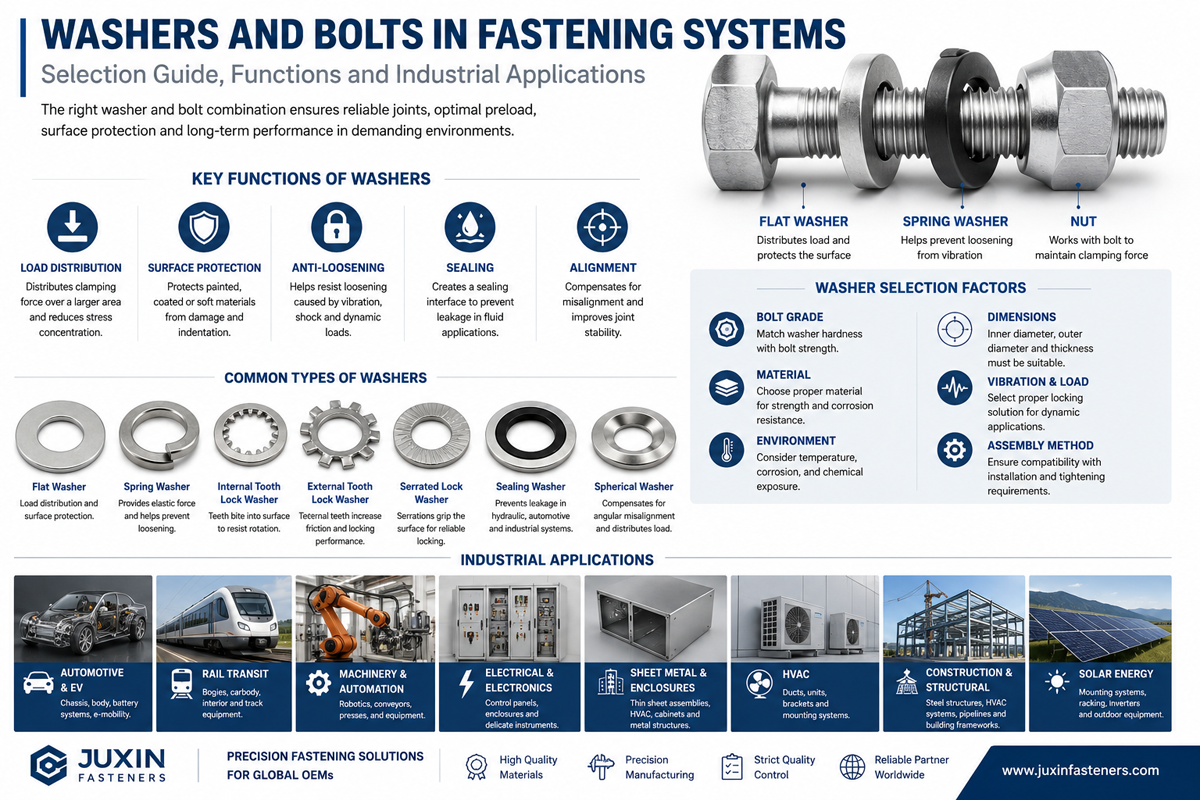
The need for a washer can differ between the two sides of a joint.
The engineering drawing should determine whether a washer is required:
under the bolt head;
under the nut;
on both sides;
on neither side.
Do not automatically add washers to both sides without a defined reason.
A washer changes the bearing interface.
That can affect friction beneath the rotating fastener component.
Because torque is only an indirect method of developing preload, changes in bearing friction can influence the achieved clamp force for a given torque.
Therefore:
Adding a Washer Can Change the Torque–Preload Relationship
This matters when modifying an existing production assembly.
The bearing interface can include:
steel;
stainless steel;
aluminum;
painted surfaces;
plated surfaces;
coated washers.
Each combination can behave differently.
If tightening consistency is important, the interface condition should be controlled.
A plain flat washer is primarily a bearing-interface component.
It should not be selected as the primary anti-loosening mechanism merely because the equipment vibrates.
Rotational self-loosening depends on the complete joint.
Where locking is required, engineers may need to evaluate:
prevailing-torque nuts;
locking washer systems;
thread-locking compounds;
positive mechanical locking.
A plain washer is not a vibration damper.
It may change the interface geometry, but it does not automatically dissipate meaningful vibration energy.
Therefore:
Flat Washer ≠ Vibration Damper
This is particularly important when reviewing older product descriptions.
A washer can prevent direct rotation of a bolt head or nut against some surfaces depending on the assembly sequence.
However, the washer itself still applies bearing pressure to the surface.
It can also move during tightening.
Therefore, coating protection depends on:
washer geometry;
surface finish;
tightening process;
coating hardness;
clamp load.
Do not assume that every flat washer preserves paint or plating.
Carbon steel washers are widely used in industrial fastening.
Selection can depend on:
hardness;
material specification;
coating;
corrosion environment;
mating fastener.
Surface treatment should be defined by the actual project.
Stainless steel washers can provide improved corrosion resistance in suitable environments.
However:
Stainless Steel ≠ Corrosion-Proof
The grade should be selected based on:
chloride exposure;
chemicals;
temperature;
outdoor environment;
mating materials.
The RFQ should specify the required stainless grade where it matters.
When different metals are assembled in the presence of an electrolyte, galvanic interaction may become relevant.
Examples can include combinations involving:
carbon steel;
stainless steel;
aluminum.
Material and coating selection should consider the complete assembly and service environment.
A corrosion-resistant washer alone does not guarantee a corrosion-resistant joint.
Zinc-based coatings are widely used on carbon-steel washers.
Where required, trivalent chromium passivation can be evaluated for applicable JUXIN FASTENERS projects.
The RFQ should define:
coating system;
coating thickness where controlled;
corrosion requirement;
appearance requirement;
RoHS/REACH requirement where applicable.
Black oxide can be used where its appearance and functional characteristics fit the application.
However, black oxide should not automatically be selected for demanding corrosion environments.
Corrosion requirements should drive the coating decision.
Non-metallic washers can serve different functions from steel washers.
Potential functions can include:
electrical isolation;
surface protection;
spacing;
low-mass mechanical interfaces.
Material selection can involve:
PA6;
PA66;
POM;
PP;
PC;
PVDF;
PEEK
depending on the project.
However:
Plastic Washer ≠ Automatically Electrical-Safety Certified
and:
Plastic Washer ≠ Automatically UL94 V-0
Those requirements must be specified and supported by the selected material.
Elastomeric washers are often selected for:
sealing;
cushioning;
compliance.
Their behavior is very different from a steel flat washer.
Selection may depend on:
elastomer type;
compression;
fluid exposure;
temperature;
aging.
Do not treat rubber and steel washers as interchangeable simply because both are circular.
A dedicated sealing washer may incorporate:
elastomer;
bonded sealing element;
engineered sealing geometry.
A plain flat washer does not automatically create a watertight joint.
Therefore:
Flat Washer ≠ Sealing Washer
IP67 or IP68 performance belongs to the validated enclosure or assembly, not automatically to the washer.
A nylon or engineering-plastic washer can provide electrical separation in an appropriate design.
However, electrical performance depends on:
material;
thickness;
voltage;
environment;
creepage/clearance requirements;
applicable equipment standard.
Do not infer electrical certification from material name alone.
The word structural washer should be used carefully.
Structural bolting systems can have specific requirements for:
bolts;
nuts;
washers;
installation;
inspection.
ASTM F436/F436M is one relevant hardened-washer specification for defined U.S. mechanical and structural applications.
A general ISO 7089 commodity washer should not automatically be substituted into a controlled structural bolting system.
Automotive equipment uses washers in many different assemblies.
Potential non-safety-critical applications include:
brackets;
electronic equipment;
auxiliary assemblies;
equipment mounts;
body-related hardware.
Washer selection should follow:
parent material;
clamp load;
corrosion environment;
assembly process.
Safety-critical vehicle joints require customer-specific engineering and validation.

Potential washer applications include:
power-electronics housings;
auxiliary brackets;
thermal-management equipment;
service panels;
mechanical mounting structures.
A flat washer can provide a bearing interface, but it should not automatically be described as:
a battery sealing component;
a grounding component;
an EMI shielding component;
a busbar contact solution.
Those functions require separate engineering requirements.
AI data centers and HPC infrastructure contain many bolted mechanical assemblies in:
server equipment;
racks;
UPS equipment;
power-conversion systems;
cooling equipment;
electrical enclosures.
Flat washers may be used where controlled bearing support is required.
Selection should follow the actual joint rather than the industry label.
Flat washers may be used in:
cabinet frames;
mounting brackets;
equipment covers;
power equipment structures.
Where electrical grounding or bonding is required, that function must be separately engineered.
A plain washer should not automatically be presented as a grounding component.
Potential applications include:
cabinets;
racks;
mounting structures;
equipment housings;
communication hardware.
Thin sheet and coated surfaces can make bearing-interface design important.
Flat washers may be used in:
equipment housings;
fan systems;
compressor-related assemblies;
brackets;
service panels.
Vibration in HVAC equipment does not automatically mean the flat washer is providing anti-loosening performance.
Automation equipment can contain washers in:
machine frames;
actuators;
robots;
guards;
control cabinets;
sensors;
mounting structures.
The washer may be selected for bearing support while a separate feature provides locking.
Construction, mining and agricultural machinery can expose fasteners to:
high loads;
shock;
vibration;
outdoor corrosion;
repeated maintenance.
Washer geometry, hardness and coating should therefore be considered together.
Flat washers may be used in non-sterile mechanical assemblies such as:
diagnostic equipment;
laboratory equipment;
carts;
housings;
internal brackets.
A generic washer should not automatically be described as medically certified, sterile, biocompatible or cleanroom-qualified.
| Joint Condition | Selection Direction |
|---|---|
| General controlled bearing interface | Evaluate normal-series washer |
| Need larger bearing footprint | Evaluate large-series / engineered large OD washer |
| Thin sheet | Evaluate OD, thickness and sheet deformation |
| Soft parent material | Evaluate bearing pressure and larger support area |
| High-strength fastener | Evaluate washer hardness and applicable fastener specification |
| Oversized hole | Use applicable engineered washer requirement |
| Slotted hole | Verify full slot coverage and washer stiffness |
| Corrosive environment | Select material + coating together |
| Electrical isolation | Evaluate engineering-plastic washer |
| Need sealing | Use dedicated sealing washer/system |
| Need anti-loosening | Evaluate separate locking strategy |
| Structural bolting | Follow applicable structural fastener system |
Nominal fastener diameter is only the starting point.
A larger washer also requires sufficient thickness, stiffness and installation space.
Geometry alone does not define performance.
Structural systems require applicable specifications.
A plain washer is primarily a bearing component.
A plain steel washer is not a vibration damper.
Washer support depends on the opening beneath it.
These can create very different bearing conditions.
Large washers reduce pressure but do not eliminate polymer creep or relaxation.
Changing the bearing interface can change torque-preload behavior.
Engineers may search:
how to choose flat washer size;
flat washer OD selection;
flat washer thickness selection;
ISO 7089 vs ISO 7093;
normal washer vs large washer;
washer for thin sheet metal;
washer for aluminum;
washer for oversized hole;
hardened washer for high-strength bolt;
flat washer bearing area.
These are engineering-decision searches, not simple product-definition searches.
Procurement teams may search:
flat washer manufacturer;
flat washer supplier;
ISO 7089 washer supplier;
ISO 7093 washer manufacturer;
large OD washer supplier;
hardened washer supplier;
custom flat washer manufacturer;
OEM washer supplier.
Commercial sourcing should begin from a controlled technical specification.
A request such as:
“Need M10 flat washers.”
may still leave important questions unanswered.
Which standard?
Which series?
What hardness?
What material?
What finish?
What corrosion requirement?
What quantity?
For custom projects:
What ID, OD and thickness?
The more demanding the joint, the more important these details become.
For technical and commercial evaluation by JUXIN FASTENERS, provide where applicable:
2D drawing;
physical sample;
customer part number;
applicable standard;
ISO 7089 requirement where applicable;
ISO 7090 requirement where applicable;
ISO 7093-1 requirement where applicable;
ASME B18.21.1 requirement where applicable;
ASTM F436/F436M requirement where applicable;
metric or inch system;
nominal fastener size;
fastener standard;
bolt or screw property class/grade;
washer inside diameter;
washer outside diameter;
washer thickness;
washer series;
washer hardness;
washer material;
surface treatment;
coating thickness where specified;
trivalent chromium requirement where applicable;
RoHS/REACH requirement where applicable;
corrosion-test requirement;
parent material;
parent-material thickness;
parent-material hardness where relevant;
clearance-hole diameter;
slot dimensions where applicable;
oversized-hole dimensions where applicable;
edge distance;
expected clamp load where known;
tightening requirement;
operating temperature;
corrosion environment;
electrical isolation requirement where applicable;
sealing requirement where applicable;
sample quantity;
production quantity;
annual demand;
inspection requirements;
packaging requirements;
labeling requirements;
customer-specific requirements.
Start with the fastener and applicable standard, then evaluate hole geometry, parent material, required bearing area, washer OD, thickness, hardness, material and finish.
Only partly.
The bolt diameter establishes the nominal size, but joint conditions determine whether a normal, large-series, hardened or custom washer is appropriate.
ISO 7089 specifies normal-series plain washers, product grade A, within its defined scope.
ISO 7093-1 specifies large-series plain washers, product grade A, within its defined scope.
The key distinction is the dimensional series.
ISO 7093-1 provides a larger-series washer geometry for its applicable nominal sizes.
Selection depends on the required bearing interface.
Not necessarily.
“Fender washer” is commonly used as a commercial description for a large OD washer.
ISO 7093-1 defines a specific standardized large-series washer.
Always compare actual dimensions.
Not automatically.
Washer thickness, stiffness, material and parent-material behavior also influence load transfer.
A hardened washer may be required where the applicable high-strength fastener system, structural specification or joint design requires sufficient bearing hardness.
Follow the fastener and joint specification.
No.
ASTM F436/F436M is a specific specification for hardened steel washers within its defined mechanical and structural applications.
A plain flat washer should not be relied upon as the primary anti-loosening mechanism.
Its main role is normally associated with the bearing interface.
It can change the bearing interface, but it does not guarantee that paint or coating will remain undamaged.
The result depends on the washer, coating, surface and tightening process.
A larger bearing area can reduce local pressure, but polymer creep, relaxation and temperature behavior must still be considered.
A conventional plain washer is not a dedicated sealing element.
Use a sealing washer or engineered sealing system where sealing is required.
An engineer may begin with:
“What washer should I use with an M10 bolt?”
That question should develop into:
What Is the Hole Geometry? → What Is the Parent Material? → What Bearing Area Is Required? → Normal or Large Series? → What Thickness and Hardness? → What Material and Finish? → What Standard? → How Will the Joint Be Validated?
Procurement can then move from:
“M10 washer supplier”
to:
Controlled Washer Specification → Approved Supplier → Production RFQ
That is the connection between engineering search intent and commercial sourcing.
JUXIN FASTENERS supports OEM sourcing of standard and custom flat washers, large OD washers, industrial washers and related bolts, nuts, screws and custom fastening components for automotive equipment, EV systems, AI data centers, electrical equipment, telecommunications, HVAC, industrial machinery, automation and heavy equipment.
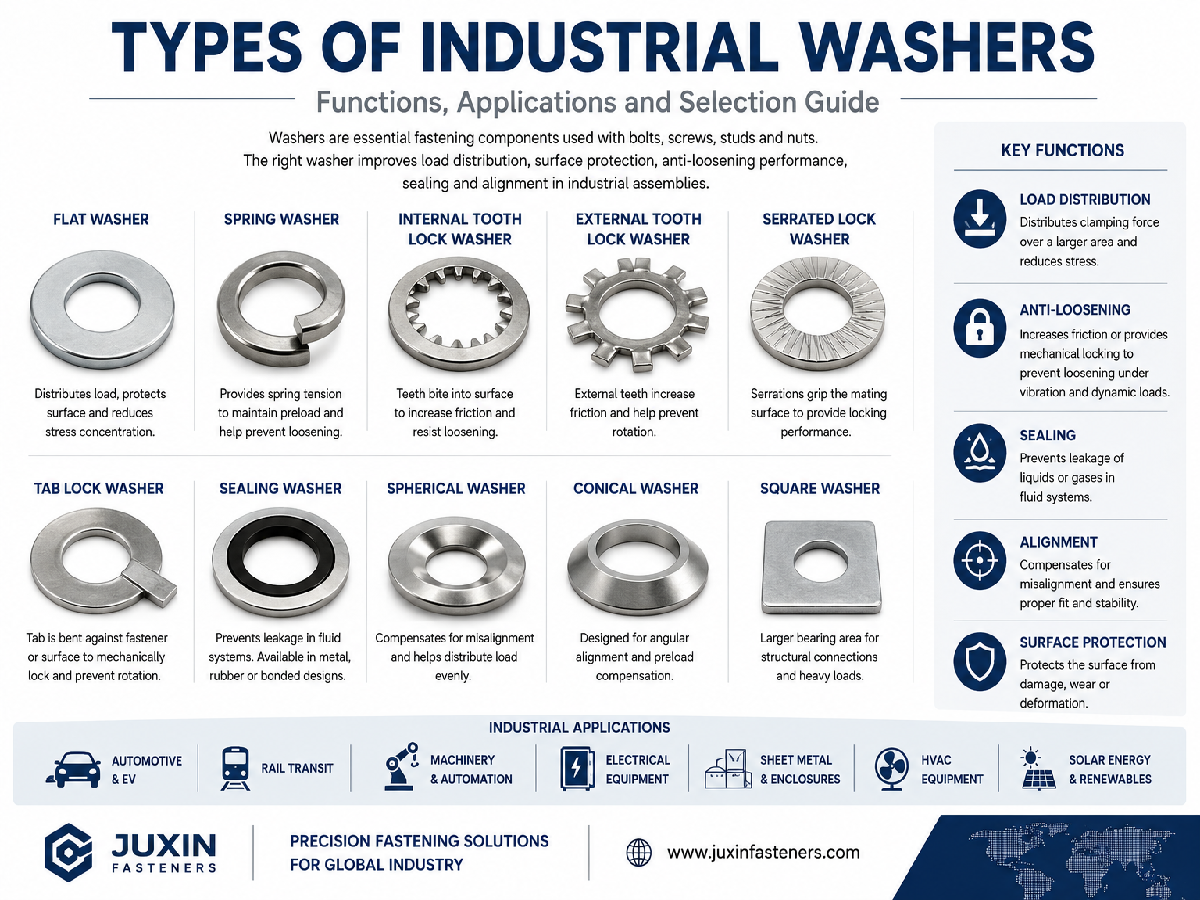
For the broader washer family, see Industrial Washers: Types, Functions & Selection Guide.
For washer-and-fastener system selection, see Washers and Bolts: Fastening Systems Selection Guide.
For high-strength fastener selection, see High-Strength Bolts & Nuts: Engineering Selection Guide.
For locking alternatives where rotational loosening is the real problem, see Nylon Insert Locknuts for Anti-Vibration Applications.
For flat washer RFQs, send your drawing, standard, fastener size, washer ID/OD/thickness, hardness requirement, material, finish, parent material, application and estimated annual demand to:
The correct flat washer is not simply the washer that fits over the bolt.
It is the washer whose geometry, hardness, material and bearing interface match the joint.
 MORE NEWS
Sep. 25, 2026
Sep. 25, 2026
Sep. 25, 2026
Contact Us
Tel.:
+86 020 8621 0320
+86 020 3121 6067
E-mail:
Technical Support:
Navigation
SEND INQUIREY