
Call Us
+86 136 6007 9809
Call Us
+86 136 6007 9809

Oct. 21, 2023
Flat washers—also commonly called plain washers—are among the simplest components in a bolted joint, but their engineering function is often misunderstood.
A flat washer is normally positioned beneath the bearing surface of a bolt head, screw head, or nut. Depending on the joint design,
it can provide a controlled bearing interface, distribute load over a larger area, protect the mating surface, accommodate an oversized or clearance hole,
or provide a defined interface between the fastener and assembled component.
However, an ordinary flat washer is not automatically a locking washer, sealing gasket, vibration isolator, or universal solution for an uneven joint.
For engineers and procurement teams, selecting a washer therefore requires more than matching the nominal thread size.
The important question is:
What function does the washer need to perform in the complete bolted joint?
JUXIN FASTENERS supplies standard and custom flat washers and application-specific fastening components for global OEM, ODM,
Tier 1 and Tier 2 manufacturing programs, supporting specification-based, drawing-based and sample-based sourcing.
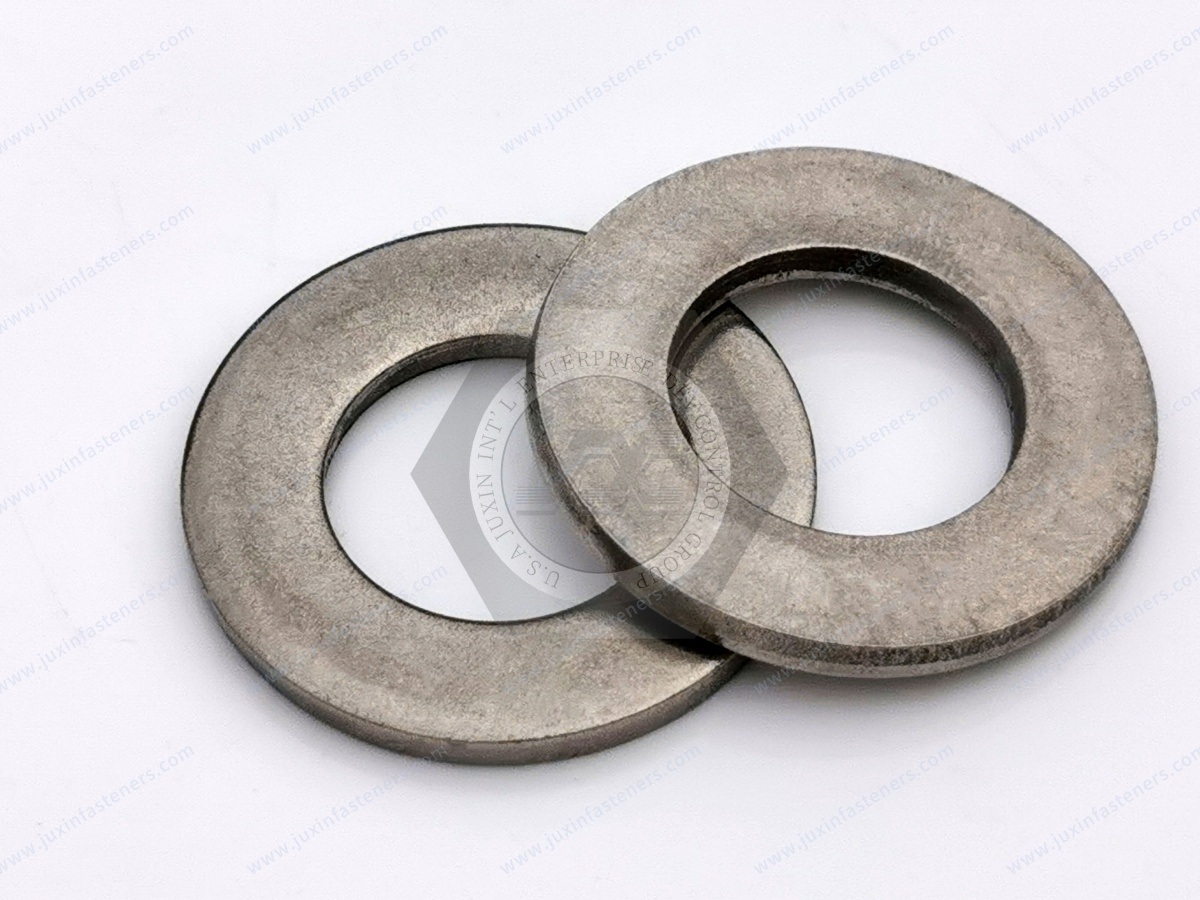
A flat washer is a generally flat component with a central hole, designed to be used in a fastening assembly.
In international standards, the term plain washer is commonly used.
The basic geometry is defined by three important dimensions:
inside diameter (ID);
outside diameter (OD);
thickness.
Although the geometry is simple, changing any of these dimensions can significantly change how the washer interacts with the joint.
A larger outside diameter increases the available bearing area.
A different inside diameter changes clearance around the bolt, screw or stud.
Thickness influences washer stiffness, deformation resistance and the geometry of the assembled joint.
Material and hardness can be just as important as dimensions.
These terms should not normally be treated as synonyms.
A flat washer is primarily a fastening component.
A gasket is primarily a sealing component designed to control leakage across an interface.
Some specialized washer-shaped components can provide sealing functions, including certain:
copper sealing washers;
crush washers;
bonded sealing washers;
sealing rings;
application-specific gasket washers.
But a standard steel or stainless steel flat washer should not automatically be described as a gasket.
For engineering drawings, RFQs and supplier communication, distinguishing washer from gasket helps prevent incorrect material and component selection.
A flat washer can perform several functions depending on the joint.
During tightening, the bolt head or nut applies compressive force against the assembled component.
A washer creates an intermediate bearing interface between the rotating fastener component and the joint surface.
This can be useful where the original surface is unsuitable for direct fastener bearing.
Increasing the effective bearing area can reduce localized contact pressure at the immediate fastener interface.
This can help protect materials that could otherwise experience local indentation, embedment or pull-through.
However, the amount of useful load distribution depends on the washer geometry, stiffness, material and substrate.
Simply increasing washer OD does not make every joint stronger.
A washer can reduce direct contact between the rotating bolt head or nut and the assembled component.
This can help protect certain surfaces from:
local scoring;
indentation;
galling;
coating damage;
installation marks.
The actual result depends on the washer and mating materials, hardness, surface finish and tightening conditions.
Large-series washers or custom large-OD washers can provide additional bearing area around clearance holes, slots or other openings.
This is particularly useful in suitable sheet-metal, fabrication and equipment assemblies.
The washer must still have sufficient stiffness and geometry for the intended load.
In engineered assemblies, washers can help standardize the interface beneath a fastener.
This can be useful where joint geometry, surface condition, material combination or service requirements make direct bearing undesirable.
One common misunderstanding is that adding a flat washer automatically increases fastening force.
It does not.
Bolt preload is primarily generated by tightening the threaded fastener and is influenced by factors such as:
applied torque or tensioning method;
thread friction;
bearing friction;
lubrication;
fastener geometry;
coating;
joint stiffness;
material properties.
A washer changes the bearing interface and may therefore influence friction and load transfer, but it should not be described as automatically increasing clamp load.
Where preload is critical, the complete bolted joint should be evaluated.
Several ISO standards define commonly used metric plain washer series.
ISO 7089 covers plain washers in the normal series, Product Grade A.
This is an important general-purpose metric washer reference for engineered bolted joints.
ISO 7090 covers chamfered plain washers in the normal series, Product Grade A.
Chamfer geometry can be relevant where the fastener or joint requires appropriate clearance at the bearing interface.
ISO 7091 covers normal-series plain washers with Product Grade C.
Product grade is related to dimensional and geometrical tolerance classification and should not be confused with material strength grade.
ISO 7092 covers small-series plain washers, Product Grade A.
A smaller outside diameter can be useful where surrounding installation space is limited.
ISO 7093-1 covers large-series plain washers, Product Grade A.
The increased outside diameter provides a larger bearing footprint where the application requires it.
ISO 7093-2 defines large-series plain washers in Product Grade C.
ISO 7094 covers extra-large-series plain washers, Product Grade C.
The correct washer series should be selected from the actual joint geometry and specification rather than assuming that a larger washer is always better.
This distinction is important for engineers and buyers.
In washer standards, Product Grades such as A and C relate to dimensional and geometrical tolerance classifications.
They should not automatically be interpreted as:
material grade;
hardness grade;
strength class;
corrosion-resistance class.
A washer can have the correct nominal dimensions but still be unsuitable if its material or mechanical properties do not match the bolted joint.
For supplier qualification, dimensional standard and material/mechanical requirements should therefore be reviewed separately.
The washer series primarily changes the relationship between the center hole, outside diameter and other specified geometry.
A simplified selection logic is:
| Washer Series | Typical Engineering Reason |
|---|---|
| Small series | Restricted radial installation space |
| Normal series | General bolted-joint applications |
| Large series | Increased bearing footprint |
| Extra-large / special large OD | Application-specific need for substantially larger bearing area |
This does not mean large-series washers are automatically superior.
A larger OD also requires:
sufficient surrounding space;
appropriate washer stiffness;
compatible joint geometry;
adequate edge distance;
suitable substrate conditions.
Engineering selection should therefore be based on the actual interface.
The term fender washer is widely used commercially, particularly for washers with a relatively large outside diameter compared with their hole size.
However, commercial naming does not by itself define the complete engineering specification.
When sourcing large-OD or fender washers, buyers should define:
inside diameter;
outside diameter;
thickness;
material;
finish;
dimensional tolerance;
application requirements.
For OEM programs, a drawing is often more reliable than relying solely on the term "fender washer."
Flat washers and locking washers perform different primary functions.
A flat washer is generally selected for bearing-interface management, load distribution, surface protection or geometry.
A locking washer introduces a specific locking or rotational-resistance mechanism.
Examples include:
external serrated washers;
internal serrated washers;
countersunk serrated washers;
other engineered locking washer systems.
A flat washer should not automatically be expected to prevent rotational loosening.
Likewise, a locking washer should not automatically be substituted for a plain washer when the joint requires a defined load-distribution interface.
No.
The traditional combination of a flat washer and spring washer is encountered in many assemblies, but it should not be treated as a universal fastening rule.
The correct anti-loosening strategy depends on:
preload;
vibration;
transverse joint movement;
joint stiffness;
materials;
surface coatings;
temperature cycling;
maintenance;
safety requirements.
If loosening is a critical concern, engineers should evaluate the complete fastening system and select a locking method appropriate to the actual failure mechanism.
Adding more washer components does not automatically create a more reliable joint.
Standard flat washers should not generally be treated as sealing devices.
A conventional flat washer is not designed to guarantee resistance to:
water;
oil;
hydraulic fluid;
fuel;
coolant;
gas;
dust.
If sealing is required, the assembly may need an appropriate sealing technology such as:
copper sealing washer;
crush washer;
bonded sealing washer;
gasket;
O-ring system;
customer-designed sealing component.
The correct choice depends on pressure, temperature, media, mating surfaces and joint geometry.
Only to a limited extent.
A flat washer can provide a defined bearing interface, but it should not be used to correct significant angular misalignment or badly uneven surfaces.
Applications involving angular misalignment may require specialized components such as spherical washer systems.
Structural steel interfaces involving tapered flanges may require suitable taper or beveled washers according to the applicable structural design.
These components should not be classified as ordinary flat washers simply because they are installed beneath a bolt or nut.
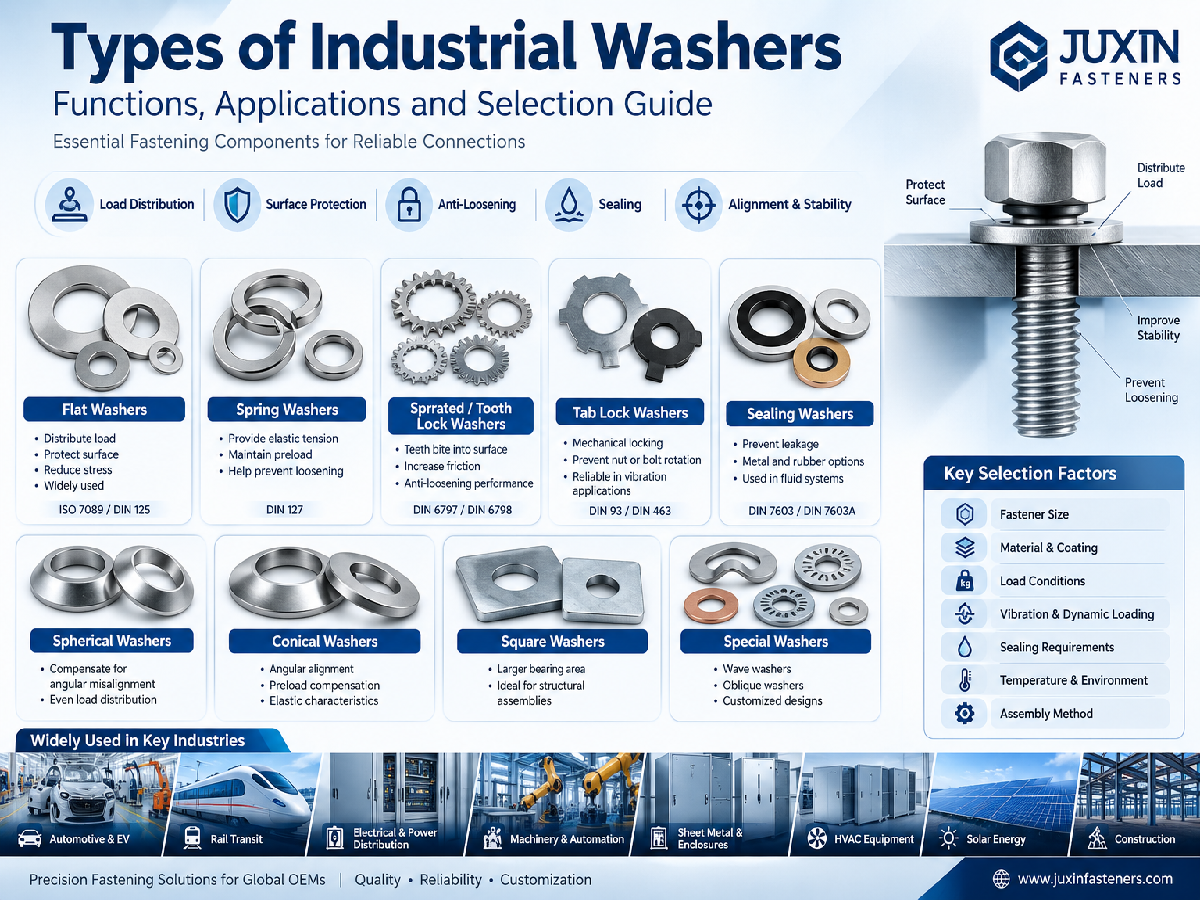
A washer transfers compressive load between the fastener bearing surface and the joint.
If the washer is too soft for the application, it can experience:
indentation;
cupping;
permanent deformation;
embedment;
loss of interface stability.
If the washer is being used with higher-strength fasteners, mechanical properties become particularly important.
Engineers should therefore avoid selecting a washer based only on ID, OD and thickness.
The relationship between:
fastener strength + washer mechanical properties + substrate material
can be important to joint performance.
Carbon steel is widely used for industrial flat washers.
Depending on the application, carbon steel washers can be supplied with different mechanical properties and surface finishes.
Potential finish systems can include application-appropriate zinc-based, zinc-flake, phosphate or other specified coatings.
Selection should consider:
corrosion environment;
mating fastener coating;
friction requirements;
customer specification;
appearance;
electrical requirements where applicable.
The coating should be treated as an engineering requirement rather than a cosmetic afterthought.
Stainless steel flat washers are commonly used where corrosion resistance, hygiene, material compatibility or environmental durability is required.
Potential applications include:
food-service equipment;
industrial kitchens;
HVAC equipment;
outdoor equipment;
electrical equipment;
industrial machinery;
transportation equipment.
Stainless washer selection should consider the required stainless grade, mechanical properties, mating fasteners and service environment.
ISO 3506-7 provides an international framework for specified grades and property classes of corrosion-resistant stainless steel flat washers used in bolted joints.
A2 and A4 terminology should therefore be tied to the actual specified material and mechanical requirements rather than used as a generic synonym for every stainless washer.
Copper flat washers provide a different material function.
Depending on the application, copper may be selected for:
electrical conductivity;
thermal conductivity;
material compatibility;
controlled deformation;
application-specific bearing or spacing.
A copper flat washer should not automatically be treated as a copper sealing or crush washer.
Where sealing is the primary function, material condition, geometry, mating surfaces and installation requirements become part of the sealing design.
Aluminum washers can be considered where low mass, material compatibility or application-specific corrosion behavior is important.
However, aluminum material and temper affect mechanical performance.
For highly loaded joints, the washer's bearing behavior and compatibility with the fastener and substrate should be evaluated.
Nylon and other engineering-polymer washers can be useful where the application requires:
electrical insulation;
separation of dissimilar materials;
surface protection;
low mass;
non-metallic contact;
corrosion avoidance.
They should not be treated as direct substitutes for metal washers in highly loaded joints.
Polymer behavior can be affected by:
temperature;
moisture absorption;
creep;
stress relaxation;
chemical exposure;
sustained compression.
These factors become important when a plastic washer forms part of a preload-sensitive assembly.
Outside diameter determines the washer's available bearing footprint.
A larger OD can spread load over a larger immediate area, but the benefit is not unlimited.
If the washer is too thin relative to its geometry and load, it may deform.
If the substrate is extremely soft, additional joint analysis may still be required.
If the washer approaches a component edge, available edge distance can become relevant.
Therefore:
larger OD ≠ automatically stronger joint.
The washer must be considered together with thickness, stiffness and substrate.
Thickness is not merely a catalog dimension.
It can influence:
washer stiffness;
resistance to cupping;
bearing behavior;
joint stack height;
thread engagement geometry;
installation clearance.
For custom washers, reducing thickness only to reduce material cost can change functional behavior.
Likewise, increasing thickness without considering the assembly can create interference or reduce available thread engagement.
The washer inside diameter must provide appropriate clearance for the fastener while maintaining sufficient bearing area.
An excessively large hole can:
reduce effective bearing area;
increase eccentric positioning;
create inconsistent assembly location.
An excessively small hole can create assembly problems or interfere with coatings and fastener geometry.
Standard washer series address common dimensional relationships, but custom assemblies may require drawing-controlled dimensions.
Sheet-metal applications are an important use case for flat and large-OD washers.
A larger bearing area can help reduce localized deformation or pull-through in suitable assemblies.
However, sheet thickness, hole geometry, washer thickness, fastener preload and substrate strength all influence performance.
For thin-sheet applications, engineers may also need to evaluate other fastening technologies such as:
rivet nuts;
self-clinching fasteners;
weld nuts;
threaded inserts;
blind fasteners.
A larger washer is not always the best way to solve a thin-sheet fastening problem.
Flat washers are widely used in:
electrical cabinets;
switchgear;
power distribution equipment;
industrial controls;
automation systems;
equipment housings;
mounting brackets.
The washer's function may be mechanical, electrical, insulating or a combination depending on the material and joint design.
Where grounding or electrical continuity is required, an ordinary flat washer alone should not be assumed to create a compliant electrical connection.
Contact resistance, coatings, materials, preload and applicable electrical requirements should be evaluated separately.
Flat washers are used throughout automotive and transportation assemblies, including suitable:
brackets;
equipment mounts;
electrical systems;
interior assemblies;
body components;
thermal-management systems;
general mechanical connections.
However, washer requirements in safety-critical joints should follow the approved engineering drawing, customer specification and validation requirements.
A general-purpose catalog washer should not automatically be substituted into a safety-critical assembly based only on nominal bolt size.
Industrial equipment uses flat washers across:
machine frames;
equipment housings;
guards;
motors;
pumps;
compressors;
automation equipment;
mounting systems;
serviceable assemblies.
Selection should consider load, vibration, maintenance frequency, corrosion environment and the condition of the mating surfaces.
For repeated service, the washer can also provide a replaceable interface between the rotating fastener and the equipment surface.
Standard ISO, DIN, ASME/ANSI or other recognized washer dimensions can meet many industrial requirements.
Custom washers become relevant when an OEM assembly requires:
non-standard ID;
non-standard OD;
special thickness;
unusual material;
special hardness;
custom tolerance;
non-circular geometry;
tabs or slots;
application-specific coating;
controlled edge condition;
customer-specific inspection.
JUXIN FASTENERS supports drawing-based and sample-based development of custom washers for OEM applications.
Many flat washers can be manufactured efficiently by stamping.
For custom washer sourcing, manufacturing feasibility can depend on:
material;
material thickness;
ID-to-OD relationship;
dimensional tolerances;
flatness;
burr requirements;
edge condition;
production quantity;
tooling;
surface treatment.
For high-volume programs, material utilization can also become an important cost factor, particularly for large-OD washers and more expensive materials.
Stamped washers can have different edge characteristics on the punch-entry and breakout sides.
For many general-purpose applications, this may not be functionally important.
For sensitive interfaces, however, burr orientation or edge condition may affect:
surface marking;
electrical contact;
seating;
cosmetic appearance;
assembly orientation.
If edge condition is critical, it should be defined on the drawing or RFQ rather than assumed.
A practical selection process starts with the joint rather than the catalog.
Does the joint need:
bearing-area distribution;
surface protection;
hole bridging;
spacing;
electrical insulation;
conductive contact;
another controlled interface?
Determine:
metric or inch;
bolt/screw/stud diameter;
fastener property class or grade;
head or nut bearing geometry.
Consider:
steel;
stainless steel;
aluminum;
sheet metal;
polymer;
composite;
coated surface;
other material.
Choose normal, small, large or another appropriate geometry based on the actual available space and required bearing area.
Material must support the mechanical, environmental and functional requirements of the joint.
Consider corrosion, friction, electrical behavior and compatibility with the mating fastener and substrate.
Do not select from nominal thread size alone where the assembly has special geometric requirements.
For structural, safety-critical, high-vibration, electrical or highly loaded assemblies, validate the complete fastening system under representative conditions.
A useful flat washer RFQ can include:
applicable standard or drawing;
nominal fastener size;
inside diameter;
outside diameter;
thickness;
material;
mechanical property or hardness requirement where applicable;
surface finish;
corrosion requirement;
dimensional tolerances;
inspection requirement;
application;
mating fastener;
substrate material;
order quantity;
estimated annual demand;
packaging requirements.
Providing these details helps the supplier distinguish between a general-purpose washer and a function-critical OEM component.
The cost of a washer is not determined by diameter alone.
Important cost drivers can include:
material grade;
material thickness;
OD and ID;
material utilization;
tooling;
order quantity;
dimensional tolerance;
hardness or heat treatment;
coating;
deburring;
flatness;
inspection;
packaging.
For high-volume OEM programs, unnecessarily tight tolerances can increase cost without improving assembly performance.
Design and procurement teams can therefore benefit from reviewing functional tolerances before finalizing the drawing.
Legacy equipment often contains washers with no available drawing or standard reference.
Sourcing can begin from:
a physical sample;
photographs;
ID;
OD;
thickness;
fastener size;
material information;
finish;
assembly photographs.
A used sample should be inspected carefully because wear, corrosion or permanent deformation may affect measured dimensions.
JUXIN FASTENERS can use the available information as a starting point for dimensional review, material discussion and manufacturing feasibility evaluation.
Have an ISO, DIN or ASME/ANSI specification? Send the designation.
Have a customer drawing? Send the drawing.
Have a CAD model? Send the available CAD data.
Have only a physical sample? We can start from the sample.
Need a large-OD washer for sheet metal? Send the fastener size, hole geometry, washer dimensions and application information.
Need a stainless, copper, aluminum or nylon washer? Tell us what function the material needs to provide.
Need a completely non-standard washer? Send the available dimensions, annual quantity and application requirements.
JUXIN FASTENERS can review the available information and identify what additional details may be required for quotation, sample development or production sourcing.
A flat washer generally provides a controlled bearing interface beneath a bolt head, screw head or nut. Depending on the joint,
it can distribute bearing load, protect the mating surface, bridge clearance holes or provide an application-specific interface.
No. A standard flat washer is primarily a fastening component, while a gasket is designed primarily for sealing.
Specialized washer-shaped sealing components exist, but ordinary flat washers should not automatically be described as gaskets.
Ordinary flat washers do not provide a dedicated locking mechanism. If loosening is a concern, the complete joint and appropriate locking strategy should be evaluated.
Not automatically. Preload is generated primarily by tightening the threaded fastener. A washer changes the bearing interface and can influence friction and load transfer, but it does not inherently increase clamp load.
ISO 7089 specifies normal-series plain washers, Product Grade A, for metric bolted-joint applications.
ISO 7089 covers normal-series plain washers, while ISO 7093-1 covers large-series plain washers. The large series provides a larger outside diameter relative to the fastener size.
Product Grade A relates to dimensional and geometrical tolerance classification. It should not be confused with washer material grade, strength class or corrosion-resistance grade.
No. A larger OD increases the available bearing footprint, but washer thickness, stiffness, substrate material, available space and joint geometry must also be considered.
Ordinary flat washers should not be assumed to provide sealing. If liquid or gas sealing is required, an appropriate sealing washer, gasket or other validated sealing system should be selected.
No. This combination exists in many assemblies, but it is not a universal engineering requirement. The appropriate locking strategy depends on the actual joint and service conditions.
Depending on the specification and application, flat washers can be produced from carbon steel, stainless steel, copper, aluminum, nylon and other engineering materials.
A custom washer can be appropriate when standard washer dimensions, materials, mechanical properties, coatings or geometry do not meet the assembly requirements.
Yes. JUXIN FASTENERS supports standard and custom fastening components based on drawings, specifications, CAD data, physical samples and application requirements.
Flat washers are simple components, but their function should not be reduced to "a ring placed under a bolt."
Washer diameter, thickness, material, mechanical properties, surface finish and mating substrate all influence the bearing interface.
For engineers, the correct selection process begins with the function of the joint.
For procurement and supplier-development teams, distinguishing between normal-series washers,
large-OD washers, stainless steel washers, conductive washers, insulating washers and drawing-controlled custom washers improves quotation accuracy and reduces substitution risk.
JUXIN FASTENERS supports global OEM, ODM, Tier 1, Tier 2, engineering, procurement, sourcing and supplier-development teams with standard and custom washers and application-specific fastening components.
Whether your requirement is a standard ISO flat washer, stainless steel washer,
large-OD washer, special-material washer or a custom component manufactured from a drawing or sample, send us the technical information currently available.
We can support drawing review, application review, manufacturing feasibility evaluation, sample development, quotation and production sourcing.
Email: info@juxinfasteners.com
Website: www.juxinfasteners.com
 MORE NEWS
Sep. 27, 2026
Sep. 27, 2026
Sep. 27, 2026
Contact Us
Tel.:
+86 020 8621 0320
+86 020 3121 6067
E-mail:
Technical Support:
Navigation
SEND INQUIREY