Call Us
+86 136 6007 9809
Call Us
+86 136 6007 9809

Oct. 21, 2023
DIN 6798 A external serrated lock washers are metric washers with multiple serrations around their outer circumference.
They are commonly identified as Form A within the DIN 6798 serrated washer family and are used beneath compatible screw heads, bolt heads, or nuts where localized surface engagement is part of the joint design.
They may also be described in the market as external tooth lock washers, external toothed washers, external serrated washers, or Form A serrated lock washers.
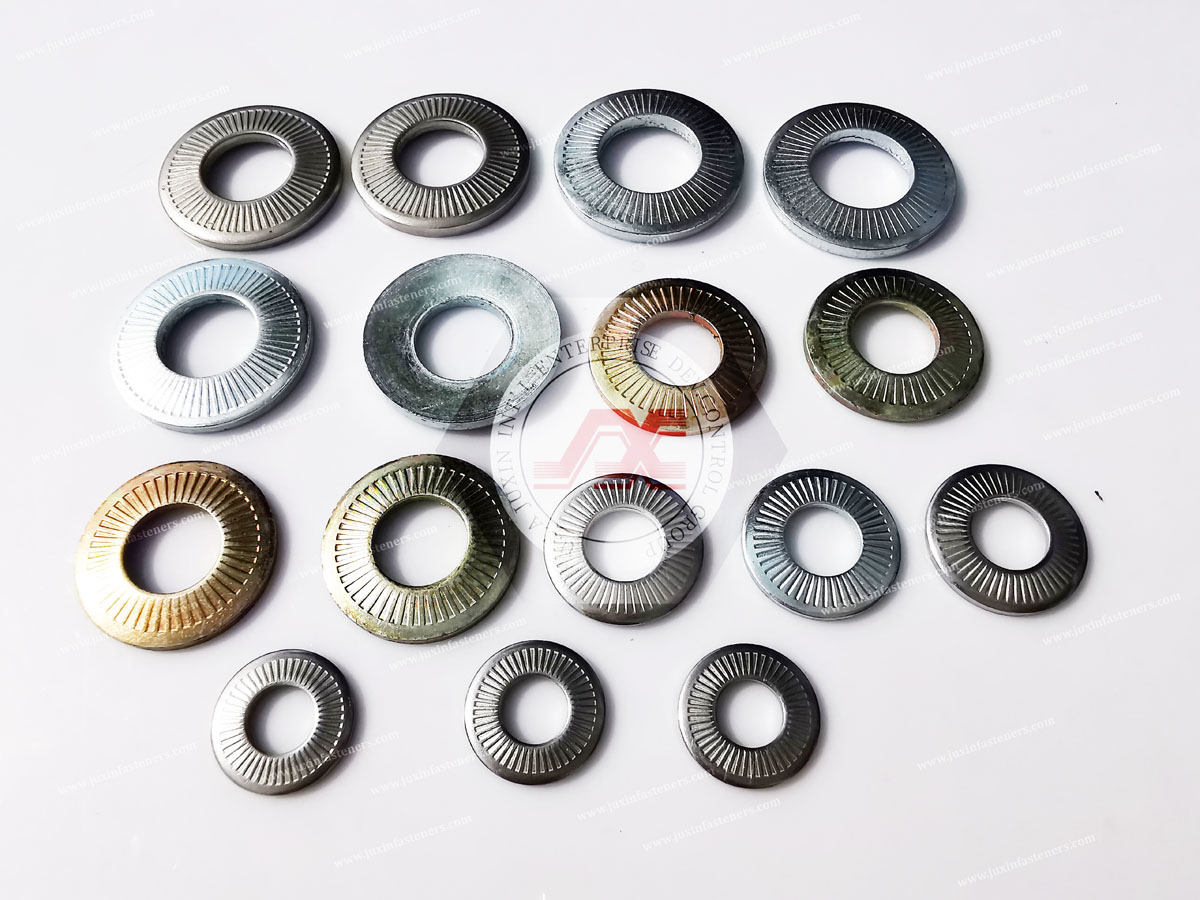
The external teeth distinguish Form A from DIN 6798 J internal serrated washers and DIN 6798 V countersunk serrated washers.
For engineers and sourcing teams, this distinction matters because tooth location changes the contact radius, outside clearance, bearing interface, and interaction with the mating surface.
JUXIN FASTENERS supplies standard and custom washers and fastening components for industrial OEM applications, supporting specification-based, drawing-based, and sample-based sourcing.
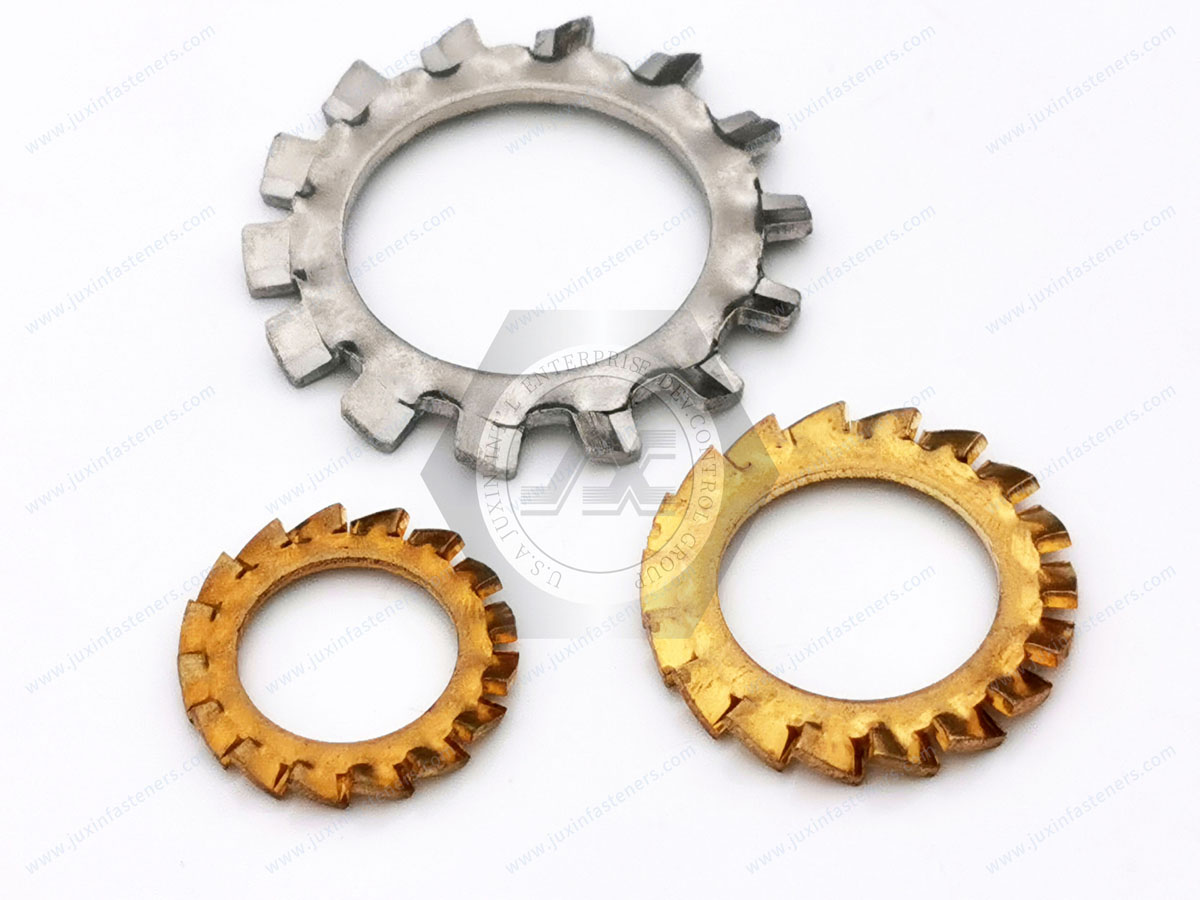
DIN 6798 A identifies the external-serration Form A configuration within the DIN 6798 washer family.
The washer has multiple formed teeth or serrations distributed around its outside region.
During tightening, the washer is compressed between the rotating fastener component and the mating surface.
Depending on the materials, surface hardness, coatings, geometry, and applied preload, the teeth can engage the contacting surfaces and contribute resistance to relative rotation.
The important product identifier is:
Form A = external serrations.
This differentiates it from:
Form J = internal serrations
and
Form V = countersunk / conical serrated configuration.
These washer forms belong to the same historical DIN product family but should not be treated as interchangeable components.
DIN 6798 is a legacy standard designation that has been withdrawn.
However, DIN 6798 terminology remains widely used in the international fastener market to identify serrated washer geometries,
dimensions, existing inventory, legacy drawings, replacement parts, and purchasing requirements.
This creates an important distinction between:
a legacy standard designation used for product identification
and
the specification requirements governing a new engineering project.
If an existing drawing calls for DIN 6798 A, procurement teams may still use that designation when sourcing a replacement component.
For a new design, engineers should confirm the applicable current project specification, customer requirement, dimensions, material,
finish, and performance requirements rather than assuming that a legacy DIN designation alone defines every requirement.
DIN 6798 washer forms solve different geometric requirements.
| Form | Geometry | Primary Selection Consideration |
|---|---|---|
| DIN 6798 A | External serrations | Larger serration radius and sufficient surrounding clearance |
| DIN 6798 J | Internal serrations | Compact outside profile and inward-facing tooth engagement |
| DIN 6798 V | Countersunk / conical serrated form | Compatibility with countersunk fastener geometry |
The nominal fastener size alone does not determine which form is correct.
Engineers should also evaluate:
fastener-head geometry;
bearing-face diameter;
available outside clearance;
mating-surface material;
surface finish;
required function.
This prevents a Form A washer from being substituted with Form J or V simply because all three are described as DIN 6798 serrated washers.
DIN 6798 A and ASME B18.21.1 external tooth lock washers may appear similar because both use external tooth geometry.
They should not be treated as the same standard product.
DIN 6798 A is associated with metric serrated washer dimensions and legacy DIN product identification.
ASME B18.21.1 covers inch-series washers.
Therefore, a sourcing request should distinguish between:
metric DIN-type external serrated washers;
inch-series ASME external tooth lock washers;
customer-drawing washers.
This is particularly important for global OEM sourcing because a visually similar metric and inch washer may have different inside diameter, outside diameter, thickness, tooth geometry, and fastener fit.
The functional feature of a Form A washer is its external serration geometry.
When the fastener is tightened, the washer is loaded between the fastener bearing surface and the mating component.
The serrations create multiple localized contact points.
Depending on the actual joint, these contact points can engage the adjacent surfaces and increase resistance to relative rotational movement.
However, this should not be interpreted as the washer automatically increasing bolt preload or clamp load.
Fastener preload is generated primarily through tightening and is influenced by:
tightening method;
thread friction;
bearing friction;
lubrication;
fastener geometry;
coating;
material;
joint stiffness.
The serrated washer affects the contact interface but does not replace correct preload design.
External teeth act at a greater radius from the fastener axis than internal teeth.
This changes the contact geometry.
Where sufficient bearing area and surrounding clearance are available, external serrations can provide multiple contact points around a relatively large radius.
However, the larger outside profile can also create limitations.
Form A may not be appropriate when:
surrounding clearance is restricted;
the washer could interfere with adjacent components;
the mating surface is too small;
external tooth marking is unacceptable;
another washer form better matches the fastener head.
This is why external versus internal serrations should be selected from the joint geometry rather than from a general assumption that one provides "better locking."
No.
An external serrated lock washer can contribute to resistance against relative rotation, but it does not make a threaded joint immune to loosening.
Joint behavior depends on factors including:
preload;
transverse movement;
vibration;
impact;
joint stiffness;
thermal cycling;
fastener material;
mating material;
surface hardness;
coatings;
lubrication;
installation process.
For joints exposed to severe vibration, cyclic transverse movement, or safety-critical loading, the complete fastening system should be validated.
Depending on the application, another locking method may be more appropriate.
Potential alternatives include:
prevailing-torque nuts;
serrated flange fasteners;
wedge-locking systems;
thread-locking compounds;
mechanical locking devices;
application-specific fastener designs.
These technologies use different locking principles and should not be treated as automatically interchangeable.
Serrated washers depend on interaction with adjacent surfaces.
If the mating surface is relatively soft, the teeth may engage it differently than they would a hardened surface.
If the surface is very hard, thickly coated, or otherwise resistant to tooth penetration, the resulting contact behavior can change.
Relevant factors include:
washer hardness;
fastener bearing-surface hardness;
substrate hardness;
coating hardness;
surface roughness;
installation preload.
Therefore, selecting an external serrated washer only by thread size overlooks one of its most important functional interfaces.
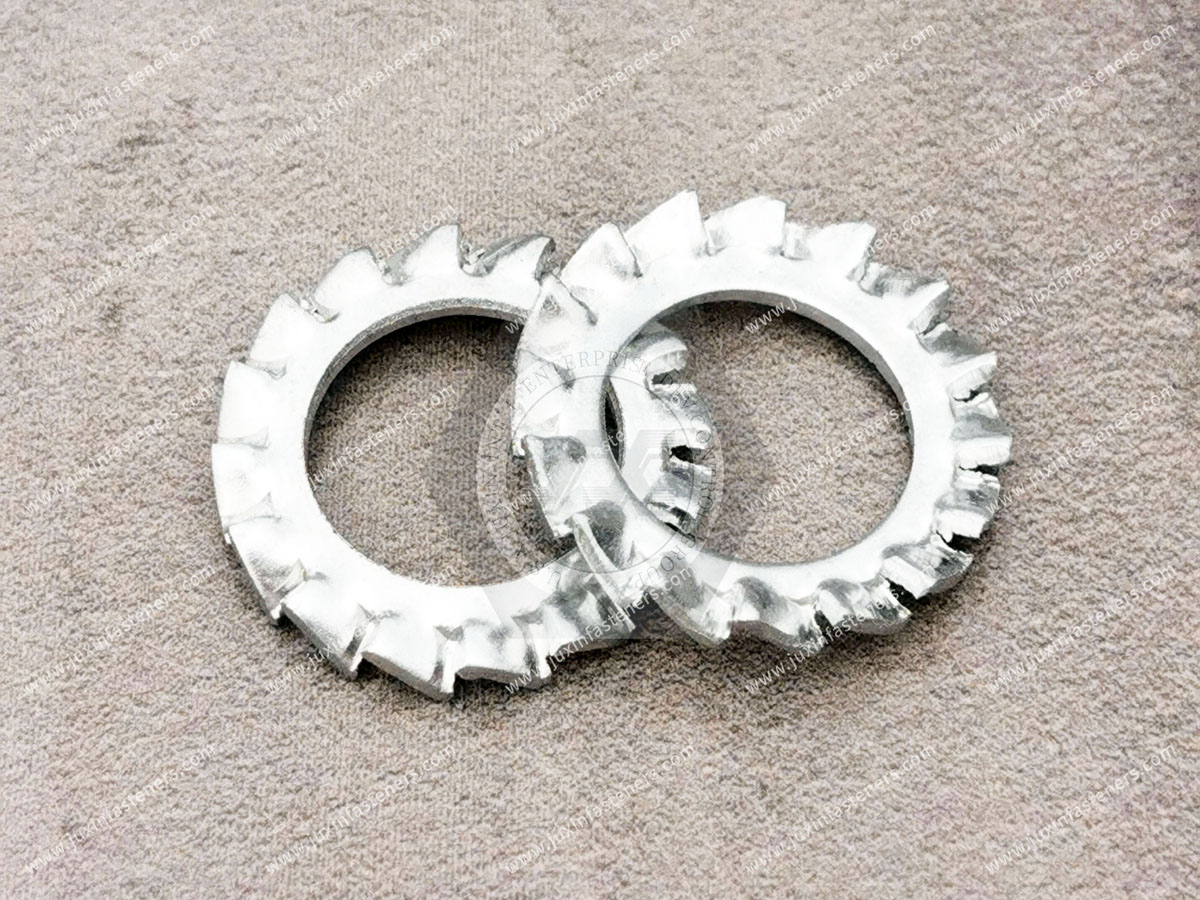
External serrations can locally disturb surface coatings during tightening.
Potential effects include:
localized coating penetration;
cosmetic marking;
exposure of base metal;
changes in friction;
changes in corrosion behavior;
changes in electrical contact.
Whether this is beneficial or undesirable depends on the application.
For decorative equipment, outdoor products, corrosion-sensitive assemblies, electrical cabinets, and coated sheet-metal structures, engineers should evaluate the washer together with the coating system.
A serrated washer should not be added after surface-finish selection without considering this interaction.
External serrated washers are commonly encountered in electrical and electronic assemblies.
Potential applications can include:
control cabinets;
electrical enclosures;
equipment housings;
mounting brackets;
switchgear;
industrial controls;
communications equipment;
power distribution equipment.
The teeth can create localized metal-to-metal contact where the surface condition allows it.
However, a serrated washer alone does not guarantee a compliant electrical grounding or bonding connection.
If electrical continuity is a functional or safety requirement, the complete connection should be evaluated for:
contact resistance;
substrate material;
coating;
contact pressure;
corrosion;
environmental exposure;
applicable electrical requirements.
Mechanical retention and electrical bonding are related in some assemblies, but they are not the same engineering requirement.
Industrial automation equipment often includes:
control assemblies;
sensors;
actuators;
brackets;
machine guards;
equipment housings;
electrical enclosures.
DIN 6798 A-type washers may be considered where their external serration geometry is compatible with the available bearing surface and surrounding clearance.
For equipment subject to repeated movement or vibration, engineers should still evaluate the complete joint rather than relying on the washer name as proof of vibration resistance.
External serrated washers can be used in suitable:
machine housings;
brackets;
guards;
electrical assemblies;
equipment panels;
mounting systems;
general threaded connections.
Their suitability depends on the mechanical joint, surface conditions, required retention strategy, and maintenance requirements.
For highly loaded structural joints, the washer should not automatically be selected simply because the assembly experiences vibration.
Metric external serrated washers may be used in suitable automotive and transportation components such as:
brackets;
electrical assemblies;
equipment housings;
accessories;
control components;
non-critical mounting systems.
They should not automatically be specified for engine internals, chassis safety joints, wheel connections, or other safety-critical locations solely because vibration is present.
Those joints require application-specific design, customer specifications, and validation.
A Form A serrated washer should not automatically replace a plain hardened washer used for load distribution in a structural bolted joint.
The two components serve different primary functions.
A plain washer may be selected to provide:
bearing-area distribution;
controlled bearing surface;
protection of the substrate;
dimensional compatibility.
A serrated washer introduces tooth engagement and localized surface interaction.
Substitution between the two changes the contact mechanics of the joint.
DIN 6798 A washers are not sealing components.
The serrated geometry does not create a defined liquid-tight or gas-tight barrier.
If an assembly requires sealing against:
water;
oil;
fuel;
hydraulic fluid;
coolant;
gas;
dust;
the sealing function should be provided by an appropriate sealing component or validated sealing system.
Locking, bearing, electrical contact, and sealing are separate engineering functions.
DIN 6798 A-type external serrated washers are available in different materials depending on the supplier, specification, and application.
Common sourcing categories include spring steel and stainless steel.
Spring steel is widely used for serrated washer designs where formed tooth geometry and mechanical behavior are required.
The actual material grade, processing condition, and hardness should follow the applicable product specification or approved drawing.
Stainless steel versions may be selected where corrosion resistance or material compatibility is important.
The exact stainless grade should be specified where the application controls material performance.
Selection should consider:
service environment;
mating fastener;
substrate material;
galvanic compatibility;
corrosion exposure;
customer material requirements.
Depending on the washer material and project requirements, potential finish categories can include:
zinc-based coatings;
phosphate-based finishes;
mechanical zinc coatings;
zinc-flake systems;
other customer-specified finishes.
Stainless washers may use material-appropriate surface finishing or passivation requirements where specified.
The coating should not be considered independently from the tooth geometry.
Coating thickness, hardness, friction, and behavior during installation can influence how the serrations interact with the mating surfaces.
Lubrication should not be added casually as a maintenance practice.
Lubrication can change friction at the threads and bearing surfaces and therefore affect the relationship between tightening torque and resulting preload.
If a joint has a specified lubricant, assembly compound, coating, or tightening procedure, those requirements should be followed.
Adding oil after the fastener system has been designed can change assembly behavior.
This is one reason the old advice to "apply lubrication when required" needs more engineering context.
Reuse should not automatically be assumed.
Tooth lock washers can be permanently affected during tightening, and the serrations can alter both the washer and the mating surfaces.
After removal:
teeth may be deformed;
contact edges may be altered;
the mating surface may contain tooth impressions;
the original installation condition may not be reproducible.
Where predictable assembly performance is required, replacement with a new washer may be appropriate according to the applicable assembly specification or quality plan.
External serrated washers normally do not require a separate "cleaning schedule" as if they were independent machine components.
Maintenance should focus on the condition of the assembled joint.
Relevant inspection questions can include:
Has the fastener moved?
Is corrosion present?
Is the washer visibly damaged?
Has the mating surface deteriorated?
Has the assembly been disassembled?
Has the operating environment changed?
This is more meaningful than routinely cleaning a serrated washer while it remains part of a bolted connection.
A practical selection process begins with the complete joint.
Is the assembly metric or inch?
For metric legacy DIN applications, DIN 6798 A terminology may be relevant.
For inch-series external tooth washers, an ASME-based product may be appropriate.
Determine whether the joint needs:
external serrations;
internal serrations;
countersunk Form V geometry;
or another washer design.
Confirm that the screw head, bolt head, or nut provides an appropriate contact interface.
External serrations require sufficient surrounding space.
Consider hardness, plating, paint, powder coating, anodizing, and other surface treatments.
Is the washer intended for:
rotational resistance;
electrical contact;
general fastening;
another specific function?
Do not assume it also provides load distribution or sealing unless those functions are separately engineered.
Consider vibration, transverse movement, corrosion, thermal cycling, maintenance, and disassembly.
Where loosening resistance, electrical continuity, or another characteristic is critical, validation should represent the actual joint.
For sourcing and supplier-development teams, "external tooth washer" alone may not fully define the requirement.
Useful RFQ information can include:
DIN 6798 A designation or customer drawing;
nominal fastener size;
washer dimensions where controlled;
material;
finish or coating;
mating fastener;
substrate material;
corrosion requirement;
electrical requirement where applicable;
inspection requirements;
packaging requirements;
order quantity;
estimated annual usage.
For legacy drawings, it is also useful to identify whether DIN 6798 A is being used as a dimensional/product reference or whether additional customer-specific requirements apply.
Legacy equipment creates an important procurement situation.
A drawing may specify DIN 6798 A even though the original standard has been withdrawn.
That does not automatically mean the existing component must be redesigned.
For replacement sourcing, the first step is to determine what the assembly actually requires.
Useful information can include:
original drawing;
washer size;
material;
finish;
physical sample;
mating fastener;
assembly photographs;
application requirements.
JUXIN FASTENERS can review the available information and help identify whether an existing DIN-type washer, drawing-controlled washer, or custom component is the appropriate sourcing path.
Existing DIN-type dimensions can meet many legacy and general industrial requirements.
Custom development may be appropriate when the project requires:
non-standard inside diameter;
modified outside diameter;
special tooth geometry;
different thickness;
application-specific material;
special coating;
modified bearing interface;
customer-controlled tolerances;
replacement of a proprietary washer.
JUXIN FASTENERS supports drawing-based and sample-based development of custom washers and application-specific fastening components.
Have a drawing? Send the drawing.
Have a CAD model? Send the available CAD data.
Have an existing washer? We can start from the physical sample.
Only have photographs and basic dimensions? Those can still provide a useful starting point.
Your old drawing says DIN 6798 A but you are unsure how to source it today? Send the drawing and current application information.
Still deciding between external and internal serrations? Send the mating fastener and assembly details.
JUXIN FASTENERS can review the available information and identify which additional details may be useful for quotation, manufacturing feasibility review, sample development, or production sourcing.
DIN 6798 A identifies the Form A external-serrated configuration within the DIN 6798 serrated washer family. The teeth are located around the outside region of the washer.
DIN 6798 A is commonly described as an external tooth or external serrated lock washer.
However, the DIN designation defines a metric legacy product family and should not be confused with inch-series external tooth washers covered by other standards.
DIN 6798 has been withdrawn, but the designation remains widely used commercially for legacy drawings, product identification, replacement parts, and sourcing.
Form A uses external serrations. Form J uses internal serrations. This changes the contact geometry, outside clearance, and bearing interface.
Form A is an external-serrated washer configuration. Form V uses a countersunk or conical geometry designed around a different fastener-head interface.
DIN 6798 A is associated with metric external-serrated washers, while ASME B18.21.1 covers inch-series washers. Their dimensions should not be assumed to be interchangeable.
They should not be described as automatically increasing clamp load. Preload is generated primarily by tightening the threaded fastener. The serrations influence the contact interfaces.
They can contribute resistance to relative rotation, but joint performance depends on preload, vibration, transverse movement, materials, coatings, and installation conditions. Critical applications require joint-level validation.
They may be used in some electrical assemblies, but the washer alone does not guarantee compliant grounding or bonding. Electrical performance should be evaluated for the complete connection.
Reuse should not automatically be assumed because tightening can alter the serrations and mating surfaces. Follow the applicable assembly or quality requirements.
Yes. JUXIN FASTENERS supports drawing-based and sample-based development of custom fastening components.
Drawings, CAD data, physical samples, photographs, dimensions, material requirements, and application information can provide the starting point.
DIN 6798 A remains an important commercial product designation even though the underlying standard has been withdrawn.
For engineers, the key is to distinguish the external-serrated Form A geometry from internal Form J, countersunk Form V, inch-series external tooth washers, plain washers, and other locking technologies.
For procurement and supplier-development teams, identifying the washer form, thread system, material, finish, mating surface, and application helps prevent incorrect substitutions and improves quotation accuracy.
JUXIN FASTENERS supports global OEM, ODM, Tier 1, Tier 2, engineering, procurement, sourcing, and supplier-development teams with standard and custom washers and application-specific fastening components.
Whether your requirement comes from a DIN 6798 A legacy drawing, an existing physical sample, a new customer drawing, or an application that still needs technical review, send us the information currently available.
We can support drawing review, application review, manufacturing feasibility evaluation, sample development, quotation, and production sourcing.
Email: info@juxinfasteners.com
Website: www.juxinfasteners.com
 MORE NEWS
Sep. 27, 2026
Sep. 27, 2026
Sep. 27, 2026
Contact Us
Tel.:
+86 020 8621 0320
+86 020 3121 6067
E-mail:
Technical Support:
Navigation
SEND INQUIREY