
Call Us
+86 136 6007 9809
Call Us
+86 136 6007 9809

Jul. 01, 2024
Hex Head Screw Manufacturing Process: Cold Heading, Thread Rolling and OEM Quality Control
Hex head screws and hex bolts are fundamental fastening components used in industrial machinery, automotive equipment,
electrical systems, construction equipment and many other engineered assemblies.
Although these fasteners may appear simple, their manufacturing process involves several decisions that influence dimensional consistency,
mechanical properties, corrosion protection and installation reliability.
A hexagonal head allows tightening with a wrench or socket, while the threaded shank provides the connection to a mating nut or internally threaded component.
For industrial OEMs, the quality of a hex head screw cannot be judged by appearance alone.
The finished product must satisfy the required geometry, thread specification, material properties and application-specific performance criteria.
At JUXIN FASTENERS, we supply industrial hex head screws, hex bolts, high-strength fasteners and drawing-based OEM fastening components for international manufacturers.
This guide explains the principal manufacturing processes, from material preparation and cold heading to thread rolling, heat treatment, surface finishing and inspection.
It also addresses the engineering and purchasing decisions that connect fastener manufacturing with reliable volume assembly.
Why the Manufacturing Process Matters
The performance of a hex head screw depends on the interaction of several characteristics:
Material composition and condition
Head and shank geometry
Thread dimensions and tolerances
Manufacturing method
Heat-treatment condition
Surface finish
Joint design
Installation procedure
Manufacturing variation can influence thread fit, tool engagement, tightening behavior and mechanical performance.
However, the manufacturing process alone does not establish the reliability of the finished joint.
Correct product selection, mating components and assembly controls are equally important.
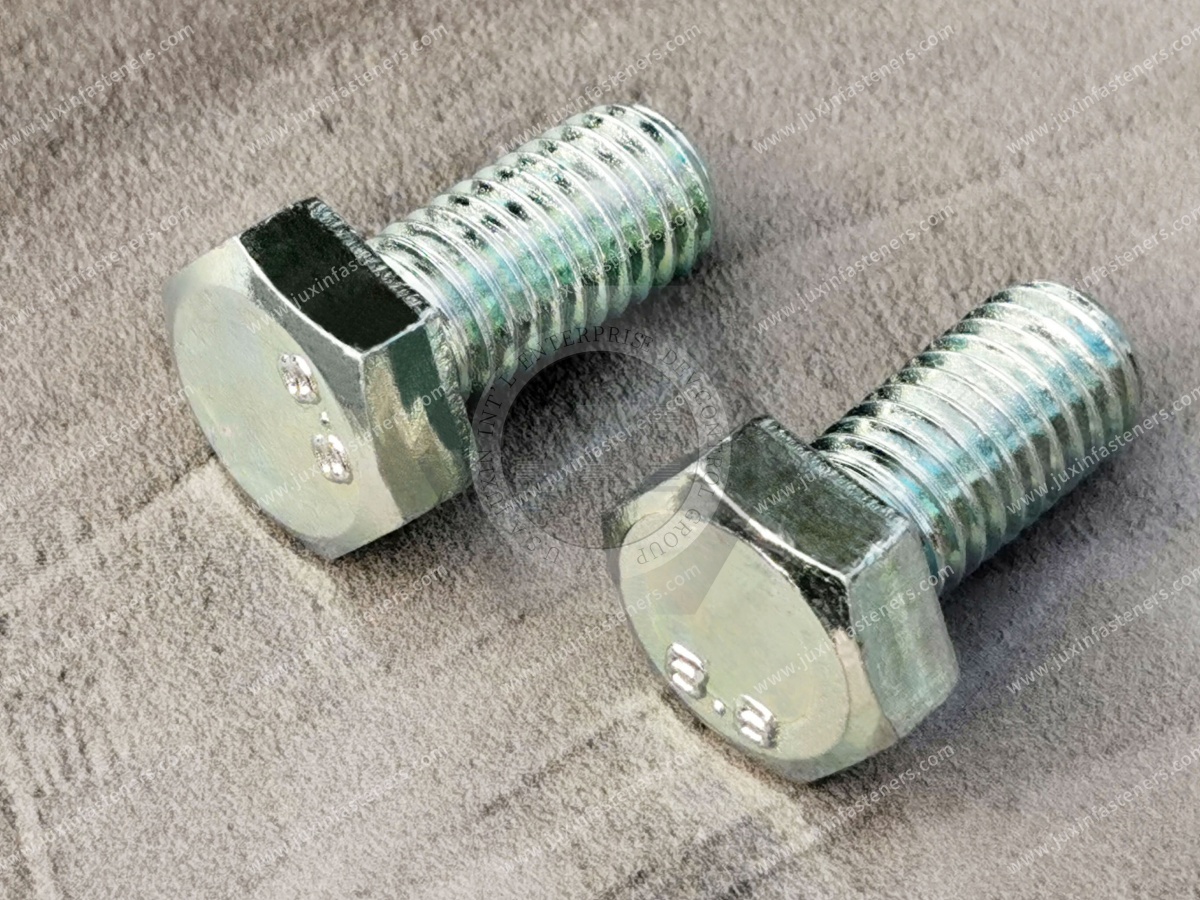
Hex Head Screws, Hex Bolts and International Standards
The terms hex head screw and hex bolt are often used broadly in industrial purchasing.
For technical procurement, the exact product specification is more important than the general commercial name.
ISO 4014
ISO 4014 covers hexagon head bolts with defined product dimensions and configurations.
ISO 4017
ISO 4017 covers hexagon head screws with defined product dimensions and configurations.
These standards are commonly associated with metric hexagonal-head fasteners.
ISO 898-1
ISO 898-1 defines mechanical property requirements for specified metric carbon steel and alloy steel fasteners.
ISO 3506-1
ISO 3506-1 is relevant to specified stainless steel fastener mechanical properties.
ASME and Unified Inch Threads
For inch-series products, applicable ASME dimensional and thread standards should be identified separately.
UNC and UNF are Unified inch-series thread systems.
Important Compatibility Rule
Metric, UNC, UNF, BSW and BSF threads are different systems.
They must not be treated as interchangeable merely because their nominal diameters appear similar.
Manufacturing Route Selection: Cold Heading vs. CNC Machining
Before production begins, the manufacturer must select a suitable manufacturing route.
The decision depends on:
Product geometry
Material
Mechanical requirements
Dimensional tolerances
Production volume
Tooling requirements
Delivery schedule
Cold Heading
Cold heading is commonly used for suitable standard and high-volume hex head fasteners.
It forms the head by plastically deforming the starting material.
CNC Machining
CNC machining may be appropriate for selected custom fasteners, prototypes, special materials or geometries that are unsuitable for economical cold forming.
Manufacturing Decision Matrix
| Requirement | Potential manufacturing route | Main consideration |
|---|---|---|
| Standard high-volume hex bolts | Cold heading | Tooling and production efficiency |
| Custom low-volume fasteners | CNC machining | Flexibility and setup cost |
| Special head geometry | Forming or machining | Geometry and tolerances |
| Difficult-to-form material | Machining or specialized forming | Material behavior |
| Prototype development | Suitable machining or forming route | Design verification |
The most economical process should be determined from the actual drawing and forecast demand.
Raw Material Selection
Raw material selection is the foundation of the manufacturing process.
Common material categories include:
Carbon steel
Medium-carbon steel
Alloy steel
Boron-alloyed steel
Stainless steel
Brass
Aluminum alloys
Titanium alloys
The appropriate material depends on mechanical loading, corrosion exposure, operating temperature, manufacturing method and customer specifications.
Carbon Steel
Carbon steel is widely used for general industrial fasteners.
Its suitability depends on the grade, condition and finished mechanical requirements.
Alloy Steel
Selected alloy steels may be used where specified mechanical properties require suitable heat treatment.
Stainless Steel
Stainless steel may be selected for applications requiring suitable corrosion resistance.
A2 and A4 stainless steel fastener designations are commonly encountered.
Brass
Brass may be appropriate for selected electrical and mechanical applications where its conductivity and material properties are useful.
Aluminum and Titanium Alloys
These materials may be considered for specialized lightweight components, subject to the actual design requirements.
Important Engineering Principle
A raw material designation does not automatically establish the finished fastener's property class.
The finished product must satisfy the applicable mechanical specification.
Steel Wire Preparation and Spheroidizing Annealing
For suitable cold-headed steel fasteners, material preparation may involve several operations before forming.
Depending on the supplied wire condition and manufacturing route, these may include:
Annealing
Descaling
Surface preparation
Lubrication
Wire drawing
The sequence is not universal.
Spheroidizing Annealing
Spheroidizing annealing may be used for certain steels to improve cold formability.
Potential benefits include:
Reduced forming resistance
Improved ductility
Reduced risk of forming defects
Whether annealing is necessary depends on the material and starting condition.
Surface Descaling
Oxide scale and surface contamination may need to be removed before subsequent processing.
Possible methods include mechanical or chemical surface preparation.
Why Surface Preparation Matters
Poor surface condition can contribute to:
Tool wear
Forming defects
Surface damage
Process instability
Wire Drawing
Wire drawing reduces or controls wire diameter through suitable dies.
It may also influence surface condition and material properties.
Production Recommendation
Wire diameter, material condition and surface quality should be controlled according to the intended forming process.
Cold Heading and Hexagonal Head Formation
Cold heading forms the fastener head by deforming material without extensive chip removal.
Suitable equipment may include single-die or multi-station forming systems.
The process may produce:
Hexagonal head geometry
Underhead features
Shank configuration
Selected flange or collar features
The exact operations depend on the product.
Why Cold Heading Is Common
Potential benefits include:
Efficient material utilization
High-volume manufacturing capability
Repeatable dimensions under controlled conditions
Reduced machining requirements
Engineering Limitations
Cold heading is not automatically superior for every design.
Its feasibility depends on:
Material formability
Head dimensions
Head-to-shank ratio
Tooling configuration
Production quantity
Required tolerances
Common Cold-Heading Defects
Potential defects include:
Head cracks
Incomplete head formation
Excessive flash
Dimensional variation
Surface damage
Tooling-related defects
Quality-Control Recommendation
Inspect critical head dimensions and forming defects according to the approved specification and inspection plan.
Thread Rolling Process
Thread rolling is commonly used to manufacture external threads on suitable high-volume fasteners.
The process forms threads by plastically displacing material between dies.
Unlike thread cutting, it does not create the thread profile primarily by removing chips.
Potential Benefits
Efficient production
Good repeatability under controlled conditions
Suitable surface characteristics
Potential fatigue-related advantages in certain designs
However, rolled threads do not automatically guarantee higher fatigue life or greater load capacity in every application.
Critical Thread Characteristics
Nominal diameter
Thread pitch
Thread profile
Pitch diameter
Thread length
Thread tolerance
Surface condition
Common Thread Defects
Incorrect pitch diameter
Incomplete thread formation
Damaged thread
Poor thread profile
Burrs
Surface defects
Thread Inspection
Suitable thread gauges and dimensional inspection methods should be used according to the specified thread standard.
Rolled Threads vs. Cut Threads
| Feature | Thread rolling | Thread cutting |
|---|---|---|
| Method | Plastic deformation | Material removal |
| Common application | Suitable volume production | Selected custom or machined parts |
| Material suitability | Requires adequate formability | Depends on machinability |
| Tooling | Rolling dies | Cutting tools |
| Fatigue performance | Design and process dependent | Design and process dependent |
| Dimensional control | Process dependent | Process dependent |
Engineering Recommendation
Specify the required thread geometry, tolerance and mechanical performance.
Do not assume that the manufacturing method alone proves compliance.
Heat Treatment for High-Strength Hex Bolts
Certain steel hex bolts require controlled heat treatment to achieve their specified mechanical properties.
For applicable carbon steel and alloy steel fasteners, quenching and tempering may be relevant.
Mechanical Property Classes
Metric fasteners may be specified using property classes such as:
8.8
10.9
12.9
These designations describe defined mechanical property requirements under the applicable standard.
They should not be interpreted as simple material grades.
Heat-Treatment Variables
Material composition
Temperature
Holding time
Cooling conditions
Tempering conditions
Part geometry
Potential Heat-Treatment Problems
Excessive distortion
Surface decarburization
Undesired hardness variation
Cracking
Failure to meet specified mechanical properties
Important Limitation
A higher property class does not automatically provide better performance in every joint.
The mating components, preload, fatigue conditions and environment must also be considered.
Surface Finishing and Corrosion Protection
Surface treatment is selected according to environmental exposure, appearance, friction requirements and customer specifications.
Potential finishes include:
Zinc plating
Zinc-nickel plating
Zinc-flake coating
Mechanical zinc coating
Black oxide
Phosphate-based finishes
Nickel plating
Other approved coating systems
Stainless steel fasteners may require different surface preparation or passivation processes depending on the specification.
Zinc Plating
May provide suitable corrosion protection for selected general industrial environments.
Zinc-Nickel Plating
May be considered where specified corrosion protection is required.
Zinc-Flake Coating
May be suitable for selected industrial fastening systems.
Black Oxide
Provides a dark appearance with corrosion protection dependent on the complete treatment.
Important Technical Consideration: Hydrogen Embrittlement
Certain high-strength steel fasteners may be susceptible to hydrogen embrittlement associated with particular processing conditions.
The coating process and relevant preventive controls should therefore be reviewed according to the product specification.
Relevant Coating Standards
ISO 4042 may be applicable to electroplated fasteners.
ISO 10683 may be applicable to specified non-electrolytically applied zinc-flake coating systems.
Corrosion Testing
Salt spray performance must be defined using an applicable test method and acceptance criteria.
No universal salt spray duration should be assumed from a coating name alone.
Why Surface Finish Affects Assembly
A coating can influence:
Thread fit
Friction
Torque-to-preload behavior
Corrosion performance
Appearance
Changing the coating may require renewed assembly validation.
Quality Inspection of Hex Head Screws
Inspection should focus on the characteristics that determine conformity and assembly reliability.
Raw Material Verification
Depending on the project, this may include material identification and required documentation.
Dimensional Inspection
Potential checks include:
Width across flats
Head height
Screw length
Shank diameter
Thread length
Underhead geometry
Thread Inspection
Thread gauges and suitable dimensional methods may be used to verify the specified thread requirements.
Mechanical Property Testing
Depending on the applicable specification, relevant testing may include:
Hardness
Tensile strength
Proof-load performance
Other specified mechanical tests
Surface Inspection
Potential checks include:
Coating thickness
Surface condition
Appearance
Corrosion-related test requirements
Important Supplier Qualification Principle
Not every test is necessarily performed on every production batch.
The actual inspection plan, sampling requirements, reports and acceptance criteria should be agreed during supplier qualification and purchasing.

Engineering Design: Head Geometry and Tool Engagement
Hexagonal head geometry affects installation access and tool engagement.
Important Dimensions
Width across flats
Head height
Bearing surface
Underhead radius
Available wrench clearance
Common Assembly Problems
Rounded hexagonal head
Insufficient wrench engagement
Tool interference
Damaged bearing surface
Design Recommendation
Check the required tool access and surrounding component clearance before approving the fastener.
Thread Engagement and Joint Design
The correct screw length and thread engagement are essential.
Engineering Checks
Grip length
Mating thread depth
Thread engagement
Hole clearance
Joint stiffness
Required preload
Potential Failure: Bottoming in a Blind Hole
A screw may reach the bottom of a blind tapped hole before the joint is properly clamped.
This can create misleading tightening results.
Potential Failure: Thread Stripping
Insufficient thread engagement or unsuitable mating material may lead to thread failure.
Engineering Recommendation
Evaluate the complete bolted joint rather than selecting screw length solely from nominal dimensions.
Torque, Preload and Assembly Reliability
Applied tightening torque is not the same as achieved bolt preload.
A simplified relationship is:
T ≈ K × F × d
Where:
T = applied tightening torque
K = simplified torque coefficient
F = bolt preload
d = nominal diameter
This is an approximate relationship, not a universal torque specification.
Factors Affecting Preload
Thread friction
Underhead friction
Lubrication
Surface coating
Joint stiffness
Tightening method
Production Recommendation
Validate tightening conditions using the actual fastener, mating components and surface finish.
Vibration Loosening and Fatigue
A standard hex head screw is not inherently self-locking.
Potential causes of loosening include:
Insufficient preload
Joint movement
Embedment
Relaxation
Transverse vibration
Depending on the application, appropriate measures may include:
Controlled preload
Suitable locking nuts
Approved threadlocking compounds
Mechanical locking features
Improved joint design
Fatigue Performance
Fatigue life depends on cyclic loading, preload, thread geometry, material condition and joint stiffness.
The fastener property class alone does not determine fatigue performance.
Industrial Applications
Automotive and Electric Vehicle Equipment
Potential applications include:
Mechanical brackets
Equipment housings
EV battery equipment supports
Vehicle production fixtures
Auxiliary mechanical assemblies
Engineering Considerations
Vibration
Corrosion
Temperature
Preload
Tool access
General industrial fasteners are not automatically qualified for safety-critical steering, braking or suspension connections.
Industrial Machinery
Potential applications include:
CNC machine assemblies
Pumps
Gearboxes
Mechanical fixtures
Automation equipment
Material handling systems
Engineering Considerations
Joint stiffness
Thread engagement
Maintenance access
Mechanical loading
Electrical and Power Equipment
Potential applications include:
Electrical cabinets
Switchgear housings
Control panels
Power conversion equipment
Mechanical equipment supports
Engineering Considerations
Sheet metal thickness
Coating compatibility
Electrical clearance
Mechanical stability
HVAC Equipment
Potential applications include:
Ventilation equipment
Mechanical brackets
Compressor accessories
Equipment housings
Engineering Considerations
Vibration
Corrosion
Maintenance access
Railway Equipment
Hex head fasteners may be used in approved auxiliary mechanical assemblies.
Safety-critical railway connections require application-specific qualification.
Aerospace-Related Equipment
Specialized fasteners may be considered for approved aerospace-related support equipment and mechanical assemblies.
General industrial hex bolts are not automatically qualified for flight-critical applications.
Medical and Laboratory Equipment
Suitable hex head fasteners may be used in approved equipment housings, support structures and mechanical assemblies.
Material, cleanliness and regulatory requirements depend on the actual application.
Construction and Heavy Equipment
Hex bolts may be used in selected machinery and equipment assemblies.
Structural steel bolting applications require their own applicable specifications and approval.
Production-Line Quality and Batch Consistency
Manufacturing engineers and production managers should evaluate both fastener conformity and assembly process stability.
Incoming Inspection
Depending on project requirements, checks may include:
Product identification
Head dimensions
Thread dimensions
Material documentation
Mechanical property documentation
Coating condition
Assembly Validation
Verify:
Correct screw length
Adequate thread engagement
Suitable tightening method
Required preload
Acceptable tool engagement
No interference or bottoming
Tooling Control
Wrenches, sockets and powered tools should be compatible with the fastener head.
Rework Control
Define when fasteners may be reused and when replacement is required.
Damaged heads, threads or bearing surfaces may justify replacement.
Production Problem Matrix
| Problem | Possible cause | Recommended review |
|---|---|---|
| Rounded head | Incorrect or worn tool | Tool compatibility |
| Cross-threading | Misalignment | Thread-starting process |
| Variable tightening | Friction variation | Assembly validation |
| Thread stripping | Insufficient engagement | Joint design |
| Screw bottoming | Incorrect length | Hole depth |
| Corrosion complaints | Unsuitable finish | Coating specification |
| Repeated loosening | Joint movement | Preload and locking method |
| High rejection rate | Process variation | Manufacturing controls |
OEM Custom Hex Head Screws
Custom hex head screws may require features outside standard product configurations.
Potential drawing-specific requirements include:
Nominal thread diameter
Thread pitch
Screw length
Head dimensions
Thread length
Shank geometry
Underhead features
Material
Mechanical properties
Surface finish
Dimensional tolerances
Manufacturing Feasibility
The drawing should be reviewed against the proposed manufacturing route.
Cold heading may be appropriate for certain volume requirements.
CNC machining may be considered for selected custom designs.
The final decision depends on geometry, material, tolerances, tooling and purchasing volume.
OEM Procurement and Supplier Qualification
Procurement managers and supplier development teams should compare fasteners using complete technical specifications.
Recommended RFQ Information
| Requirement | Information to provide |
|---|---|
| Product | Hex head screw or hex bolt |
| Standard | ISO 4014, ISO 4017 or approved drawing |
| Thread | Nominal diameter and pitch |
| Length | Screw length |
| Head geometry | Required dimensions |
| Material | Approved material |
| Mechanical properties | Required property class |
| Coating | Surface treatment |
| Application | Equipment and operating environment |
| Assembly | Tightening and locking requirements |
| Inspection | Acceptance criteria |
| Samples | Prototype or approval quantity |
| Purchasing volume | Batch and annual demand |
| Delivery | Target schedule |
Supplier Substitution Checklist
Before approving an alternative product, verify:
Thread compatibility
Head dimensions
Screw length
Material
Mechanical properties
Coating
Tightening behavior
Inspection requirements
A visually similar fastener may not be technically equivalent.
Total Installed Cost
For high-volume OEM production, purchasing decisions should consider:
Unit price
Tooling
Assembly cycle time
Inspection
Rework
Inventory
Supplier qualification
Delivery reliability
A lower fastener unit price does not always produce the lowest installed cost.
Frequently Asked Questions
How are hex head screws manufactured?
Suitable high-volume products are commonly manufactured using material preparation, cold heading,
thread rolling, heat treatment where required, surface finishing and inspection.
Are all hex bolts cold forged?
No. Certain custom or specialized fasteners may be machined or produced using other suitable processes.
Why is thread rolling used?
Thread rolling is an efficient external-thread manufacturing process for suitable materials and production volumes.
Does cold heading always improve strength?
No. Finished mechanical performance depends on material, geometry, processing and the applicable specification.
What is the difference between ISO 4014 and ISO 4017?
They define different hexagonal-head fastener product configurations.
The applicable standard should be selected according to the required product.
Are class 10.9 and 12.9 bolts always better than class 8.8?
No. The correct property class depends on the complete joint design and operating conditions.
Can stainless steel hex bolts replace high-strength alloy steel bolts?
Not automatically. Mechanical properties, corrosion requirements and joint design must be reviewed.
Can JUXIN FASTENERS review custom hex bolt drawings?
Yes. Drawing-based inquiries can be reviewed for geometry, material, mechanical properties, surface finish and quotation requirements.
JUXIN FASTENERS: Hex Head Screws and OEM Fastening Solutions
JUXIN FASTENERS supplies industrial fastening components and supports drawing-based OEM inquiries for international manufacturers.
Relevant product categories include:
Hex head screws
Hex bolts
High-strength bolts
Alloy steel fasteners
Stainless steel fasteners
Hex flange bolts
Socket head cap screws
Thread-cutting screws
Self-tapping screws
Weld nuts
Blind rivet nuts
Lock nuts
Threaded inserts
Custom CNC-machined fasteners
Specific dimensions, materials, property classes, coatings, inspection requirements, MOQ and lead time are confirmed during project review.
Request a Hex Head Screw Engineering Review and OEM RFQ
Are you sourcing ISO 4014 hex bolts, ISO 4017 hex head screws, high-strength steel fasteners, stainless steel hex bolts or drawing-based custom fasteners for industrial equipment?
JUXIN FASTENERS welcomes inquiries from design engineers, structural engineers, mechanical engineers, manufacturing engineers, production managers,
procurement specialists, purchasing managers, supplier development teams and supply chain managers.
For an efficient technical and commercial review, please provide:
2D drawing or applicable standard + thread designation + screw length + head dimensions + material + mechanical property class + coating
+ application + tightening requirements + inspection criteria + sample quantity + annual purchasing volume + target delivery schedule
Our team can review your requirements, discuss suitable standard or drawing-based options, confirm sample arrangements and prepare quotation information.
Company: Juxin Fasteners
Website: https://www.juxinfasteners.com/
Email: info@juxinfasteners.com
Send your hex head screw drawings and RFQ to JUXIN FASTENERS for technical evaluation and quotation.
Contact Us
Tel.:
+86 020 8621 0320
+86 020 3121 6067
E-mail:
Technical Support:
Navigation
SEND INQUIREY



