
Call Us
+86 136 6007 9809
Call Us
+86 136 6007 9809

Jul. 01, 2024
Flange Nut Manufacturing Process: DIN 6923, Quality Control and OEM Sourcing
Flange nuts are widely used in industrial mechanical assemblies where a threaded fastening component with an integral bearing surface is required.
A hex flange nut combines a hexagonal nut body with a flange beneath the nut. Compared with a conventional hex nut without a washer,
this design can provide a larger bearing surface and may reduce the number of separate assembly components.
However, a larger flange does not automatically guarantee uniform load distribution, prevent vibration loosening or eliminate the need for every type of washer.
Reliable performance depends on the complete bolted joint, including material properties, thread engagement, flange geometry, tightening conditions and the mating components.
For design engineers, flange nut selection begins with dimensional compatibility, bearing pressure, thread strength and joint loading.
For manufacturing engineers and production managers, the important questions concern forming feasibility, thread quality, automated assembly, process stability and inspection.
For purchasing managers and supplier development teams, the decision also involves manufacturing route, technical equivalence,
material and coating requirements, MOQ, lead time and long-term supply consistency.
JUXIN FASTENERS supplies industrial flange nuts, locking nuts and drawing-based fastening components for international OEM applications.
This guide explains flange nut manufacturing methods, engineering considerations, common defects, industrial applications and supplier qualification requirements.
What Is a Hex Flange Nut?
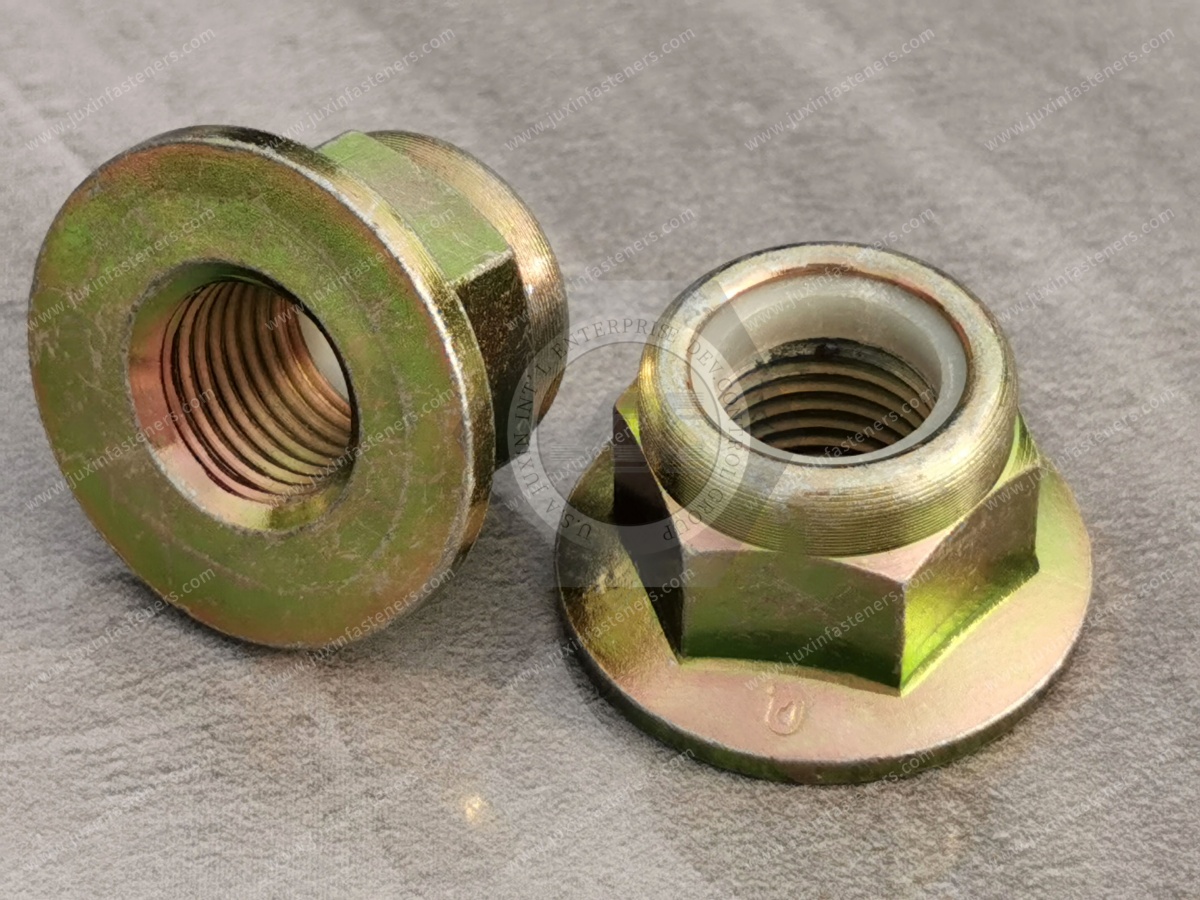
A hex flange nut is an internally threaded fastener with an external hexagonal drive and an integral flange at one end.
Its principal features include:
Hexagonal wrenching surfaces
Internal thread
Integral flange
Defined overall height
Specified flange diameter
Defined material and mechanical properties
The flange provides a bearing surface that may be larger than the bearing face of a conventional hex nut.
This can be useful where the joint design benefits from a wider contact area.
Key Engineering Consideration
The effective bearing area depends on flange geometry, contact flatness, surface condition and the mating material.
An integral flange does not automatically replace a hardened washer, sealing washer or other specially specified washer.
DIN 6923 Flange Nuts and Product Variations
DIN 6923 is a widely recognized designation for hexagon flange nuts.
However, procurement teams should identify the exact product configuration rather than relying on the generic description flange nut.
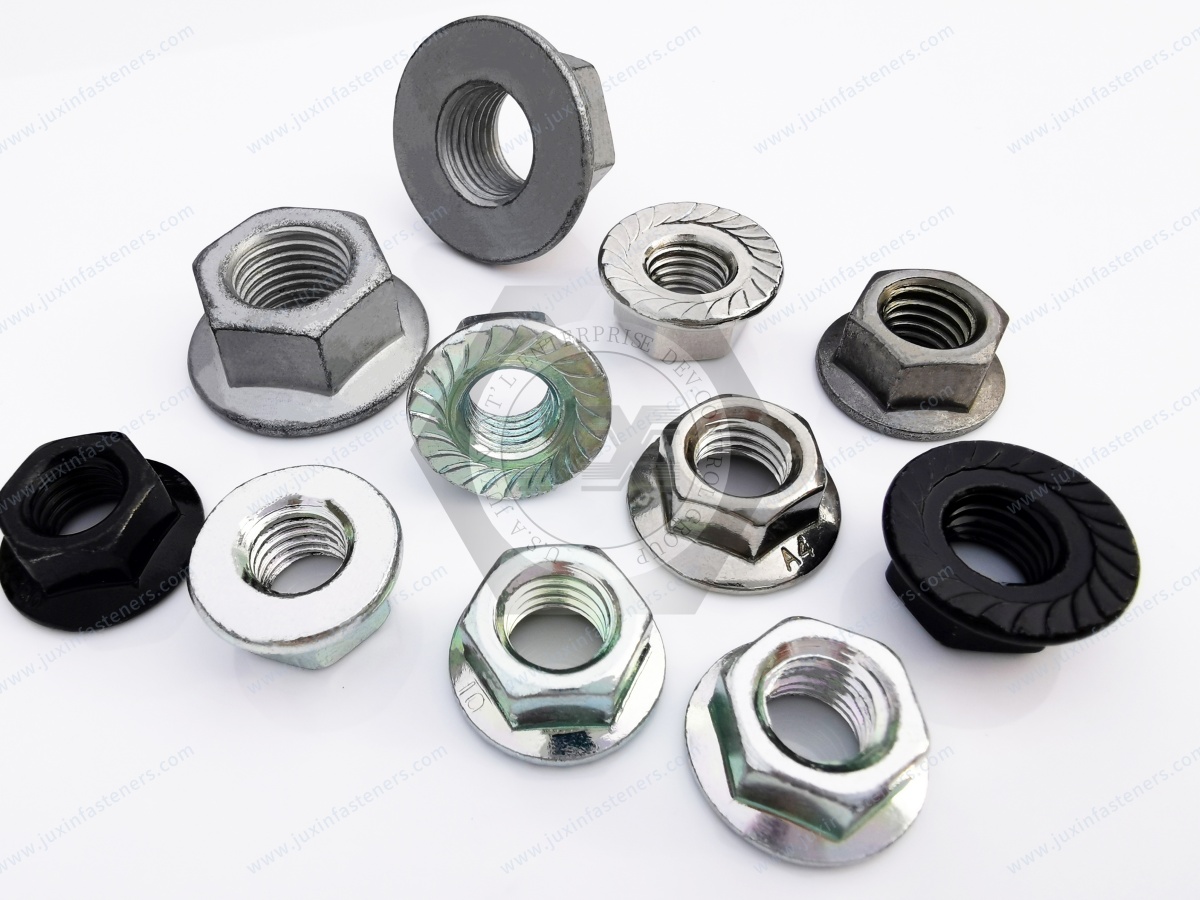
Non-Serrated Hex Flange Nuts
These have a flange bearing surface without intentional locking serrations.
They may be suitable for selected machinery, equipment housings and general industrial connections.
Serrated Flange Nuts
These incorporate serrations beneath the flange.
The serrations may provide additional resistance to rotation in certain assemblies by interacting with the mating surface.
However, their effectiveness depends on the joint and must not be assumed for all vibration conditions.
All-Metal Locking Flange Nuts
These incorporate a prevailing-torque locking feature, depending on the design.
Their locking function is different from the bearing function of the flange.
Nylon Insert Locking Nuts
Nylon insert locking nuts are another fastening category and should not be treated as equivalent to an all-metal locking flange nut.
Product Selection Matrix
| Product type | Main characteristic | Critical review |
|---|---|---|
| Non-serrated flange nut | Integral bearing flange | Contact pressure and preload |
| Serrated flange nut | Flange with serrations | Surface damage and locking performance |
| All-metal locking flange nut | Prevailing-torque feature | Reuse, temperature and locking requirements |
| Nylon insert lock nut | Polymeric locking insert | Temperature and chemical compatibility |
| Custom flange nut | Drawing-specific geometry | Manufacturing feasibility and approval |
Engineering Recommendation
Identify the exact flange and locking configuration on the drawing or purchase specification.
How Are Flange Nuts Manufactured?
Flange nut manufacturing depends on the product geometry, material, mechanical requirements and purchasing volume.
Two important manufacturing routes are cold forming and CNC machining.
Cold Forming
Cold forming is commonly used for suitable standard and high-volume flange nut production.
CNC Machining
CNC turning and milling may be appropriate for selected custom geometries, low-volume orders or materials that are difficult to form.
The correct manufacturing route should be selected after reviewing the actual drawing and production requirements.
Manufacturing Stage 1: Raw Material Selection
The manufacturing process begins with material selection.
Potential materials include:
Carbon steel
Alloy steel
Stainless steel
Brass
Other drawing-specified materials
Material selection depends on:
Mechanical requirements
Formability
Machinability
Corrosion exposure
Temperature
Thread performance
Cost
Carbon Steel
May be suitable for general industrial flange nuts where the specified mechanical properties and corrosion protection requirements are satisfied.
Alloy Steel
May be selected where particular mechanical properties or heat-treatment responses are required.
Stainless Steel
May be selected for suitable corrosion-sensitive applications.
A2 and A4 stainless steel fastener designations are commonly encountered.
Brass
May be considered for selected electrical, mechanical or corrosion-related applications where its properties are appropriate.
Important Principle
Material grade and finished fastener property class are different requirements.
A particular steel grade does not automatically establish the finished nut's mechanical performance.
Manufacturing Stage 2: Material Preparation
For cold-formed flange nuts, suitable wire or bar stock may be prepared for the forming process.
For machined products, bar stock or other suitable starting material may be used.
Relevant controls can include:
Material identification
Starting dimensions
Surface condition
Material consistency
The actual preparation method depends on the manufacturing route.
Manufacturing Stage 3: Cold Heading and Flange Formation
Cold forming can produce the nut body and flange through suitable forming operations.
Depending on the tooling and product design, the process may include:
Material upsetting
Hexagonal body formation
Flange formation
Hole preparation
Dimensional control
Potential Manufacturing Benefits
Efficient material utilization
Suitability for volume production
Repeatable geometry under controlled conditions
Reduced machining requirements
Manufacturing Limitations
Cold forming feasibility depends on:
Material formability
Flange diameter
Nut height
Hexagonal dimensions
Hole geometry
Tooling design
Production quantity
OEM Design Recommendation
Large flange diameters or unusual geometries should be reviewed for forming feasibility before tooling is approved.
Manufacturing Stage 4: CNC Turning and Milling for Custom Flange Nuts
Not every flange nut requires CNC machining.
However, machining may be appropriate for selected custom products.
Potential Machining Operations
Turning the flange diameter
Machining special profiles
Producing non-standard heights
Milling wrenching features
Preparing special holes
Finishing drawing-specific dimensions
When CNC Machining May Be Appropriate
Prototype development
Selected low-volume orders
Unusual flange geometry
Special materials
Drawing-specific dimensional requirements
Commercial Consideration
A machined prototype and a cold-formed production version may have different tooling, unit cost and dimensional characteristics.
Before moving from prototype to volume production, the manufacturing route should be reviewed and approved.
Manufacturing Stage 5: Internal Thread Tapping
Internal thread quality is critical to flange nut performance.
The thread must engage correctly with the specified mating screw or bolt.
Important Thread Characteristics
Nominal diameter
Thread pitch
Thread tolerance
Thread alignment
Effective thread engagement
Surface condition
Potential Thread Defects
Oversized thread
Undersized thread
Damaged thread
Incomplete thread
Poor alignment
Burrs
Contamination
Thread Inspection
Suitable thread gauges and inspection methods may be used according to the product specification.
Production Implication
A flange nut may appear dimensionally correct externally while still having an unacceptable internal thread.
For high-volume OEM assembly, thread defects can cause feeding problems, installation delays, cross-threading and rework.
Metric and Inch Thread Systems
Metric threads should be specified using the applicable ISO thread designation.
UNC and UNF are different Unified inch-series thread systems.
BSW and BSF are separate thread systems.
These systems are not directly interchangeable.
Important Rule
A nominal metric-to-inch diameter conversion does not establish thread compatibility.
Manufacturing Stage 6: Heat Treatment
Some steel flange nuts require heat treatment to achieve specified mechanical properties.
The process depends on the material and product specification.
Potential Requirements
Hardness
Proof-load performance
Material condition
Mechanical strength
ISO 898-2 may be relevant for specified metric carbon steel and alloy steel nuts.
Important Limitation
Heat treatment does not automatically guarantee better fatigue performance or longer service life.
The finished nut must meet the applicable requirements.
Manufacturing Stage 7: Surface Treatment
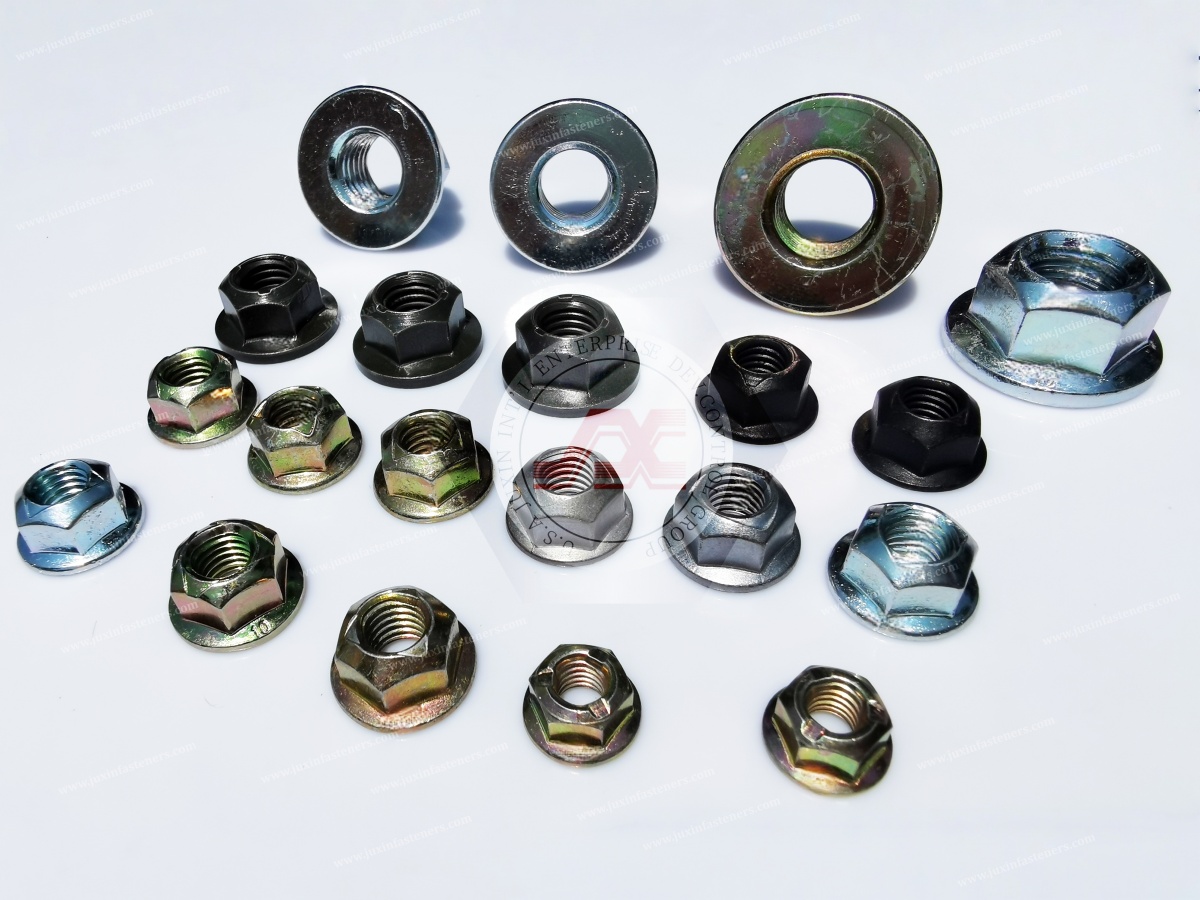
Surface treatment may be used for corrosion protection, appearance or assembly requirements.
Zinc Plating
May provide suitable corrosion protection in selected industrial environments.
Zinc-Nickel Coating
May be considered where specified corrosion protection is required.
Zinc-Flake Coating
May be suitable for certain fastener systems depending on the coating specification.
Black Oxide
Provides a dark appearance with corrosion performance dependent on the complete treatment.
Stainless Steel
May be selected where suitable corrosion resistance is required without relying on a conventional plated steel configuration.
Relevant Standards
ISO 4042 may apply to electroplated fasteners.
ISO 10683 may apply to specified non-electrolytically applied zinc-flake coating systems.
Important Production Consideration
Coating can affect thread fit and friction.
The thread and coating specifications must therefore be considered together.
Manufacturing Stage 8: Inspection and Quality Control
Quality control should address the characteristics that affect both assembly and joint performance.
Dimensional Inspection
Potential checks include:
Width across flats
Nut height
Flange diameter
Flange thickness
Hole geometry
Internal thread dimensions
Mechanical Property Verification
Depending on the specification, relevant tests may include:
Hardness
Proof-load testing
Other required mechanical tests
Surface Inspection
Potential checks include:
Coating appearance
Coating thickness
Surface defects
Corrosion-related test requirements
Locking Performance
For applicable prevailing-torque locking nuts, the required locking characteristics and test method should be defined separately.
Supplier Qualification Principle
Inspection frequency and documentation must be agreed for the actual project.
A generic flange nut description does not establish that every production batch receives every possible test.
Engineering Design: Flange Diameter and Bearing Pressure
The flange is one of the main reasons engineers select this nut configuration.
A larger bearing surface may reduce nominal contact pressure compared with a smaller bearing area.
However, actual pressure distribution depends on:
Flange geometry
Mating surface flatness
Material hardness
Surface finish
Joint preload
Component stiffness
Thin Sheet Metal Applications
Flange nuts may be considered in suitable thin-sheet assemblies.
However, thin sheet metal may experience:
Local indentation
Permanent deformation
Coating damage
Joint relaxation
Engineering Recommendation
Evaluate the complete fastening arrangement rather than relying on flange diameter alone.
For blind-side or sheet metal applications, alternatives may include self-clinching nuts, blind rivet nuts, weld nuts or cage nuts.
Thread Engagement and Joint Strength
A flange nut must provide suitable internal thread engagement for the mating bolt.
The required engagement depends on:
Nut height
Thread geometry
Material
Mechanical properties
Bolt strength
Joint loading
Important Principle
A high-strength bolt does not automatically create a high-strength joint if the mating nut or connected material is unsuitable.
Vibration Resistance: Flange Nut vs. Locking Nut
A standard non-serrated flange nut is not inherently self-locking.
The flange increases the available bearing area but does not independently prevent rotation.
Serrated Flange Nuts
Serrations may provide additional resistance to rotation in suitable applications.
However, they may also damage certain coatings or soft surfaces.
All-Metal Locking Nuts
An all-metal prevailing-torque locking nut uses a separate locking mechanism.
Such designs may be appropriate for certain temperature or vibration requirements, depending on the specification.
Engineering Recommendation
Select the locking method according to the actual joint, not simply the product name.
Flange Nut Applications in Automotive and EV Equipment
Flange nuts may be used in suitable automotive mechanical assemblies.
Potential applications include:
Mechanical brackets
Equipment housings
EV battery equipment supports
Vehicle production fixtures
Auxiliary mechanical components
Engineering Considerations
Vibration
Corrosion
Temperature
Joint loading
Tightening consistency
Surface compatibility
Important Limitation
General industrial flange nuts are not automatically qualified for safety-critical steering, braking or suspension connections.
Industrial Machinery and Automation
Potential applications include:
CNC machinery
Mechanical fixtures
Automation equipment
Packaging machinery
Material handling systems
Industrial equipment frames
Production Considerations
Tool accessibility
Nut feeding
Thread engagement
Tightening repeatability
Inspection
Rework
Electrical and Telecommunications Equipment
Flange nuts may be used in suitable mechanical fastening applications involving:
Electrical cabinets
Control panels
Telecom enclosures
Power conversion equipment
Equipment supports
Engineering Considerations
Sheet metal thickness
Electrical clearance
Corrosion
Coating compatibility
Assembly access
HVAC and Building Equipment
Potential applications include:
HVAC equipment housings
Mechanical brackets
Ventilation equipment
Industrial equipment supports
Engineering Considerations
Vibration
Corrosion
Maintenance access
Joint loading
Construction and Structural Applications
Flange nuts may be used in selected construction-related equipment and mechanical assemblies.
However, general industrial flange nuts should not automatically be substituted into structural steel bolting assemblies.
Applicable structural specifications and project approval must govern such connections.
Production-Line Consistency and Defect Prevention
Manufacturing engineers and production managers should evaluate flange nuts as part of the complete assembly process.
Incoming Inspection
Depending on project requirements, checks may include:
Product identification
Flange geometry
Hexagonal dimensions
Internal thread
Material and mechanical property documentation
Coating condition
Automated Assembly
For automated nut installation, important considerations include:
Nut orientation
Feeding stability
Tool engagement
Thread starting
Tightening consistency
Common Production Problems
| Problem | Possible cause | Recommended review |
|---|---|---|
| Cross-threading | Misalignment or damaged thread | Feeding and thread-starting process |
| Nut does not fit | Incorrect thread or tolerance | Thread specification |
| Flange indentation | Excessive bearing pressure | Joint design |
| Variable tightening | Friction variation | Tightening validation |
| Coating damage | Serration interaction | Surface compatibility |
| Repeated loosening | Joint movement | Locking method |
| High rejection rate | Dimensional inconsistency | Process and inspection controls |
Production Recommendation
Define measurable acceptance criteria for the characteristics that affect assembly performance.
OEM Supplier Qualification and Purchasing Decisions
Procurement managers and supplier development teams should compare flange nuts using complete technical specifications.
Recommended RFQ Information
| Requirement | Information to provide |
|---|---|
| Product | Hex flange nut |
| Standard | DIN 6923 or approved drawing |
| Thread | Nominal diameter and pitch |
| Flange type | Serrated or non-serrated |
| Flange dimensions | Diameter and thickness |
| Nut dimensions | Height and width across flats |
| Material | Approved material |
| Mechanical properties | Required property class |
| Coating | Surface treatment |
| Application | Equipment and operating environment |
| Locking | Required locking feature |
| Inspection | Acceptance criteria |
| Samples | Prototype or approval quantity |
| Purchasing volume | Batch and annual forecast |
| Delivery | Target schedule |
Supplier Substitution Checklist
Before approving an alternative flange nut, verify:
Thread compatibility
Flange dimensions
Hexagonal dimensions
Material
Mechanical properties
Coating
Locking characteristics
Inspection requirements
A visually similar flange nut may not be dimensionally or functionally equivalent.
Total Installed Cost
Purchasing decisions should consider:
Unit price
Manufacturing route
Tooling
Assembly cycle time
Inspection
Rework
Inventory
Supplier qualification
Delivery reliability
A lower unit price does not always produce the lowest installed cost.
Frequently Asked Questions
What is the main advantage of a flange nut?
Its integral flange provides a defined bearing surface and may reduce the need for a separate washer where the joint design permits.
Are flange nuts manufactured by CNC turning?
Some custom flange nuts are machined, but cold forming is common for suitable standard and high-volume products.
Are DIN 6923 flange nuts self-locking?
Not automatically. A flange nut requires a defined locking feature or suitable joint design to achieve the required resistance to loosening.
What is the difference between serrated and non-serrated flange nuts?
Serrated flange nuts have teeth beneath the flange, while non-serrated versions do not.
Can a flange nut replace a standard hex nut and washer?
Only after verifying bearing geometry, material, mechanical properties and the complete joint requirements.
Can stainless steel flange nuts be used outdoors?
Suitable stainless steel grades may be considered, but corrosion performance depends on the actual environment.
What information is required for a custom flange nut quotation?
A drawing, thread designation, material, mechanical property requirements, coating, quantity and delivery requirements are important.
Can JUXIN FASTENERS review custom flange nut drawings?
Yes. Drawing-based inquiries can be reviewed for geometry, materials, mechanical properties, coatings and quotation requirements.
JUXIN FASTENERS: Flange Nuts and OEM Fastening Solutions
JUXIN FASTENERS supplies industrial fastening components and supports drawing-based OEM inquiries for international manufacturers.
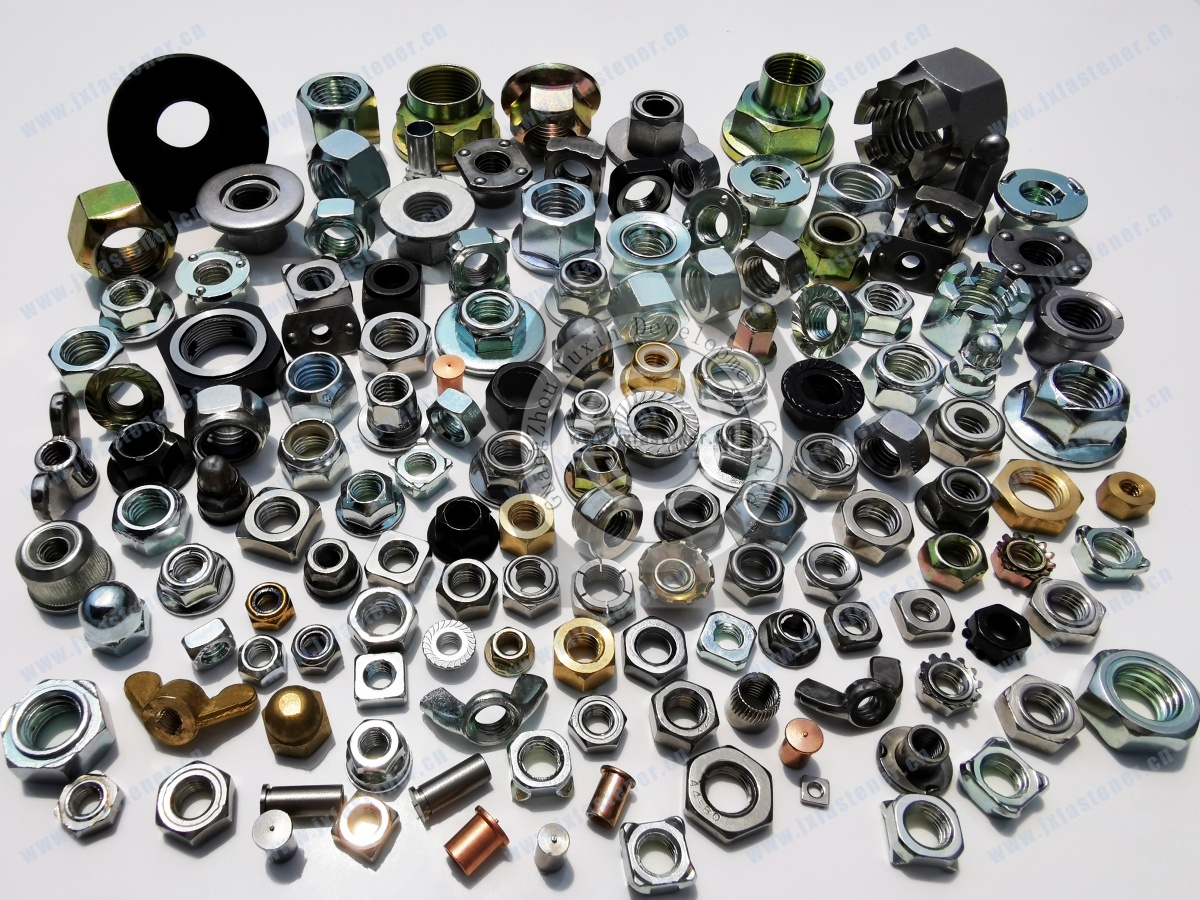
Relevant product categories include:
Hex flange nuts
DIN 6923 flange nuts
Serrated flange nuts
Non-serrated flange nuts
Carbon steel flange nuts
Stainless steel flange nuts
All-metal locking nuts
Nylon insert lock nuts
Hexagon nuts
Weld nuts
Blind rivet nuts
Self-clinching nuts
Threaded inserts
Custom CNC-machined fasteners
Specific dimensions, materials, mechanical properties, coatings, inspection requirements, MOQ and lead time are confirmed during project review.
Request a Flange Nut Engineering Review and OEM RFQ
Are you sourcing DIN 6923 flange nuts, serrated flange nuts, stainless steel flange nuts or custom flange nuts for automotive equipment,
industrial machinery, electrical enclosures, HVAC systems or other OEM applications?
JUXIN FASTENERS welcomes inquiries from design engineers, structural engineers, mechanical engineers, manufacturing engineers, production managers,
procurement specialists, purchasing managers, supplier development teams and supply chain managers.
For an efficient technical and commercial review, please provide:
2D drawing or applicable standard + thread designation + flange dimensions + serration or locking type + material + mechanical property class
+ coating + application + inspection requirements + sample quantity + annual purchasing volume + target delivery schedule
Our team can review your requirements, discuss suitable standard or drawing-based options, confirm sample arrangements and prepare quotation information.
Company: Juxin Fasteners
Website: https://www.juxinfasteners.com/
Email: info@juxinfasteners.com
Send your flange nut drawings and RFQ to JUXIN FASTENERS for technical evaluation and quotation.
Contact Us
Tel.:
+86 020 8621 0320
+86 020 3121 6067
E-mail:
Technical Support:
Navigation
SEND INQUIREY



