
Call Us
+86 136 6007 9809
Call Us
+86 136 6007 9809

Nov. 07, 2023
Industrial nuts are not interchangeable commodity components. The correct nut must match the thread system, fastener strength, joint geometry,
installation method, operating environment, vibration conditions, service temperature, corrosion requirement, and applicable engineering standard.
A standard hex nut may be appropriate for a general machinery connection, while an automotive sheet-metal assembly may require a weld nut,
a vibration-sensitive joint may require a prevailing-torque lock nut, and a threaded-rod assembly may require a coupling nut.
The practical engineering question is therefore not:
“Which nut is strongest?”
It is:
“Which nut provides the required function in this specific bolted joint?”
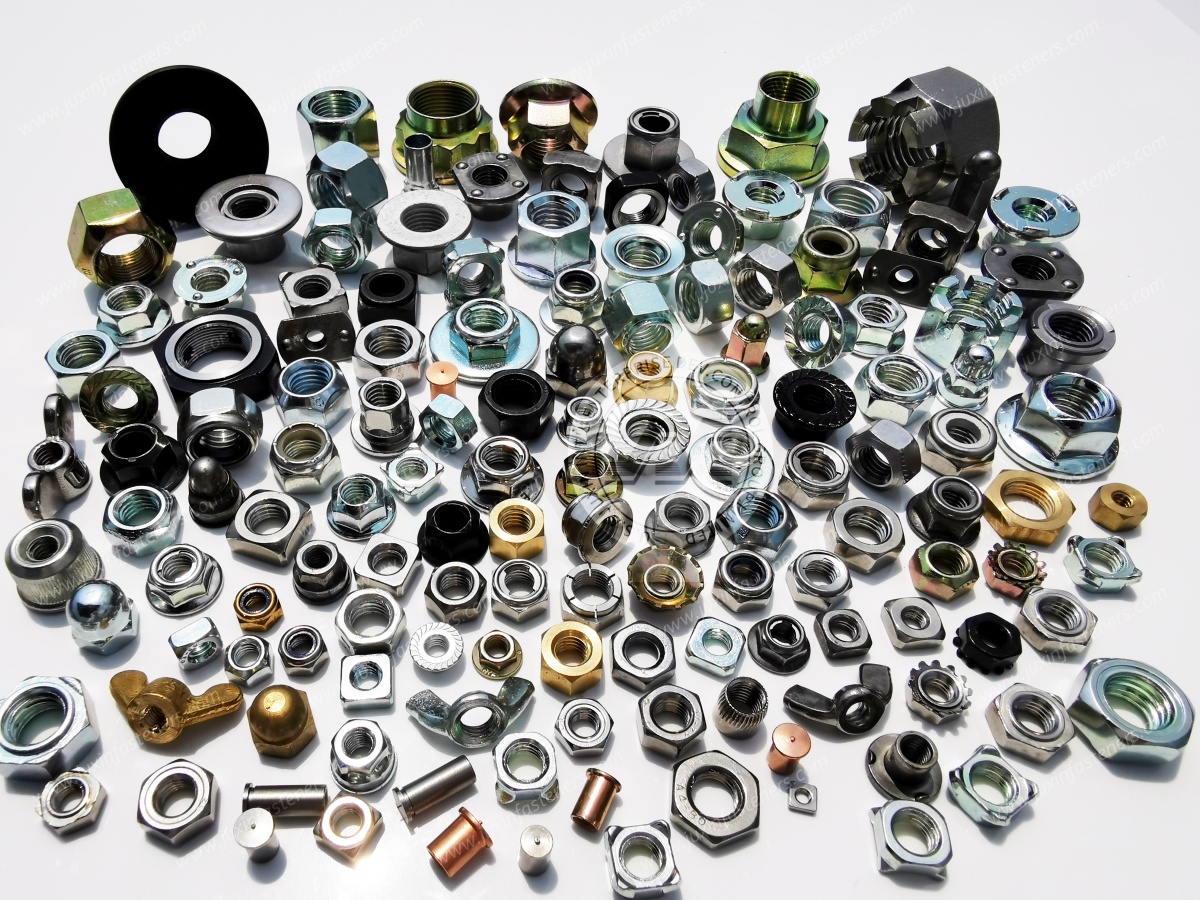
JUXIN FASTENERS supplies hex nuts, flange nuts, nylon insert lock nuts, all-metal lock nuts, prevailing-torque nuts, weld nuts,
coupling nuts, stainless steel nuts, brass nuts, insert nuts, cage nuts, rivet nuts, and custom made-to-drawing nuts for industrial OEM applications.
A nut is an internally threaded fastener designed to mate with a compatible externally threaded bolt, screw, stud, or threaded rod.
When the threaded assembly is tightened, the bolt or stud elongates and develops tension while the joined components are clamped together.
This distinction matters:
The nut does not simply “hold the bolt.” It forms part of the system that develops and maintains the bolted-joint clamp load.
Nut selection therefore affects:
thread engagement;
proof-load capability;
tightening behavior;
bearing conditions;
vibration resistance;
corrosion performance;
assembly efficiency;
maintenance and serviceability.
A nut that physically threads onto a bolt is not necessarily suitable for the joint.
The first requirement is exact thread compatibility.
For metric threads, engineers should verify:
nominal diameter;
thread pitch;
thread tolerance;
applicable ISO thread specification.
For inch fasteners, verify:
nominal diameter;
threads per inch;
UNC, UNF, or other specified thread series;
applicable ASME thread requirements.
Examples:
M6 × 1.0 bolt → M6 × 1.0 compatible nut
1/4-20 UNC bolt → 1/4-20 UNC compatible nut
Nominal diameter alone is not enough.
An M10 fine-thread nut should not be treated as interchangeable with every M10 bolt, and a 1/4-inch nut does not automatically match every 1/4-inch threaded fastener.
For OEM procurement, thread designation should always appear clearly on the drawing, purchase specification, or RFQ.
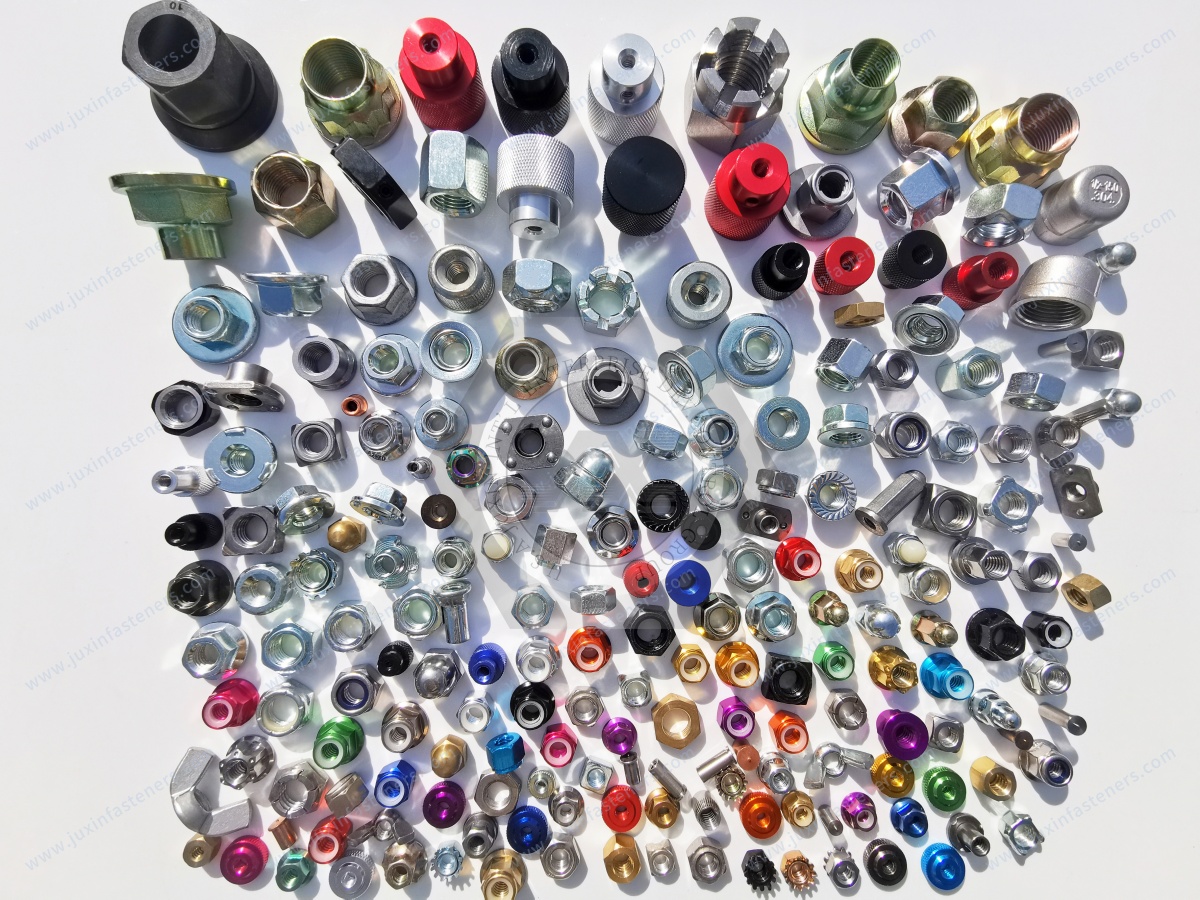
Global supply chains frequently use both metric and Unified inch fasteners.
Mixing them creates obvious assembly risks, but similar diameters can make mistakes possible during uncontrolled sourcing or line-side handling.
Common metric nut standards include configurations based on standards such as ISO 4032 and related ISO nut specifications.
Unified inch-thread nuts may reference relevant ASME/ANSI dimensional and thread standards according to nut type.
The correct standard depends on the exact component.
Procurement teams should therefore avoid vague descriptions such as:
“Standard 1/4 nut”
and instead specify the complete thread and product requirement.
One of the most important sourcing errors is selecting nuts based on dimensions alone.
For a highly loaded bolted joint, the nut must have mechanical properties compatible with the mating fastener and applicable specification.
For metric carbon and alloy steel nuts, ISO 898-2 is an important reference for specified property classes and mechanical properties.
For corrosion-resistant stainless steel nuts, ISO 3506-2 is relevant to applicable stainless-steel fastener mechanical properties.
For inch fastener systems, ASTM and SAE specifications may apply depending on the joint, material, industry, and product.
The essential principle is:
Correct Thread + Incorrect Mechanical Properties = Incorrect Fastener Assembly
Procurement teams should never substitute a lower-strength nut merely because the thread fits.
A nut needs sufficient engaged thread to transfer the required load without thread stripping or other failure.
This is one reason industrial nut standards control dimensions such as nut height.
A physically thinner nut is not automatically equivalent to a standard full-height nut.
Likewise, an unusually long nut should not automatically be described as “stronger” simply because it has more threads.
Performance depends on:
nut material;
bolt material;
engaged thread length;
thread geometry;
proof load;
joint loading;
applicable specification.
For non-standard thin, jam, coupling, or special nuts, the intended function should be evaluated rather than assuming dimensional interchangeability.
Different nut geometries exist because industrial joints have different functional requirements.
Hex nuts are the most widely used general-purpose industrial nuts.
Their six-sided geometry provides convenient wrench engagement and makes them suitable for:
industrial machinery;
equipment frames;
fabricated assemblies;
construction equipment;
maintenance systems;
general OEM manufacturing.
Hex nuts are available across many metric and inch standards, materials, strength levels, and surface treatments.
A standard hex nut is usually the logical starting point when the joint does not require a special locking, mounting, captive, or load-distribution function.
A flange nut incorporates an enlarged bearing flange at its base.
The flange increases the bearing area beneath the nut and may reduce the need for a separate flat washer in applications specifically designed for flange-nut installation.
Typical applications include:
automotive assemblies;
machinery;
equipment frames;
fabricated brackets;
production equipment.
Some flange nuts also incorporate serrations or other locking features, but a plain flange nut and a serrated flange lock nut are not the same product.
This distinction should remain clear in product specifications and procurement descriptions.
Flange Function → Bearing Area
Locking Feature → Separate Functional Requirement
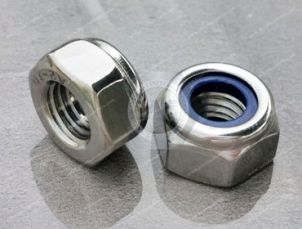
A nylon insert lock nut, often called a nylon lock nut or prevailing-torque nut, incorporates a polymer insert that interferes with the mating thread.
This creates prevailing torque that remains present independently of bolt tension.
These nuts are useful where resistance to rotational loosening is required and the operating environment is compatible with the polymer insert.
Typical applications can include:
machinery;
transportation equipment;
enclosures;
industrial assemblies;
equipment subject to vibration.
However, the polymer insert introduces application limits.
Engineers should consider:
operating temperature;
chemical exposure;
repeated reuse;
installation speed;
mating thread condition.
A nylon insert lock nut should not automatically be substituted for an all-metal lock nut in elevated-temperature environments.
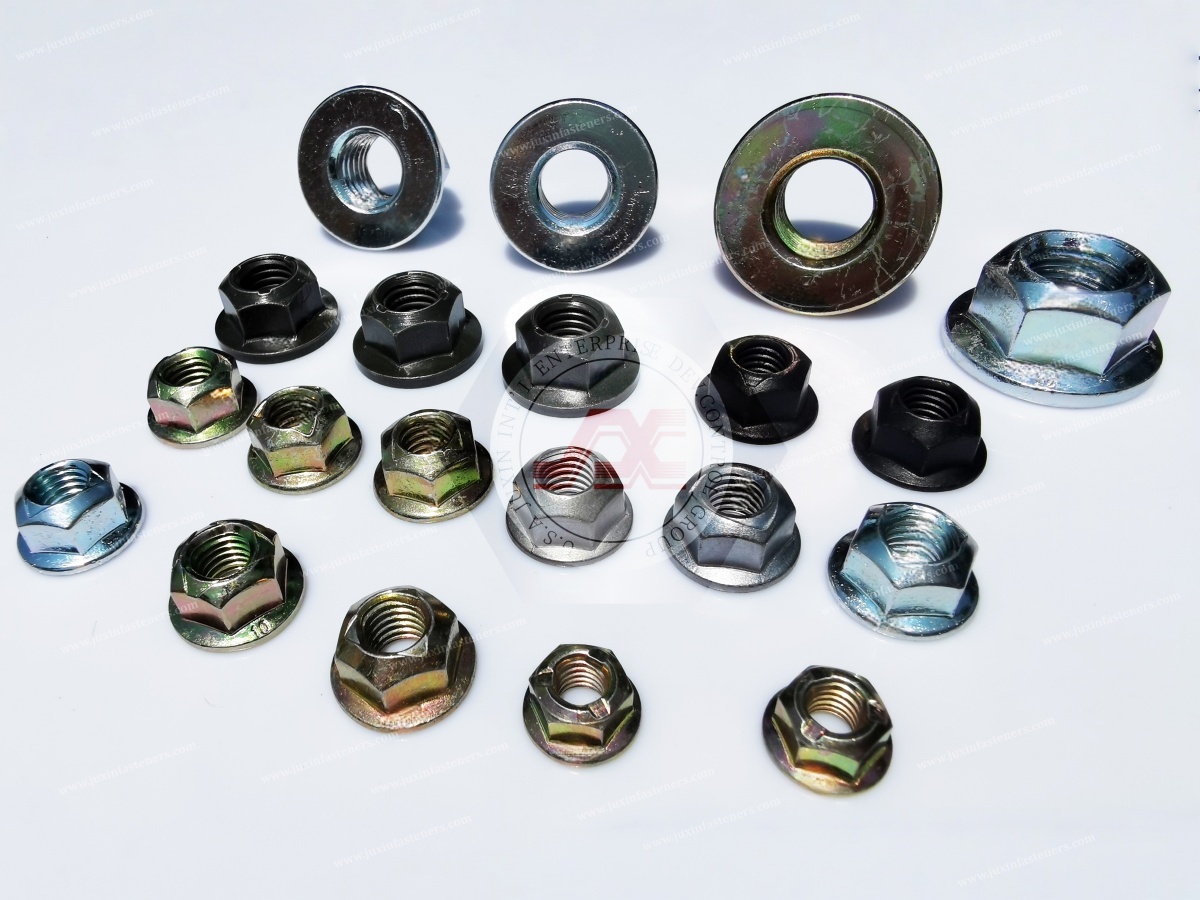
All-metal prevailing-torque lock nuts create thread interference through controlled metallic geometry rather than a polymer insert.
They can be appropriate where:
elevated temperatures are present;
polymer inserts are undesirable;
specified prevailing-torque behavior is required;
industrial vibration conditions justify a locking nut.
Designs vary considerably.
Examples may include distorted-thread, top-lock, side-lock, or other engineered all-metal locking configurations.
The relevant standard and prevailing-torque requirements should therefore be specified rather than purchasing any nut marketed generically as an “all-metal lock nut.”
The correct selection depends on the application.
| Selection Factor | Nylon Insert Lock Nut | All-Metal Lock Nut |
|---|---|---|
| Locking mechanism | Polymer thread interference | Metallic thread interference |
| Elevated temperature | Limited by insert material | Often better suited |
| Polymer-free requirement | No | Yes |
| Prevailing torque | Yes | Yes |
| Reuse | Must follow specification/application limits | Must follow specification/application limits |
| Typical selection driver | General vibration resistance | Temperature / metal-only requirement |
Neither type should be declared universally superior.
The correct lock nut is the one that meets the joint's mechanical, environmental, and assembly requirements.
Weld nuts create a permanent internally threaded attachment on sheet metal or fabricated components.
Common configurations include:
square weld nuts;
hex weld nuts;
projection weld nuts;
round weld nuts;
application-specific weld nuts.
International references can include designs such as DIN 928 square weld nuts and DIN 929 hexagon weld nuts, together with OEM-specific configurations.
Weld nuts are particularly valuable in production environments because they can provide a captive thread before final assembly.
Typical applications include:
automotive body structures;
seating structures;
chassis components;
battery enclosures;
sheet-metal cabinets;
appliances;
industrial equipment.
For weld nuts, purchasing only by thread size is insufficient.
Critical characteristics can include:
projection geometry;
pilot geometry;
sheet thickness;
weld process;
nut orientation;
material;
coating;
weldability.
For deeper engineering information, link to the JUXIN FASTENERS Weld Nut Solutions content cluster.
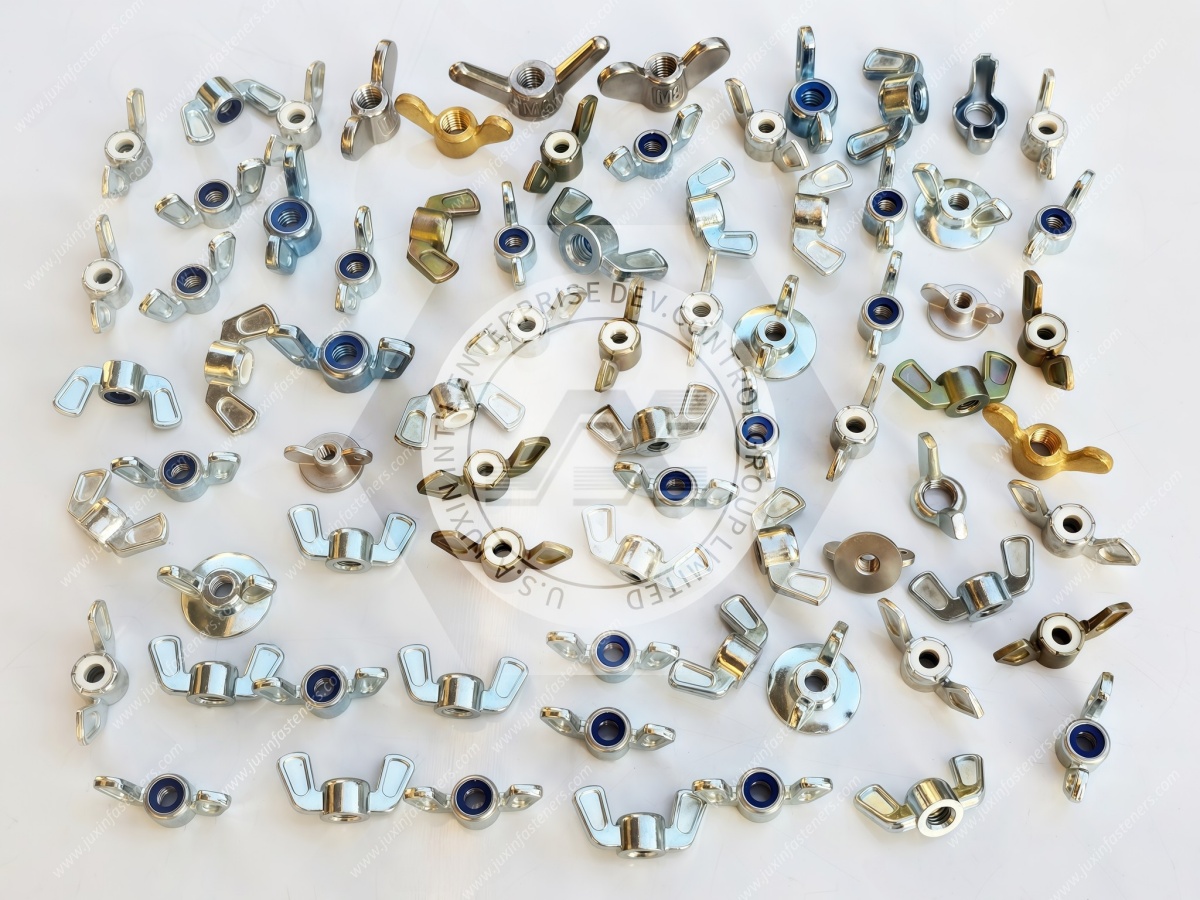
Coupling nuts are elongated internally threaded components used to connect two male threaded components such as threaded rods.
Applications can include:
threaded-rod extensions;
construction assemblies;
equipment supports;
suspended systems;
industrial installation.
Their extended geometry should not be interpreted simply as “higher strength.”
The required performance depends on:
material;
thread engagement;
dimensional standard;
mating threaded components;
tensile load;
applicable specification.
When structural or safety-related loads are involved, the complete threaded-rod system must be specified.
Wing nuts provide hand-operated tightening and removal through integral wings.
They are suited to assemblies requiring:
frequent adjustment;
tool-free access;
removable covers;
fixtures;
temporary positioning.
Different wing nut designs can include stamped or formed metal types, cast designs, polymer components, or specialized locking versions.
Wing nuts should not be selected for high-preload structural joints merely because their thread matches the bolt.
Their value is primarily assembly convenience and manual adjustability.
Cage nuts and other captive nut systems retain the threaded component within a panel or assembly.
They are particularly useful where:
rear access is limited;
assembly speed matters;
serviceability is required;
the nut must remain associated with the panel.
Applications include:
electrical cabinets;
server and network equipment;
industrial enclosures;
transportation interiors;
machinery panels.
Depending on design, captive systems can also accommodate limited positional variation to help align mating screws during assembly.
Rivet nuts create a reusable internal thread in thin sheet or other components where access may be available from only one side.
They are different from conventional loose nuts because they become mechanically installed into the parent material.
Common industrial uses include:
sheet-metal enclosures;
transportation equipment;
electrical equipment;
HVAC systems;
machinery;
thin-wall structures.
Important selection parameters include:
body style;
open or closed end;
round, knurled, hex, or other anti-rotation geometry;
grip range;
parent material;
installation method;
thread size.
Rivet nuts should link internally to the dedicated JUXIN FASTENERS Rivet Nut product and engineering cluster rather than trying to cover their full engineering design on this overview page.
Threaded inserts provide durable internal threads in materials where direct threading may be impractical or insufficient.
Depending on design, inserts may be intended for:
plastics;
molded components;
wood;
soft metals;
sheet materials;
other engineered substrates.
Examples can include:
brass inserts;
heat-set inserts;
ultrasonic inserts;
press-in inserts;
molded-in inserts;
application-specific threaded inserts.
A brass insert for thermoplastic should not be classified simply as a “brass nut.” Its installation method and host material are fundamental to product selection.
This distinction improves both engineering accuracy and search-entity clarity.
Nut material should be selected according to the complete joint requirement rather than appearance or price alone.
Carbon and alloy steels are widely used for industrial nuts because mechanical properties can be engineered for a broad range of joint requirements.
Applications include:
machinery;
automotive manufacturing;
construction equipment;
fabricated assemblies;
industrial structures.
Depending on the required mechanical properties and specification, heat treatment may be necessary.
Possible surface finishes include:
zinc plating;
zinc-nickel plating;
phosphate-based finishes;
black oxide;
zinc-flake coating systems;
other specified industrial coatings.
Material, heat treatment, and coating should be considered together.
Stainless steel nuts are used where corrosion resistance is important.
Common industrial material families include A2 / 304-type stainless steel and A4 / 316-type stainless steel, depending on the applicable specification and application.
Potential applications include:
food-processing equipment;
outdoor machinery;
marine-related equipment;
chemical-processing equipment;
industrial enclosures.
However, stainless steel is not automatically the best solution for every corrosive environment.
Engineers should evaluate:
chlorides;
temperature;
chemical exposure;
mating material;
required mechanical properties.
An important Information Gain issue in stainless-steel nut selection is thread galling.
Under unfavorable combinations of material, surface condition, tightening speed, friction, and load, stainless mating threads can experience adhesive damage or seizure during tightening.
Risk-management strategies depend on the actual assembly and may include evaluation of:
suitable material combinations;
thread condition;
lubrication;
coatings;
installation speed;
tightening procedure.
This matters commercially because a stainless nut that passes dimensional inspection can still create assembly-line problems if the complete fastening system is not evaluated.
Brass and copper-alloy threaded components may be useful where applications require combinations of:
electrical conductivity;
corrosion characteristics;
machinability;
non-ferrous material.
Typical uses can include:
electrical equipment;
terminals;
electronics;
instrumentation;
plastic assemblies.
However, material selection must still consider mechanical load and thread strength.
Electrical conductivity does not make a brass or copper component appropriate for every structural fastening application.
Aluminum nuts may be considered where low mass or specific corrosion/material compatibility requirements justify their use.
Applications can include selected:
transportation equipment;
electronics;
specialized machinery;
lightweight assemblies.
Because aluminum has different bearing, thread, and galvanic behavior from steel, substitution should be based on engineering requirements rather than weight reduction alone.
Surface treatment affects more than appearance.
Depending on the fastener system, it can influence:
corrosion resistance;
friction;
torque-tension behavior;
dimensions;
electrical characteristics;
assembly performance.
Possible treatments include:
zinc plating;
zinc-nickel;
zinc-flake systems;
phosphate coatings;
black oxide;
nickel plating;
passivation for applicable stainless steels;
project-specific coatings.
A purchasing specification should identify the required coating rather than simply requesting a particular color.
This is especially important in OEM sourcing.
Changing from one coating system to another can change friction at the threads and bearing surfaces.
Because installation torque depends strongly on friction:
Same Nut Geometry + Different Coating ≠ Automatically Same Torque-Tension Behavior
A coating substitution should therefore be reviewed when bolt preload is important.
This is one reason procurement teams should not treat surface treatment as an independent cosmetic attribute.
For high-strength steel nuts and mating fasteners, certain electroplating and surface-treatment processes require consideration of hydrogen embrittlement risk where applicable.
Risk depends on:
material strength/hardness;
manufacturing history;
cleaning process;
coating process;
post-treatment;
applicable specification.
Supplier-development teams should therefore review both mechanical properties and coating requirements when qualifying high-strength fasteners.
A common purchasing request is:
“We need an anti-loosening nut.”
But vibration resistance is a system-level issue.
Engineers should first determine:
What causes loosening?
Is transverse movement present?
Is temperature cycling significant?
Is joint settlement occurring?
Is preload adequate?
Is frequent disassembly required?
What operating temperature applies?
Only then should the locking method be selected.
Possible approaches can include:
prevailing-torque lock nuts;
nylon insert lock nuts;
all-metal lock nuts;
serrated flange designs where appropriate;
thread-locking compounds;
other mechanical locking systems.
A locking feature cannot compensate for an incorrectly designed or inadequately tightened joint.
This distinction is particularly important when specifying lock nuts.
A prevailing-torque nut produces resistance to rotation even before the nut develops full bearing contact.
That resistance is not the same thing as bolt preload.
During installation:
Applied Torque = Thread/Bearing Friction Effects + Prevailing Torque Effects + Bolt Tension Development
Therefore, torque values developed for a conventional free-spinning nut should not automatically be applied to every prevailing-torque lock nut.
The complete fastener specification and tightening procedure must be considered.
A practical selection matrix is:
| Joint Requirement | Nut Type to Evaluate |
|---|---|
| General removable threaded joint | Hex Nut |
| Increased bearing area | Flange Nut |
| Polymer prevailing torque | Nylon Insert Lock Nut |
| High-temperature / metal-only prevailing torque | All-Metal Lock Nut |
| Permanent captive thread on weldable sheet | Weld Nut |
| Connect threaded rods | Coupling Nut |
| Tool-free adjustment | Wing Nut |
| Captive panel fastening | Cage / Captive Nut |
| One-sided installation into thin material | Rivet Nut |
| Thread in plastic or molded component | Threaded Insert |
| Non-standard OEM geometry | Custom Made-to-Drawing Nut |
This matrix should be treated as a selection starting point, not as a substitute for engineering validation.
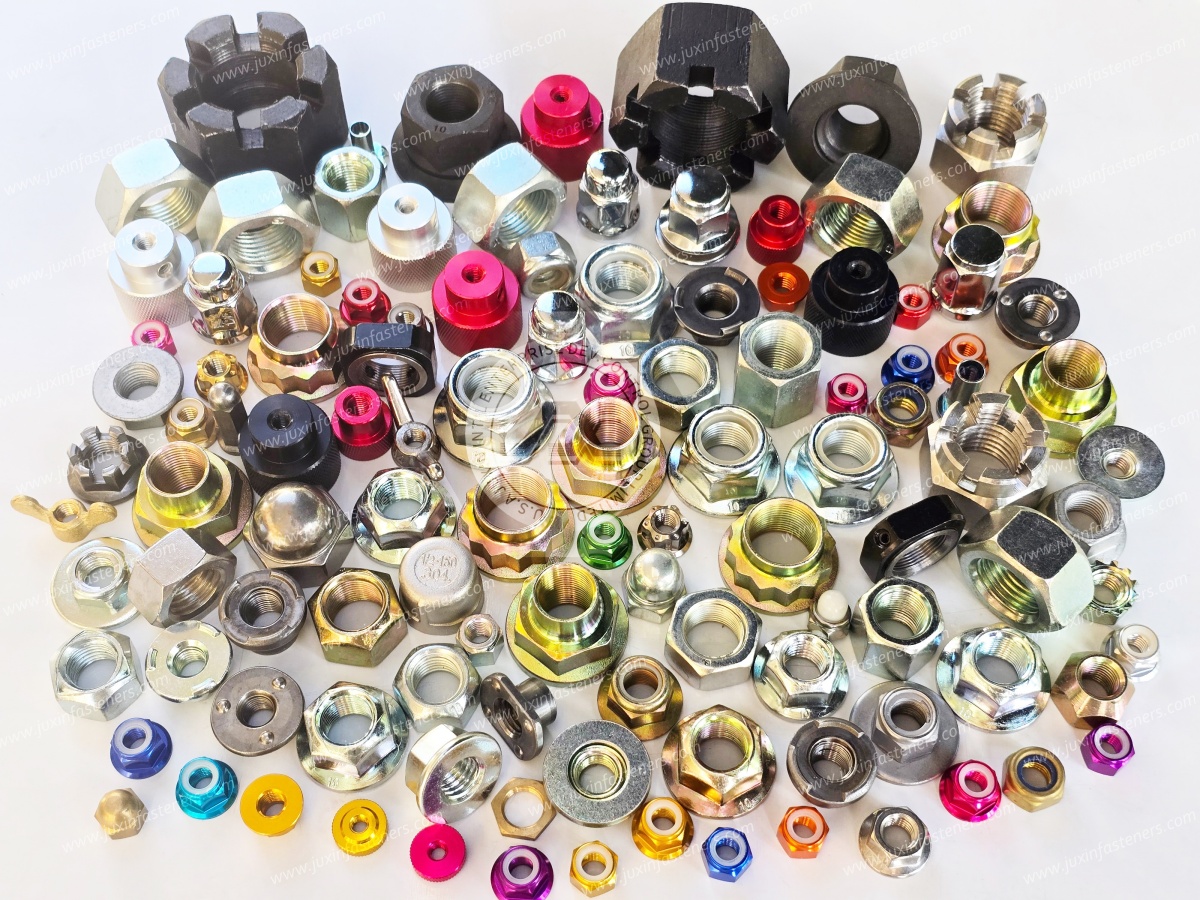
Automotive fastening requirements vary significantly by assembly location.
Potential nut technologies include:
projection weld nuts for body and bracket assemblies;
flange nuts for production fastening;
prevailing-torque lock nuts where specified;
cage or captive nuts for serviceable assemblies;
rivet nuts for suitable thin-wall structures;
custom nuts for OEM-specific geometry.
EV applications can add requirements related to:
battery enclosure assembly;
lightweight structures;
corrosion protection;
electrical isolation strategies;
automated installation;
serviceability.
The correct product should follow the OEM drawing and validated joint design rather than a generic “automotive nut” designation.
Machinery builders may require several nut technologies within the same machine.
Examples include:
hex nuts for general assemblies;
lock nuts for vibration-sensitive connections;
flange nuts for brackets and frames;
coupling nuts for threaded-rod systems;
cage nuts for enclosures;
custom machined nuts for proprietary mechanisms.
For automation equipment, repeatable assembly and tool access may be as important as component strength.
Design engineers should therefore consider assembly process requirements during nut selection.
Electrical and electronic assemblies can use:
cage nuts;
captive nuts;
brass nuts;
threaded inserts;
stainless steel nuts;
specialized non-ferrous threaded components.
Applications can include:
control cabinets;
network equipment;
server racks;
telecommunications hardware;
plastic housings;
industrial electronics.
Material selection may need to consider electrical conductivity, grounding, insulation strategy, corrosion, and assembly method.
These requirements should be evaluated separately from mechanical strength.
Railway and transportation assemblies can require a wide range of nut systems for:
interior equipment;
lighting assemblies;
electrical cabinets;
equipment brackets;
serviceable panels;
exterior equipment;
structural and mechanical systems.
Depending on the joint, engineers may evaluate:
prevailing-torque nuts;
flange nuts;
weld nuts;
cage nuts;
rivet nuts;
stainless steel nuts;
custom OEM nuts.
Rail applications may also introduce project-specific requirements for vibration, fire behavior of associated non-metallic components, corrosion, traceability, and documentation.
The applicable project specification must govern the final fastener selection.
Solar, wind, and energy-storage equipment can expose fasteners to:
outdoor moisture;
temperature cycling;
vibration;
long service intervals;
mixed-metal assemblies.
Nut selection may therefore involve:
corrosion-resistant materials;
engineered coatings;
locking requirements;
flange geometry;
high-strength mechanical properties.
For battery-energy-storage and related equipment, the correct fastening system should be selected according to the actual enclosure, electrical, structural, and service requirements.
Structural applications require particular care because the complete bolting system may be governed by specific project and structural standards.
Procurement teams should not substitute generic industrial nuts into structural bolting assemblies based solely on thread size.
Requirements can include:
specific material;
mechanical properties;
dimensional standard;
coating;
matching bolt and washer;
testing;
certification;
lot traceability.
Where ASTM, EN, ISO, or other structural bolting specifications apply, the complete specified system should be maintained.
Stainless steel nuts can be relevant to food-processing, laboratory, and selected medical equipment because of corrosion and cleaning requirements.
However, simply specifying “304 stainless” or “316 stainless” does not establish hygienic suitability.
Designers may also need to evaluate:
surface condition;
cleanability;
crevices;
cleaning chemicals;
accessibility;
applicable equipment standards.
Fastener material is only one part of hygienic equipment design.
A robust selection process can follow eight questions.
Define:
metric or inch;
diameter;
pitch or TPI;
thread tolerance;
applicable standard.
Identify:
bolt property class or grade;
nut property class or specification;
proof-load requirement;
application load.
Determine whether the nut must provide:
standard clamping;
locking;
increased bearing area;
captive installation;
welding;
one-sided installation;
rod connection;
manual adjustment.
Consider:
corrosion;
moisture;
chemicals;
temperature;
outdoor exposure;
galvanic interaction.
If yes, evaluate the actual loosening mechanism and suitable retention technology.
Consider:
manual wrench;
automated assembly;
welding;
riveting;
insertion into plastic;
line-side tooling.
A permanently installed weld nut and a removable cage nut solve very different service requirements.
Use an established standard component when it satisfies the engineering requirement.
Develop a custom nut when the assembly genuinely requires non-standard geometry or functionality.
Standard fasteners generally provide advantages in:
availability;
interchangeability;
qualification;
sourcing flexibility;
cost.
Custom nuts become relevant where the assembly requires:
non-standard dimensions;
special thread;
unusual flange geometry;
proprietary locking feature;
custom weld projections;
special pilot;
special material;
unusual coating;
controlled installation feature;
OEM-specific geometry.
The commercial decision should consider total project cost rather than unit price alone.
A custom component can introduce:
tooling;
sample approval;
additional inspection;
longer development time;
supplier qualification requirements.
It is justified when those costs solve a genuine assembly or performance problem.
For a custom nut, the drawing should define functional requirements without unnecessarily restricting the production process.
Depending on geometry and volume, manufacturing may involve processes such as:
cold forming;
machining;
stamping/forming;
welding-related component production;
heat treatment;
thread forming or thread machining as appropriate;
surface finishing.
Production volume matters.
A machined prototype may be appropriate for early validation, while higher-volume production may justify a different manufacturing route.
The supplier should therefore know both prototype quantity and expected annual demand during quotation.
Depending on the product, engineers should specify:
thread designation;
thread tolerance/class;
external dimensions;
nut height;
width across flats where applicable;
flange dimensions;
pilot geometry;
weld projections where applicable;
locking feature;
material;
property class or mechanical requirements;
heat treatment;
hardness where required;
surface treatment;
dimensional tolerances;
burr/edge requirements;
applicable international standard;
inspection requirements.
For special-function nuts, an assembly drawing can help the supplier understand why particular dimensions are critical.
For efficient quotation of industrial nuts or custom OEM nuts, provide as applicable:
product type;
applicable ISO, DIN, ASME/ANSI, ASTM, SAE, BS or EN specification;
drawing;
thread size;
thread pitch/TPI;
thread class/tolerance;
material;
property class or grade;
heat treatment;
coating/surface finish;
locking requirement;
application;
mating bolt/stud;
operating environment;
order quantity;
estimated annual demand;
sample quantity;
inspection requirements;
material certification requirements;
packaging requirements.
A request stating only “M8 nut, zinc plated” is often insufficient for an OEM sourcing decision.
For recurring industrial programs, procurement should verify more than dimensions and price.
Depending on the application, supplier review can include:
thread inspection;
dimensional inspection;
material documentation;
mechanical-property verification;
hardness;
coating requirements;
prevailing-torque testing for applicable lock nuts;
weld-performance validation for applicable weld nuts;
traceability requirements;
packaging controls.
Testing should follow the actual product standard, drawing, and application risk.
Not every nut requires every test.
Many fastener failures begin not with manufacturing defects but with an incorrect substitution.
Examples include:
standard nut replacing a lock nut;
low-strength nut paired with a high-strength bolt;
nylon insert nut substituted into a high-temperature assembly;
different coating introduced without torque review;
generic weld nut substituted despite different projection geometry;
stainless grade changed without environmental review.
For OEM supply chains, critical attributes should therefore be controlled in the purchasing specification rather than left to supplier interpretation.
This article should operate as the industrial nut selection hub, not compete with every individual product page.
Recommended internal links:
Hex Nuts → detailed product page
Flange Nuts → detailed product page
Nylon Insert Lock Nuts → locking product page
All-Metal Lock Nuts → high-temperature/vibration locking page
Weld Nuts → weld-fastener engineering cluster
Rivet Nuts → blind threaded fastening cluster
Cage Nuts / Captive Nuts → sheet-metal assembly cluster
Threaded Inserts → plastic and metal insert cluster
Stainless Steel Nuts → corrosion-resistant fastener page
Custom Nuts → made-to-drawing OEM manufacturing page
Individual product pages should link back to this guide where buyers need help deciding between nut technologies.
This creates a search architecture of:
Industrial Nut → Joint Requirement → Nut Type → Product Specification → Industry Application → RFQ
rather than producing multiple generic pages that all compete for “nut manufacturer.”
JUXIN FASTENERS supports OEM and industrial customers sourcing standard and custom nut solutions.
Product categories include:
hex nuts;
flange nuts;
nylon insert lock nuts;
all-metal lock nuts;
prevailing-torque nuts;
weld nuts;
coupling nuts;
wing nuts;
cage and captive nuts;
rivet nuts;
stainless steel nuts;
brass and non-ferrous nuts;
threaded inserts;
custom made-to-drawing nuts.
Project review can include:
drawing evaluation;
thread specification;
material selection;
mechanical-property requirements;
locking function;
manufacturing feasibility;
heat treatment;
surface treatment;
sample requirements;
inspection requirements;
production quantities;
packaging and repeat-supply requirements.
JUXIN FASTENERS supports both metric and inch-thread OEM requirements according to applicable international standards and customer drawings.
If your project requires hex nuts, lock nuts, flange nuts, weld nuts, coupling nuts, cage nuts, rivet nuts, stainless steel nuts, threaded inserts, or custom OEM nuts,
send JUXIN FASTENERS your specification or drawing for manufacturing review.
For faster technical and commercial evaluation, include the thread designation, nut type, material, mechanical requirements, surface treatment, mating bolt or stud,
application environment, quantity, annual demand, and inspection requirements.
JUXIN FASTENERS
Website: www.juxinfasteners.com
Email: info@juxinfasteners.com
 MORE NEWS


Oct. 13, 2026
Contact Us
Tel.:
+86 020 8621 0320
+86 020 3121 6067
E-mail:
Technical Support:
Navigation
SEND INQUIREY