Call Us
+86 136 6007 9809
Call Us
+86 136 6007 9809

Nov. 07, 2023
When an OEM assembly requires a reusable internal thread in thin sheet, tubing, hollow sections, enclosures, or structures accessible from only one side,
a blind rivet nut can provide an efficient alternative to conventional nuts, welding, or direct tapping.
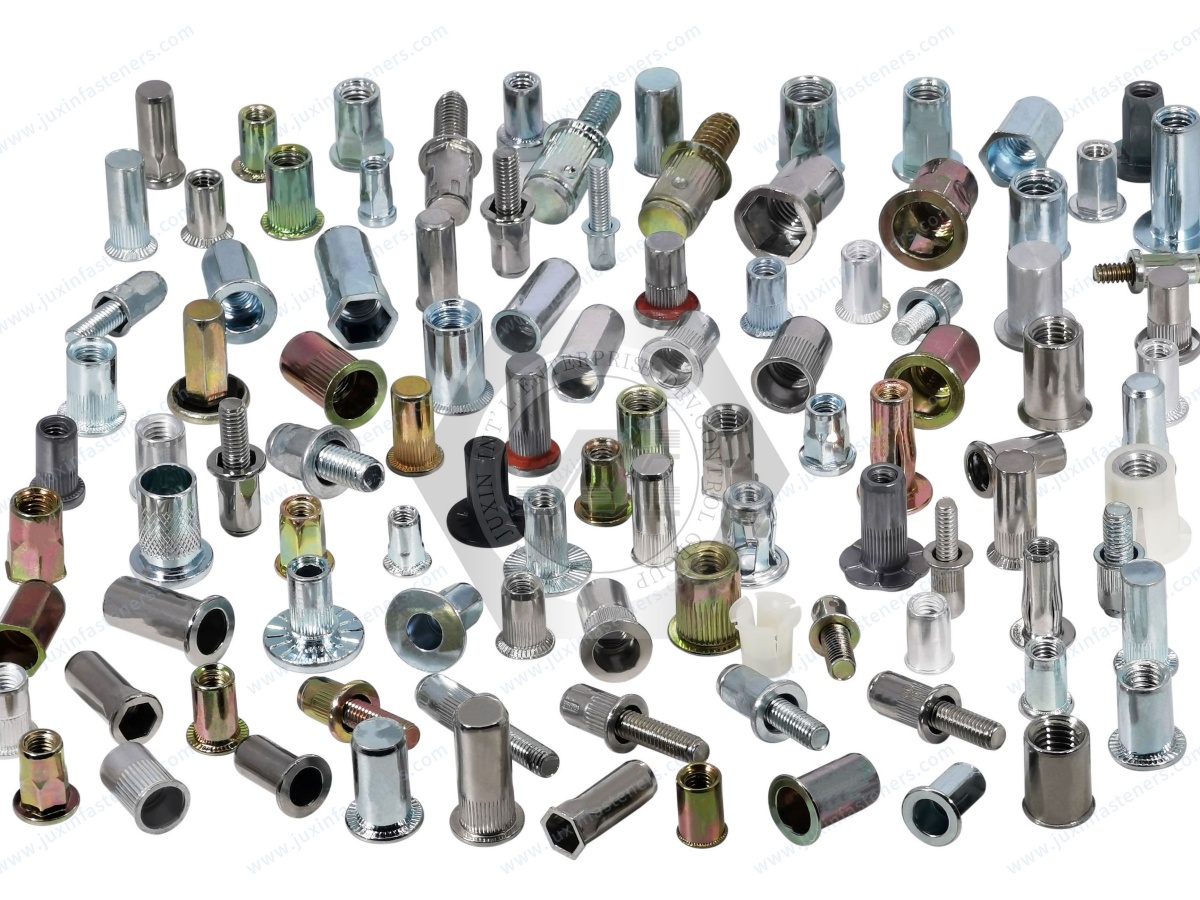
Also called rivet nuts, blind rivet nuts, rivnuts, rivnuts, nutserts, or blind threaded inserts, these components are installed mechanically into a prepared hole.
During installation, a controlled portion of the body collapses behind the parent material and clamps the rivet nut into position.
The result is a permanent threaded attachment point that can subsequently accept a removable bolt or screw.
But selecting a rivet nut by thread size alone is a common engineering mistake.
A reliable installation depends on the interaction between:
Thread Size × Parent Material × Material Thickness × Grip Range × Hole Size × Body Geometry × Head Style × Installation Setting × Applied Service Load
JUXIN FASTENERS supplies steel rivet nuts, stainless steel rivet nuts, aluminum rivet nuts, round-body rivet nuts, knurled rivet nuts, hex-body rivet nuts,
closed-end rivet nuts, flange rivet nuts and custom blind threaded inserts for OEM and industrial applications.
A blind rivet nut is an internally threaded mechanical fastener designed to be installed into a workpiece from one accessible side.
A typical rivet nut contains:
an internally threaded section;
a deformable or collapsible body;
a head or flange;
application-specific body geometry.
During installation, the setting tool engages the internal thread and applies the required axial setting action.
The designed collapse zone deforms behind the parent material, producing a mechanical clamp.
After installation, the tooling is removed and the internal thread remains available for assembly with a mating bolt or screw.
This creates an important distinction:
Rivet Nut Installation → Creates the Threaded Attachment
Bolt Installation → Creates the Final Assembly
These are two separate mechanical operations and should not be confused during joint design.
Rivet nuts solve a specific manufacturing problem: how to create a durable internal thread where conventional fastening methods are difficult or inefficient.
They are particularly useful when:
only one side of the structure is accessible;
the parent material is too thin for sufficient tapped-thread engagement;
welding is undesirable;
heat input must be avoided;
a removable bolt connection is required;
the threaded feature must be installed after coating or fabrication;
a captive threaded attachment is needed.
Typical parent structures include:
sheet-metal panels;
hollow sections;
tubes;
electrical enclosures;
equipment cabinets;
fabricated frames;
aluminum structures;
selected plastic or composite panels.
However, the correct rivet nut must be selected for the actual substrate and loading conditions.
One of the most useful early engineering decisions is determining whether a rivet nut is actually the correct fastening technology.
| Requirement | Rivet Nut | Weld Nut | Direct Tapped Thread |
|---|---|---|---|
| One-side installation | Excellent | Process-dependent | Possible with access to drilling/tapping |
| Thin sheet | Excellent | Excellent where weldable | Often limited by thread engagement |
| Heat-free installation | Yes | No | Yes |
| Reusable machine thread | Yes | Yes | Yes |
| Post-coating installation | Possible | Usually less convenient | Possible |
| Non-weldable substrate | Possible depending on material | No | Depends on substrate |
| Automated high-volume assembly | Possible | Excellent in suitable production lines | Process-dependent |
| Replacement after installation | Application-dependent | Difficult | Parent material may require repair |
The decision should therefore follow:
Assembly Access → Parent Material → Sheet Thickness → Production Process → Load → Service Requirements
not simply unit price.
For welded sheet-metal assemblies, see the JUXIN FASTENERS Weld Nut Engineering Solutions cluster.
For general nut selection, see our Industrial Nut Selection Guide.
The grip range defines the parent-material thickness range for which a particular rivet nut is designed.
This is not simply the overall length of the rivet nut.
A single thread size may be available in multiple body lengths because different sheet thicknesses require different grip ranges.
For example, two M6 rivet nuts may share:
the same internal thread;
similar head diameter;
similar body diameter;
while being designed for completely different material thicknesses.
Selecting the wrong grip range can result in:
incomplete body collapse;
excessive deformation;
insufficient backside formation;
weak retention;
poor head seating;
parent-material damage.
Therefore:
Thread Size ≠ Grip Range
Both must be specified.
Engineers sometimes assume that a thicker sheet simply requires a proportionally longer rivet nut.
That is not a reliable selection method.
The component must be designed so that its intended deformation zone works correctly across the specified grip range.
The correct process is:
Measure Total Grip Thickness → Select Manufacturer's Appropriate Grip Range → Verify Installation
If multiple layers are clamped during installation, the relevant stack thickness must be considered according to the intended design.
The installation hole is part of the rivet nut system.
If the hole is too small:
insertion may be difficult;
coating may be damaged;
excessive force may be required;
the component may not seat correctly.
If the hole is too large:
anti-rotation performance can decrease;
the rivet nut may move during installation;
torque resistance may be reduced;
concentricity may deteriorate.
This relationship is particularly important with round-body rivet nuts.
The correct hole specification should come from the applicable product drawing or manufacturer's dimensional specification.
Procurement teams should not assume that all M6 rivet nuts require the same installation-hole diameter.
Different body designs can require different holes.
Body geometry has a major effect on installation and resistance to rotation.
Round-body rivet nuts are widely used because they are compatible with simple drilled or punched round holes.
Advantages include:
straightforward hole preparation;
convenient installation;
broad industrial applicability;
suitability for many sheet-metal assemblies.
However, resistance to spinning depends on the complete installation system, including:
body design;
substrate material;
hole tolerance;
grip range;
setting quality;
head design.
A smooth round body should therefore not be selected solely because its hole is easiest to manufacture.
Knurled-body rivet nuts incorporate external serrations or knurling intended to improve interaction with the parent material.
They may improve rotational resistance in suitable substrates and installation conditions.
Common applications include:
sheet-metal equipment;
automotive assemblies;
industrial machinery;
cabinets;
fabricated structures.
However:
Knurling ≠ Guaranteed Anti-Rotation
Performance still depends on correct hole size, substrate properties, body deformation and installation quality.
Hex-body rivet nuts fit into corresponding hexagonal holes.
Their geometry provides mechanical resistance to rotation through the shape of the body and installation hole.
They can be useful where higher torque resistance is required.
The trade-off is manufacturing complexity.
A hex hole may require:
punching;
laser cutting;
specialized fabrication;
suitable production tooling.
The engineering decision therefore becomes:
Higher Anti-Rotation Requirement vs. Hole-Manufacturing Cost
For high-volume OEM production, this trade-off should be evaluated early in the design stage.
The head of a rivet nut affects load distribution, installed height and assembly geometry.
A larger flange can provide greater bearing area against the parent material.
This may be useful for:
softer materials;
larger installation loads;
thin sheet;
applications requiring increased surface support.
But a larger flange also increases installed projection and required surface space.
Standard flange designs provide a balance between bearing area and compact installation.
They are common in general industrial assemblies.
Reduced-head designs minimize projection above the parent surface.
They can be useful where:
space is limited;
a lower installed profile is required;
the mating component needs to sit closer to the panel.
However, reducing head size also reduces available bearing area.
Head style should therefore be selected from the assembly requirement, not appearance alone.
Open-end rivet nuts allow the mating bolt to extend through the threaded portion where geometry permits.
They are widely used in general machinery and sheet-metal assemblies.
Advantages can include:
broad availability;
flexible bolt engagement;
compact manufacturing;
suitability for many standard applications.
A closed-end rivet nut incorporates a sealed bottom in the metal body.
This can be useful where the designer wants to reduce direct passage through the threaded insert.
Applications can include:
electrical enclosures;
outdoor equipment;
transportation assemblies;
machinery exposed to contaminants.
However, an important distinction is necessary:
Closed End ≠ Automatically Watertight Assembly
The closed body can prevent direct passage through the bottom of the rivet nut itself, but leakage may still occur around the flange-to-panel interface.
Where environmental sealing is required, engineers must evaluate the complete installed system.
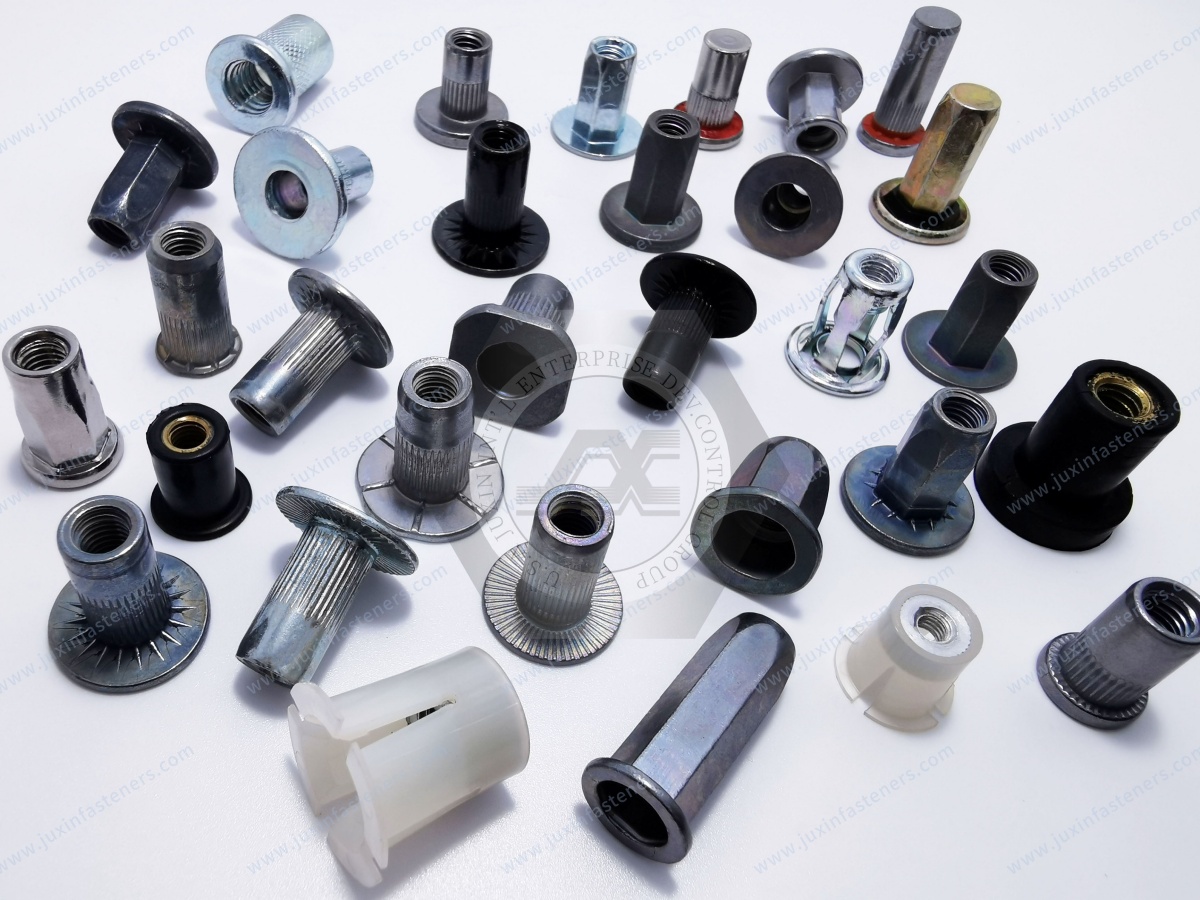
Some rivet nut designs incorporate sealing elements beneath the head or flange.
Depending on the design, these may help control ingress around the installed component.
But sealing performance depends on more than the presence of a seal.
Engineers should consider:
panel surface condition;
hole tolerance;
sealing material;
flange geometry;
installation setting;
pressure differential;
temperature;
chemicals;
aging.
Therefore:
Closed-End Rivet Nut + Seal ≠ Automatic IP Rating
If an enclosure must satisfy a defined ingress-protection requirement, the complete assembly should be validated according to the applicable enclosure specification.
This distinction prevents a common procurement error where a “closed-end” product is assumed to guarantee waterproof performance.
Steel rivet nuts are widely used where mechanical strength and cost efficiency are important.
Typical applications include:
automotive equipment;
industrial machinery;
fabricated sheet-metal structures;
equipment frames;
enclosures.
Possible surface treatments can include:
zinc plating;
zinc-nickel plating;
zinc-flake coating systems;
other project-specific finishes.
The correct finish should be selected according to:
corrosion requirement;
assembly environment;
friction considerations;
OEM specification.
A coating should not be selected only by color.
Stainless steel rivet nuts may be appropriate for applications requiring increased corrosion resistance.
Common industrial materials can include 304-type and 316-type stainless steel, depending on product design and project requirements.
Applications can include:
outdoor equipment;
food-processing equipment;
marine-related equipment;
chemical-processing machinery;
industrial enclosures.
However, stainless steel rivet nuts generally require greater installation forces than comparable softer materials.
This means tooling capacity must be considered before changing from steel or aluminum to stainless steel.
A procurement substitution based only on corrosion resistance can create installation-line problems if the existing setting equipment cannot reliably install the new component.
Aluminum rivet nuts offer low weight and relatively low installation force.
They can be considered for:
lightweight assemblies;
aluminum structures;
electronic housings;
transportation equipment;
selected aerospace-related equipment where project specifications permit.
Advantages may include:
reduced mass;
corrosion characteristics suitable for certain environments;
easier deformation during installation.
However, lower material strength means the required service load must be evaluated carefully.
An aluminum rivet nut should not be selected simply because the parent panel is aluminum.
Brass or other non-ferrous rivet nut designs may be relevant to specialized electrical, corrosion or manufacturing requirements.
These are application-specific rather than universal alternatives to steel, stainless steel or aluminum.
Before specifying a special material, determine whether the actual requirement is:
conductivity;
corrosion resistance;
installation force;
non-magnetic behavior;
material compatibility;
appearance.
The material should solve a defined engineering requirement.
Rivet nut performance cannot be evaluated independently from the material into which it is installed.
The same rivet nut can behave differently in:
carbon steel sheet;
stainless steel sheet;
aluminum;
thermoplastic;
composite panel.
Important parent-material properties include:
thickness;
hardness;
tensile strength;
ductility;
surface condition;
local stiffness.
For this reason, supplier testing on a thick steel test plate may not represent performance in a thin aluminum OEM panel.
For critical applications, validation should use representative production material.
Rivet nuts can be used in selected polymer and composite structures, but the design logic differs from sheet steel.
Soft or brittle substrates may require:
larger bearing surfaces;
specialized body designs;
controlled installation force;
wider load distribution;
careful hole preparation.
Possible failure mechanisms include:
cracking;
crushing;
creep;
pull-through;
rotation.
A rivet nut intended for steel sheet should not automatically be transferred to a plastic or composite panel.
The substrate must be treated as part of the fastening system.
A spinning rivet nut is one of the most common field and assembly problems.
Possible causes include:
oversized installation hole;
incorrect body style;
insufficient setting;
wrong grip range;
weak or soft parent material;
damaged hole;
excessive service torque;
installation-tool misalignment.
The correct troubleshooting sequence is not simply:
“Use a stronger rivet nut.”
Instead:
Check Hole → Check Grip Range → Check Body Geometry → Check Setting → Check Parent Material → Check Applied Torque
This can prevent unnecessary material upgrades that fail to solve the actual problem.
Pull-out occurs when the installed insert loses retention under axial loading.
Potential contributors include:
insufficient backside formation;
incorrect grip range;
oversized hole;
weak parent material;
inadequate head/bearing area;
excessive axial service load;
poor installation.
Pull-out performance therefore cannot be described accurately using the rivet nut material alone.
A “high-strength steel rivet nut” installed incorrectly into weak sheet can still produce poor joint performance.
These three failure modes should not be grouped together.
Spin-Out
The installed rivet nut rotates in the parent material.
Pull-Out
The rivet nut is extracted axially from the parent material.
Thread Failure
The internal or mating external thread fails.
Each can have a different root cause.
This distinction is useful for engineers reviewing prototypes because the corrective action depends on the observed failure mode.
For example:
Spin-Out → Review hole/body/setting
Pull-Out → Review backside formation/substrate/bearing/load
Thread Failure → Review thread engagement/material/mechanical properties
A correctly specified rivet nut can still fail if installed with inappropriate tooling or settings.
Installation equipment can include:
manual tools;
pneumatic tools;
hydraulic-pneumatic systems;
electric setting tools;
automated production equipment.
The tool must be compatible with:
thread size;
rivet nut material;
required setting force;
production volume;
accessibility.
The installation process should also control tool alignment and setting parameters.
Rivet nut setting systems may use different installation principles depending on tooling and production requirements.
In general terms, systems may use rotational action to thread the mandrel into the rivet nut, followed by a controlled setting action.
Production engineers should focus on the final requirement:
Consistent Rivet Nut Deformation and Installed Condition
rather than assuming that any tool capable of threading into the insert will provide equivalent installation quality.
Tooling selection should follow the rivet nut supplier's installation requirements and production process.
Both insufficient and excessive installation can create problems.
If the rivet nut is not collapsed sufficiently:
backside formation may be inadequate;
rotational resistance can be low;
axial retention can decrease;
the head may not seat correctly.
Excessive setting can cause:
thread distortion;
parent-material deformation;
damage to the rivet nut;
excessive backside deformation;
reduced installation consistency.
The objective is therefore:
Controlled Setting — Not Maximum Setting Force
This is particularly important when changing material, grip range or supplier.
Hole quality affects final joint performance.
Engineers should control as applicable:
hole diameter;
roundness or hex geometry;
burr condition;
edge quality;
coating buildup;
location tolerance.
Heavy burrs or irregular holes can prevent proper seating.
Likewise, post-fabrication coatings can change effective hole dimensions.
The finished production hole—not only the nominal CAD diameter—should be considered during validation.
Another common specification problem is confusing:
Rivet Nut Installation Setting
with
Final Bolt Tightening
The rivet nut is first mechanically installed into the parent material.
Later, a bolt or screw is tightened into the installed thread.
These are separate operations with separate limits.
Excessive final bolt tightening torque can rotate or damage an otherwise correctly installed rivet nut.
The allowable assembly torque depends on the complete installed system and should not be inferred solely from internal thread size.
Rivet nuts are widely relevant to transportation manufacturing because they provide reusable threads in thin and lightweight structures.
Potential applications include:
body panels;
brackets;
interior structures;
equipment mounting;
serviceable panels;
battery enclosure components;
electrical equipment mounting.
EV platforms can increase interest in blind threaded fastening because lightweight structures often combine:
aluminum;
thin steel;
extrusions;
enclosed sections;
serviceable battery and electrical assemblies.
However, fastener selection must follow the actual OEM drawing and validated joint requirements.

Rivet nuts can provide threaded mounting points for:
control cabinets;
switchgear housings;
electrical panels;
distribution equipment;
industrial enclosures.
Benefits include:
one-side installation;
reusable machine threads;
post-fabrication installation;
compatibility with thin sheet.
For outdoor enclosures, engineers should additionally consider:
corrosion;
sealing requirements;
coating compatibility;
grounding requirements where applicable.
Closed-end or sealed configurations may be evaluated when environmental protection is part of the design.
Network, server and telecommunications equipment frequently relies on thin sheet-metal structures.
Rivet nuts may be used in:
equipment cabinets;
communication racks;
network enclosures;
power-distribution equipment;
equipment mounting structures.
For these applications, assembly efficiency, serviceability, grounding strategy and dimensional consistency can be as important as ultimate mechanical strength.
Where cage nuts or other captive fasteners provide better serviceability, they should also be evaluated rather than assuming rivet nuts are always the preferred solution.
Railway interiors, equipment cabinets and transportation systems can require reusable threaded attachment points in thin fabricated structures.
Potential applications include:
interior panels;
lighting equipment;
electrical cabinets;
partition structures;
equipment brackets;
serviceable covers.
Selection should consider project-specific requirements for:
vibration;
corrosion;
material;
traceability;
maintenance access;
associated fire and smoke requirements where non-metallic sealing elements are involved.
The applicable railway project specification should govern the final selection.
Industrial machinery uses rivet nuts in:
machine guards;
sheet-metal covers;
control panels;
equipment frames;
automation enclosures;
access panels.
For frequently serviced components, a reusable machine thread can simplify maintenance compared with sheet-metal screws.
Production engineers should consider expected assembly cycles and service torque when selecting the rivet nut system.
Metal furniture and commercial equipment may use rivet nuts in tubular or sheet-metal structures.
Applications can include:
office furniture;
shelving;
frames;
modular systems;
commercial fixtures.
Here, manufacturing efficiency and appearance can be important alongside mechanical performance.
Body and head style should therefore be selected according to both structural and assembly requirements.
A practical selection sequence is:
Specify:
metric or inch;
nominal diameter;
pitch or TPI;
thread requirement.
Define:
steel;
stainless steel;
aluminum;
plastic;
composite;
other substrate.
Select a rivet nut whose specified grip range covers the actual material stack.
Choose between:
round;
knurled round;
half-hex;
full-hex;
other application-specific body designs.
Consider:
bearing area;
available space;
installed projection;
substrate strength.
Evaluate:
corrosion;
moisture;
temperature;
chemicals;
sealing.
Consider:
axial load;
tightening torque;
vibration;
repeated assembly.
Confirm the production tool can install the selected material and size consistently.
Test the component in the actual or representative production substrate before final approval.
Standard rivet nuts should normally be evaluated first because they can offer:
shorter lead time;
lower development cost;
easier qualification;
greater sourcing flexibility.
A custom rivet nut may become appropriate when the OEM assembly requires:
unusual grip range;
special body length;
special head geometry;
custom anti-rotation feature;
closed-end configuration;
sealing feature;
special material;
special coating;
non-standard thread;
restricted installation envelope.
The custom design should solve a specific engineering requirement rather than simply create a proprietary component.
Depending on the design, the drawing should define:
internal thread;
thread tolerance;
body diameter;
body geometry;
overall length;
head diameter;
head thickness;
grip range;
recommended installation-hole dimensions;
material;
surface treatment;
closed/open-end configuration;
knurl or anti-rotation feature;
dimensional tolerances;
burr requirements;
applicable standard;
inspection requirements.
Where installation performance is critical, the engineering specification may also define appropriate validation requirements.
For an efficient quotation, provide as applicable:
drawing or exact product specification;
internal thread size;
metric or inch thread;
body style;
head style;
open or closed end;
material;
surface treatment;
grip range;
parent material;
parent-material thickness;
installation-hole geometry;
application;
environmental requirements;
prototype quantity;
production quantity;
annual demand;
inspection requirements;
documentation requirements;
packaging requirements.
Providing only:
“M6 steel rivet nut — 10,000 pcs”
may not be sufficient.
An M6 rivet nut can exist in multiple grip ranges, body geometries, flange styles and material specifications.
For OEM supplier development, useful questions include:
Which grip range is proposed?
What installation hole is required?
Is the body smooth, knurled, half-hex or full-hex?
What parent material is the product intended for?
What installation equipment is recommended?
What surface treatment is supplied?
What dimensional and thread inspections are performed?
Can samples be supplied for installation testing?
Can the supplier support custom geometry if the standard product does not fit?
What documentation is available according to the project requirement?
These questions provide more sourcing value than comparing price per piece alone.
For an OEM application, validation should reproduce the actual assembly as closely as practical.
Depending on project risk, evaluation may include:
installation consistency;
visual backside formation;
rotational resistance;
axial retention;
thread condition;
bolt assembly;
final tightening behavior;
corrosion performance;
environmental sealing where applicable.
Testing should use representative:
Parent Material + Thickness + Hole + Coating + Rivet Nut + Installation Tool + Setting Parameters
Changing any one of these variables can change installed performance.
This is one of the most important differences between purchasing rivet nuts and purchasing a conventional loose nut.
A supplier can provide a dimensionally correct rivet nut, but the customer's production panel ultimately determines how the component behaves after installation.
For example, changing from:
1.5 mm steel → 1.5 mm aluminum
does not preserve identical installation behavior simply because sheet thickness remains unchanged.
Likewise:
Same Rivet Nut + Larger Production Hole
can produce different torque resistance.
For this reason, engineering approval should focus on the installed fastening system, not the loose rivet nut alone.
This article should operate as the Rivet Nut Engineering & Selection Hub.
Recommended internal-link structure:
Rivet Nut Selection Guide
→ Steel Rivet Nuts
→ Stainless Steel Rivet Nuts
→ Aluminum Rivet Nuts
→ Closed-End Rivet Nuts
→ Knurled Rivet Nuts
→ Hex Body Rivet Nuts
→ Large-Flange Rivet Nuts
→ Rivet Nuts for Plastic / Composite Applications
→ Automotive Rivet Nut Solutions
→ Rail & Transportation Fastening Solutions
→ Electrical Enclosure Fasteners
→ Custom Rivet Nuts
Also connect laterally to:
Industrial Nut Selection Guide → Article 5
Weld Nut Solutions → when welding is an alternative
Threaded Inserts → when the substrate is plastic or another engineered material
Blind Rivets → when a permanent non-threaded joint is sufficient
This produces the search path:
Engineering Problem → Blind-Side Thread → Rivet Nut → Body / Material / Grip Range → Industry Application → Product Page → RFQ
rather than publishing multiple generic pages competing for “rivet nut manufacturer.”
JUXIN FASTENERS supports OEM and industrial customers sourcing:
blind rivet nuts;
steel rivet nuts;
stainless steel rivet nuts;
aluminum rivet nuts;
round-body rivet nuts;
knurled rivet nuts;
hex-body rivet nuts;
flange rivet nuts;
closed-end rivet nuts;
special threaded inserts;
custom made-to-drawing rivet nuts.
Project evaluation can include:
drawing review;
thread requirements;
grip-range review;
body and head configuration;
material selection;
surface-treatment requirements;
parent-material information;
sample requirements;
manufacturing feasibility;
dimensional inspection requirements;
production quantity;
packaging requirements;
repeat OEM supply.
If your project requires rivet nuts, blind rivet nuts, rivnuts, nutserts, closed-end rivet nuts, stainless steel rivet nuts, knurled rivet nuts,
hex-body rivet nuts or custom blind threaded inserts, send JUXIN FASTENERS your drawing or application requirements for review.
For faster engineering evaluation and quotation, provide:
Thread Size + Parent Material + Material Thickness + Grip Range + Hole Size/Shape + Body Style + Head Style + Material + Surface Treatment + Quantity
If you are unsure which grip range or body configuration is suitable, provide the panel material, finished thickness, installation-hole information and application,
so the proposed rivet nut can be reviewed against the actual assembly rather than thread size alone.
JUXIN FASTENERS
Website: www.juxinfasteners.com
Email: info@juxinfasteners.com
Contact Us
Tel.:
+86 020 8621 0320
+86 020 3121 6067
E-mail:
Technical Support:
Navigation
SEND INQUIREY