Call Us
+86 136 6007 9809
Call Us
+86 136 6007 9809

Sep. 23, 2023
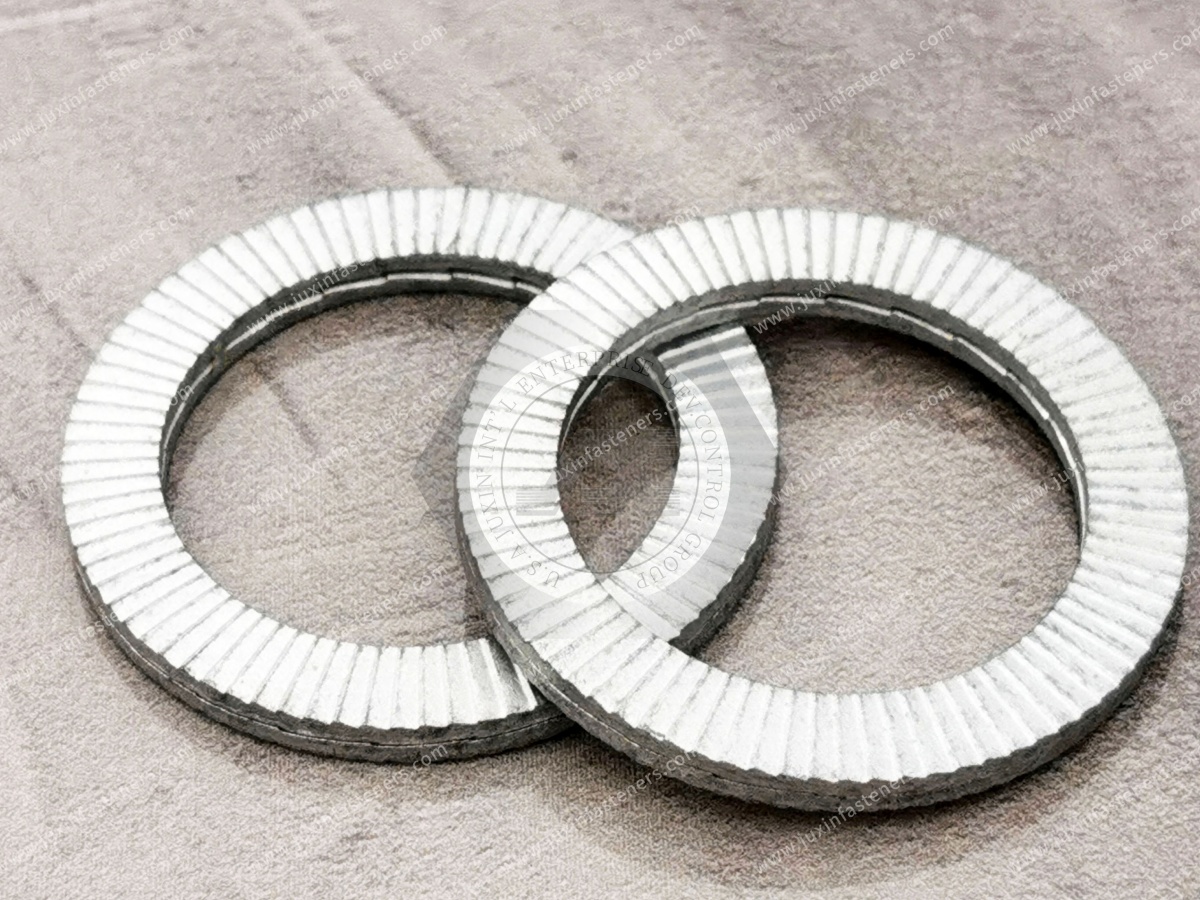
NF E25-511 serrated conical washers are steel locking elements designed for use in bolted assemblies where a combination of conical spring geometry and serrated contact surfaces is required.
They are also commonly searched or specified as:
CS washers;
French lock washers;
serrated conical washers;
serrated conical lock washers;
contact washers;
tooth-face locking washers;
SKL-type washers.
For engineers and OEM procurement teams, however, the product should not be selected simply because an assembly experiences “vibration.”
A serrated conical washer interacts with the complete bolted joint:
Bolt + Nut or Mating Thread + Washer + Contact Surface + Tightening Process + External Loads
Its actual performance therefore depends on more than washer geometry alone.
The most important engineering distinction is this:
Spring Reaction ≠ Serration Friction ≠ Clamp-Load Retention ≠ Guaranteed Resistance to Rotational Loosening
Understanding these mechanisms separately leads to better joint design, more accurate RFQs and more reliable supplier qualification.
NF E25-511 is the French national standard covering serrated conical washers for bolted joints, identified by the symbol CS.
The current NF E25-511 edition specifies dimensions and characteristics for steel serrated conical washers with nominal diameters from 3 mm to 20 mm.
The standard also defines applicable testing and product designation requirements.
These washers are intended for use in static bolted assemblies with specified screws and corresponding nuts.
Their geometry combines:
a conical washer profile;
serrated contact features;
controlled dimensions;
spring behavior under tightening.
This combination distinguishes the product from both a conventional flat washer and a plain conical spring washer.
The original article referred to:
“NFE-S.L.M.Z French standard.”
That terminology should be removed.
The verified French standard is:
NF E25-511
with the designation:
Serrated conical washers for bolted joints — CS symbol
For OEM drawings, sourcing documents and supplier RFQs, use the actual standard reference rather than an informal or supplier-generated abbreviation.
This is another important correction.
NF E25-511 covers serrated conical washers.
DIN 6796 covers conical spring washers for bolted connections.
The products are related in the sense that both use conical spring geometry, but they should not be represented as the same standard.
A supplier should therefore not automatically state:
“NF E25-511 / DIN 6796”
as though the two specifications are interchangeable.
If the customer drawing requires NF E25-511, quote and manufacture against NF E25-511.
If it requires DIN 6796, evaluate the DIN 6796 requirement separately.
Similar Function ≠ Same Standard
Within NF E25-511, CS identifies the serrated conical washer product family.
This is a more technically useful term for international sourcing than relying solely on names such as:
French washer;
SKL washer;
tooth washer.
Commercial names can vary between suppliers and countries.
The controlled standard or drawing should therefore remain the primary purchasing reference.
A particularly important point for engineers is the standard's intended application.
NF E25-511 serrated conical washers are specified for use in static bolted assemblies.
This should not be interpreted to mean that the washer can never be installed in equipment that operates, moves or experiences environmental excitation.
Rather, it means engineers should not use the NF E25-511 designation itself as proof that the washer is qualified for a dynamic spring application.
Dynamic spring-washer requirements must be evaluated separately.
Industrial equipment may contain a mechanically static bolted joint while the surrounding machine experiences:
vibration;
motor excitation;
transport shock;
thermal cycling;
operational movement.
The critical question is not simply whether the machine vibrates.
The engineering question is:
How does the actual bolted joint respond to the applied service loads?
That distinction matters when selecting any locking element.
The washer combines two mechanical concepts:
The conical shape deflects as the bolted joint is tightened.
This creates an elastic reaction within the joint.
The serrated geometry interacts with the adjacent contact surface.
Depending on the materials, hardness, finish and preload, these serrations can increase local surface engagement and influence resistance to relative movement.
These mechanisms work at different parts of the joint.
They should not be treated as one generic “locking force.”
The conical shape introduces elastic deflection into the fastening stack.
This can be useful where a joint experiences limited changes in stack thickness caused by mechanisms such as:
embedment;
surface settling;
limited relaxation;
coating compression.
As the joint thickness changes, the spring element can recover through part of its deflection range.
This may help reduce the amount of clamp-force loss compared with an otherwise more rigid stack in an appropriate application.
However:
Elastic Compensation ≠ Constant Clamp Load
The available spring travel and load-deflection behavior must be appropriate for the actual joint.
Serrations create localized contact points at the washer interface.
Their behavior depends on:
tooth geometry;
washer hardness;
mating-surface hardness;
coating;
surface roughness;
applied preload.
The serrations may engage the mating surface and influence resistance to relative movement.
But this does not mean every serrated washer will prevent every bolt from rotating loose.
This is one of the most important concepts when specifying an anti-loosening washer.
A bolted joint can lose clamp force without any visible screw or nut rotation.
Potential causes include:
surface embedment;
material creep;
stress relaxation;
gasket compression;
coating deformation;
thermal effects.
This is clamp-load loss without rotational loosening.
Another mechanism occurs when relative movement causes the threaded fastener to rotate.
That is rotational loosening.
A fastening solution should be selected according to the actual failure mechanism.
Suppose an assembly loses preload because a soft polymer component creeps.
Increasing serration aggressiveness may not solve the root cause.
The joint may instead require:
more appropriate spring travel;
different clamped material geometry;
compression limiters;
another preload strategy.
Conversely, if the problem is severe transverse slip causing fastener rotation, spring compliance alone may not be sufficient.
Therefore:
Diagnose the Failure Mechanism Before Selecting the Locking Washer
The current NF E25-511 scope identifies serrated conical washers for static bolted assemblies using screws of property classes:
6.8;
8.8;
with corresponding nuts.
This is much more precise than the original article's statement that the washer is simply “designed to work effectively with Grade 8.8 bolts and similar strength levels.”
Do not generalize beyond the applicable standard without engineering review.
Installing a higher-strength bolt does not automatically increase the performance of the complete washer joint.
The limiting component may instead be:
mating thread;
washer;
contact surface;
clamped material;
bearing area;
coating.
Therefore:
Bolt Strength ≠ Joint Strength
NF E25-511 covers nominal diameters from:
3 mm to 20 mm
This makes the product relevant to a wide range of industrial bolted assemblies.
However, nominal bolt diameter alone is not sufficient for procurement.
An RFQ should identify the complete washer designation and geometry required.
A request such as:
“Need M8 SKL washer”
can be ambiguous.
Different commercial product families may vary in:
outside diameter;
thickness;
free height;
serration pattern;
material;
hardness;
finish.
For OEM second-source projects, the controlled standard, drawing or approved sample should be supplied.
The original article listed:
M;
S;
L;
I.
Various supplier catalogues use form letters for serrated conical washer geometries.
However, these letters should not be presented without the governing specification.
For purchasing, always connect the form designation to:
NF E25-511 where applicable;
customer drawing;
supplier-controlled specification.
A letter by itself is not a complete technical specification.
NF E25-511 applies to steel serrated conical washers within its defined scope.
For OEM sourcing, material should be specified according to the applicable standard or controlled customer drawing.
The old article used regional material designations such as:
65Mn;
SK5;
SK7.
These should not be used as the primary international specification for a European or North American OEM sourcing page.
A better procurement approach is to specify:
controlled spring-steel material and finished mechanical requirements according to the applicable product specification.
Spring-washer behavior depends on more than raw material chemistry.
Finished performance can depend on:
material condition;
washer thickness;
conical geometry;
serration geometry;
forming;
heat treatment;
hardness;
surface treatment.
Therefore:
Same Material Name ≠ Same Finished Washer Performance
A2 or A4 stainless versions may be commercially available for certain serrated conical washer designs.
However, a stainless version should not automatically be assumed to conform to the same requirements as the standard carbon-steel product unless the governing specification permits it.
Changing material can affect:
spring behavior;
hardness;
serration performance;
forming;
corrosion behavior;
surface interaction.
For OEM sourcing, define stainless requirements separately.
Where stainless material is specified, selection still depends on the actual environment.
Relevant factors include:
chloride exposure;
humidity;
chemicals;
temperature;
crevice conditions;
mating materials.
A stainless designation alone does not guarantee unlimited corrosion resistance.
For spring-steel serrated washers, potential surface systems may include customer-specified:
black finishes;
zinc-based coatings;
zinc-flake coating systems;
other corrosion-protection systems.
The correct coating should be selected according to the actual application and product specification.
A surface-treatment change can affect:
corrosion resistance;
friction;
tightening behavior;
tooth engagement;
coating damage during tightening.
Therefore:
Same Washer + Different Coating ≠ Automatically Same Joint Behavior
For susceptible hardened spring-steel components, manufacturing and coating processes capable of introducing hydrogen require appropriate risk control.
Risk depends on factors including:
material;
hardness;
processing route;
hydrogen exposure;
applied stress.
The old phrase:
“zinc plating with dehydrogenation”
is too simplistic for an engineering specification.
There is no universal post-process treatment that can be stated as automatically eliminating hydrogen-embrittlement risk for every washer configuration.
Zinc-flake systems may be considered where appropriate for:
corrosion protection;
OEM surface specifications;
certain high-strength fastener applications.
However, the specific coating system and acceptance requirements should be defined.
“Zinc flake” alone is not a complete finish specification.
A serrated washer does not operate in isolation.
The serrations contact another material.
Possible mating surfaces include:
hardened steel;
carbon steel;
stainless steel;
aluminum;
coated steel;
painted sheet metal.
The same washer can behave differently on each surface.
When the mating material is relatively soft, serrations may create:
indentation;
surface damage;
coating penetration;
localized settling.
These effects can alter the joint's preload and corrosion behavior.
Therefore the mating material should be included in engineering evaluation.
A hardened serrated washer against aluminum deserves particular attention.
Potential concerns include:
local indentation;
coating damage;
embedment;
preload loss;
galvanic interaction where moisture is present.
A washer validated against steel should not automatically be assumed to perform identically against aluminum.
Serrations can penetrate or damage coatings.
Depending on the application, this may:
alter friction;
expose base metal;
change corrosion protection;
affect electrical contact.
This can be beneficial for a specifically designed electrical contact interface or undesirable for a corrosion-protected enclosure.
The function must be intentional.
Because serrations can penetrate some surface films, these washers are sometimes assumed to provide electrical bonding.
That should not be automatic.
Electrical:
grounding;
bonding;
protective-earth;
EMI
requirements must be separately designed and validated.
Mechanical locking does not establish electrical compliance.
A bolt is tightened primarily to create preload.
But installation torque is not equal to clamp force.
A substantial portion of tightening torque is consumed by friction at:
the threads;
the bearing interface.
Changing the washer changes one of those interfaces.
Therefore:
Same Tightening Torque + Different Washer ≠ Automatically Same Clamp Load
The serrated surface may alter bearing friction during tightening.
This can influence:
torque-preload relationship;
torque scatter;
surface indentation;
final joint condition.
When replacing a plain washer with a serrated conical washer, engineers should review the tightening specification.
There is no universal tightening torque simply because the washer is:
M6;
M8;
M10.
Torque depends on the complete fastener system.
Relevant inputs include:
bolt size;
bolt property class;
thread condition;
lubrication;
coating;
mating thread;
contact surfaces;
target preload.
The original article claimed that the washer automatically distributes clamp force evenly.
That statement is too broad.
Bearing stress depends on:
washer geometry;
bolt/nut bearing geometry;
mating surface;
preload;
local deformation.
A conical washer changes the contact condition, but uniform pressure distribution should not be assumed without analysis.
The original article stated that SKL washers absorb vibration.
That is not an appropriate general description.
The washer has elastic behavior, but that does not make it a vibration isolator or damper.
A better distinction is:
Spring Compliance ≠ Vibration Damping
Machine vibration remains a system-level mechanical phenomenon.
A machine may experience vibration while the bolted interface remains fully clamped and does not slip.
Another joint on the same machine may experience transverse movement.
These two joints can have very different loosening risks.
Therefore the useful question is not:
“Does the machine vibrate?”
It is:
“What relative movement and load occur at this bolted interface?”
Repeated transverse movement can be particularly important in threaded-joint loosening.
If external forces exceed the frictional resistance between the clamped components, interface slip may occur.
Once slip develops, the loosening mechanism can change substantially.
A serrated conical washer should not be advertised as universally preventing this condition.
Because NF E25-511 identifies static bolted-joint applications, some buyers may interpret the washers as low-load products.
That conclusion is incorrect.
“Static” describes the application category in the standard.
Actual joint loading must still be evaluated according to the design.
Conversely, passing a static requirement does not automatically establish:
vibration durability;
fatigue life;
shock resistance;
long-term dynamic performance.
Where these characteristics are required, they should be separately validated.
The old article stated:
“The concave side should face the clamped components.”
That should not be presented as a universal installation rule for every serrated conical washer.
Correct orientation depends on the specific:
washer geometry;
serration location;
standard;
product drawing;
assembly design.
For production assemblies, orientation should be controlled by the approved specification.
If the two washer faces are functionally different, the production operator should not be expected to guess the orientation.
The assembly documentation should clearly identify:
bolt side;
component side;
serration direction where applicable.
This becomes particularly important in automated assembly.
Depending on the joint architecture, the washer may be installed under:
bolt head;
nut;
another specified rotating bearing surface.
The correct position should be defined by the joint design.
Moving the washer from one side to another can change the friction condition and should not be treated as irrelevant.
The original article recommended combining a smooth conical washer with the serrated washer in some assemblies.
That is not a universal recommendation.
Adding another washer changes:
stack height;
spring compliance;
bearing interfaces;
friction;
load-deflection behavior.
If multiple washers are required, the arrangement should be intentionally engineered and validated.
A serrated conical washer should not automatically be considered indefinitely reusable.
During tightening and service, the washer may experience:
spring deflection;
tooth engagement;
surface marking;
coating damage;
permanent set.
Where the joint is repeatedly serviced, the OEM should define whether the washer is:
replaced after removal;
inspected before reuse;
qualified for a defined service cycle.
If the locking strategy depends partly on serration engagement, tooth condition after disassembly becomes relevant.
A previously installed washer may not recreate the same contact interface during a second installation.
Possible causes include:
embedment;
surface settling;
coating compression;
material creep;
thermal effects;
stress relaxation.
This is not necessarily a failure of the serration.
Possible contributors include:
insufficient preload;
transverse slip;
unsuitable locking strategy;
incorrect tightening;
friction variation;
severe cyclic loading.
The washer should be evaluated as one part of the complete system.
Potential contributors can include:
material defect;
forming defect;
incorrect heat treatment;
excessive loading;
hydrogen embrittlement;
inappropriate installation.
A cracked washer requires root-cause analysis rather than automatic replacement with a thicker washer.
Possible contributors include:
soft mating material;
high contact stress;
aggressive serration geometry;
thin or fragile coating.
The correct solution depends on the required interface function.
If the teeth substantially indent a soft mating surface, the joint stack thickness can change after tightening.
This may contribute to preload reduction.
Therefore:
Higher Tooth Penetration ≠ Automatically Better Locking
Where serrations disturb a protective coating, local substrate exposure may occur.
Corrosion risk then depends on:
base materials;
coatings;
moisture;
electrolyte exposure;
galvanic combination.
A replacement washer may fit dimensionally but have different:
tooth geometry;
hardness;
coating;
surface roughness.
This can change bearing friction and tightening behavior.
Therefore:
Dimensional Fit ≠ Functional Equivalence
A plain washer primarily provides a bearing interface and load-spreading function.
An NF E25-511 serrated conical washer adds:
conical spring geometry;
serrated contact behavior.
Neither design is universally superior.
The joint requirement determines the correct solution.
Primary product architecture:
Serrated conical washer for bolted joints
Primary product architecture:
Conical spring washer for bolted connections
They should be treated as separate specifications.
These are fundamentally different locking concepts.
A wedge-locking system typically uses paired washers with engineered cam surfaces.
An NF E25-511 serrated conical washer uses a different geometry and operating mechanism.
Do not substitute one for the other based solely on the phrase “anti-loosening washer.”
A prevailing-torque nut generates resistance to rotation through a locking feature in the nut/thread system.
A serrated conical washer acts primarily through:
spring geometry;
bearing-surface interaction.
The mechanisms are different.
Thread-locking adhesive acts within the threaded interface.
The serrated conical washer acts primarily at the bearing interface and through its elastic geometry.
Again:
Different Locking Mechanism = Different Validation Requirement
Potential applications include suitable bolted joints in:
pumps;
compressors;
gearboxes;
conveyors;
machine tools;
packaging machinery;
production equipment.
Selection should be based on the actual joint behavior rather than a generic statement that industrial machinery vibrates.
Potential mechanical applications include:
equipment frames;
brackets;
enclosure structures;
support assemblies.
Electrical bonding requirements remain separate from mechanical locking.
Serrated conical washers may be considered for appropriate mechanical fastening of:
brackets;
covers;
frames;
auxiliary equipment.
They should not automatically be specified for:
busbar joints;
grounding connections;
high-current interfaces
without the applicable electrical and thermal engineering requirements.
Possible applications include appropriate:
brackets;
machinery covers;
auxiliary assemblies;
equipment structures.
Safety-critical lifting or load-bearing connections require dedicated engineering and applicable regulatory compliance.
A standard washer designation alone does not establish safety qualification.
Rail equipment can expose fastened joints to:
vibration;
shock;
thermal variation;
long service intervals.
However, NF E25-511 itself does not establish complete rail-system qualification.
Rail applications should follow the applicable project and assembly requirements.
Potential applications include:
fan housings;
compressor equipment;
brackets;
machinery frames;
service assemblies.
The actual joint loading and maintenance requirements should determine washer selection.
Suitable mechanical joints may exist in:
automation frames;
controller cabinets;
auxiliary brackets;
machine enclosures.
Dynamic robot structures and motion-critical joints require system-specific engineering rather than generic washer claims.
Potential mechanical applications include:
racks;
outdoor enclosures;
equipment brackets;
structural support assemblies.
Outdoor applications may introduce additional corrosion and thermal requirements.

Potential mechanical applications include:
diagnostic equipment housings;
laboratory instruments;
carts;
covers;
equipment frames.
Use in medical equipment does not automatically imply:
medical-device certification;
biocompatibility;
sterilization compatibility;
cleanroom qualification.
These are separate requirements.
Determine whether the concern is:
clamp-load loss;
rotational loosening;
settling;
interface slip;
thermal movement;
another failure mechanism.
If the requirement is NF E25-511, specify it clearly.
Do not casually cross-reference DIN 6796.
Identify:
nominal diameter;
thread;
property class;
coating.
Specify:
nut;
tapped component;
threaded insert;
other threaded element.
Identify:
material;
hardness where relevant;
coating;
surface condition.
Control the required:
inside diameter;
outside diameter;
thickness;
free height;
serration geometry;
conical geometry.
Use the applicable standard or controlled OEM material specification.
Specify:
coating system;
corrosion requirement;
friction requirement where applicable.
Document:
target torque or approved tightening method;
lubrication condition;
assembly tooling.
Consider:
static loading;
transverse loading;
vibration exposure;
shock;
thermal cycling.
Where function is critical, test the production-intent:
Bolt + Washer + Mating Thread + Mating Surface + Coatings + Tightening Process
After validation, convert the approved configuration into controlled:
drawing requirements;
purchasing specifications;
quality requirements.
Engineers searching this topic may ask:
What is NF E25-511?
How does a serrated conical washer work?
Is NF E25-511 the same as DIN 6796?
Does a CS washer prevent bolt loosening?
How do serrations affect preload?
Can serrated washers damage coatings?
How should a conical lock washer be installed?
Their fundamental question is:
What does this washer actually do inside my bolted joint?
Procurement and supplier-development teams may search:
NF E25-511 washer supplier;
CS washer manufacturer;
French lock washer supplier;
serrated conical washer OEM;
SKL washer supplier;
NF E25-511 second source;
bulk serrated conical washers.
Their fundamental question is:
Can the supplier reproduce the required standard, geometry, material, finish and functional behavior consistently?
If an OEM currently buys a serrated conical washer from another supplier, JUXIN FASTENERS can evaluate:
drawing;
existing part number;
physical sample;
dimensional requirements;
material;
finish;
annual demand.
However:
Cross-Reference Candidate ≠ Automatic Drop-In Equivalent
A supplier change can affect:
dimensions;
hardness;
tooth geometry;
coating;
friction;
tightening behavior.
Critical applications should follow the customer's supplier-change and validation process.
A sample that fits beneath an M8 bolt proves only limited dimensional compatibility.
It does not automatically establish:
preload behavior;
loosening resistance;
corrosion performance;
production consistency;
long-term durability.
Production-intent validation should match the actual application requirement.
For a more accurate quotation and engineering review, provide where applicable:
NF E25-511 designation;
nominal size;
existing part number;
existing supplier reference;
customer drawing;
approved sample;
bolt diameter;
thread system;
bolt property class;
bolt coating;
mating nut or threaded component;
washer inside diameter;
washer outside diameter;
thickness;
free height;
serration configuration;
material requirement;
hardness requirement where specified;
surface treatment;
corrosion requirement;
mating-surface material;
mating-surface coating;
tightening method;
target torque where controlled;
lubrication condition;
joint stack;
expected service load;
vibration/shock environment where relevant;
temperature range;
reuse/service requirement;
inspection requirements;
documentation requirements;
sample quantity;
pilot quantity;
production quantity;
annual demand;
packaging requirements.
NF E25-511 is the French standard for steel serrated conical washers used in bolted joints, designated by the symbol CS.
The current standard covers nominal diameters from 3 mm to 20 mm.
The standard identifies use in static bolted assemblies with screws of property classes 6.8 or 8.8 and corresponding nuts.
No. NF E25-511 covers serrated conical washers. DIN 6796 covers conical spring washers for bolted connections. They should not automatically be treated as interchangeable.
“French lock washer” is a useful commercial search term, but NF E25-511 is the more precise technical reference.
CS is the designation used by NF E25-511 for this serrated conical washer product family.
The washer can influence spring response and bearing-interface behavior, but complete resistance to rotational loosening depends on the entire bolted joint and service condition.
It should not be treated as a vibration damper. Spring compliance and vibration damping are different mechanical functions.
Its conical spring geometry can provide elastic travel that may help retain some reaction force when limited settling occurs. The amount depends on the complete joint.
Yes. Depending on tooth geometry, preload and mating-surface properties, serrations can mark or penetrate coatings.
Do not assume so. Grounding and bonding are separate electrical engineering requirements.
Not automatically. Material substitution can change spring behavior, hardness, serration interaction and manufacturing requirements.
Reuse should be determined by the application and controlled maintenance specification. Do not assume unlimited reuse.
The part number can help identify a candidate, but controlled drawings, specifications or samples should be used to establish actual equivalence.
JUXIN FASTENERS supports OEM and industrial sourcing for fastening components including:
NF E25-511 serrated conical washers;
CS washers;
serrated locking washers;
conical spring washers;
spring washers;
retaining rings;
blind rivet nuts;
self-clinching fasteners;
weld fasteners;
threaded inserts;
drawing-based stamped components;
CNC-machined components.
For a standard serrated conical washer requirement, provide the applicable:
standard;
size;
material;
finish;
quantity.
For a supplier-development or second-source project, provide:
existing drawing;
sample;
current supplier part number;
bolt specification;
mating surface;
application;
annual volume.
Where joint performance is critical, also provide the relevant:
tightening process;
service loading;
coating requirements;
validation requirements.
For OEM quotations, sample evaluation, supplier-development projects or production sourcing, contact:
The most useful question is not simply:
“Which anti-loosening washer should we use?”
It is:
“Which joint failure mechanism must the fastening system control?”
A stronger engineering and sourcing pathway is:
Failure Mechanism → Applicable Standard → Bolt → Mating Thread → Contact Surface
→ Washer Geometry → Material → Finish → Tightening Process → Service Conditions → Validation → Controlled Specification → RFQ
That approach makes NF E25-511 serrated conical washer selection more reliable for both engineering teams and global OEM procurement.
 MORE NEWS
Sep. 27, 2026
Sep. 27, 2026
Sep. 27, 2026
Contact Us
Tel.:
+86 020 8621 0320
+86 020 3121 6067
E-mail:
Technical Support:
Navigation
SEND INQUIREY