
Call Us
+86 136 6007 9809
Call Us
+86 136 6007 9809

Nov. 04, 2023
Internally threaded dowel pins solve a specific engineering problem: how to maintain accurate component location while still allowing a tightly fitted locating pin to be removed for maintenance, repair, tooling changes or equipment rebuilding.
Also called pull-out dowel pins, female threaded dowel pins, internally threaded cylindrical pins or threaded locating pins, these components combine a precision cylindrical locating surface with an internal extraction thread.
The cylindrical surface performs the locating function. The internal thread provides a controlled interface for removal.
This distinction is important. The thread is not normally the feature that locates the assembly—the precision outside diameter is.
JUXIN FASTENERS supplies internally threaded dowel pins, ISO 8735 cylindrical pins with internal thread, DIN 7979 dowel pins, hardened locating pins, stainless steel dowel pins and custom precision-machined pins for industrial machinery, molds and dies, automation equipment, automotive manufacturing, robotics, tooling and OEM mechanical assemblies.
An internally threaded dowel pin is a precision cylindrical locating component incorporating an internal threaded hole at one end.
The pin is installed into a controlled mating hole to establish accurate component position.
When maintenance or disassembly is required, a compatible screw, puller or extraction tool can engage the internal thread so the pin can be removed without requiring access from the opposite side.
This makes the design particularly useful for:
Blind-hole installations
Molds and dies
Jigs and fixtures
Machine housings
Tooling plates
Automation equipment
Serviceable mechanical assemblies
Equipment requiring periodic rebuilding
The design provides two different functions in one component:
Precision outside diameter → locating
Internal thread → extraction
Understanding these two functions helps engineers avoid treating the extraction thread as part of the primary locating interface.
A conventional solid dowel pin can provide excellent positioning accuracy, but removal may become difficult when the pin is tightly retained in a blind hole.
An internally threaded dowel pin addresses this serviceability problem.
| Engineering Requirement | Standard Solid Dowel Pin | Internally Threaded Dowel Pin |
|---|---|---|
| Precision locating | Yes | Yes |
| Controlled fit | Yes | Yes |
| Shear-load transfer | Application dependent | Application dependent |
| Blind-hole installation | Possible | Particularly useful |
| Built-in extraction feature | No | Yes |
| Maintenance access | May be difficult | Improved |
| Repeated equipment servicing | Application dependent | Often advantageous |
| Tooling and mold maintenance | Common | Especially useful where extraction is required |
The decision should therefore not be based on the assumption that one design is universally better.
Use the extraction feature when the assembly architecture or maintenance strategy actually requires it.
ISO 8735 covers hardened parallel pins with an internal thread and is an important international reference for this product family.
These pins are used where engineers require a precision cylindrical locating element combined with an extraction feature.
For ISO-based projects, the complete specification should be reviewed rather than identifying the component only as a “threaded dowel pin.”
Relevant drawing information may include:
Nominal pin diameter
Pin length
Diameter tolerance
Internal thread
Material
Hardness
End geometry
Surface condition
Applicable standard
JUXIN FASTENERS can support standard-based sourcing as well as custom designs manufactured according to customer drawings.
DIN 7979 is another widely recognized reference associated with cylindrical locating pins incorporating an internal extraction thread.
DIN-based threaded dowel pins are commonly encountered in:
European machinery
Tooling systems
Molds
Fixtures
Production equipment
Mechanical assemblies
When replacing an existing DIN component, procurement teams should verify the complete designation and drawing rather than assuming that every internally threaded pin is dimensionally interchangeable.
For international OEM sourcing, providing the original specification, drawing or sample reduces the risk of mismatching:
Diameter
Length
Thread
End geometry
Fit
Material
Hardness
The commercial value of an internally threaded dowel pin is not simply that it contains a thread.
Its real value is serviceability.
Consider a hardened locating pin installed into a blind hole in an expensive mold plate.
If the pin has no accessible extraction feature, maintenance personnel may need to use less controlled removal methods that risk damaging:
The pin
The locating hole
The mold plate
Adjacent precision surfaces
A pull-out dowel pin gives maintenance personnel a defined extraction interface.
This can simplify servicing while helping protect expensive mating components.
Blind holes are one of the strongest use cases for internally threaded dowel pins.
With a through hole, engineers may have the option of accessing the opposite end of a conventional pin during removal.
A blind hole removes that access.
The internal thread therefore becomes valuable because the removal force can be applied from the accessible side.
Typical blind-hole applications include:
Mold plates
Die components
Machine housings
Fixture bases
Automation tooling
Precision equipment
Replaceable machine modules
However, successful removal still depends on correct fit, corrosion condition, contamination, service history and extraction method.
An internal thread should not be treated as a guarantee that any severely seized pin can be removed easily.
This is one of the most important engineering distinctions for this product.
The outside cylindrical surface establishes location.
The internal thread provides an extraction interface.
Therefore, increasing the size or strength of the internal thread does not automatically improve locating accuracy.
Locating performance depends more directly on factors such as:
Outside diameter
Diameter tolerance
Hole tolerance
Hole position
Roundness
Surface condition
Mating material
Assembly fit
Extraction performance depends on a different set of factors, including:
Internal thread design
Thread engagement
Pin material
Pin wall section
Removal force
Extraction tooling
Condition of the installed joint
The two functions must be engineered together without confusing their roles.
The fit between the pin and retaining hole is fundamental to performance.
Depending on the application, the design may involve:
Interference fit
Transition fit
Controlled clearance on a mating component
Application-specific locating arrangements
There is no universal hole tolerance or interference value suitable for every internally threaded dowel pin.
The correct fit depends on:
Pin specification
Mating-hole tolerance
Base material
Wall thickness
Required locating accuracy
Retention requirement
Installation method
Removal requirement
Operating temperature
Maintenance frequency
For detailed fit engineering, the Dowel Pin Fit & Hole Tolerance Guide should be treated as a related design resource.
A common serviceable locating strategy is to retain the dowel pin in one component while allowing another component to locate over the exposed portion.
Conceptually:
Base component → retained dowel pin
Removable component → controlled locating hole
This arrangement can provide:
Repeatable component positioning
Easier disassembly
Better maintenance access
Reduced risk of losing the locating pin
Faster module replacement
Internally threaded pins add another maintenance advantage because the retained pin itself can be extracted when replacement becomes necessary.
A frequent engineering mistake is assuming that a tighter press fit always produces a better locating system.
Excessive interference can create:
High installation force
Difficult extraction
Hole deformation
Pin damage
Component distortion
Local stress
Increased maintenance difficulty
The fit should provide the required retention and locating performance without creating unnecessary assembly or servicing problems.
For standard ISO or DIN components, use the thread defined by the applicable specification.
For a custom pull-out dowel pin, the extraction thread must be considered as part of the pin geometry.
Engineering considerations may include:
Pin outside diameter
Available wall thickness
Thread diameter
Thread depth
Thread engagement
Material strength
Hardness
Required extraction force
Extraction tool
Blind-hole depth
A larger extraction thread is not automatically better.
Removing too much material from the center of a small pin can change the available cross-section.
Custom designs should therefore be reviewed as complete mechanical components rather than by thread size alone.
Hardened steel is commonly used for precision locating applications requiring combinations of:
Wear resistance
Dimensional stability
Surface hardness
Mechanical strength
Repeated positioning
Typical applications include:
Machine tools
Fixtures
Molds
Dies
Automation systems
Industrial machinery
Material grade and hardness should be specified according to the applicable standard or customer drawing.
JUXIN FASTENERS does not recommend applying one universal hardness requirement to every custom threaded dowel pin.
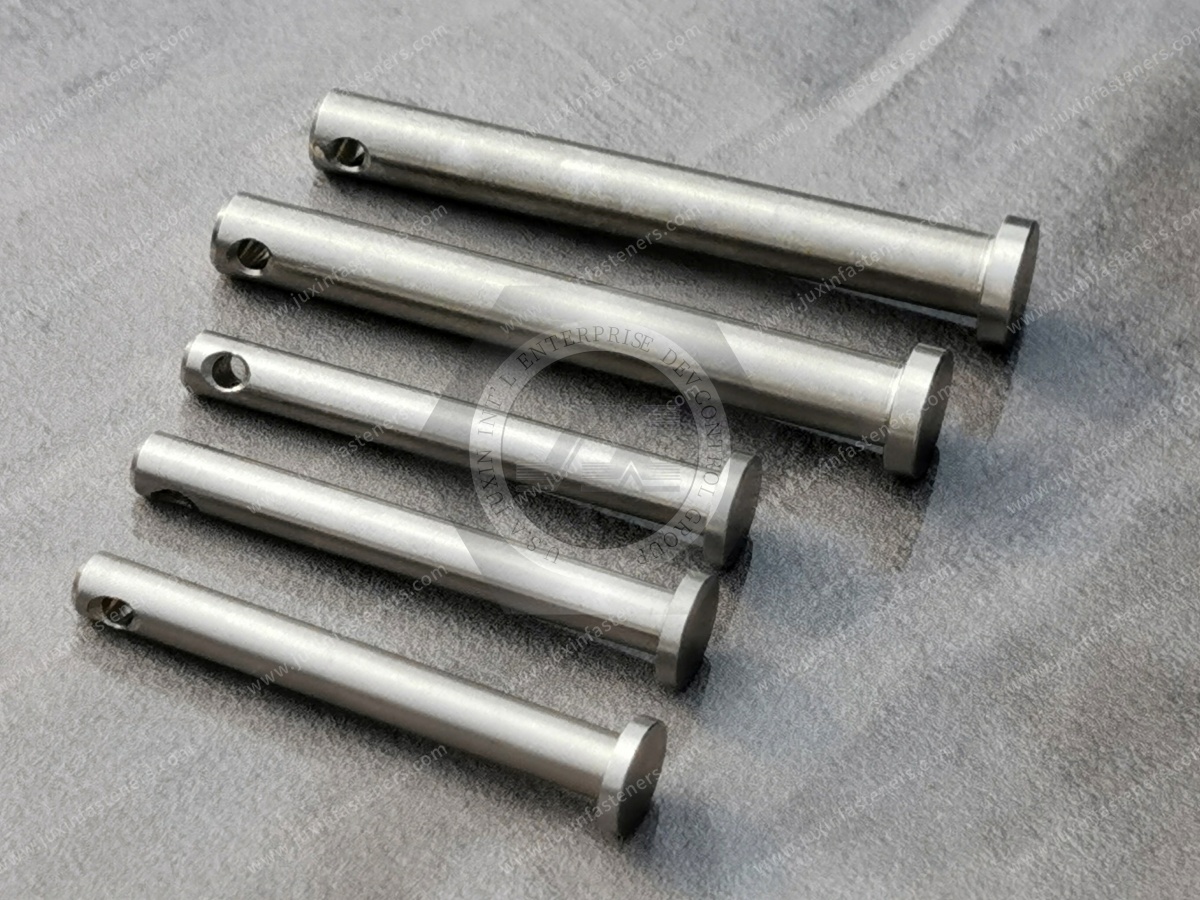
Stainless steel may be appropriate when corrosion resistance is an important design requirement.
Potential applications include:
Food-processing machinery
Packaging equipment
Medical and laboratory equipment
Outdoor equipment
Chemical-processing machinery
Corrosion-sensitive industrial assemblies
However, stainless steels differ significantly in:
Hardness
Strength
Wear behavior
Machinability
Corrosion resistance
Austenitic grades such as 304 or 316 should not automatically be considered equivalent to hardened steel locating pins.
Material selection should balance corrosion resistance with the required mechanical and locating performance.
Instead of selecting material from a generic catalog list, engineers should evaluate:
Required hardness
Wear conditions
Shear loading
Corrosion environment
Temperature
Mating material
Installation fit
Expected removal frequency
Required service life
For a mold locating pin, wear resistance may dominate the decision.
For processing equipment, corrosion resistance may be more important.
For frequently serviced tooling, removal behavior may become a major design consideration.
For precision locating pins, the outside diameter is one of the most important manufactured features.
Depending on the specification and application, manufacturing may involve:
CNC machining
Heat treatment
Precision grinding
Diameter inspection
Roundness control
Surface inspection
Thread inspection
The exact production route depends on:
Material
Geometry
Hardness
Tolerance
Quantity
Customer specification
For custom OEM pins, the manufacturing process should be selected to achieve the drawing requirements rather than applying one fixed process to every design.
An accurately manufactured threaded dowel pin cannot compensate for an incorrectly positioned mating hole.
In multi-pin locating systems, engineers should evaluate:
Hole diameter
Hole position
Center-to-center distance
Positional tolerance
Component distortion
Thermal effects
If two precision pins are installed into inaccurately positioned holes, the assembly may bind even though each individual pin meets its dimensional specification.
Precision pin selection and component GD&T therefore need to work together.
Molds and dies are among the most logical applications for pull-out dowel pins because accurate alignment and periodic maintenance are both important.
Potential applications include:
Injection mold plates
Stamping dies
Progressive dies
Tooling assemblies
Replaceable mold components
The internal extraction thread can simplify pin replacement during:
Preventive maintenance
Tool repair
Component replacement
Mold rebuilding
Dimensional correction
This can be particularly valuable when the pin is installed in an expensive precision-machined component.
Manufacturing fixtures frequently require repeatable location combined with periodic reconfiguration or repair.
Applications include:
Welding fixtures
Assembly fixtures
Inspection fixtures
CNC workholding
Production jigs
Robotic tooling
Internally threaded locating pins can help engineers design fixtures that are accurate during production but still maintainable over the equipment lifecycle.
In automotive manufacturing, pull-out and precision dowel pins may be used in production equipment such as:
Welding fixtures
Assembly tooling
Inspection fixtures
Machining fixtures
Mold and die systems
Automation equipment
EV component production tooling
It is important to distinguish between a pin used in automotive production equipment and a pin installed in the vehicle itself.
The loading, validation, material and quality requirements may be different.
Automation equipment often combines precision location with modular construction.
Internally threaded dowel pins can be used for:
Robot tooling
End-of-arm tooling interfaces
Fixture plates
Assembly stations
Replaceable machine modules
Inspection systems
Production changeover equipment
When a locating component eventually wears or becomes damaged, an extraction feature can reduce maintenance difficulty.
Precision machine assemblies may use internally threaded dowel pins for:
Housing alignment
Fixture location
Machine-module positioning
Guide assemblies
Tooling systems
The required fit should be derived from the machine's functional accuracy, structural requirements and maintenance strategy.
Installation should follow the applicable drawing and assembly procedure.
A typical engineering sequence includes:
Verify pin specification and dimensions.
Inspect the mating-hole diameter and position.
Remove burrs and contamination.
Confirm the required fit.
Align the pin correctly with the hole.
Apply controlled installation force.
Verify installation depth and projection.
Inspect the final locating condition.
For interference-fit applications, controlled pressing is generally preferable to uncontrolled impact.
For more detailed assembly guidance, refer to the Dowel Pin Installation Guide.
The internal thread allows an extraction screw or appropriate pulling tool to engage the pin.
The exact procedure depends on the assembly.
Before removal, technicians should consider:
Extraction-thread condition
Required tool
Available access
Pin fit
Corrosion
Contamination
Retaining compound, if specified
Surrounding component condition
The extraction load should be applied in a controlled manner.
Improvised removal methods can damage both the pin and the precision locating hole.
Possible causes include:
Excessive interference
Corrosion
Contamination
Surface damage
Retaining compound
Hole distortion
Inappropriate extraction method
Possible causes include:
Incorrect extraction screw
Cross-threading
Excessive extraction load
Contamination
Insufficient thread engagement
Thread damage during service
Possible causes include:
Hole wear
Incorrect fit
Repeated removal
Base-material deformation
Incorrect pin tolerance
Surface damage
Possible causes include:
Incorrect replacement-pin dimensions
Hole wear
Positional error
Wrong standard
Different end geometry
Damage to the locating hole
Root-cause analysis should examine the entire locating system rather than only the pin.
A standard ISO or DIN product is often appropriate when:
Standard dimensions fit the design
Standard material and hardness are suitable
Existing machinery specifies the standard
Interchangeability is important
Procurement wants a clearly defined international specification
This can simplify engineering communication and sourcing.
A custom pin may be required when the application needs:
Non-standard diameter
Special length
Special extraction thread
Modified end geometry
Special material
Special hardness
Corrosion-resistant material
Unique installation depth
Special surface requirement
Combined locating and functional features
JUXIN FASTENERS can manufacture custom precision pins according to customer 2D drawings, 3D models, samples and application specifications.
For purchasing and supplier-development teams, the decision can be simplified:
Standard available and technically suitable?
Use the specified ISO or DIN component.
Standard geometry close but not functionally correct?
Do not modify the requirement simply to fit a catalog part.
Evaluate a custom precision pin.
Existing component with no drawing?
Provide a sample and application information for dimensional review.
New OEM project?
Provide the drawing, mating conditions, expected volume and technical requirements before quotation.
This reduces unnecessary quotation cycles and helps the supplier evaluate manufacturability correctly.
A complete technical drawing should define applicable requirements such as:
Standard, if applicable
Pin outside diameter
Diameter tolerance
Overall length
Internal thread specification
Thread depth
Material
Hardness
Heat treatment
Surface finish
Surface treatment
Chamfer or end geometry
Installation depth
Required projection
Special inspection requirements
For custom components, also provide the functional requirements that affect manufacturing decisions.
To obtain an accurate engineering review and quotation, provide:
2D drawing
3D model where available
ISO/DIN specification if applicable
Outside diameter
Diameter tolerance
Length
Internal thread
Thread depth
Material
Hardness
Heat-treatment requirement
Surface finish
Surface treatment
End geometry
Mating-hole information where relevant
Mating material
Required fit
Application
Operating environment
Prototype quantity
Production quantity
Estimated annual volume
Inspection requirements
Material documentation requirements
This information allows the supplier to evaluate both manufacturing feasibility and commercial production requirements.
Common search terms include pull-out dowel pin, female threaded dowel pin, internally threaded cylindrical pin and threaded locating pin.
Terminology varies by market and specification.
The internal thread provides an interface for extraction.
It is especially useful when the pin is installed in a blind hole or where pushing the pin out from the opposite side is impossible.
Normally, no.
The precision outside diameter performs the locating function. The internal thread primarily supports extraction.
No.
Blind holes are an important application, but internally threaded pins may also be selected wherever controlled removal and maintenance are desirable.
Yes, depending on the applicable standard and assembly design.
The required fit must be determined from the pin specification, hole tolerance, mating material and application.
Do not assume interchangeability based only on product names.
Verify the complete dimensions, tolerances, material requirements, thread details and applicable drawing before substitution.
Not automatically.
Corrosion resistance, hardness, strength, wear behavior and fit requirements must all be evaluated.
Yes. JUXIN FASTENERS supports custom precision pins manufactured according to customer drawings, samples and application requirements.
For engineers, the selection path should be:
locating requirement → maintenance requirement → standard or custom design → material → outside-diameter tolerance → hole fit → extraction thread → installation → removal validation
For purchasing and supplier-development teams, the sourcing path should be:
drawing/specification → supplier technical review → quotation → prototype → fit and extraction validation → inspection approval → production
JUXIN FASTENERS supplies ISO 8735 internally threaded dowel pins, DIN 7979 dowel pins, pull-out dowel pins, hardened locating pins,
stainless steel dowel pins and custom precision-machined pins for machinery, molds and dies, automotive production, industrial automation, robotics, tooling and global OEM applications.
For related engineering information, see our guides covering Precision Dowel Pins, ISO 8734 Cylindrical Pins, Dowel Pin Fit & Hole Tolerance, and Dowel Pin Installation.
Send your 2D drawing, 3D model, sample or technical specification to our engineering team for review and quotation.
JUXIN FASTENERS
FASTENING SOLUTIONS FOR GLOBAL OEMS
Website: www.juxinfasteners.com
Email: info@juxinfasteners.com
 MORE NEWS
Sep. 27, 2026
Sep. 27, 2026
Sep. 27, 2026
Contact Us
Tel.:
+86 020 8621 0320
+86 020 3121 6067
E-mail:
Technical Support:
Navigation
SEND INQUIREY