
Call Us
+86 136 6007 9809
Call Us
+86 136 6007 9809

Oct. 17, 2023
Spherical washers are engineered fastening components used where a bolt, nut, clamping element,
or mating surface cannot maintain a perfectly perpendicular load path because the supporting surfaces are not parallel.
Unlike a conventional flat washer, a spherical washer system creates an articulating bearing interface between mating curved surfaces.
This allows the fastening assembly to accommodate limited angular misalignment while transmitting clamping force through a more appropriately aligned contact surface.
DIN 6319 spherical washers and matching dished washers are widely recognized for this type of mechanical clamping application.
For design engineers, their value is not simply "better load distribution." The more important engineering function is to reduce undesirable edge loading
and bolt bending that may occur when a conventional nut or washer is tightened against a non-parallel surface.
For procurement and supplier-development teams, spherical washer sourcing therefore requires more than matching the nominal bolt size.
Washer type, mating seat, material, hardness, surface treatment, supporting geometry, load condition, and application must all be considered.
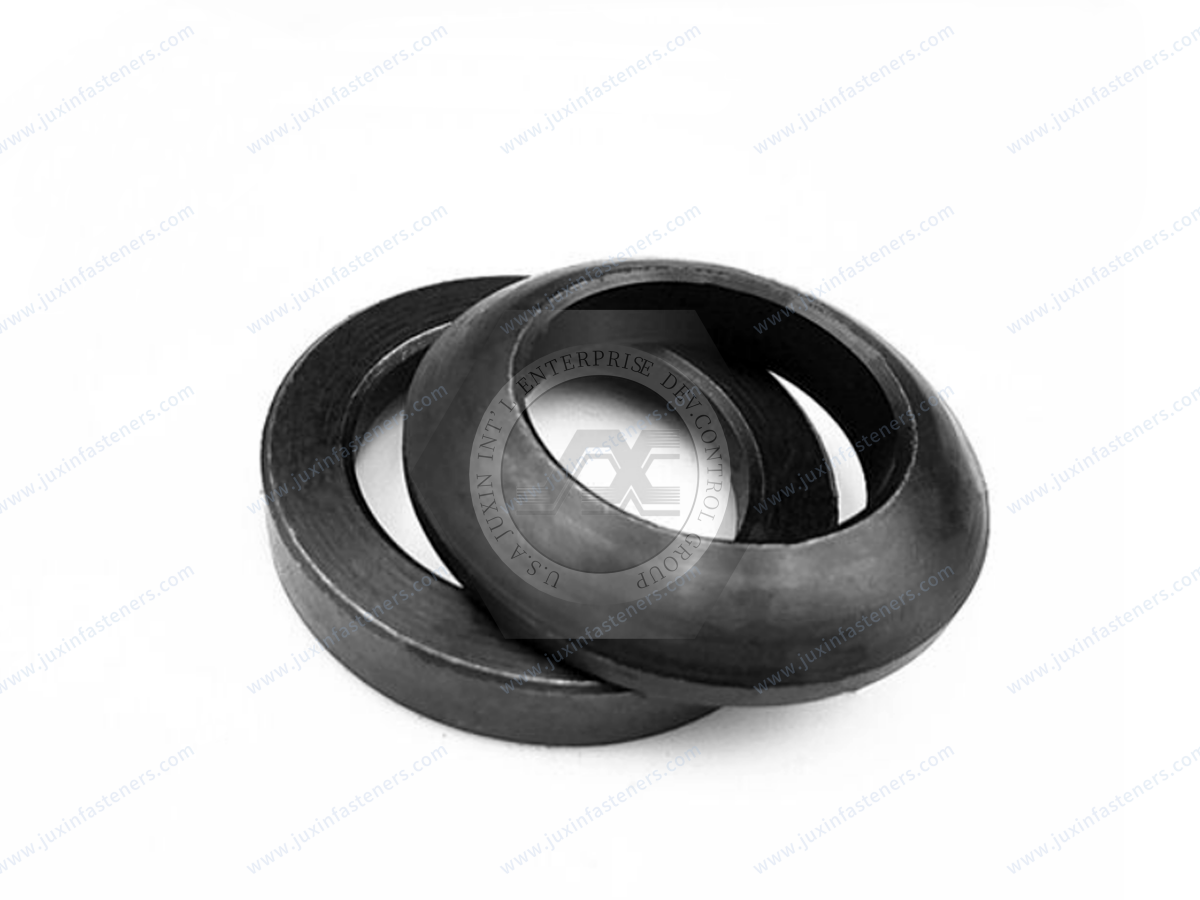
A spherical washer is a washer with a convex spherical bearing surface.
It is commonly used together with a corresponding concave dished or seat washer.
When the two curved surfaces are assembled together, they can articulate relative to one another within the geometry permitted by the design.
The resulting assembly can compensate for limited angular deviation between:
The bolt axis
Nut or bolt-head bearing surface
Clamping component
Machine surface
Structural member
Fixture
Equipment mounting surface
The basic engineering principle is:
Non-Parallel Surface → Spherical Interface Adjusts → Load Path Becomes Better Aligned → Clamping Force Is Transmitted More Uniformly
This makes spherical washers useful where a rigid flat washer would otherwise bear unevenly against the mating surface.
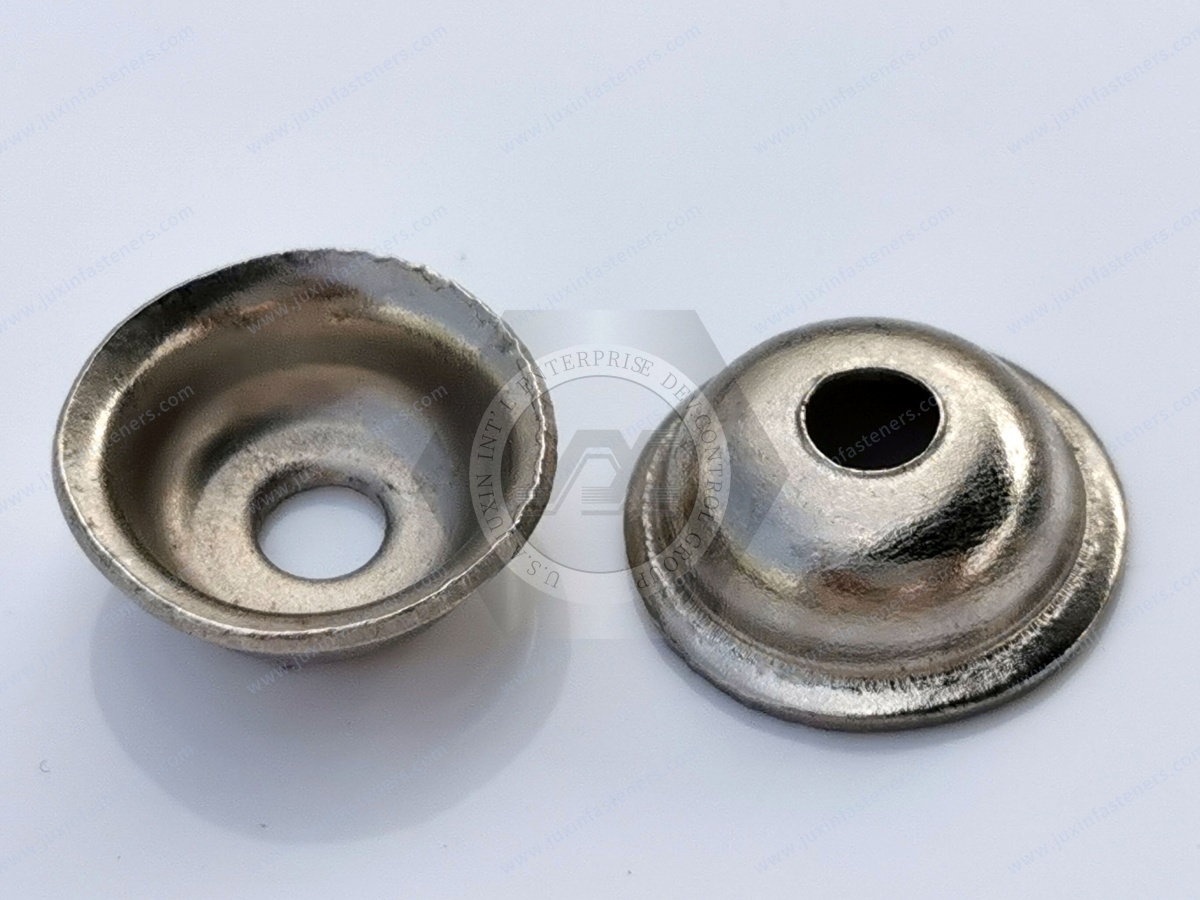
DIN 6319 defines spherical washers and matching dished washers used for clamping on non-parallel surfaces.
The system includes several important configurations.
Type C is the convex spherical washer.
Its curved surface forms the articulating interface with the corresponding dished seat.
Type D provides the corresponding concave bearing surface for the spherical washer.
When Type C and Type D are used together, the two mating surfaces allow the assembly to compensate for angular deviation.
Type G uses a larger outside diameter than the standard dished washer configuration.
This type can be useful where the supporting geometry requires a larger bearing area, including certain applications involving elongated or slotted holes.
The correct configuration should be selected according to the joint geometry rather than simply choosing a spherical washer based on bolt diameter.
Consider a bolted connection where the surface beneath the nut is not perpendicular to the bolt axis.
With an ordinary flat washer, tightening can create uneven bearing contact.
Instead of loading the washer uniformly, one side may contact first.
As tightening continues, the assembly can introduce:
Edge loading
Uneven bearing pressure
Bolt bending
Localized surface stress
Reduced clamping efficiency
Distortion of the clamped component
A spherical washer and matching seat change the interface.
During tightening:
The convex spherical washer contacts the concave seat.
The curved surfaces move relative to each other.
The washer aligns with the fastener load direction.
The clamping load is transferred through the spherical interface.
The joint can accommodate the permitted angular deviation without forcing the washer to sit flat against a non-parallel surface.
The spherical pair therefore acts as a mechanical alignment interface.
One of the most important reasons to consider a spherical washer is bolt bending.
Bolts are generally intended to carry axial tensile preload efficiently.
If the bearing surface beneath the nut or bolt head is significantly inclined relative to the fastener axis, tightening may introduce an additional bending component.
This creates a combined loading condition:
Axial Bolt Tension + Bending Stress
That is fundamentally different from a well-aligned bolted joint.
A spherical washer does not "strengthen the bolt." Instead, it can improve the geometry through which the load is transferred.
This distinction is important for structural and mechanical design.
Spherical washers are sometimes incorrectly grouped together with locking washers because both are installed beneath a bolt head or nut.
Their primary functions are different.
A spherical washer is mainly used for:
Angular compensation
Alignment of the bearing interface
Improved load transfer across non-parallel surfaces
Reduction of undesirable edge loading
Reduction of bolt bending caused by angular misalignment
A locking washer is intended to address a different fastening problem related to loosening.
Therefore:
Spherical Washer ≠ Lock Washer
If an assembly has both misalignment and self-loosening risks, these should be treated as separate engineering problems.
The complete joint may require both alignment compensation and an appropriate locking strategy.
Another important distinction is sealing.
Standard spherical washer systems should not automatically be described as sealing components.
Their curved bearing surfaces are intended primarily for mechanical alignment and load transfer.
If a bolted assembly also requires:
Water sealing
Oil sealing
Gas sealing
IP protection
Pressure sealing
a separate sealing design should be evaluated.
This may involve sealing washers, bonded seals, O-rings, gaskets, sealing screws, or other engineered sealing systems depending on the application.
A flat washer works best when the bearing surfaces are already suitably aligned.
Its common functions include:
Bearing-pressure distribution
Surface protection
Providing an appropriate bearing interface
Supporting the fastener over a hole
A spherical washer system addresses a different condition:
The surfaces are not sufficiently parallel for a conventional flat bearing interface.
This distinction provides a useful selection rule.
Bearing surfaces are parallel
Angular compensation is unnecessary
Conventional load distribution is sufficient
The support surface is inclined
Structural geometry introduces angular deviation
A clamping element contacts a non-parallel surface
Bolt bending caused by the bearing angle is a concern
Alignment cannot easily be corrected by machining
Spherical washers and conical spring washers may look somewhat similar to buyers unfamiliar with their functions, but they solve different problems.
A spherical washer provides:
Angular Compensation
A conical spring washer provides:
Elastic Deflection / Spring Action
DIN 6796 conical spring washers, for example, are designed around elastic behavior in bolted joints.
DIN 6319 spherical washer systems are designed around alignment between non-parallel surfaces.
They should not be substituted for each other merely because both have non-flat geometry.
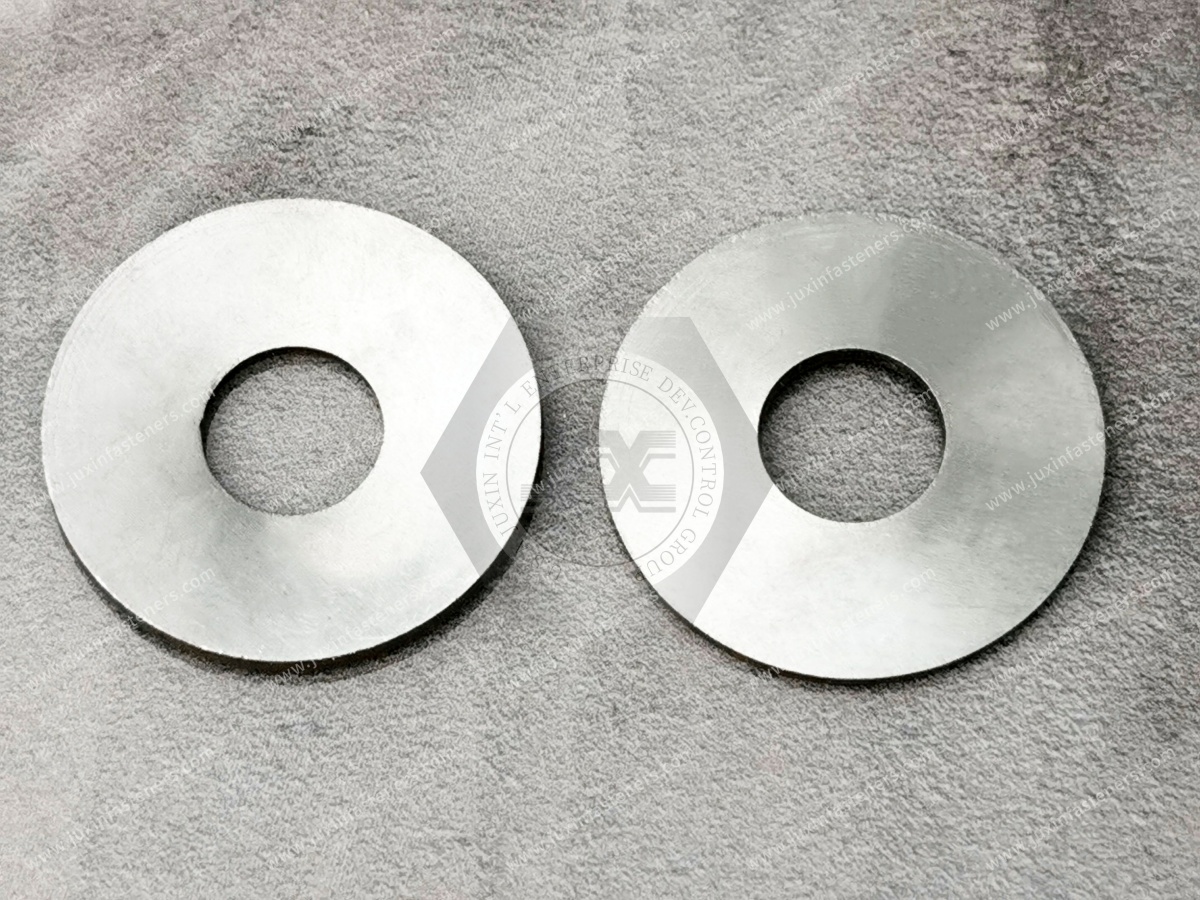
Belleville washers, or disc springs, are conical spring elements designed to provide controlled axial force and deflection.
They may be used for:
Preload
Force control
Compensation
Shock absorption
Spring systems
Spherical washers are not primarily spring elements.
Their role is geometric alignment.
A useful engineering distinction is:
Need Spring Force → Evaluate Disc Spring
Need Angular Alignment → Evaluate Spherical Washer
Some complex assemblies may require both functions, but they should be engineered independently.
Misalignment can come from many sources.
Welded structures can contain dimensional variation or distortion.
Cast surfaces may not always provide perfectly perpendicular bearing interfaces without additional machining.
Accumulated manufacturing tolerances can create angular deviation across large structures.
Fabricated brackets, beams, frames, and supports may create inclined bearing conditions.
Machine bases, fixtures, and adjustable mechanisms may intentionally operate at different angles.
Some adjustment systems use slots that change the final relationship between the fastener and supporting component.
In these cases, the fastening system should be designed around the actual geometry rather than assuming ideal alignment.
Slotted holes are common in equipment requiring:
Positional adjustment
Assembly tolerance
Alignment during installation
Adjustable mounting
Thermal movement accommodation
However, an elongated hole can reduce the supporting area available beneath a conventional washer.
DIN 6319 Type G uses an enlarged outside diameter and may therefore be considered for suitable elongated-hole applications.
The designer must still verify:
Available bearing area
Slot dimensions
Washer dimensions
Static load
Material strength
Edge distance
Joint geometry
An enlarged washer does not automatically make every slotted-hole joint suitable for a given load.
Material selection depends on the standard, mechanical load, environment, corrosion exposure, temperature, and customer specification.
Steel spherical washers are widely used for industrial clamping applications.
Depending on the applicable specification and product design, material processing can include:
Machining or forming
Heat treatment
Case hardening
Tempering
Surface finishing
DIN 6319 steel Type C and Type D components are commonly supplied in hardened configurations.
The exact material condition and hardness requirement should be verified against the applicable specification and customer requirement.
Stainless steel spherical washer systems may be selected where corrosion resistance is important.
Possible environments include:
Food-service equipment
Processing machinery
Outdoor equipment
HVAC systems
Laboratory equipment
Electrical equipment
Chemical-processing equipment
AISI 303 and AISI 316 stainless steel versions are available in the DIN 6319 product family.
Material selection should nevertheless be based on the actual environment rather than assuming that all stainless steels provide equivalent corrosion performance.
Depending on material and project requirements, spherical washers may be supplied with finishes such as:
Blackened and oiled surfaces
Phosphate-based finishes
Zinc-based coatings
Zinc-nickel systems
Zinc-flake coatings
Customer-specified protective finishes
Coating selection should consider:
Corrosion environment
Base material
Hardness
Dimensional tolerance
Contact surface behavior
Friction requirements
Customer specifications
For hardened steel components, the coating process should also be evaluated for compatibility with the material and applicable hydrogen-embrittlement requirements.
A spherical washer's ability to correct angular alignment does not automatically qualify the joint for every dynamic-load condition.
Engineers should distinguish between:
Static clamping
Slowly varying load
Cyclic loading
Shock loading
Vibration
Fatigue-critical loading
For demanding dynamic applications, the complete bolted joint must be evaluated.
This includes:
Bolt stress
Bearing stress
Washer contact stress
Joint stiffness
Fatigue loading
Surface condition
Preload
Movement between joint members
The presence of a spherical washer does not remove the need for joint validation.
Heavy industrial machinery is one of the most natural application areas for spherical washer systems.
Potential applications include:
Machine frames
Presses
Large gearboxes
Hydraulic equipment
Mining machinery
Material-handling equipment
Industrial processing machinery
Heavy-duty fixtures
Large fabricated structures frequently contain alignment variation that can make conventional flat bearing interfaces less suitable.
Spherical washers provide engineers with a compact method for accommodating such angular differences.
Potential applications include:
Steel frames
Equipment supports
Structural brackets
Heavy machinery foundations
Adjustable supports
Construction equipment
Industrial platforms
However, structural connections must comply with the applicable engineering specification.
A DIN 6319 washer should not automatically be substituted for a structural washer specified under another standard.
The structural engineer must approve the fastening architecture.
Spherical washers may be used in suitable mechanical assemblies and manufacturing equipment associated with:
Automotive production lines
EV assembly equipment
Battery-pack manufacturing equipment
Robotic fixtures
Welding fixtures
Material-handling systems
Testing equipment
Adjustable machine frames
They may also be evaluated for vehicle components where the joint geometry genuinely requires angular compensation.
However, automotive qualification depends on the specific component, drawing, material, production process, documentation, and validation requirements.
Battery-pack manufacturing relies heavily on:
Precision fixtures
Robotic handling
Welding equipment
Module assembly systems
Lifting equipment
Positioning systems
Inspection equipment
Where machine structures or clamping systems include non-parallel surfaces, spherical washer systems may provide a useful mechanical alignment solution.
This should not be confused with automatically specifying spherical washers inside the battery pack itself.
The application must be evaluated from the actual joint.
Potential applications include:
Maintenance equipment
Mechanical fixtures
Auxiliary machinery
Equipment mounts
Rail workshop equipment
Structural machinery
Rail applications can involve additional requirements for:
Traceability
Material documentation
Surface treatment
Corrosion resistance
Inspection
Fatigue validation
These requirements should be defined by the project specification.
Robotics creates several potential spherical washer applications because adjustable and articulated equipment frequently involves alignment-sensitive mounting.
Examples can include:
Robot bases
Positioning fixtures
Gripper equipment
Automated production machinery
Assembly fixtures
Adjustable brackets
End-of-line testing equipment
Spherical washers can be particularly useful when equipment must be aligned during installation without machining every mating surface to the final angle.
Fabricated sheet-metal and welded assemblies can accumulate tolerance across:
Frames
Brackets
Mounting plates
Welded supports
Equipment enclosures
Where this results in non-parallel clamping surfaces, engineers may evaluate spherical washer systems.
However, thin sheet requires additional attention to bearing pressure and local deformation.
A spherical washer cannot compensate for inadequate sheet strength.
Potential applications include mechanical mounting systems associated with:
Electrical cabinets
Switchgear
Power-conversion equipment
Transformer accessories
Industrial power systems
Mechanical support frames
Spherical washers are generally relevant where mechanical alignment is required.
They should not be confused with electrical grounding washers, which serve a different purpose.
AI data centers require substantial supporting infrastructure beyond computing hardware.
Mechanical systems can include:
Liquid-cooling equipment
Pumps
Chillers
Heat-exchange systems
Power-distribution equipment
UPS equipment
Equipment frames
Mechanical support structures
Where large equipment frames or supports create non-parallel clamping surfaces, spherical washer systems may be evaluated.
Again, the selection should be driven by joint geometry—not simply by the fact that the equipment is installed in a data center.
Potential applications include:
Chiller equipment
Pumps
Compressors
Heat exchangers
Skid-mounted systems
Pipe-support equipment
Equipment frames
Large HVAC and liquid-cooling assemblies can involve fabricated structures and field installation conditions where alignment variation occurs.
Spherical washers may help accommodate suitable mechanical mounting deviations.
Possible applications include:
Antenna support equipment
Outdoor cabinets
Adjustable mounting structures
Mechanical support frames
Communication infrastructure
For outdoor applications, corrosion protection becomes an important sourcing consideration.
Semiconductor manufacturing equipment may contain:
Precision machine frames
Handling systems
Pumps
Positioning equipment
Auxiliary machinery
Spherical washers can be evaluated where mechanical alignment is required.
However, applications involving cleanroom, vacuum, outgassing, contamination, or special chemical environments require additional material and surface-finish review.
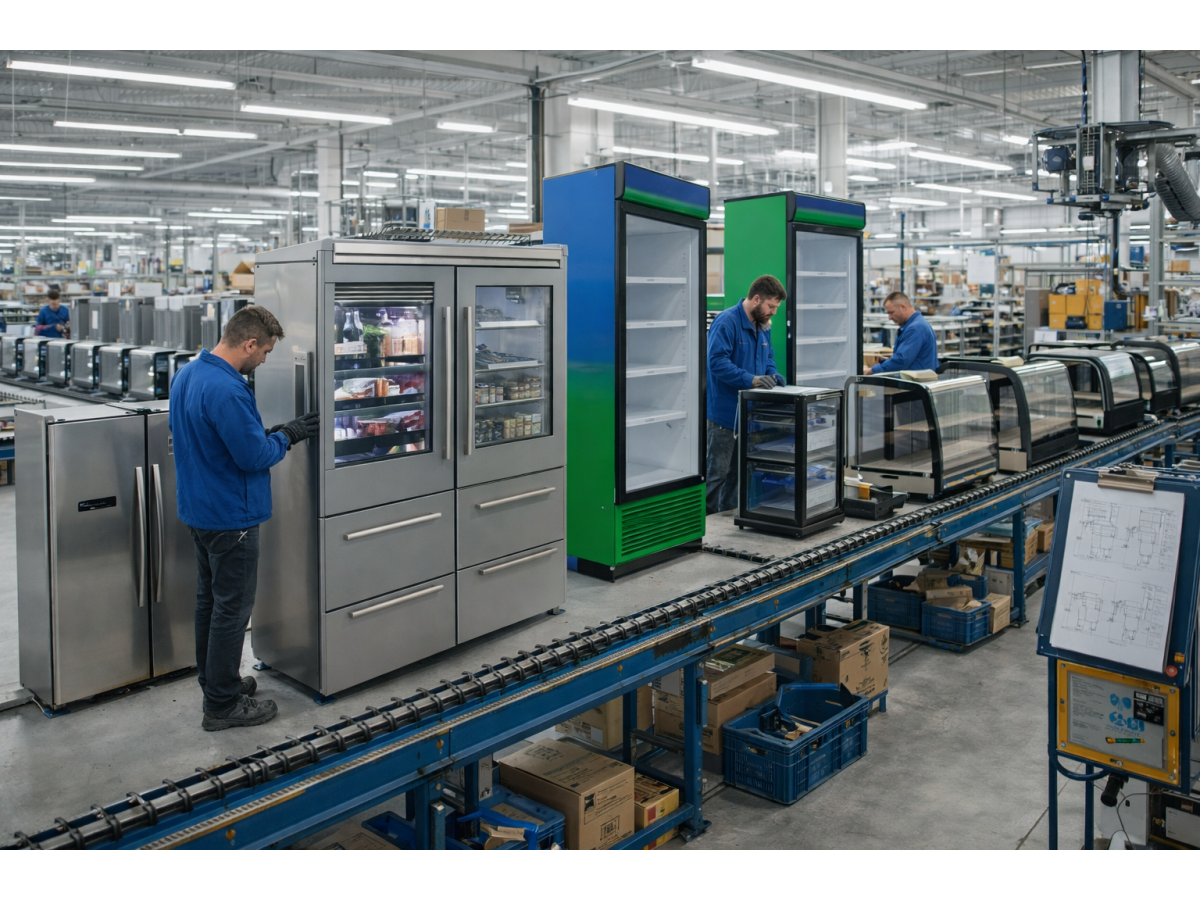
Stainless steel spherical washer systems may be evaluated for suitable mechanical assemblies in:
Commercial kitchen machinery
Food-processing equipment
Packaging machinery
Refrigeration equipment
Conveyors
Adjustable equipment frames
Use in food-processing equipment does not automatically establish suitability for direct food contact.
Material, surface finish, cleaning environment, and hygiene requirements must be reviewed separately.
Spherical washers may be used in appropriate non-implant mechanical equipment, including:
Laboratory automation
Diagnostic machinery
Equipment frames
Positioning systems
Test equipment
Medical equipment projects may require additional documentation, material controls, cleanliness requirements, traceability, or customer-specific validation.
Spherical alignment concepts can be relevant to aerospace tooling, ground-support equipment, fixtures, and certain engineered assemblies.
However, aerospace applications should not be generalized.
The required component must be evaluated against the applicable aerospace drawing, material specification, quality system, traceability requirement, inspection plan, and engineering approval.
A standard industrial DIN 6319 washer should not automatically be described as aerospace-qualified.
Before specifying a spherical washer system, determine:
Is the bearing surface non-parallel?
What angular deviation must be accommodated?
Is the bolt axis fixed?
Is the hole round, oversized, or slotted?
Bolt diameter
Bolt property class
Nut type
Required preload
Available bearing area
Static load
Cyclic load
Shock
Vibration
Fatigue requirement
Steel
Stainless steel
Customer-specified material
Indoor
Outdoor
Humid
Corrosive
High temperature
Chemical exposure
Black finish
Phosphate
Zinc-based coating
Zinc-nickel
Zinc-flake
Customer specification
Drawing
Material requirement
Inspection requirement
Traceability
Packaging
Customer-specific documentation
A useful decision path is:
Are the mating surfaces parallel?
→ Yes: a conventional washer system may be sufficient.
→ No: continue evaluating.
Can the surface be machined or corrected economically?
→ Yes: correcting the interface may be preferable.
→ No: evaluate a spherical washer and seat.
Is the joint primarily static or clamping-oriented?
→ Evaluate DIN 6319 and the required load capacity.
Is the joint dynamically or fatigue loaded?
→ Perform a complete bolted-joint evaluation.
Is the hole elongated or does the assembly need a larger bearing area?
→ Evaluate the appropriate dished-seat configuration, including enlarged-OD options where applicable.
This approach prevents spherical washers from being specified merely because an assembly "looks uneven."
A spherical washer should not automatically be selected when the real engineering problem is:
Fastener self-loosening
Insufficient preload
Electrical grounding
Fluid sealing
Large axial movement
Spring-force generation
Inadequate base-material strength
Excessive hole clearance
These conditions require different fastening solutions.
Correctly identifying the failure mechanism is the first step in selecting the right component.
Procurement teams should avoid RFQs containing only:
"Please quote spherical washer M16."
That description may not provide enough information.
A better RFQ should identify:
DIN 6319 or customer drawing
Type C, D, G, or required combination
Bolt size
Required dimensions
Material
Hardness where applicable
Surface finish
Quantity
Annual demand
Application
Documentation requirements
For replacement projects, an existing sample can also be useful.
For an existing spherical washer application, a practical second-source process can include:
Existing Drawing / Sample → Dimensional Review → Standard Identification → Material Review → Hardness Review → Surface Finish → Sample Production → Assembly Validation → Pilot Lot → Production
Do not qualify a replacement based only on:
Outside diameter
Inside diameter
Thickness
The spherical radius and mating geometry are critical to the function of the assembly.
Not every application fits a standard DIN 6319 configuration.
Custom spherical washers or mating seats may be required for:
Non-standard bolt sizes
Larger bearing areas
Special spherical radii
Restricted installation envelopes
Special materials
High corrosion resistance
Existing legacy equipment
Customer-specific load requirements
Drawing-based OEM assemblies
For these projects, the preferred starting point is a 2D or 3D drawing.
If a drawing is unavailable, an existing sample plus application information can support initial evaluation.
Engineers may search for:
DIN 6319 spherical washer
Spherical washer and conical seat
Spherical seat washer
Self-aligning washer for bolts
Washer for non-parallel surfaces
Angular misalignment washer
Spherical washer for slotted hole
Spherical washer vs Belleville washer
DIN 6319 Type C
DIN 6319 Type D
DIN 6319 Type G
The real engineering question behind these searches is:
How can I maintain an appropriate clamping load path when my bearing surfaces are not parallel?
That is the core problem this washer family addresses.
Procurement teams may search for:
DIN 6319 spherical washer manufacturer
DIN 6319 washer supplier
Spherical washer supplier
Spherical seat washer manufacturer
Stainless steel spherical washer supplier
Custom spherical washer manufacturer
OEM spherical washer supplier
Spherical washer and dished seat supplier
Their decision involves a different set of questions:
Can the supplier provide the required standard?
Can the spherical geometry be controlled?
Is the required material available?
Can hardness and finish requirements be maintained?
Can samples be supplied?
Can production quantities be supported?
Can inspection and documentation requirements be met?
A strong sourcing process connects these commercial questions with the engineering function of the component.
For conventional bearing-pressure distribution, review our Flat Washer Solutions.
For elastic preload compensation, review our Curved Spring Washer resources.
For high-load conical elastic washers, see our DIN 6796 Conical Spring Washer engineering guides.
For controlled spring force and stacking systems, review our Disc Spring Washer / Belleville Washer solutions.
For electrical bonding applications, review our Grounding Washer Solutions.
For non-standard geometries, materials, or drawing-based components, see our Custom Washers & Precision Metal Components capabilities.
JUXIN FASTENERS supports OEM and industrial sourcing projects involving:
Spherical washers
DIN 6319 spherical washers
Dished washers
Spherical washer and seat combinations
Steel spherical washers
Stainless steel spherical washers
Custom spherical washers
Custom dished seats
Drawing-based washer components
Projects can be evaluated from:
International standard
Customer drawing
Existing physical sample
Material specification
Surface-treatment requirement
Application conditions
Production quantity
Depending on the requirement, the sourcing route may be:
Standard DIN 6319 Component → Material / Finish Variant → Modified Standard → Custom Drawing-Based Component
To improve quotation accuracy, send as much of the following information as possible:
Standard
DIN 6319 or other applicable specification
Configuration
Spherical washer only
Dished washer only
Matched washer and seat
Type C / D / G where applicable
Dimensions
Bolt size
Inside diameter
Outside diameter
Thickness / height
Spherical radius where controlled
Material
Steel
Stainless steel
Customer-specified material
Surface Finish
Required coating or finish
Corrosion requirement
Application
Clamping geometry
Estimated angular misalignment
Static or dynamic loading
Operating temperature
Environmental conditions
Commercial Information
Sample quantity
Prototype quantity
Production quantity
Estimated annual volume
Packaging requirement
Inspection documentation
Required delivery schedule
The most effective sourcing process begins with the actual engineering problem:
Non-Parallel Surface → Required Angular Compensation → Bolt Size → Load Condition → Spherical Washer / Seat Configuration
→ Material → Heat Treatment → Surface Finish → Sample → Assembly Validation → Production
This is more reliable than selecting a spherical washer simply from nominal thread size.
For DIN 6319 spherical washers, dished washers, spherical seat washers, stainless steel spherical washers,
custom spherical washers, drawing-based components, OEM production, or second-source projects, send your standard, drawing, sample, material, surface finish, application information and quantity to:
JUXIN FASTENERS can review the available information and evaluate whether a standard DIN 6319 configuration,
material or finish variant, modified-standard component, or custom spherical washer solution is appropriate for the application.
 MORE NEWS
Sep. 27, 2026
Sep. 27, 2026
Sep. 27, 2026
Contact Us
Tel.:
+86 020 8621 0320
+86 020 3121 6067
E-mail:
Technical Support:
Navigation
SEND INQUIREY