
Call Us
+86 136 6007 9809
Call Us
+86 136 6007 9809

Oct. 17, 2023
DIN 128A curved spring washers are elastic washer components used in bolted assemblies where additional joint elasticity,
preload compensation, compact spring action, or compensation for limited settlement is required.
Sometimes described commercially as curved spring washers, curved washers, saddle-type spring washers, or curved lock washers,
these components differ fundamentally from ordinary flat washers. Their formed profile allows the washer to deflect elastically as the bolted joint is tightened.
For mechanical engineers, however, an important distinction should be made:
A curved spring washer can add elasticity to a bolted joint, but it should not automatically be treated as a universal solution for preventing self-loosening under severe vibration.
Its suitability depends on the joint design, preload, loading direction, mating materials, temperature, vibration environment, washer material, dimensional relationship, and installation conditions.
For OEM procurement teams, DIN 128A provides a useful reference point for sourcing standardized curved spring washers,
while application-specific projects may require additional control of material, hardness, surface treatment, corrosion resistance, dimensions, packaging, and inspection requirements.
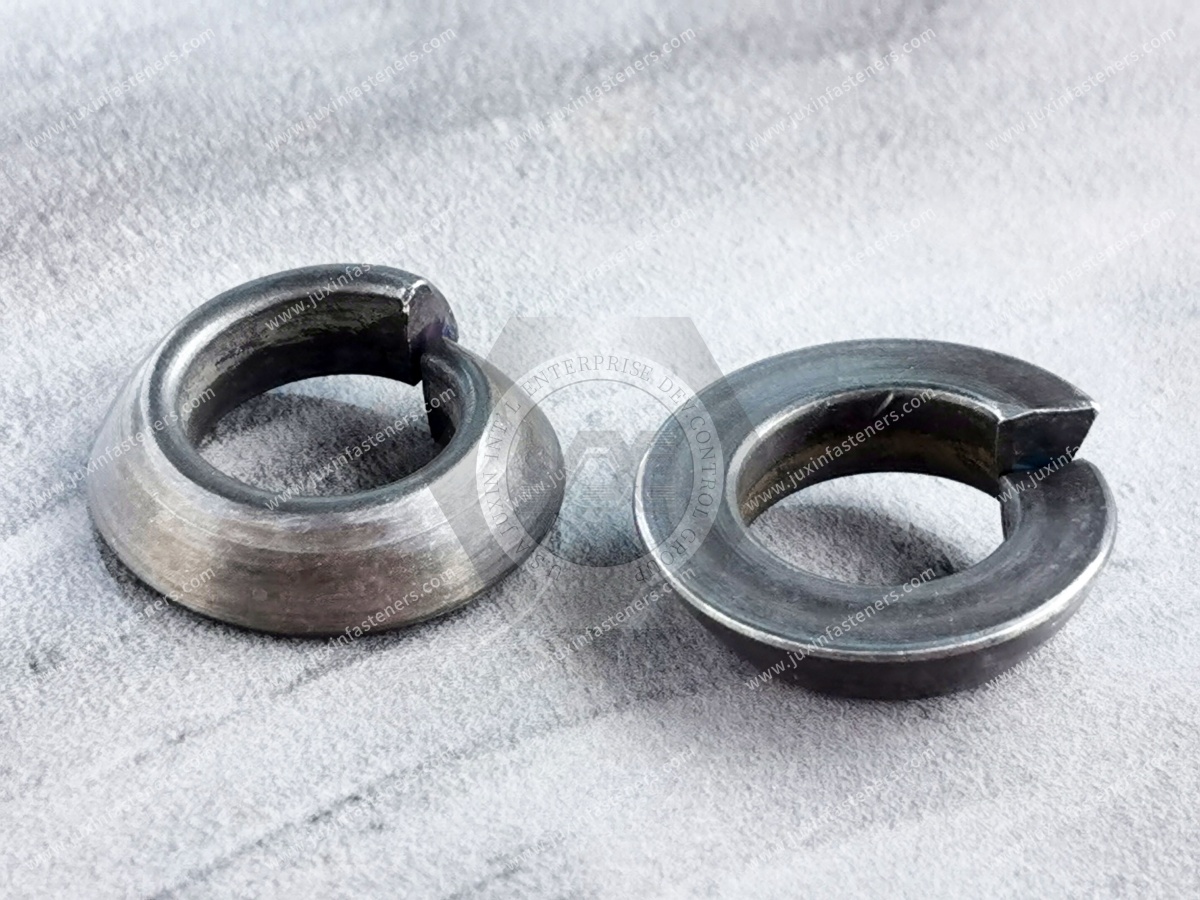
A DIN 128A curved spring washer is a formed elastic washer with a curved profile rather than the flat geometry of a conventional plain washer.
When compressed between a bolt head or nut and the mating component, the washer deflects and generates an opposing spring force.
The basic mechanical sequence can be understood as:
Bolt Tightening → Washer Deflection → Elastic Reaction Force → Increased Joint Elasticity
The washer therefore functions as a compact spring element within the bolted assembly.
This characteristic can be useful where designers need to accommodate limited changes caused by:
Surface settlement
Dimensional tolerances
Thermal movement
Gasket or interface compression
Component relaxation
Assembly variation
Limited axial displacement
The actual benefit depends on how the washer interacts with the complete bolted joint.
A flat washer and a curved spring washer perform different mechanical roles.
A conventional flat washer is generally used to:
Distribute bearing pressure
Protect the mating surface
Provide a suitable bearing interface
Accommodate hole geometry
Support certain assembly requirements
It is not intentionally designed to provide substantial spring deflection.
A curved spring washer is intentionally formed so that tightening produces elastic deformation.
Its primary engineering contribution is therefore:
Elastic Deflection + Reaction Force + Additional Joint Compliance
This makes the component useful in assemblies where some controlled elastic response is desirable.
The two washer types should not automatically be considered interchangeable.
Before installation, the washer has a curved profile.
As the bolt or nut is tightened, the washer is compressed toward a flatter condition.
During this process, elastic deformation generates a restoring force.
The simplified operating sequence is:
The fastener begins applying clamp load.
The curved washer contacts the mating surfaces.
Further tightening compresses the washer.
The washer stores elastic energy.
The washer reacts against the bolt or nut and the joint.
Changes in the assembly may be partially accommodated within the washer's available elastic deflection.
This additional compliance can be useful in selected joints where the assembly would otherwise be relatively stiff.
However, the washer must remain within an appropriate operating range. Excessive compression, unsuitable geometry, material yielding,
or repeated overloading can reduce its ability to provide useful elastic response.
This distinction is especially important when selecting spring washers.
A washer that provides elastic force is not automatically a complete locking system.
Bolted-joint problems can arise from different mechanisms, including:
Embedment and settlement
Thermal expansion and contraction
Gasket relaxation
Material creep
Transverse vibration
Shock
Cyclic loading
Relative movement between joint members
Adding elasticity may help compensate for some loss of clamp load caused by settlement or dimensional change.
But severe transverse vibration can produce self-loosening through relative movement within the joint.
Therefore:
Preload compensation and resistance to rotational self-loosening are related engineering topics, but they are not the same function.
Where loosening risk is critical, engineers should evaluate the complete joint and consider an appropriate locking strategy rather than assuming that a curved spring washer alone will solve every vibration problem.
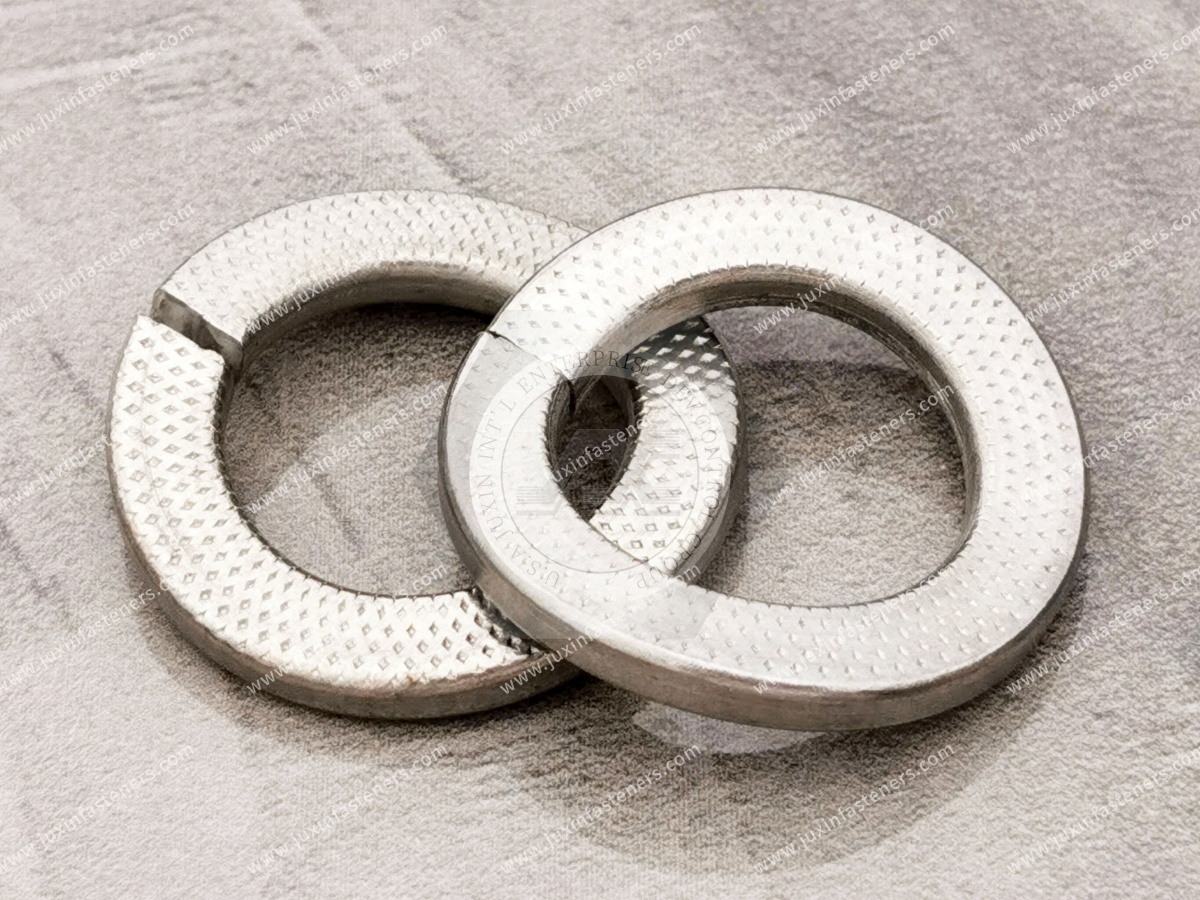
A bolted connection behaves as a mechanical system consisting of the fastener and the clamped components.
The relative stiffness of these elements influences how external loads affect bolt tension and joint separation.
A curved spring washer adds another elastic element to this system.
This can increase the available deflection associated with changes in clamp load.
A useful conceptual model is:
Bolt + Clamped Components + Elastic Washer = Combined Joint System
This is more useful than evaluating the washer independently.
Engineers should therefore ask:
What change in joint thickness is expected?
How much elastic travel is available?
What clamp force must be maintained?
Will the washer remain elastic at the required compression?
Is the joint exposed to settlement or thermal cycling?
Is severe transverse vibration present?
Is a separate locking mechanism required?
These questions lead to better washer selection than simply specifying "spring washer required."
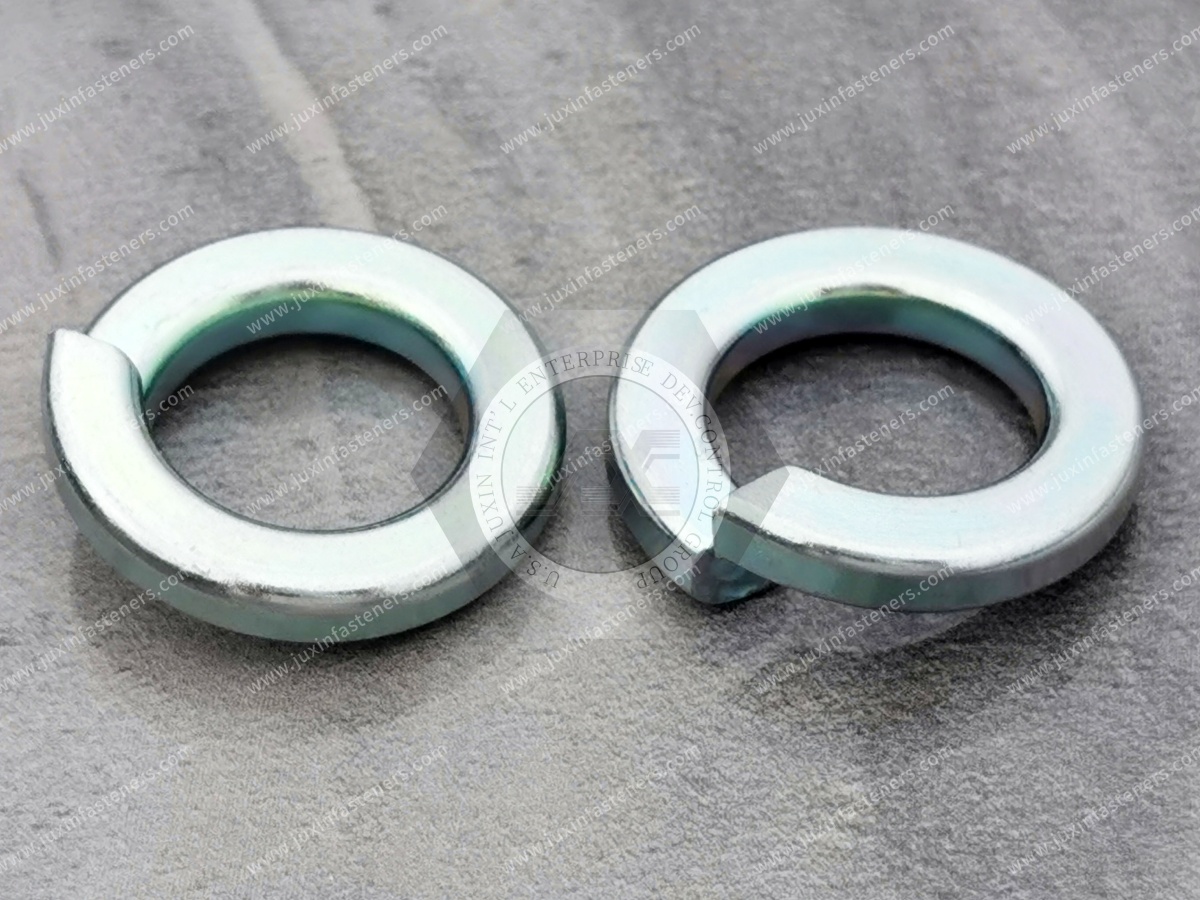
Curved spring washers and conventional split spring washers should not be treated as the same product.
A split washer has a helical split-ring geometry.
A curved washer uses formed curvature across the washer body to create elastic deflection.
Their geometry, load-deflection behavior, bearing interface, installation behavior, and suitability for specific joints differ.
When replacing one design with another, engineers should verify the application rather than making a substitution based only on nominal bolt size.
Curved and wave washers both provide elastic axial deflection, but their geometries are different.
Wave washers typically use multiple waves around the circumference to provide spring action.
They may be selected for applications such as:
Bearing preload
Axial tolerance compensation
Endplay control
Light spring loading
Compact mechanical assemblies
DIN 128A curved washers use a different formed profile and should be evaluated according to their intended bolted-joint application.
The correct choice depends on required:
Load
Deflection
Installation space
Contact geometry
Service life
Assembly architecture
Disc springs, commonly known as Belleville springs or Belleville washers, are conical spring elements designed for controlled axial load-deflection behavior.
They can be engineered individually or in stacks to obtain different combinations of load and travel.
DIN 128A curved spring washers generally serve a different fastening role.
For applications requiring engineered spring loads, substantial axial forces, defined load-deflection characteristics, or stacked spring systems, a disc spring may be more appropriate.
For compact elastic compensation within a bolted assembly, a curved spring washer may offer a simpler solution.
The application should determine the component—not the similarity of the words "spring washer."
DIN 128A curved spring washers should also be distinguished from DIN 6796 conical spring washers for bolted connections.
DIN 6796 products use conical geometry and are intended for applications involving high bolt loads.
DIN 128A uses a curved washer geometry.
These components should not be substituted merely because both provide elastic deformation.
Selection should consider:
Bolt size
Bolt property class
Required clamp load
Washer geometry
Required deflection
Bearing surface
Joint stiffness
Installation space
Applicable standard
For high-load conical washer applications, review our DIN 6796 engineering resources.
Material selection influences:
Elasticity
Strength
Fatigue behavior
Corrosion resistance
Temperature capability
Surface-treatment compatibility
Manufacturing consistency
Spring steel is commonly used for elastic washer components where strength and spring performance are required.
The manufacturing process may include:
Material Preparation → Forming / Stamping → Heat Treatment → Surface Finishing → Inspection
Material grade, heat treatment, hardness, and dimensional control should be specified according to the applicable standard or customer requirement.
Stainless steel curved washers may be selected where improved corrosion resistance is required.
Potential applications include:
Food-service equipment
HVAC equipment
Outdoor machinery
Pumps
Electrical equipment
Laboratory equipment
Processing machinery
The appropriate stainless grade depends on the actual environment.
A2 and A4 are common fastener material designations,
but engineers should not assume that every stainless curved washer automatically provides the same spring behavior as a heat-treated carbon spring steel washer.
Material condition and mechanical properties must be considered.
For unusual operating conditions, projects may require:
Corrosion-resistant alloys
High-temperature materials
Special spring alloys
Customer-specified materials
These applications should be evaluated from the drawing and operating conditions.
Surface treatment may be selected for corrosion protection, appearance, friction behavior, or customer specification.
Depending on material and project requirements, possible finishes can include:
Phosphate and oil
Black finishes
Zinc-based coatings
Zinc-nickel coatings
Zinc-flake systems
Other engineered coatings
The finish should not be selected independently from the base material.
For hardened spring components, the coating process must be evaluated for compatibility with the material and required mechanical performance,
including relevant hydrogen-embrittlement considerations where applicable.
Coating is not merely cosmetic.
On small spring washers, coating thickness can affect:
Finished dimensions
Contact conditions
Friction
Assembly behavior
Corrosion performance
When a washer is being qualified as an OEM replacement or second-source component, the original finish should therefore be identified whenever possible.
Changing from one coating system to another may require validation even when the base washer dimensions appear unchanged.
Selecting a curved spring washer requires more than matching the bolt diameter.
Important parameters include:
The washer must be dimensionally compatible with the bolt or screw.
The joint's preload requirement influences whether the washer geometry and material are appropriate.
The washer requires sufficient elastic travel to perform its intended function.
Assemblies containing coatings, gaskets, soft materials, multiple interfaces, or rough contact surfaces may experience settlement.
The expected magnitude should be considered.
Temperature changes can alter dimensions, material properties, coating behavior, and joint preload.
The type and direction of vibration matter.
Axial vibration and severe transverse joint movement should not automatically be treated as equivalent conditions.
Humidity, condensation, chemicals, outdoor exposure, cleaning agents, and salt-containing environments can affect material and coating selection.
Applications involving repeated loading should consider fatigue behavior rather than relying solely on static strength.
For an OEM project, the drawing or purchasing specification may need to identify:
Applicable standard
Nominal size
Outside diameter
Inside diameter
Thickness
Free height or profile where relevant
Material
Material condition
Hardness requirement
Heat treatment
Surface finish
Coating requirement
Corrosion requirement
Dimensional tolerances
Special inspection requirements
For custom curved washers, the drawing becomes particularly important because small geometry changes can influence spring behavior.
A curved spring washer should be installed according to the intended joint architecture and applicable specification.
Before production release, engineers should verify:
Correct washer size
Correct washer type
Suitable mating surfaces
Required tightening method
Sufficient washer compression
No unintended interference
No permanent washer deformation
Required joint preload
Installation should not rely on arbitrary orientation rules unless the product design or application specifically requires them.
One common mistake with spring elements is assuming that more compression always improves performance.
That is not necessarily true.
If a curved washer is compressed beyond its intended elastic operating range, it may lose useful spring travel or experience permanent deformation.
The correct installed condition depends on:
Washer geometry
Material
Required load
Required deflection
Applicable specification
Joint design
Engineering validation should determine the appropriate working condition.
Curved spring washers may be considered in suitable assemblies within:
Electric motors
Pumps
Actuators
Seat mechanisms
Brackets
Auxiliary equipment
Thermal-management systems
Electrical and mechanical subassemblies
Automotive applications may introduce additional requirements for:
Material consistency
Surface finish
Corrosion resistance
Traceability
Inspection
Packaging
Production repeatability
The washer should be qualified for the specific assembly rather than described generically as suitable for every automotive joint.
DIN 128A curved spring washers may be used in suitable bolted assemblies for:
Motors
Pumps
Gearboxes
Conveyors
Machine tools
Packaging machinery
Material-handling equipment
Processing equipment
They can be particularly useful where compact elastic compensation is needed without adding a larger spring mechanism.
Potential applications include:
Electrical cabinets
Motors
Generators
Switching equipment
Power-conversion equipment
Mechanical actuator systems
Cooling assemblies
In electrical equipment, material and coating selection may also depend on environmental exposure and electrical-design requirements.
Modern AI data centers contain extensive mechanical, electrical, power-conversion, and thermal-management infrastructure.
Curved spring washers may be used in appropriate assemblies within:
Cooling equipment
Pumps
Fans
Blowers
Electrical cabinets
Power distribution equipment
UPS systems
Mechanical support equipment
However, the washer should be selected according to the actual bolted joint.
A component should not be represented as "data-center qualified" merely because it is used somewhere within data-center infrastructure.
Potential applications include:
Pumps
Compressors
Fans
Blowers
Valve actuators
Cooling units
Heat-exchange equipment
Mechanical support systems
These environments may involve:
Condensation
Temperature cycling
Humidity
Outdoor exposure
Vibration
Material and finish should therefore be selected according to the actual operating environment.
Curved spring washers may be used in appropriate mechanical and electrical subassemblies such as:
Door systems
Seat mechanisms
Electrical equipment
Auxiliary machinery
HVAC systems
Maintenance equipment
Rail projects may impose additional material, coating, traceability, inspection, and documentation requirements.
These should be defined by the customer specification.
Compact elastic washers can be useful in:
Robotic equipment
Actuators
Grippers
Automated production machinery
Material-handling systems
Sensors and mechanical mounting systems
For precision assemblies, engineers should pay particular attention to tolerance stack and the relationship between washer deflection and component positioning.
Potential applications include:
Outdoor cabinets
Cooling equipment
Antenna mechanisms
Motors
Fans
Actuators
Mechanical mounting systems
Outdoor exposure may require enhanced corrosion protection depending on the environment.
Curved spring washers may be used in suitable mechanical assemblies within semiconductor manufacturing equipment, including:
Pumps
Motors
Actuators
Handling systems
Auxiliary mechanical equipment
Applications involving vacuum, cleanroom, outgassing, contamination, or special chemical requirements require separate material and surface-treatment evaluation.
A general industrial washer should not automatically be considered suitable for those environments.
Stainless steel curved washers may be considered for appropriate mechanical assemblies in:
Commercial kitchen equipment
Refrigeration equipment
Processing machinery
Conveyors
Pumps
Motors
Material selection must reflect actual corrosion and cleaning conditions.
Use within food equipment does not automatically establish suitability for direct food contact.
Curved spring washers may be used in suitable non-implant mechanical assemblies such as:
Diagnostic equipment
Laboratory automation
Pumps
Motors
Actuators
Positioning systems
Medical projects can involve additional material, cleanliness, documentation, packaging, and traceability requirements.
These must be defined by the specific customer project.
Engineering value also comes from knowing when not to use a product.
A DIN 128A curved spring washer may not be the optimum solution when the assembly requires:
Large controlled spring travel
Very high spring force
Precisely engineered load-deflection characteristics
Severe transverse-vibration locking
Torque transmission
Large axial displacement compensation
A positive mechanical locking feature
Depending on the problem, alternatives may include:
Disc springs
Wave washers
DIN 6796 conical washers
Lock nuts
Prevailing-torque nuts
Wedge-locking systems
Thread-locking systems
Mechanical locking features
Engineered spring assemblies
The correct fastener should be selected according to the failure mechanism being controlled.
Standard DIN 128A washers are useful where the application fits established dimensions and material requirements.
Custom curved washers may be considered when the project requires:
Non-standard inside diameter
Non-standard outside diameter
Special thickness
Modified curvature
Different spring response
Special material
Special coating
Restricted installation space
Existing legacy geometry
For a custom project, engineers should provide a drawing whenever possible.
If no drawing exists, an existing physical sample can be used as a starting point for dimensional evaluation.
A second-source project should not focus only on nominal washer size.
A useful qualification process may include:
Existing Drawing / Sample → Dimensional Review → Material Confirmation → Hardness / Heat Treatment Review
→ Surface Finish Review → Sample → Assembly Test → Pilot Lot → Production Approval
Important characteristics can include:
Material
Thickness
Free geometry
Hardness
Spring response
Surface finish
Dimensional tolerance
Production consistency
This is particularly important when the washer influences joint preload or assembly height.
Mechanical and design engineers may search for:
DIN 128A curved spring washer
Curved spring washer
Curved washer for bolt preload
Saddle spring washer
Spring washer for preload compensation
Curved washer vs wave washer
Curved washer vs Belleville washer
DIN 128A dimensions
Spring washer for vibration
Elastic washer for bolted joint
Their underlying question is often:
Will this washer provide the type of elasticity and preload compensation required by my joint?
A useful technical page should answer that question instead of simply listing dimensions.
Procurement and supplier-development teams may search for:
DIN 128A washer manufacturer
DIN 128A spring washer supplier
Curved spring washer supplier
Stainless steel curved washer manufacturer
Spring steel washer supplier
Custom curved washer manufacturer
OEM washer supplier
Drawing-based washer manufacturer
Their question is different:
Can the supplier consistently provide the required geometry, material, heat treatment, finish, documentation, quantity and delivery schedule?
That is where technical specification must connect to the commercial RFQ process.
For efficient quotation and engineering review, provide:
DIN 128A or other applicable specification
Customer drawing if available
Existing part number
Physical sample if replacing an existing component
Nominal fastener size
Inside diameter
Outside diameter
Thickness
Free profile or height if controlled
Dimensional tolerances
Required material
Material condition
Hardness requirement where applicable
Heat-treatment requirement
Phosphate and oil
Zinc-based coating
Zinc-nickel
Zinc-flake
Stainless steel condition
Customer-specified finish
Bolt or screw size
Mating materials
Required clamp load
Expected settlement
Vibration conditions
Operating temperature
Corrosion environment
Required service life
Sample quantity
Prototype quantity
Production quantity
Estimated annual volume
Packaging
Traceability
Inspection documentation
Target delivery schedule
Providing these details helps determine whether a standard DIN 128A washer is suitable or whether a modified or custom solution should be evaluated.
A practical decision path is:
What problem is the washer expected to solve?
→ Surface pressure distribution only?
Consider a flat washer.
→ Limited preload or settlement compensation?
Evaluate a curved or wave spring washer.
→ High axial spring force in limited space?
Evaluate a disc spring or conical spring washer.
→ Severe vibration-related self-loosening?
Evaluate the complete bolted joint and an appropriate locking strategy.
→ Non-standard geometry or special material required?
Evaluate a custom washer from drawing or sample.
This decision path helps prevent spring washers from being specified simply because "the machine vibrates."
For high-load conical washer applications, review our DIN 6796 Conical Spring Washer resources.
For engineered axial spring force and stacking arrangements, see our Disc Spring Washer / Belleville Washer engineering guides.
For axial tolerance compensation and bearing preload applications, review our Wave Spring Washer solutions.
For bearing-pressure distribution, review our Flat Washer resources.
For severe self-loosening conditions, evaluate our broader Locking Fastener Solutions.
For non-standard dimensions, materials or spring profiles, see our Custom Washers & Precision Stampings capabilities.
JUXIN FASTENERS supports industrial OEM and supply-chain projects involving:
DIN 128A curved spring washers
Curved spring washers
Spring steel washers
Stainless steel spring washers
Disc spring washers
Conical spring washers
Wave washers
Flat washers
Custom washers
Drawing-based stamped components
Projects can be evaluated from:
International standard
Customer drawing
Existing sample
Material requirement
Surface-finish specification
Application conditions
Production quantity
Depending on the project, the sourcing route may be:
Standard Washer → Material / Finish Variant → Modified Standard Washer → Drawing-Based Custom Washer
For OEM sourcing, the most useful process begins with the actual assembly requirement:
Joint Function → Fastener Size → Clamp Load → Expected Settlement → Required Elasticity → Washer Geometry
→ Material → Heat Treatment → Surface Finish → Prototype → Validation → Production
This converts a generic inquiry such as:
"Please quote DIN 128A spring washers."
into a much stronger technical RFQ:
"Please quote this DIN 128A size in the specified material and finish for our bolted assembly, including sample and production quantities."
For DIN 128A curved spring washers, curved washers, spring steel washers, stainless steel spring washers, custom spring washers, drawing-based washers,
OEM production or second-source projects, send your standard, drawing, sample, dimensions, material, surface finish, application requirements and quantity to:
JUXIN FASTENERS can review the available technical information and evaluate whether a standard DIN 128A washer, material or finish variant, modified-standard washer, or custom washer is appropriate for the application.
 MORE NEWS
Sep. 27, 2026
Sep. 27, 2026
Sep. 27, 2026
Contact Us
Tel.:
+86 020 8621 0320
+86 020 3121 6067
E-mail:
Technical Support:
Navigation
SEND INQUIREY