Call Us
+86 136 6007 9809
Call Us
+86 136 6007 9809

Oct. 22, 2023
Tab lock washers are mechanical locking components designed to resist rotation of a nut, bolt or other fastening element through the engagement of formed tabs with adjacent structural features.
Unlike conventional flat washers, which primarily manage bearing contact, tab lock washers use a positive mechanical locking principle.
Their function depends on physical engagement rather than friction alone.
A correctly designed tab washer arrangement can provide a visible, inspectable means of restricting fastener rotation in industrial machinery, motors, pumps, gearboxes and other mechanical assemblies.
Among the available configurations, tab washers with long and short tabs at right angles are particularly relevant where one tab must engage a fixed structural feature while another is formed against a fastener.
For OEM design engineers, the main challenge is ensuring that the locking tabs have suitable geometry, material properties and engagement surfaces.
For manufacturing engineers and production managers, installation sequence, bending access, inspection and assembly repeatability are equally important.
For purchasing and supplier-development teams, a complete drawing-based specification helps ensure that the supplied washer matches the approved design.
JUXIN FASTENERS supplies industrial fastening components, including tab washer configurations and drawing-based fastening solutions, subject to technical review and product availability.
This guide explains the working principle, major types, installation methods, material selection, engineering limitations and OEM sourcing considerations for tab lock washers.
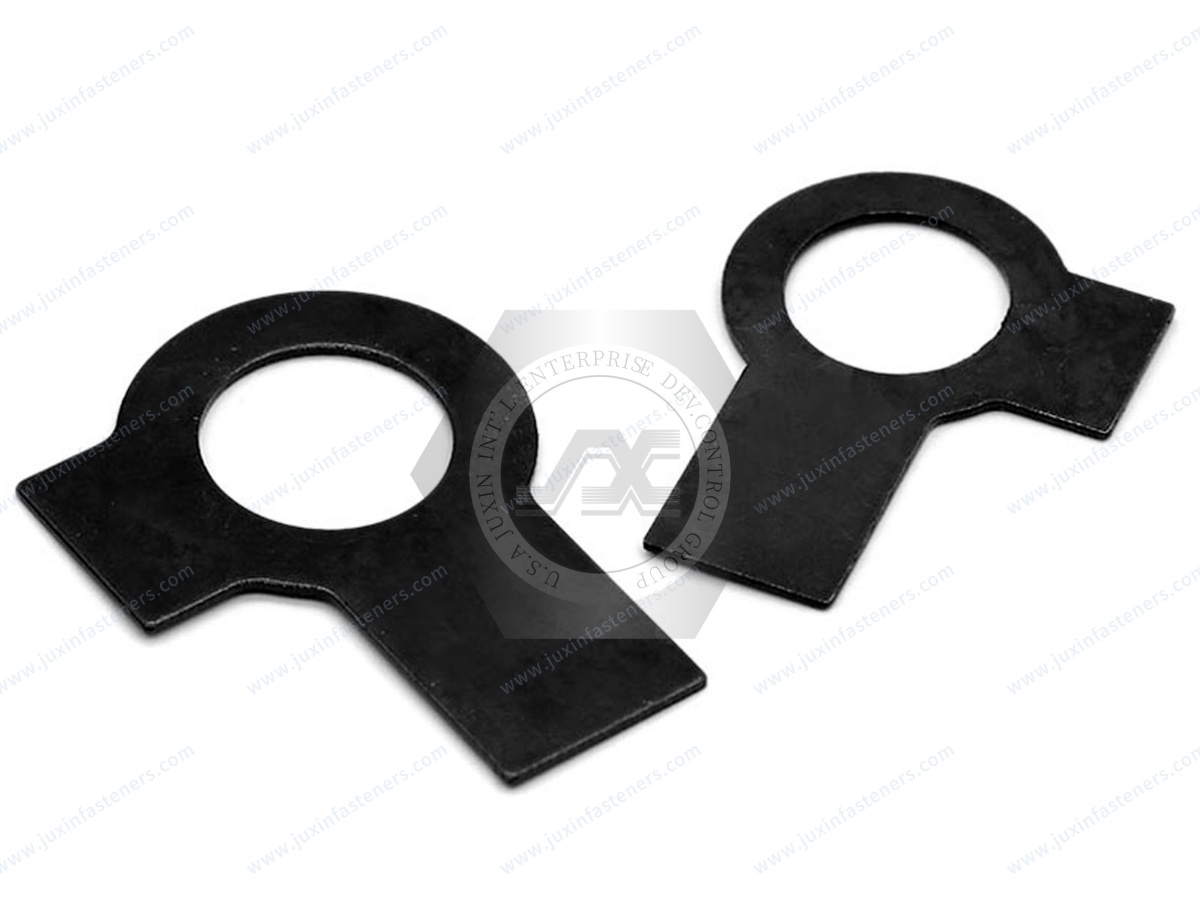
A tab lock washer is a washer or formed locking component incorporating one or more tabs intended to engage a fastener and an adjacent fixed feature.
The locking mechanism typically involves two functional interfaces:
A tab or formed section that engages the nut or bolt.
A second tab or anchoring feature that engages a stationary component.
When the tabs are correctly positioned and engaged, they provide a mechanical restraint against rotation.
The washer itself is not necessarily intended to create or maintain bolt preload.
Its primary function is to restrict relative rotation after the fastener has been tightened.
This distinction is important because preload retention and rotational locking are related but different aspects of bolted-joint performance.
A tab washer can help prevent rotation while other joint problems, such as embedding, settlement, fatigue or loss of clamp load, may still require separate engineering attention.
The working principle is based on physical engagement and controlled deformation.
A typical installation follows this sequence:
Position the tab washer at the specified fastening interface.
Engage the anchoring feature with the designated fixed surface or structural feature.
Install and tighten the nut or bolt according to the approved assembly procedure.
Bend the designated locking tab against an appropriate flat or other specified locking feature.
Inspect the engagement and confirm that the tab is not cracked, damaged or improperly positioned.
The completed arrangement restricts relative rotation between the fastener and the fixed structure.
Friction-based locking systems depend on frictional resistance or prevailing torque.
A tab washer uses a mechanical stop.
The fastener cannot rotate freely while the locking features remain properly engaged and structurally intact.
However, this does not mean that a tab washer is immune to all vibration, shock or fatigue conditions.
The assembly still depends on:
Tab strength
Tab engagement
Washer material
Fastener geometry
Anchor rigidity
Joint loading
Installation quality
Service conditions
Positive locking should be understood as a defined mechanical restraint, not a universal guarantee against every form of joint failure.
Tab lock washers are available in different geometries for different installation arrangements.
The following categories describe common design principles rather than a single universal dimensional standard.
A single-tab washer incorporates a locking or anchoring feature that works with the surrounding assembly.
Depending on the design, the washer may also include another edge or feature intended to engage the fastener.
Potential applications include compact machinery, brackets and equipment assemblies where the required restraint can be achieved with a relatively simple geometry.
The actual locking arrangement must be verified from the product drawing.
Double-tab configurations incorporate two distinct tab features.
One may be used to anchor the washer against a fixed component while another engages the nut or bolt.
Other designs may use two tabs in a different arrangement.
The number of tabs alone does not establish the locking capacity.
The effectiveness of the design depends on the engagement geometry and the loads transmitted through the tabs.
This configuration is the main focus of this article.
A long-and-short-tab right-angle washer incorporates two tabs arranged approximately perpendicular to one another in the flat or specified formed geometry.
In a suitable assembly:
The longer tab may provide access to a structural anchoring feature.
The shorter tab may engage the nut, bolt or another designated locking surface.
The actual role of each tab must follow the approved drawing.
The approximately 90-degree arrangement can be useful where the available anchoring and locking surfaces are located in different directions.
A right-angle tab arrangement may allow the designer to use existing component geometry as part of the locking system.
This can be useful where:
A nearby flange provides an anchoring surface.
The nut has accessible flats.
A conventional locking arrangement would interfere with surrounding components.
The installation space favors a particular tab orientation.
The design must still provide sufficient room for installation and bending.
A 90-degree tab layout is a geometric feature, not an automatic indication of superior vibration resistance.
For a custom right-angle tab washer, the geometry of each tab is a functional design requirement.
The long tab must reach the intended anchoring feature while maintaining suitable clearance from adjacent components.
An excessively short tab may not engage the structure adequately.
An unnecessarily long tab may interfere with equipment or create handling difficulties.
The short tab must provide sufficient material for the specified bending and engagement operation.
It should reach the intended nut or bolt feature without requiring uncontrolled deformation.
Tab width influences bending behavior, contact area and resistance to local deformation.
The appropriate width depends on material thickness, geometry and expected loading.
Thickness influences:
Bending force
Resistance to deformation
Springback
Installation effort
Risk of cracking
Engagement stiffness
A thicker tab may be more difficult to form.
A thinner tab may be easier to bend but may not provide adequate resistance for the intended locking duty.
Sharp transitions at the tab root can concentrate stress during bending.
For custom designs, the bend radius, corner geometry, material condition and grain direction should be reviewed where relevant.
The central washer section must be compatible with:
Fastener diameter
Bearing surface
Clearance hole
Assembly stack height
Nearby features
The tab arrangement should not compromise the intended seating of the washer.
A tab washer cannot provide effective positive locking if the anchoring feature has no suitable fixed reference.
The anchoring surface must be sufficiently rigid and geometrically compatible with the washer.
Potential anchoring features include:
Housing edges
Bracket flanges
Slots
Recesses
Designed stops
Other stationary structural features
The correct arrangement depends on the assembly.
A washer may appear correctly installed while the anchoring tab has insufficient engagement.
If the washer can rotate with the nut, the intended positive locking function may be lost.
Before approving the design, verify:
The tab reaches the intended anchoring feature.
The anchoring feature is sufficiently rigid.
Engagement remains effective under expected loads.
Assembly tolerances do not eliminate contact.
The tab can be inspected after installation.
This is especially important in assemblies where the washer is installed close to castings, formed sheet-metal edges or machined housings.
Installation quality directly affects the reliability of the locking arrangement.
The washer must be oriented according to the approved drawing.
The anchoring feature should align with the intended fixed structure.
The nut or bolt should be tightened according to the specified assembly procedure before final locking-tab formation, unless the product design specifies a different sequence.
The tab washer is not a substitute for establishing the required joint preload.
The designated tab should be bent against the specified fastener feature using a suitable tool and controlled process.
Avoid uncontrolled hammering or excessive deformation that may damage the tab or surrounding components.
Inspection should confirm:
Correct washer orientation
Adequate anchor engagement
Correct tab position
Appropriate contact with the fastener
Absence of visible cracking
No interference with adjacent components
No unintended damage to the joint
For production applications, the installation process should define the bending method, tool access and inspection criteria.
An assembly that depends entirely on operator judgment may produce inconsistent results.
Material selection should consider both the operating environment and the forming requirements of the locking tabs.
A material with excellent corrosion resistance may still be unsuitable if its condition does not allow the required bending operation.
Carbon steel can be considered for general industrial applications where the specified mechanical properties and protective finish meet the design requirements.
Potential advantages include material availability and cost considerations.
However, material grade, hardness and forming condition must be defined where they affect tab performance.
Zinc-plated steel tab washers may be suitable for applications requiring a specified level of corrosion protection.
The coating system should be compatible with the intended forming operation.
Bending after coating may damage the protective layer at the bend.
The coating specification and installation process should therefore be reviewed together.
18-8 stainless steel is a commonly used commercial designation for certain austenitic stainless steel compositions.
For OEM purchasing, the actual stainless grade and material condition should be specified where required.
Corrosion resistance depends on the environment, grade and surface condition.
316 stainless steel may be considered where improved resistance to certain corrosive environments is required.
However, suitability depends on the actual chemical exposure, temperature and service conditions.
316 stainless steel is not universally resistant to every marine or chemical environment.
For bend-tab locking components, ductility is a critical consideration.
The selected material must tolerate the specified forming operation without unacceptable cracking or damage.
Where necessary, the drawing should define material condition, hardness and bend requirements.
| Material option | Potential application | Main engineering consideration |
|---|---|---|
| Carbon steel | General industrial machinery | Strength, formability and corrosion protection |
| Zinc-plated steel | Protected industrial assemblies | Coating performance and bending damage |
| 18-8 stainless steel | Corrosion-sensitive equipment | Actual grade, condition and formability |
| 316 stainless steel | Selected corrosive environments | Environmental compatibility and forming behavior |
| Custom specified alloy | Special OEM equipment | Drawing requirements and verified performance |
Final material selection must follow the customer specification and application requirements.
Tab washers are often considered for equipment exposed to vibration or repeated mechanical loading.
Potential applications include:
Motors
Pumps
Gearboxes
Industrial machinery
Automotive assemblies
Heavy equipment
However, the correct engineering question is not simply whether the washer is described as vibration resistant.
It is whether the mechanical locking arrangement can withstand the expected service conditions.
The tab arrangement should provide adequate resistance to the relative rotation that the joint may experience.
Repeated loads may contribute to fatigue or progressive deformation of the tabs or adjacent features.
Positive locking does not automatically prevent preload loss caused by embedding, settlement or other joint effects.
For critical applications, the complete fastening system should be evaluated using appropriate customer-defined testing or engineering validation.
No universal vibration performance should be assumed from the tab washer geometry alone.
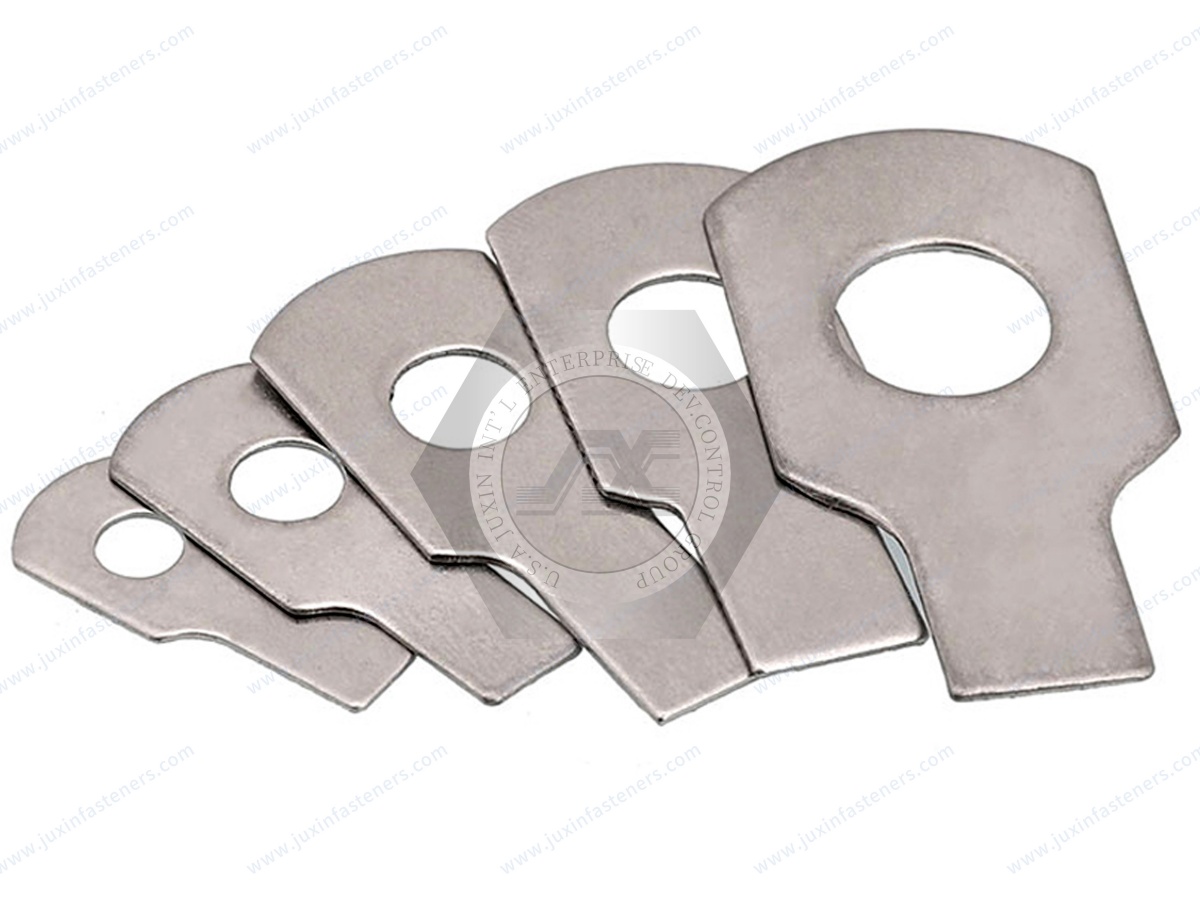
Tab lock washers may be used in selected automotive mechanical assemblies where a positive locking arrangement is specified.
Potential application areas include:
Mechanical brackets
Gearbox-related assemblies
Engine-related components
Specialized retaining arrangements
Serviceable mechanical connections
Automotive applications may impose requirements involving:
Vibration
Thermal cycling
Corrosion
Assembly repeatability
Inspection
Service procedures
The washer must be selected and approved for the particular joint.
A generic tab washer should not be assumed suitable for safety-critical automotive applications without the necessary engineering evaluation.
Motors and pumps often contain fastening arrangements exposed to vibration, rotation and maintenance activity.
Tab washers may be appropriate where a physical locking feature is required and suitable anchoring geometry is available.
Potential considerations include:
Available space
Fastener accessibility
Vibration
Temperature
Inspection access
Potential considerations include:
Dynamic loading
Maintenance requirements
Corrosion exposure
Adjacent housing geometry
Gearboxes and other mechanical systems may use tab locking arrangements in selected retaining and fastening applications.
The correct design depends on the fastener type, housing features and loading conditions.
Positive mechanical locking is used in various demanding engineering environments.
However, an ordinary commercial tab washer must not be assumed suitable for aerospace or other safety-critical applications.
Such applications may require specific approved materials, product specifications, inspection methods and qualification procedures.
The customer drawing and applicable program requirements govern suitability.
Tab washers may also be considered for selected electrical equipment and compact mechanical assemblies.
Design considerations include:
Limited installation space
Fastener access
Nearby components
Surface treatments
Assembly sequence
Inspection requirements
A tab washer should not automatically be described as an electrical grounding component.
Any electrical bonding function must be designed and verified separately.
Understanding potential failure mechanisms is essential when specifying a positive locking component.
| Failure mode | Possible cause | Recommended engineering review |
|---|---|---|
| Tab disengagement | Insufficient contact or incorrect geometry | Anchor and fastener engagement |
| Tab cracking | Excessive bending or unsuitable material | Material condition and bend geometry |
| Washer rotation | Inadequate anchoring | Fixed structural interface |
| Tab deformation | Insufficient strength or excessive loading | Tab geometry and service loads |
| Coating damage | Forming after surface treatment | Coating and installation process |
| Incorrect locking position | Assembly variation | Tooling and inspection criteria |
| Fastener movement | Incomplete locking engagement | Complete locking arrangement |
| Joint preload loss | Settlement or other joint effects | Joint design and tightening process |
| Corrosion | Unsuitable material or coating | Service environment and material compatibility |
Corrective actions should be based on the actual failure mechanism.
Simply increasing washer thickness or changing to a harder material may not solve the problem.
Tab lock washers that require plastic deformation of a locking feature should generally be treated as replacement items after the locking tab has been formed and subsequently released,
unless the approved product specification explicitly permits reuse.
Repeated bending may cause:
Work hardening
Cracking
Permanent deformation
Reduced engagement reliability
Surface damage
For maintenance-intensive equipment, the service procedure should identify replacement requirements.
Procurement and maintenance teams should consider the expected consumption of replacement locking components.
| Locking method | Principal mechanism | Main consideration |
|---|---|---|
| Tab lock washer | Positive mechanical engagement | Requires suitable anchor and bend access |
| Split spring washer | Formed spring geometry | Not a universal severe-vibration solution |
| Tooth lock washer | Surface engagement through teeth | Contact surface and coating |
| Prevailing-torque nut | Resistance within the threaded connection | Installation and reuse requirements |
| Thread-locking compound | Adhesive locking mechanism | Surface condition and application process |
| Lock plate | Physical restraint through a separate feature | Space and assembly geometry |
| Safety wire arrangement | Mechanical restraint through wire routing | Dedicated installation procedure |
The appropriate solution depends on the joint, operating conditions and maintenance requirements.
No single locking method is universally suitable for every application.
Tab washers are often suitable for production using sheet-metal forming processes.
However, the actual manufacturing route depends on the product drawing and order requirements.
For suitable geometries and quantities, stamping and forming may be considered.
The manufacturing process should account for:
Material thickness
Tab geometry
Bend requirements
Burr direction
Edge condition
Dimensional tolerances
Surface treatment
Production quantity
Some tab washers may be supplied flat for forming during installation.
Others may require specified preformed features.
The drawing should clearly distinguish the as-supplied geometry from the final installed configuration.
Bend direction can affect installation access and functional engagement.
The required orientation should be clearly defined.
Burrs can interfere with seating or damage mating surfaces.
Where functionally important, burr limits and orientation should be controlled.
The manufacturing and installation sequence should consider whether bending occurs before or after surface treatment.
This is particularly important where the coating may crack or become damaged during deformation.
For production managers and manufacturing engineers, a tab washer must be practical to install consistently.
The installation tool must reach the locking tab without damaging nearby components.
The washer orientation and bending operation should be clear and repeatable.
Where semi-automated assembly is considered, the equipment must accommodate the tab geometry and required forming operation.
A visible locking tab may support visual inspection.
However, visual appearance alone does not necessarily confirm the required mechanical performance.
Inspection criteria should be established by the customer.
The total installed cost may include:
Washer cost + feeding and handling + tightening + tab forming + inspection + rework + replacement
This can be more useful than comparing washer unit prices alone.
A custom tab lock washer drawing should define the geometry and functional requirements sufficiently for manufacturing and inspection.
Important information includes:
Washer inside diameter
Washer outside dimensions
Material thickness
Overall length and width
Tolerances
Number of tabs
Long-tab length
Short-tab length
Tab width
Relative tab angle
Bend direction
Bend radius where required
As-supplied and installed conditions
Material grade
Material condition
Hardness where applicable
Formability requirements
Surface treatment
Coating requirements
Edge condition
Burr limits
Intended locking interface
Anchoring arrangement
Installation sequence
Inspection criteria
Replacement or reuse requirements
Prototype quantity
Initial order quantity
Estimated annual usage
Packaging
Delivery requirements
Documentation
A drawing is particularly important for right-angle long-and-short-tab washers because similar-looking products may have different functional geometry.
Two tab washers may have the same nominal hole diameter and material thickness but differ in:
Tab length
Tab orientation
Bend location
Edge geometry
Material condition
Surface finish
Anchor engagement
These differences can affect installation and locking performance.
For OEM purchasing, a generic description such as stainless steel tab washer is not a complete technical specification.
Tab washers are not governed by one universal standard covering every possible geometry.
Certain washer and locking arrangements may be addressed by specific DIN, ISO or other applicable product standards.
For a custom long-and-short-tab right-angle washer, the approved customer drawing may be the primary controlling specification.
Where a customer references a standard, the supplier should verify:
Exact standard designation
Applicable product scope
Dimensions
Material
Surface treatment
Revision requirements
Tab washer clearance geometry must be compatible with the specified fastener.
Metric ISO threads, Unified UNC/UNF threads and British BSW/BSF threads are different systems and must not be treated as directly interchangeable.
For example, a washer intended for a nominal M8 fastener should not automatically be approved for an inch-series fastener solely because the nominal diameters appear close.
The complete fastener and locking geometry must be checked.
OEM procurement teams should compare suppliers against the same controlled technical specification.
Review:
Drawing interpretation
Material requirements
Dimensional requirements
Tab forming requirements
Surface treatment
Inspection criteria
Packaging
Documentation
Consider:
Manufacturing feasibility
Process consistency
Inspection arrangements
Sample approval requirements
Production planning
Change-control procedures
Confirm:
Quotation quantity
Minimum order requirements
Tooling requirements where applicable
Prototype requirements
Lead-time expectations
Packaging
Delivery arrangements
Annual demand
MOQ, lead time and tooling requirements should be confirmed for the specific project.
A substitute tab washer should not be approved merely because it fits the same nut or bolt.
The anchoring and locking geometry must also be compatible.
A practical engineering and sourcing workflow is:
Define the joint and locking requirement
→ Determine the required rotational restraint.
Identify the anchoring feature
→ Confirm a suitable fixed structural interface.
Select the washer geometry
→ Define the washer body, tab lengths and orientation.
Select the material
→ Review strength, ductility, corrosion and temperature.
Define the installation process
→ Establish tightening, bending and inspection procedures.
Validate the locking arrangement
→ Review performance under relevant loading and environmental conditions.
Approve the drawing
→ Control dimensions, material, finish and revision.
Proceed to supplier qualification
→ Compare technically equivalent quotations and confirm production requirements.
This approach connects mechanical design, manufacturing and purchasing decisions.
A tab lock washer is a mechanical locking component that uses formed tabs to restrict fastener rotation through physical engagement with a nut, bolt or fixed structural feature.
It provides a positive mechanical restraint against rotation.
The complete joint must still be designed and tightened correctly.
It is a tab washer with tab features arranged approximately perpendicular to one another, often allowing engagement with locking and anchoring surfaces in different directions.
They may be used where one tab must reach a fixed structural feature and another must engage a fastener.
The actual function depends on the approved design.
Not necessarily.
Performance depends on geometry, material, engagement and loading rather than tab count alone.
They may be suitable for certain vibrating assemblies, but performance must be evaluated against the actual joint and operating conditions.
Washers with tabs that have been plastically bent and released should generally be replaced unless the approved specification permits reuse.
The appropriate material depends on the required strength, formability, corrosion resistance and service environment.
Custom geometry and material options can be reviewed against the drawing and manufacturing requirements.
Provide the drawing, dimensions, tab geometry, material, surface treatment, application, quantity and required documentation.
JUXIN FASTENERS supports industrial customers sourcing fastening components for machinery, automotive equipment, mechanical assemblies and other OEM applications.
For tab lock washers, the correct product should be selected according to the customer's actual locking arrangement.
Relevant requirements may include:
Single-tab washer designs
Double-tab washer designs
Long-and-short-tab right-angle configurations
Stainless steel tab washers
Carbon steel tab washers
Zinc-plated steel tab washers
Drawing-based custom locking washers
The feasibility of a particular configuration, material, finish or order quantity must be confirmed during technical review.
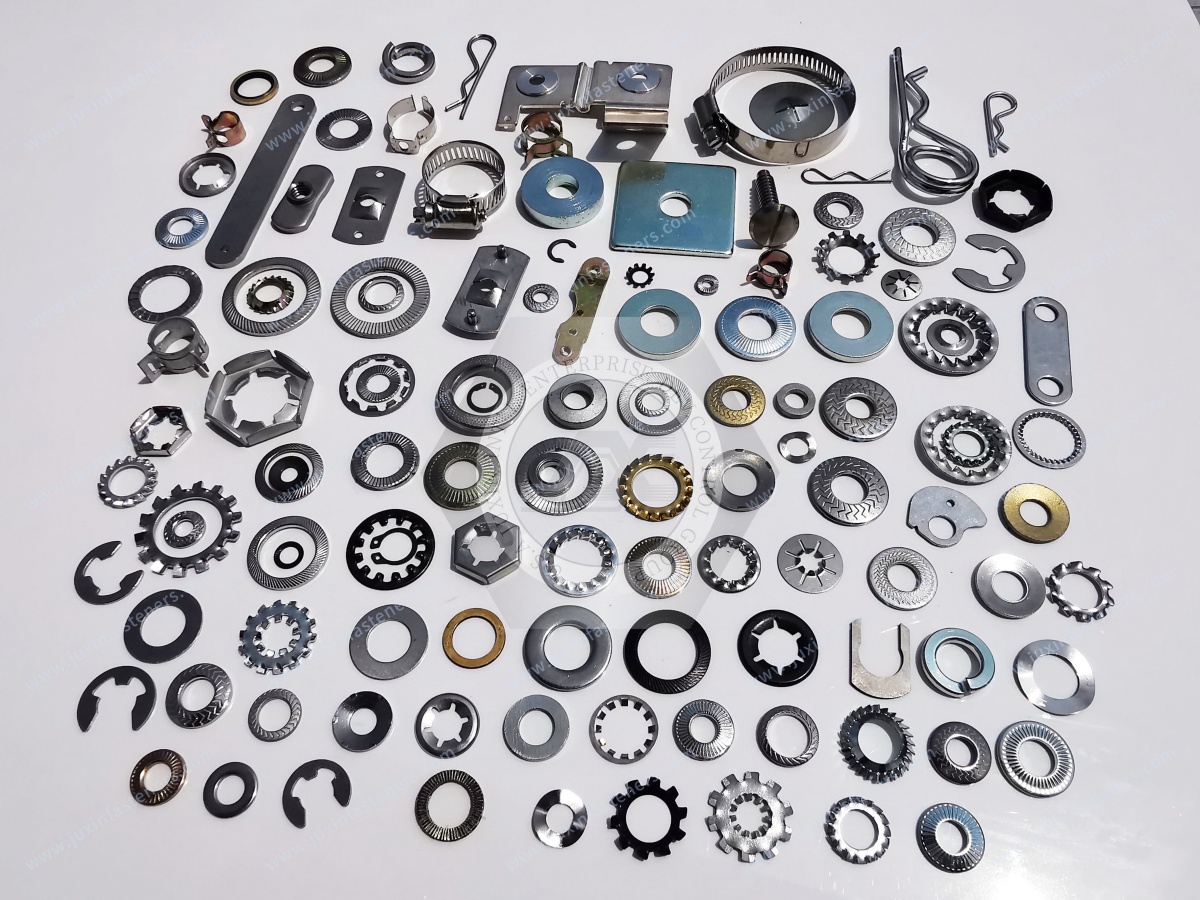
If your project requires tab lock washers for motors, pumps, gearboxes, machinery, automotive equipment or another OEM application,
send your drawing or technical specification to JUXIN FASTENERS.
For an efficient review, include:
2D drawing
3D model where applicable
Washer dimensions
Long- and short-tab geometry
Material and thickness
Surface treatment
Nut or bolt specification
Anchoring-surface details
Application and operating environment
Prototype quantity
Estimated annual volume
Packaging requirements
Required inspection documentation
Company: JUXIN FASTENERS
Website: https://www.juxinfasteners.com/
Email: info@juxinfasteners.com
Send your tab lock washer drawing to JUXIN FASTENERS for technical review, custom product evaluation and OEM bulk quotation.
Previous: Double Tab Lock Washers
Next: Long Tab Washers Guide
Contact Us
Tel.:
+86 020 8621 0320
+86 020 3121 6067
E-mail:
Technical Support:
Navigation
SEND INQUIREY