
Call Us
+86 136 6007 9809
Call Us
+86 136 6007 9809

Oct. 22, 2023
Long tab washers are mechanical locking components designed to restrict rotation of a nut, bolt head or other compatible threaded fastener after tightening.
Unlike locking methods that rely primarily on friction, prevailing torque or spring action, a properly designed tab washer creates a physical rotational restraint.
The basic principle is straightforward:
install the washer in the specified orientation;
tighten the threaded fastener according to the assembly requirement;
bend the designated locking tab against an appropriate flat or reaction feature;
the formed tab physically restricts unwanted rotation.
This makes tab washers useful in applications where engineers want a simple, visible and mechanically defined locking feature.
However, a tab washer should not automatically be considered suitable for every vibration environment or every critical bolted joint.
Its effectiveness depends on:
washer geometry + reaction feature + fastener geometry + material + installation + load condition.
JUXIN FASTENERS supplies standard and custom washers, locking components, stamped fasteners and made-to-drawing fastening solutions for OEM and industrial applications.
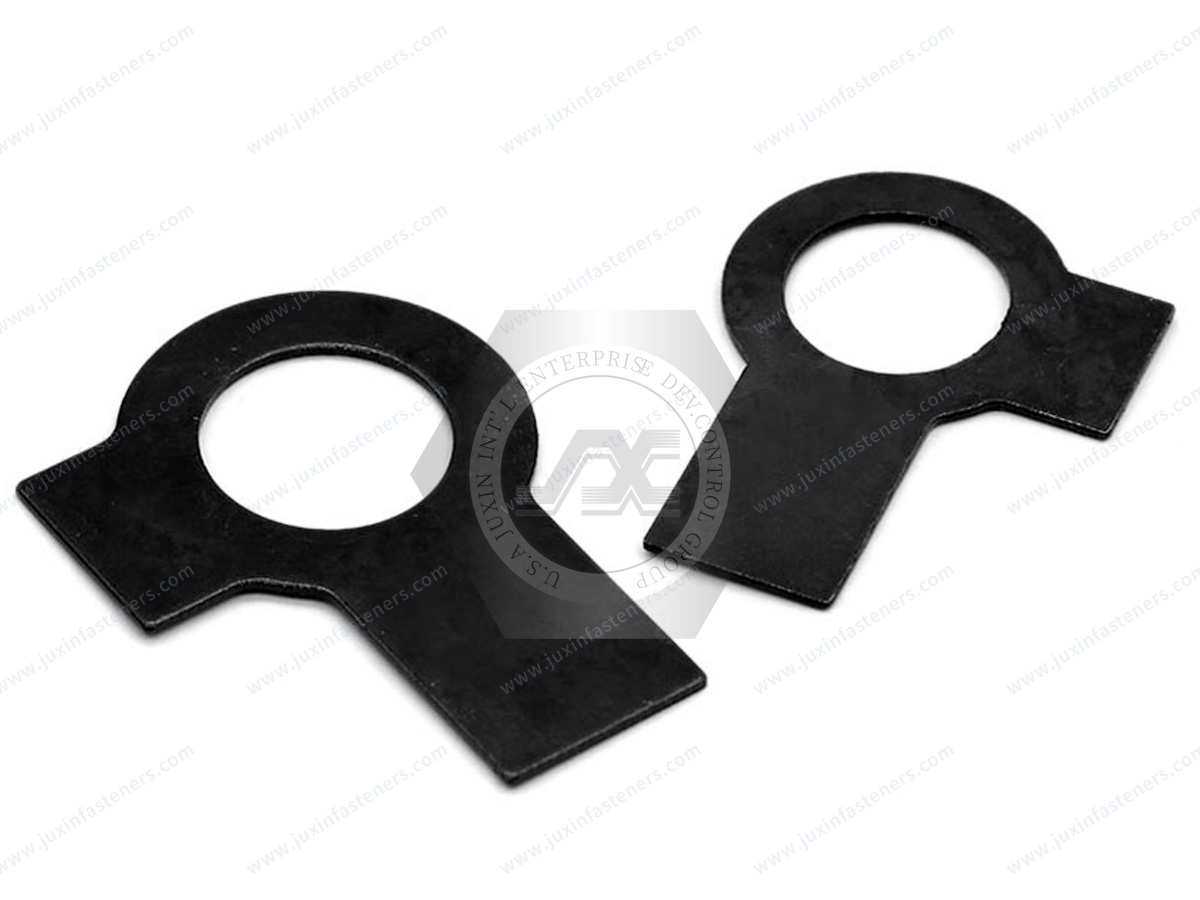
A long tab washer is typically a stamped metal washer incorporating one or more extended tabs.
Depending on the design, the tab may be bent against:
a nut flat;
a bolt-head flat;
a housing edge;
a slot;
another stationary feature of the assembly.
The objective is to create a mechanical barrier to fastener rotation.
The term long tab washer generally describes the geometry of the locking feature rather than one universal washer design.
Different applications can therefore require significantly different tab lengths, widths, orientations and washer-body geometries.
The locking mechanism depends on mechanical interference.
After the fastener has been tightened, the locking tab is plastically formed against a suitable reaction surface.
If the nut or bolt attempts to rotate in the loosening direction, the tab contacts that feature and resists further rotation.
This is fundamentally different from relying only on increased friction.
For that reason, tab washers are often described as a form of positive mechanical locking.
Understanding this distinction is important when selecting an anti-loosening method.
A friction-based locking system attempts to increase resistance to relative rotation through friction or prevailing torque.
A tab washer creates a physical obstruction to rotation after installation.
That does not mean one method is universally superior.
The appropriate technology depends on:
joint design;
loading;
vibration;
service requirements;
installation access;
inspection requirements;
maintenance strategy.
A long tab by itself does not create a complete locking system.
The tab needs something to react against.
This may be:
a nut flat;
bolt-head flat;
housing wall;
machined slot;
bracket edge;
other stationary geometry.
Without a correctly positioned reaction feature, the tab may not provide effective rotational restraint.
This is one of the most important design considerations for custom tab washers.
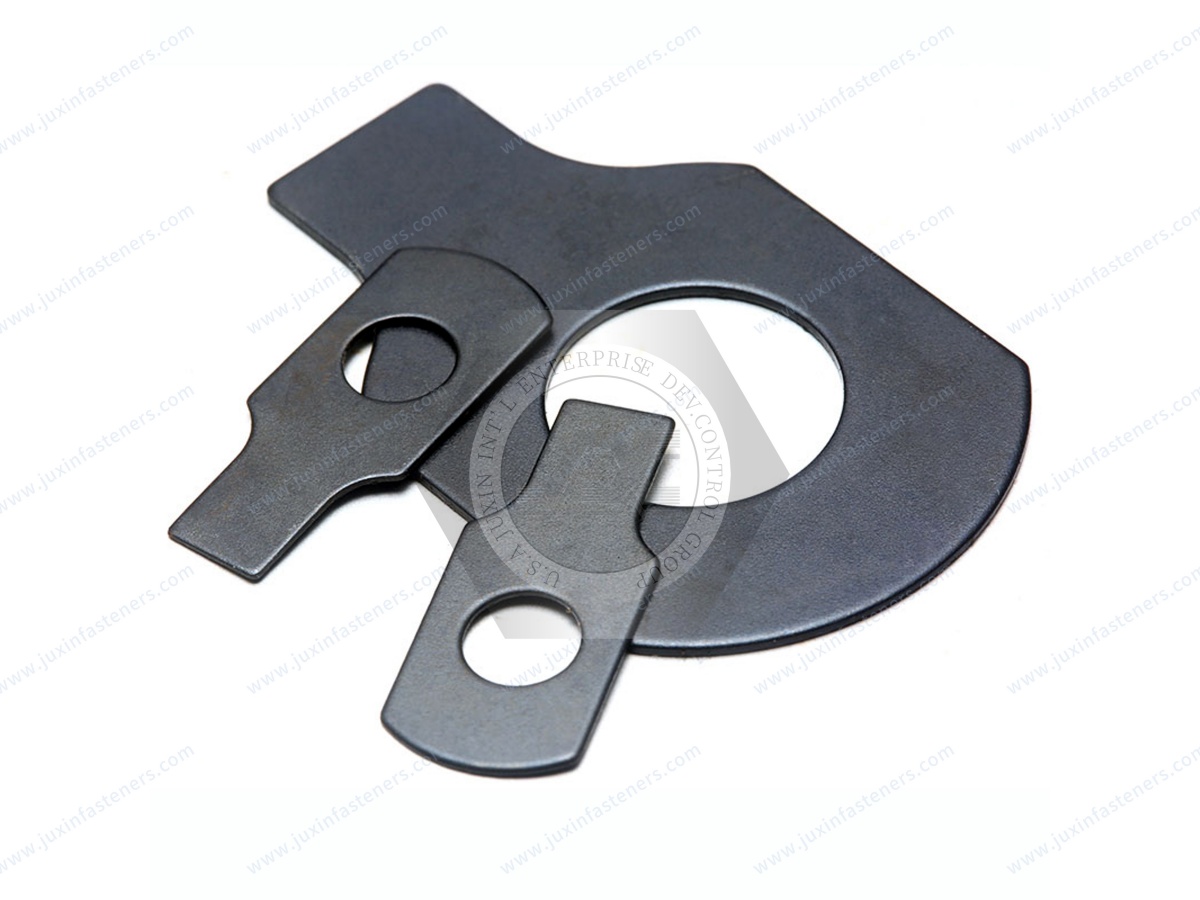
Tab washers can use different locking geometries.
An external tab extends beyond the washer body and can be bent against a nut, bolt head or adjacent structural feature.
An internal feature may engage a keyway, slot or other mating geometry to prevent the washer itself from rotating.
Some designs combine both concepts.
For example, one feature can locate the washer relative to a shaft or housing while another tab locks the nut.
The exact configuration depends on the assembly.
Multi-tab designs can provide more than one possible locking position.
This can be useful where the final angular position of a nut cannot be predicted precisely before tightening.
Rather than forcing the fastener to align with one specific tab, the installer may select the most appropriately positioned locking feature according to the approved assembly procedure.
The design should still maintain the required fastener preload and assembly requirements.
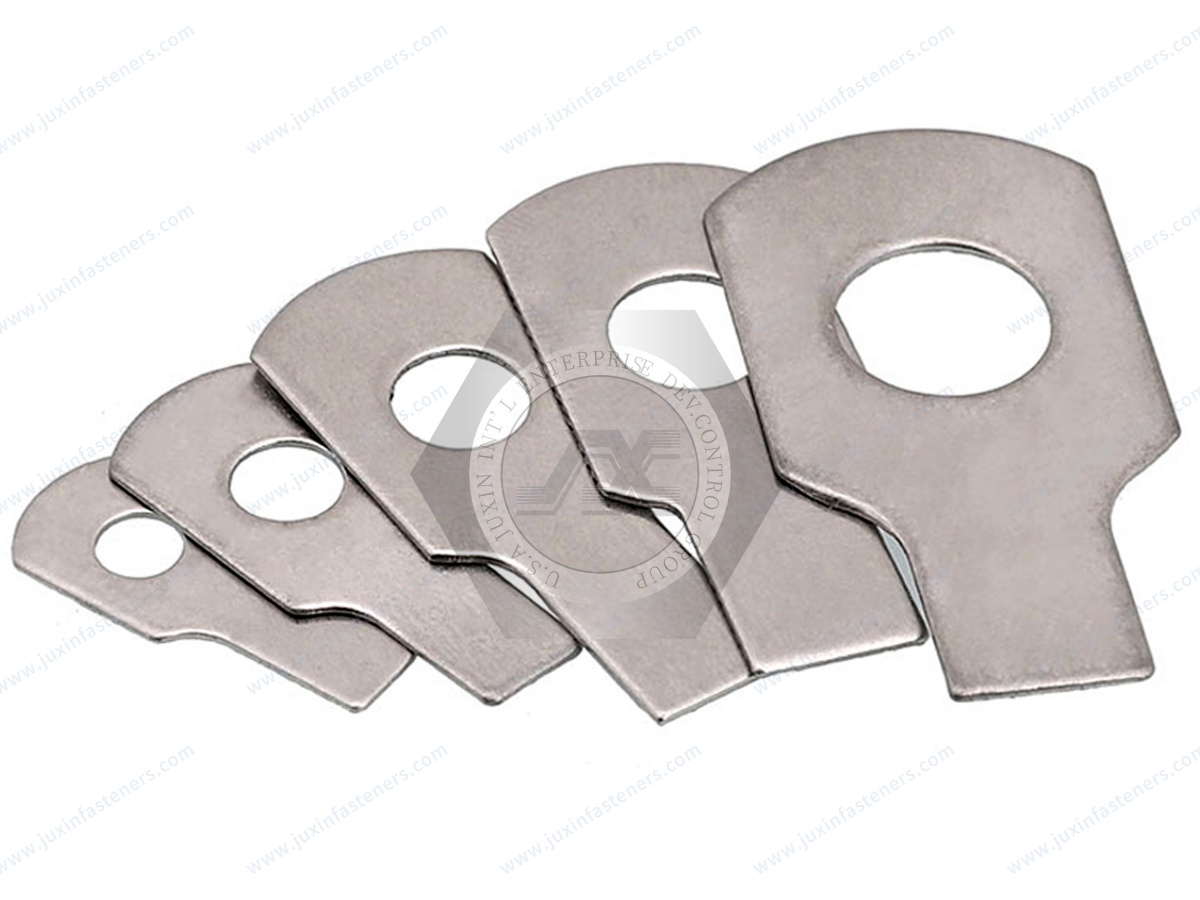
The locking tab must be long enough to reach the intended reaction feature after installation.
Important dimensions can include:
tab length;
tab width;
tab thickness;
bend location;
distance from washer center;
angular position;
corner radius;
washer outside diameter;
washer inside diameter.
These dimensions should be based on the actual assembly geometry.
Simply making the tab longer does not automatically improve locking performance.
A narrow tab may be easier to form but can have less section available to resist deformation.
A wider tab may provide greater section width but can require more bending force and additional installation space.
The optimum geometry depends on:
washer material;
thickness;
available clearance;
bend radius;
reaction surface;
expected rotational load.
Material thickness influences both formability and mechanical resistance.
If the washer is too thin for the application, the tab may deform too easily.
If it is unnecessarily thick, field bending or production assembly may become difficult.
Thickness should therefore be selected together with material properties and locking geometry.
A sharp uncontrolled bend can create high local strain.
A suitable bend geometry can help reduce the risk of:
cracking;
tearing;
uncontrolled deformation.
This becomes particularly important with thicker material, higher-strength material or corrosion-resistant alloys with different forming characteristics.
Tab washers require a combination of properties.
The material must be capable of:
being stamped economically;
surviving the required forming operation;
providing adequate locking resistance;
meeting environmental requirements.
Possible materials can include suitable carbon steels, stainless steels and other application-specific alloys.
Material should be specified according to the drawing and service conditions rather than by a generic assumption that one material is always preferable.
Carbon steel can be appropriate for many industrial applications.
Depending on the service environment, an appropriate surface treatment may be applied for corrosion protection.
Engineering considerations can include:
strength;
formability;
material thickness;
coating;
operating environment.
Stainless steel can be appropriate where corrosion resistance is important.
However, stainless grades have different forming and mechanical characteristics.
The material should therefore be selected with consideration of:
required tab bending;
thickness;
corrosion exposure;
temperature;
mating components.
Stainless steel should not automatically be treated as interchangeable with carbon steel at the same dimensions.
Where carbon or alloy steel is used, surface treatment may be selected according to the application.
Possible industrial coating systems can include appropriate zinc-based or other specified protective finishes.
Coating selection should consider:
corrosion exposure;
coating thickness;
bend behavior;
mating materials;
customer specification.
If the tab is bent after coating, the effect of forming on the coating should also be considered.
In a typical application, the threaded fastener is first tightened according to the required assembly procedure.
The locking tab is then bent into its locking position.
The tab should not be used as a substitute for proper fastener tightening.
Its purpose is to restrict subsequent rotation, not to create the initial bolt preload.
This is an important engineering distinction.
Clamp load is generated by tightening the threaded fastener.
The tab washer provides a locking feature after tightening.
Therefore:
tightening creates preload; the tab provides rotational restraint.
Confusing these two functions can lead to poor joint design.
A typical installation sequence is:
Confirm washer, nut or bolt, mating component and locking geometry.
Position the tab so it can reach the intended reaction feature.
Follow the approved tightening requirement for the joint.
Ensure an appropriate tab can be formed without incorrectly changing the required fastener condition.
Form the designated tab against the intended locking surface.
Confirm the tab is seated appropriately and has not cracked or torn.
This should not be done casually.
If a fastener has been tightened to an engineered preload or torque requirement, backing it off simply to align a locking feature can alter the joint condition.
The assembly design and installation procedure should account for locking-tab alignment.
Where angular alignment is important, multi-tab or application-specific washer geometry may provide a better solution.
Reuse should generally not be assumed.
A locking tab is plastically bent during installation.
Bending it back and forming it again introduces additional deformation.
Repeated bending can increase the risk of:
work hardening;
cracking;
reduced section strength;
unreliable locking geometry.
For service assemblies, replacement after removal is often the safer engineering approach unless the approved specification explicitly permits reuse.
One useful characteristic of a tab washer is that the locking condition can often be visually inspected.
An inspector may be able to verify:
whether the correct tab was bent;
whether it contacts the intended reaction feature;
whether the tab is cracked;
whether obvious deformation has occurred.
This can be useful in maintenance-oriented industrial assemblies.
However, visual confirmation of the tab does not prove that the threaded fastener was originally tightened correctly.
These two washer types use very different principles.
Typically relies on elastic geometry and friction-related behavior.
Uses a bent physical feature to restrict rotation.
They should therefore not be treated as interchangeable simply because both are marketed as locking washers.
Serrated washers use surface interaction and frictional mechanisms.
Tab washers create a physical rotational stop.
Selection should be based on the joint architecture rather than simply choosing whichever washer appears to offer stronger "anti-loosening."
A prevailing-torque nut creates resistance to rotation through a locking feature in the nut itself.
A tab washer creates external mechanical restraint after installation.
A prevailing-torque nut may be preferable where:
compact assembly is required;
no external reaction surface exists;
automated assembly is important.
A tab washer may be attractive where:
visible positive locking is desirable;
a suitable reaction feature exists;
service inspection is important.
Threadlocking adhesives and tab washers use fundamentally different locking methods.
Adhesives depend on:
compatible materials;
surface condition;
product chemistry;
curing conditions;
temperature;
service environment.
Tab washers use mechanical geometry.
The appropriate solution depends on the application and approved assembly process.
Safety wire can provide positive mechanical restraint in certain applications, particularly where the assembly has been specifically designed for wired fasteners.
Tab washers can provide a simpler stamped locking solution where suitable reaction geometry exists.
These systems should not be substituted for one another in controlled or safety-critical applications without engineering approval.
One important application family involves threaded shaft nuts.
In these assemblies, a washer may incorporate geometry that prevents the washer itself from rotating relative to the shaft, while one or more tabs are bent against the locking nut.
This can create a defined rotational locking arrangement.
However, the tab washer itself does not directly prevent axial movement of the shaft.
The threaded nut and the overall shaft assembly provide the axial retention.
The washer's role is to help prevent unintended nut rotation.
Certain bearing and shaft arrangements use purpose-designed locking washers together with compatible locknuts.
In such systems, engineers should use the washer and nut configuration specified for the bearing arrangement.
A generic long-tab washer should not automatically be substituted for a standardized bearing lock washer.
Critical dimensions and locking geometry can differ.
Gearboxes and mechanical drive assemblies can contain threaded shaft connections where unwanted nut rotation must be controlled.
Tab washers can be useful where:
the assembly provides an appropriate reaction feature;
the fastener is accessible for tab forming;
visual inspection is valuable;
the specified locking method permits the design.
Rotating equipment such as pumps and compressors can contain nuts, shafts and mechanical subassemblies exposed to vibration and cyclic operation.
Where a tab washer is specified, material, geometry, operating temperature and service access should be evaluated together.
The washer should be selected as part of the engineered locking system rather than as a generic anti-vibration accessory.
Industrial machinery can use tab washers in:
drive assemblies;
gear systems;
shaft-mounted components;
adjustment mechanisms;
heavy mechanical equipment.
Custom geometry can be particularly useful where the locking tab must interact with a machine-specific housing or bracket.
Construction and heavy industrial equipment can expose threaded joints to:
vibration;
shock;
dirt;
corrosion;
repeated service.
A mechanically visible locking method can be useful in certain assemblies.
Actual suitability must still be validated for the specific joint and load condition.
Power-generation, electrical and energy equipment can contain mechanical assemblies where rotational locking of threaded components is required.
Material, corrosion protection and temperature should be selected according to the service environment and equipment specification.
Tab washers can appear in certain automotive mechanical assemblies, but the term should not be generalized to engines, gearboxes or wheels without reference to the approved design.
Automotive applications can have highly specific validation requirements.
A generic tab washer should not be substituted into a safety-critical joint simply because it provides mechanical locking.
Transportation equipment can use positive locking devices in suitable mechanical assemblies.
Where tab washers are specified, traceability, material, dimensions, coating and inspection requirements should follow the relevant drawing and customer specification.
A custom tab washer may be appropriate when a standard washer cannot reach or engage the required reaction feature.
Customizable variables can include:
inside diameter;
outside diameter;
thickness;
tab length;
tab width;
tab angle;
tab quantity;
tab orientation;
internal locating features;
material;
surface finish.
The assembly drawing is usually more useful than the washer drawing alone because the reaction geometry determines whether the locking concept will work.
A useful design process starts with the assembled joint.
Ask:
What must be prevented from rotating?
Then:
What stationary feature can react against the tab?
From there, determine:
washer location;
tab direction;
tab length;
available bending access;
material;
thickness;
installation tooling.
This assembly-first approach can avoid a common mistake: designing a washer that looks correct on a drawing but cannot actually be bent into position after installation.
Tab washers are commonly produced through suitable stamping and forming processes.
Manufacturing considerations can include:
material thickness;
blanking;
burr direction;
tab geometry;
bend features;
dimensional tolerances;
surface treatment;
production quantity.
For high-volume OEM programs, tooling design can significantly affect production economics.
Stamping creates a characteristic edge condition.
Depending on the application, burr direction may matter where the washer contacts:
a finished surface;
a rotating component;
a sealing surface;
a soft mating material.
If surface protection is important, burr control and washer orientation should be defined in the drawing or quality requirement.
Washer flatness may influence assembly depending on the design.
However, the tab itself is intentionally formed during installation.
Inspection requirements should therefore distinguish between:
washer-body flatness;
tab geometry before installation;
final tab condition after assembly.
Not every dimension needs an unnecessarily tight tolerance.
Critical dimensions may include:
inside diameter;
washer thickness;
tab position;
tab length;
locating features.
Other dimensions may allow greater manufacturing variation.
Functional tolerancing can improve manufacturability and cost without reducing performance.
Possible causes:
incorrect tab length;
wrong orientation;
assembly dimensional change;
incorrect washer.
Possible causes can include:
unsuitable material;
excessive hardness;
inadequate bend radius;
excessive thickness;
repeated bending.
The washer may require a reaction or locating feature to prevent rotation.
The geometry or final fastener position may be incompatible.
The locking geometry, material or loading may be inappropriate for the application.
These problems are usually better solved by reviewing the complete assembly than by simply specifying a thicker washer.
Use the following decision sequence.
Identify the fastener and what must be prevented from rotating.
Determine where the locking tab will physically engage.
Specify inside diameter, outside diameter, thickness and tab geometry.
Determine the expected angular and axial position after tightening.
Confirm the installer can actually bend the tab after tightening.
Balance strength, formability and environmental requirements.
Match the coating to the service environment.
Determine whether the washer should be replaced after disassembly.
For important joints, validate the complete assembly under representative conditions.
For an accurate quotation, provide:
washer drawing;
assembly drawing where available;
inside diameter;
outside diameter;
thickness;
tab length;
tab width;
tab position;
tab quantity;
material;
finish/coating;
mating nut or bolt dimensions;
reaction feature geometry;
application;
operating environment;
order quantity;
estimated annual demand;
inspection requirements;
packaging requirements.
For replacement parts, a physical sample and photographs of the installed assembly can also be useful.
A long tab washer is a locking washer with an extended tab that can be bent against a nut, bolt head or stationary assembly feature to restrict unwanted rotation.
It creates a physical rotational restraint after the threaded fastener has been tightened.
Its primary function is not to increase tightening torque. The fastener is tightened first; the tab is then formed to provide rotational restraint.
No. Bolt preload is generated by tightening the threaded fastener.
Reuse should not automatically be assumed because repeated bending can damage or weaken the tab.
They use different locking principles. Selection depends on the joint, load, installation and service requirements.
Not necessarily. Some bearing locknut systems use purpose-designed locking washers. A generic long-tab washer should not automatically be substituted.
Yes. Tab length, width, position, quantity, washer dimensions, material and finish can be designed around the application.
The most useful information includes the washer dimensions, fastener geometry, reaction feature, material, coating, application and expected production quantity.
Yes. JUXIN FASTENERS supports drawing-based and sample-based development of custom washers, stamped fasteners and application-specific locking components.
The most important question when specifying a long tab washer is not simply:
"What size washer fits this bolt?"
A better engineering question is:
"What feature will physically stop this fastener from rotating after tightening?"
That changes the selection process from choosing a generic washer to designing a complete locking interface.
For engineers, this means considering the fastener, washer and reaction feature together.
For procurement and supplier-development teams, supplying the complete assembly geometry can reduce the risk of sourcing a washer that fits the bolt but cannot perform the required locking function.
JUXIN FASTENERS supports global OEM, ODM, engineering, procurement, sourcing and supplier-development teams with standard and custom tab washers,
locking washers, stamped fasteners and application-specific fastening solutions.
If you have an existing drawing, send the drawing.
If the original drawing is unavailable, send the existing washer together with photographs or dimensions of the installed assembly.
For new development, provide the bolt or nut size, reaction geometry, washer dimensions, material, finish, operating environment and estimated annual demand.
We can support technical review, sample evaluation, manufacturing feasibility review, custom development, quotation and volume production sourcing.
Email: info@juxinfasteners.com
Website: www.juxinfasteners.com
 MORE NEWS
Sep. 27, 2026
Sep. 27, 2026
Sep. 27, 2026
Contact Us
Tel.:
+86 020 8621 0320
+86 020 3121 6067
E-mail:
Technical Support:
Navigation
SEND INQUIREY