
Call Us
+86 136 6007 9809
Call Us
+86 136 6007 9809

Oct. 22, 2023
Double tab lock washers, also called double lug tab washers or two-tab locking washers, are stamped mechanical locking components designed to restrict unwanted rotation in threaded assemblies.
A typical design incorporates two functional tabs or lugs positioned to interact with different parts of the assembly.
Depending on the washer geometry and application, one feature may locate or restrain the washer relative to a stationary component, while another tab is formed against a nut or bolt head after tightening.
This creates a positive mechanical locking path rather than relying only on friction.
The important engineering principle is:
Stationary reaction feature → washer → locking tab → threaded fastener
For the system to work as intended, every part of this mechanical restraint path must be properly defined.
JUXIN FASTENERS supplies standard and custom locking washers, tab washers, stamped fasteners and made-to-drawing fastening components for OEM and industrial applications.
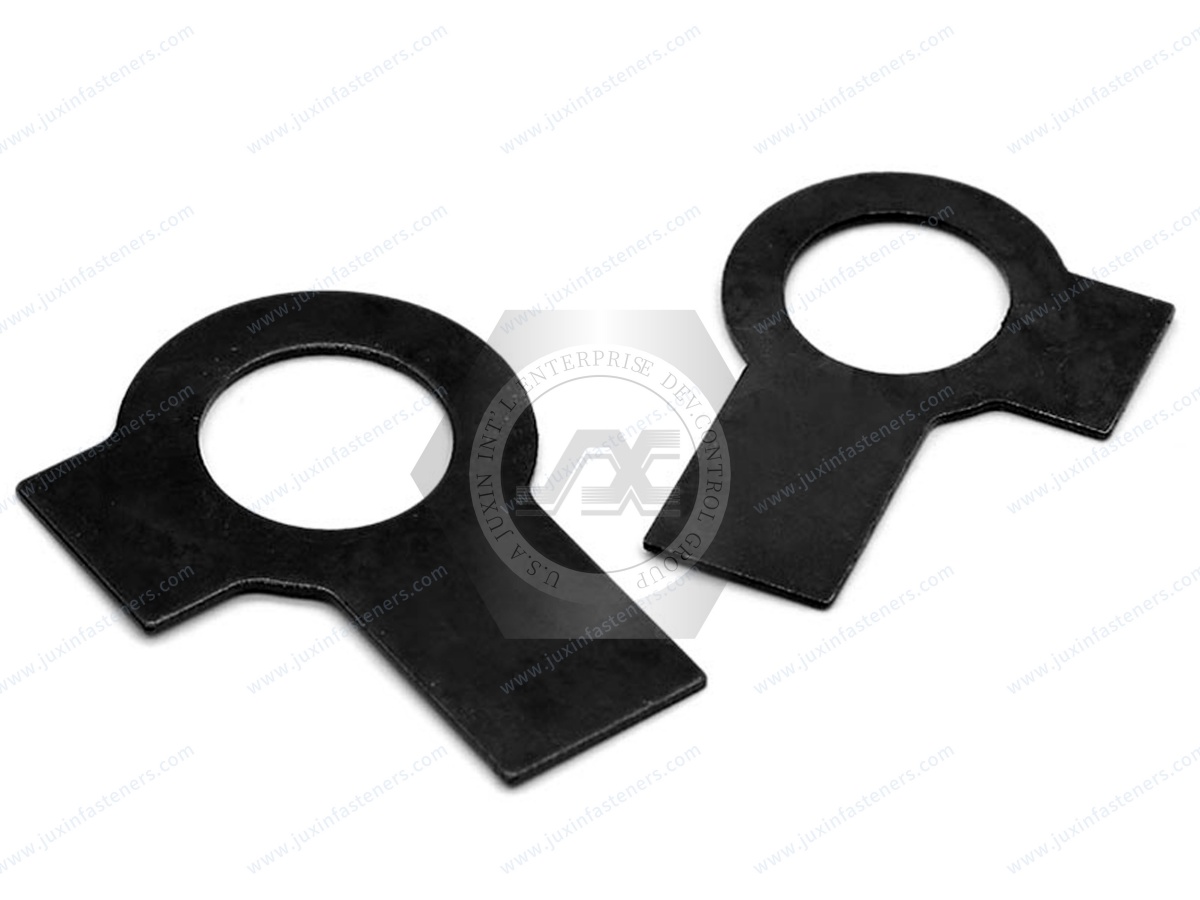
A double tab lock washer is generally a one-piece stamped washer containing two distinct projecting or locating features.
Depending on the design, these may include:
one long external tab and one short tab;
two external locking tabs;
an internal locating tab plus an external locking tab;
two tabs positioned at different angular orientations;
application-specific lugs designed around surrounding assembly geometry.
The terms double tab washer, double lug tab washer, two-tab lock washer, and long and short tab washer may therefore describe related but not necessarily identical geometries.
For OEM sourcing, the drawing should control the specification rather than the product name alone.
A double-tab system typically performs two related functions.
One feature establishes a relationship between the washer and a stationary component.
The second feature restricts rotation of the threaded fastener.
A simplified locking path may be:
Housing → locating tab → washer body → locking tab → nut
If the nut attempts to rotate after installation, the formed tab transfers that rotational tendency through the washer toward the stationary reaction feature.
This is why a double-tab washer should be considered part of an assembly rather than as an isolated component.
Two tabs do not automatically mean "twice the locking strength."
Their primary advantage may instead be functional separation.
One feature can control washer rotation while another controls fastener rotation.
This distinction is important.
If a single external tab is bent against a nut but the washer itself is free to rotate, the complete locking path may not be established.
A second locating or reaction feature can solve that design problem.
The original product configuration may use a long and short tab positioned at different angles.
However, their functions should not be universally assigned based only on tab length.
Depending on the actual assembly:
the long tab may engage a housing or bracket;
the short tab may lock against a nut flat;
the opposite arrangement may be used;
one tab may serve primarily as a locating feature;
both tabs may interact with application-specific geometry.
The assembly drawing determines the function.
Some double-tab washers have tabs arranged approximately 90 degrees apart around the washer body.
This angular relationship can help the washer interact with two different surrounding features.
However, "right-angle" should not be interpreted as a universal dimensional requirement for all double-tab washers.
Custom designs may require different angular positions depending on:
nut orientation;
housing geometry;
available bending access;
interference with adjacent components;
assembly sequence.
For custom stamped washers, tab angle is therefore a functional dimension.
Tab washers are commonly classified as positive mechanical locking devices because the final locking action is created by physical geometry.
The washer does not primarily depend on increasing thread friction.
After the fastener reaches its required installed condition, a tab is formed against an appropriate reaction surface.
The physical obstruction then restricts rotation.
This is fundamentally different from locking technologies based on:
prevailing torque;
serration friction;
spring action;
adhesive chemistry.
Each technology has its own application conditions.
This is one of the most important engineering points for double-tab designs.
Suppose a tab is bent against a nut flat.
If the washer underneath can freely rotate with the nut, the tab alone may not establish the intended positive locking condition.
The washer therefore needs a suitable rotational reaction.
Depending on the design, that reaction may come from:
a second tab;
a slot;
a keyway;
a housing edge;
a flat;
another locating feature.
This is the core reason many double-tab washers exist.
Instead of asking only:
"Will this tab stop the nut?"
engineers should trace the entire restraint path:
What stops the nut?
The bent locking tab.
What stops the washer?
The locating tab or reaction feature.
What stops that feature?
The stationary housing, bracket, shaft feature or other structural component.
If one link in this path is undefined, the locking concept requires further review.
A single long tab washer may be sufficient when its geometry can both locate the washer and create the required locking relationship within the assembly.
A double-tab design becomes useful when two distinct interfaces are required.
For example:
Single-tab concept:
Washer geometry → one reaction feature → fastener restraint.
Double-tab concept:
Stationary component → first tab → washer → second tab → fastener.
The choice should therefore be driven by assembly architecture rather than an assumption that more tabs automatically provide better performance.
A spring washer and double-tab washer use different operating principles.
A spring washer relies on its elastic geometry and friction-related behavior.
A double-tab washer uses physical rotational restraint.
The two products should not be treated as interchangeable simply because both may appear under the broad category of locking washers.
Serrated washers use contact geometry to influence friction between mating surfaces.
Double-tab washers create a defined mechanical obstruction to rotation.
Surface condition and friction remain important to the bolted joint overall, but they are not the primary mechanism by which the bent tab prevents rotation.
A prevailing-torque nut incorporates a locking mechanism within the nut.
This can be advantageous when external locking geometry is unavailable.
A double-tab washer may be considered where:
the assembly provides suitable reaction features;
positive mechanical restraint is desired;
visual inspection of the locking condition is useful;
external tab forming is practical.
The appropriate choice depends on the complete joint.
Threadlocking adhesives depend on chemical and surface conditions.
Their performance can be influenced by factors such as:
substrate material;
surface cleanliness;
product chemistry;
curing conditions;
temperature;
service environment.
A double-tab washer uses mechanical geometry.
Neither system should automatically replace the other without reviewing the assembly requirements.
No locking device should be described as creating a universal "zero loosening risk."
A double-tab washer can restrict rotation when correctly designed and installed, but joint integrity still depends on factors including:
fastener preload;
joint stiffness;
external loading;
fastener strength;
mating materials;
tab geometry;
reaction geometry;
installation quality.
Positive locking does not eliminate the need for proper bolted-joint design.
The threaded fastener creates clamp load when tightened.
The tab washer performs a different function.
Its role is to restrict subsequent rotation.
Therefore:
Fastener tightening → creates preload
Tab forming → establishes rotational restraint
These functions should not be confused.
A typical double-tab washer installation may follow this sequence.
Determine where the washer-locating feature and fastener-locking tab will engage.
Orient the washer according to the assembly drawing.
Where applicable, position the first tab or lug against or into the designated stationary feature.
Tighten the nut or bolt according to the approved assembly requirement.
Confirm that the designated locking tab can reach an appropriate fastener flat or reaction surface.
Bend the tab into the specified locking position.
Confirm correct seating, contact and absence of visible cracking or unintended deformation.
The tab should not be treated as a lever for producing final fastener torque.
The nut or bolt should first reach its specified installed condition using the approved tightening method.
The locking tab is formed afterward.
This preserves the distinction between joint preload and locking function.
After tightening, the angular position of the nut or bolt head may determine whether the tab can engage correctly.
This should be considered during design.
Potential approaches can include:
multiple available locking tabs;
optimized tab angular position;
application-specific washer geometry;
an approved installation procedure.
The solution should not compromise the required fastener condition merely to align the tab.
Tab length must be sufficient to reach its intended reaction surface after installation.
Too short and it may not engage.
Unnecessarily long tabs can create:
packaging interference;
bending difficulty;
reduced stiffness;
conflicts with neighboring components.
The correct length is determined by the assembly geometry.
Tab width influences forming behavior and resistance to deformation.
A narrower tab may be easier to bend.
A wider tab provides more section width but can require greater forming force and installation clearance.
Material and thickness must be considered together with width.
Thickness affects:
stamping;
forming force;
tab stiffness;
washer-body stiffness;
available bending radius.
Increasing thickness is not automatically the correct response to a locking problem.
The complete geometry should be reviewed.
The intended bend line should be considered during washer design.
Uncontrolled bending at a sharp transition can increase local strain and the possibility of cracking.
Material properties, thickness and bend geometry should therefore be considered together.
Suitable carbon steels can be used for many industrial applications.
Selection should consider:
mechanical requirements;
formability;
thickness;
corrosion protection;
operating environment.
Where required, a specified surface treatment can provide additional environmental protection.
Stainless steel may be selected where corrosion resistance is required.
However, stainless grades can differ in:
strength;
ductility;
work-hardening behavior;
forming characteristics;
corrosion resistance.
A stainless washer should therefore be engineered for the intended bending operation rather than substituted solely on the basis of corrosion resistance.
Surface treatments for steel washers should be selected according to customer specifications and service conditions.
Important considerations can include:
corrosion environment;
coating thickness;
compatibility with mating materials;
temperature;
forming after coating.
If the tab is bent after surface finishing, the coating's behavior at the bend should be considered.
Reuse should not automatically be assumed.
The locking tab normally undergoes plastic deformation during installation.
Removal can require the tab to be bent back.
Repeating this cycle can cause:
work hardening;
cracking;
permanent geometry changes;
reduced locking reliability.
Where service procedures require disassembly, replacement of the locking washer may be appropriate according to the approved specification.
A useful characteristic of tab locking systems is that the final locking condition can often be inspected visually.
Inspection can verify whether:
the correct washer is installed;
the locating feature is engaged;
the locking tab is formed;
the tab contacts the intended surface;
cracking or abnormal deformation is visible.
However, a correctly bent tab does not prove that the threaded fastener was tightened correctly before locking.
Double-tab lock washers are commonly suited to stamping because the washer body and locking features can be produced from sheet or strip material.
A production sequence may include appropriate combinations of:
blanking;
piercing;
tab forming;
secondary forming;
deburring;
heat treatment where required;
surface finishing;
inspection.
The exact process depends on material, geometry, thickness, quantity and customer requirements.
For suitable production volumes, progressive tooling may combine multiple operations into a controlled production sequence.
Potential advantages can include:
repeatable geometry;
efficient cycle time;
consistent tab location;
reduced handling between operations;
economical volume production.
However, tooling strategy should be selected according to projected quantity and part complexity.
Low-volume custom components may justify a different manufacturing route.
The original version of this article described work hardening as a universal advantage of cold stamping.
That is too broad.
Material properties after stamping depend on:
starting material;
forming severity;
material grade;
process sequence;
heat treatment where applicable.
Manufacturing method should therefore be selected for functional and economic reasons rather than assuming stamping automatically produces a stronger washer.
A flat or simply formed tab washer does not inherently require deep drawing.
Deep drawing would only be relevant where the specific geometry requires that forming process.
For many tab washers, blanking, piercing and bending/forming operations are more relevant manufacturing descriptions.
Stamped components have characteristic edge conditions.
Burr direction can matter where the washer contacts:
finished surfaces;
softer materials;
moving components;
precision interfaces.
If burr height or orientation is functionally important, it should be controlled by the drawing or quality specification.
For double-tab washers, angular and linear tab positions can be functional characteristics.
An apparently small positional error can determine whether the tab reaches the intended housing feature or nut flat.
Critical dimensions may therefore include:
tab angular position;
tab length;
tab width;
inside diameter;
outside diameter;
thickness;
locating-feature geometry.
Not every washer dimension requires the same tolerance.
A useful drawing distinguishes between:
Function-critical dimensions
that determine fit, location or locking behavior.
and
Non-critical dimensions
that allow normal manufacturing variation.
This approach can improve manufacturing efficiency without sacrificing assembly performance.
Industrial equipment may use double-tab washers in suitable:
gear assemblies;
shaft systems;
adjustment mechanisms;
drive components;
machine subassemblies.
The surrounding machine geometry often makes custom tab positioning valuable.
Gearboxes contain threaded shaft and mechanical connections where rotational restraint may be required.
A double-tab washer can be useful where one feature can engage a stationary geometry while another locks the threaded fastener.
The washer must be designed around the specific shaft, housing and nut configuration.
Pumps and compressors can expose mechanical assemblies to vibration and cyclic operating conditions.
Where a tab washer is specified, engineers should consider:
operating temperature;
corrosion;
service access;
fastener geometry;
inspection requirements.
Suitability should be based on the actual joint.
Heavy industrial and construction equipment can expose fastening systems to vibration, contamination and mechanical loading.
A visible positive-locking feature may be useful for some serviceable mechanical assemblies.
The washer should still be validated within the complete joint.
Mechanical assemblies in power equipment and energy systems may use tab washers where positive rotational restraint is required.
Material, coating and geometry should reflect the environmental and maintenance requirements of the equipment.
Double-tab washers can be used in appropriate automotive mechanical assemblies.
However, generic statements such as "engines, transmissions and chassis" do not establish suitability.
Automotive applications should follow the component drawing, validation plan and customer-specific requirements.
Safety-related joints require application-specific engineering approval.
Rail and transportation equipment can contain mechanically locked threaded connections.
Where double-tab washers are specified, relevant requirements can include:
material traceability;
dimensional control;
coating;
inspection;
customer drawing compliance.
The locking washer should be treated as an engineered component of the assembly.
Mechanical subassemblies within electrical equipment and automation systems can use tab washers where a suitable stationary reaction feature exists.
Potential considerations include:
available installation space;
accessibility for tab forming;
corrosion environment;
maintenance requirements.
The presence of positive mechanical locking alone does not make a generic tab washer suitable for aerospace use.
Aerospace fastening systems are governed by application-specific design, material, traceability, qualification and approved hardware requirements.
A generic industrial tab washer should not be promoted as aerospace hardware without the required specification and approval.
A generic statement that double-tab washers are ideal for photovoltaic mounting systems is also too broad.
Solar mounting architectures use application-specific fasteners and locking systems.
Tab washers may be relevant to certain equipment or mechanical subassemblies, but suitability depends on the actual design, environmental exposure and approved specification.
Custom tab washers become particularly valuable when standard geometry cannot interact correctly with the assembly.
JUXIN FASTENERS can evaluate drawing-based or sample-based requirements involving variables such as:
inside diameter;
outside diameter;
material thickness;
long-tab length;
short-tab length;
tab width;
angular relationship;
locating features;
material;
coating;
stamping geometry.
The surrounding assembly should be considered during development.
The most effective way to design a double-tab washer is often to begin with the complete joint.
First ask:
Which component must not rotate?
Then:
What stationary feature is available?
Then determine:
How can the washer mechanically connect those two interfaces?
Only after these questions are answered should the final tab geometry be defined.
This prevents the common problem of designing a washer independently and later discovering that one of the tabs cannot reach or engage its intended surface.
Custom geometry may be justified when:
the housing has a unique reaction feature;
nut position is constrained;
available space is limited;
standard tab lengths do not fit;
two different reaction surfaces must be engaged;
automated assembly requires controlled orientation;
an existing discontinued component must be replaced.
The commercial decision should consider tooling cost against annual volume and assembly value.
When the original drawing is unavailable, a replacement double-tab washer can be evaluated from:
an unused sample where possible;
assembly photographs;
mating fastener dimensions;
reaction-feature geometry;
material requirements;
coating requirements;
installed position.
Used samples require caution because previously bent tabs no longer represent the original flat geometry accurately.
For an accurate quotation or engineering review, provide:
existing drawing;
assembly drawing if available;
physical sample if applicable;
inside diameter;
outside diameter;
thickness;
long-tab dimensions;
short-tab dimensions;
tab angular positions;
locating features;
nut or bolt dimensions;
stationary reaction geometry;
material;
surface finish;
application;
operating environment;
annual demand;
order quantity;
inspection requirements;
packaging requirements.
For custom parts, assembly photographs can also help explain the function of each tab.
They may have completely different roles.
Locking the nut is ineffective if the washer itself lacks the intended rotational restraint.
Excess length can cause interference without improving locking.
This can make tab forming unnecessarily difficult.
The complete bolted joint still requires proper engineering.
Repeated plastic deformation can alter tab integrity.
The locking mechanism exists only when the washer interacts correctly with the surrounding assembly.
Use the following sequence when selecting or developing a double-tab washer.
Identify the nut or bolt to be rotationally restrained.
Find the housing, bracket, shaft feature or other component that can restrain the washer.
Confirm:
stationary structure → washer → fastener
Define exactly what the first and second tabs must do.
Specify tab length, width, thickness, angle and bend location.
Verify that both locating and bending operations are physically possible.
Match mechanical forming and environmental requirements.
Identify function-critical dimensions and final locking-condition checks.
Where joint performance is important, validate the complete fastening system under representative conditions.
It is a locking washer with two functional tabs or lugs used to create mechanical rotational restraint within a threaded assembly.
One tab may restrain or locate the washer while another locks the nut or bolt. Their exact functions depend on the assembly.
Not universally. A double-tab design is useful when the assembly requires two distinct reaction interfaces.
No. It can mechanically restrict rotation, but complete joint reliability still depends on preload, loading, materials, geometry and installation.
No. Preload is generated by tightening the threaded fastener.
Reuse should not automatically be assumed because the tabs undergo plastic deformation during installation.
Yes, some designs use approximately right-angle tab positions, but custom angular relationships can be manufactured according to the application.
Many designs are well suited to sheet-metal stamping and forming, especially for production quantities.
Yes. JUXIN FASTENERS supports drawing-based and sample-based development of custom stamped washers and locking components for OEM applications.
A double-tab washer may look like a simple stamped component, but its engineering function depends on a complete mechanical restraint path.
The key question is not:
"Does this washer have two tabs?"
The better question is:
"What does each tab lock against, and where does the resulting reaction force go?"
For design engineers, answering that question defines the locking architecture.
For procurement and supplier-development teams, providing the washer drawing together with the mating nut, housing or reaction geometry helps prevent sourcing errors.
JUXIN FASTENERS supports global OEM, ODM, engineering, procurement, sourcing and supplier-development teams with standard and custom locking washers, tab washers,
stamped components and application-specific fasteners.
For an existing component, send the drawing or an unused sample together with assembly information.
For new development, provide the fastener dimensions, stationary reaction features, tab geometry, material, finish, application and estimated annual demand.
We can support technical review, sample evaluation, manufacturing feasibility review, custom tooling, quotation and volume production sourcing.
Email: info@juxinfasteners.com
Website: www.juxinfasteners.com
 MORE NEWS
Sep. 27, 2026
Sep. 27, 2026
Sep. 27, 2026
Contact Us
Tel.:
+86 020 8621 0320
+86 020 3121 6067
E-mail:
Technical Support:
Navigation
SEND INQUIREY