
Call Us
+86 136 6007 9809
Call Us
+86 136 6007 9809

Nov. 05, 2023
Slotted spring pins are self-retaining mechanical pins used for fastening, locating, pivoting and component retention in assemblies exposed to vibration, shock and repeated loading.
Also widely called roll pins or tension pins, slotted spring pins are formed as hollow cylindrical pins with a longitudinal slot.
Their outside diameter before installation is larger than the specified installation hole. As the pin is inserted, it compresses and generates radial spring force against the hole wall.
This spring action differentiates slotted spring pins from solid dowel pins and allows them to accommodate controlled hole variation
while remaining mechanically retained without a separate nut, retaining ring or locking component.
JUXIN FASTENERS supplies slotted spring pins, ISO 8752 heavy-duty spring pins, stainless steel spring pins, coiled spring pins and custom precision pins for automotive,
industrial machinery, agricultural equipment, construction equipment, power tools, electrical equipment, automation systems and OEM assemblies.
Standard and made-to-drawing pins can be supplied according to the required material, dimensions, heat treatment, surface finish and application conditions.
A slotted spring pin is a spring-type straight pin formed from strip material into a cylindrical shape with a longitudinal slot.
During installation:
The pin enters the specified hole.
The pin diameter compresses.
Elastic deformation creates radial contact with the hole.
Spring force helps retain the pin within the assembly.
Depending on the joint design, a slotted spring pin may function as:
A retaining pin
A locating pin
A fastening pin
A hinge or pivot pin
A stop pin
A shaft-to-hub connection
A linkage pin
A component-retention device
This makes spring pins useful in high-volume mechanical assemblies where simple installation and self-retention are important.
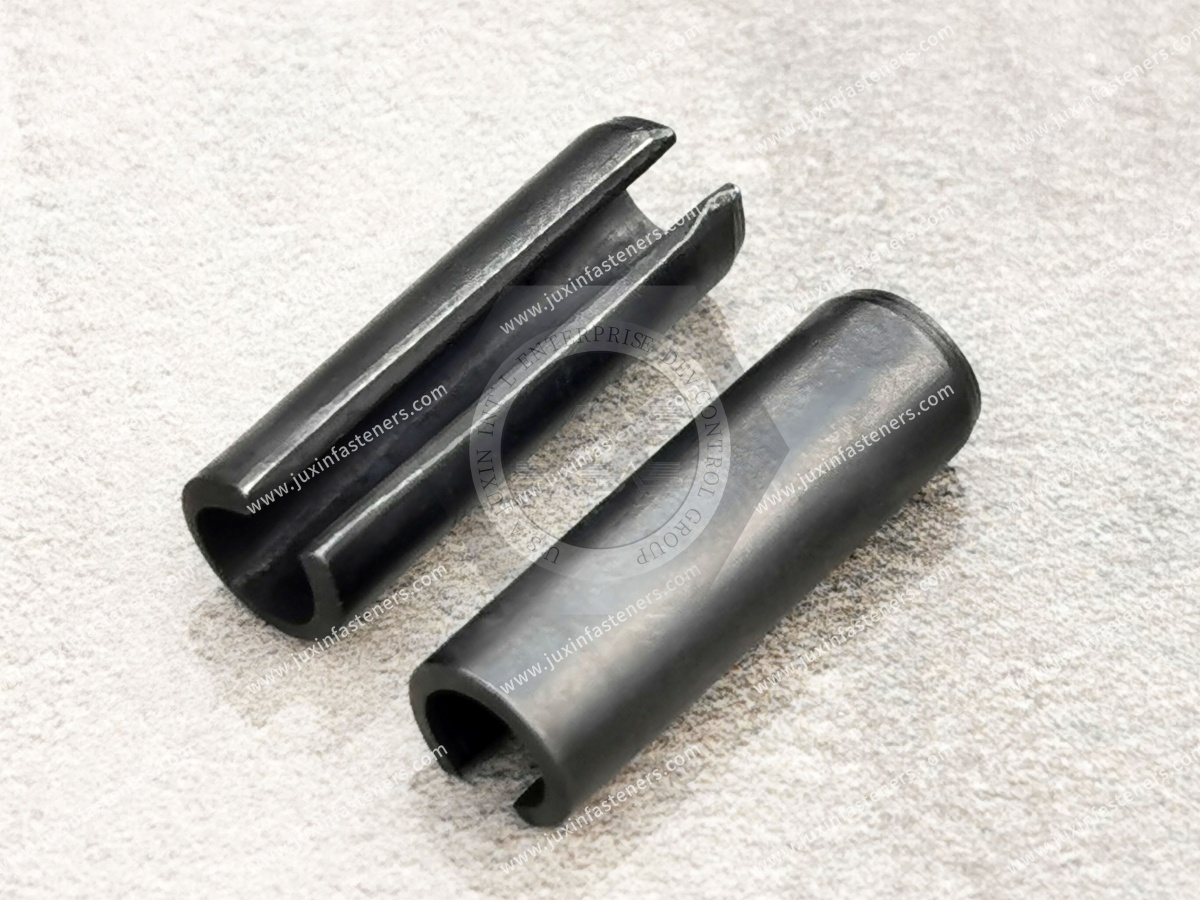
In commercial and industrial sourcing, roll pin and tension pin are commonly used search terms for spring-type pins.
However, terminology should be handled carefully.
A slotted spring pin specifically describes a pin with a longitudinal slot.
A coiled spring pin is constructed from coiled strip and is a different spring-pin design.
A solid dowel pin is a precision solid locating component and operates differently from either type of spring pin.
The term split pin should not be used as a general synonym for a slotted spring pin because, particularly in international and European fastening terminology, “split pin” commonly refers to a cotter pin used as a locking device.
For engineering drawings and RFQs, use the specific product designation and applicable standard rather than relying only on informal trade names.
ISO 8752 covers heavy-duty slotted spring-type straight pins.
These pins are designed around the elastic behavior of the slotted body and are available in steel and specified stainless steel material categories according to the applicable standard.
ISO 8752 is an important search and sourcing specification for applications requiring standardized slotted spring pins.
For an RFQ, however, writing only “ISO 8752” may not provide every purchasing requirement.
The sourcing specification should also identify:
Nominal pin diameter
Pin length
Material
Surface condition or coating
Quantity
Application requirements
Inspection requirements
Documentation requirements
Where a customer drawing introduces additional requirements, the drawing should be reviewed together with the referenced standard.
Depending on the market and application, slotted spring pins may be specified according to international or regional standards.
Common references include:
ISO 8752 — Slotted spring-type straight pins, heavy duty
ISO 13337 — Slotted spring-type straight pins, light duty
DIN 1481 — Slotted spring pins
Customer-specific OEM drawings
Application-specific dimensional specifications
Coiled spring pins belong to a separate standards family and should not be treated as interchangeable with slotted pins solely because the nominal diameter and length are similar.
The engineering principle of a slotted spring pin is based on controlled elastic compression.
Before installation, the pin's free outside diameter is larger than the corresponding specified hole.
As the pin enters the hole, the slot partially closes and the body compresses.
The compressed pin then exerts radial force against the hole wall.
This creates several useful characteristics:
Self-retention
Accommodation of specified hole tolerances
Resistance to unintended movement
Ability to absorb some shock and vibration
Simplified assembly
Reduced need for secondary retention hardware
However, this does not mean that any spring pin can be installed into any approximate hole.
The relationship between pin geometry, hole diameter, material, wall thickness and load direction remains critical.
Slotted spring pins and solid dowel pins may look similar in an assembly drawing, but they solve different engineering problems.
| Engineering Factor | Slotted Spring Pin | Solid Dowel Pin |
|---|---|---|
| Construction | Hollow, longitudinal slot | Solid precision cylinder |
| Retention | Elastic radial force | Designed fit between pin and hole |
| Hole Requirement | Designed for specified spring-pin hole | Often requires closer fit control |
| Vibration Response | Can accommodate dynamic movement | Primarily rigid positioning |
| Shock Absorption | Better suited to compliant joints | Limited compliance |
| Precision Locating | Application-dependent | Typically preferred for precision locating |
| Installation | Drive or press installation | Often controlled press/slip-fit assembly |
| Typical Function | Retention, fastening, pivoting | Precision alignment and locating |
If the primary engineering requirement is highly repeatable precision positioning, a cylindrical dowel pin may be more appropriate.
If the requirement is self-retention, vibration accommodation and efficient assembly, a spring pin may offer advantages.
This is another important engineering decision.
Both are spring-type pins, but their structures are different.
A slotted spring pin uses a single formed wall with a longitudinal slot.
Potential advantages include:
Simple construction
Efficient high-volume production
Self-retaining installation
Broad industrial availability
Cost-effective fastening
Good performance in many general mechanical assemblies
A coiled spring pin is manufactured from material wound into multiple coils.
Depending on the duty class and application, the coiled construction can provide different flexibility, stress distribution and fatigue behavior.
Coiled spring pins are often considered where the assembly involves:
Repeated impact
Dynamic loading
Fatigue-sensitive joints
Controlled flexibility
Sensitive host materials
Neither design should automatically be described as universally “better.”
Selection should be based on the joint geometry, load spectrum, host material, hole condition and required service life.
No.
This is one of the most useful distinctions for engineers designing spring-pin joints.
Spring pins can accommodate a designed range of hole variation, but that does not mean hole dimensions are unimportant.
An oversized hole may reduce retention and change joint behavior.
An undersized hole can require excessive installation force and may:
Over-compress the pin
Damage the pin
Damage the surrounding component
Increase assembly force
Create undesirable stress in the host material
Hole diameter should therefore be established from the applicable standard, supplier data or validated engineering design for the selected pin.
A nominal hole diameter alone does not fully describe a spring-pin installation.
Engineers should also consider:
Hole roundness
Hole straightness
Entry chamfer
Burr condition
Hole alignment through multiple components
Host material hardness
Wall thickness around the hole
Hole surface condition
Misaligned holes can force the spring pin to bend or scrape during installation.
Excessive burrs can damage coatings or interfere with assembly.
Thin sections or brittle host materials may require a different joint design from thick steel components.
Spring pins are frequently used to transfer shear loads, but the allowable load should not be estimated solely from nominal pin diameter.
Joint performance depends on factors including:
Pin material
Pin geometry
Single or double shear
Hole condition
Host material
Edge distance
Joint clearance
Static or dynamic loading
Impact
Fatigue
Temperature
Corrosion
For safety-critical or highly loaded applications, the pin should be selected using the applicable engineering data and validated against the actual joint conditions.
The way a pin is loaded can substantially change the joint.
In single shear, the load acts across one primary shear plane.
In double shear, the pin is loaded across two shear planes.
This distinction should be communicated when sourcing custom or application-critical pins because two assemblies using the same nominal pin can experience very different stresses.
A useful RFQ therefore describes not only the pin dimensions but also its mechanical function.
Slotted spring pins can also function as pivot pins in suitable assemblies.
Potential applications include:
Linkages
Levers
Hinges
Latches
Actuating mechanisms
Equipment handles
Mechanical joints
In a pivot application, engineers should evaluate more than retention.
Important considerations include:
Relative movement
Bearing pressure
Wear
Lubrication
Hole material
Pin surface condition
Required service life
A pin that performs well as a static retainer may not necessarily provide the same life in a continuously moving pivot joint.
Spring steel is widely used for slotted spring pins because the component depends on elastic deformation.
The selected material and heat-treatment condition must provide the required combination of:
Elasticity
Strength
Toughness
Fatigue performance
Dimensional stability
Surface protection can then be selected according to the application environment.
Potential finishes, where technically appropriate, can include:
Zinc plating
Zinc-nickel coating
Black oxide
Phosphate-based finishes
Other customer-specified coatings
The final coating system should be evaluated together with material, dimensional and application requirements.
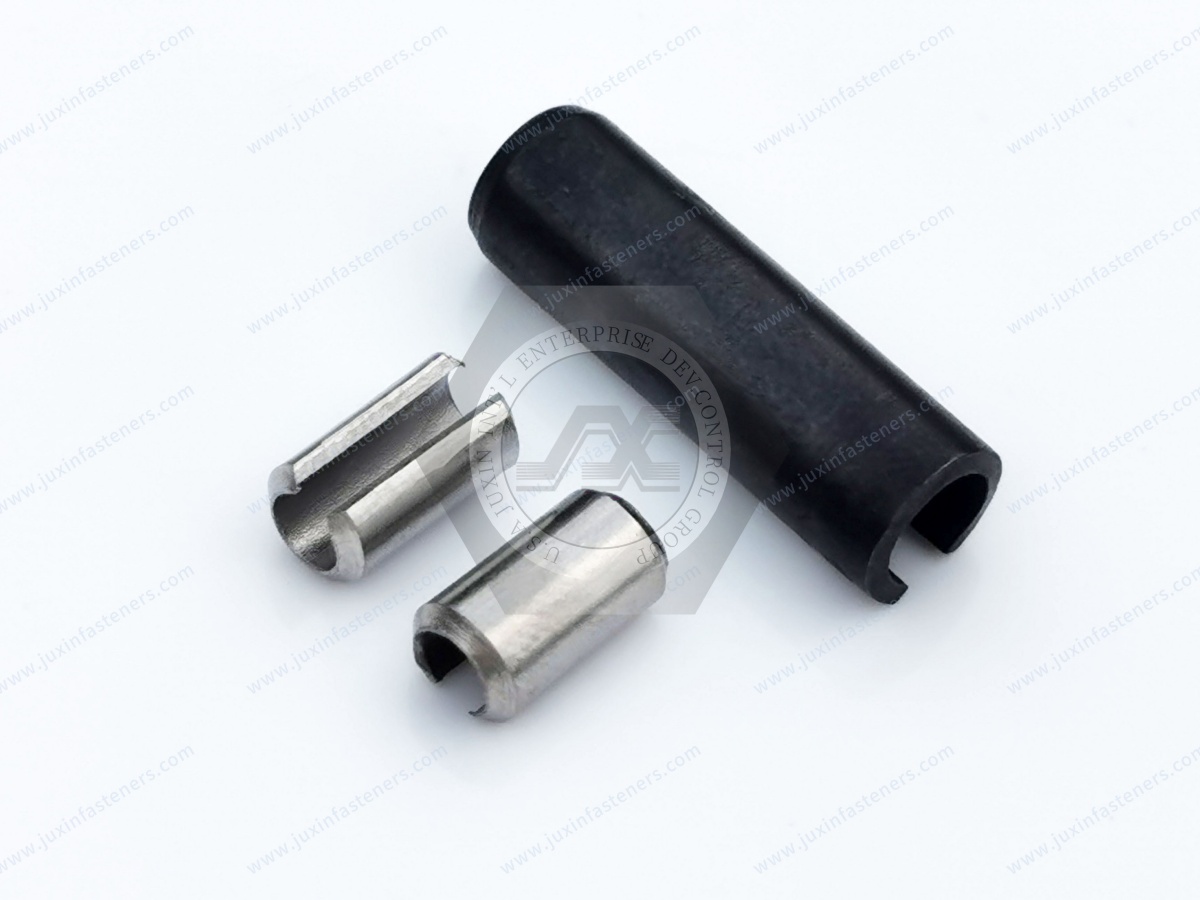
Stainless steel spring pins are selected where corrosion resistance is an important part of the design.
However, “stainless steel” should not be treated as one universal material specification.
Different stainless steel families provide different combinations of:
Corrosion resistance
Hardness
Spring properties
Strength
Magnetic behavior
Formability
The appropriate grade depends on the required spring behavior and service environment.
For OEM sourcing, specify the actual material requirement or applicable standard rather than simply requesting a “stainless roll pin.”
For many fasteners, buyers commonly request 304 or 316 stainless steel because those grades are familiar.
A spring pin is different from a conventional solid nut or bolt because its function depends strongly on elastic spring behavior.
Material selection must therefore consider both corrosion resistance and the mechanical properties required after forming.
If an OEM drawing requires a specific stainless grade, JUXIN FASTENERS can review the material requirement against the pin geometry and application.
Material should not be substituted solely because another stainless grade offers higher corrosion resistance.
The corrosion system should be selected according to actual environmental exposure.
Engineering questions include:
Indoor or outdoor installation?
Humidity exposure?
Salt exposure?
Chemical contact?
Automotive underbody environment?
Agricultural chemicals?
Temperature cycling?
Required corrosion test?
RoHS or REACH requirements?
A coating name alone does not establish corrosion performance.
If a specific corrosion requirement is important, include the required test method and acceptance criteria in the drawing or RFQ.
Correct installation is essential to achieving reliable performance.
Confirm:
Pin diameter
Pin length
Hole diameter
Material
Standard
Surface finish
Do not substitute a different pin series based only on nominal diameter.
The hole should be free from:
Excessive burrs
Chips
Contamination
Severe misalignment
Damage
The pin should enter the hole as straight as practical.
A suitable chamfer helps guide installation.
Depending on production volume and assembly design, installation may use:
Arbor presses
Pneumatic equipment
Hydraulic equipment
Automated pin insertion systems
Appropriate manual driving tools
The tooling should apply force without unnecessarily damaging or distorting the pin.
Check:
Insertion depth
Pin position
Component alignment
Surface damage
Functional performance
Not necessarily.
Generic instructions such as “always orient the slot away from the load” can oversimplify spring-pin joint design.
The effect of slot orientation depends on:
Joint geometry
Loading direction
Pin specification
Dynamic behavior
Host material
Application requirements
For engineered joints where slot orientation affects performance, the required orientation should be defined on the drawing or validated during assembly testing.
Do not create an undocumented universal installation rule.
Reuse should not be assumed.
A spring pin undergoes elastic deformation during installation and may experience additional deformation, wear or surface damage during service and removal.
Whether reuse is acceptable depends on:
Pin condition
Application criticality
Installation history
Hole condition
Load
Customer specification
For production and safety-related assemblies, replacement with a new pin is often the more controlled manufacturing approach unless reuse has been specifically validated.
Slotted spring pins are used in a wide range of automotive and automotive-production applications.
Potential applications include:
Linkages
Hinges
Latches
Seat mechanisms
Transmission-related mechanisms
Steering-related mechanisms
Actuation systems
Production tooling
Assembly fixtures
Automotive projects may introduce additional requirements for:
Material traceability
Surface treatment
Corrosion resistance
Dimensional control
Lot control
Production consistency
These requirements should be defined by the OEM or Tier supplier drawing and purchasing specification.
Spring pins are commonly used in:
Gear mechanisms
Conveyor equipment
Packaging machinery
Automation equipment
Robotic systems
Pumps
Material-handling equipment
Mechanical linkages
Their self-retaining design can simplify assembly where a separate locking component would otherwise increase part count.
Agricultural and outdoor machinery frequently operates under:
Vibration
Shock
Dirt
Moisture
Repeated mechanical loading
Slotted spring pins may be used in suitable:
Linkages
Control mechanisms
Hinges
Adjustment mechanisms
Equipment assemblies
Material and surface treatment should be selected for the actual environmental exposure rather than relying only on the generic description “heavy duty.”
Construction equipment can expose pins to high loads and severe operating conditions.
Potential spring-pin applications include:
Control mechanisms
Linkages
Latches
Equipment attachments
Mechanical subassemblies
For highly loaded structural joints, however, a spring pin should not automatically be substituted for a solid pin, bolt or engineered pivot.
The joint must be designed for the required load path.
Compact mechanical assemblies often use spring pins because they can provide retention without adding a separate nut or clip.
Applications may include:
Gear retention
Trigger mechanisms
Shaft assemblies
Handles
Pivot joints
Adjustment mechanisms
Production-volume applications can also benefit from automated pin insertion.
Slotted spring pins can be used in suitable mechanical sections of:
Electrical cabinets
Switchgear
Industrial controls
Equipment housings
Actuation mechanisms
Mechanical interlocks
Where electrical conductivity, grounding or insulation is part of the functional requirement, those characteristics must be considered separately rather than inferred from the spring pin itself.
A useful engineering selection path is:
1. Define the function
Retention, locating, pivoting, stop function or shear-load transfer?
2. Define the load
Static, dynamic, impact, vibration or fatigue?
3. Define the host material
Steel, aluminum, casting, polymer or another material?
4. Define the hole
Diameter, tolerance, wall thickness, surface condition and alignment.
5. Select the pin family
Slotted spring pin, coiled spring pin, solid dowel pin or another retaining solution?
6. Select material
Spring steel or appropriate stainless steel based on mechanical and environmental requirements.
7. Select corrosion protection
Define the finish and required corrosion performance.
8. Validate the joint
For demanding applications, evaluate installation force, retention, shear performance, fatigue and service conditions.
This approach is more reliable than selecting a roll pin only by diameter and length.
For an accurate quotation, provide:
Applicable standard
Pin diameter
Pin length
Material
Surface treatment
Quantity
Annual usage
Application
Host material
Hole diameter where relevant
Load conditions for engineered applications
Corrosion requirement
Inspection requirements
Material documentation requirements
Packaging requirements
2D drawing for custom pins
For made-to-drawing components, a 2D drawing is strongly preferred.
Inspection should be based on the applicable standard and customer specification.
Depending on the project, quality control may include:
Dimensional inspection
Material verification
Surface inspection
Hardness verification
Spring characteristics
Shear testing where specified
Coating inspection
Corrosion testing where specified
Functional assembly testing
For OEM projects, critical characteristics should be identified during drawing review rather than assumed after production.
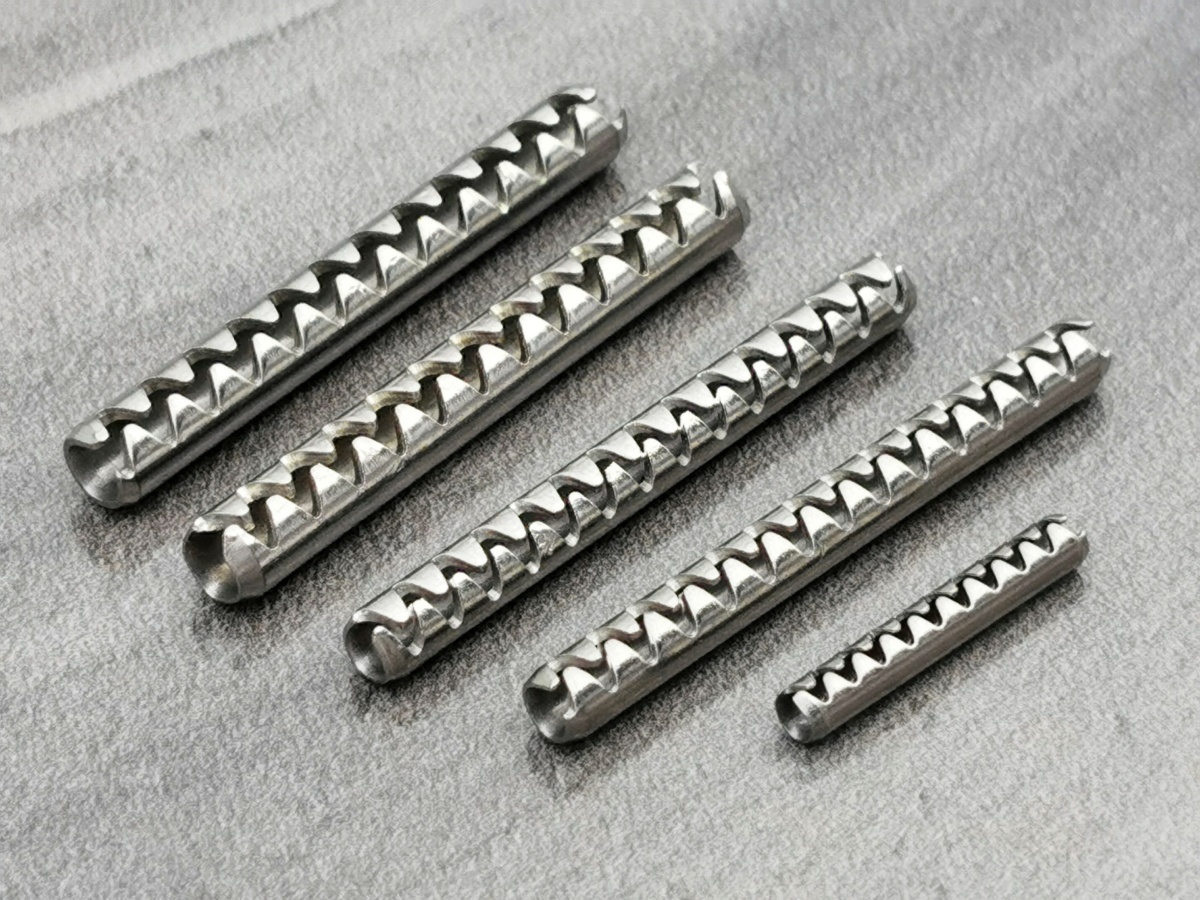
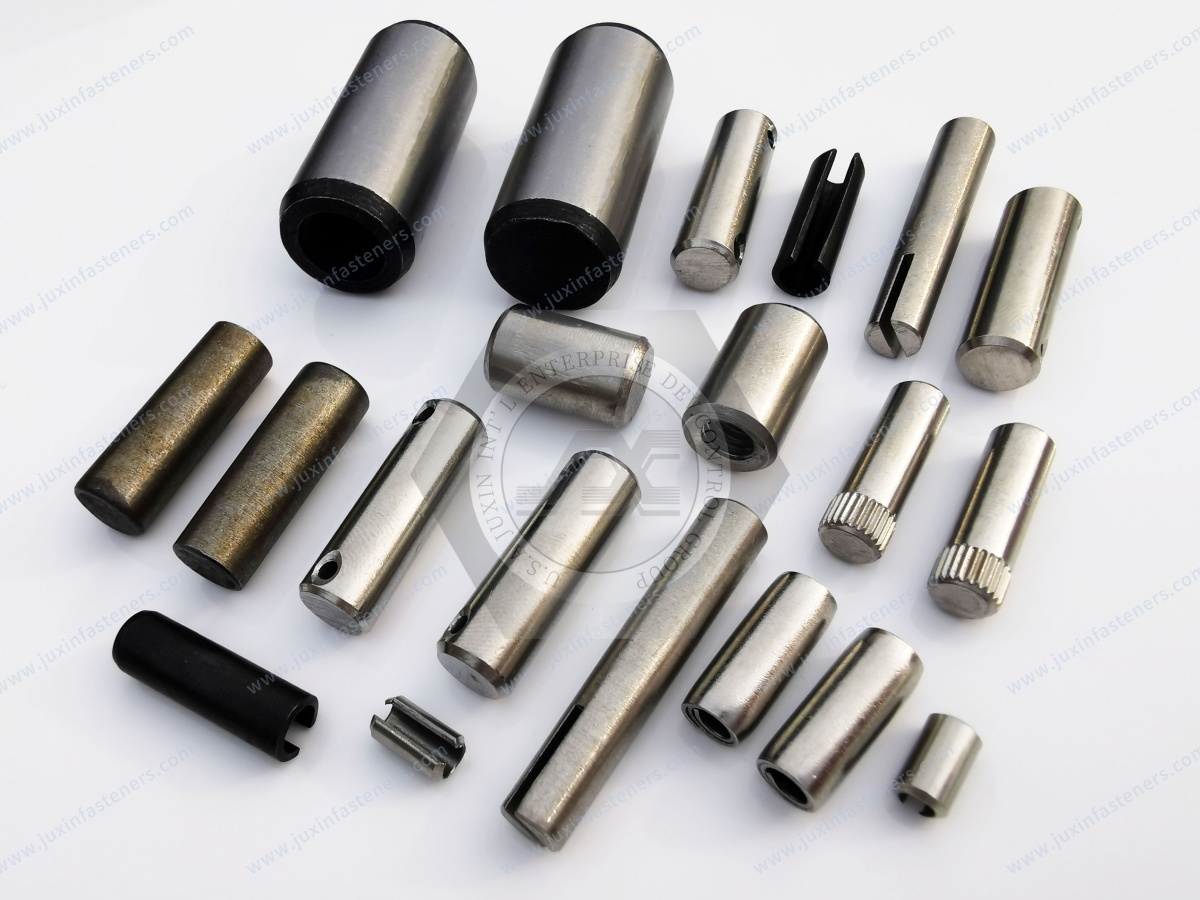
JUXIN FASTENERS supplies standard and custom spring pins for global OEM and industrial customers.
Our product and manufacturing capabilities include:
Slotted Spring Pins
ISO 8752 Spring Pins
Stainless Steel Spring Pins
Coiled Spring Pins
Custom Spring-Type Pins
Precision Formed Pins
Custom CNC Machined Pins
Heat Treatment
Surface Treatment
Precision Inspection
Prototype and Production Quantities
Made-to-Drawing Components
We support projects requiring custom:
Diameters
Lengths
Materials
Surface treatments
Pin geometries
Inspection requirements
Packaging specifications
Engineers and procurement teams sourcing slotted spring pins may also require:
Coiled Spring Pins
Precision Dowel Pins
ISO 8734 Cylindrical Pins
Internally Threaded Dowel Pins
Taper Pins
Clevis Pins
Cotter Pins and Split Pins
Custom Machined Pins
Shafts and Precision CNC Components
Automotive Custom Fasteners
Industrial Equipment Fastening Solutions
These pages should be internally linked according to engineering selection paths so users can move naturally from pin type → design comparison → application → RFQ.
If you are sourcing slotted spring pins, roll pins, ISO 8752 spring pins, stainless steel spring pins, coiled spring pins or custom fastening pins, send your technical requirements to JUXIN FASTENERS.
For custom or OEM projects, please include:
Standard or drawing
Diameter and length
Material
Surface finish
Quantity
Annual demand
Application
Operating environment
Required testing
Documentation requirements
Our team can review whether a standard spring pin, alternative spring-pin design or custom made-to-drawing component is appropriate for your assembly.
JUXIN FASTENERS
FASTENING SOLUTIONS FOR GLOBAL OEMS
Website: www.juxinfasteners.com
Email: info@juxinfasteners.com
 MORE NEWS
Sep. 27, 2026
Sep. 27, 2026
Sep. 27, 2026
Contact Us
Tel.:
+86 020 8621 0320
+86 020 3121 6067
E-mail:
Technical Support:
Navigation
SEND INQUIREY