Call Us
+86 136 6007 9809
Call Us
+86 136 6007 9809

Automotive OEM Requirements for Bolt Fatigue Testing and Engineering Validation Strategy (ISO / DIN Approach)
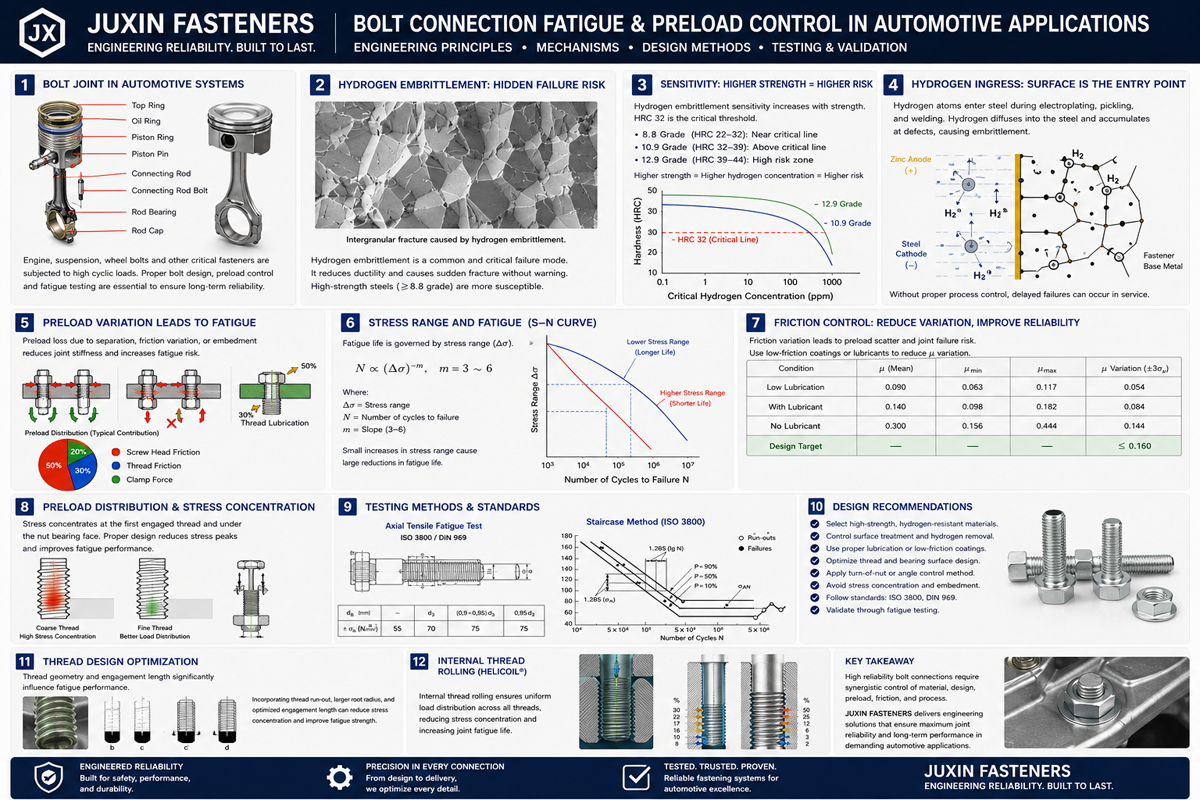
In modern automotive engineering, fatigue failure of bolted joints remains one of the most critical and often underestimated failure mechanisms. However, compared with industries such as wind power or heavy machinery, many automotive OEMs do not explicitly define fatigue testing requirements for general bolted connections.
Product Specification
Automotive OEM Requirements for Bolt Fatigue Testing and Engineering Validation Strategy (ISO / DIN Approach)
In modern automotive engineering, fatigue failure of bolted joints remains one of the most critical and often underestimated failure mechanisms. However, compared with industries such as wind power or heavy machinery, many automotive OEMs do not explicitly define fatigue testing requirements for general bolted connections.
Fatigue validation is typically limited to highly loaded safety-critical applications such as engine assemblies, suspension systems, and wheel fastening systems.
This difference is not due to lower risk, but rather to the dominant load characteristics and joint design philosophy in automotive structures.
1. When Fatigue Testing Is Required in Automotive Applications
In vehicle engineering, most bolted joints operate under conditions where:
Shear load dominates rather than axial cyclic tension
Structural members instead of the bolt carry external loads
Contact friction contributes significantly to load transfer
Therefore, fatigue testing is usually specified only for:
Engine connecting bolts
Suspension and chassis structural joints
Wheel bolts and wheel hub connections
High-cycle vibration or dynamic load components
For other applications, fatigue performance is generally ensured through design rules and validated fastening systems rather than direct fatigue testing requirements.
2. Standardized Methods for Bolt Fatigue Testing (ISO / DIN)
Where fatigue verification is required, internationally recognized standards are applied:
ISO 3800 — Metallic materials: fatigue testing of fasteners under axial load
DIN 969 — Fasteners: axial fatigue testing method and evaluation
2.1 Staircase Method for Fatigue Limit Determination
The staircase method is commonly used to determine the endurance limit:
Typical test configuration:
Minimum specimens: 15 (30 recommended for statistical reliability)
Static preload:
ISO method: ~60% of yield preload
DIN method: ~70% of yield preload
Dynamic load:
Determined from prior experience or analytical models (e.g., VDI 2230 approach)
Initial stress amplitude is typically referenced around 50–60 MPa for standard metric threads
Load step adjustment:
Failure occurs → reduce stress amplitude (typically 5–10 MPa steps)
No failure → increase load until failure boundary is identified
The final evaluation is performed through statistical treatment of the results in accordance with the ISO 3800 methodology.
3. Critical Locations for Fatigue Crack Initiation
Fatigue cracks in bolted joints most commonly initiate at:
First engaged thread under the nut
Thread run-out region
Thread-to-shank transition radius
Among these, the first-loaded thread carries the highest load concentration and is the most critical site for fatigue initiation.
This is primarily due to non-uniform load distribution along the engaged threads.
4. Engineering Measures to Improve Fatigue Performance
Improving fatigue resistance of automotive fasteners requires a combined approach involving preload control, geometry optimization, and material utilization.
4.1 Increasing Preload for Improved Fatigue Resistance
In real bolted joints, preload directly influences joint stiffness and load transfer behavior.
Higher preload results in:
Increased joint stiffness
Larger effective contact area
Reduced cyclic stress amplitude in the bolt
In eccentric loading conditions, which are common in automotive assemblies, preload variation significantly affects fatigue performance by altering load sharing between the bolt and the clamped parts.
4.2 Optimization of Joint Geometry
A common design issue is the presence of exposed threads within the clamped length.
This leads to:
High stress concentration at the first engaged thread
Reduced fatigue strength of the joint
Improved configurations include:
Increased nut height or engagement length
Full containment of threads within the nut
Thread-free clamping zones
These modifications shift the critical stress region away from the thread and significantly improve fatigue performance.
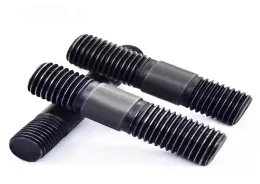
4.3 Fully Threaded Bolt Configuration
Fully threaded bolts are widely used in automotive applications because they:
Provide more uniform axial load distribution
Improve adaptability to torque-angle tightening methods
Enhance plastic deformation capacity during tightening
In many cases, fully threaded designs improve dynamic load capacity without compromising static strength.
4.4 MJ Thread Geometry for Improved Fatigue Resistance
MJ thread profiles, derived from aerospace fastening standards, incorporate an increased root radius compared to standard metric threads.
This reduces stress concentration at the thread root and significantly improves fatigue resistance.
In many applications, MJ threads demonstrate fatigue performance improvements several times greater than those of standard metric threads.
4.5 Thread Inserts for Lightweight Materials
In aluminum or other lightweight structures, wire thread inserts are commonly used to:
Improve load distribution across multiple thread turns
Reduce peak stress at the first thread
Increase durability of threaded joints
This is particularly effective in automotive lightweight design strategies.
4.6 Load Distribution Optimization in Internal Threads
Alternative thread designs, such as wedge-thread or elastic-thread systems, improve load sharing between engaged threads.
These systems reduce peak loading on the first engaged thread and enhance fatigue durability.
4.7 Increasing Thread Engagement Length
Longer engagement length improves:
Elastic deformation capacity of the joint
Load distribution uniformity
Resistance to cyclic fatigue loading
This is especially effective in mixed-material joints such as steel-aluminum assemblies.
4.8 Increasing Clamp Length for Reduced Stress Amplitude
Increasing clamp length reduces bolt stiffness and improves load sharing between the bolt and the joint.
Benefits include:
Lower stress amplitude under external cyclic loading
Improved fatigue resistance
Enhanced tolerance to assembly misalignment
Although this increases weight and cost, it is widely used in high-performance engine and chassis applications.
5. Fatigue Strength Evaluation Basis (VDI 2230-1 Framework)
When specific fatigue requirements are not defined, engineering evaluation can be based on VDI 2230-1 design principles:
Non-heat-treated estimation:
σ_f ≈ 0.85 × (150/d + 45) MPa
Heat-treated rolled-thread fasteners may achieve up to twice this level under optimized conditions
Typical industry practice:
8.8 grade fasteners: ≥ 80 MPa fatigue strength
10.9 / 12.9 grade fasteners: ≥ 90 MPa fatigue strength
6. Why Fatigue Testing Is Not Universally Specified in Automotive Design
In automotive engineering, fatigue testing is not universally required because:
Many joints are not primarily subjected to axial fatigue loads
Structural load paths often bypass the fastener
Shear-dominated joints do not generate significant bolt axial stress
As a result, fatigue verification is typically reserved for critical safety components only.
7. Engineering Conclusion
The absence of universal fatigue testing requirements in automotive fastener specifications reflects application-driven engineering practice rather than reduced safety expectations.
Reliable bolt fatigue performance is achieved through:
ISO / DIN standardized fatigue testing where applicable
VDI 2230-based design verification
Optimized joint geometry and load path design
Controlled preload strategies
Improved thread design and load distribution methods
A robust fastening system is not defined by testing alone, but by the integration of design, manufacturing, and assembly control across the entire system.
Product Packaging
Packaging Standard
At Juxin Fasteners, we apply standardized export packaging to ensure product protection, traceability, and compliance with international logistics requirements.
1. Standard Export Packaging
Unless otherwise specified, all products will be packed according to our factory standard export packaging, which includes:
Moisture-resistant inner protection
Poly bag or small box packing as required
Reinforced export cartons
Clear labeling with part number, specification, batch number, and quantity
Palletizing for sea or air shipment when necessary
Our standard packaging is designed to ensure safe transportation, efficient warehousing, and long-distance international shipping.
2. Customized Packaging Options
We also provide customized packaging solutions according to customer requirements, including but not limited to:
Private labeling
Customized barcodes
Specific carton dimensions
Retail packaging
Special pallet configuration
Customer-specific marking and identification
So that you know, customized packaging may involve additional costs and extended lead time depending on the complexity of the requirements.
3. Compliance & Quality Assurance
All packaging processes are controlled under our ISO 9001 quality management system to ensure consistency, traceability, and product integrity throughout the supply chain.
Product Pictures

Contact Us
Tel.:
+86 020 8621 0320
+86 020 3121 6067
E-mail:
Technical Support:
Navigation
SEND INQUIREY