Call Us
+86 136 6007 9809
Call Us
+86 136 6007 9809

Where Does 90% of Tightening Energy Go?
Friction Coefficient Control in ISO/DIN Fasteners and Its Impact on Bolt Preload Accuracy
When tightening a bolt, engineers often assume that applied torque is directly converted into clamping force. In reality, the physics behind bolted joints tells a very different story.
Product Specification
Where Does 90% of Tightening Energy Go?
Friction Coefficient Control in ISO/DIN Fasteners and Its Impact on Bolt Preload Accuracy
When tightening a bolt, engineers often assume that applied torque is directly converted into clamping force. In reality, the physics behind bolted joints tells a very different story.
According to engineering calculation models defined in VDI 2230, approximately:
Only about 10% of the tightening energy becomes a useful preload force
while around 90% is lost due to friction
This energy is mainly consumed by:
Thread friction (bolt–nut interface)
Bearing surface friction (under-head or washer contact)
This explains why identical torque values can produce dramatically different preload results in real-world assembly.
The key controlling parameter behind this phenomenon is:
Friction coefficient of threaded fasteners
1. Friction Coefficient: The Most Underestimated Fastener Parameter
The friction coefficient is not a single number—it is a system-level mechanical behavior indicator combining:
Thread friction
Bearing surface friction
Surface coating behavior
Lubrication performance
It directly determines the relationship between:
Applied torque → Bolt preload (clamping force)
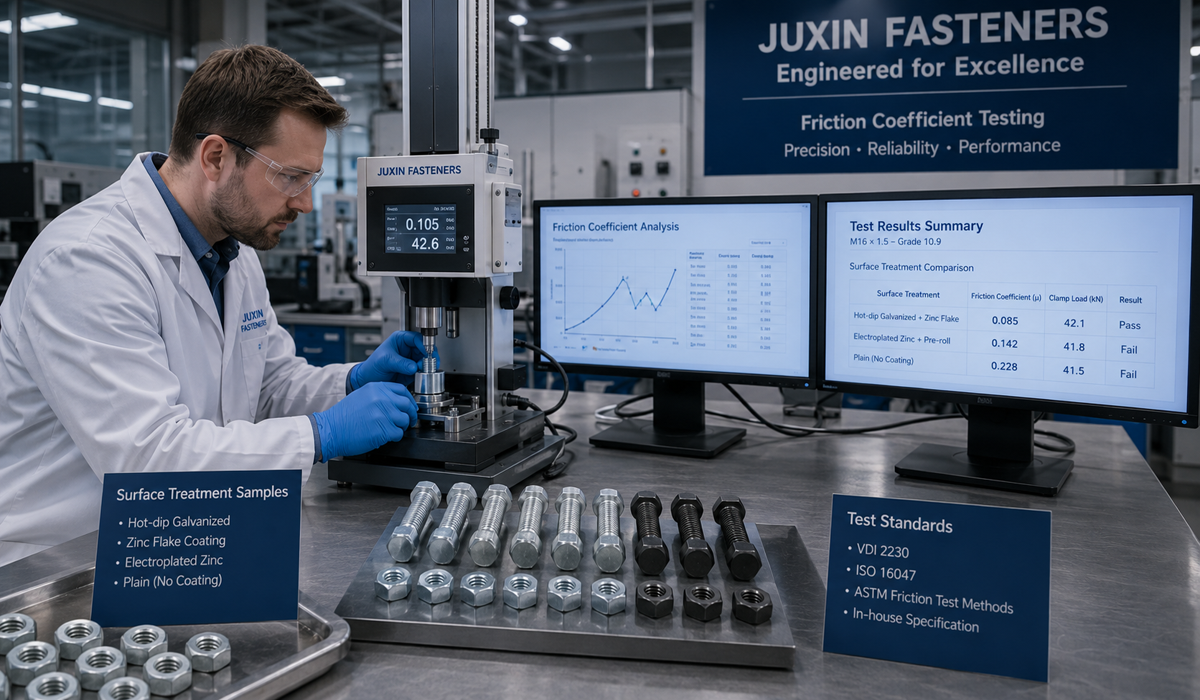
Engineering Example: M16×1.5 High-Strength Bolts
For ISO 898-1 high-strength bolts (10.9 grade):
Case 1: Low-friction system
Heat treatment + thread rolling
Zinc–aluminum flake coating + controlled lubrication
Friction coefficient: 0.08–0.12
Result: Maximum achievable preload
Case 2: High-friction system
Pre-heat rolling + standard electroplating
Friction coefficient: 0.14–0.23
Result: Lower preload under the same torque
Key Engineering Insight
Higher friction coefficient = lower preload efficiency
This means the bolt becomes “harder to tighten effectively” even if the torque is identical.
2. Surface Engineering: The Main Driver of Friction Behavior
Fastener surface treatment is the primary factor governing the stability of the friction coefficient in ISO/DIN-compliant fastening systems.
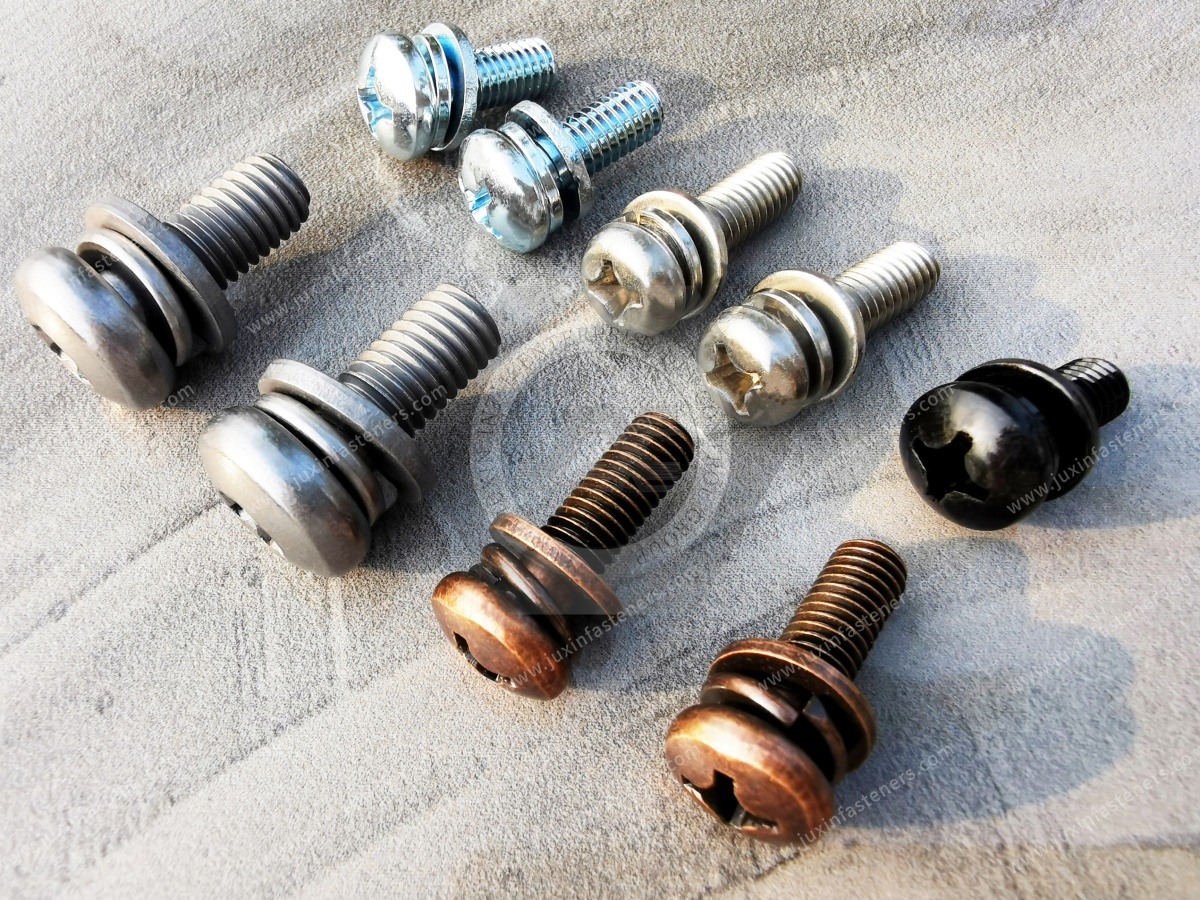
2.1 Electroplating + Passivation Systems
Electroplated fasteners with passivation layers are widely used in industrial applications.
However:
Passivation layer increases baseline friction
Sealing agent composition strongly affects lubrication behavior
Critical process variables:
Sealing agent concentration
Centrifuge speed after coating
Drying temperature
Loading density during the coating process
Any deviation can significantly increase friction variation.
2.2 Zinc–Aluminum Flake Coating Systems
Widely used in automotive applications under OEM specifications.
Typical performance:
Stable friction coefficient range: 0.08–0.12
Low batch-to-batch variation
High consistency in the torque–tension relationship
When combined with top-coat lubrication systems, friction can be precisely controlled within target ranges required by OEM standards.
2.3 Phosphate Coating Systems
Phosphate-coated fasteners are widely used in:
Engine systems
Powertrain assemblies
High-strength structural joints
Advantages:
Excellent torque–tension consistency
Reduced risk of hydrogen embrittlement in high-strength grades
Stable lubrication compatibility with wax or oil-based coatings
Critical process parameters include:
Coating temperature
Lubricant type
Drying conditions
Post-treatment handling
3. OEM Friction Coefficient Standards in the Automotive Industry
Global automotive manufacturers define strict friction coefficient windows to ensure predictable preload behavior:
Volkswagen VW 01110-2: 0.09–0.15
BMW standard: 0.09–0.15
Ford specification: 0.11–0.17
General Motors specification: 0.10–0.16
FAW commercial vehicle standard: 0.08–0.14
Engineering Meaning
Even a small deviation of 0.02–0.05 in the friction coefficient can lead to:
±20–40% preload variation
Incorrect torque–tension correlation
Potential joint failure under dynamic loads
4. Real Engineering Case: Why Torque Does Not Match Preload
Case Study: M14 Flange Bolt Assembly (10.9 Grade)
Surface: Zinc–aluminum coating + lubrication system
Tightening method: Torque–angle (150 N·m + 180°)
Observed result:
Bolt reached torque limit (380 N·m) at only 124° rotation
Calculated friction coefficient: 0.17–0.21
Exceeded specification range
Root Cause Analysis
The deviation was caused by:
Washer anti-slip teeth embedding into the joint surface
Relative rotation between contact surfaces
Lubrication film damage during assembly
This led to:
Increased friction coefficient
Reduced preload efficiency
Early torque saturation
Engineering Conclusion
Friction coefficient is not a fixed property—it is a dynamic system variable
5. Why Friction Coefficient Control Is Critical in ISO/DIN Fasteners
For ISO 898-1 / DIN 931 / DIN 933 high-strength fasteners, the friction coefficient directly affects:
Torque calibration accuracy
Preload consistency
Fatigue life performance
Assembly reliability
Without controlled friction behavior:
Even high-strength bolts (10.9 / 12.9) cannot guarantee a correct clamping force
6. Engineering Control Strategy for Fastener Manufacturers
To ensure reliable torque–tension performance, industry best practice includes:
6.1 Standardized Surface Process Control
Strict control of coating chemistry
Defined lubrication formulation
Controlled drying and curing conditions
6.2 Friction Coefficient Testing per Batch
Each production batch should include:
Torque–tension testing
Friction coefficient sampling
Statistical process validation
6.3 Process Change Revalidation
Any change in:
Coating chemistry
Lubricant type
Thermal process parameters
requires full friction coefficient revalidation.
6.4 Special Application Engineering Validation
For high-risk applications:
Torque–angle tightening
Yield-controlled tightening methods
Direct tension measurement systems
are recommended.
7. Engineering Fastener Solutions
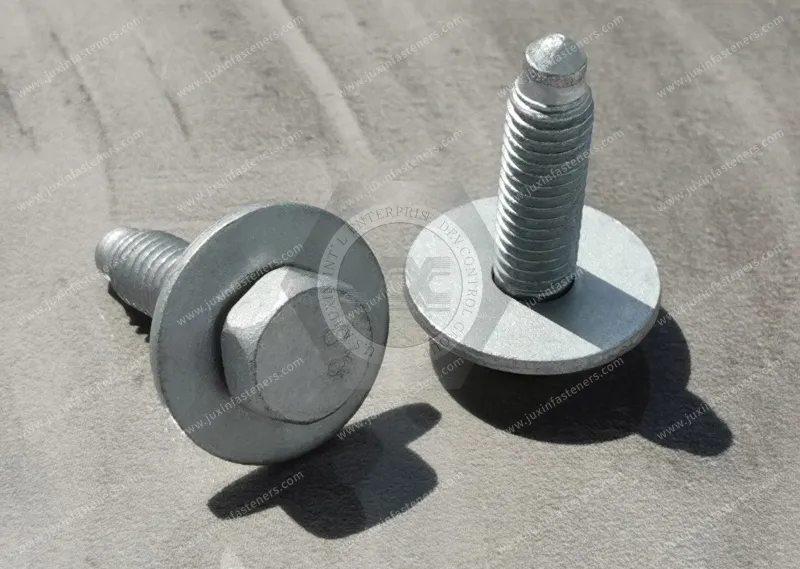
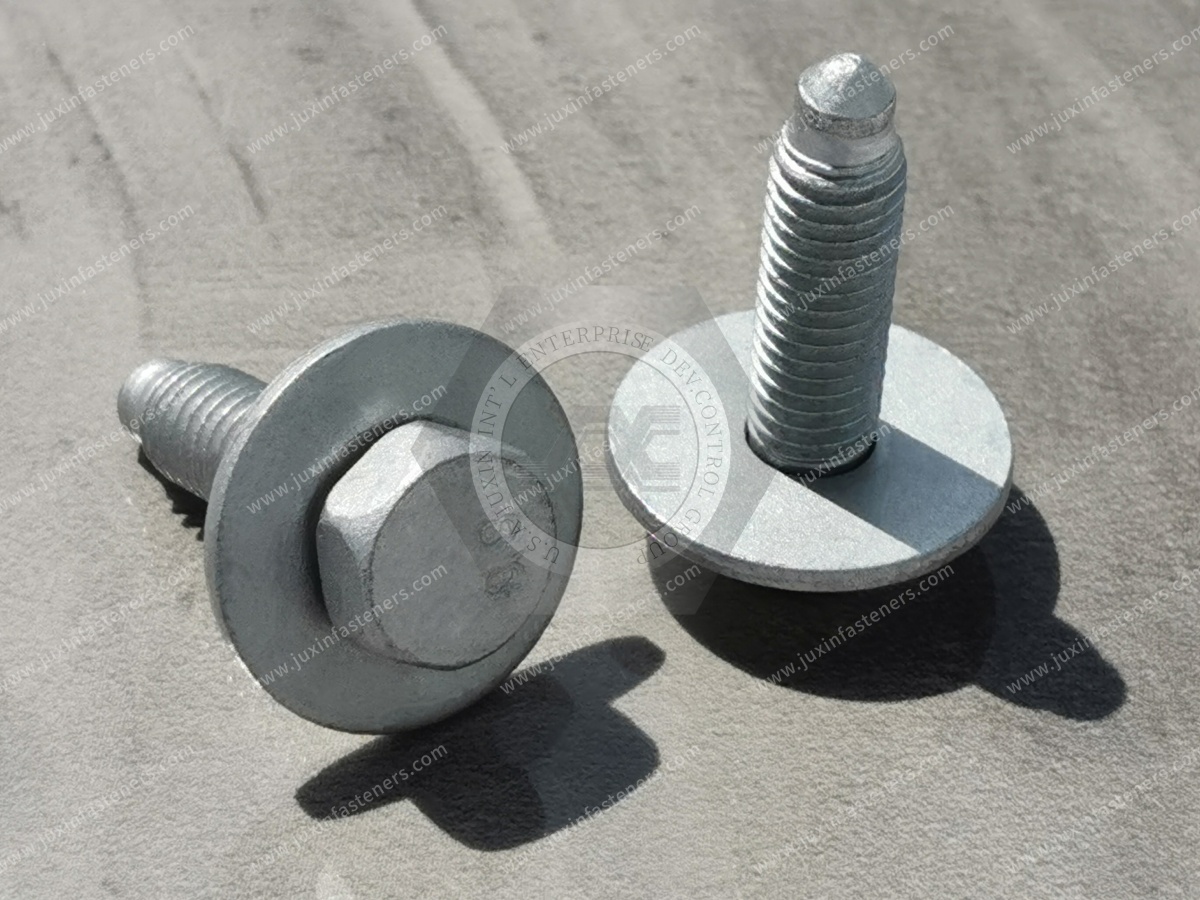
Guangzhou Juxin Development Co., Ltd. provides engineered fastening solutions, including:
ISO / DIN standard high-strength bolts (8.8, 10.9, 12.9)
Controlled friction coefficient surface systems
Automotive-grade torque–tension optimized fasteners
Custom-engineered fastening solutions for critical assemblies
Our engineering focus is not only strength grade compliance, but:
Precision friction control + stable torque–tension behavior + ISO/OEM compatibility
Conclusion: Friction Coefficient Defines Whether a Bolt Is “Tightened” or “Controlled”
Although often overlooked, the friction coefficient is the key bridge between:
Torque application → Real clamping force
Key engineering insights:
~90% of tightening energy is consumed by friction
Surface treatment defines friction behavior
Small friction variations cause large preload differences
Friction is a dynamic system parameter, not a fixed value
In modern ISO/DIN fastener engineering, understanding and controlling the friction coefficient is the difference between:
“It is tightened” vs “It is precisely controlled.”
Product Packaging
Packaging Standard
At Juxin Fasteners, we apply standardized export packaging to ensure product protection, traceability, and compliance with international logistics requirements.
1. Standard Export Packaging
Unless otherwise specified, all products will be packed according to our factory standard export packaging, which includes:
Moisture-resistant inner protection
Poly bag or small box packing as required
Reinforced export cartons
Clear labeling with part number, specification, batch number, and quantity
Palletizing for sea or air shipment when necessary
Our standard packaging is designed to ensure safe transportation, efficient warehousing, and long-distance international shipping.
2. Customized Packaging Options
We also provide customized packaging solutions according to customer requirements, including but not limited to:
Private labeling
Customized barcodes
Specific carton dimensions
Retail packaging
Special pallet configuration
Customer-specific marking and identification
So that you know, customized packaging may involve additional costs and extended lead time depending on the complexity of the requirements.
3. Compliance & Quality Assurance
All packaging processes are controlled under our ISO 9001 quality management system to ensure consistency, traceability, and product integrity throughout the supply chain.
Product Pictures
Contact Us
Tel.:
+86 020 8621 0320
+86 020 3121 6067
E-mail:
Technical Support:
Navigation
SEND INQUIREY