Call Us
+86 136 6007 9809
Call Us
+86 136 6007 9809

Why Bolted Joints Loosen After Tightening: Engineering Causes & Anti-Loosening Fastener Solutions
In industrial engineering systems, bolts and nuts are widely used because they are removable, reusable, and easy to assemble. However, these same advantages also introduce a critical challenge:
Even after correct tightening, bolted joints can still loosen and lose preload over time, sometimes leading to equipment shutdowns, production loss, or serious safety risks.
Product Specification
Why Bolted Joints Loosen After Tightening: Engineering Causes & Anti-Loosening Fastener Solutions
In industrial engineering systems, bolts and nuts are widely used because they are removable, reusable, and easy to assemble. However, these same advantages also introduce a critical challenge:
Even after correct tightening, bolted joints can still loosen and lose preload over time, sometimes leading to equipment shutdowns, production loss, or serious safety risks.
In industries such as automotive manufacturing, construction, petrochemical plants, and heavy machinery, loose fasteners are among the most common root causes of mechanical failure.
Understanding the mechanism behind bolt loosening is essential for selecting the right industrial fasteners, high-strength bolts, and anti-loosening fastener systems.
1. Why Bolted Fasteners Lose Preload After Tightening
A properly tightened bolted joint relies on preload to maintain friction between the clamped components. When this preload is reduced, the joint begins to fail.
Bolt loosening is mainly caused by two fundamental mechanisms:
Self-loosening due to dynamic motion
Material deformation within the joint structure
These two mechanisms often occur simultaneously in real engineering applications.
2. Self-Loosening Under Vibration, Shock, and Dynamic Loads
The most common cause of bolt failure is self-loosening due to external dynamic forces.
When lateral forces exceed the friction force created by bolt preload:
Micro-slip occurs between contact surfaces
Repeated vibration causes relative movement
Thread rotation gradually develops
Preload is continuously reduced
Engineering principle:
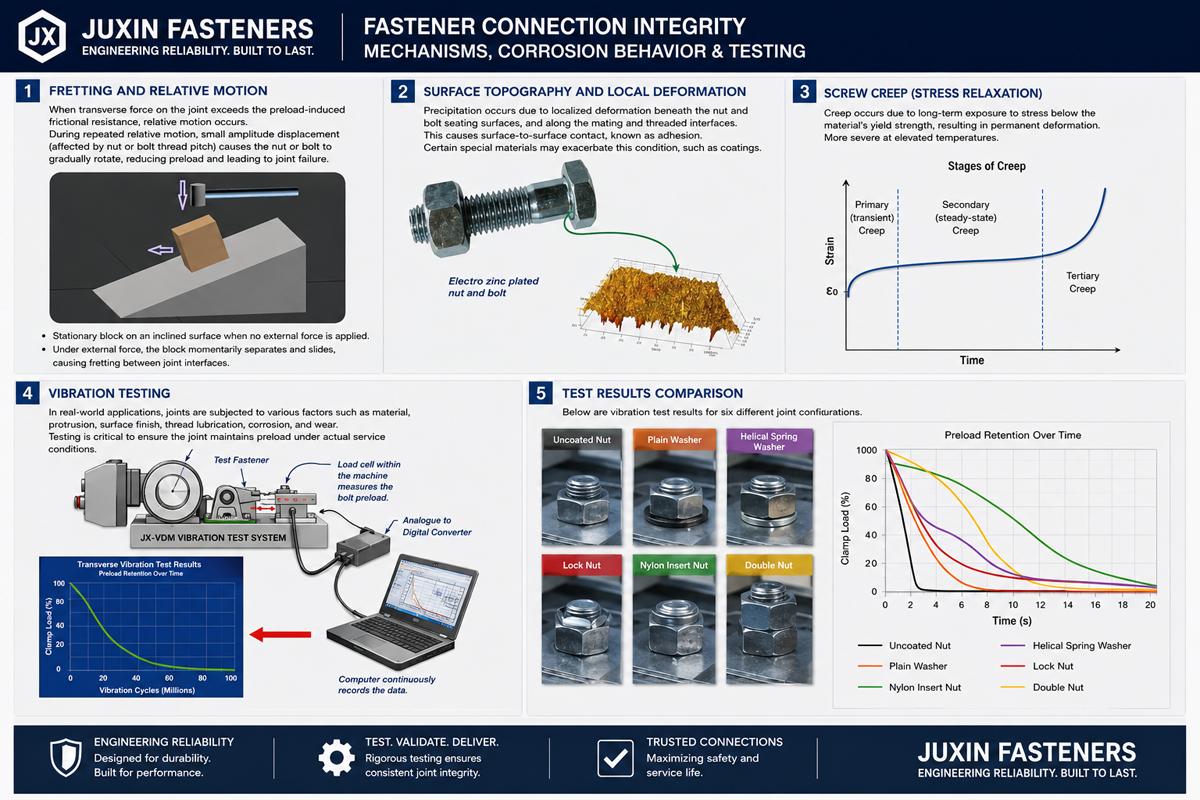
If the friction resistance is lower than the applied transverse load, the joint will experience micro-sliding, which eventually leads to rotation of the bolt or nut.
Even extremely small movements are enough to eliminate the preload completely.
Real-world interpretation
This behavior can be compared to a block on an inclined surface:
Without external force → stable due to friction
With repeated vibration or impact → friction breaks intermittently
The block gradually moves downward
A bolted joint behaves in the same way under cyclic loading conditions.
Why self-loosening is critical
Self-loosening is the most dangerous because:
It develops progressively and invisibly
It can fully eliminate preload without visible damage
It often leads to sudden structural failure
This is why anti-vibration fasteners, locking nuts, and high-friction bolt assemblies are widely used in critical applications.
Common engineering countermeasures
To prevent self-loosening in bolted fastening systems, engineers typically:
Increase clamp force (preload)
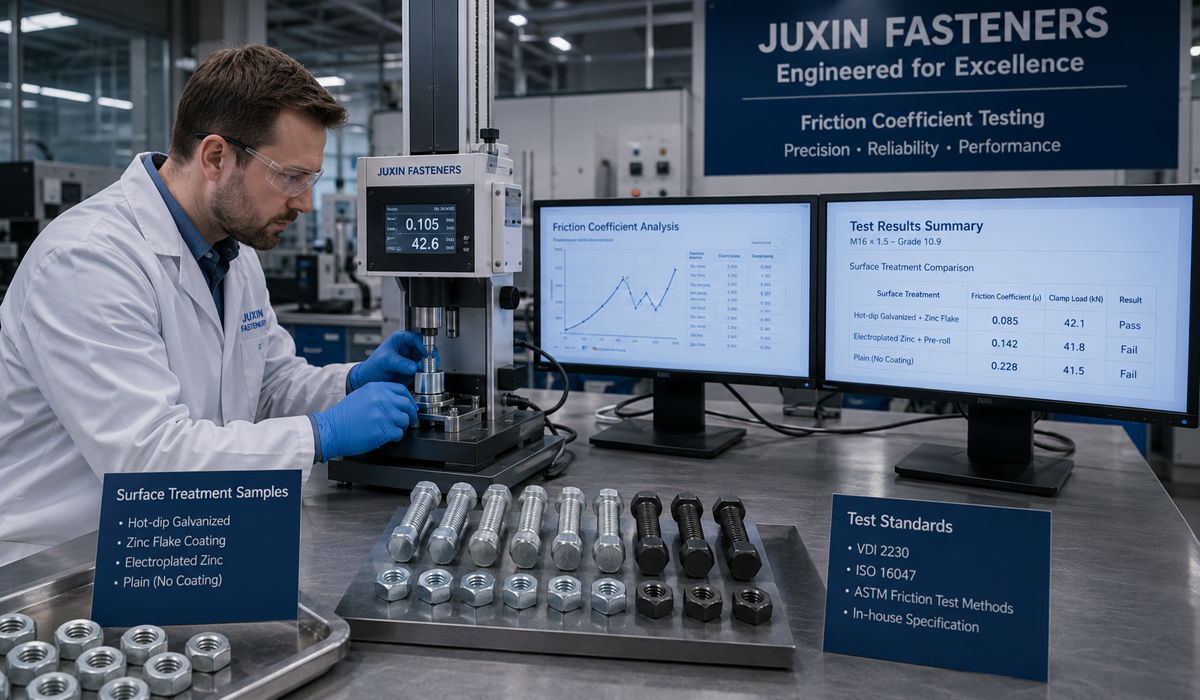
Increase surface friction between joint interfaces
Reduce vibration, shock, or cyclic loads
Improve thread locking performance using mechanical or chemical methods
However, some solutions introduce trade-offs:
Adhesive locking compounds reduce the reusability of bolts
Increased thread friction may reduce the achievable preload under the same torque
Maintenance and disassembly become more difficult
3. Material Deformation: A Hidden Cause of Preload Loss
The second major mechanism is material deformation inside the joint structure, which includes:
3.1 Embedding (Surface Settlement)
Embedding occurs due to:
Local deformation under the bolt head and nut surfaces
Micro-roughness flattening between contact interfaces
Plastic deformation in threads and clamped materials
Even when stresses are below yield strength, localized deformation still occurs due to surface contact conditions.
Coated surfaces, such as painted or treated layers, can increase this effect.
3.2 Creep in Bolted Joints
Creep refers to:
Long-term permanent deformation under sustained load
Occurs even when stress is below the material yield strength
Significantly accelerated at elevated temperatures
Creep is especially critical in high-temperature industrial fastener applications such as petrochemical and power systems.
3.3 Stress Relaxation
Stress relaxation occurs when:
Internal microstructure of materials rearranges over time
Elastic deformation gradually transforms into plastic deformation
Clamp length remains unchanged, making detection difficult
This is one of the most underestimated causes of preload loss in high-strength bolts and structural fasteners.
Engineering impact
These three mechanisms collectively lead to:
Reduction of clamp force
Opening of joint interfaces
Increased vibration sensitivity
Accelerated fatigue damage in bolts and connected components
4. Vibration Testing: The Only Reliable Way to Evaluate Anti-Loosening Performance
In real engineering environments, laboratory torque values alone are not enough.
The only practical validation method is:
Dynamic vibration testing of bolted joints under real service conditions
Modern testing systems evaluate:
Torque retention
Preload decay
Micro-slip behavior
Anti-loosening performance under cyclic loading
Key insight from testing
Different fastener systems and locking designs perform differently under identical vibration conditions.
Performance is influenced by:
Material pairing of bolts and joint surfaces
Surface finish and roughness
Lubrication conditions
Corrosion exposure
Joint geometry and stiffness
Engineering conclusion
Bolt loosening is rarely caused by a single factor. In most real cases:
It is the combined result of vibration, surface behavior, and material deformation.
5. Engineering Design Strategies for Anti-Loosening Fastener Systems
To ensure long-term stability of bolted joints, engineers must design beyond simple tightening torque.
5.1 Ensure sufficient preload stability
A stable joint requires enough clamping force to maintain friction under maximum external load.
This depends on:
Bolt grade selection (high-strength bolts)
Proper tightening method (torque, torque-angle, or tension control)
Joint stiffness optimization
5.2 Increase interface friction
Friction can be improved by:
Surface texturing
Serrated washers
Controlled roughness design
Optimized coating systems
5.3 Control material deformation
To reduce preload loss:
Minimize embedding by improving surface finish
Reduce soft coating thickness where possible
Select materials with matched thermal expansion coefficients in high-temperature systems
5.4 Use engineered anti-loosening fastener systems
In high-vibration industries such as automotive, rail transit, and heavy machinery, standard bolts are often insufficient.
Advanced solutions include:
Mechanical locking fasteners
Prevailing torque nuts
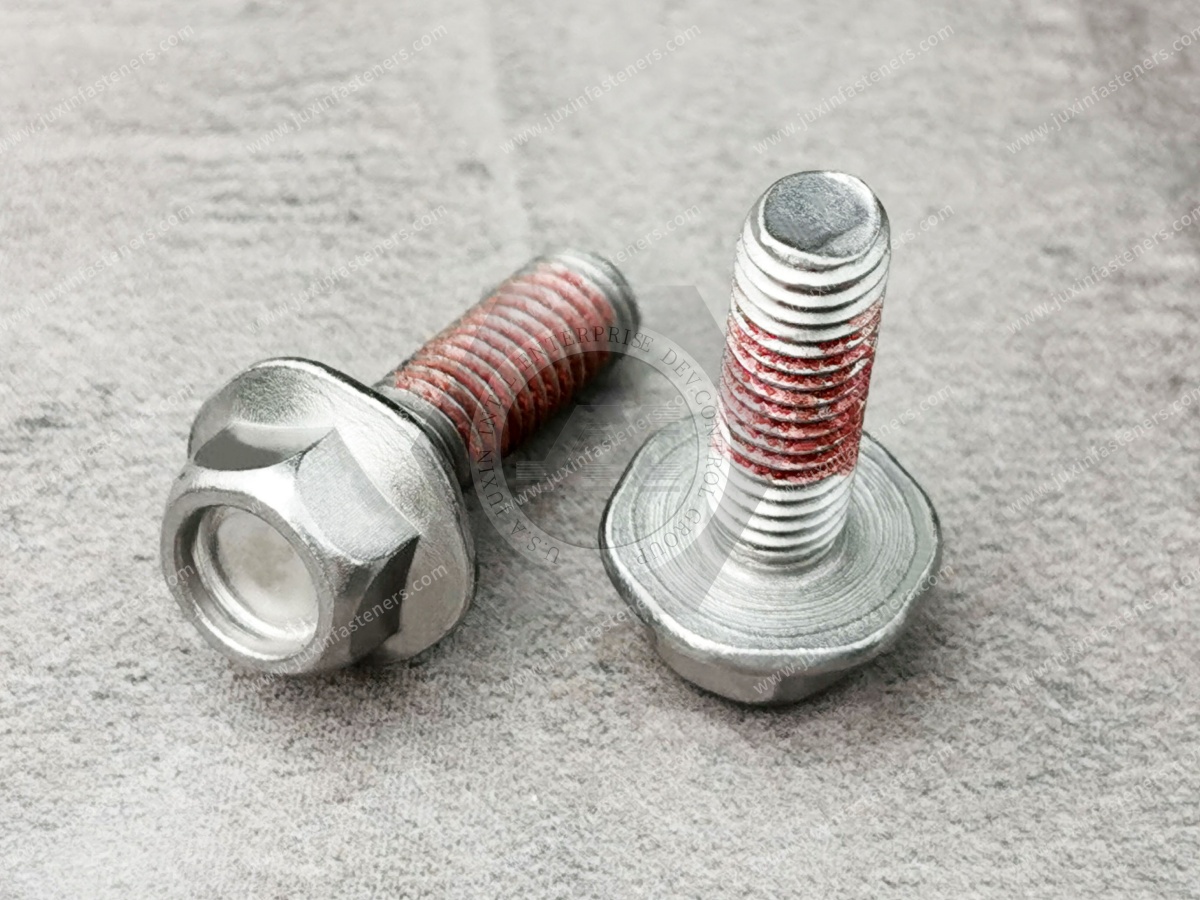
Structural adhesive-assisted fastening systems
Vibration-resistant bolt assemblies
6. Industry-Specific Fastener Requirements
Different industries prioritize different failure risks:
Petrochemical industry → corrosion resistance is the primary concern
Automotive industry → vibration loosening and corrosion are both critical
Construction industry → joint slip and corrosion dominate
Aerospace industry → fatigue failure of fasteners is the primary focus
This means there is no universal bolted joint solution—each application requires tailored fastener design engineering.
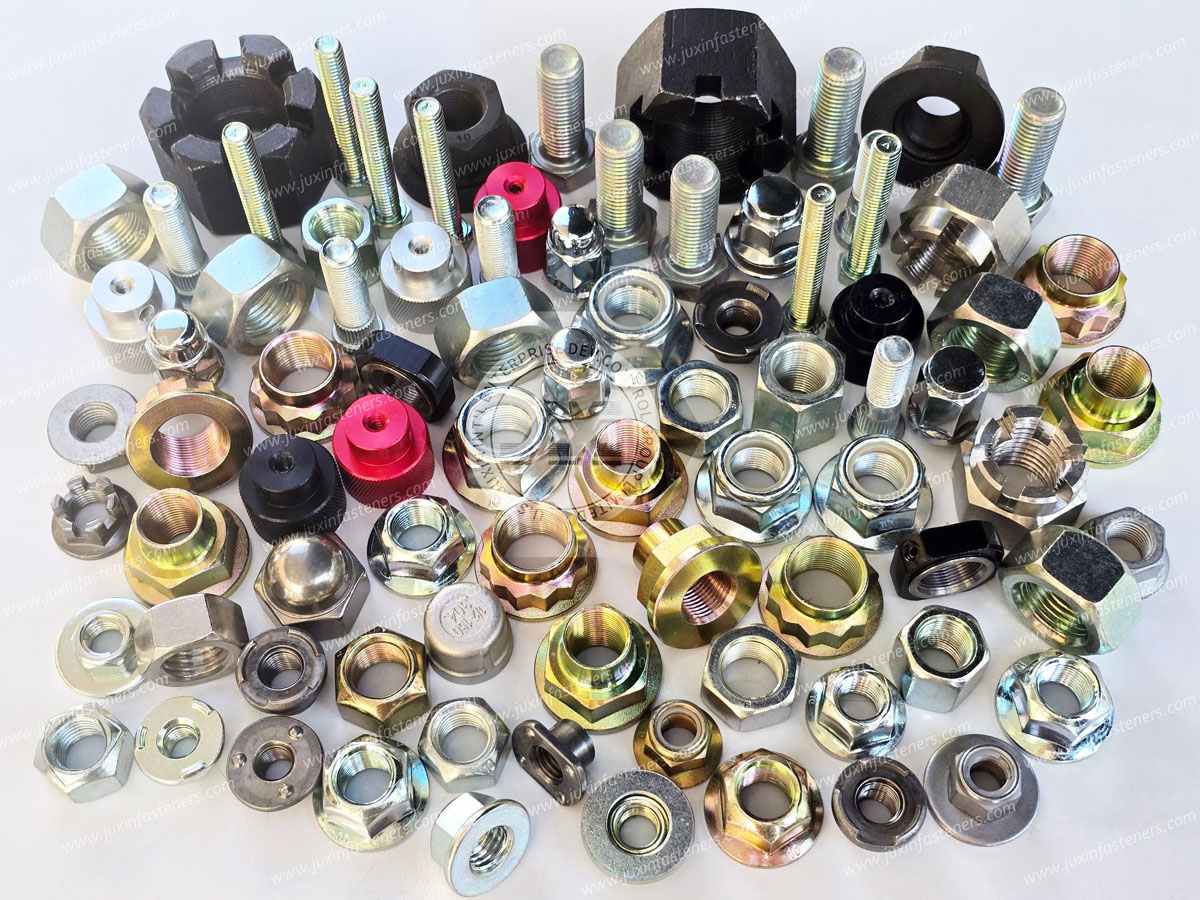
7. Engineering Fastener Solutions from JUXIN FASTENERS
At JUXIN FASTENERS, we design and manufacture high-performance fastening systems for demanding industrial applications, including:
Anti-loosening fastener systems for high-vibration environments
High-strength bolts for structural and automotive applications
Stainless steel fasteners for corrosion-critical assemblies
Custom-engineered industrial fasteners for OEM applications
Hybrid fastening solutions combining mechanical and surface engineering
Our approach focuses on:
Not just tightening bolts, but engineering the long-term stability of the entire bolted joint system.
Conclusion
Bolted joint loosening is caused by a combination of:
Self-loosening under vibration and dynamic loads
Material deformation, including embedding, creep, and stress relaxation
Environmental and design factors such as corrosion, surface finish, and lubrication
The reliability of a bolted connection is determined not only by tightening torque but also by the complete interaction among fastener design, material behavior, and operating conditions.
A robust industrial fastening system must be engineered to maintain preload throughout its entire service life—not just at the moment of installation.
Product Packaging
Packaging Standard
At Juxin Fasteners, we apply standardized export packaging to ensure product protection, traceability, and compliance with international logistics requirements.
1. Standard Export Packaging
Unless otherwise specified, all products will be packed according to our factory standard export packaging, which includes:
Moisture-resistant inner protection
Poly bag or small box packing as required
Reinforced export cartons
Clear labeling with part number, specification, batch number, and quantity
Palletizing for sea or air shipment when necessary
Our standard packaging is designed to ensure safe transportation, efficient warehousing, and long-distance international shipping.
2. Customized Packaging Options
We also provide customized packaging solutions according to customer requirements, including but not limited to:
Private labeling
Customized barcodes
Specific carton dimensions
Retail packaging
Special pallet configuration
Customer-specific marking and identification
So that you know, customized packaging may involve additional costs and extended lead time depending on the complexity of the requirements.
3. Compliance & Quality Assurance
All packaging processes are controlled under our ISO 9001 quality management system to ensure consistency, traceability, and product integrity throughout the supply chain.
Product Pictures
Contact Us
Tel.:
+86 020 8621 0320
+86 020 3121 6067
E-mail:
Technical Support:
Navigation
SEND INQUIREY