Call Us
+86 136 6007 9809
Call Us
+86 136 6007 9809

Why German Automotive Engineering Prefers Fine Thread Fasteners
Engineering Analysis & Fastener Design Solution for High-Performance Bolted Connections
In modern automotive engineering, threaded fasteners and bolt connections play a critical role in safety, durability, and long-term structural stability. Among global automotive standards, German OEMs are well known for their strict engineering philosophy and their preference for fine-thread fasteners in critical bolted joints.
Product Specification
Why German Automotive Engineering Prefers Fine Thread Fasteners
Engineering Analysis & Fastener Design Solution for High-Performance Bolted Connections
In modern automotive engineering, threaded fasteners and bolt connections play a critical role in safety, durability, and long-term structural stability. Among global automotive standards, German OEMs are well known for their strict engineering philosophy and their preference for fine-thread fasteners in critical bolted joints.
A common design pattern in German vehicles is:
Coarse thread bolts (metric coarse pitch) used for M10 and below
Fine thread fasteners are used extensively for M10 and above
Although fine-thread bolts are more expensive and less universally compatible than coarse-thread fasteners, they are still widely used in German automotive systems, including engines, chassis, and drivetrains.
This is not a cost-driven decision—it is a performance-driven fastening system design strategy.
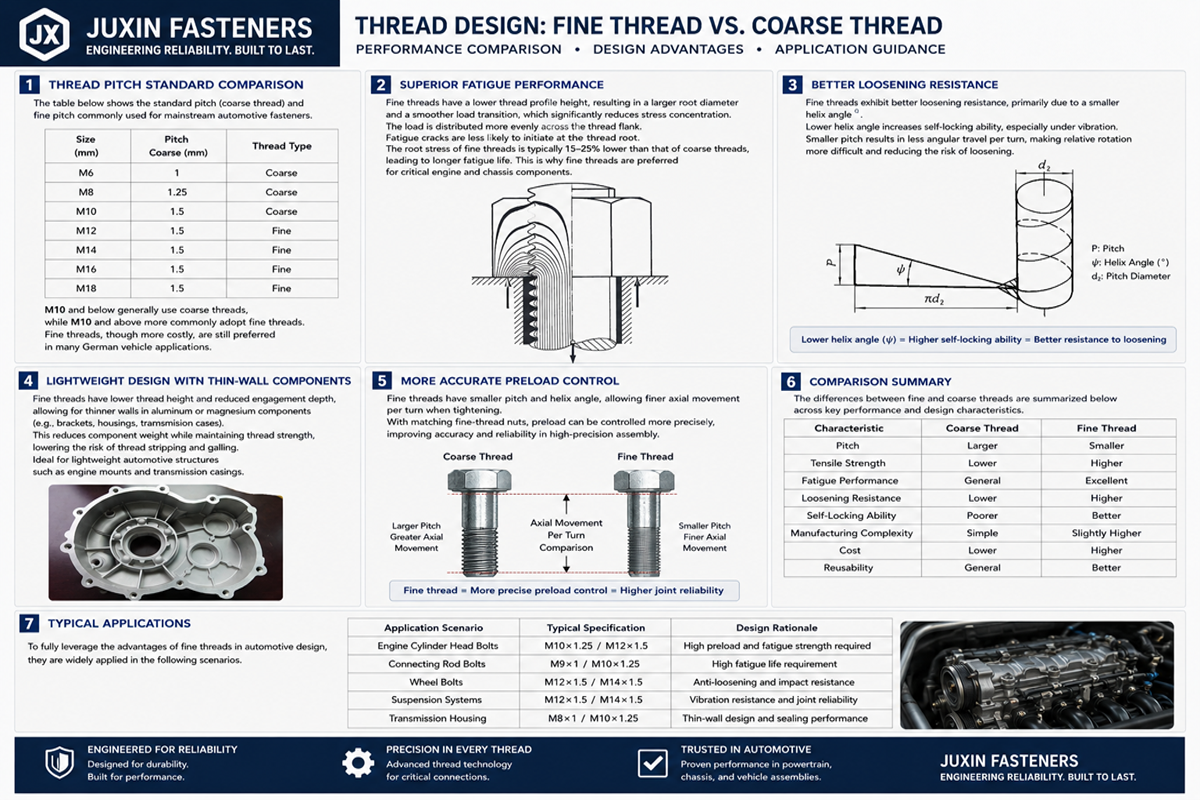
1. Technical Advantages of Fine Thread Fasteners in Automotive Engineering
1.1 Higher Tensile Strength in Bolted Joints
Fine thread fasteners have a smaller pitch, which results in:
Reduced thread height
Increased root diameter
Larger tensile stress area
From a mechanical engineering perspective:
A larger stress cross-sectional area directly increases the bolt's tensile load capacity.
This is why high-strength bolts with fine thread design are commonly used in engine and chassis applications where structural safety is critical.
German OEMs often apply torque-to-yield (TTY) tightening methods and angle-controlled tightening strategies in these systems. Fine thread bolts provide better compatibility with these advanced tightening processes by enabling:
More stable plastic deformation control
More predictable preload generation
Higher consistency in bolt elongation
The combination of fine-thread geometry and precision tightening technology significantly improves the reliability of automotive bolted connections under high-load conditions.
1.2 Improved Fatigue Resistance for Cyclic Loading
Fatigue failure typically initiates at the thread root, where stress concentrations occur.
Fine thread fasteners provide:
Larger root diameter
Lower stress concentration factor
More uniform load distribution across threads
Compared with coarse thread fasteners, fine thread bolts reduce stress concentration by approximately 15–25%, significantly improving fatigue life under:
Engine vibration
Suspension dynamic loading
Powertrain torque fluctuation
This is why components such as:
Engine connecting rods
Cylinder heads
Transmission housings
almost always rely on fine thread automotive fasteners in German engineering design.
1.3 Superior Anti-Loosening Performance in Vibrating Systems
One of the key advantages of fine thread fasteners is their enhanced resistance to loosening under vibration.
The self-locking behavior of threaded joints is closely related to the thread helix angle:
Smaller pitch → smaller helix angle
Smaller helix angle → stronger self-locking effect
Fine thread bolts, therefore:
Resist rotational loosening under vibration more effectively
Maintain preload stability under cyclic loading
Reduce micro-slip between mating threads
In addition, fine thread fasteners exhibit:
More uniform elastic deformation
Slower preload relaxation
Reduced fretting wear at thread interfaces
This makes them ideal for anti-vibration fastening systems in automotive applications.
1.4 Lightweight Design Compatibility for Aluminum Structures
Modern German vehicles extensively use aluminum alloys in:
Subframes
Transmission housings
Steering knuckles
Engine components
Fine thread fasteners are particularly suitable for these materials because:
Thread depth is shallower
Less base material is removed during tapping
Reduced risk of thread stripping in low-strength aluminum alloys
Compared with coarse thread designs, fine thread bolts for aluminum structures:
Preserve more parent material thickness
Improve pull-out resistance
Reduce cracking risk in thin-wall components
This makes them a key enabler for automotive lightweight fastening systems.
1.5 Higher Precision in Preload Control
German automotive engineering places strong emphasis on precision-controlled bolted joints.
Fine thread fasteners offer:
Smaller axial displacement per rotation
Higher tightening accuracy
Improved preload adjustment resolution
This is especially important in:
Torque-angle tightening systems
Yield-controlled bolt tightening
Engine and chassis critical joint assembly
Fine thread geometry allows engineers to achieve:
More accurate bolt elongation control and more stable clamping force distribution across the joint.
This directly improves the consistency of high-performance bolted connections in automotive systems.
2. Comparison: Fine Thread vs Coarse Thread Fasteners
Feature | Fine Thread Fasteners | Coarse Thread Fasteners |
Tensile Strength | Higher due to a larger stress area | Lower stress area |
Fatigue Resistance | Better under cyclic loading | More stress concentration |
Anti-Loosening Performance | Strong self-locking effect | More prone to vibration loosening |
Aluminum Application | Ideal for thin-wall structures | Higher risk of stripping |
Preload Control | High precision tightening | Lower adjustment accuracy |
General Use | Engine, chassis, drivetrain | General assembly, non-critical joints |
3. Application Scenarios in German Automotive Design
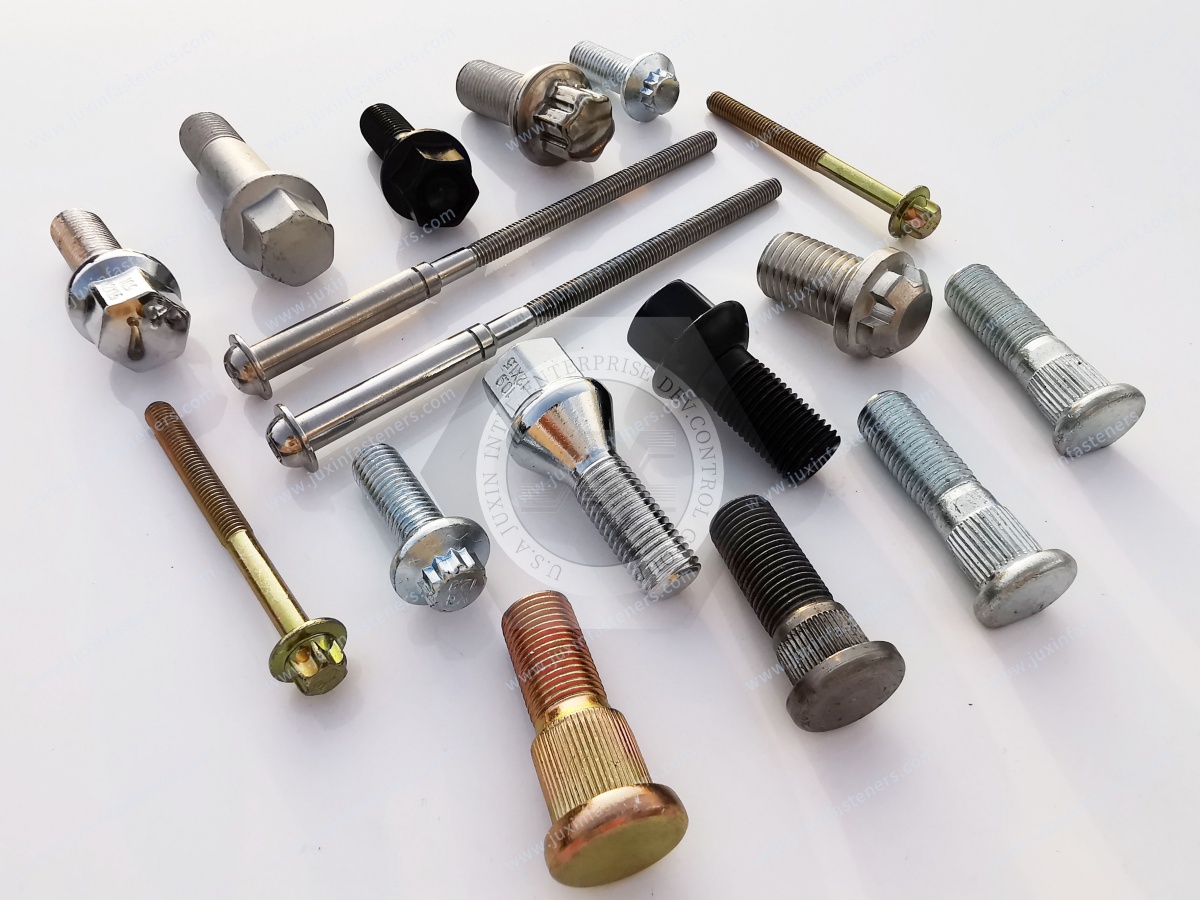
In real German OEM vehicle platforms, fine thread fasteners and high-strength bolts are widely used in:
Engine Systems
Cylinder head bolts
Connecting rod bolts
Timing system fasteners
Chassis Systems
Suspension mounting bolts
Subframe connection fasteners
Steering system joints
Powertrain Systems
Transmission housing bolts
Differential fastening systems
Driveline structural connections
Lightweight Aluminum Structures
Engine block aluminum threads
Gearbox aluminum housings
Structural brackets and supports
These applications require not only strength, but also:
Vibration resistance
Long-term preload stability
Thermal cycling reliability
Lightweight compatibility
4. Engineering Insight: Why German OEMs Prefer Fine Thread Fasteners
The widespread adoption of fine thread bolts in German automotive engineering is not a design tradition—it is a performance-based engineering decision.
Fine thread fasteners provide:
Higher tensile capacity for critical joints
Improved fatigue resistance under dynamic loading
Superior anti-loosening behavior in vibration environments
Better compatibility with aluminum lightweight structures
Higher precision in preload control systems
In modern automotive design, especially in safety-critical systems, fastener reliability directly determines system reliability.
5. Engineering Fastener Solutions from JUXIN FASTENERS
At JUXIN FASTENERS, we provide engineered fastening solutions for global automotive and industrial applications, including:
Fine thread high-strength bolts for automotive systems
Structural fasteners for chassis and drivetrain assemblies
Aluminum-compatible fastening solutions for lightweight design
Anti-loosening bolt systems for high-vibration environments
Custom-engineered threaded fasteners for OEM requirements
Our focus is not only on producing fasteners but also on delivering complete bolted-joint engineering solutions for automotive manufacturers and Tier 1 suppliers.
Conclusion
The preference for fine thread fasteners in German automotive engineering is based on clear mechanical and functional advantages:
Higher strength and stress capacity
Improved fatigue resistance
Better anti-loosening performance
Superior compatibility with aluminum lightweight structures
Higher precision in preload control
In high-performance automotive systems, the choice of thread type is not a minor design detail—it is a core engineering decision that directly affects safety, durability, and long-term reliability of the entire vehicle structure.
Product Packaging
Packaging Standard
At Juxin Fasteners, we apply standardized export packaging to ensure product protection, traceability, and compliance with international logistics requirements.
1. Standard Export Packaging
Unless otherwise specified, all products will be packed according to our factory standard export packaging, which includes:
Moisture-resistant inner protection
Poly bag or small box packing as required
Reinforced export cartons
Clear labeling with part number, specification, batch number, and quantity
Palletizing for sea or air shipment when necessary
Our standard packaging is designed to ensure safe transportation, efficient warehousing, and long-distance international shipping.
2. Customized Packaging Options
We also provide customized packaging solutions according to customer requirements, including but not limited to:
Private labeling
Customized barcodes
Specific carton dimensions
Retail packaging
Special pallet configuration
Customer-specific marking and identification
So that you know, customized packaging may involve additional costs and extended lead time depending on the complexity of the requirements.
3. Compliance & Quality Assurance
All packaging processes are controlled under our ISO 9001 quality management system to ensure consistency, traceability, and product integrity throughout the supply chain.
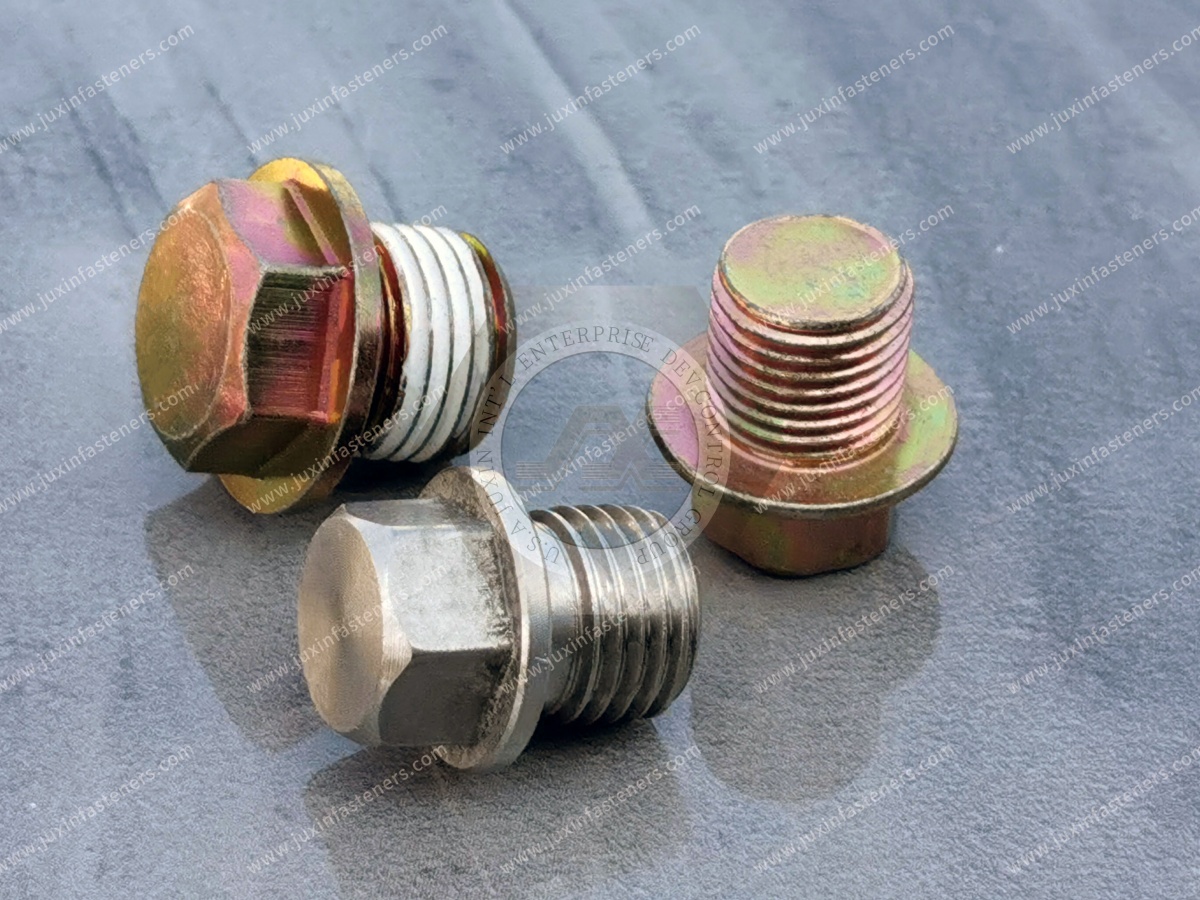
Product Pictures
Contact Us
Tel.:
+86 020 8621 0320
+86 020 3121 6067
E-mail:
Technical Support:
Navigation
SEND INQUIREY