Call Us
+86 136 6007 9809
Call Us
+86 136 6007 9809

Why Uneven Bolt Preload Accelerates Fatigue Failure in Multi-Bolt Joints
Engineering Analysis & Fastener System Design Solution for Industrial Applications
In industrial engineering systems, bolted connections are among the most widely used fastening methods in wind turbines, pressure vessels, automotive engines, and heavy machinery. However, a critical but often overlooked failure mechanism exists:
Most multi-bolt joint failures do not start with overloading — they start with uneven preload distribution.
Product Specification
Why Uneven Bolt Preload Accelerates Fatigue Failure in Multi-Bolt Joints
Engineering Analysis & Fastener System Design Solution for Industrial Applications
In industrial engineering systems, bolted connections are among the most widely used fastening methods in wind turbines, pressure vessels, automotive engines, and heavy machinery. However, a critical but often overlooked failure mechanism exists:
Most multi-bolt joint failures do not start with overloading — they start with uneven preload distribution.
Even when using high-strength bolts manufactured according to ISO 898-1 / DIN EN ISO 898-1 fastener standards, inconsistent tightening can significantly accelerate bolt fatigue damage and joint failure.
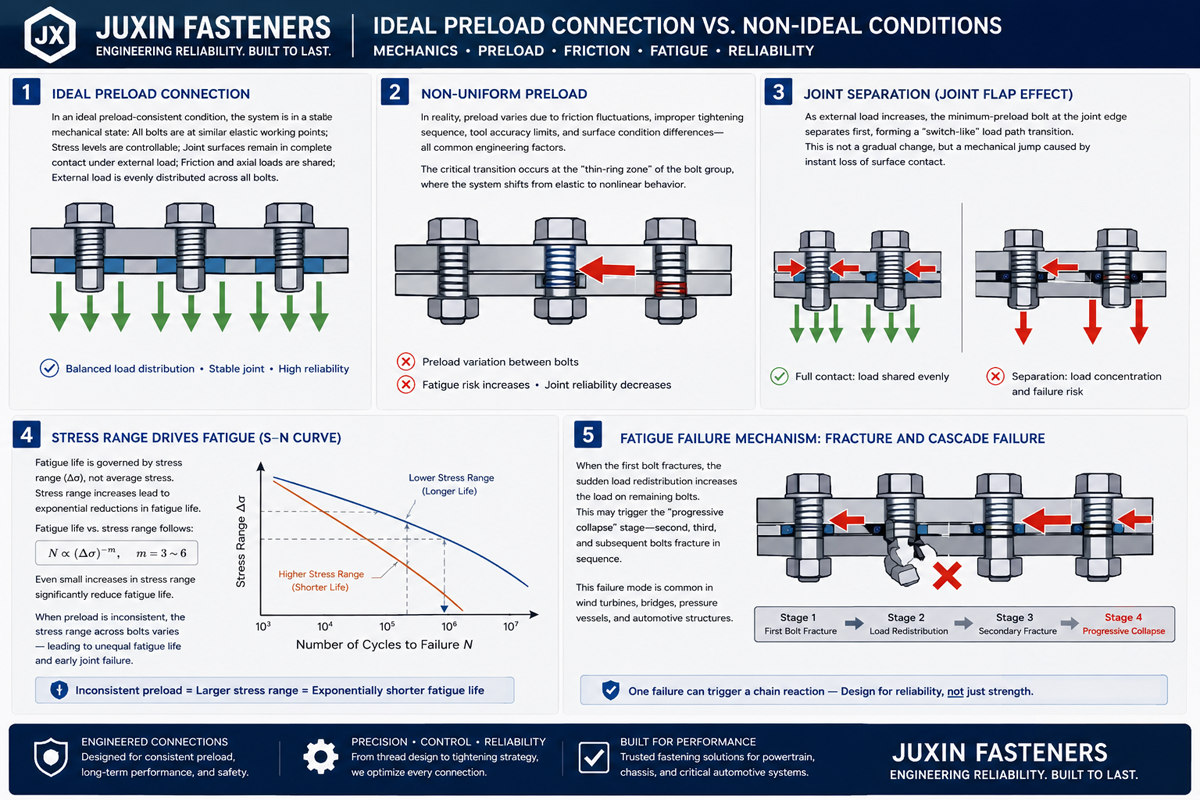
1. Ideal Condition: Multi-Bolt Joints as a Parallel Load-Bearing System
Under ideal engineering conditions, a multi-bolt connection behaves as a parallel elastic load-sharing system.
When preload is uniform:
All high-strength bolts operate at similar elastic stress levels
Contact surfaces remain fully closed under external loads
External forces are distributed evenly across all fasteners
Load is primarily carried through friction between clamped surfaces
In this state, the system has high redundancy and excellent fatigue resistance.
This is the design assumption underlying most ISO/DIN structural bolted-joint calculations.
2. Real Engineering Problem: Uneven Preload Distribution in Fastener Systems
In real assembly conditions, perfect preload uniformity is rarely achieved.
Common causes include:
Variation in the friction coefficient between threads and bearing surfaces
Torque tool accuracy limitations
Improper tightening sequence
Surface finish inconsistency of mating components
Operator and process variation in industrial assembly lines
These factors lead to preload scatter in multi-bolt fastener systems, which becomes the root cause of fatigue failure.
Critical engineering insight
Once a single low-preload bolt appears, the entire system's behavior changes:
The bolted joint transitions from uniform load sharing to localized overload concentration.
3. Load Redistribution: From Uniform Sharing to Single-Bolt Overloading
The load carried by each bolt is not constant—it depends on the stiffness distribution between:
Bolt stiffness
Clamped component stiffness
When preload is uneven, local contact stiffness decreases, causing:
Higher load concentration on weaker bolts
Nonlinear redistribution of external forces
Sudden increase in load carried by the lowest-preload fastener
This is especially critical in large structures such as:
Wind turbine tower flange bolted joints
Pressure vessel flange connections
Automotive engine block assemblies
In these systems, a single weak fastener can dominate the load-transfer behavior.
4. Contact Separation Effect: Sudden Transition in Load Path
When external load increases:
The lowest-preload bolt reaches separation first
Frictional load transfer is lost locally
The joint surface opens in that region
At this moment, load transfer changes abruptly:
From friction-based shear transfer
To direct axial tensile loading on the bolt
This is not gradual — it is a step-change mechanical transition.
The affected industrial fastener immediately experiences a sharp increase in stress amplitude, becoming the weakest point in the system.
5. Fatigue Acceleration: Stress Amplitude and S–N Curve Behavior
Bolt fatigue life is governed by stress amplitude rather than mean stress.
According to fatigue theory (S–N curve behavior):
Small increases in stress amplitude lead to an exponential reduction in fatigue life
Fatigue damage follows a nonlinear power-law relationship
In practical terms:
A normally loaded bolt may experience ~50 MPa stress amplitude
A low-preload bolt may exceed 100 MPa or more
This means:
The fatigue life of a single underloaded bolt can drop to 10% or less of normal service life.
This is a critical issue in high-strength bolt applications under ISO/DIN fatigue design requirements.
6. Positive Feedback Failure Loop in Fastener Systems
Uneven preload not only creates stress imbalance — it triggers a self-accelerating failure cycle:
Low-preload bolt experiences higher fatigue stress
Micro-slip and damage reduce local stiffness
Reduced stiffness further decreases preload
Load shifts even more to the weakened bolt
This creates a positive feedback loop, leading to rapid fatigue propagation and eventual fracture.
Once initiated, the process becomes irreversible.
7. Cascade Failure in Multi-Bolt Fastener Assemblies
When the first bolt fails:
Its load is redistributed to the remaining bolts
Stress levels of all remaining fasteners increase suddenly
Previously safe bolts enter high fatigue regimes
This leads to:
Second and third bolt failures
Progressive joint degradation
Complete structural collapse in extreme cases
This cascading failure mode is well documented in:
Wind turbine flange joints
Bridge structures
Pressure vessel closures
Automotive drivetrain assemblies
8. Engineering Countermeasures for Stable Fastener Systems
Modern engineering design does not rely solely on tightening torque control. Instead, it focuses on reducing system sensitivity to preload variation.
8.1 Increase effective bolt elasticity
Using:
Longer grip length designs
Elastic fasteners
Controlled stiffness bolted joints
This reduces load redistribution sensitivity.
8.2 Introduce elastic elements
Such as:
Disc springs (Belleville washers)
Elastic washers
Preload compensation systems
These components absorb preload scatter and stabilize load distribution across multi-bolt fastening systems.
8.3 Improve assembly control strategy
Best practices include:
Cross-pattern tightening sequence
Multi-stage tightening process
Torque-angle or tension-controlled tightening methods
Calibrated tightening tools compliant with ISO/DIN assembly standards
8.4 Optimize load path design
Structural design should ensure:
Friction surfaces primarily carry external loads
Reduced dependence on bolt axial load
More uniform stress distribution in the joint
This improves the robustness of high-strength bolted connections.
9. Engineering Insight: Design for Robustness, Not Perfect Assembly
The fundamental engineering conclusion is:
Preload variation is unavoidable in real industrial assembly, but system failure is avoidable through robust design.
The real danger of uneven preload is not the deviation itself, but that it pushes a normally linear elastic system into a nonlinear, unstable failure regime.
For engineers working with ISO/DIN high-strength fasteners, structural bolts, and industrial bolted joints, the design philosophy should shift from:
“Perfect tightening control.”
to
“System tolerance to tightening variation.”
10. Engineering Fastener Solutions from JUXIN FASTENERS
At JUXIN FASTENERS, we provide engineered fastening systems designed for high-reliability industrial applications, including:
High-strength ISO/DIN compliant bolts for structural assemblies
Anti-fatigue fastener systems for wind energy and heavy industry
Precision-engineered multi-bolt joint fastening solutions
Automotive-grade structural fasteners for chassis and engine systems
Customized fastening systems for vibration and fatigue-critical environments
Our engineering approach focuses on:
Improving the reliability of the entire bolted joint system, not just individual fastener strength.
Conclusion
Uneven preload distribution in multi-bolt systems is one of the most critical causes of accelerated fatigue failure in industrial fasteners.
Key findings:
Load redistribution amplifies stress on weak bolts
Contact separation causes sudden load path changes
Fatigue damage grows exponentially under increased stress amplitude
Cascade failure can lead to total joint collapse
Understanding this mechanism allows engineers to design more robust ISO/DIN bolted joint systems that tolerate real-world assembly variations while maintaining long-term structural safety.
Product Packaging
Packaging Standard
At Juxin Fasteners, we apply standardized export packaging to ensure product protection, traceability, and compliance with international logistics requirements.
1. Standard Export Packaging
Unless otherwise specified, all products will be packed according to our factory standard export packaging, which includes:
Moisture-resistant inner protection
Poly bag or small box packing as required
Reinforced export cartons
Clear labeling with part number, specification, batch number, and quantity
Palletizing for sea or air shipment when necessary
Our standard packaging is designed to ensure safe transportation, efficient warehousing, and long-distance international shipping.
2. Customized Packaging Options
We also provide customized packaging solutions according to customer requirements, including but not limited to:
Private labeling
Customized barcodes
Specific carton dimensions
Retail packaging
Special pallet configuration
Customer-specific marking and identification
So that you know, customized packaging may involve additional costs and extended lead time depending on the complexity of the requirements.
3. Compliance & Quality Assurance
All packaging processes are controlled under our ISO 9001 quality management system to ensure consistency, traceability, and product integrity throughout the supply chain.
Product Pictures
Contact Us
Tel.:
+86 020 8621 0320
+86 020 3121 6067
E-mail:
Technical Support:
Navigation
SEND INQUIREY