Call Us
+86 136 6007 9809
Call Us
+86 136 6007 9809

Cold Work Strengthened Non-Quenched and Tempered Steel: A Green Manufacturing Solution for High-Strength Fasteners
Sustainable High-Strength Fasteners for Automotive, Construction, and Industrial Engineering Applications
In today’s fast-growing fastener industry, manufacturers are under increasing pressure to balance high mechanical performance, cost efficiency, and low-carbon manufacturing. In this context, a new generation of material, known as non-quenched and tempered steel (NQT steel), has emerged as a breakthrough solution.
Product Specification
Cold Work Strengthened Non-Quenched and Tempered Steel: A Green Manufacturing Solution for High-Strength Fasteners
Sustainable High-Strength Fasteners for Automotive, Construction, and Industrial Engineering Applications
In today’s fast-growing fastener industry, manufacturers are under increasing pressure to balance high mechanical performance, cost efficiency, and low-carbon manufacturing. In this context, a new generation of material, known as non-quenched and tempered steel (NQT steel), has emerged as a breakthrough solution.
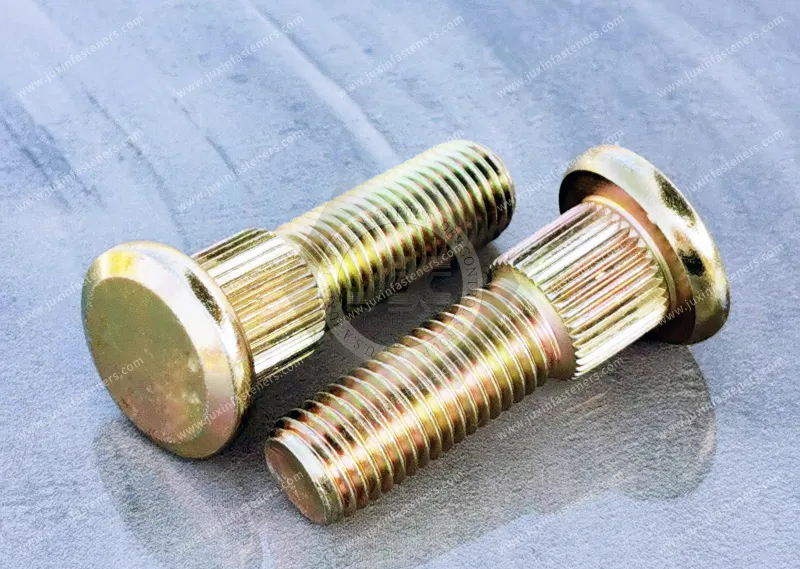
Unlike conventional quenched and tempered steels used in high-strength fasteners, NQT steel eliminates multiple energy-intensive heat treatment steps while still achieving 10.9-grade high-strength fastener performance through advanced microalloying and controlled processing routes.
This article provides a detailed engineering analysis of the application of NQT steel in high-strength bolts, structural fasteners, and cold-formed components, focusing on materials science, processing routes, and industrial applications.
1. The Bottleneck of Conventional Heat Treatment in High-Strength Fasteners
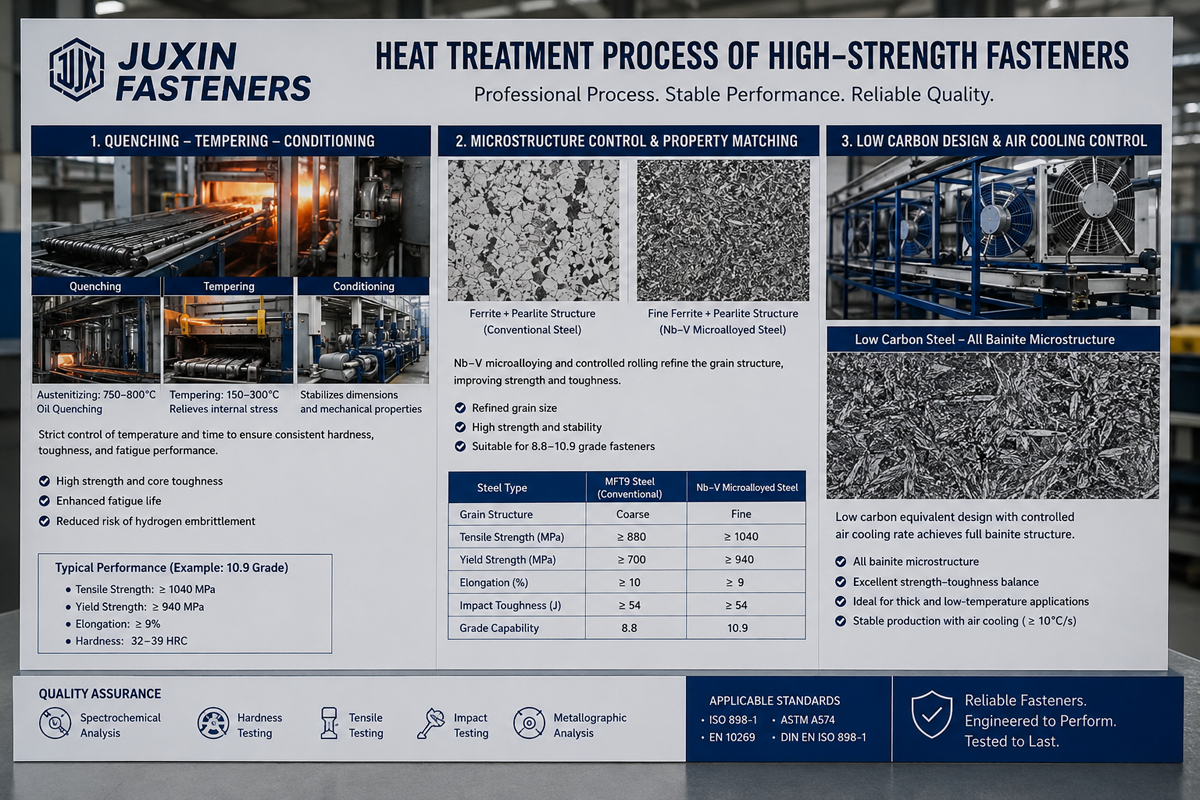
Traditional manufacturing of high-strength bolts, such as ISO 898-1 10.9 and 12.9 grade fasteners, typically requires a full heat treatment route:
Spheroidizing annealing
Cold heading / cold forging
Quenching + high-temperature tempering
Among these processes, quenching and tempering alone account for more than 40% of total energy consumption, making it the most expensive and carbon-intensive stage of production.
In addition, conventional heat treatment often introduces:
Surface decarburization
Oxidation scale formation
Dimensional distortion
Residual stress instability
For high-precision applications such as automotive and structural engineering, these issues directly affect fatigue reliability and dimensional consistency.
The Breakthrough: Non-Quenched and Tempered Steel (NQT Steel)
Non-quenched and tempered steel eliminates the need for quenching and tempering by using:
Microalloying with Nb, V, Ti
Controlled rolling and controlled cooling (TMCP process)
Precipitation strengthening during hot deformation
Grain refinement strengthening
Cold work strengthening via cold drawing or cold heading
This allows the material to achieve 10.9-grade mechanical properties without post-forging heat treatment, significantly improving production efficiency and environmental performance.
According to ISO 898-1 and ISO 898-2 fastener mechanical standards, NQT steel is increasingly recognized as a viable material pathway for high-strength cold-formed fasteners.
In China, standards such as (Cold heading and cold extrusion steel) define industrial-grade NQT steels, including MFT8, MFT9, and MFT10, enabling standardized industrial adoption.
2. Microstructure Design: The Key to Strength Without Quenching
The performance of non-quenched and tempered steel depends entirely on its microstructural architecture, which can be classified into three main types:
2.1 Ferrite–Pearlite NQT Steel (Most Widely Used)
This is the most mature industrial form of NQT steel.
Key features:
Nb–V microalloy precipitation strengthening
Fine ferrite + pearlite structure
Stable mechanical properties
Excellent cold heading performance
Engineering applications:
ISO 898-1 8.8 to 10.9 grade fasteners
Structural bolts and standard industrial screws
Research from Shanghai University and Yonggang Group shows that:
MFT9 steel after 50% cold reduction + 300°C aging achieves
Tensile strength: ~1038 MPa
Yield strength: ~978 MPa
Fully meeting 10.9-grade high-strength fastener requirements.
2.2 Bainitic NQT Steel (High Toughness Applications)
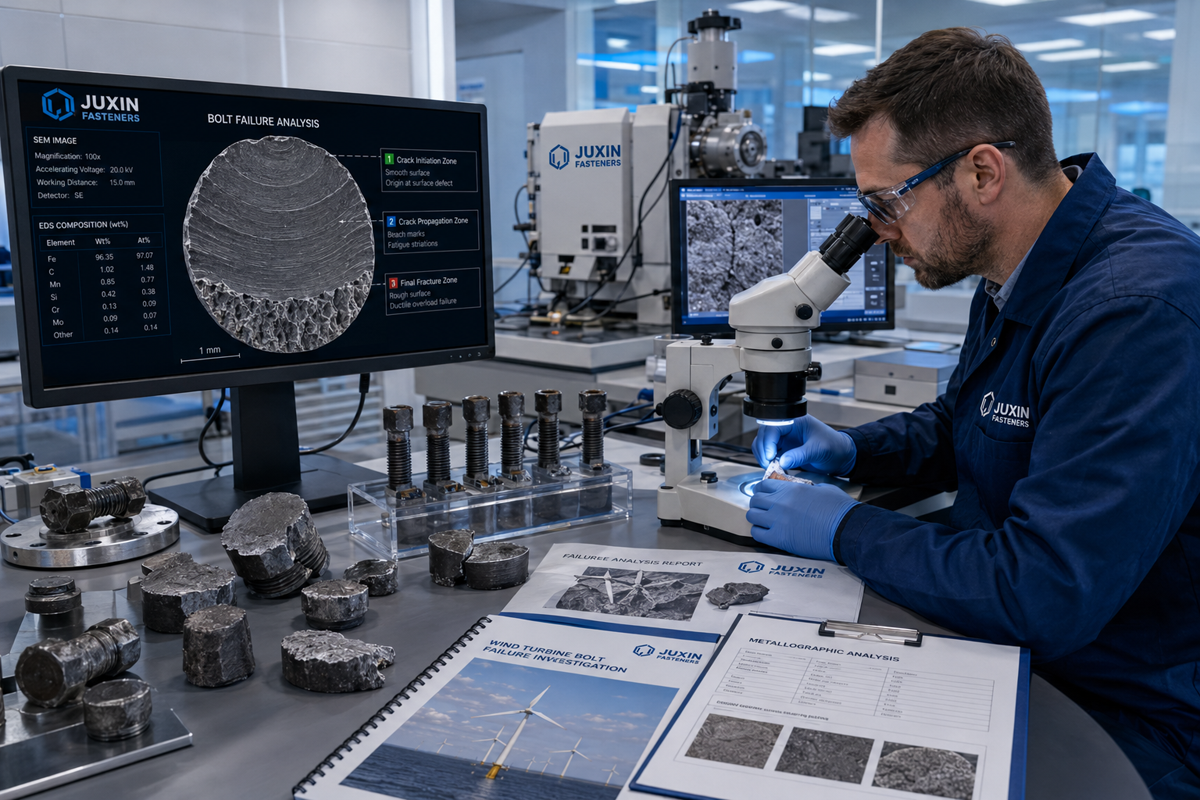
This grade uses:
Low-carbon + high-manganese alloy design
Controlled air cooling transformation
Granular bainite microstructure
Advantages:
Excellent low-temperature toughness
High strength–ductility balance
Improved impact resistance
Typical applications:
Construction machinery fasteners
Railway structural bolts
Cold climate engineering systems
2.3 Ferrite–Martensite Dual-Phase NQT Steel
A more advanced structure with:
10%–30% martensite phase
Strong work-hardening capability
Low yield ratio (improved safety margin)
Performance benefits:
High strength equivalent to quenched-tempered steel
Excellent deformation adaptability
Superior fatigue resistance potential
3. Cold Work Strengthening: The Core of NQT Steel Performance
Cold deformation (cold drawing or cold heading) is the most critical step in strengthening NQT fasteners.
Strengthening Mechanism
Cold deformation increases strength through:
Dislocation multiplication
Dislocation interaction and entanglement
Strain hardening accumulation
As deformation increases, strengthening follows a nonlinear growth pattern.
Engineering Data Example (MFT9 Steel)
After 50% reduction in cold drawing:
Tensile strength: 715 MPa → 997 MPa (+282 MPa)
Yield strength: 509 MPa → 910 MPa (+401 MPa)
Hardness: 219 HV → 286 HV
Dislocation density increases from:
5.10 × 10¹⁴ cm⁻² → 1.14 × 10¹⁶ cm⁻²
This represents more than a 20× increase in dislocation density, which is directly responsible for the strength improvement.
Low-Temperature Aging Stabilization
Aging treatment at 250–400°C plays a critical role:
Carbon and nitrogen atoms diffuse and pin dislocations
Formation of Cottrell atmospheres
Stabilization of cold work structure
At optimal condition (300°C × 2h):
Tensile strength increases further (~+41 MPa)
Ductility improves (elongation restored from 11% to 17%)
However, overheating may cause over-aging and carbide coarsening, reducing strength.
4. Industrial Production Control Requirements
To ensure stable industrial-scale production of NQT fasteners, strict control is required in three key areas:
4.1 Steel Cleanliness Control
Impurity elements must be tightly controlled:
S ≤ 0.008%
P ≤ 0.018%
Total oxygen ≤ 15 ppm
Microalloying elements:
Nb + V ≥ 0.05%
These elements form nano-scale carbonitrides (~50 nm), providing:
Precipitation strengthening
Hydrogen trapping effect (improves delayed fracture resistance)
4.2 Microstructure Uniformity Control
Banding structure ≤ Grade 3
Hardness variation ≤ 2 HRC
End quench hardenability fluctuation ≤ ±5 HBW
Uniformity is essential for consistent cold heading behavior.
4.3 Grain Size and Texture Control
Grain size requirement: ≥ ASTM grain size 8
After heavy cold deformation:
Grain orientation transforms into dominant 〈110〉 fiber texture
Improved structural alignment
Enhanced load-bearing stability
This structural refinement significantly improves tensile strength and consistency in fastener manufacturing.
5. Industrial Applications of Non-Quenched Fasteners
Non-quenched and tempered steel is now widely used in:
Automotive Industry
Engine compartment bolts
Suspension system fasteners
Chassis structural connectors
Construction Engineering
Steel structure bolts
High-rise building connectors
Preloaded structural fasteners
Heavy Machinery
Excavator structural bolts
Mining equipment connectors
Hydraulic system fasteners
Rail and Energy Systems
Wind turbine bolts
Rail transit fastening systems
Power plant structural assemblies
Key Engineering Advantage
For large-diameter bolts (≥ M20) and long slender fasteners:
Eliminates quenching deformation
Improves dimensional stability
Reduces production distortion risk
This makes NQT steel especially valuable for precision structural applications.
6. Future Development Trends
The next generation of non-quenched steel development focuses on:
Higher strength grades (beyond 13.9 level performance potential)
Improved low-temperature toughness for extreme environments
Reduced vanadium content for cost optimization
Enhanced fatigue resistance through microstructure engineering
As global industries move toward low-carbon manufacturing and energy-efficient production, NQT steel is expected to become a mainstream material for high-strength fasteners.
7. Conclusion: A Green Revolution in Fastener Manufacturing
Cold-worked, non-quenched, and tempered steel represents a major shift in fastener material engineering.
By combining:
Controlled rolling and cooling (TMCP)
Cold deformation strengthening
Low-temperature aging stabilization
Manufacturers can achieve 10.9-grade high-strength fasteners without quenching and tempering, significantly reducing energy consumption and production cost.
For industrial buyers and engineering designers, this material system provides:
Lower carbon footprint
Higher production efficiency
Stable mechanical performance
Competitive lifecycle cost advantage
Industrial Fastener Engineering Solutions
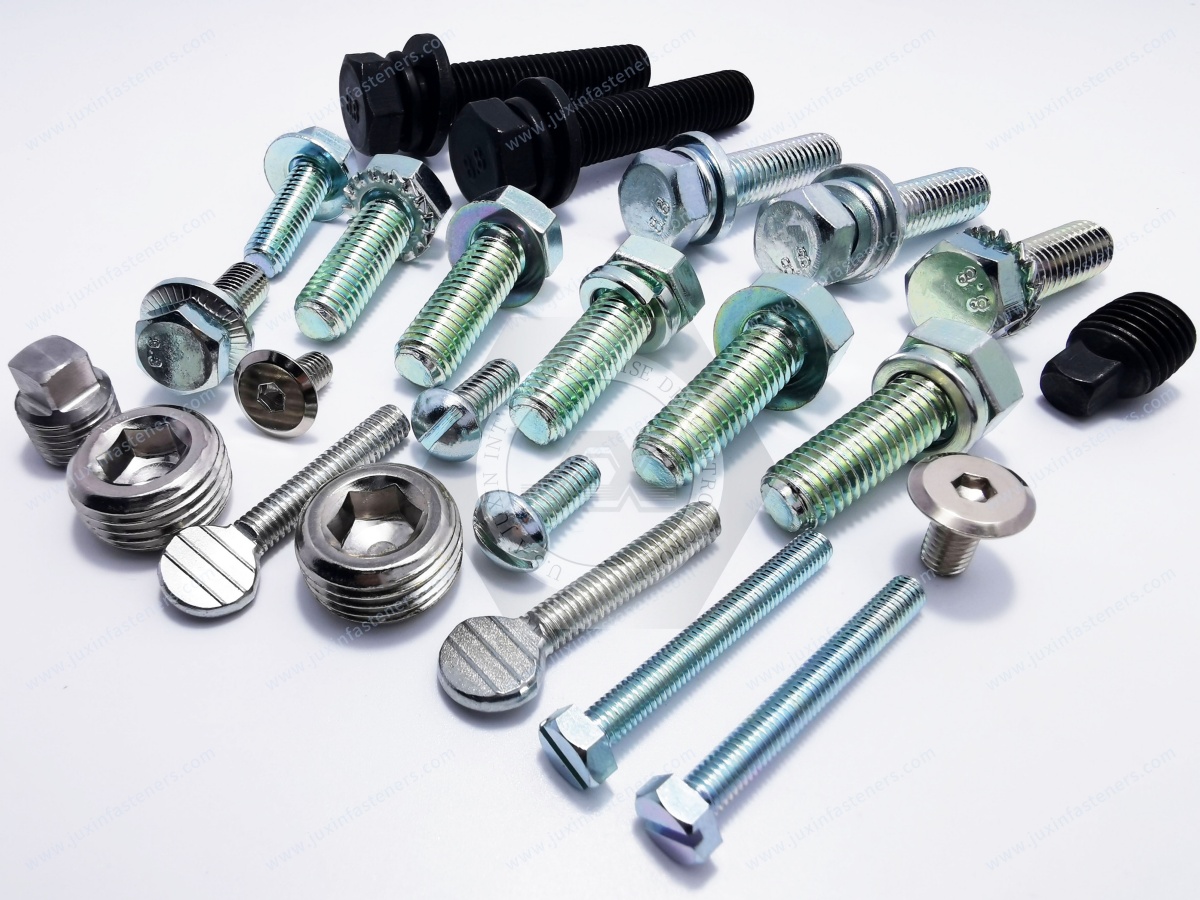
Guangzhou Juxin Development Co., Ltd. specializes in advanced high-strength fasteners, cold-formed bolts, and engineered fastening solutions, supporting global industries with ISO/DIN-standard compliant products designed for high-performance and sustainable manufacturing systems.
Product Packaging
Packaging Standard
At Juxin Fasteners, we apply standardized export packaging to ensure product protection, traceability, and compliance with international logistics requirements.
1. Standard Export Packaging
Unless otherwise specified, all products will be packed according to our factory standard export packaging, which includes:
Moisture-resistant inner protection
Poly bag or small box packing as required
Reinforced export cartons
Clear labeling with part number, specification, batch number, and quantity
Palletizing for sea or air shipment when necessary
Our standard packaging is designed to ensure safe transportation, efficient warehousing, and long-distance international shipping.
2. Customized Packaging Options
We also provide customized packaging solutions according to customer requirements, including but not limited to:
Private labeling
Customized barcodes
Specific carton dimensions
Retail packaging
Special pallet configuration
Customer-specific marking and identification
So that you know, customized packaging may involve additional costs and extended lead time depending on the complexity of the requirements.
3. Compliance & Quality Assurance
All packaging processes are controlled under our ISO 9001 quality management system to ensure consistency, traceability, and product integrity throughout the supply chain.
Product Pictures

Contact Us
Tel.:
+86 020 8621 0320
+86 020 3121 6067
E-mail:
Technical Support:
Navigation
SEND INQUIREY