Call Us
+86 136 6007 9809
Call Us
+86 136 6007 9809

Thread Pair Clearance: The Hidden Driver Behind Bolt Loosening in High-Performance Bolted Joints
A Critical but Overlooked Engineering Factor in Fastener Reliability
Bolt loosening remains one of the most persistent and costly problems in mechanical design. In automotive systems, rail transit, aerospace structures, and heavy industrial equipment, unexpected loosening can lead to:
Loss of preload
Structural vibration amplification
Joint separation
Catastrophic system failure
Engineers often attribute this phenomenon to vibration load, insufficient preload, or improper locking methods. However, recent research published in the Journal of Aerospace Dynamics reveals a far more subtle but decisive factor:
Thread pair clearance (bolt–nut fit clearance) is a key, often hidden, driver of bolt loosening behavior.
This parameter is often ignored in design, yet it is fundamentally governed by fastener manufacturing precision and by thread quality standards such as the ISO and DIN systems.
Product Specification
Thread Pair Clearance: The Hidden Driver Behind Bolt Loosening in High-Performance Bolted Joints
A Critical but Overlooked Engineering Factor in Fastener Reliability
Bolt loosening remains one of the most persistent and costly problems in mechanical design. In automotive systems, rail transit, aerospace structures, and heavy industrial equipment, unexpected loosening can lead to:
Loss of preload
Structural vibration amplification
Joint separation
Catastrophic system failure
Engineers often attribute this phenomenon to vibration load, insufficient preload, or improper locking methods. However, recent research published in the Journal of Aerospace Dynamics reveals a far more subtle but decisive factor:
Thread pair clearance (bolt–nut fit clearance) is a key, often hidden, driver of bolt loosening behavior.
This parameter is often ignored in design, yet it is fundamentally governed by fastener manufacturing precision and by thread quality standards such as the ISO and DIN systems.
1. What Is Thread Pair Clearance?
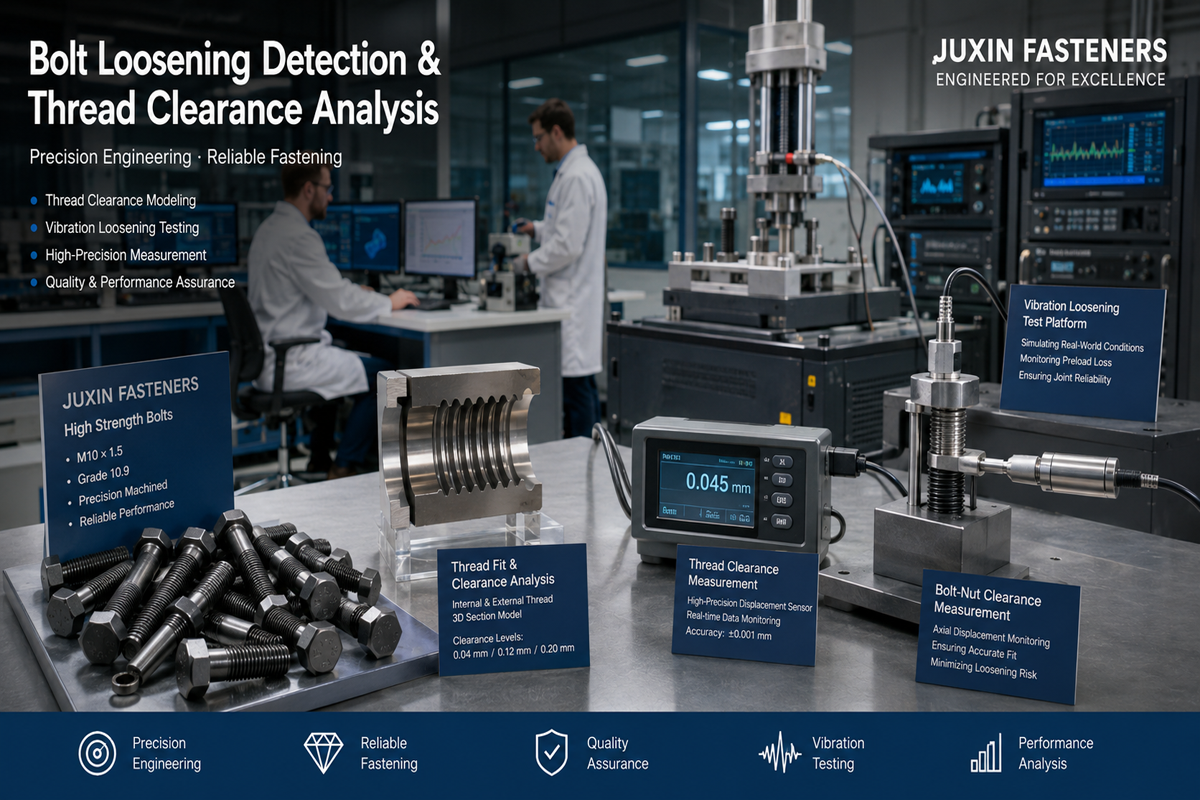
Thread pair clearance refers to the radial and geometric clearance between internal and external threads when a bolt and nut are assembled.
In real engineering systems:
Perfect zero-clearance thread engagement does not exist
Manufacturing tolerances always introduce gaps
The magnitude of this clearance varies depending on machining precision
Even small variations in thread geometry can significantly influence:
Load distribution
Contact stability
Friction behavior
Anti-loosening torque retention
Engineering Model Insight (M10×1.5 System)
A high-precision finite element model based on Fukuoka’s thread modeling method was developed to simulate:
0.04 mm clearance
0.12 mm clearance
0.20 mm clearance
Under transverse vibration loading conditions, the results clearly show:
Larger thread clearance leads to more severe micro-sliding between the thread flanks and to unstable contact behavior at the bearing surfaces.
2. Why Thread Clearance Directly Affects Bolt Loosening
Under transverse vibration, bolt joints do not fail randomly. Instead, loosening is driven by progressive contact instability.
As thread clearance increases:
2.1 Increased Micro-Slippage
Thread flanks lose stable engagement
Relative sliding increases under lateral load
Frictional resistance becomes inconsistent
2.2 Reduced Bearing Surface Stability
Contact between the bolt head and the joint surface becomes unstable
Load transfer path fluctuates
Preload decay accelerates
2.3 Loss of Anti-Loosening Torque
Friction torque decreases over cycles
Self-locking ability weakens
Preload relaxation accelerates
Key Finding
Thread pair clearance directly governs the stability of the frictional system that maintains bolt preload.
This means that fastener manufacturing precision is not just a dimensional requirement—it is a functional safety parameter.
3. Critical Discovery: Why Bolts Loosen Before Nuts
One of the most interesting findings from the study is the asymmetric loosening behavior:
Bolts loosen earlier than nuts under transverse vibration
Engineering Explanation:
The contact conditions are not symmetrical:
Nut bearing surface contact is more stable
Bolt head bearing surface is more sensitive to vibration-induced micro-motion
As a result:
The bolt experiences a higher effective loosening torque and begins to rotate first.
This phenomenon becomes more severe as thread clearance increases.
4. Vibration Amplitude and “Critical Loosening Threshold.”
The study further identifies a key nonlinear behavior:
Low vibration amplitude:
No relative rotation
Joint remains stable
Medium vibration amplitude:
Bolt loosening begins
Nut remains stable
High vibration amplitude:
Both bolt and nut rotate
Rapid preload loss occurs
Critical Insight
The “critical amplitude threshold” is not fixed.
It is strongly dependent on:
Thread pair clearance
Contact stiffness
Friction coefficient stability
This explains why identical bolts behave differently under the same vibration conditions in real-world applications.
5. Experimental Validation: Measured Impact of Clearance Control
To validate the simulation results, controlled vibration tests were conducted using specially machined fasteners with different thread clearances:
0.04 mm
0.12 mm
0.20 mm
Test conditions:
Transverse vibration amplitude: 0.5 mm
Initial preload: 12 kN
Key Result
Reducing thread clearance by 0.08 mm reduces the bolt loosening rate by approximately 23%
This is a significant improvement in fatigue-sensitive and vibration-critical applications.
6. Engineering Implications: Manufacturing Precision Matters More Than Expected
Thread pair clearance is not typically a design variable—it is primarily determined by:
Thread machining accuracy
Tool wear condition
Manufacturing tolerances
Quality control of bolt and nut production
However, this research highlights an important shift in perspective:
Fastener performance is defined not only by material grade or preload design but also by manufacturing-level geometric precision.
Industrial Reality
Within the same production batch:
Larger tolerance deviation parts
Lower thread consistency components
are more likely to experience:
Faster preload loss
Higher loosening risk
Reduced fatigue life
This makes thread geometry control as important as mechanical strength testing.
7. Quality Control Perspective for High-Reliability Fasteners
For manufacturers and engineering procurement teams, this research suggests a new quality focus:
Beyond:
Tensile strength (ISO 898-1 / DIN standards)
Hardness and yield strength
Engineers should also emphasize:
Thread dimensional accuracy
Thread pair clearance distribution
Consistency of nut–bolt engagement behavior
This is especially critical for:
Aerospace fasteners
Rail transit structural bolts
Wind turbine bolting systems
Heavy machinery vibration environments
8. Role of High-Fidelity Simulation in Fastener Engineering
The study also confirms that modern finite element modeling is highly reliable:
Preload error vs theoretical calculation: < 5%
Accurate representation of threaded contact behavior
Validated vibration-induced loosening prediction
This indicates that:
Digital simulation has become a core tool for understanding and predicting bolted joint failure mechanisms.
9. Engineering Fastener Solutions for High-Vibration Applications
In practical industrial applications, controlling thread quality and precision is essential for improving joint reliability.
Guangzhou Juxin Development Co., Ltd. provides engineered fastening solutions, including:
High-precision ISO/DIN standard bolts and nuts
Controlled thread tolerance manufacturing systems
High-vibration resistant structural fasteners
Custom-engineered bolting solutions for critical assemblies
Our focus is not only on material strength but also on controlling thread geometry and optimizing assembly reliability.
Conclusion: Thread Clearance Is a Hidden Safety Parameter
Bolt loosening is not a single-factor problem. It is a multi-physics interaction involving:
Vibration mechanics
Friction behavior
Preload stability
Manufacturing precision
This research clearly demonstrates that:
Thread pair clearance is a hidden but critical factor controlling bolt loosening behavior.
For future engineering design and manufacturing practice, controlling thread precision may become as important as controlling preload itself.
In high-reliability systems, even micrometer-level differences in thread geometry can determine whether a joint remains secure—or gradually fails in service.
Product Packaging
Packaging Standard
At Juxin Fasteners, we apply standardized export packaging to ensure product protection, traceability, and compliance with international logistics requirements.
1. Standard Export Packaging
Unless otherwise specified, all products will be packed according to our factory standard export packaging, which includes:
Moisture-resistant inner protection
Poly bag or small box packing as required
Reinforced export cartons
Clear labeling with part number, specification, batch number, and quantity
Palletizing for sea or air shipment when necessary
Our standard packaging is designed to ensure safe transportation, efficient warehousing, and long-distance international shipping.
2. Customized Packaging Options
We also provide customized packaging solutions according to customer requirements, including but not limited to:
Private labeling
Customized barcodes
Specific carton dimensions
Retail packaging
Special pallet configuration
Customer-specific marking and identification
So that you know, customized packaging may involve additional costs and extended lead time depending on the complexity of the requirements.
3. Compliance & Quality Assurance
All packaging processes are controlled under our ISO 9001 quality management system to ensure consistency, traceability, and product integrity throughout the supply chain.
Product Pictures
Contact Us
Tel.:
+86 020 8621 0320
+86 020 3121 6067
E-mail:
Technical Support:
Navigation
SEND INQUIREY