Call Us
+86 136 6007 9809
Call Us
+86 136 6007 9809

High Temperature vs Low Temperature Bolts: Why Can the Same Bolt Cost 20 Times More?
Engineering Guide to Extreme Temperature Fastener Material Selection
Selecting industrial bolts for standard operating conditions is relatively straightforward. Engineers typically evaluate tensile strength, yield strength, preload requirements, and safety factors before making a decision.
Product Specification
High Temperature vs Low Temperature Bolts: Why Can the Same Bolt Cost 20 Times More?
Engineering Guide to Extreme Temperature Fastener Material Selection
Selecting industrial bolts for standard operating conditions is relatively straightforward. Engineers typically evaluate tensile strength, yield strength, preload requirements, and safety factors before making a decision.
However, when operating temperatures deviate significantly from ambient conditions, the selection process becomes significantly more complex.
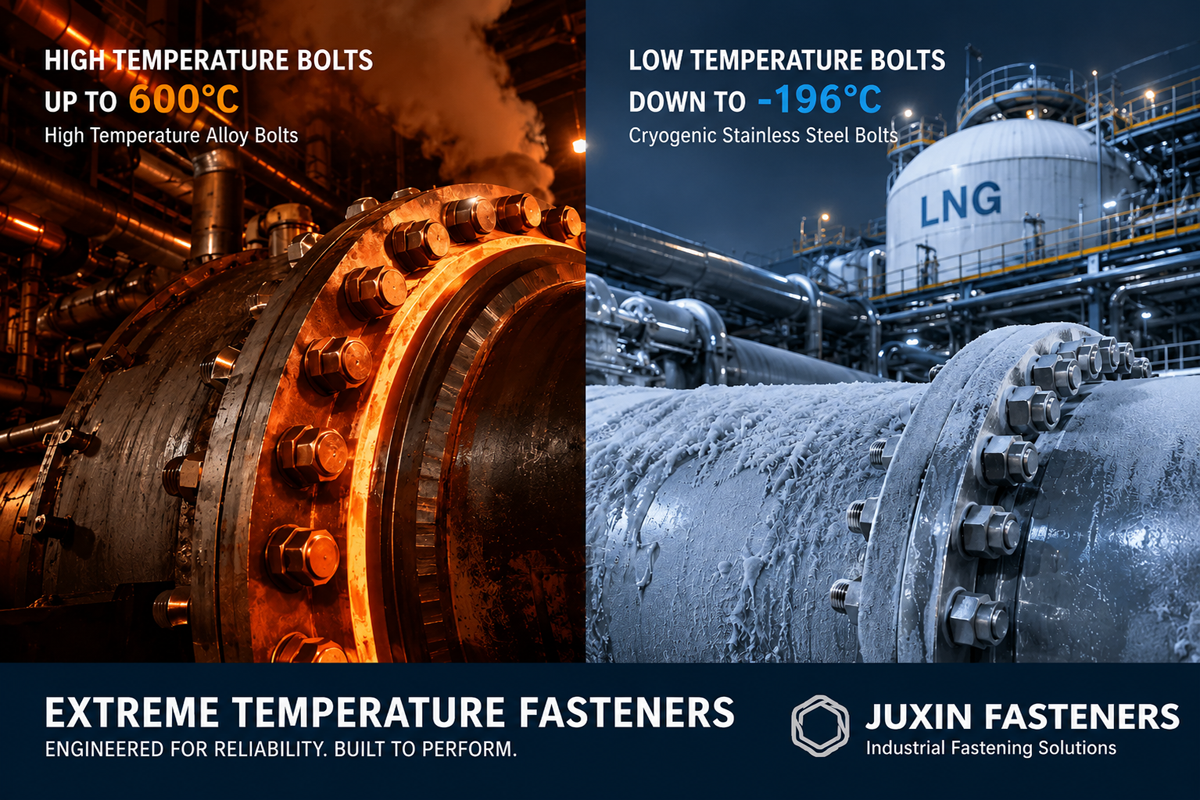
A standard M24 bolt used in a petrochemical reactor operating at 600°C is fundamentally different from a bolt used on an LNG pipeline exposed to -162°C. Although both components may appear identical externally, their material composition, manufacturing process, testing requirements, and service life expectations are entirely different.
This is why the cost of a high-performance temperature-resistant bolt can be 10 to 20 times higher than that of a conventional industrial fastener.
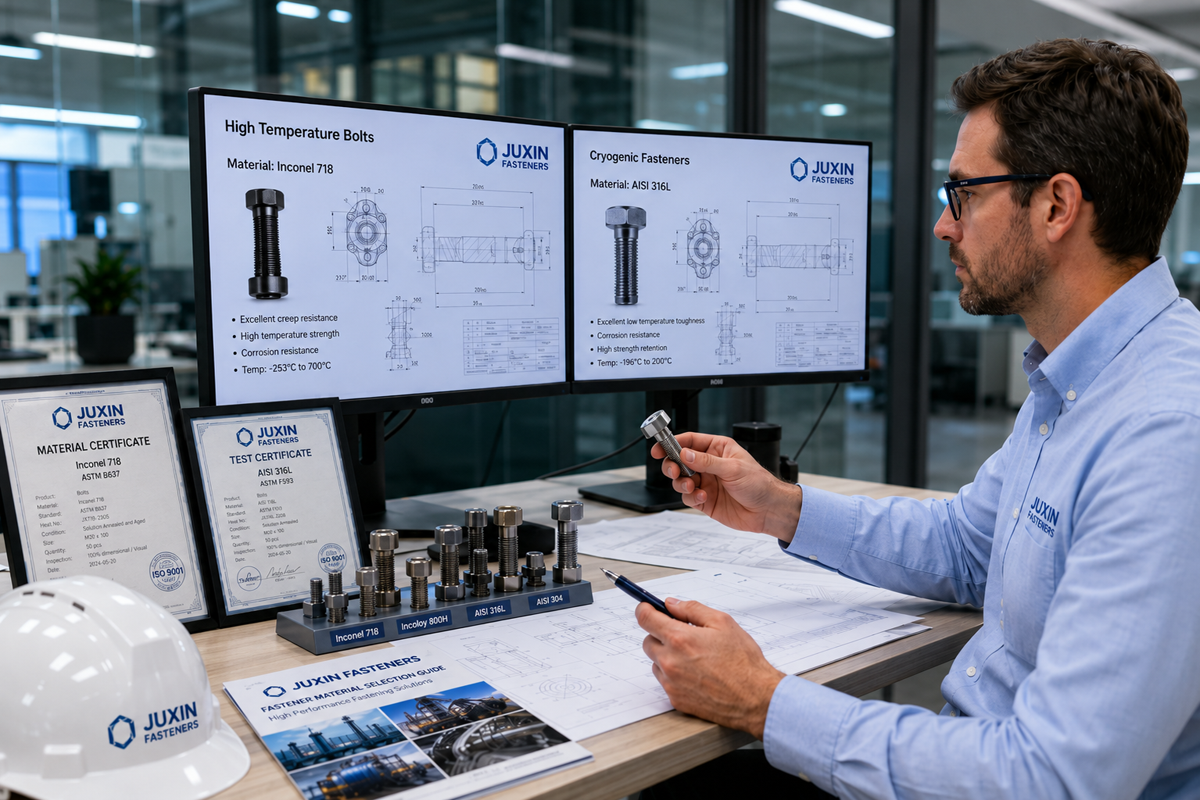
At JUXIN FASTENERS, we help global customers select optimal high-temperature, low-temperature, and extreme-temperature fastening solutions for power generation, LNG infrastructure, petrochemical facilities, aerospace systems, and critical industrial equipment.
Why Conventional Bolt Selection Rules Fail at Extreme Temperatures
Under room-temperature conditions, bolt selection primarily focuses on:
Tensile strength
Yield strength
Fatigue resistance
Corrosion protection
Safety factor requirements
Extreme temperatures introduce entirely different failure mechanisms.
High Temperature Challenge: Creep Deformation
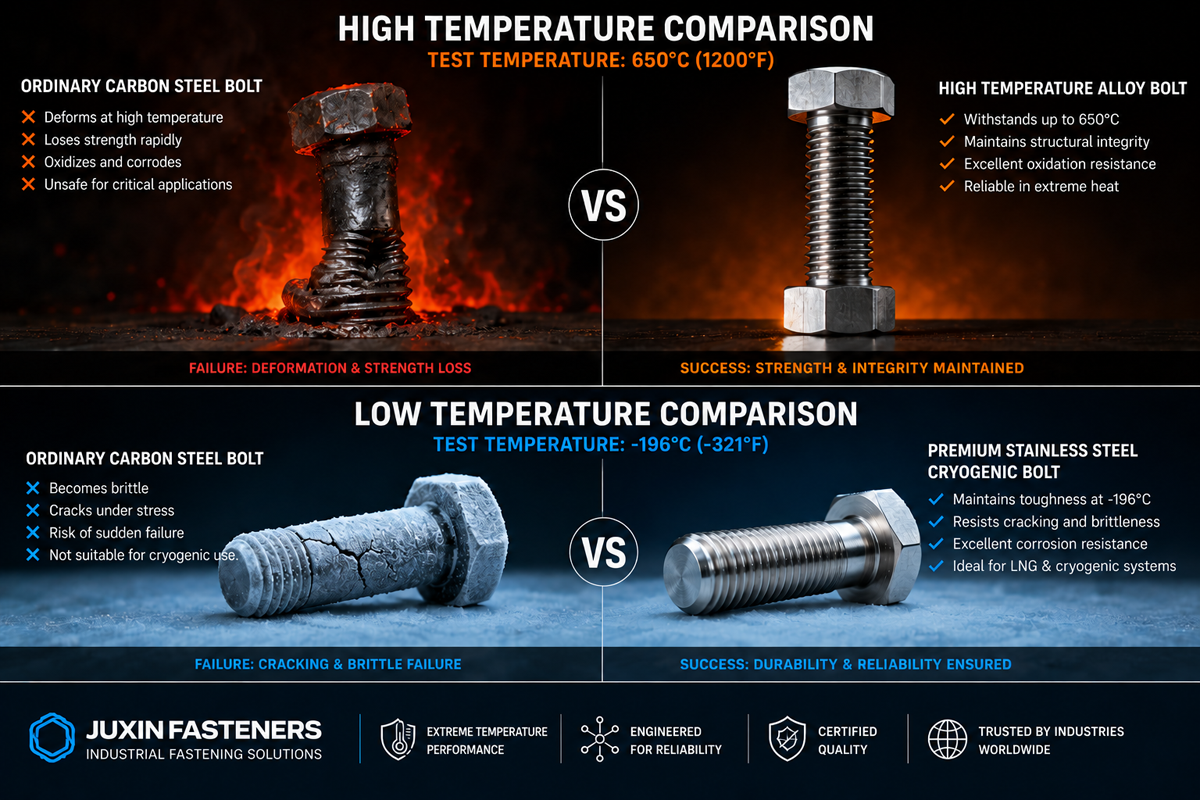
At temperatures above approximately 300°C, metals begin experiencing creep.
Creep is the gradual deformation of a material under constant load over time. Even when the applied load remains unchanged, a bolt can slowly elongate, lose preload, and eventually fail.
For standard carbon steel fasteners, creep becomes increasingly significant above 450°C, making conventional bolt materials unsuitable for long-term service.
For this reason, high-temperature fasteners must be selected based on:
Creep resistance
Stress relaxation resistance
Thermal stability
Long-term mechanical strength
Low Temperature Challenge: Brittle Fracture
Cryogenic applications create the opposite problem.
Carbon steel and low-alloy steel materials lose impact toughness as temperatures decrease. At extremely low temperatures, these materials can fracture suddenly without noticeable deformation.
This phenomenon is known as a brittle fracture.
In LNG facilities, liquid gas processing systems, and cryogenic storage tanks, brittle failure is one of the most critical design concerns.
Therefore, low-temperature bolts and cryogenic fasteners must prioritize:
Impact toughness
Fracture resistance
Material ductility
Low-temperature structural stability
High Temperature Bolt Material Selection Guide
200°C – 450°C Applications
This temperature range is common in:
Industrial boilers
Steam piping systems
Heat exchangers
Medium-temperature petrochemical equipment
Recommended materials include:
35CrMo Alloy Steel
42CrMo Alloy Steel
These chromium-molybdenum steels provide excellent strength and moderate creep resistance when properly quenched and tempered.
Typical Applications
Steam system flange connections
Industrial pressure vessels
Turbine auxiliary equipment
Petrochemical processing units
450°C – 550°C Applications
This range is frequently encountered in:
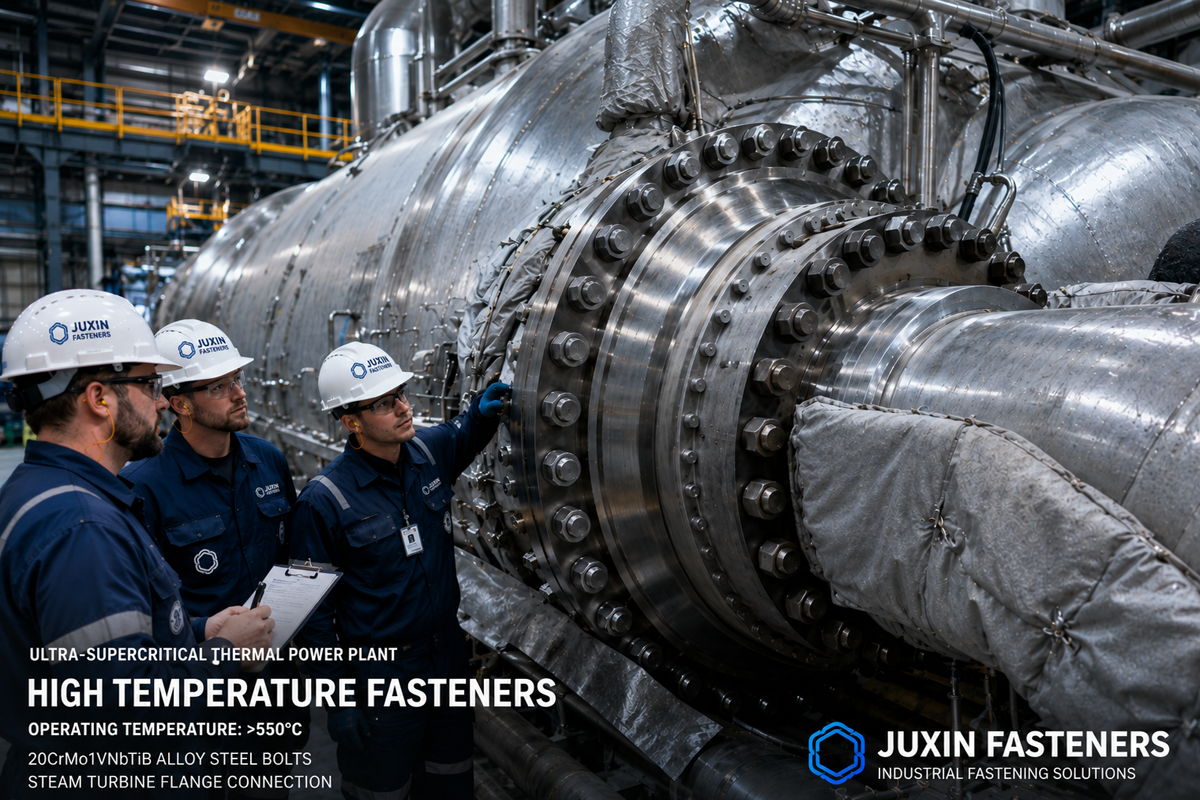
Supercritical power plants
Ultra-supercritical power generation systems
Steam turbine flanges
One of the most widely used materials is:
20CrMo1VNbTiB Steel
This advanced creep-resistant alloy incorporates vanadium and niobium to improve grain boundary stability and long-term strength retention.
Compared with conventional Cr-Mo steels, it offers significantly better resistance to preload relaxation and creep deformation.
Typical Applications
High-pressure steam turbines
Intermediate-pressure turbine casings
Thermal power generation equipment
Power plant fastening systems
550°C – 650°C Applications
At these temperatures, conventional alloy steels begin reaching their performance limits.
Recommended materials include:
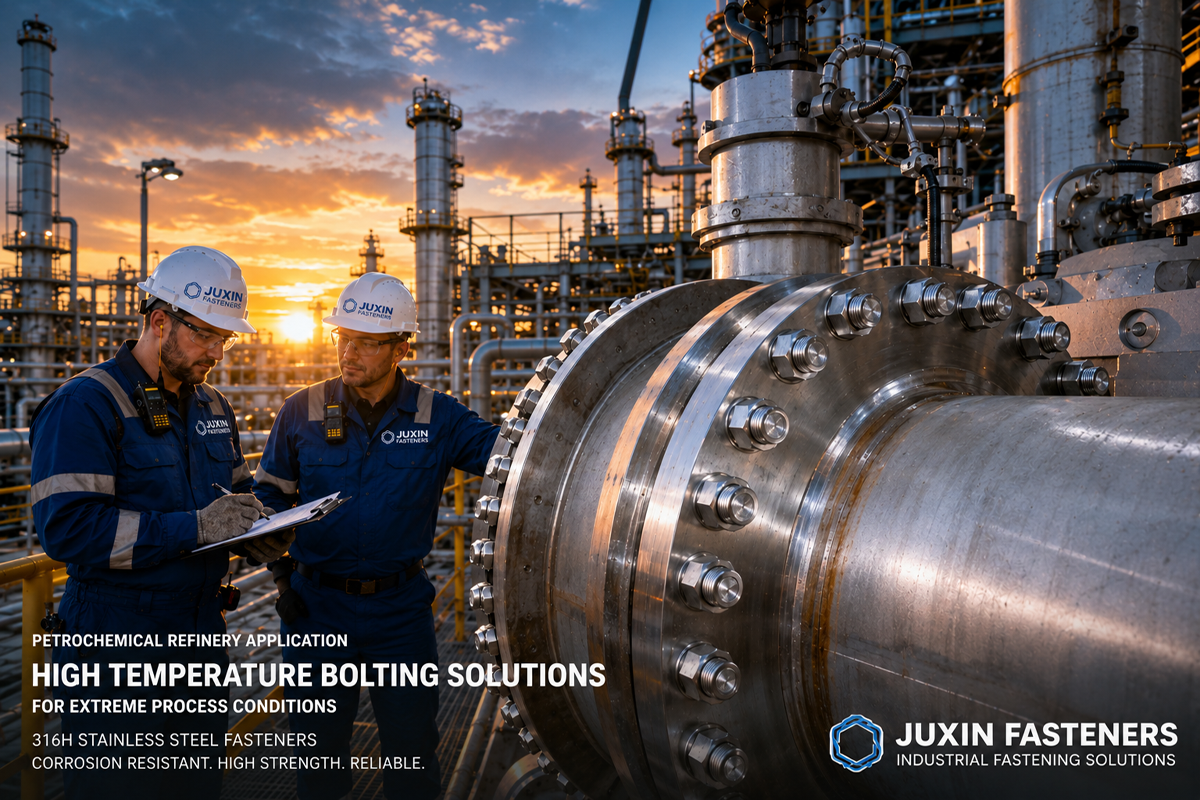
316H Stainless Steel Bolts
Advantages:
Excellent oxidation resistance
Good creep strength
Strong corrosion resistance
Commonly used in:
Hydroprocessing units
Refinery equipment
Chemical reactors
321H Stainless Steel Bolts
Benefits include:
Improved thermal stability
Enhanced resistance to intergranular corrosion
Widely used in:
High-temperature exhaust systems
Petrochemical processing plants
Inconel 718 (GH4169) Bolts
For critical applications requiring exceptional reliability, Inconel 718 bolts provide superior performance.
Applications include:
Nuclear power systems
Gas turbines
Aerospace engines
High-temperature pressure equipment
Above 650°C Applications
When temperatures exceed 650°C, nickel-based superalloys become the preferred solution.
Inconel 718 Fasteners
Key advantages include:
Tensile strength exceeding 1000 MPa
Outstanding creep resistance
Excellent oxidation resistance
Service capability from cryogenic temperatures up to approximately 650°C
Typical Industries
Aerospace
Aviation engines
Industrial gas turbines
Petrochemical cracking furnaces
Energy infrastructure
Although a single nickel-alloy bolt may cost dozens of times more than a conventional steel bolt, its service life and operational reliability often justify the investment.
Thermal Expansion: A Critical Factor Often Overlooked
Selecting the correct material is only part of the solution.
Engineers must also consider the coefficient of thermal expansion.
When a bolt and flange expand at different rates during startup and shutdown cycles, preload loss or excessive stress may occur.
For optimal performance:
Stainless steel bolts should ideally be paired with stainless steel flanges.
Similar thermal expansion coefficients help maintain a stable preload.
Reduced thermal mismatch minimizes fatigue and joint failure risks.
This consideration is especially important for:
Power plant fasteners
Petrochemical flange bolts
Heat exchanger assemblies
Steam turbine connections
Low Temperature Bolt Material Selection Guide
Why Austenitic Materials Dominate Cryogenic Applications
Material crystal structure determines low-temperature performance.
Materials with a Face-Centered Cubic (FCC) structure retain ductility at extremely low temperatures.
Examples include:
Austenitic stainless steels
Nickel alloys
Certain aluminum alloys
These materials remain tough even under cryogenic conditions.
LNG Applications (-196°C to -162°C)
The most commonly used materials are:
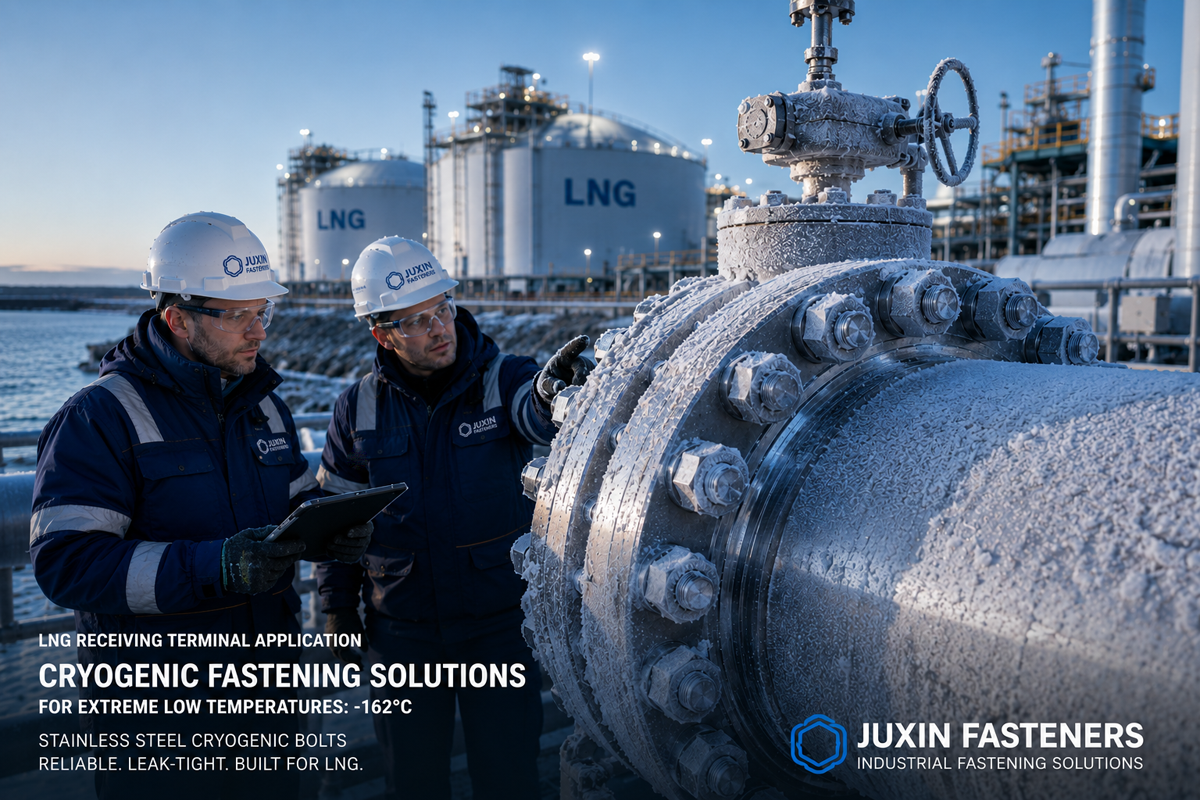
304L Stainless Steel Bolts
Advantages:
Excellent cryogenic toughness
Good weldability
Cost-effective solution
Applications:
LNG storage tanks
Cryogenic valves
Low-temperature piping systems
316L Stainless Steel Bolts
Advantages:
Superior chloride corrosion resistance
Excellent low-temperature ductility
Enhanced marine environment performance
Applications:
Coastal LNG terminals
Offshore energy facilities
Cryogenic processing plants
As a result, 316L stainless steel bolts are among the most widely specified LNG fasteners worldwide.
Ultra-Low Temperature Applications
For more demanding environments, engineers often select:
UNS N08926 (1.4529)
Features include:
High nickel content
High molybdenum content
Exceptional pitting resistance
Excellent cryogenic toughness
Applications:
Air separation plants
Offshore energy projects
Cryogenic process equipment
Chemical storage systems
Material Purity Matters More Than Many Buyers Realize
In cryogenic applications, material grade alone is not sufficient.
Impurities such as:
Sulfur
Phosphorus
Non-metallic inclusions
can significantly reduce low-temperature toughness.
Therefore, professional procurement teams should always review:
Mill Test Certificates (MTC)
Chemical composition reports
Impact testing results
Heat treatment records
Mechanical property certifications
For critical LNG and cryogenic projects, material traceability is essential.
Surface Treatment Recommendations for Low-Temperature Fasteners
Traditional coatings may crack under cryogenic conditions.
For cryogenic bolts and low temperature fasteners, preferred surface treatments include:
Passivation
Phosphating
Controlled surface finishing
These treatments reduce stress concentration risks while maintaining long-term corrosion resistance.
Quick Engineering Selection Guide
Below -50°C
Recommended:
✔ 304L Stainless Steel Bolts
✔ 316L Stainless Steel Bolts
✔ Nickel Alloy Fasteners
Avoid:
✘ Carbon Steel Bolts
✘ Standard Alloy Steel Fasteners
200°C – 450°C
Recommended:
✔ 35CrMo Bolts
✔ 42CrMo Bolts
✔ Heat-Resistant Alloy Steel Fasteners
450°C – 550°C
Recommended:
✔ 20CrMo1VNbTiB High Temperature Bolts
✔ Power Plant Fasteners
✔ Turbine Flange Bolts
Above 550°C
Recommended:
✔ Inconel 718 Bolts
✔ Nickel Alloy Fasteners
✔ High Temperature Superalloy Bolts
JUXIN FASTENERS Extreme Temperature Fastening Solutions
With over 23 years of manufacturing experience, JUXIN FASTENERS supplies custom-engineered fastening solutions for demanding industrial environments.
Our product range includes:
High Temperature Bolts
Low Temperature Bolts
Cryogenic Fasteners
Inconel 718 Bolts
Nickel Alloy Bolts
Stainless Steel Fasteners
LNG Fasteners
Power Plant Fasteners
Petrochemical Fasteners
Custom Industrial Fasteners
We support OEM and project-based manufacturing in accordance with international standards, customer drawings, and application-specific performance requirements.
Whether your project operates at 650°C in a gas turbine or at -196°C in an LNG storage system, selecting the correct fastening material is key to ensuring safety, reliability, and long-term operational success.
JUXIN FASTENERS — Engineering Reliable Fastening Solutions for Extreme Temperature Applications Worldwide.
Product Packaging
Packaging Standard
At Juxin Fasteners, we apply standardized export packaging to ensure product protection, traceability, and compliance with international logistics requirements.
1. Standard Export Packaging
Unless otherwise specified, all products will be packed according to our factory standard export packaging, which includes:
Moisture-resistant inner protection
Poly bag or small box packing as required
Reinforced export cartons
Clear labeling with part number, specification, batch number, and quantity
Palletizing for sea or air shipment when necessary
Our standard packaging is designed to ensure safe transportation, efficient warehousing, and long-distance international shipping.
2. Customized Packaging Options
We also provide customized packaging solutions according to customer requirements, including but not limited to:
Private labeling
Customized barcodes
Specific carton dimensions
Retail packaging
Special pallet configuration
Customer-specific marking and identification
So that you know, customized packaging may involve additional costs and extended lead time depending on the complexity of the requirements.
3. Compliance & Quality Assurance
All packaging processes are controlled under our ISO 9001 quality management system to ensure consistency, traceability, and product integrity throughout the supply chain.
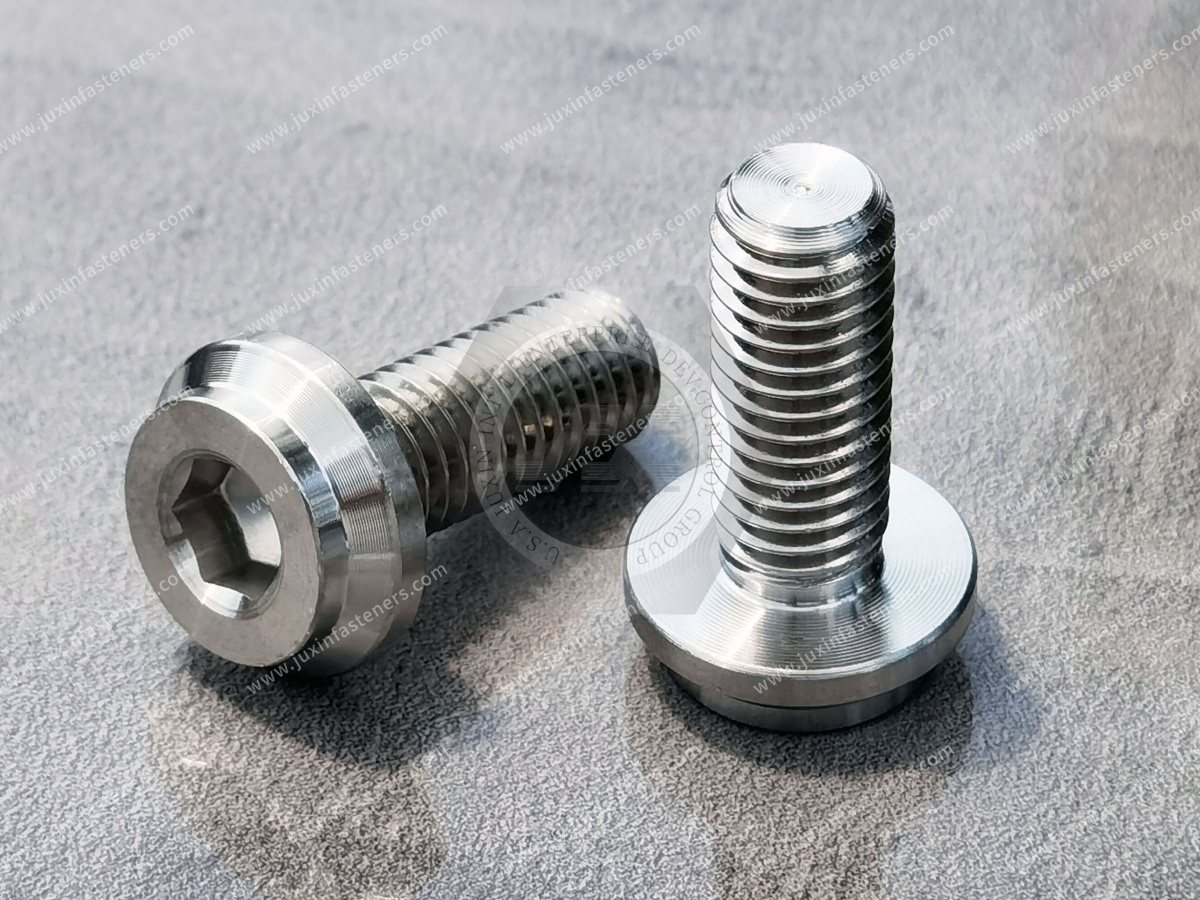
Product Pictures
Contact Us
Tel.:
+86 020 8621 0320
+86 020 3121 6067
E-mail:
Technical Support:
Navigation
SEND INQUIREY