Call Us
+86 136 6007 9809
Call Us
+86 136 6007 9809

Why Stainless Steel Bolts Can Accelerate Corrosion in Certain Industrial Applications
Electrochemical Mechanism & Fastener Corrosion Design Solution for Harsh Environments
In marine engineering, offshore structures, rail transit systems, and heavy industrial equipment, stainless steel bolts are widely considered a premium solution for corrosion resistance. However, field experience shows a counterintuitive phenomenon:
Product Specification
Why Stainless Steel Bolts Can Accelerate Corrosion in Certain Industrial Applications
Electrochemical Mechanism & Fastener Corrosion Design Solution for Harsh Environments
In marine engineering, offshore structures, rail transit systems, and heavy industrial equipment, stainless steel bolts are widely considered a premium solution for corrosion resistance. However, field experience shows a counterintuitive phenomenon:
In certain assemblies, replacing hot-dip galvanized bolts with stainless steel fasteners can lead to more severe localized corrosion instead of improved protection.
This behavior is not related to material quality alone, but to the electrochemical interaction within the entire fastening system.
1. Field Observation: Corrosion Appearing After Upgrading to Stainless Steel Fasteners
A marine flange connection operated stably for years using HDG bolts (hot-dip galvanized fasteners) without corrosion issues.
During a maintenance upgrade:
Original HDG bolts were replaced with stainless steel bolts (A2/A4 fasteners)
Later, gasket materials were upgraded from 316L stainless steel to 6Mo super austenitic stainless steel
Unexpectedly, corrosion still developed in the system
Corrosion characteristics:
Localized attack concentrated in the narrow crevice between gasket and flange
Corrosion intensity higher near the gasket interface
No improvement even after upgrading stainless steel grades
This case clearly demonstrates that improving stainless steel grade alone does not guarantee better corrosion resistance in bolted joints.
2. Why Stainless Steel Fasteners Can Trigger Corrosion
Corrosion in bolted connections is governed by electrochemical coupling rather than individual material performance.
In a multi-material fastening system:
One material behaves as the anodic component
Another acts as the cathodic surface
The entire assembly forms a galvanic corrosion circuit
When switching from galvanized steel bolts to stainless steel fasteners, the system electrochemical balance changes significantly.
Key effect:
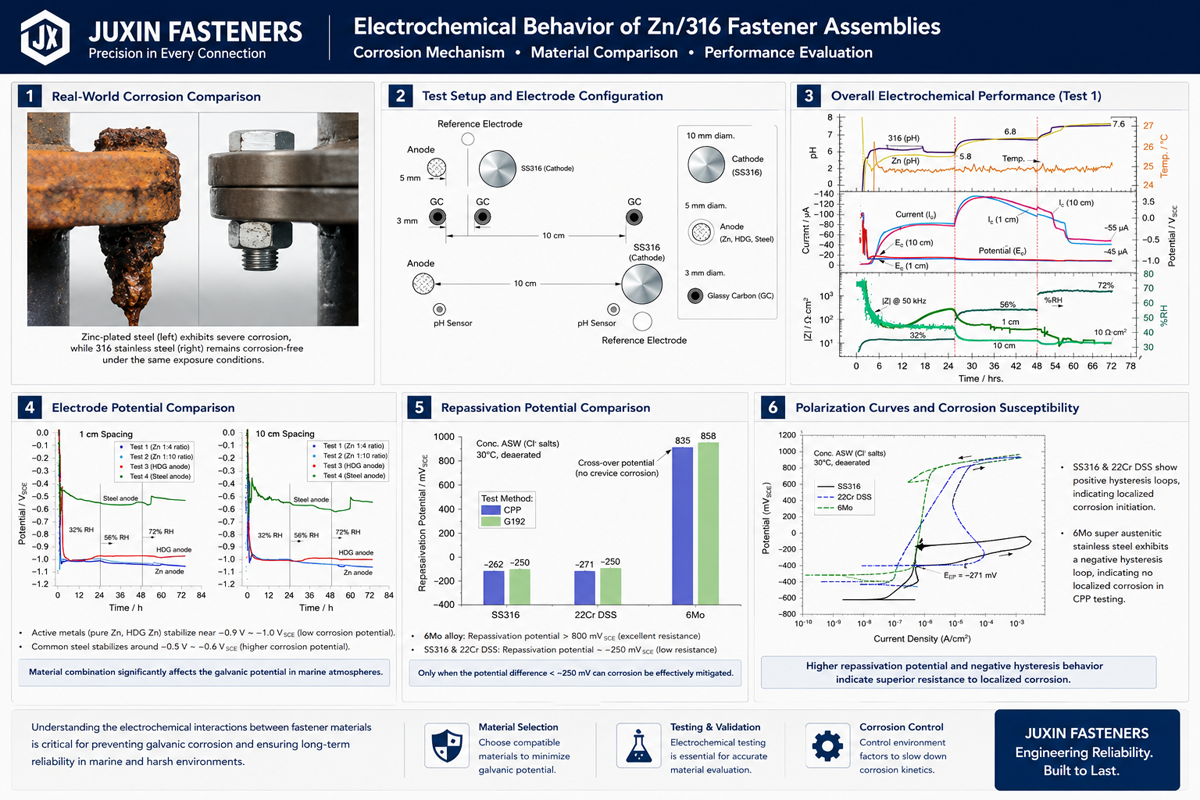
The protective zinc layer in galvanized bolts acts as a sacrificial element, keeping the system potential low and suppressing corrosion in critical crevice zones.
Once replaced by stainless steel bolts, this protective electrochemical buffering disappears.
3. System Potential Shift in Fastener Assemblies
Experimental simulation in marine salt-film environments shows that different bolt materials strongly influence the overall electrochemical potential of the connection system.
Typical behavior:
Zinc-based bolts or HDG fasteners
System potential: approximately -0.9 V to -1.0 V (SCE)
Strong suppression of localized corrosion
Stable performance even under humidity and chloride variation
Carbon steel bolts
System potential: approximately -0.5 V to -0.6 V
Partial protection effect
Increased risk of crevice corrosion over time
Stainless steel bolts
System potential shifts to a more noble range
In many cases enters a range where stainless steel structures become electrochemically active in chloride environments
This explains why stainless steel fasteners do not always provide better corrosion resistance in mixed-material assemblies.
4. Repassivation Behavior of Stainless Steel in Fastener Joints
Corrosion stability is also governed by the ability of stainless steel to maintain a passive film.
Typical repassivation potentials:
316 stainless steel bolts: around -250 mV (SCE)
22Cr duplex stainless steel fasteners: around -270 mV (SCE)
6Mo super austenitic stainless steel: significantly higher resistance to localized corrosion initiation
Engineering interpretation:
If the system potential remains above the repassivation threshold → localized corrosion continues
If the system potential is pushed below this threshold → corrosion propagation is suppressed
This is the core reason why corrosion behavior depends more on system interaction than on selecting higher-grade stainless steel bolts.
5. Crevice Corrosion in Stainless Steel Bolted Connections
In real engineering structures, corrosion is often concentrated in:
Gasket-to-flange interfaces
Bolt preload contact zones
Narrow oxygen-depleted crevices
These areas create ideal conditions for crevice corrosion in stainless steel fasteners, driven by:
Oxygen concentration differences
Chloride accumulation in confined gaps
Local acidification inside the joint
Even high-performance stainless steel bolts cannot fully eliminate this risk if the electrochemical environment remains unfavorable.
6. Why “Better Material” Does Not Always Mean “Better Protection”
The failure mechanism observed in field cases can be summarized as:
Galvanized bolts provide a low-potential electrochemical environment
Stainless steel bolts remove this buffering effect
The system potential rises into a range where corrosion becomes sustainable
Upgrading gasket materials alone cannot correct this imbalance
Therefore, corrosion resistance in bolted assemblies is not determined by the corrosion resistance rating of a single material, but by the electrochemical compatibility of the entire fastening system.
7. Engineering Approach to Fastener Corrosion Prevention
A reliable anti-corrosion strategy for industrial fastening systems should focus on system-level design:
7.1 Control galvanic coupling in bolt assemblies
Avoid uncontrolled mixing of metals that create unfavorable electrochemical potential shifts.
7.2 Use sacrificial protection where appropriate
In marine and offshore applications, hot-dip galvanized bolts or zinc-based protection systems can sometimes outperform stainless steel fasteners in real operating conditions.
7.3 Design crevice-optimized joints
Reduce stagnant electrolyte zones in flange and gasket interfaces to minimize crevice corrosion in stainless steel bolts.
7.4 Select stainless steel grades based on system behavior
316 stainless steel fasteners: general marine applications
Duplex stainless steel bolts (22Cr): improved chloride resistance
6Mo stainless steel fasteners: high-end corrosive environments
But material selection must always be matched with system potential control.
8. Industrial Fastener Design Insight
For engineers and procurement teams working with industrial fasteners, the key takeaway is:
Corrosion performance in bolted joints is determined by electrochemical system balance, not by upgrading to higher-grade stainless steel bolts alone.
A stable design must consider:
Galvanic interaction between bolts, flanges, and gaskets
Electrochemical potential distribution in the assembly
Crevice geometry and electrolyte conditions
Long-term stability of passive films on stainless steel fasteners
9. Engineering Fastener Solutions from JUXIN FASTENERS
At JUXIN FASTENERS, we specialize in engineered fastening systems for demanding environments, including:
Stainless steel bolts for marine and offshore structures
High-performance galvanized fasteners for corrosion-critical applications
Automotive structural fastening systems
Anti-loosening and vibration-resistant industrial fasteners
Customized fastening solutions for mixed-material assemblies
Our engineering approach focuses on:
Designing the entire fastening system rather than only upgrading individual fastener materials.
Conclusion
The phenomenon where stainless steel bolts appear to cause corrosion is not a contradiction—it is a system-level electrochemical effect.
In many industrial applications:
Hot-dip galvanized bolts can provide more stable corrosion protection than stainless steel fasteners
Stainless steel does not guarantee corrosion immunity in galvanically active assemblies
The real design challenge is controlling system potential and crevice conditions, not simply upgrading material grade
Understanding this principle allows engineers to design truly reliable corrosion-resistant fastening systems for marine, offshore, and heavy industrial environments.
Product Packaging
Packaging Standard
At Juxin Fasteners, we apply standardized export packaging to ensure product protection, traceability, and compliance with international logistics requirements.
1. Standard Export Packaging
Unless otherwise specified, all products will be packed according to our factory standard export packaging, which includes:
Moisture-resistant inner protection
Poly bag or small box packing as required
Reinforced export cartons
Clear labeling with part number, specification, batch number, and quantity
Palletizing for sea or air shipment when necessary
Our standard packaging is designed to ensure safe transportation, efficient warehousing, and long-distance international shipping.
2. Customized Packaging Options
We also provide customized packaging solutions according to customer requirements, including but not limited to:
Private labeling
Customized barcodes
Specific carton dimensions
Retail packaging
Special pallet configuration
Customer-specific marking and identification
So that you know, customized packaging may involve additional costs and extended lead time depending on the complexity of the requirements.
3. Compliance & Quality Assurance
All packaging processes are controlled under our ISO 9001 quality management system to ensure consistency, traceability, and product integrity throughout the supply chain.
Product Pictures
Contact Us
Tel.:
+86 020 8621 0320
+86 020 3121 6067
E-mail:
Technical Support:
Navigation
SEND INQUIREY