Call Us
+86 136 6007 9809
Call Us
+86 136 6007 9809

Aluminum Alloy Bolts in New Energy Vehicle Battery Packs: Engineering Application and ISO/DIN Fastening Solution
Lightweight Fastening Strategy for EV Battery Structural Systems
With the rapid expansion of the electric vehicle industry—global EV production and sales increased by 18% in Q1 2026—battery pack structural design has become a critical engineering focus.
Product Specification
Aluminum Alloy Bolts in New Energy Vehicle Battery Packs: Engineering Application and ISO/DIN Fastening Solution
Lightweight Fastening Strategy for EV Battery Structural Systems
With the rapid expansion of the electric vehicle industry—global EV production and sales increased by 18% in Q1 2026—battery pack structural design has become a critical engineering focus.
Modern battery systems widely adopt full aluminum alloy enclosures, typically using 6xxx and 7xxx series aluminum alloys, which raises a key engineering question:
Should battery pack fastening systems use aluminum alloy bolts or traditional steel fasteners?
This article provides a technical application guide based on ISO 898-1 / ISO 16047 / DIN fastening engineering principles, analyzing when and how to use aluminum alloy bolts for EV battery pack systems.
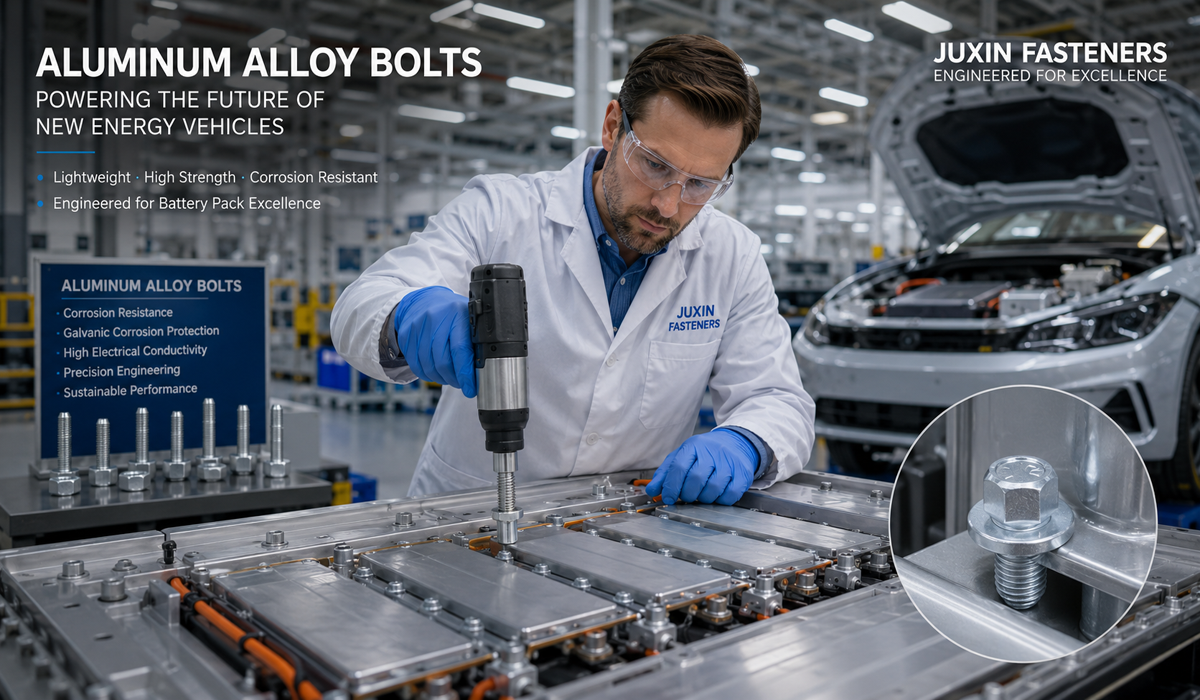
1. Why Battery Packs Are Naturally Suitable for Aluminum Alloy Fasteners
1.1 Material Compatibility Advantage
Battery housings made from 6xxx / 7xxx aluminum alloys naturally align with:
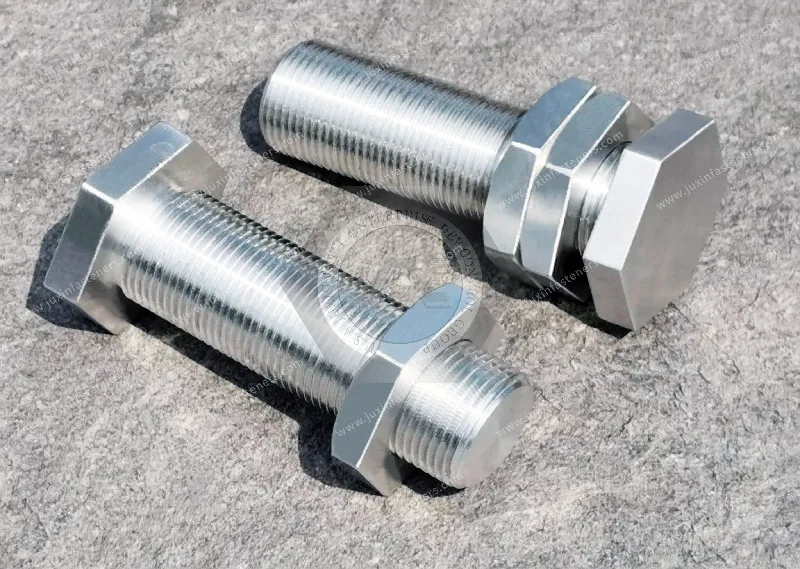
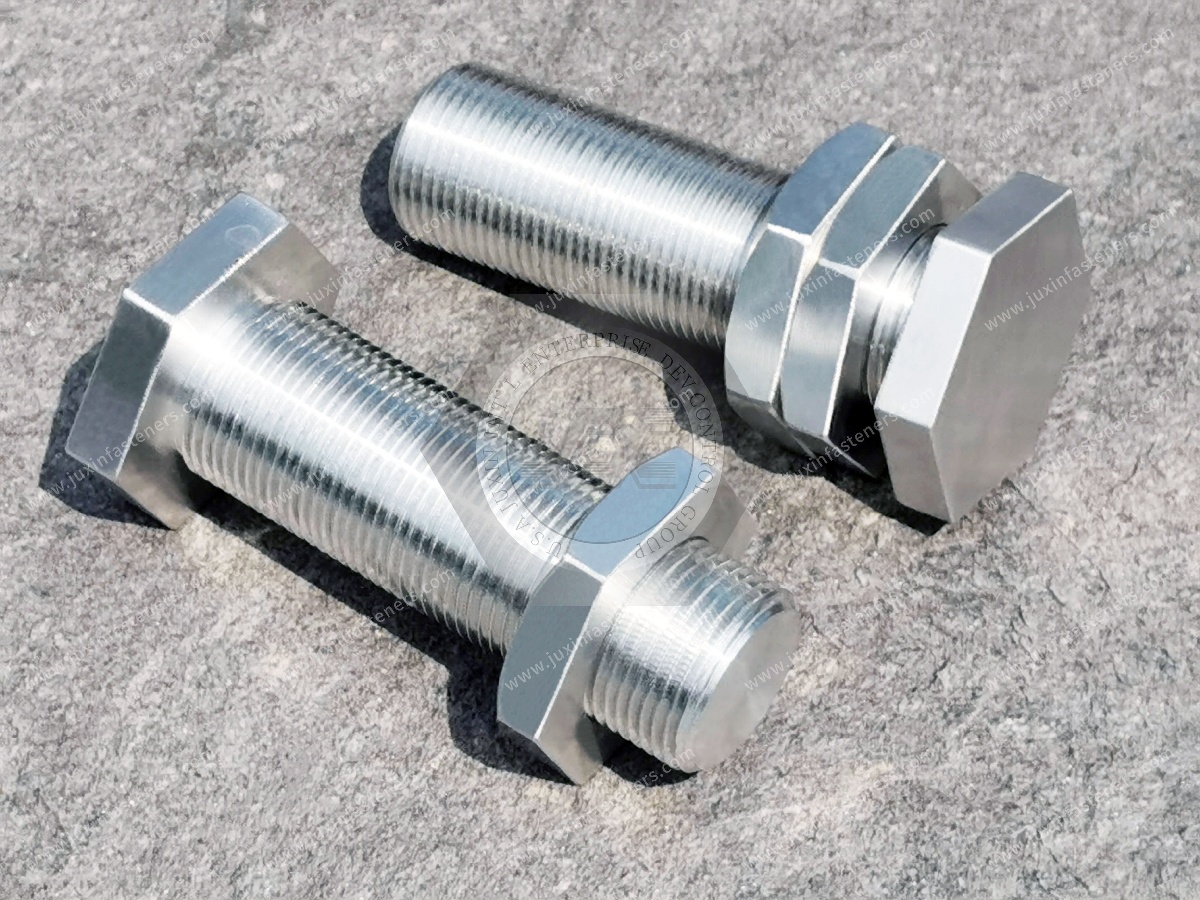
Aluminum alloy bolts
Aluminum structural fasteners
Lightweight threaded connection systems
This material consistency helps:
Reduce galvanic corrosion risk
Improve thermal expansion compatibility
Enhance long-term joint stability
1.2 Lightweight Engineering Benefit
Compared with steel fasteners:
Aluminum alloy bolts weigh ~70% less
Steel fasteners dominate mass in large EV battery packs (hundreds of fastening points)
Even small per-bolt weight reduction leads to:
Significant overall vehicle range improvement through system-level mass reduction
1.3 Common Application Zones in Battery Packs
Aluminum alloy bolts for EV battery pack fastening systems are typically used in:
Battery module interconnect brackets
Battery tray and cover plate fastening points
Auxiliary high-voltage connector fixation systems
These areas share common characteristics:
Medium load conditions
High vibration exposure
High weight sensitivity
Assembly efficiency requirements
2. Material Systems: Aluminum Alloy Bolt Performance Range
2.1 6xxx Series Aluminum Fasteners
Tensile strength: ~300–400 MPa
Excellent corrosion resistance
Good formability
Suitable for:
Non-structural fastening
Auxiliary battery pack components
2.2 7xxx Series High-Strength Aluminum Fasteners
Tensile strength: ~480–550 MPa
Improved strength-to-weight ratio
Higher structural capability
Suitable for:
Battery structural connection points
Semi-load-bearing EV applications
Engineering Comparison
High-strength steel bolts (ISO 898-1 Grade 10.9 / 12.9):
1000 MPa tensile strength
Suitable for high-load structural joints
Conclusion:
Aluminum alloy bolts are not a full replacement, but a targeted lightweight engineering solution
3. Key Technical Challenges in EV Battery Applications
3.1 Strength Limitation
Aluminum alloy bolts have inherent mechanical limits:
Lower tensile strength than steel
Not suitable for high-clamping-force joints
Require precise load distribution design
3.2 High-Temperature Creep and Preload Relaxation
EV battery packs can experience:
Fast charging thermal spikes
60°C–80°C sustained operation
Occasional peaks above 100°C
This leads to:
Preload loss
Joint relaxation
Potential sealing failure
Engineering Mitigation
Advanced solutions include:
Rare-earth modified aluminum alloys
Optimized heat treatment processes
High-temperature stabilized fastener designs (up to ~150°C stable operation in advanced grades)
3.3 Electrochemical Corrosion Risk
Battery packs are multi-material systems:
Aluminum housings
Copper busbars
Zinc-coated steel brackets
Mixed alloy interfaces
Electrochemical Principle
Aluminum potential:
~ -1.66 V (highly anodic)
Steel potential:
~ -0.44 V
This creates strong galvanic corrosion driving force.
Risk Scenarios
Galvanic corrosion (dissimilar metals)
Crevice corrosion in confined joints
Accelerated anodic degradation of aluminum bolts
4. Corrosion Protection Strategies for Aluminum Alloy Bolts
4.1 Surface Treatment Engineering
Anodizing Treatment
Forms dense Al₂O₃ oxide layer
Improves corrosion resistance
Widely used in EV structures
Micro-Arc Oxidation (MAO)
Produces ceramic-like oxide coating
Higher hardness and wear resistance
Suitable for high-performance battery systems
4.2 Electrical Isolation Design
Using:
Insulating washers
Non-conductive coatings
Polymer isolation sleeves
Function:
Break the electrochemical current path
Prevent galvanic corrosion loops
4.3 Sacrificial Protection Systems
In severe environments:
Zinc or magnesium sacrificial elements
Controlled corrosion pathway design
Protection of primary aluminum fasteners
5. Engineering Design Guidelines for EV Battery Fastening Systems
For ISO / DIN-based EV battery structural fastening design, engineers should follow:
5.1 Load Zoning Strategy
High-load zones → steel bolts (ISO 898-1 10.9/12.9)
Medium-load zones → 7xxx aluminum bolts
Light-load zones → 6xxx aluminum bolts
5.2 Thermal Stability Validation
Fasteners must be validated under:
Thermal cycling (-40°C to +85°C typical EV range)
Fast charge thermal spikes
Long-term creep resistance testing
5.3 Corrosion Compatibility Mapping
Each joint should evaluate:
Material pairing compatibility
Electrolyte exposure risk
Protective coating requirements
6. Application Outlook in New Energy Vehicles
Aluminum alloy bolts are rapidly expanding in:
EV battery structural systems
Lightweight chassis integration
High-voltage electrical modules
Next-generation modular battery architectures
Future development trends include:
Hybrid aluminum–composite fastener systems
Nano-ceramic coated aluminum bolts
Smart preload monitoring fastening systems
7. Engineering Fastener Solutions Provider
Guangzhou Juxin Development Co., Ltd. provides advanced fastening solutions for EV battery systems, including:
ISO / DIN standard structural fasteners
Lightweight aluminum alloy bolt systems
High-strength steel battery pack bolts (ISO 898-1 Grade 10.9 / 12.9)
Surface-engineered corrosion-resistant fastening solutions
Customized EV battery pack fastening systems
Our engineering focus is:
Lightweight optimization + electrochemical protection + ISO/DIN reliability compliance
Conclusion: Aluminum Alloy Bolts Are a System-Level Lightweight Engineering Solution
In EV battery pack design, aluminum alloy bolts are not a universal replacement for steel fasteners—they are a precision-engineered lightweight fastening solution for optimized zones.
Key engineering insights:
Material compatibility improves system stability
Strength limitation defines application boundaries
Thermal and corrosion effects are critical design factors
Proper surface engineering is essential for long-term reliability
In modern EV architecture, successful fastening design is no longer about choosing one material over another, but about:
Designing a multi-material ISO/DIN-compliant fastening system with optimized performance distribution

Product Packaging
Packaging Standard
At Juxin Fasteners, we apply standardized export packaging to ensure product protection, traceability, and compliance with international logistics requirements.
1. Standard Export Packaging
Unless otherwise specified, all products will be packed according to our factory standard export packaging, which includes:
Moisture-resistant inner protection
Poly bag or small box packing as required
Reinforced export cartons
Clear labeling with part number, specification, batch number, and quantity
Palletizing for sea or air shipment when necessary
Our standard packaging is designed to ensure safe transportation, efficient warehousing, and long-distance international shipping.
2. Customized Packaging Options
We also provide customized packaging solutions according to customer requirements, including but not limited to:
Private labeling
Customized barcodes
Specific carton dimensions
Retail packaging
Special pallet configuration
Customer-specific marking and identification
So that you know, customized packaging may involve additional costs and extended lead time depending on the complexity of the requirements.
3. Compliance & Quality Assurance
All packaging processes are controlled under our ISO 9001 quality management system to ensure consistency, traceability, and product integrity throughout the supply chain
Product Pictures
Contact Us
Tel.:
+86 020 8621 0320
+86 020 3121 6067
E-mail:
Technical Support:
Navigation
SEND INQUIREY