Call Us
+86 136 6007 9809
Call Us
+86 136 6007 9809

Heat Treatment of High-Strength Bolts: Hardenability Control and Defect Prevention Solution for ISO / DIN Fasteners
Engineering-Grade Heat Treatment Optimization for High-Strength Fasteners in Critical Applications
In modern industrial engineering—covering automotive systems, wind power structures, rail transit, construction machinery, and aerospace assemblies—high-strength bolts are governed by international standards such as ISO 898-1, ISO 898-2, DIN 931, DIN 933, and ASTM A325/A490 equivalent systems.
Product Specification
Heat Treatment of High-Strength Bolts: Hardenability Control and Defect Prevention Solution for ISO / DIN Fasteners
Engineering-Grade Heat Treatment Optimization for High-Strength Fasteners in Critical Applications
In modern industrial engineering—covering automotive systems, wind power structures, rail transit, construction machinery, and aerospace assemblies—high-strength bolts are governed by international standards such as ISO 898-1, ISO 898-2, DIN 931, DIN 933, and ASTM A325/A490 equivalent systems.
Among all manufacturing processes of structural fasteners, quenching and tempering heat treatment is the most critical step, determining final mechanical performance and service reliability.
Even minor deviations in heat treatment control can result in:
Premature fastener failure
Insufficient tensile strength
Brittle fracture
Fatigue-induced joint loosening
This article provides a professional engineering analysis of the heat treatment of high-strength bolts, focusing on hardenability control, microstructure evolution, and defect prevention in accordance with ISO/DIN standards.
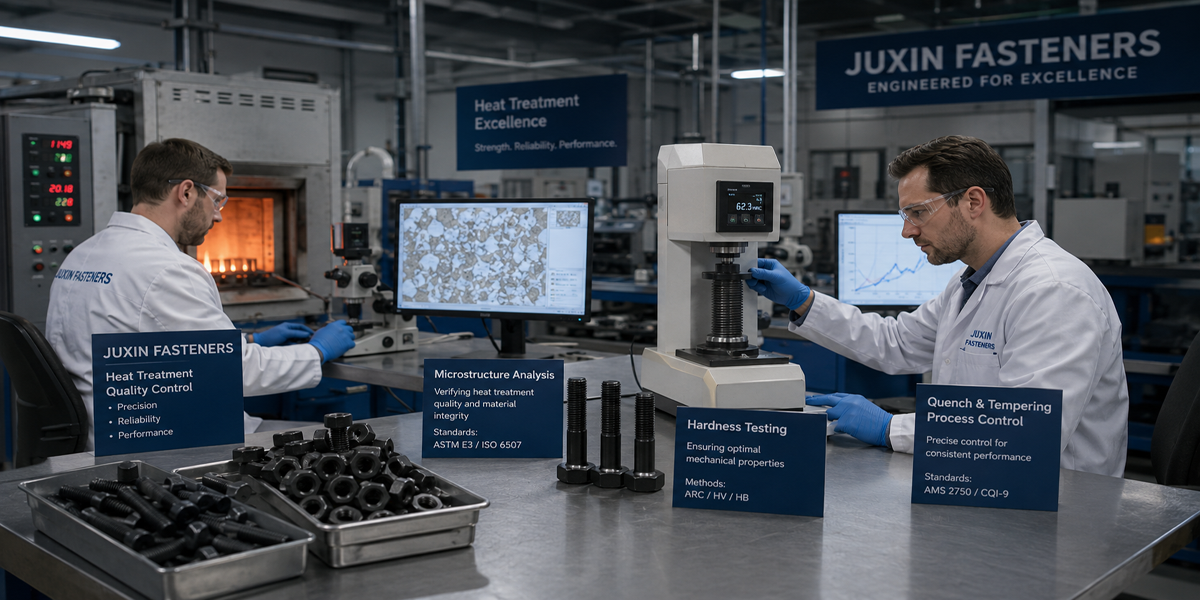
1. Quenching and Tempering in ISO / DIN High-Strength Fasteners
The heat treatment process for ISO 898-1 high-strength bolts (8.8, 10.9, 12.9 grades) consists of two essential stages:
1.1 Austenitizing and Quenching
During quenching:
Steel is heated above the austenitizing temperature
Alloying elements fully dissolve into austenite
Rapid cooling transforms the structure into martensite
This step determines:
Maximum achievable hardness
Strength potential
Phase transformation uniformity
1.2 Tempering Process
During tempering:
Martensite decomposes
Fine carbides precipitate
Internal stress is relieved
Final microstructure becomes:
Tempered sorbite
Fine carbide dispersion in ferrite matrix
This ensures:
Strength–toughness balance
Fatigue resistance stability
Reduced brittleness
Engineering Requirement (ISO 898-1)
For 8.8 grade and above fasteners:
The core structure must achieve approximately ≥90% martensite before tempering
This requirement makes one factor decisive:
Hardenability is the core controlling parameter of heat treatment quality
2. Hardenability: The Key to Through-Section Performance
2.1 Definition in Engineering Terms
Hardenability is the ability of steel to form martensite throughout its cross-section during quenching—not the hardness itself.
If hardenability is insufficient:
Surface becomes martensitic
Core transforms into bainite or ferrite
Mechanical properties become non-uniform
2.2 Standard Test Method
Hardenability is evaluated using:
Jominy End Quench Test
This method produces a hardness distribution curve along the quenched specimen, defining:
Martensite penetration depth
Alloy effectiveness
Heat treatment predictability
2.3 Alloy Steel Comparison (Engineering Insight)
Carbon steel (e.g., AISI 1045 equivalent)
Rapid hardness drop
Limited hardenability depth
Alloy steel (e.g., AISI 5140 / 4140 equivalent)
Slower hardness decay
Greater martensite penetration depth
Hardenability Mechanism
Key alloying elements:
Carbon (C): hardness level
Chromium (Cr): delay transformation
Molybdenum (Mo): improves deep hardening
Nickel (Ni): enhances toughness
Boron (B): significantly increases hardenability
3. Large Structural Fasteners: Why Hardenability Becomes Critical
In applications such as:
Wind turbine bolts
Nuclear power plant fasteners
Heavy equipment structural joints
Fasteners often exceed M36–M72 dimensions, leading to:
Slow cooling rate at the core
Insufficient martensite formation
Severe mechanical property gradient
Engineering Observation
For alloy steels such as AISI 4140 (equivalent to 42CrMo systems):
Oil quenching hardenability diameter: ~25–30 mm
Water quenching: ~35–40 mm
For oversized fasteners:
Core regions risk bainite or ferrite formation if hardenability is not optimized
Engineering Solution
For large-diameter fasteners:
Use high-hardenability steels:
4140 / 42CrMoV equivalent
Nb/V microalloyed alloy steels
Ensure ≥90% martensite across the full section
4. Microstructure Inspection Standards (ISO / DIN Based)
Heat treatment quality is verified through metallographic analysis under international standards:
4.1 Microstructure Evaluation
ISO metallographic evaluation standards
DIN metallographic inspection standards
Acceptance Criteria for High-Strength Bolts
Acceptable microstructure level: fine tempered sorbite
Martensite grading: fine and uniform
No visible coarse-grain structure
5. Heat Treatment Defects in High-Strength Bolts
Improper process control leads to critical defects:
5.1 Overheating (Grain Coarsening)
Excessive austenitizing temperature
Coarse martensite formation
Reduced toughness after tempering
5.2 Underheating (Incomplete Austenitization)
Retained ferrite in structure
Insufficient strength development
Non-uniform hardness distribution
5.3 Incomplete Hardenability
Surface martensite + soft core structure
Severe strength gradient
High fatigue failure risk
5.4 Widmanstätten Structure Formation
Needle-like ferrite from grain boundaries
Increased brittleness
Reduced impact toughness
6. Industrial Process Control System for ISO / DIN Fasteners
Reliable production of ISO 898-1 / DIN 931 / DIN 933 high-strength bolts requires full-process control:
6.1 Raw Material Control
Precise control of Cr, Mo, Ni, and B content
Low impurity levels (S, P, O, N)
Consistent chemical uniformity
6.2 Heat Treatment Parameter Control
Key variables:
Austenitizing temperature
Holding time
Quenching medium selection
6.3 Furnace Process Control
For continuous mesh belt furnace systems:
Conveyor speed controls soaking time
Improper speed leads to:
Underheating
Grain growth
6.4 Quenching Medium Selection
Carbon steels → water quenching
Alloy steels → oil quenching
Requirements:
Stable temperature
Clean cooling medium
Controlled agitation
6.5 Post-Treatment Control
Immediate tempering after quenching
Mechanical validation:
Tensile testing (ISO 898-1)
Hardness testing
Impact testing
Metallographic inspection
7. Engineering Interpretation: Why Hardenability Controls Reliability
From a fastener engineering perspective:
Hardenability is not just a material parameter—it is a system-level reliability control factor.
It determines:
Whether ISO 898-1 strength grades are truly achievable
Whether cross-section properties are uniform
Whether fatigue performance is stable under real load conditions
8. Engineering Fastener Solutions for Critical Applications
Guangzhou Juxin Development Co., Ltd. provides advanced fastening solutions, including:
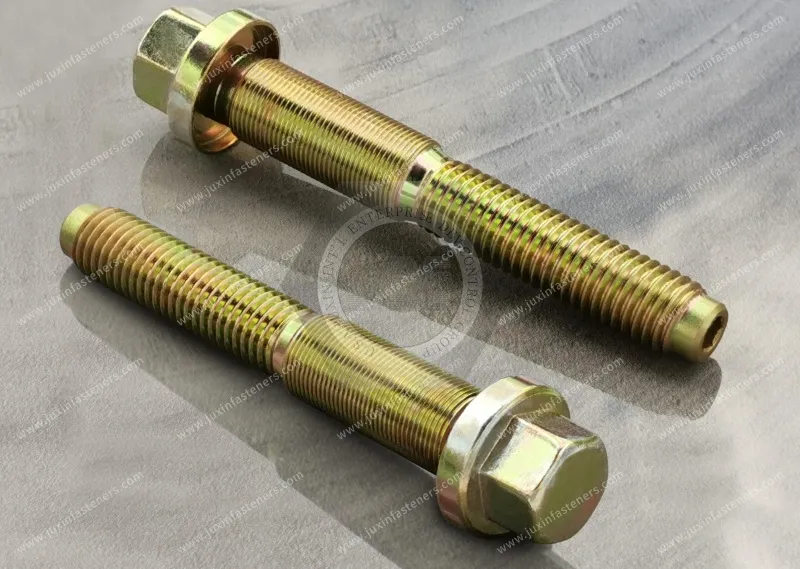
ISO / DIN standard high-strength bolts (8.8 / 10.9 / 12.9)
Precision heat-treated structural fasteners
High-hardenability alloy steel fastening systems
Custom-engineered bolting solutions for critical industries
Our engineering philosophy focuses on:
Heat treatment stability + full-section hardenability control + ISO/DIN compliance
Conclusion: Hardenability Defines the Real Performance of High-Strength Bolts
Quenching and tempering is not simply a heat process—it is a controlled metallurgical transformation system governed by international standards such as ISO 898-1 and DIN fastener specifications.
Key conclusions:
Hardenability determines martensite penetration depth
Microstructure uniformity defines mechanical reliability
Defects originate from process instability
Large fasteners require a higher alloy hardenability design
In modern engineering practice, compliance with ISO/DIN standards is not enough—the true performance of a high-strength bolt is defined by how well the heat-treatment process is controlled at the metallurgical level.
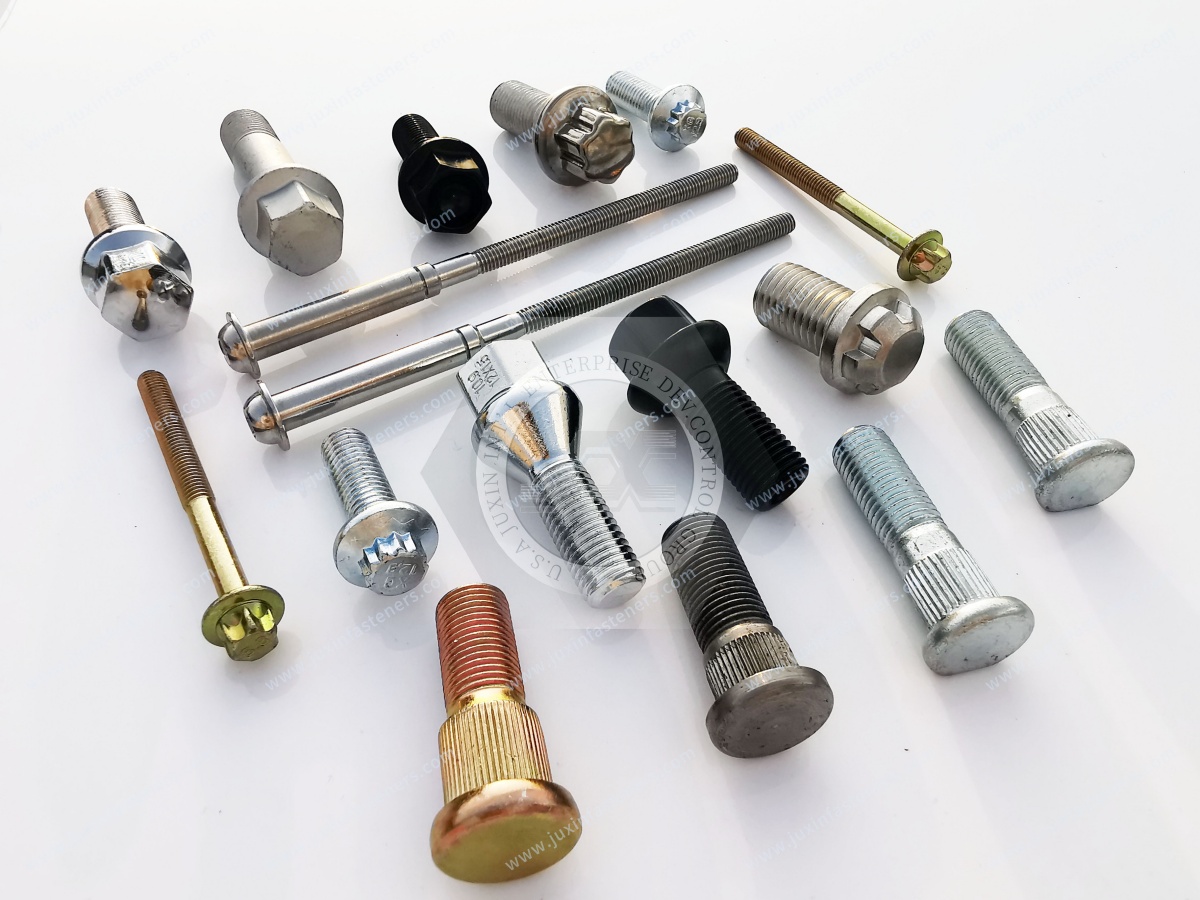
Product Packaging
Packaging Standard
At Juxin Fasteners, we apply standardized export packaging to ensure product protection, traceability, and compliance with international logistics requirements.
1. Standard Export Packaging
Unless otherwise specified, all products will be packed according to our factory standard export packaging, which includes:
Moisture-resistant inner protection
Poly bag or small box packing as required
Reinforced export cartons
Clear labeling with part number, specification, batch number, and quantity
Palletizing for sea or air shipment when necessary
Our standard packaging is designed to ensure safe transportation, efficient warehousing, and long-distance international shipping.
2. Customized Packaging Options
We also provide customized packaging solutions according to customer requirements, including but not limited to:
Private labeling
Customized barcodes
Specific carton dimensions
Retail packaging
Special pallet configuration
Customer-specific marking and identification
So that you know, customized packaging may involve additional costs and extended lead time depending on the complexity of the requirements.
3. Compliance & Quality Assurance
All packaging processes are controlled under our ISO 9001 quality management system to ensure consistency, traceability, and product integrity throughout the supply chain.
Product Pictures
Contact Us
Tel.:
+86 020 8621 0320
+86 020 3121 6067
E-mail:
Technical Support:
Navigation
SEND INQUIREY